
Life, 1910-11-03 · page 44 of 72
Life — November 3, 1910 — page 44: what you’re looking at
What you’re looking at
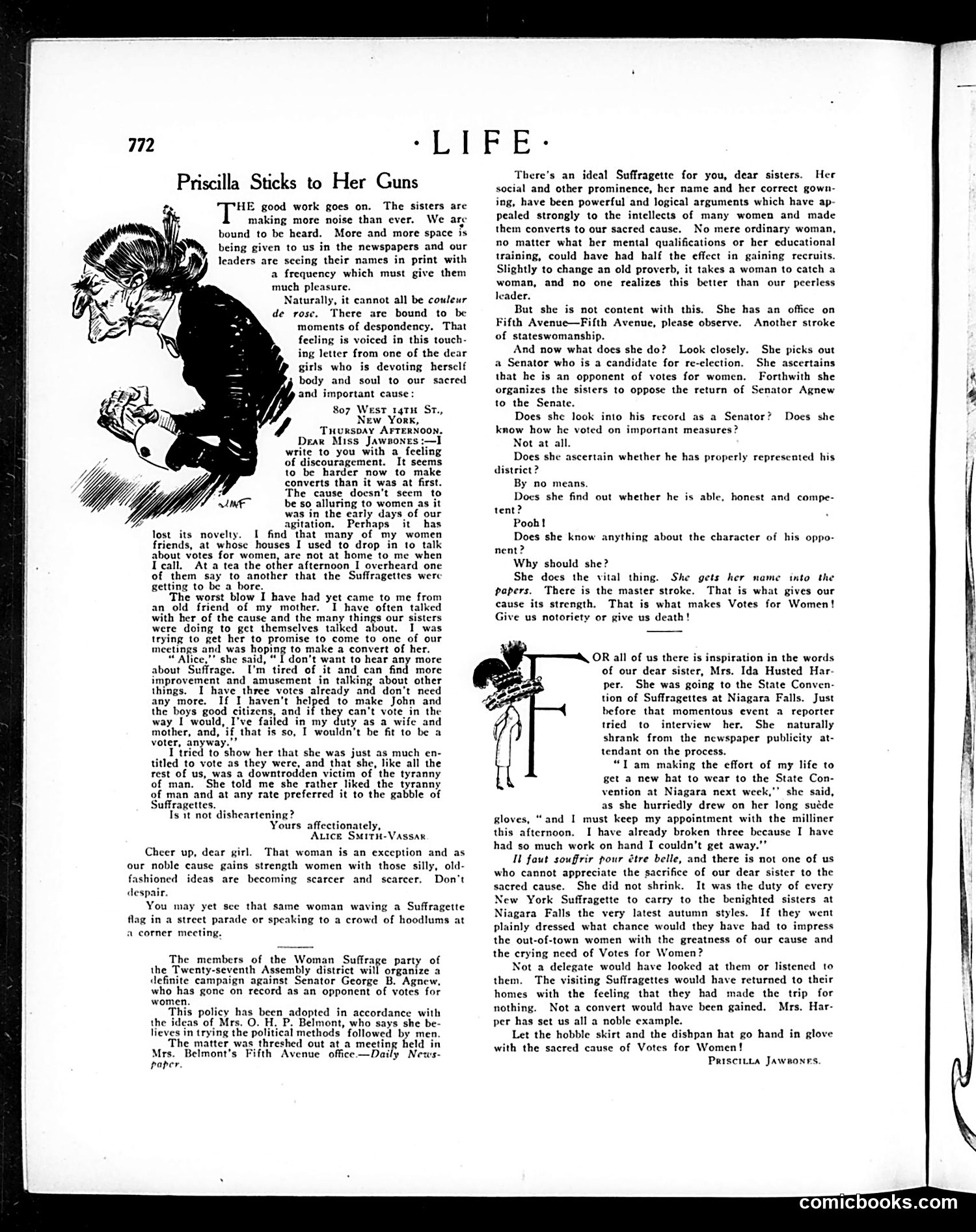
This 1912 *Life* magazine article satirizes the women's suffrage movement through a fictional letter from activist "Alice Smith-Vassar" expressing frustration that converts are harder to gain—even women she knows are avoiding her now, finding suffragettes tedious. The satire operates on two levels: The letter-writer represents overzealous, annoying activists whose evangelism backfires. More cutting, the *Life* editors mock the movement's class-based strategy by praising Mrs. O.H.P. Belmont (the wealthy, fashionable socialite mentioned) as the "ideal Suffragette"—implying that only wealthy, well-dressed women matter to the cause, not "ordinary women." The cartoon (showing a woman in fashionable dress and hat) visualizes this elitism. The editors further ridicule suffragettes' political naivety and their adoption of "political methods followed by men," particularly their campaign targeting Senator Agnew. The overall message: these women are shallow, socially awkward, class-conscious activists whose cause lacks genuine substance.
📄 Transcribed text from this page (OCR, searchable)
Machine-transcribed from the original scan — historical spelling and the odd misread are preserved.
“LIFE: Priscilla Sticks to Her Guns HE good work goes on. The sisters are making more noise than ever. We are bound to be heard. More and more space is being given to us in the newspapers and our leaders are seeing their names in print with a frequency which must give them much pleasure. Naturally, it cannot all be couleur de rose. There are bound to be moments of despondency. That fecling is voiced in this touch- ing letter from one of the dear girls who is devoting hersclf body and soul to our sacred and important cause: 807 West 14TH Sr., New York, Tuurspay AFTERNOON. Dear Miss Jawsones :—I write to you with a feeling of discouragement. It seems to be harder now to make converts than it was at first. The cause doesn't seem to be so alluring to women as it was in the early days of our agitation, Perhaps it has lost its novelty. I find that many of my women friends, at whose houses I used to drop in to talk about votes for women, are not at home to me when Teall. At a tea the other afternoon I overheard one of them say to another that the Suffragettes were getting to be a bore. The worst blow I have had yet came to me from an old friend of my mother. I have often talked with her of the cause and the aeny things our sisters were doing to get themselves talked about. I was trying to get her to promise to come to one of our meetings and was hoping to make a convert of her. “ Alice,’ she said, “ I don’t want to hear any more about Suffrage. I'm tired of it and can find more improvement and amusement in talking about other things. I have three votes already and don’t need any more. If I haven't helped to make John and the boys good citizens, and if they can't vote in the way I would, I've failed in my duty as a wife and mother, and, if that is so, I wouldn’t be fit to be voter, anyway.”” I tried to show her that she was just as much en- titled to vote as they were, and that she, like all the rest of us, was a downtrodden victim of the tyranny of man. She told me she rather liked the tyranny of man and at any rate preferred it to the gabble of Suffragettes. Is it not disheartening? Yours affectionately, ALICE SMITH-VASSAR Cheer up, dear girl. That woman is an exception and as our noble cause gains strength women with those silly, old- fashioned ideas are becoming scarcer and scarcer, Don't despair. You may yet sce that same woman waving a Suffragette flag in a street parade or speaking to a crowd of hoodlums at A corner meeting. The members of the Woman Suffrage party of the Twenty-seventh Assembly district will organize a definite campaign against Senator George B. Agnew, who has gone on record as an opponent of votes for women. This policy has been adopted in accordance with the ideas of Mrs. O. H. P. Belmont, who says she be- lieves in trying the political methods followed by men. The matter, was threshed out ata meeting held in Mrs. Belmont’s fth Avenue office. Dally News- paper. There's an ideal Suffragette for you, dear sisters. Her social and other prominence, her name and her correct gown- ing, have been powerful and logical arguments which have ap- pealed strongly to the intellects of many women and made them converts to our sacred cause. No mere ordinary woman, no matter what her mental qualifications or her educational training, could have had half the effect in gaining recruits. Slightly to change an old proverb, it takes a woman to catch a woman, and no one realizes this better than our peerless leader. But she is not content with this. She has an office on Fifth Avenue—Fifth Avenue, please observe. Another stroke of stateswomanship. And now what does she do? Look closely. She picks out a Senator who is a candidate for re-election. She ascertains that he is an opponent of votes for women. Forthwith she organizes the sisters to oppose the return of Senator Agnew to the Senate. Does she look into his record as a Senator? know how he voted on important measures? Not at all. Does she ascertain whether he has properly represented his district? By no means. Does she find out whether he is able, honest and compe- tent? Pooh! Does she know anything about the character of his oppo- nent? Why should she? She does the vital thing. She gets her name into the papers. There is the master stroke. That is what gives our cause its strength. That is what makes Votes for Women! Give us notoriety or give us death! Does she OR all of us there is inspiration in the words of our dear sister, Mrs. Ida Husted Har- per. She was going to the State Conven- tion of Suffragettes at Niagara Falls. Just before that momentous event a reporter tried to interview her. She naturally shrank from the newspaper publicity at- tendant on the process. “Tam making the effort of my life to get a new hat to wear to the State Con- vention at Niagara next week,"’ she said, as she hurriedly drew on her long suéde gloves, “and I must keep my appointment with the milliner this afternoon. I have already broken three because I have had so much work on hand I couldn’t get away.'’ Ml faut souffrir pour étre belle, and there is not one of us who cannot appreciate the sacrifice of our dear sister to the sacred cause. She did not shrink. It was the duty of every New York Suffragette to carry to the benighted sisters at Niagara Falls the very latest autumn styles. If they went plainly dressed what chance would they have had to impress the out-of-town women with the greatness of our cause and the crying need of Votes for Women? Not a delegate would have looked at them or listened to them. The visiting Suffragettes would have returned to their homes h the feeling that they had made the trip for nothing. Not a convert would have been gained. Mrs. Har- per has set us all a noble example. Let the hobble skirt and the dishpan hat go hand in glove with the sacred cause of Votes for Women! PRISCILLA JAWRONFS. comicbooks.com