
Life, 1910-11-03 · page 34 of 72
Life — November 3, 1910 — page 34: what you’re looking at
What you’re looking at
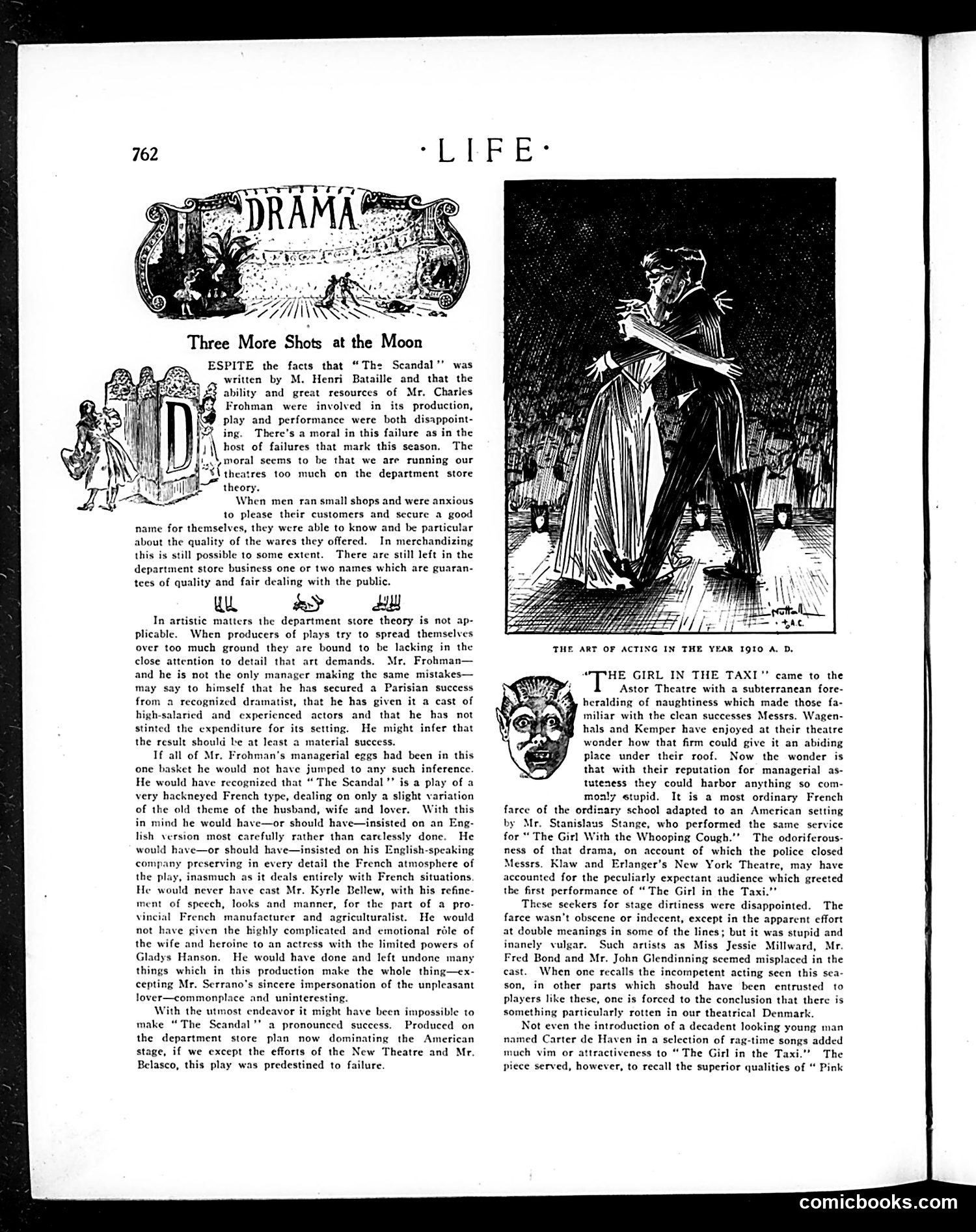
This page critiques two Broadway productions. The main article attacks "The Scandal," a French play produced by Charles Frohman, arguing it failed because Frohman operates theaters like department stores—spreading resources too thin across multiple productions rather than focusing carefully on quality. The critic names specific actors (Kyrle Bellew, Gladys Hanson) as miscast for this French-themed drama. The secondary piece dismisses "The Girl in the Taxi," another French farce adapted by Stanislaus Stange, as stupidly ordinary. The critic suggests producers Wagenhals and Kemper—normally reliable—inexplicably lowered their standards with this import. The satirical point: Broadway's commercial "department store theory" produces mediocrity. Quality requires the focused attention small shopkeepers once gave their merchandise, not the scattered approach of large theatrical operations chasing profits. The illustration (top right) appears to depict a character from one production, though the specific dramatic moment is unclear.
📄 Transcribed text from this page (OCR, searchable)
Machine-transcribed from the original scan — historical spelling and the odd misread are preserved.
ESPITE the facts that “The Scandal" was written by M. Henri Bataille and that the ability and great resources of Mr. Charles rohman were involved in its production, play and performance were both disappoint- ing. There's a moral in this failure as in the host of failures that mark this season, The moral seems to be that we are running our X( theatres too much on the department store theory. When men ran small shops and were anxious to please their customers and secure a good name for themselves, they were able to know and be particular about the quality of the wares they offered. In merchandizing this is still possible to some extent. There are still left in the department store business one or two names which are guaran- tees of quality and fair dealing with the public. Qu ay ay In artistic matters the department store theory is not ap- plicable. When producers of plays try to spread themselves over too much ground they are bound to be lacking in the close attention to detail that art demands, Mr, Frohman— and he is not the only manager making the same mistakes— may say to himself that he has secured a Parisian success from a recognized dramatist, that he has given it a cast of high-salaried and experienced actors and that he has not stinted the expenditure for its setting. He might infer that the result should be at least a material success. If all of Mr. Frohman’s managerial eggs had been in this one basket he would not have jumped to any such inference. He would have recognized that “The Scandal ’” is a play of a very hackneyed French type, dealing on only a slight variation of the old theme of the husband, wife and lover. With this in mind he would have—or should have—insisted on an Eng- lish version most carefully rather than carclessly done. He would have—or should have—insisted on his English-speaking company preserving in every detail the French atmosphere of the play, inasmuch as it deals entirely with French situations He would never have cast Mr. Kyrle Bellew, with his refine- ment of speech, looks and manner, for the part of a pro- vincial French manufacturer and agriculturalist. He would not have given the highly complicated and emotional rile of the wife and heroine to an actress with the limited powers of Gladys Hanson. He would have done and left undone many things which in this production make the whole thing—ex- cepting Mr. Scrrano’s sincere impersonation of the unpleasant lover—commonplace and uninteresting. With the utmost endeavor it might have been impossible to make “The Scandal’? a pronounced success. Produced on the department store plan now dominating the American stage, if we except the efforts of the New Theatre and Mr. Belasco, this play was predestined to failure. THE ART OF ACTING IN THE YEAR 1910 A. D, “"HE GIRL IN THE TAXI" came to the Astor Theatre with a subterranean fore- heralding of naughtiness which made those fa- miliar with the clean successes Messrs. Wagen- hals and Kemper have enjoyed at their theatre wonder how that firm could give it an abiding place under their roof. Now the wonder is that with their reputation for managerial as- tuteness they could harbor anything so com- moaly stupid. It is a most ordinary French farce of the ordinary school adapted to an American setting by Mr. Stanislaus Stange, who performed the same service for “ The Girl With the Whooping Cough.’’ The odoriferous- ness of that drama, on account of which the police closed Messrs. Klaw and Erlanger’s New York Theatre, may have accounted for the peculiarly expectant audience which greeted the first performance of “The Girl in the Taxi.”" These seekers for stage dirtiness were disappointed. The farce wasn't obscene or indecent, except in the apparent effort at double meanings in some of the lines; but it was stupid and inanely vulgar. Such artists as Miss Jessie Millward, Mr. Fred Bond and Mr. John Glendinning scemed misplaced in the cast. When one recalls the incompetent acting seen this sea- son, in other parts which should have been entrusted to players like these, one is forced to the conclusion that there is something particularly rotten in our theatrical Denmark. Not even the introduction of a decadent looking young man named Carter de Haven in a selection of rag-time songs added much vim or attractiveness to “The Girl in the Taxi.” The piece served, however, to recall the superior qualities of “ Pink comicbooks.com