
Life, 1910-11-03 · page 38 of 72
Life — November 3, 1910 — page 38: what you’re looking at
What you’re looking at
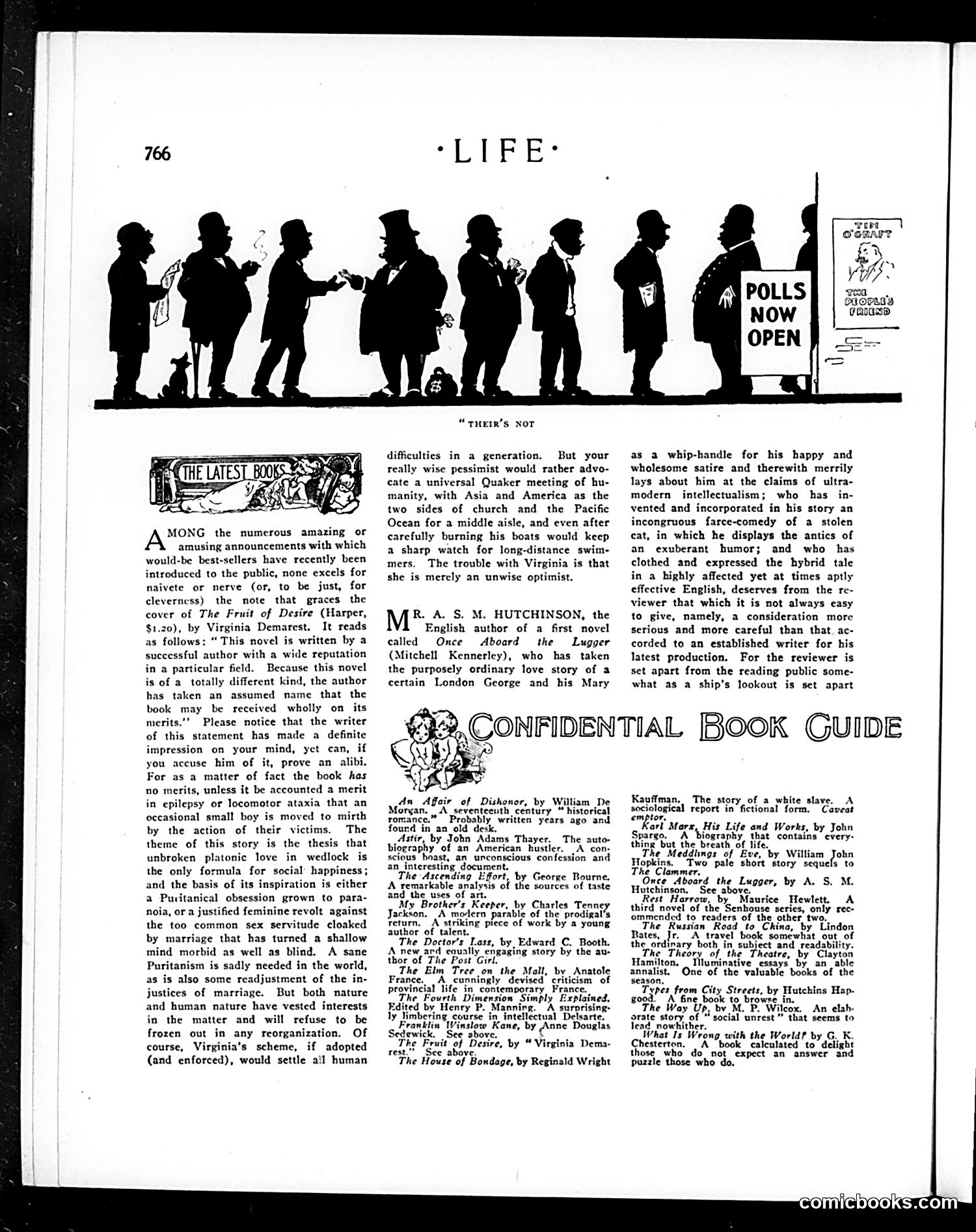
## The Cartoon The silhouette shows a line of well-dressed men in top hats approaching a "Polls Now Open" sign—a commentary on election voting. The caption "There's Not" (presumably continuing as "There's not much difference") suggests the satire targets political uniformity: despite appearing as distinct individuals, voters are essentially interchangeable, all heading toward the same polls. This likely critiques either voter apathy, the similarity between political candidates, or the futility of voting choices. ## The Book Reviews The page reviews contemporary novels, with particular mockery directed at *The Fruit of Desire* by "Virginia Demarest." The reviewer ridicules the publisher's claim that an established author used a pseudonym so readers would judge the book "wholly on its merits"—noting this is transparently self-serving marketing. The reviewer dismisses the novel's premise (platonic marriage as social salvation) as naive utopianism, calling its author an "unwise optimist." Other reviewed works address contemporary concerns: marriage inequality, social climbing, and intellectual trends.
📄 Transcribed text from this page (OCR, searchable)
Machine-transcribed from the original scan — historical spelling and the odd misread are preserved.
MONG the numerous amazing or amusing announcements with which would-be best-sellers have recently been introduced to the public, none excels for naivete or nerve (or, to be just, for cleverness) the note that graces the cover of The Fruit of Desire (Harper, $1.20), by Virginia Demarest. It reads as follows: “This novel is written by a successful author with a wide reputation in a particular field. Because this novel is of a totally different kind, the author has taken an assumed name that the book may be received wholly on its merits.’’ Please notice that the writer of this statement has made a definite impression on your mind, yct can, if you accuse him of it, prove an alibi, For as a matter of fact the book has no merits, unless it be accounted a merit in epilepsy or locomotor ataxia that an occasional small boy is moved to mirth by the action of their victims. The theme of this story is the thesis that unbroken platonic love in wedlock is the only formula for social’ happiness; and the basis of its inspiration is cither a Puritanical obsession grown to para- noia, or a justified feminine revolt against the too common sex servitude cloaked by marriage that has turned a shallow mind morbid as well as blind. A sane Puritanism is sadly needed in the world, as is also some readjustment of the in- justices of marriage. But both nature and human nature have vested interests in the matter and will refuse to be frozen out in any reorganization. Of course, Virginia’s scheme, if adopted (and enforced), would settle ail human “THEIR’S NOT dificultics in a generation, But your really wise pessimist would rather advo- cate a universal Quaker meeting of hu- manity, with Asia and America as the two sides of church and the Pacific Ocean for a middle aisle, and even after carefully burning his boats would keep a sharp watch for long-distance swim- mers. The trouble with Virginia is that she is merely an unwise optimist. M® A. S. M. HUTCHINSON, the English author of a first novel called Once Aboard the Lugger (Mitchell Kennerley), who has taken the purposely ordinary love story of a certain London George and his Mary «3 An Affair of Dishonor, by William De Morgan. | A seventecuth century “ historical romance.” Probably written years ago and fourd in an old desk. Astir, by John Adams Thayer. The auto- biography of an American hustier. A con- jous boast, an unconscious confession and an_interesting document. The Ascending Effort, by George Bourne, A remarkable analysis of the sources of taste and the uses of art. My Brother's Keeper, by Charles Tenney Jackson, A modern parable of the prodigal’s return. A striking piece of work by a young author of talent. a The, Doctor's Lass, by Edward C, Booth. A new ard eaually engaging story by the au- thor of The Post Gi The Elm Tree on the Mall, by Anatole France. A cunningly devised’ criticism of provincial life in contemporary France. The Fourth Dimension Simply Explained, Edited by Henry P. Manning. A surprising- ly Hmbering, course in, intellectual Delsarte. ranklin Winslow Kane, by Anne Douglas Sedewick. See above. % The Fruit of Desire, by “ Virginia Dema- rest.” See above. The House of Bondage, by Reginald Wright 7.) POLLS Now OPEN as a whip-handle for his happy and wholesome satire and therewith merrily lays about him at the claims of ultra- modern intellectualism; who has in- vented and incorporated in his story an incongruous farce-comedy of a stolen cat, in which he displays the antics of an exuberant humor; and who has clothed and expressed the hybrid tale in a highly affected yet at times aptly effective English, deserves from the re- viewer that which it is not always easy to give, namely, a consideration more serious and more careful than that ac- corded to an established writer for his latest production. For the reviewer is set apart from the reading public some- what as a ship’s lookout is set apart CONFIDENTIAL BOOK GUIDE Kauffman, The story of a white slave, A sociological report in fictional form, "Caveat emptor. ‘arl Mars, His Life and Works, by John Spargo. A biography that contains every- thing but the breath of life. The Meddings of Eve, by William John Hopkins. Two pale short story sequels to TS nceMboerd the L ALS. M. nce Aboard the Lugger, . SM. Hutchinson, See above. Lf Rest Harrow, by Maurice Hewlett. A third novel of the Senhouse series, only rec: ommended to readers of the other two, The Russian Road to China, by Lindon Rates, Jr. A travel book somewhat out of the ordinary both in subject and readability. The Theory of the Theatre, by Clayton Hamilton. Tituminative essays by an able annalist. One of the valuable books of the season, Types from City Streets, by Hutchins Hap- good. A fine book to browse in. The Way Up, by M. P. Wilcox. An elah- orate story of “social unrest” that seems to lead. nowhither. What Is Wrong with the World? by G. K. Chesterton. book’ calculated to delight those who do not expect an answer and puzzle those who do,