
A complete issue · 60 pages · 1907
Life — January 17, 1907
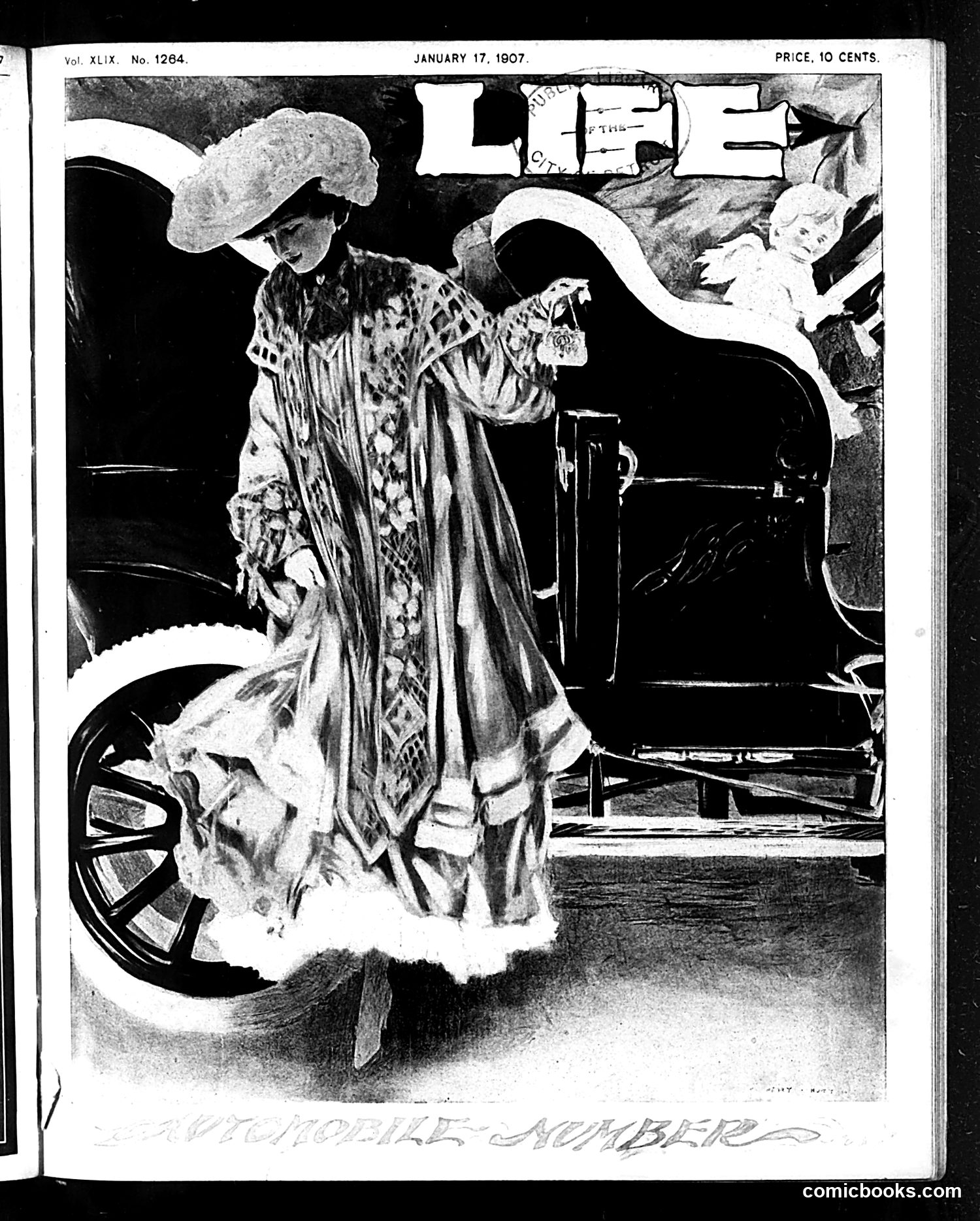
This page appears to be a cover or major illustration for *Life* magazine's "Automobile Number" issue (visible text reference). The image depicts a stylishly dressed woman in an elaborate patterned coat and large feathered hat standing beside an early automobile, with a chauffeur visible in the vehicle. The satire likely mocks the nouveau riche or wealthy women of the Edwardian era who flaunted expensive automobiles as status symbols. The woman's ostentatious clothing and the prominent display of the motorcar suggest commentary on conspicuous consumption and the emerging automobile culture among the affluent. The exaggerated fashion and posturing reflect early 20th-century social anxieties about wealth, gender, and the disruption caused by new automotive technology in American society.
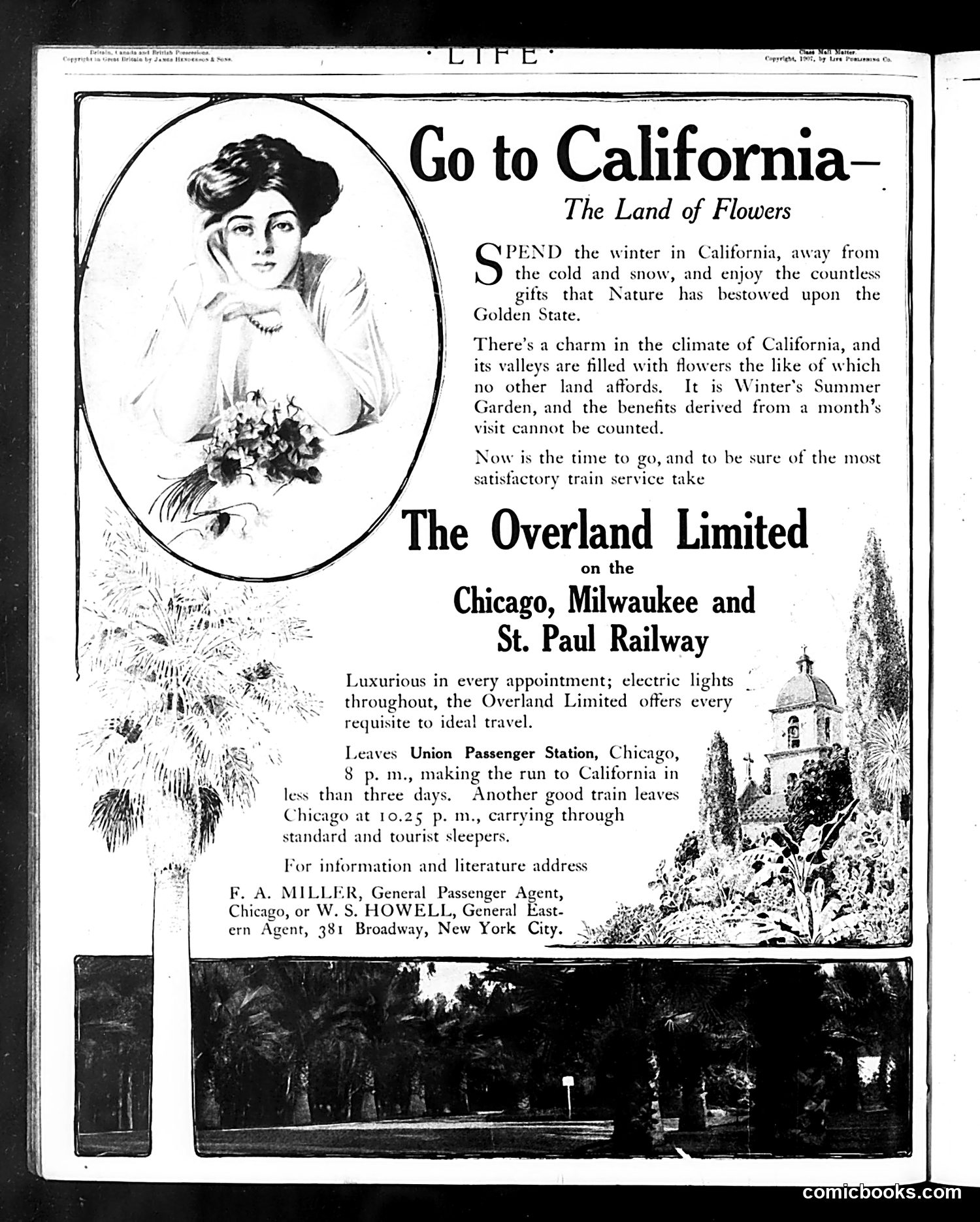
This page is primarily **advertising content**, not satire or political commentary. It promotes "The Overland Limited," a luxury train operated by the Chicago, Milwaukee and St. Paul Railway, running from Chicago to California. The ad uses typical early 20th-century marketing appeals: a romanticized illustration of an elegant woman holding flowers, references to California's natural beauty ("The Land of Flowers"), and emphasis on comfort ("luxurious in every appointment; electric lights throughout"). The scenic illustrations of palm trees and a mission-style building reinforce California's exotic appeal to winter-weary Midwesterners. This represents standard commercial advertising rather than the satirical editorial content Life magazine was known for.
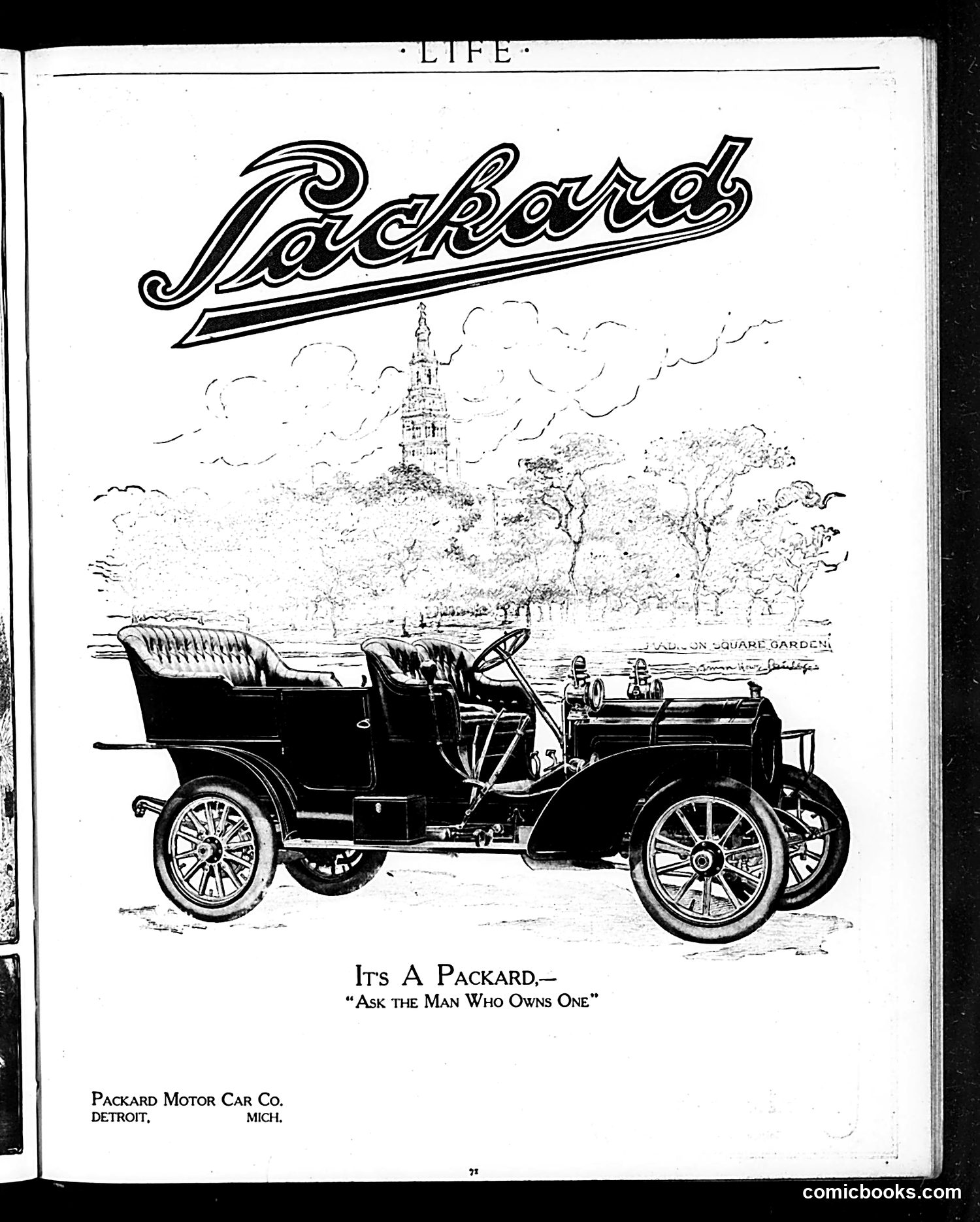
This is primarily an **automobile advertisement**, not political satire. It promotes the Packard Motor Car Company of Detroit, Michigan, featuring an early 1900s touring car with the tagline "It's A Packard,— 'Ask the Man Who Owns One.'" The advertisement uses aspirational imagery: a well-dressed automobile positioned against a scenic landscape with a church steeple visible in the distance, suggesting prosperity, respectability, and leisure. The vehicle's open design and prominent detailing showcase engineering quality. The famous slogan "Ask the man who owns one" became iconic for Packard, implying satisfied ownership and word-of-mouth endorsement. This represents early automotive marketing targeting affluent consumers during the era when automobiles were luxury goods for the wealthy.
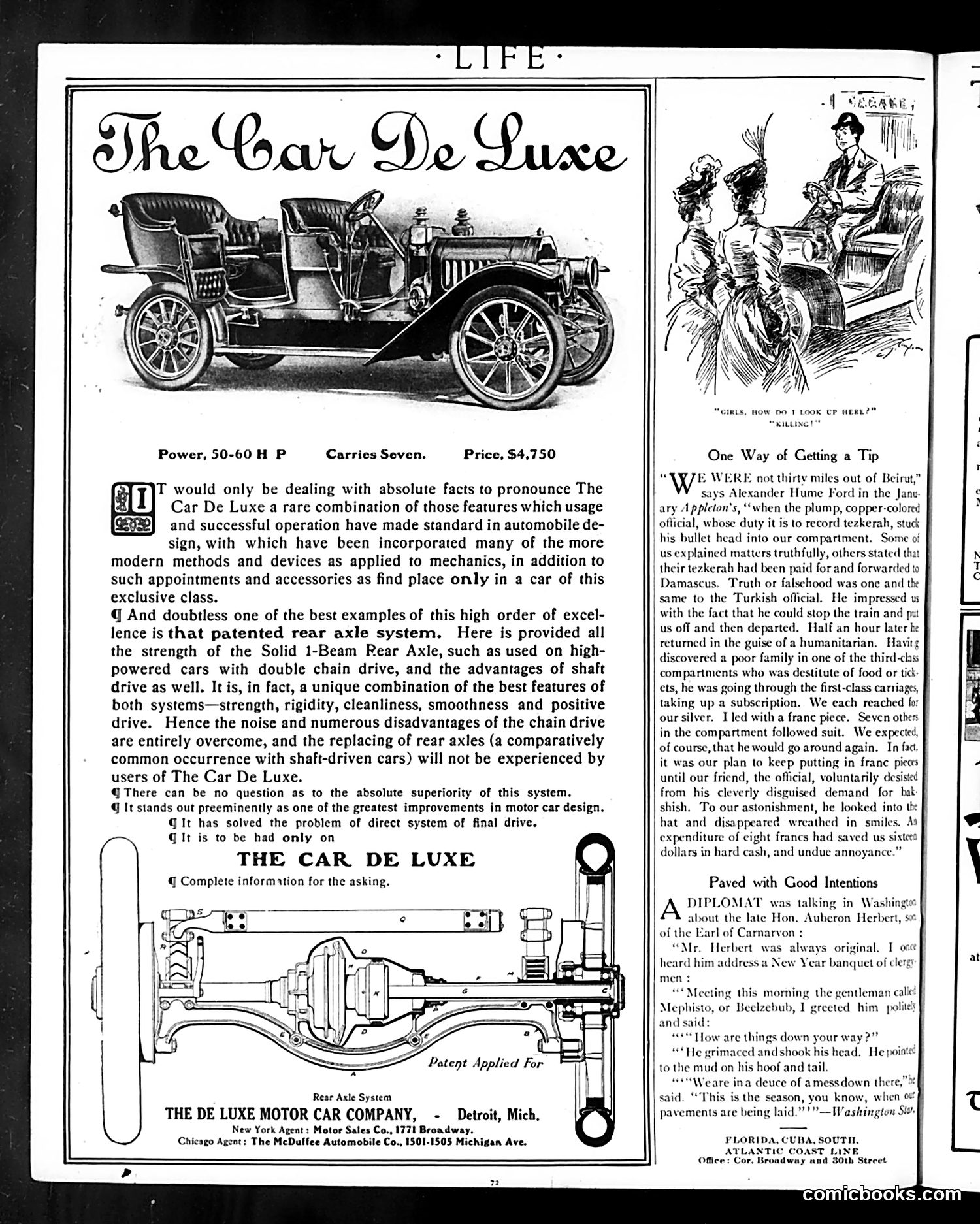
This page is primarily a **car advertisement** for "The Car De Luxe" by the De Luxe Motor Car Company (Detroit). The large left section details the vehicle's mechanical superiority, particularly its solid I-beam rear axle and shaft drive system, marketed to wealthy buyers at $4,750. The right side contains a brief humorous sketch titled "One Way of Getting a Tip." It depicts a passenger complaining to a chauffeur about service, with the joke apparently being about tipping etiquette or the interaction between employer and hired driver—a class-consciousness theme typical of Life's satirical humor aimed at upper-class readers. The overall page targets affluent automobile buyers through both luxury marketing and gentle comedy about servant relations.
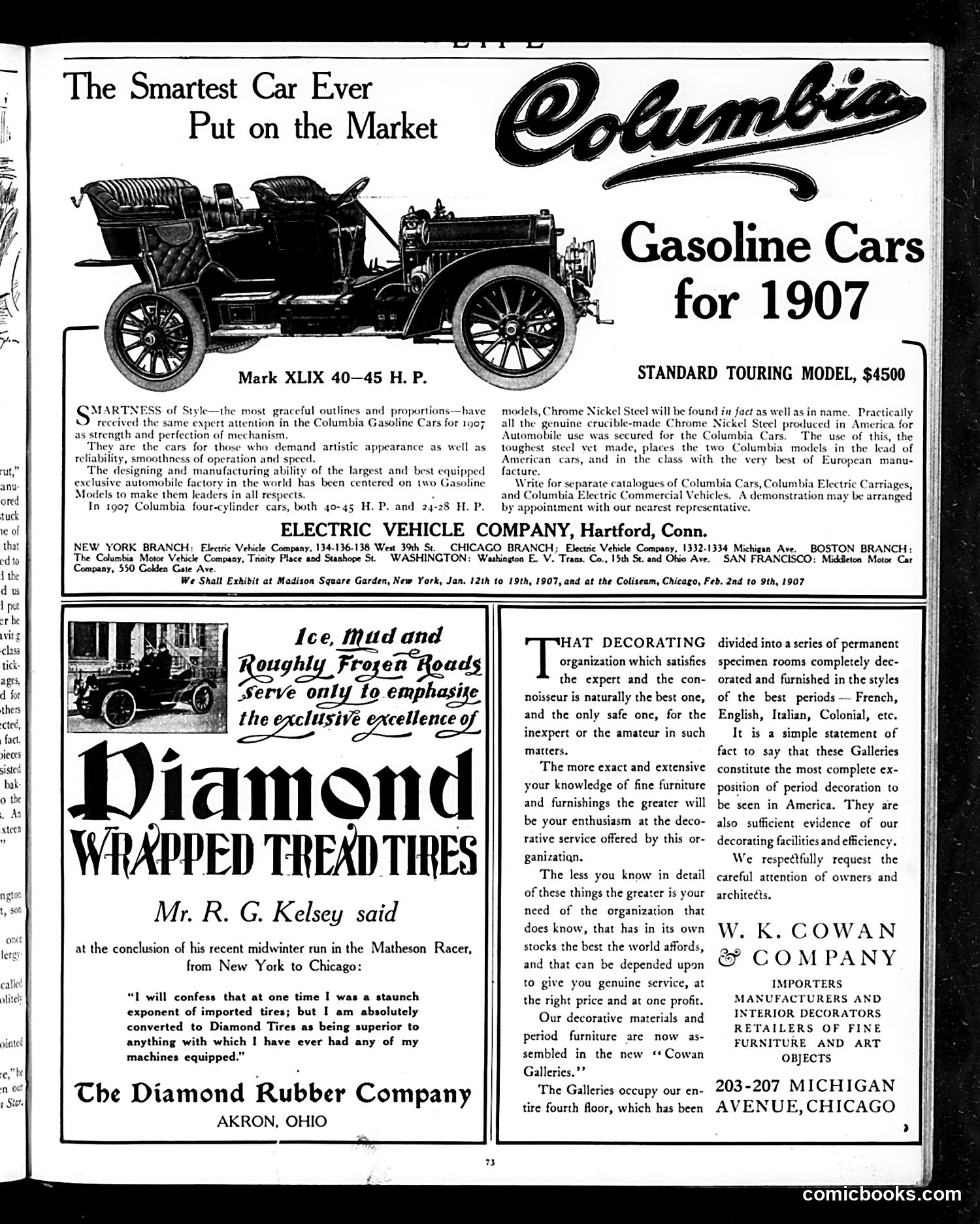
This page is **primarily advertising**, not satirical content. It contains three advertisements from 1907: 1. **Columbia Gasoline Cars** — promoting their 1907 "Standard Touring Model" at $4,500, emphasizing "smartness of style" and reliability. This represents early automobile marketing when cars were luxury goods. 2. **Diamond Wrapped Tread Tires** — featuring a testimonial from racer R.G. Kelsey, who claims he converted from imported tires to Diamond brand after success in the Matheson Race. 3. **W.K. Cowan & Company** — an interior decorating firm offering period furniture in various historical styles (French, English, Italian, Colonial). There is **no political satire** on this page. It reflects early-1900s consumer culture and the emerging automobile industry.
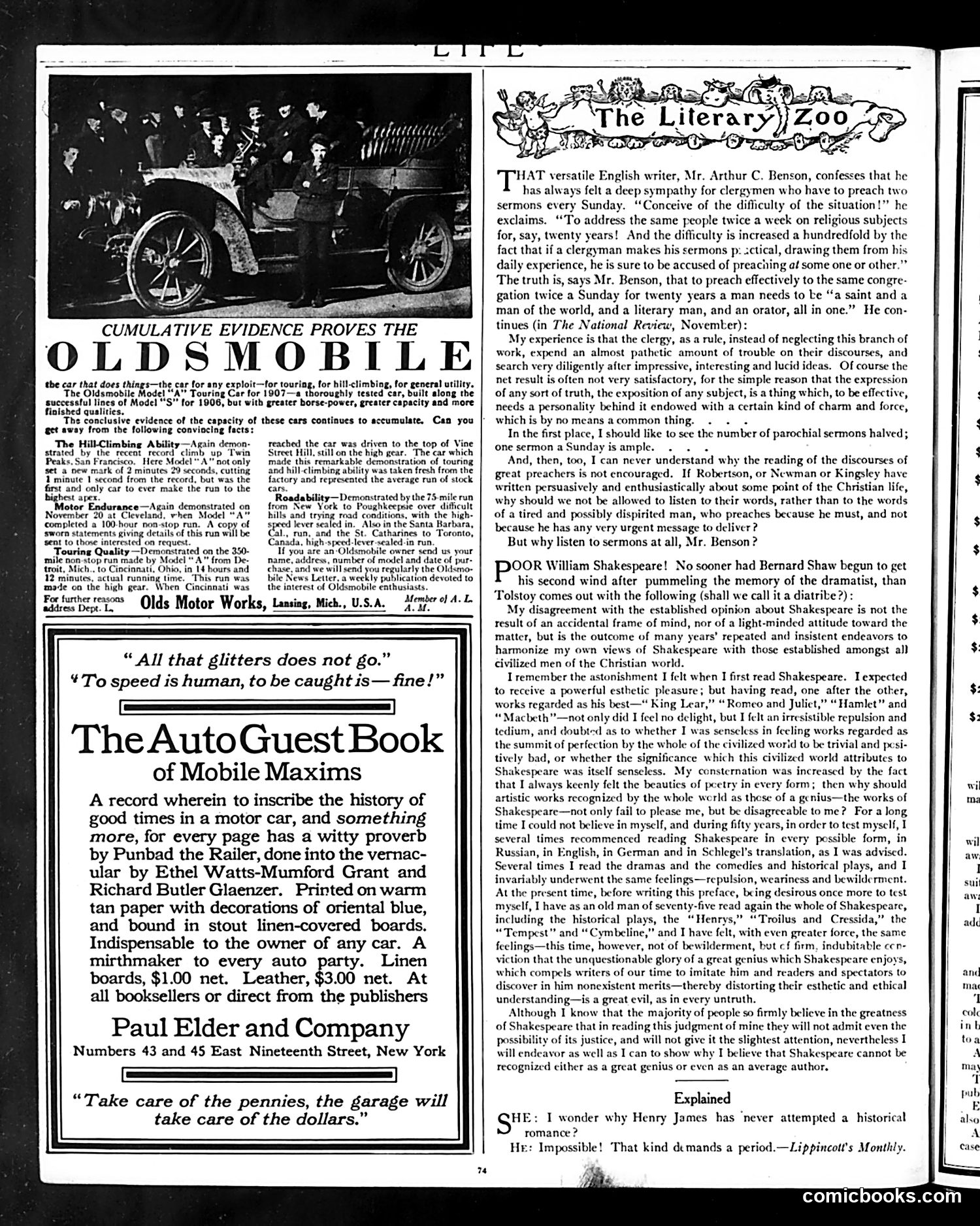
This page consists primarily of **advertisements and editorial content rather than political satire**. The main feature, "The Literary Zoo," is a **humorous essay by Arthur C. Benson about the challenges clergy face preaching sermons weekly**. Benson uses theatrical language to describe how preachers must constantly draw from personal experience while maintaining effectiveness—a relatable complaint about repetitive public speaking. The essay then pivots to **criticizing Shakespeare's reputation as an unquestionably great author**, questioning whether he deserves such universal acclaim. The author argues Shakespeare may be overrated. The page also includes multiple **commercial advertisements** for automobiles (Olds Motor Works) and "The AutoGuest Book of Mobile Maxims"—typical of Life's revenue model combining satire with advertising.
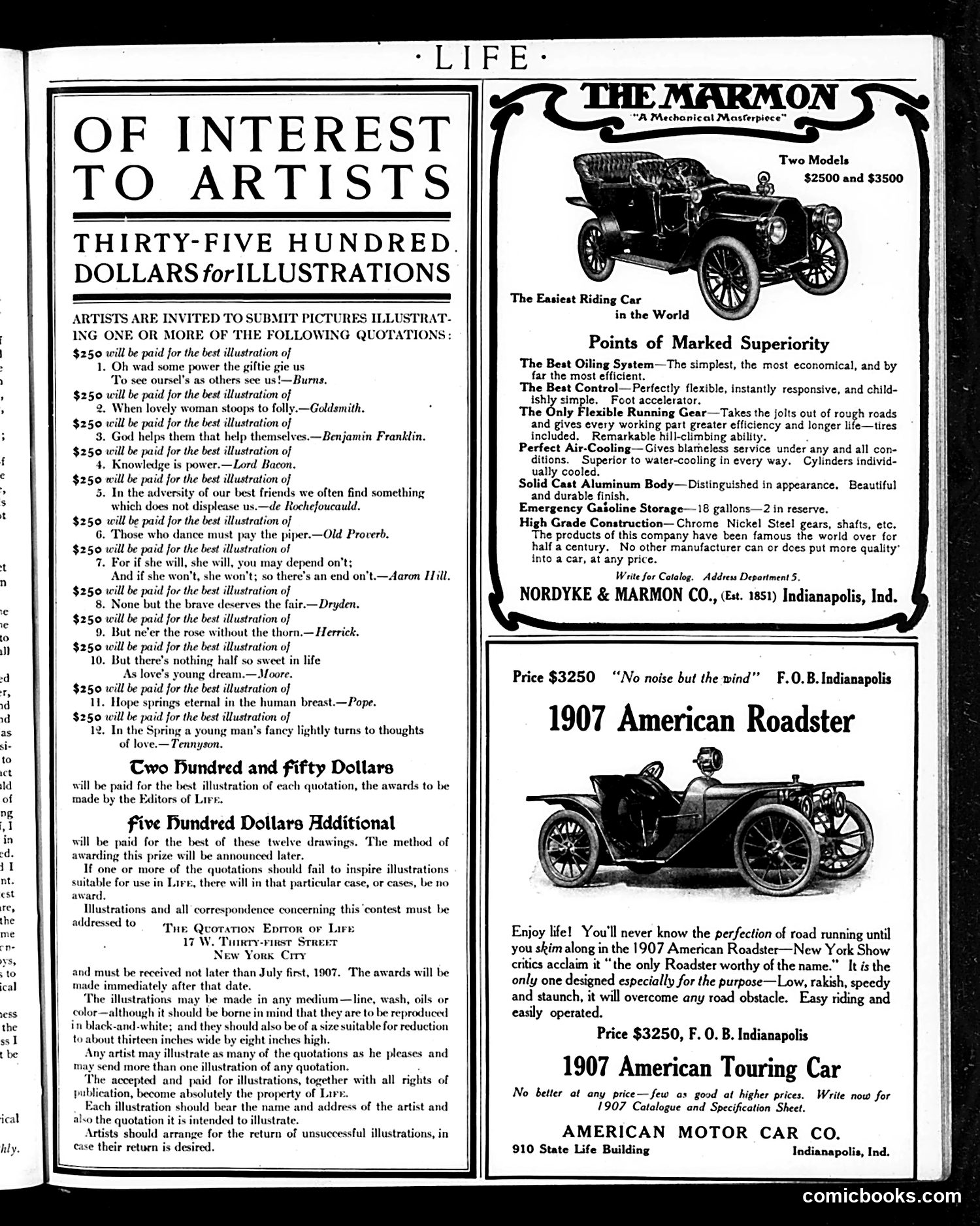
This page is primarily **advertising and a contest announcement**, not satirical content. The left side features a literary contest from *Life* magazine offering $3,500 total for illustrations of famous quotations—ranging from $250-$350 per illustration. Artists could submit drawings interpreting quotes from sources like Burns, Goldsmith, and Franklin. The right side contains three automobile advertisements: **The Marmon** (described as "A Mechanical Masterpiece," priced $2,500-$3,500), the **1907 American Roadster** ($3,250), and the **1907 American Touring Car** (American Motor Car Co., Indianapolis). These emphasize features like "easiest riding car" and "no noise but the wind." No political satire or caricature is present. This is a straightforward magazine page mixing editorial contests with period automobile marketing.
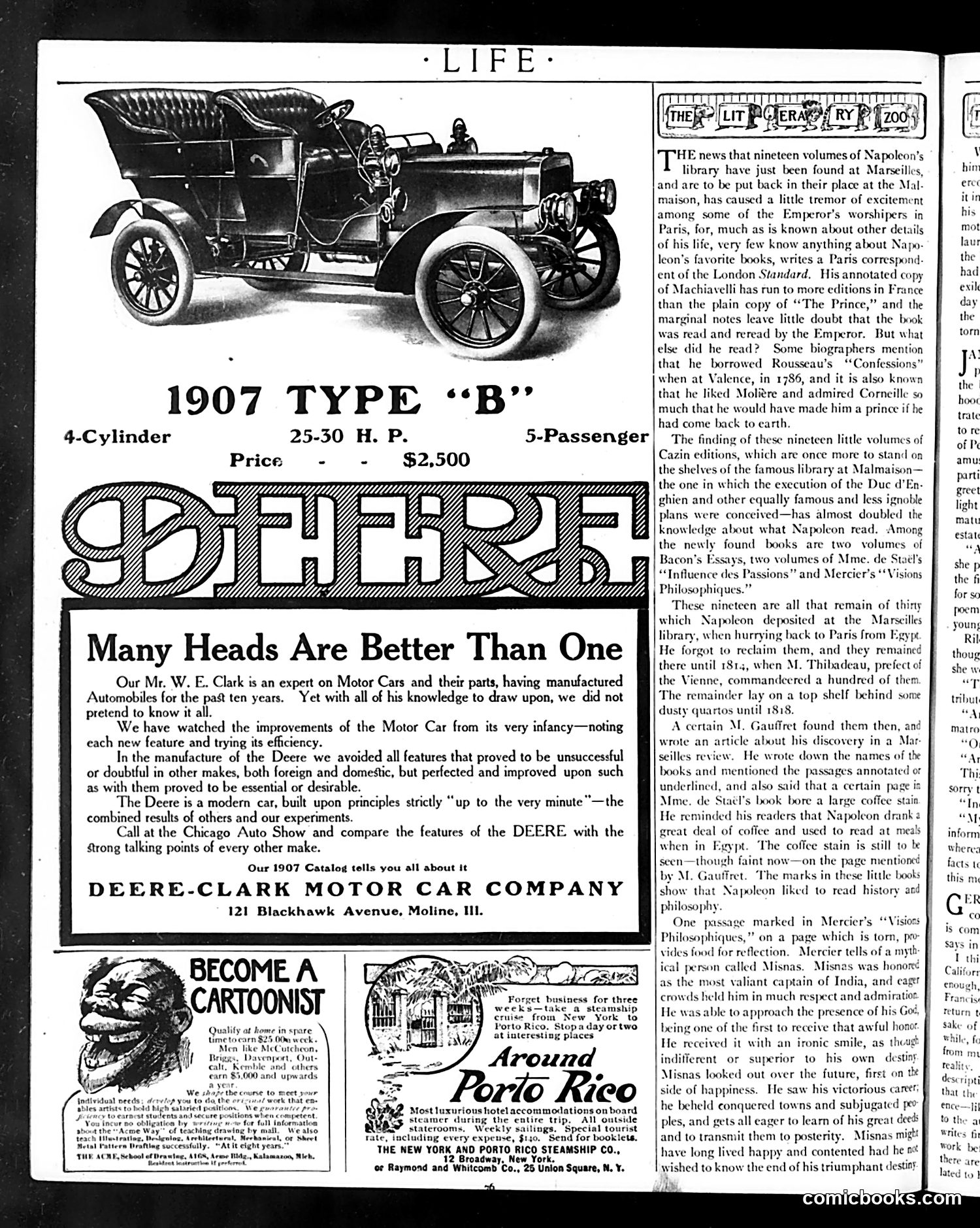
This page is primarily **advertising and product promotion** rather than political satire. The dominant content includes: 1. **1907 Deere Type "B" automobile advertisement** — promoting a 4-cylinder, 25-30 H.P. vehicle priced at $2,500, emphasizing that "Many Heads Are Better Than One" through the expertise of Mr. W.E. Clark. 2. **"Become a Cartoonist" advertisement** — promoting art instruction, offering training in cartooning for "$23.00 a week." 3. **Porto Rico steamship advertisement** — promoting tourist travel. 4. **Right column: "Literary Jury" article** — discussing Napoleon's recently-discovered library volumes at Marseilles and what books he read. No political cartoons or satire appear on this page. It represents typical early-20th-century magazine advertising mixed with cultural content.
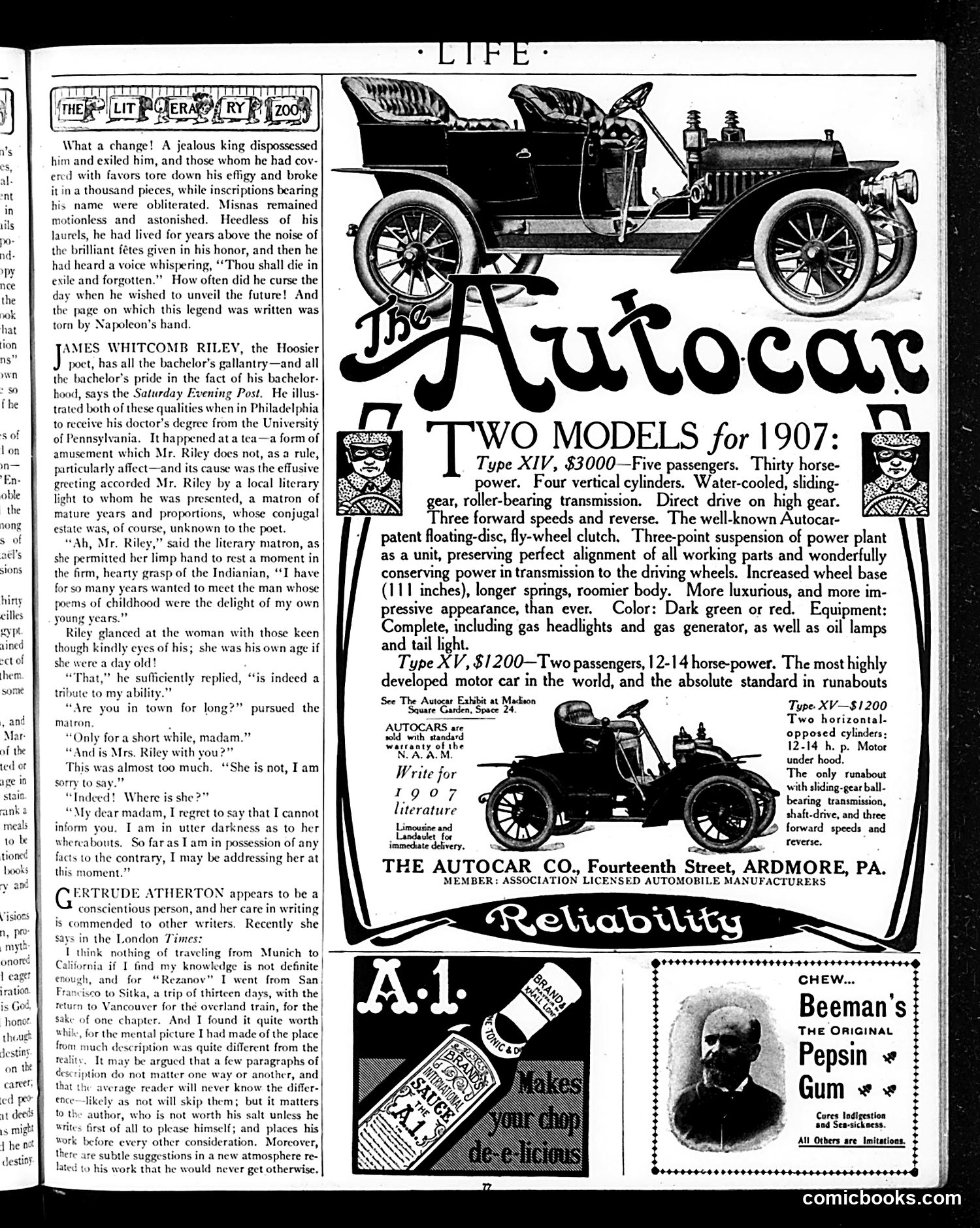
This page is **primarily advertising**, not political satire. The dominant content is a large advertisement for the Autocar automobile company, promoting two 1907 models (Type XIV at $3,000 and Type XV at $1,200). The ad emphasizes technical features like "water-cooled, sliding-gear" transmission and "floating-disc, fly-wheel clutch"—selling points meaningful to early automobile buyers. The upper portion contains literary content about James Whitcomb Riley (a Hoosier poet) and Gertrude Atherton (a writer), with anecdotal stories. A small advertisement for Beeman's Pensin Gum appears at the bottom. There is **no significant political cartoon or satire** on this page—it's a standard issue mixing editorial content with period advertising and consumer product promotion.
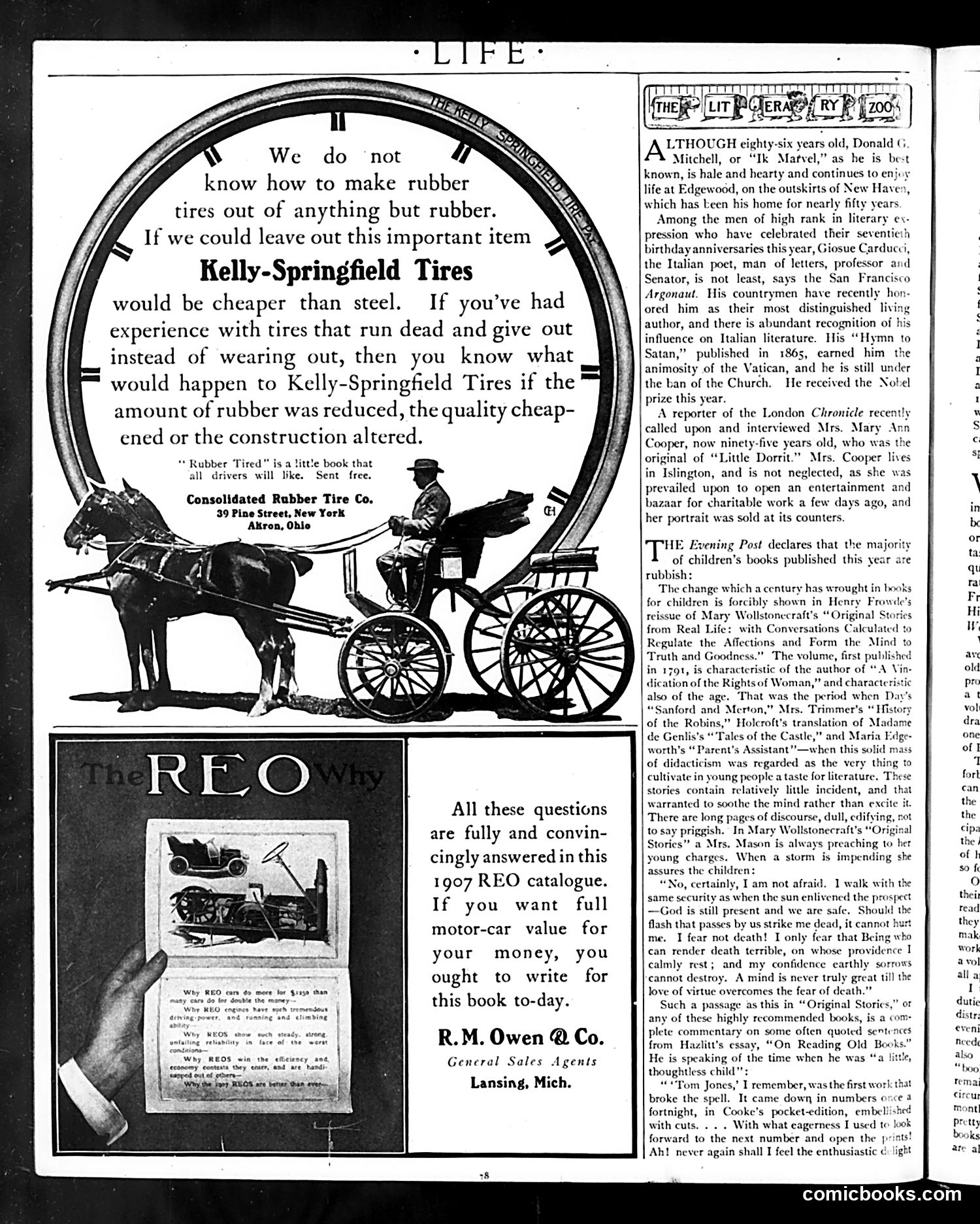
This page is primarily **advertising and editorial content rather than political satire**. The top half features a Kelly-Springfield Tires advertisement using a horse-drawn carriage scene—arguing that rubber tires are essential and irreplaceable, so removing rubber would be catastrophic to tire quality. This appears to be a straightforward product pitch rather than satire. Below are two automobile advertisements: one for REO cars (R.M. Owen & Co.) and text about children's books and literary criticism. The right column contains book reviews discussing changes in children's literature over the past century, including works by Mary Wollstonecraft and Henry Froude. This is a **standard magazine page mixing advertisements with book reviews**—not satirical content targeting political figures or social movements.
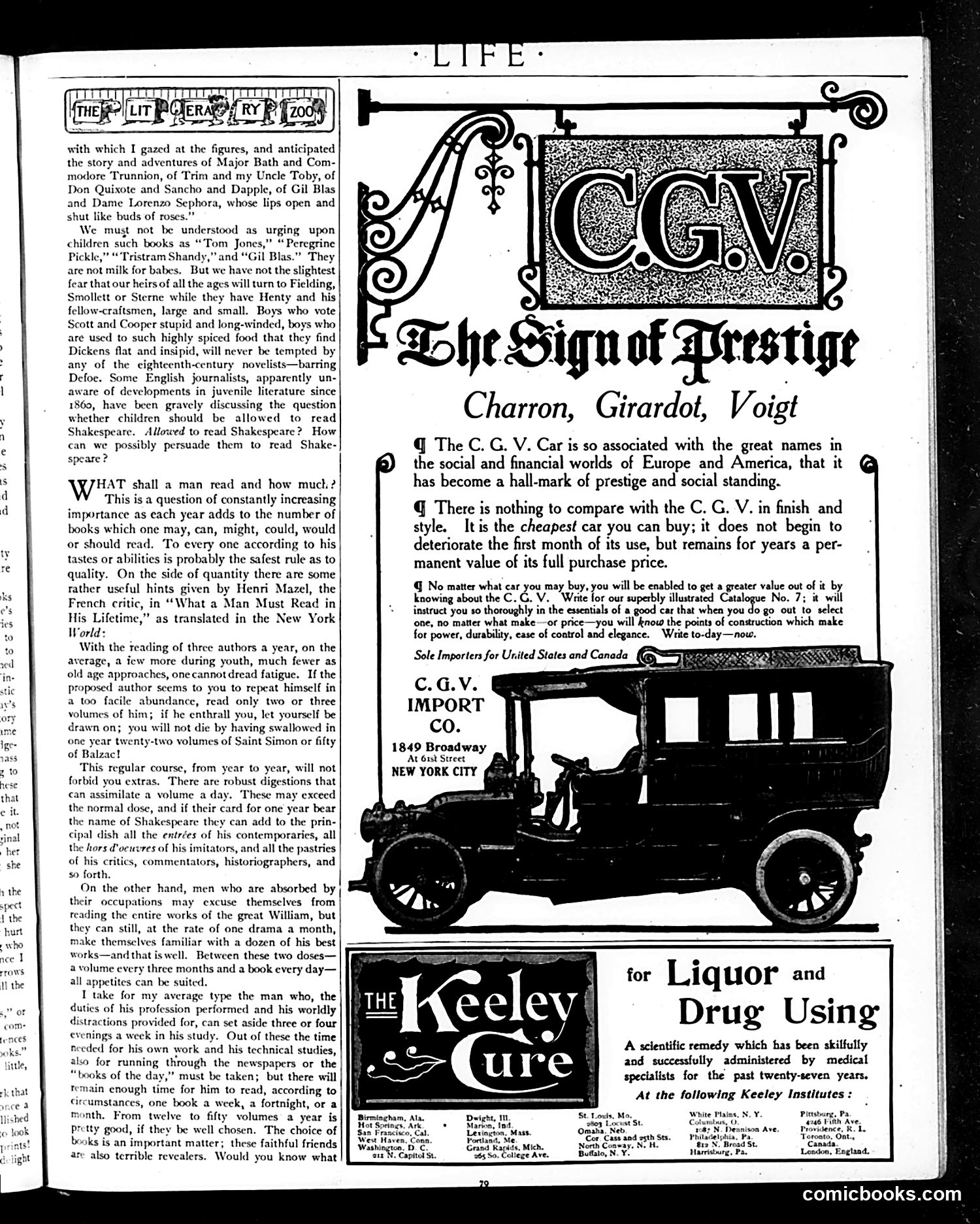
This page is primarily **advertising** rather than satirical cartoons. The main content features: 1. **C.G.V. Car Advertisement** - A decorative banner advertising the C.G.V. automobile, associated with prestigious European names (Charron, Girardot, Voigt). The ad emphasizes the car's prestige, durability, and value, targeting wealthy Americans. 2. **C.G.V. Import Co.** - Located at 1849 Broadway, New York City, selling imported vehicles. 3. **The Keeley Cure** - An advertisement for a treatment facility addressing "Liquor and Drug Using," listing multiple Keeley Institute locations across America and England. The editorial text discusses Shakespeare and reading habits but is unrelated to the advertisements. There is **no political satire visible** on this page—it's a standard magazine layout mixing editorial content with period advertisements.
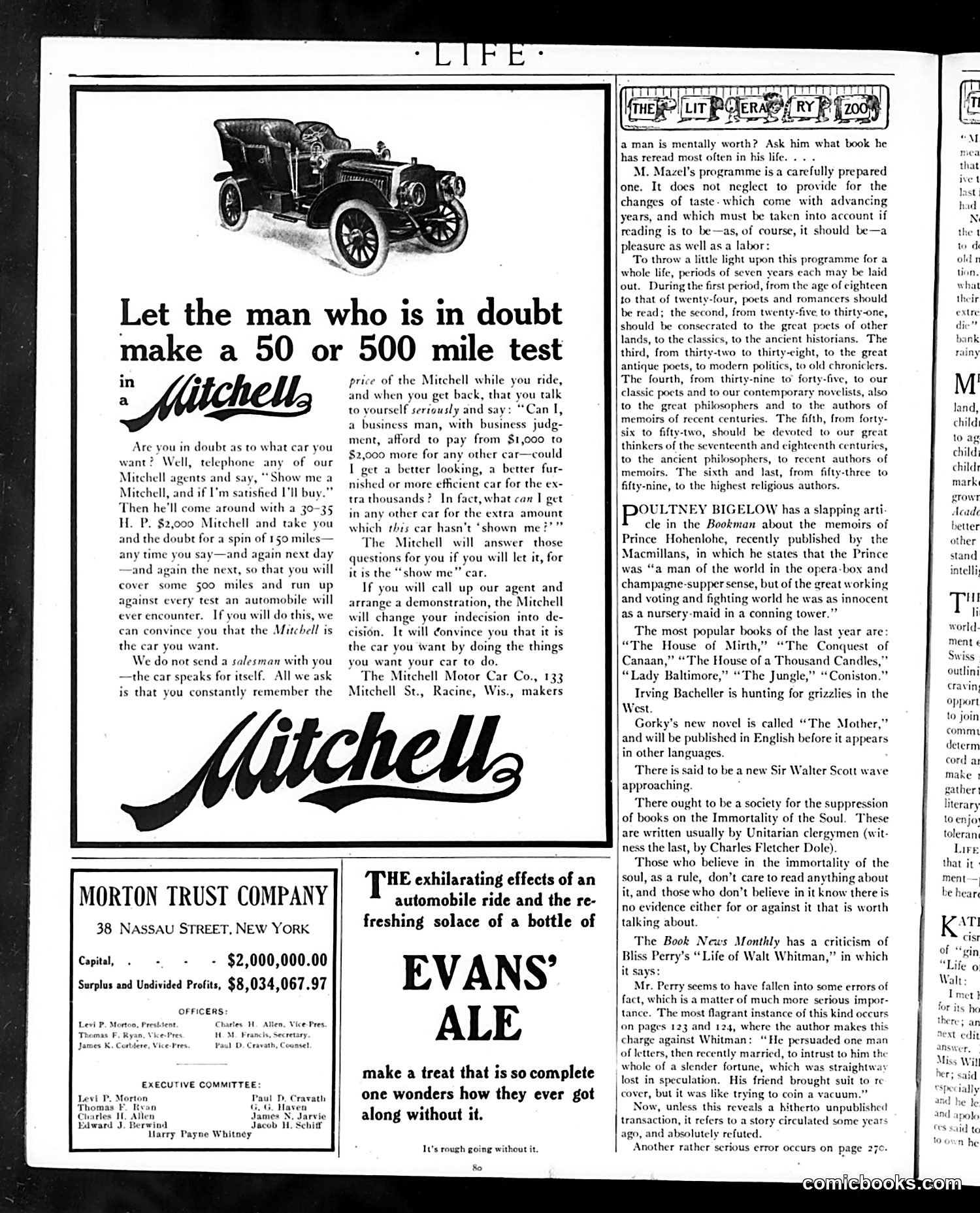
This page is primarily an advertisement for Mitchell automobiles, using a common early 20th-century sales tactic: the "test drive" challenge. The ad suggests that skeptical potential buyers should test a Mitchell against competitors over 50-500 miles to prove its superiority. The pitch emphasizes the car's efficiency and reliability compared to more expensive models, claiming Mitchell offers better value. The advertisement promises that the car itself will demonstrate quality through performance rather than mere salesmanship—"the car speaks for itself." The remainder of the page contains book reviews and literary notices unrelated to the automotive advertisement. This represents typical Life magazine content mixing advertising with cultural commentary.
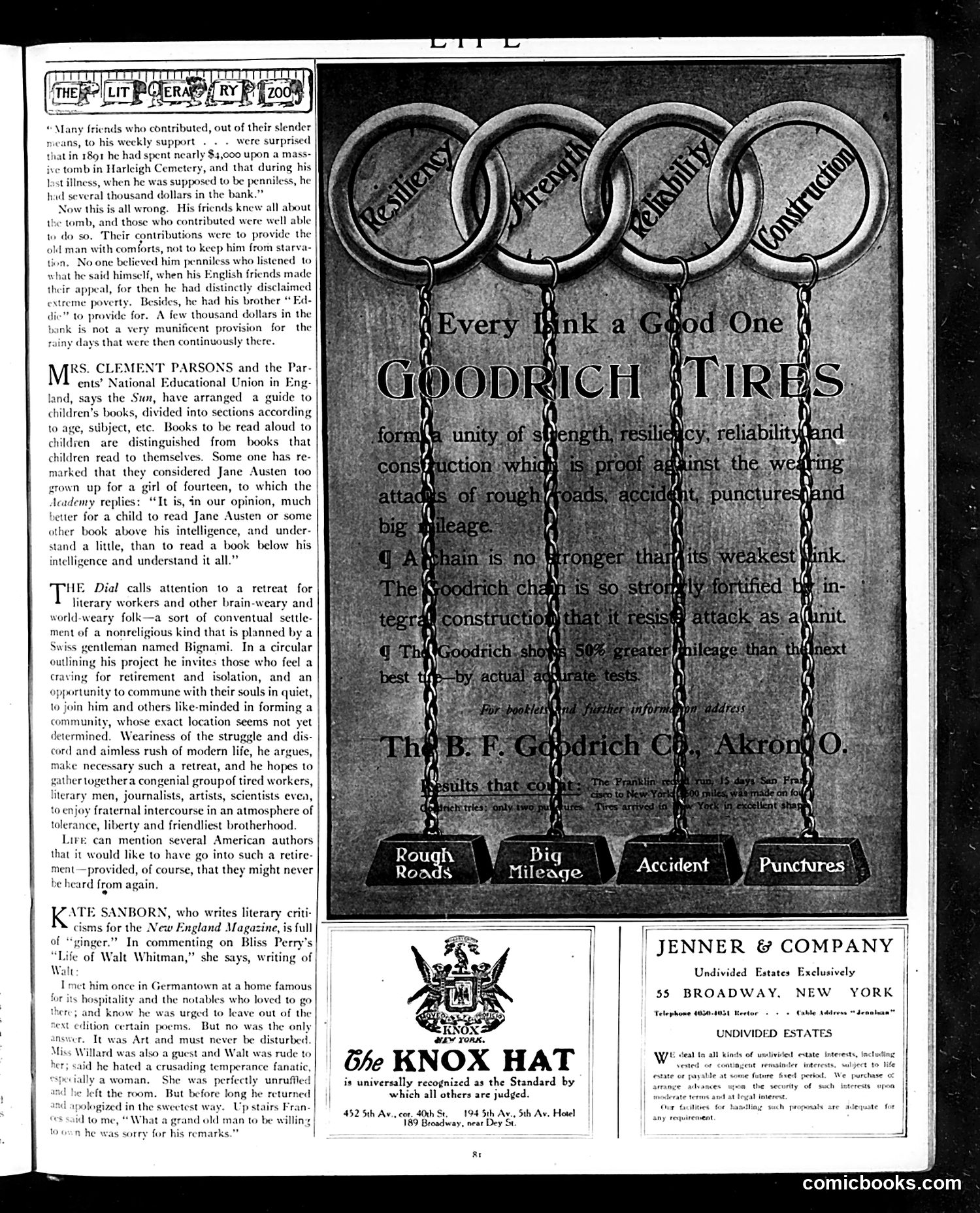
This page is primarily **advertising and literary commentary**, not political satire. The dominant feature is a **Goodrich Tires advertisement** showing three tire rings linked together, emphasizing strength and reliability against road hazards (rough roads, big mileage, accidents, punctures). The copy uses a chain metaphor—"a chain is no stronger than its weakest link"—to argue for integrated tire construction. Below are unrelated advertisements for **The Knox Hat** and **Jenner & Company** (real estate). The left column contains literary discussion: Kate Sanborn writes about Walt Whitman, and there's commentary on children's literature and a writers' retreat proposal. This appears to be a standard magazine page mixing editorial content with paid advertisements—typical of early 20th-century American magazines.
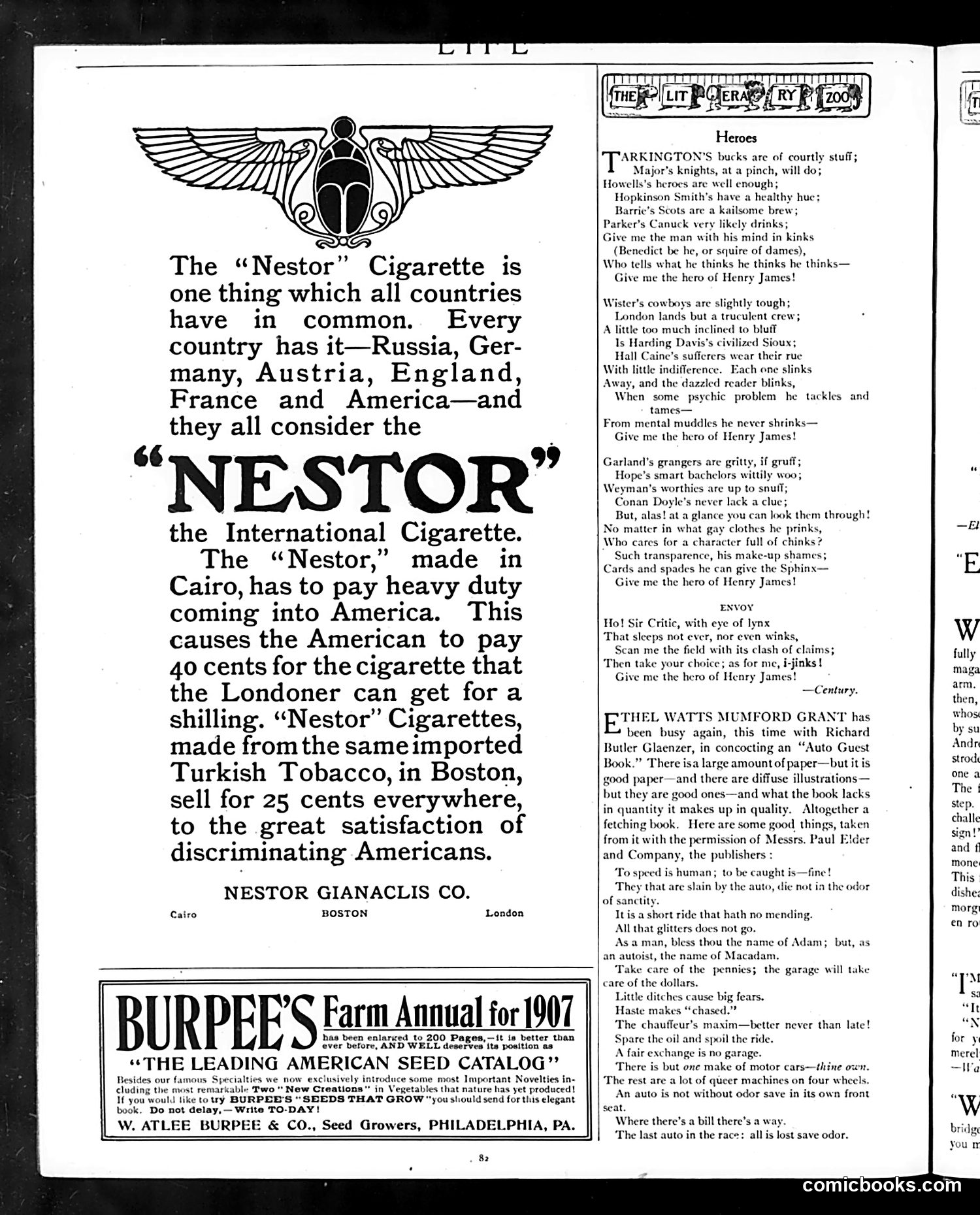
This page is primarily **advertising**, featuring a Nestor Cigarette ad alongside smaller advertisements and literary content. The cigarette advertisement uses a **protectionist trade argument** to sell American-made cigarettes. It claims that imported Egyptian "Nestor" cigarettes cost American consumers 40 cents due to heavy import duties, while identical cigarettes made from the same Turkish tobacco in Boston sell for only 25 cents. The ad appeals to "discriminating Americans" by framing domestic purchase as economically sensible patriotism. The political context reflects early 20th-century tariff debates: protective tariffs on imported goods were controversial, and this ad leverages consumer frustration with inflated prices caused by duties to market American manufacturing. The page also includes poetry praising Henry James's complex literary characters, and an advertisement for Burpee Seeds. These are standard magazine content—not satirical cartoons—typical of *Life* magazine's mixed editorial and advertising format from this era.
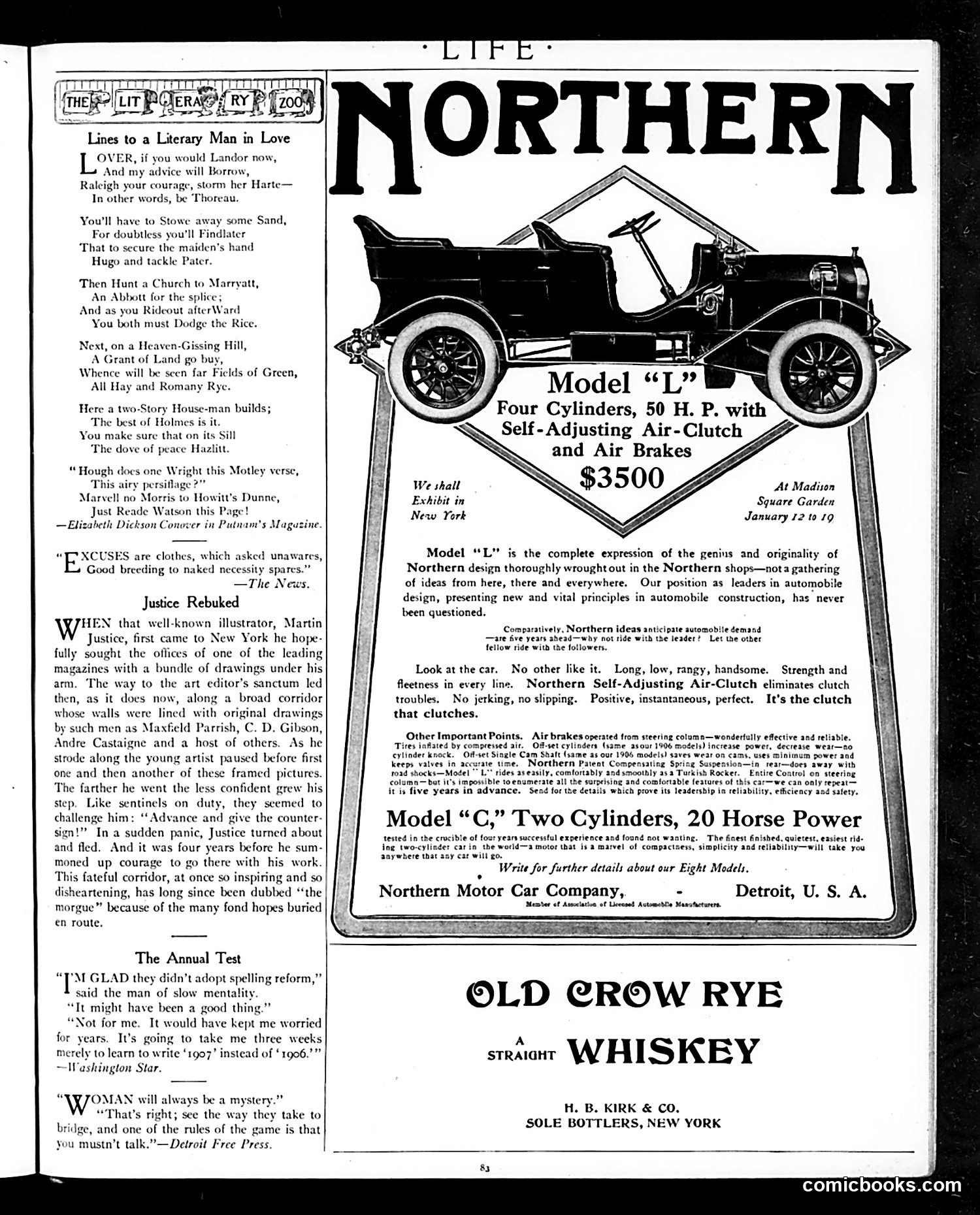
This page contains primarily **advertising and light humor**, not political satire. The main content is a **pun-filled poem** titled "Lines to a Literary Man in Love," which plays on authors' names (Landor, Borrow, Raleigh, Thoreau, etc.) as double meanings for romantic advice. It's clever wordplay rather than satire—for instance, "Raleigh your courage" uses the name Sir Walter Raleigh as a verb. Below that, an anecdote about illustrator **Martin Justice** describes his intimidation walking past famous artists' drawings in a magazine office corridor—a relatable story about artistic self-doubt. The corridor is called "the morgue" because many artists' hopes died there. The remainder is **automobile advertising** for Northern Motor Car Company's Model "L" ($3500), emphasizing its innovative self-adjusting air-clutch and air brakes, plus smaller comic quips about spelling reform and women. There is **no political cartoon or significant satire**—this is a typical early 1900s Life magazine page mixing light humor, anecdotes, and advertisements.
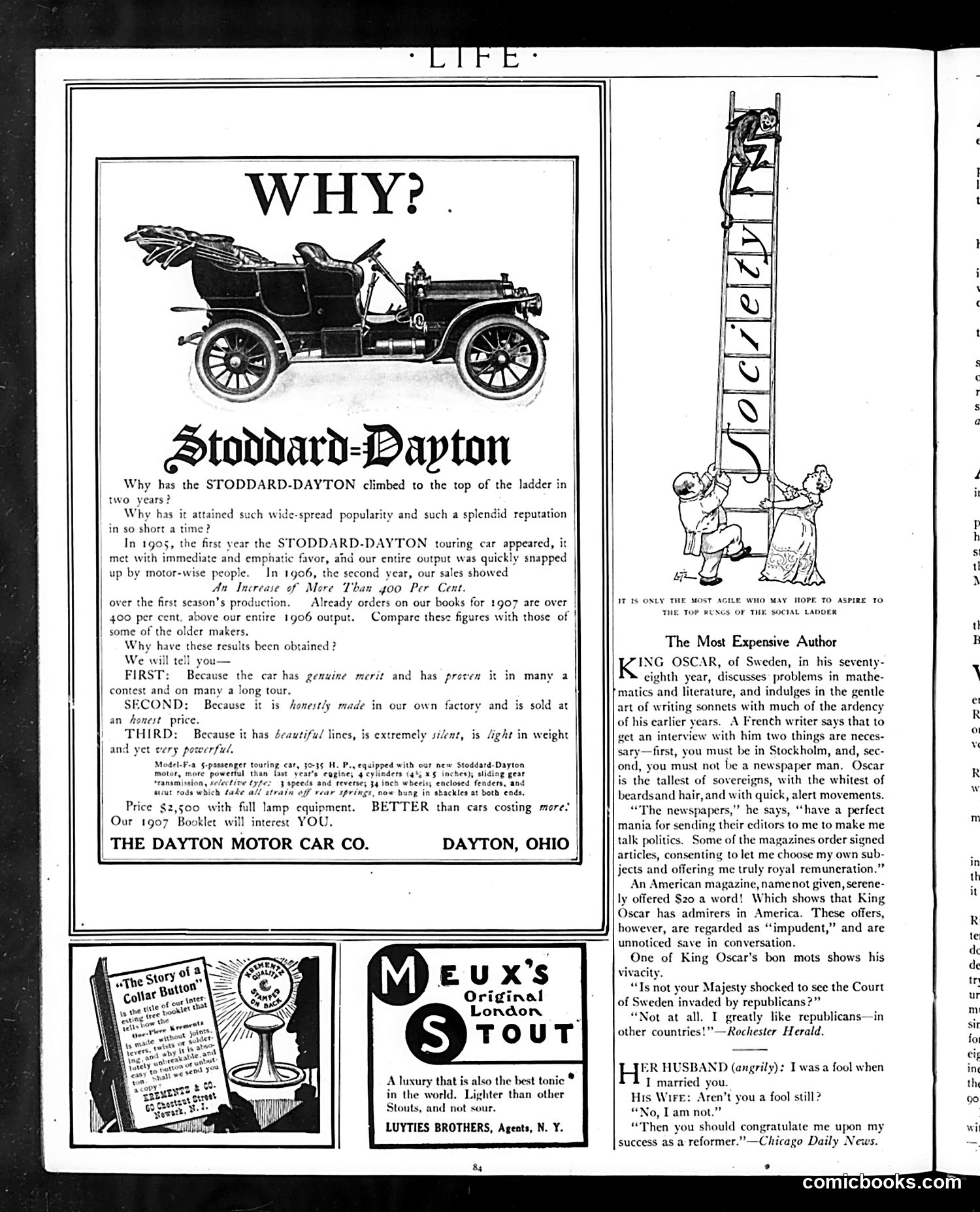
This page primarily contains **advertisements** rather than political satire. The main content is a 1907 Stoddard-Dayton automobile ad using the rhetorical question "WHY?" to promote the car's rapid commercial success and engineering quality. The ad emphasizes "genuine merit," honest manufacturing, and superior design—typical early automotive marketing appeals to affluent buyers. A secondary article profiles **King Oscar II of Sweden**, highlighting his intellectual pursuits (mathematics, sonnets) and his annoyance with journalists seeking interviews or political commentary. The piece is mildly satirical about his titled status and vanity—noting an American magazine's offer of $20 per word for his writing, which he dismisses as "impudent." Below are smaller ads for Meux's London Stout and a "Collar Button" product. The page reflects early 1900s consumer culture targeting middle-to-upper-class readers—automobiles, luxury imports, and celebrity gossip—rather than sharp political commentary.
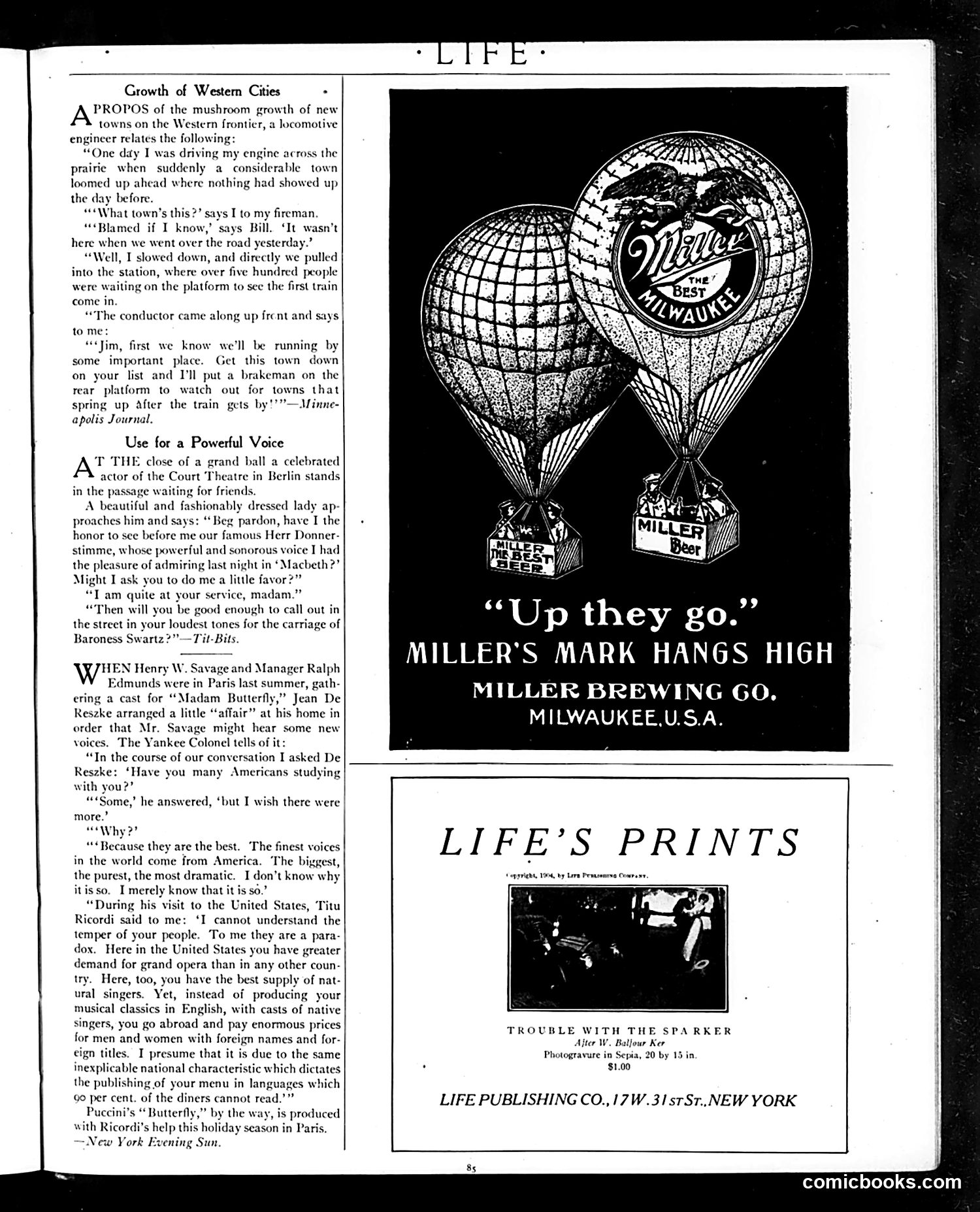
This page contains three distinct pieces of satirical content: **1. "Growth of Western Cities"** — A humorous anecdote mocking the rapid, almost overnight expansion of towns on the American Western frontier. The joke: towns spring up so fast that railroad crews can barely keep track of them, suggesting both the chaotic development and the absurdity of frontier growth. **2. "Use for a Powerful Voice"** — Two brief anecdotes. The first depicts a woman flattering a famous Berlin opera singer to exploit his loud voice for calling a carriage—satirizing both pretentiousness and practical German humor. The second discusses American opera: a visiting Italian impresario (Titu Ricordi) expresses bewilderment that Americans, despite having excellent native singers, insist on hiring foreign performers with foreign names for prestige, mocking American cultural inferiority complex. **3. Miller Beer Advertisement** — Two hot air balloons bearing Miller brewery branding, with the caption "Up they go"—a straightforward product advertisement. The page primarily showcases Life's satirical humor targeting American frontier development, social pretension, and cultural snobbery.
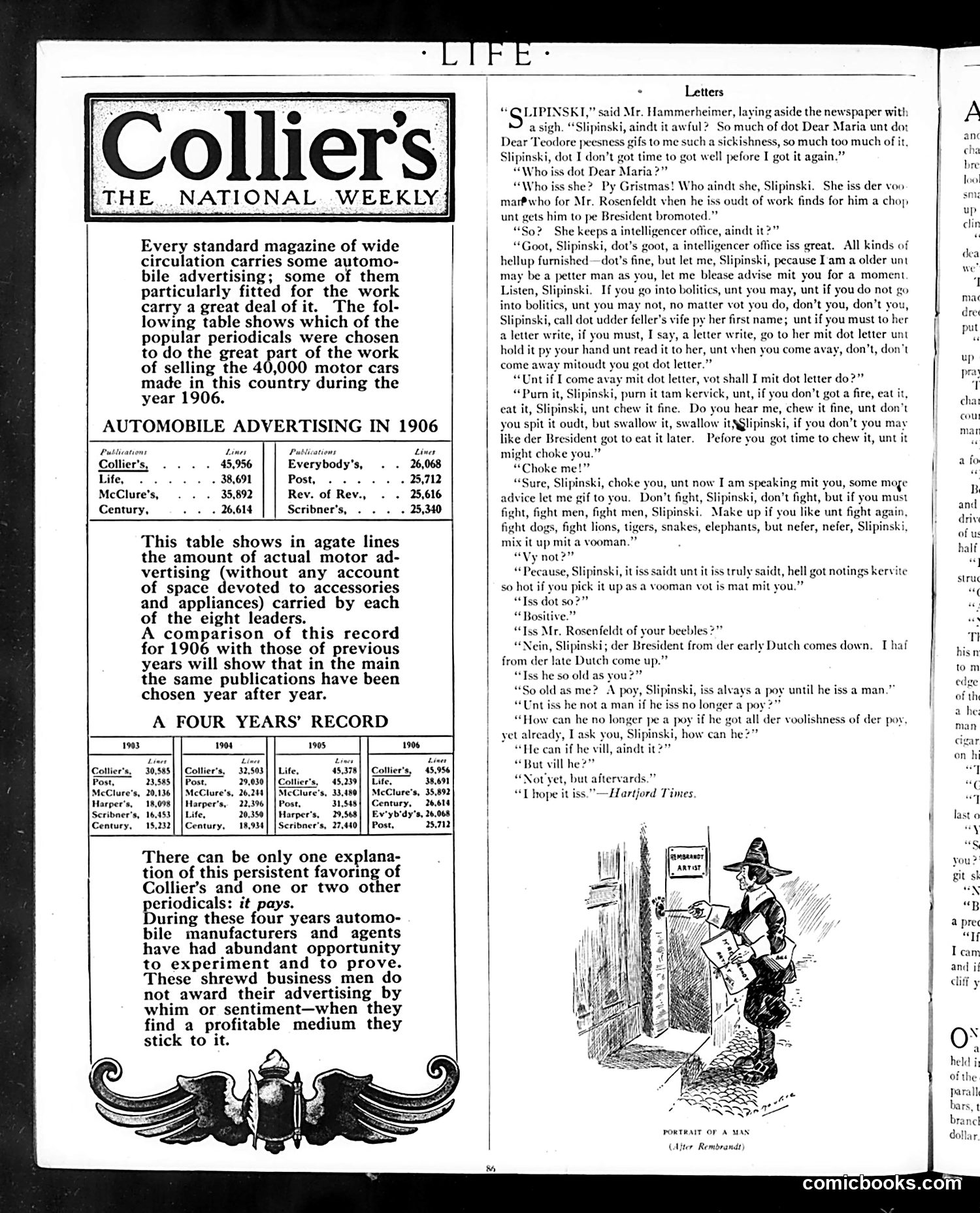
This page is primarily **automobile industry advertising analysis**, not political satire. The left side presents data showing that *Collier's* magazine received the most auto advertising lineage (45,956 lines) in 1906, followed by *Life* (38,691). The article argues manufacturers choose publications strategically based on proven sales results, not sentiment. The right page features a humorous letter column titled "Letters" containing a comedic dialogue between two Yiddish-accented characters, **Hammerheimer and Slipinski**. Hammerheimer complains about reading excessive gossip about "Dear Maria," a woman who helps unemployed men get jobs and political advancement. He then offers fatherly advice about navigating politics: avoid addressing married women by first name, destroy any letters written to them, and never fight women (though fighting men is acceptable). The cartoon below shows a **mailman** delivering mail, illustrating the letter-writing theme. This represents *Life*'s typical early 1900s humor: ethnic dialect comedy and domestic/political satire targeting immigrant working-class readers.
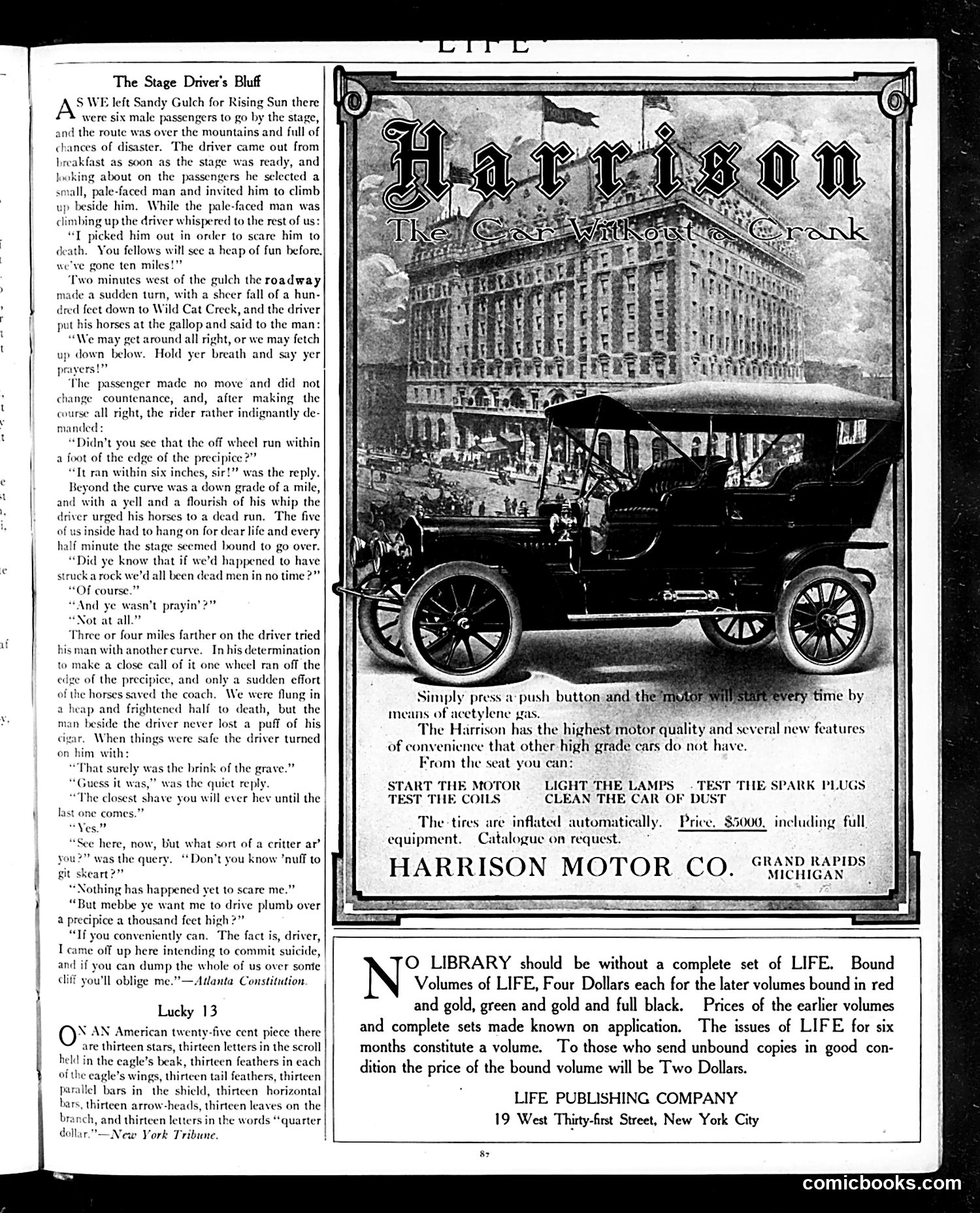
This is a humorous tall tale about a stagecoach driver attempting to frighten a pale, timid-looking passenger by recklessly driving near cliff edges. The joke hinges on the passenger's unexpected immunity to fear: he reveals he boarded the stage *intending to commit suicide*, making the driver's dangerous stunts irrelevant—nothing can scare someone actively seeking death. The satire targets both the driver's cruel entertainment (selecting victims to terrorize for amusement) and the passenger's darkly comic fatalism. It's gallows humor typical of Life magazine's satirical style. The page also includes two advertisements (Harrison Motor Company and Life Publishing) and a numerology oddity about the number 13 on U.S. currency—unrelated content typical of magazine layout from this era (approximately 1910s based on style).
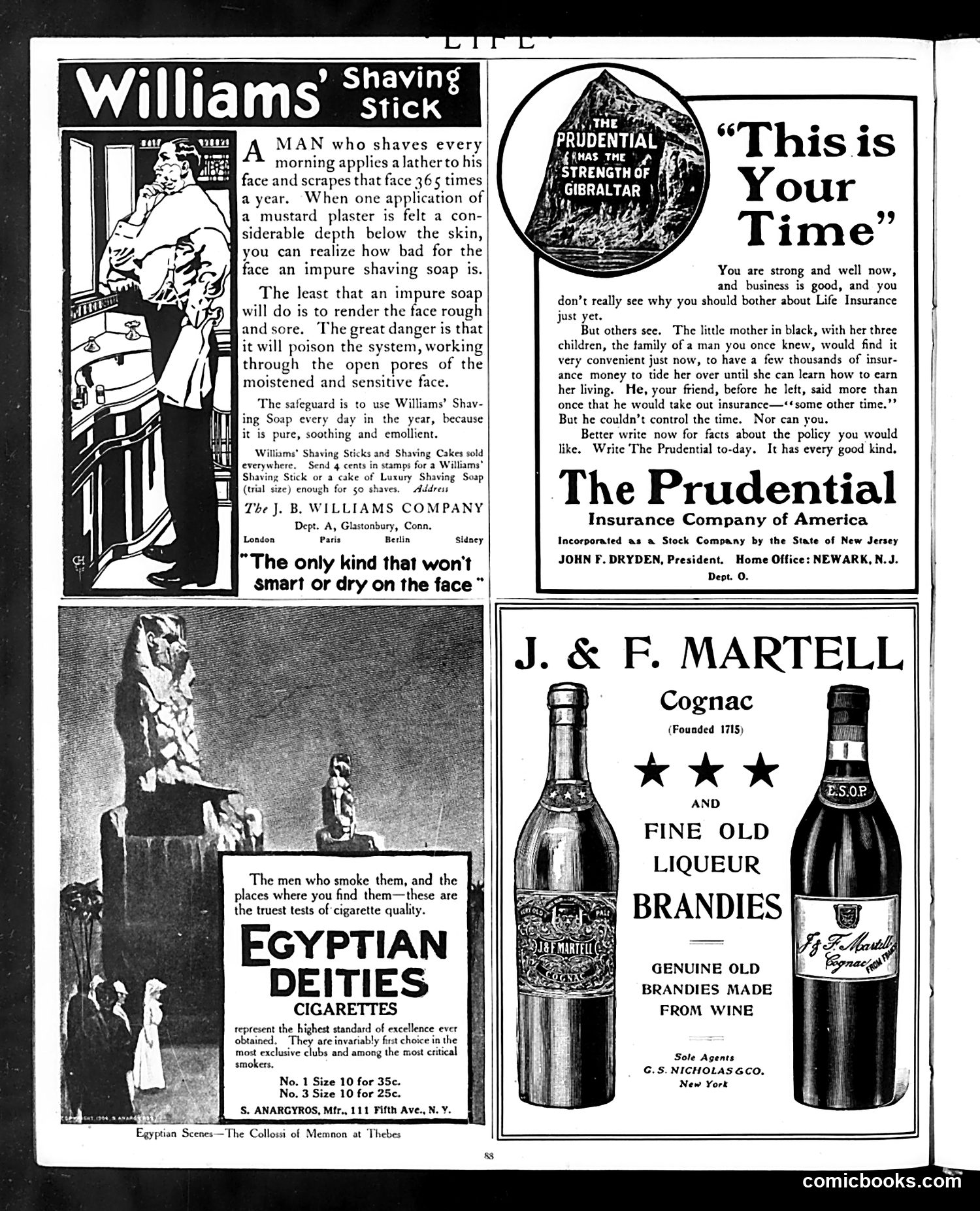
This page consists primarily of **period advertisements** rather than editorial cartoons, reflecting early 20th-century product marketing. **Key Advertisements:** 1. **Williams' Shaving Stick**: Promotes soap by warning of dangers from impure shaving products, claiming they can "poison the system" through facial pores—reflecting era-typical health anxieties about hygiene. 2. **Prudential Insurance**: Uses emotional appeal, depicting a widow and fatherless children. The message: a man ("your friend") delayed purchasing life insurance, saying "some other time," but couldn't control when death came. It's a cautionary pitch urging immediate action. 3. **Egyptian Deities Cigarettes**: Implies exclusivity by claiming use in "exclusive clubs" among "critical smokers." 4. **J. & F. Martell Cognac**: Standard spirits advertisement emphasizing age and authenticity (Founded 1715). The Prudential ad is most notable for its **social commentary**—it assumes male breadwinners and female dependents, and exploits guilt about family protection to drive sales. This was common early insurance marketing psychology.
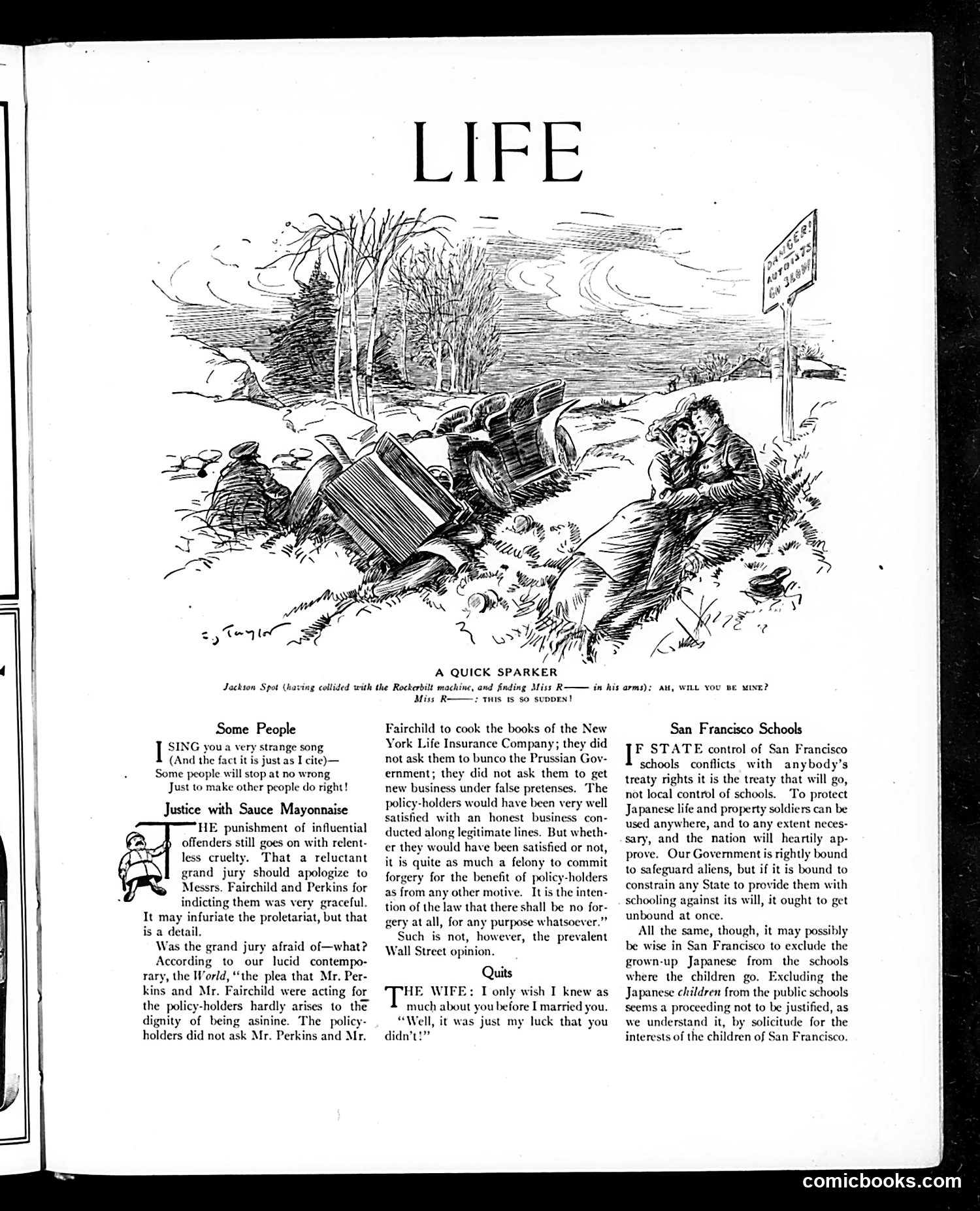
This page contains several satirical pieces critiquing corruption and hypocrisy: **"A Quick Sparker"** (top cartoon): A car accident illustration accompanying commentary on the New York Life Insurance scandal. Insurance executives Perkins and Fairchild faced indictment for fraud (forging documents, bribing foreign officials) yet received apologies from grand juries. The satire attacks the "Wall Street opinion" that committing crimes *for* policyholders somehow differs morally from other crimes. **"Some People"** and **"Justice with Sauce Mayonnaise"**: Verses mocking the protection wealthy offenders receive while ordinary people face strict punishment—the grand jury apologizing to the accused represents this double standard. **"Quits"**: A brief joke about marriage deception. **"San Francisco Schools"**: Commentary on 1906-era tensions over Japanese student exclusion from public schools, questioning whether excluding Japanese *children* truly protects American children's interests, while noting the government can deploy military force to protect Japanese adults' property rights. The page criticizes elite immunity from prosecution and inconsistent application of law based on wealth and power.
This page celebrates New York's new Governor Charles Evans Hughes, praising his independence from Republican machine politicians and his reform proposals—recount of the mayoral election, civil service changes, and better regulation of transportation corporations. The satirical edge targets the Democrats, dismissed as unfit to govern despite holding most state offices. The second section mocks contradictory predictions about economic prosperity. Named figures (Rockefeller, Stuyvesant Fish, Secretary Shaw) represent competing views: some warn of recession while others insist prosperity will continue. The satire suggests these financial elites are simply guessing, their disagreements equally valid/invalid. The veiled reference to "Theodore" likely alludes to President Theodore Roosevelt's trust-busting policies, blamed by some for economic instability.
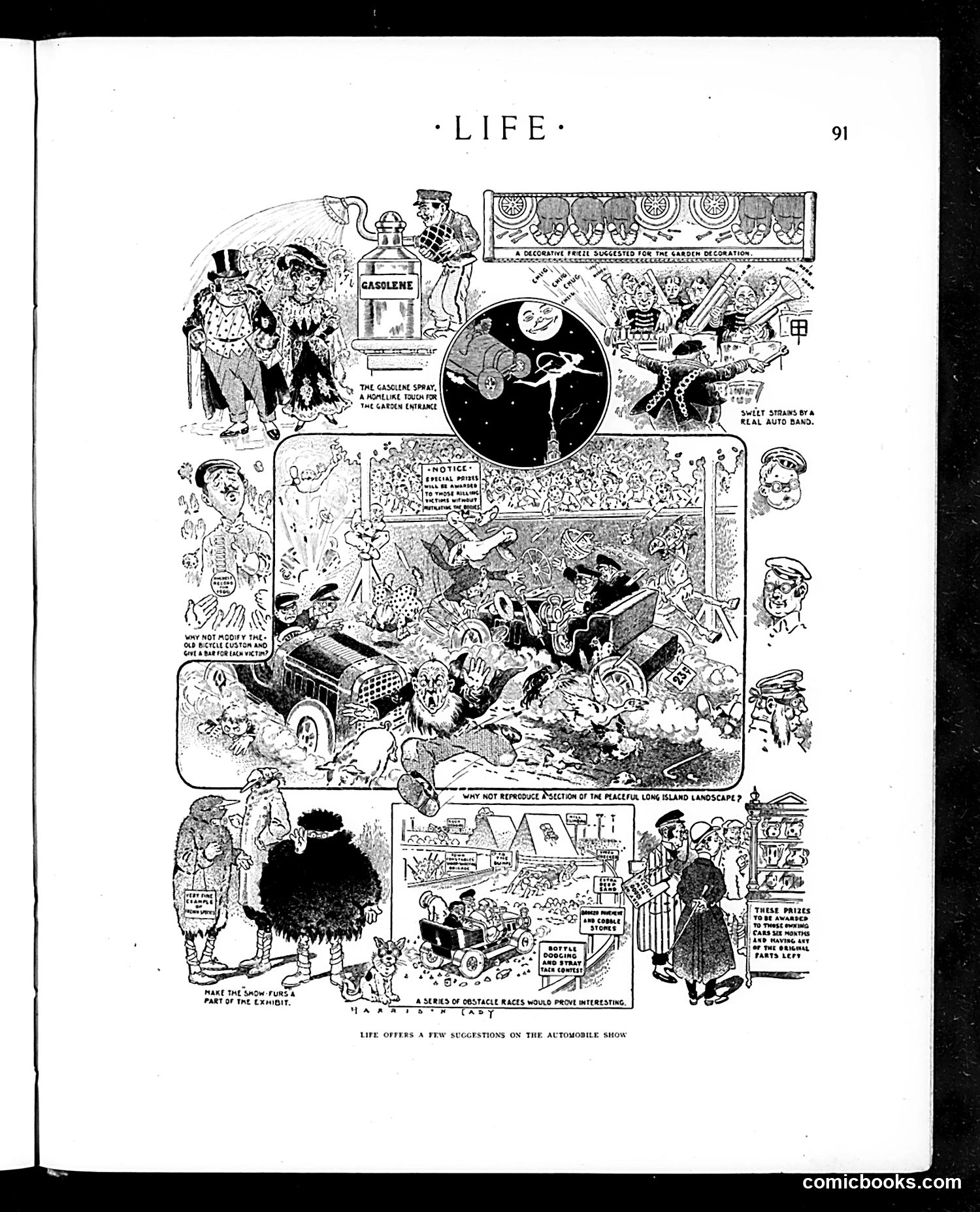
This satirical page mocks automobile show exhibits and car culture. The central illustration depicts chaotic car racing scenes with multiple vehicles colliding and pedestrians fleeing—suggesting the dangerous absurdity of automotive "progress." The surrounding panels offer tongue-in-cheek "suggestions" for the automobile show, including: - A gasoline spray as a "popular torch" for garden entrance - Snow flurries incorporated into exhibits - Obstacle races presented as entertainment - Prize-winning displays The humor targets the era's obsession with automobiles and motorcar exhibitions, presenting increasingly ridiculous (and dangerous) show concepts. The cartoonist satirizes both the automobile industry's promotional spectacles and the public's fascination with cars, implying that auto shows encourage reckless behavior and poor judgment. The style and references suggest this is from the early automotive era (likely 1910s-1920s), when car culture was novel and the automobile show was a significant public event.
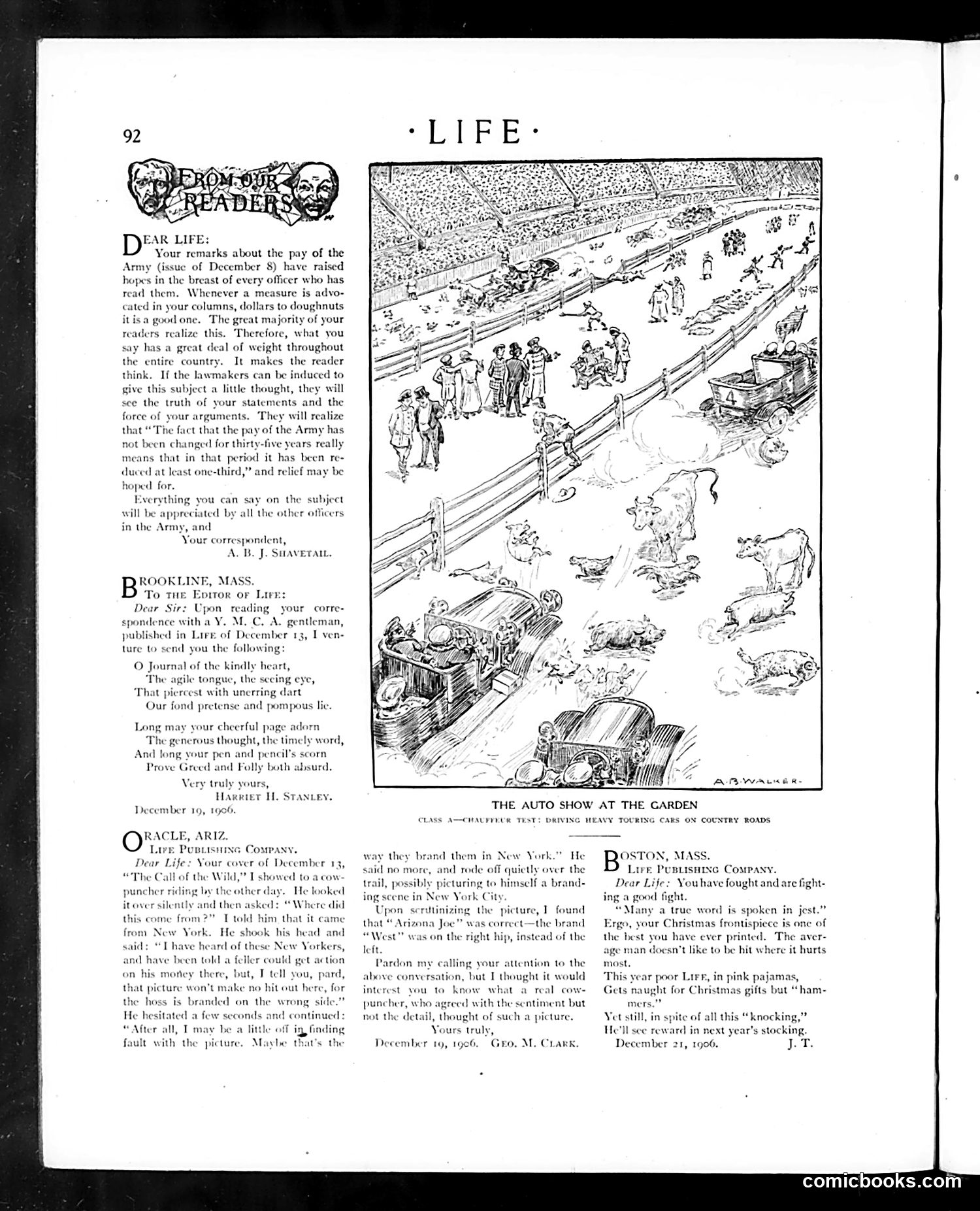
This page features readers' letters to *Life* magazine and a cartoon titled "The Auto Show at the Garden," showing an automobile exhibition with various vehicles and spectators. The letters discuss three topics: Army pay (advocating for increased military salaries), a tribute to *Life*'s editorial voice, and a correction about a previous cover illustration. A rancher from Arizona notes that a depicted branding scene had the brand placed on the wrong side of a horse—a detail error that amused him despite approving the picture's sentiment. The cartoon appears to satirize the novelty and chaos of early automobile shows, depicting multiple cars, spectators, and animals in a crowded fairground scene. The humor likely derives from contrasting the new technology of automobiles with traditional rural imagery and the confusion such modern exhibitions created. The page reflects *Life*'s role as an influential satirical publication whose editorial positions on social issues (like military pay) carried considerable weight with readers and policymakers.
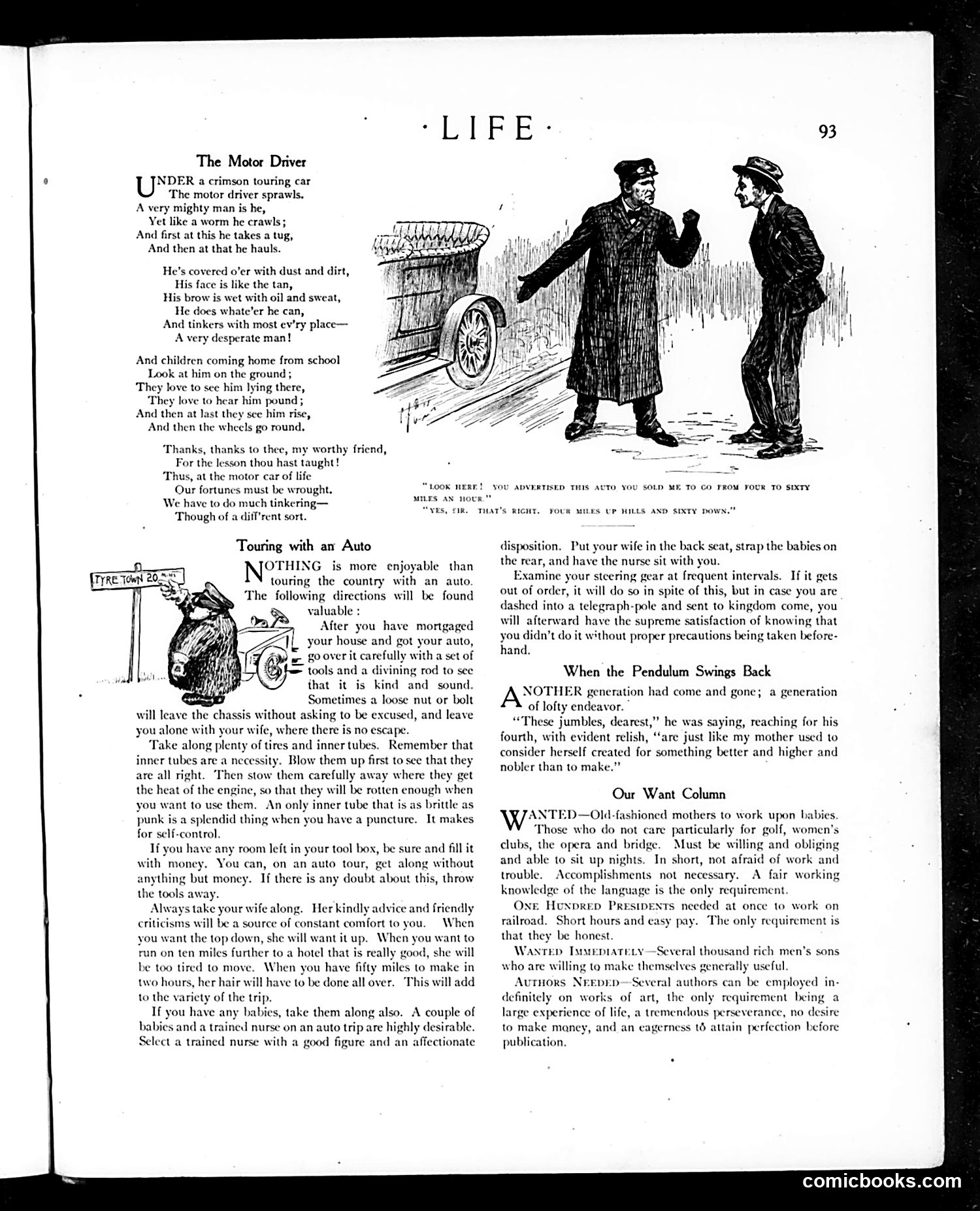
This page satirizes early automobile culture and social changes of the era. **"The Motor Driver"** poem depicts a man frantically repairing a car—a metaphor for modern life's exhausting demands. The accompanying cartoon shows two men discussing an auto, with dialogue mocking inflated advertising claims ("four to sixty miles an hour"). **"Touring with an Auto"** offers tongue-in-cheek advice assuming readers have mortgaged their homes to buy cars. The satire targets: - The automobile's unreliability (loose bolts, rotten inner tubes) - Wives as nagging travel companions (wanting tops up when husbands want them down) - The expense (fill your toolbox with money, not tools) **"Our Want Column"** advertises for "old-fashioned mothers" to care for babies—satirizing modern women's priorities. It implies young mothers prefer golf, clubs, opera, and bridge over childcare, marking anxiety about changing gender roles and domesticity in the Progressive Era. The overall message criticizes consumerism, unreliable technology, and shifting social values as distinctly modern problems.
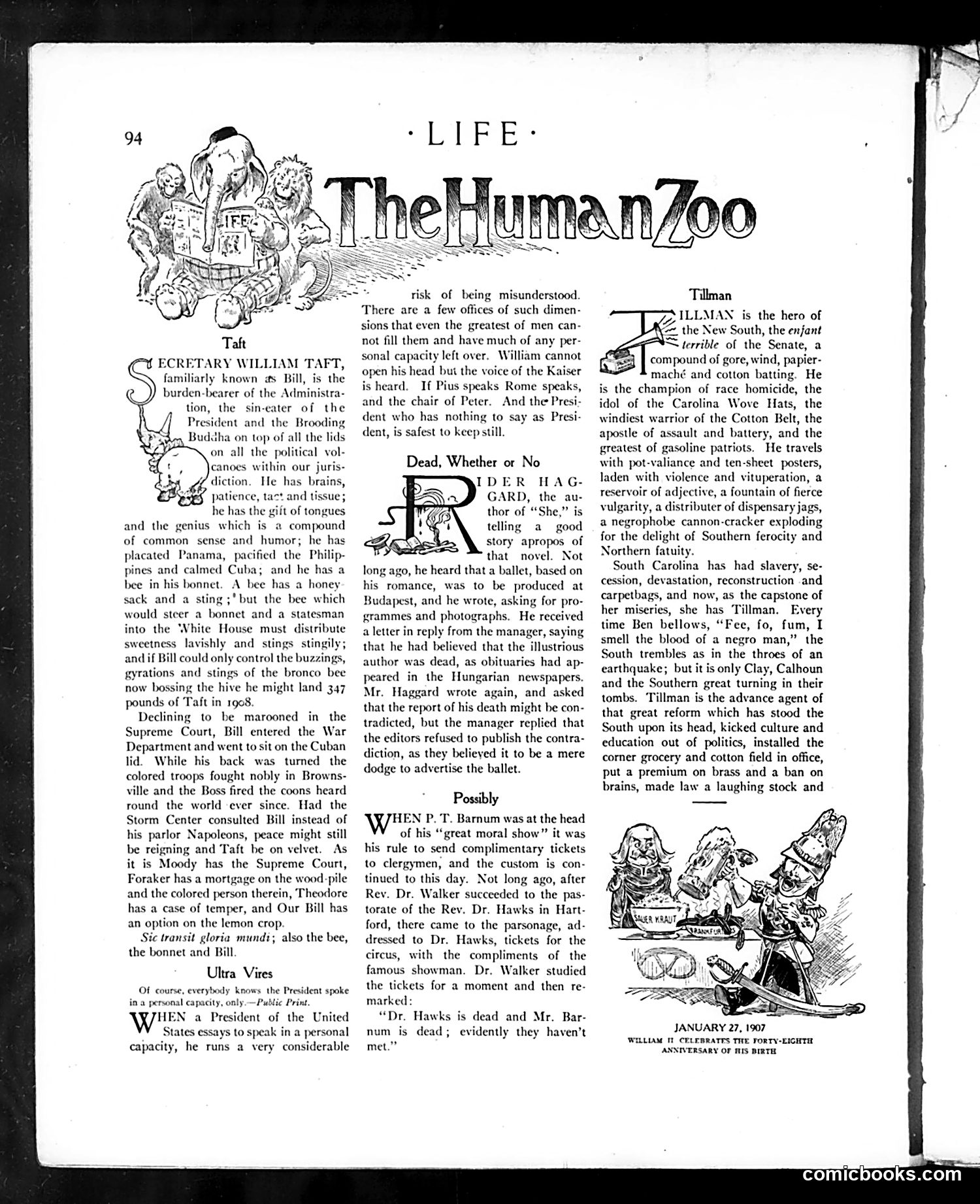
This page satirizes prominent American political and public figures through character sketches. The main targets are: **William Howard Taft** (Secretary of War): Depicted as President Theodore Roosevelt's burden-bearer and problem-solver ("sin-eater"), credited with handling Panama, the Philippines, and Cuba. The satire suggests Taft is being groomed as Roosevelt's successor for 1908, though his effectiveness is undermined by Roosevelt's unpredictability (the "bronco bee" metaphor). The reference to the "Brownsville" incident mocks how Taft's absence allowed Roosevelt to fire Black soldiers without consultation. **Benjamin Tillman** ("Tillman"): A South Carolina Senator caricatured as violent, racist, and prone to bluster—a "champion of race homicide" and "windiest warrior." This reflects Tillman's notorious advocacy for white supremacy and segregation. The page also includes lighter anecdotes about author Rider Haggard and P.T. Barnum, adding humor to what is primarily political commentary on the Roosevelt administration's inner workings and Southern racism.
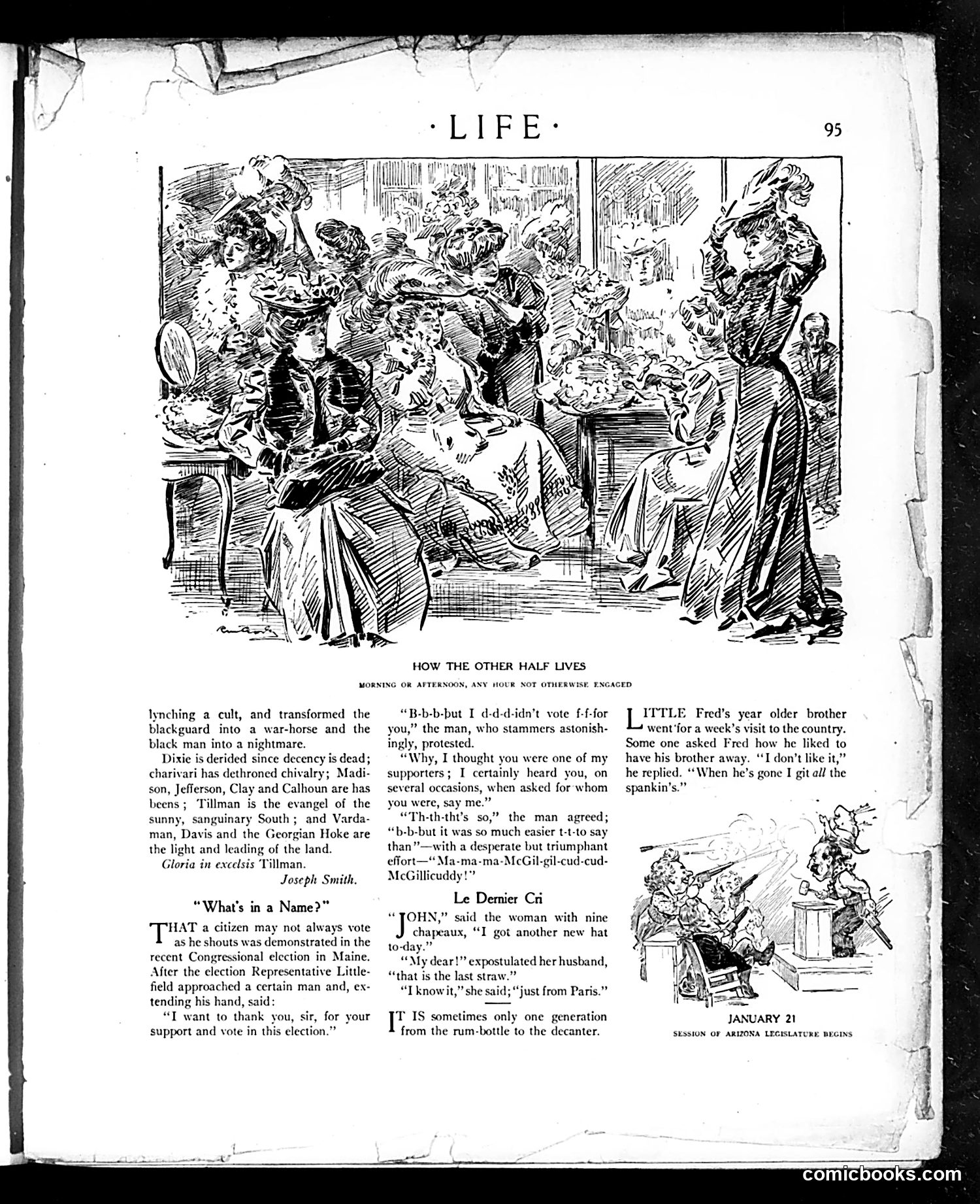
This page contains three separate satirical pieces from Life magazine: **"How the Other Half Lives"** (top): A bitter editorial denouncing the American South, specifically attacking figures like Senator Tillman and Governor Vardaman as representing moral decay. The author (Joseph Smith) condemns what he sees as the glorification of lynching and racial violence in Southern politics, contrasting these leaders unfavorably with historical figures like Jefferson and Clay. **"What's in a Name?"**: A humorous anecdote about a Maine Congressional election where Representative Littlefield believes a stammering man voted for him based on hearing him say "me"—but the man was actually stuttering through the name "McGillicuddy." The joke satirizes both voter confusion and perhaps election irregularities. **"Le Dernier Cri"**: A brief domestic humor piece mocking a wealthy woman's obsessive hat-buying, with her husband's exasperation at her claiming each purchase is "the last straw"—which she's apparently said before. The page reflects early 20th-century Life magazine's mix of political commentary and light social satire.
This is a **mock-serious news report** satirizing American political overreaction. The setup: an American woman (Mrs. Trautley) is briefly arrested in Moscow on a pickpocketing charge that proves false. The satire escalates absurdly—in response, the U.S. government allegedly mobilizes the entire military: the North Atlantic fleet rerouted to the Baltic, Mediterranean squadrons mobilized, regular army regiments deployed, the President preparing to take personal command in military uniform, and even the "Rough Riders" summoned. **Political targets**: The piece mocks prominent politicians' bellicose responses—Senator Tillman offering to raise a "negro regiment" for Russia, Secretary Taft losing weight from stress, senators grandstanding about patriotic duty. The joke hinges on the **absurd disproportion** between a minor police incident and the fictional military mobilization. It likely lampoons American jingoism and politicians' tendency toward theatrical, militaristic overreactions to international incidents—a recurring satirical theme in this era.
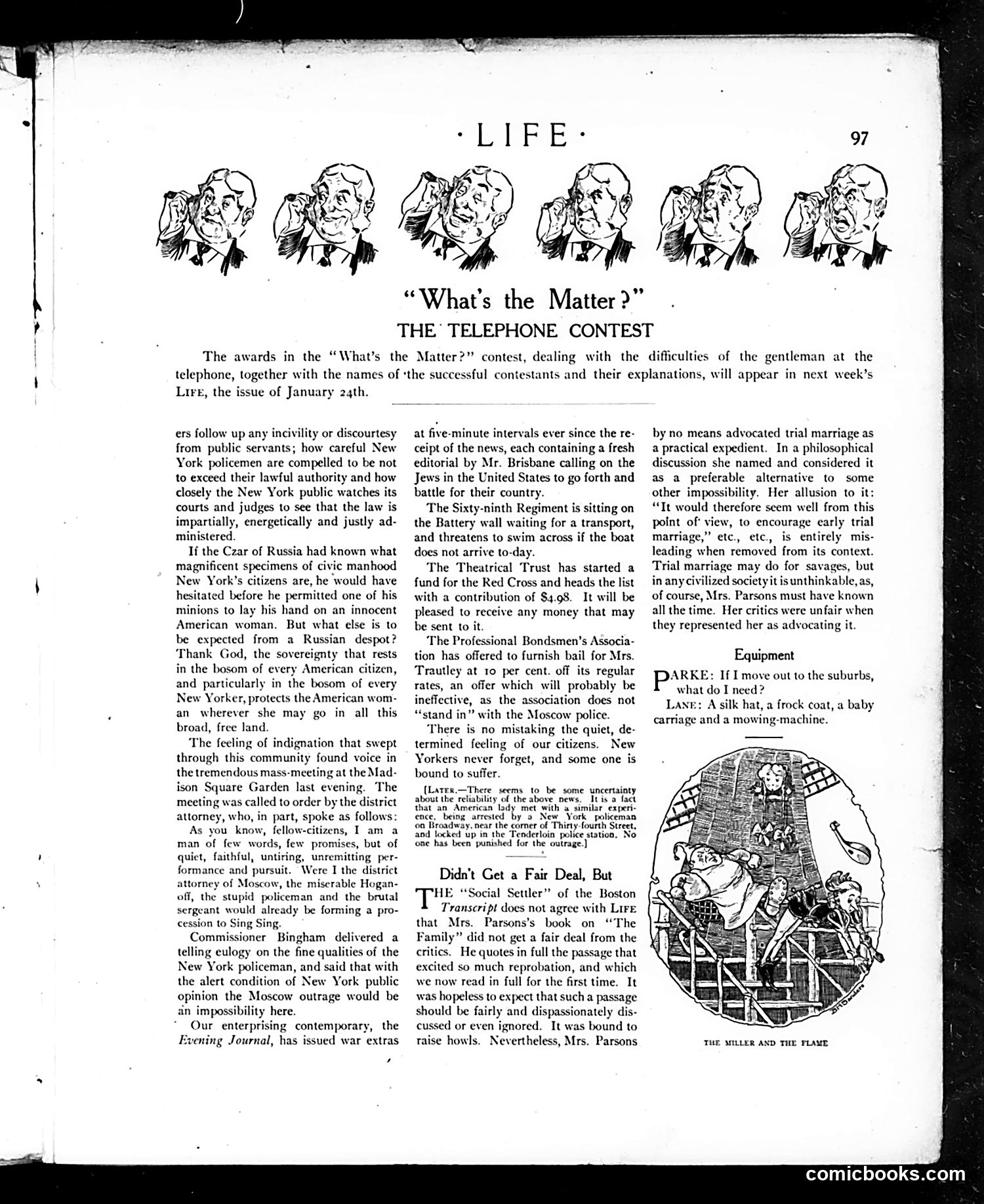
This page announces a **telephone contest** featuring six identical cartoon drawings of a bewildered man at a telephone—the visual joke is repeated to emphasize frustration with telephone difficulties, a then-modern technology. The bulk of the page satirizes American **overreaction to a real incident**: a Russian official allegedly assaulted an American woman. Life mocks New York's grandiose response—mass meetings, the 69th Regiment mobilizing, newspapers issuing "war extras," theatrical producers donating trivial sums—as absurdly disproportionate patriotic theater. The satire targets **American self-righteousness**: politicians praising NYC police virtue while ignoring that a NYC policeman similarly arrested an American woman on Broadway (noted in the editor's correction at bottom). The piece exposes hypocrisy—Americans perform moral outrage at Russian brutality while tolerating identical conduct domestically.
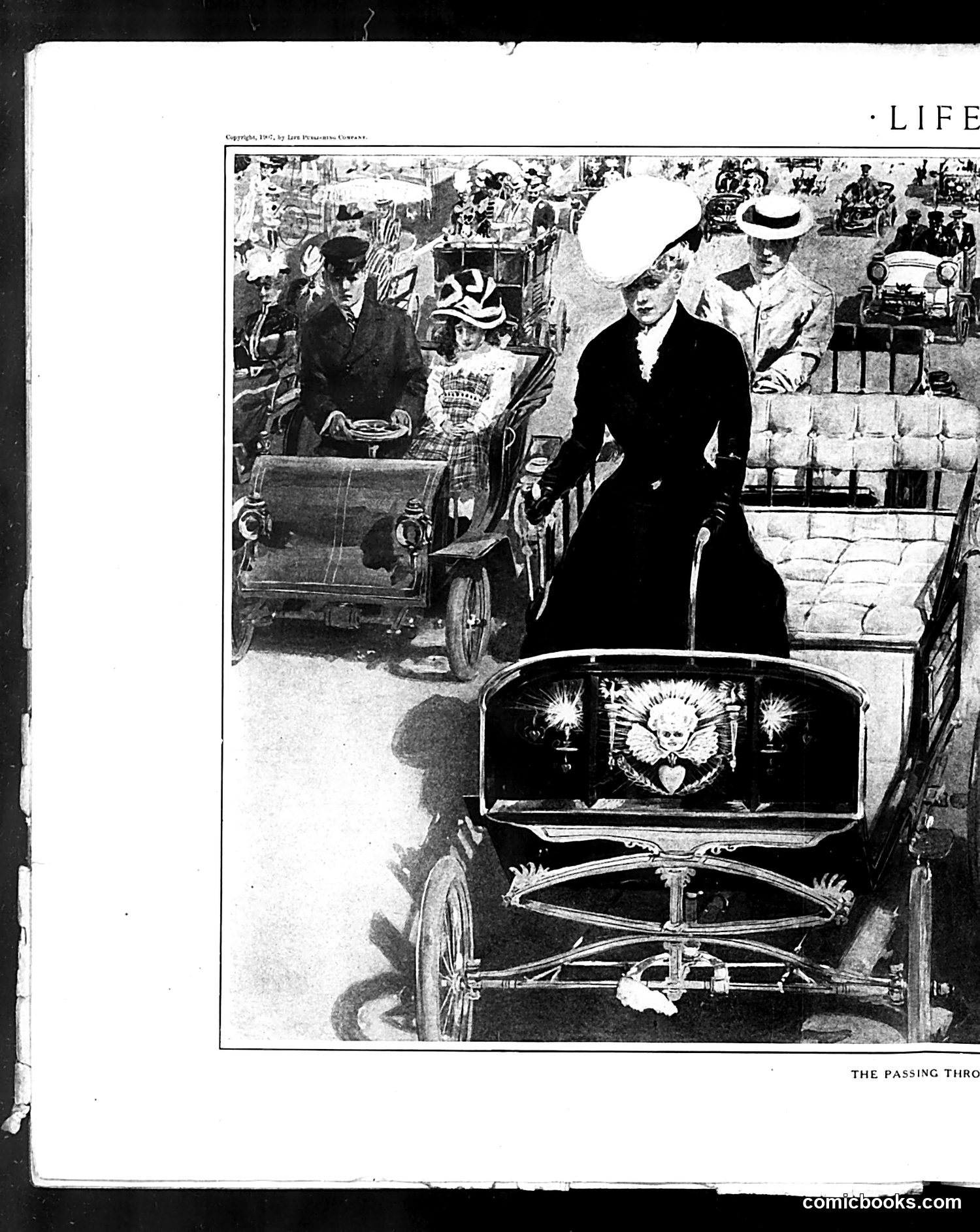
This appears to be a LIFE magazine page showing a photograph rather than a cartoon. The image depicts an ornate baby carriage or pram with religious iconography (a cherub or angel figure visible on its backrest) being pushed by a well-dressed man in formal attire. Crowds of people and vehicles are visible in the background, suggesting a public procession or parade. The partial caption reads "THE PASSING THRO[UGH]" but is cut off, preventing full understanding of the specific event or reference. Without the complete caption and publication date, I cannot definitively identify who the man is or what specific political/social event this documents. The religious imagery on the carriage suggests possible commentary on religious figures or institutions, but this remains speculative without additional context.
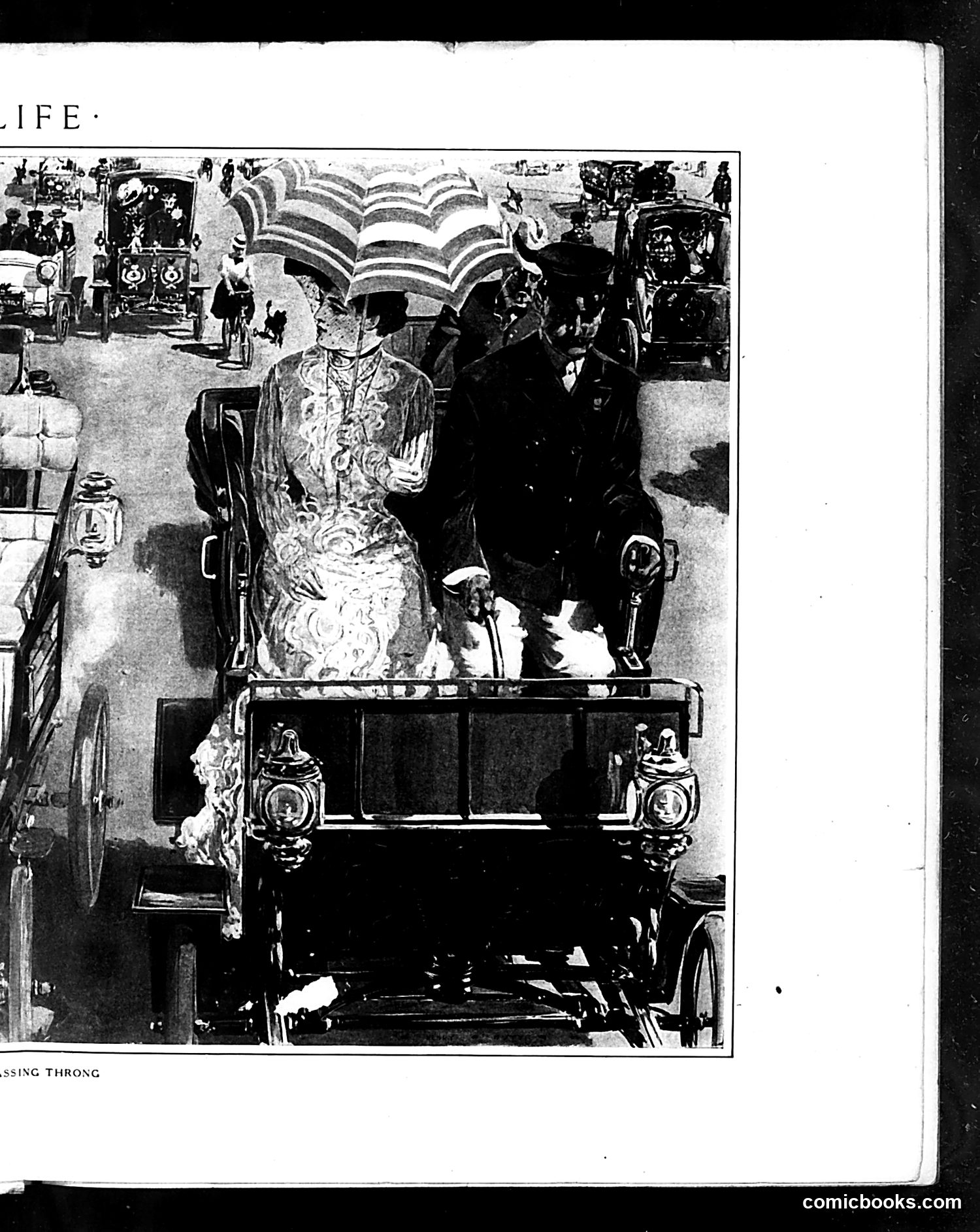
This appears to be a photograph rather than a cartoon, showing what looks like an official state or ceremonial procession. Two figures in formal dress are visible in an ornate carriage with decorative elements, passing through crowds. Large striped umbrellas or awnings are visible overhead, suggesting a formal public event. The caption reads "SSING THRONG" (likely "PASSING THRONG"), indicating this depicts a public ceremonial passage through crowds—possibly a royal visit, state occasion, or diplomatic event from the early-to-mid 20th century. Without additional context or visible dates, the specific figures and event remain unclear. The photograph appears to document a significant official moment from the era, presented in *Life* magazine's characteristic documentary style.
This page satirizes both American theater audiences and playwriting practices circa early 1900s. **The Main Cartoon (by Wallace Irwin):** Mocks tired businessmen who seek "rest" at the theater but choose mindless entertainment—"Slush," "Mush," slapstick comedies with "George Cohan brigades"—over intellectually demanding drama. The joke's punchline: they then exhaust themselves further at late-night cafés, defeating the purpose of rest. **The Drama Critique:** Reviews Clyde Fitch's play "The Straight Road" starring Blanche Walsh. The critic praises Walsh's portrayal of a degraded slum character but faults Fitch for *overextending* scenes past their natural climax through excessive dialogue, causing emotional impact to dissipate—compared unflattering to Walsh's earlier role in "Resurrection." **The Context:** Reflects tensions between "high" drama (Shakespeare, Maeterlinck, Shaw) and popular entertainment, plus Edwardian frustration with social convention—here, people unable to gracefully exit conversations or end dramatic moments.
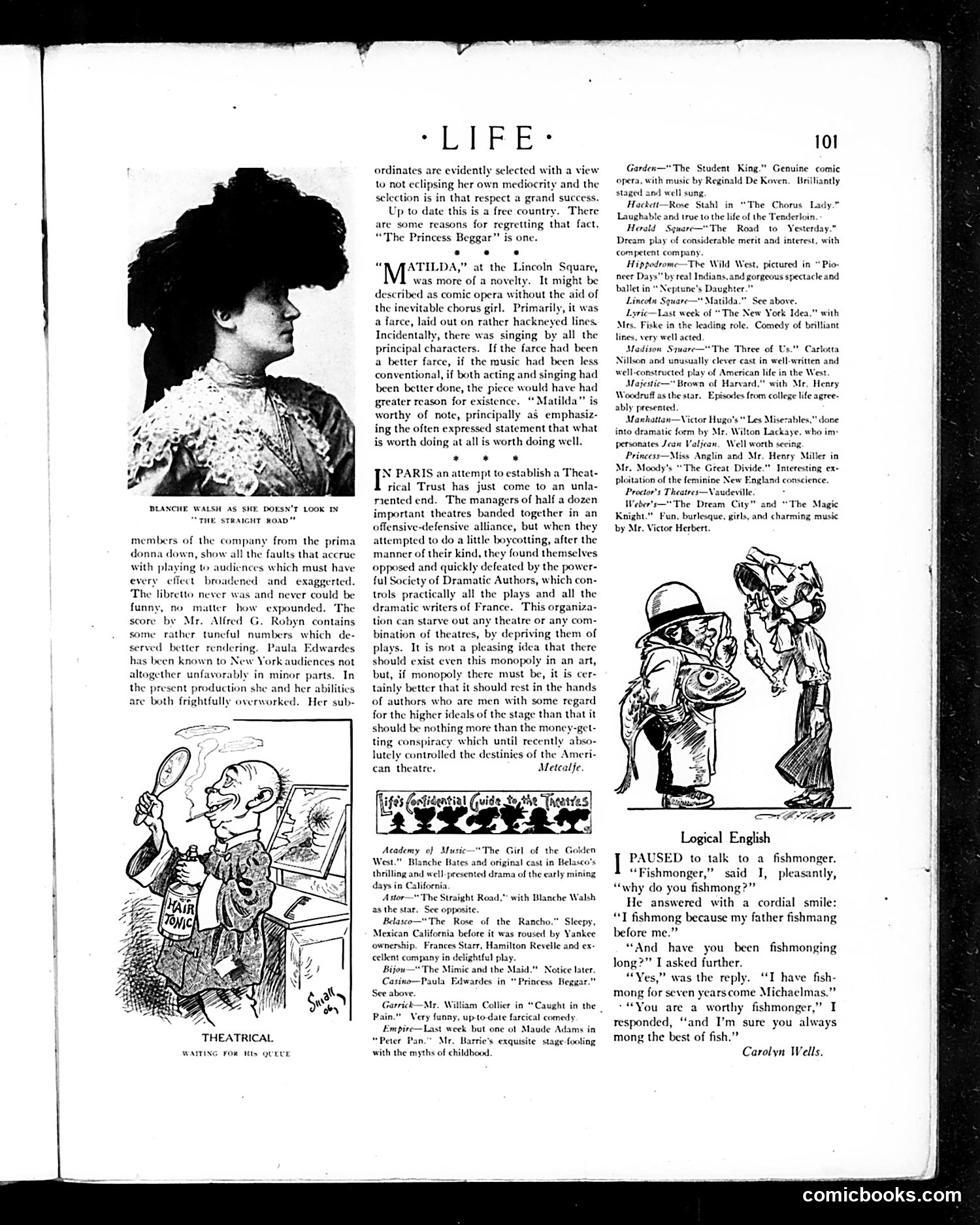
This page reviews theatrical productions in New York, featuring two cartoons mocking contemporary performances. The **left cartoon** ("Waiting for His Queen") satirizes an unnamed actor's exaggerated, hammy stage performance—likely critiquing the over-the-top acting style common in early 1900s theater. The **right cartoon** ("Logical English") presents a brief comedic dialogue about fishmonging, appearing unrelated to theater and serving as filler humor. The page's main content criticizes productions including "Matilda" (comic opera at Lincoln Square) and "The Princess Beggar," both deemed mediocre. The critic particularly faults "The Straight Road" starring Blanche Walsh, calling it unfunny and poorly executed—the libretto "never was and never could be funny." A substantial section discusses Paris's failed attempt to establish a theatrical monopoly (a "Trust"), defeated by the Society of Dramatic Authors. The author argues such author-controlled monopolies are preferable to American theatrical trusts, which prioritized profit over artistic integrity.
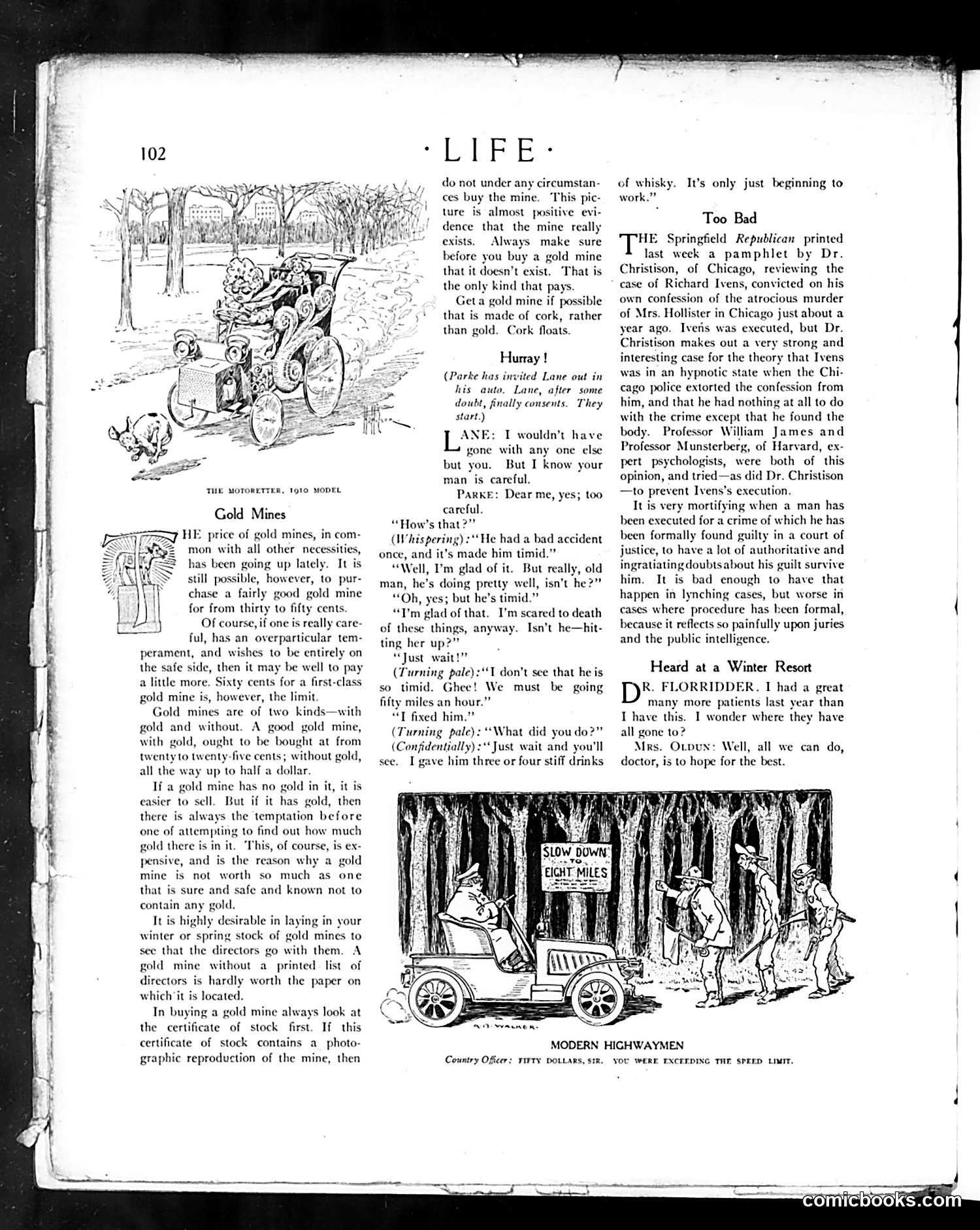
This page contains two distinct pieces of satire: **"Gold Mines"** mocks the prevalence of fraudulent mining stock schemes. The text humorously advises readers that worthless mines (those *without* actual gold) are more profitable investments than real ones, since they're easier to sell. It's absurdist commentary on widespread financial scams targeting gullible investors—purchasing "gold mines" for 30-60 cents that contained no gold whatsoever. **"Hurray!"** satirizes reckless automobile driving. A timid chauffeur becomes dangerously aggressive after his employer gives him "three or four stiff drinks of whisky" to loosen him up. The passengers, initially appreciating caution, grow terrified as the intoxicated driver accelerates to 50 mph—presented as humorously irresponsible behavior. This reflects early-1910s anxieties about automobiles and intoxication. The accompanying cartoon "Modern Highwaymen" shows speeders ignoring a speed limit sign, reinforcing the traffic safety theme.
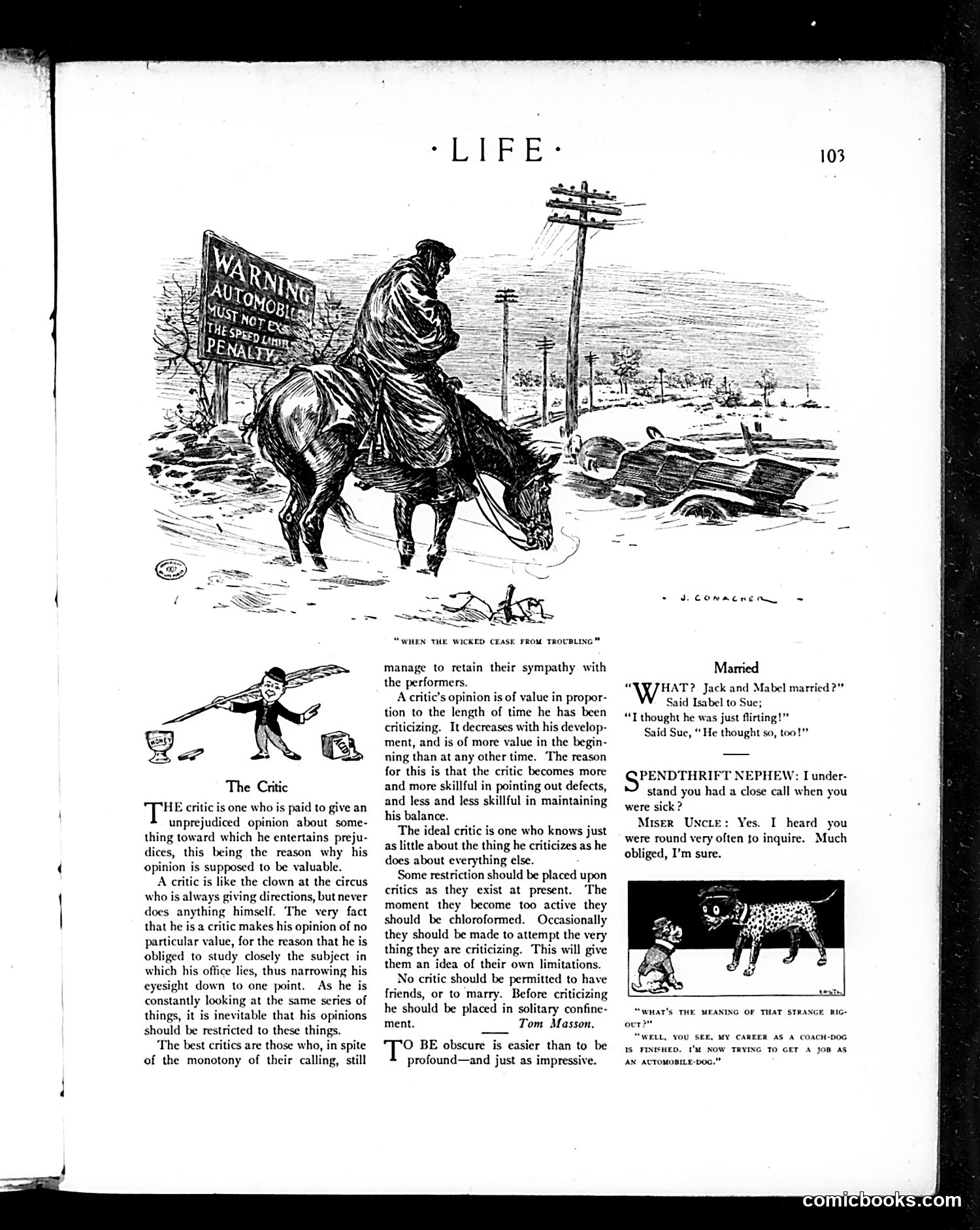
This page combines satirical commentary with humorous vignettes typical of early 20th-century Life magazine. **Main content:** A lengthy essay by Tom Masson titled "The Critic" mocks professional critics as fundamentally contradictory figures—paid to give "unprejudiced opinions" while harboring prejudices. Masson argues critics become less valuable as they develop expertise (paradoxically), and ironically suggests the ideal critic knows nothing about their subject. The piece satirizes the critical establishment's pretension and circular logic. **Cartoons:** 1. **Top illustration** (by J. Comacher): A cowboy on horseback passes a warning sign about automobiles, with abandoned car wreckage visible—satirizing the rural/automotive clash of the era. 2. **Small jokes below**: Brief humorous exchanges about marriage ("Jack and Mabel married?") and wordplay involving a "coach-dog" seeking work as an "automobile-dog"—playing on the transition from horse-drawn to motorized transportation. The page reflects pre-WWI American anxieties about modernization and urbanization.
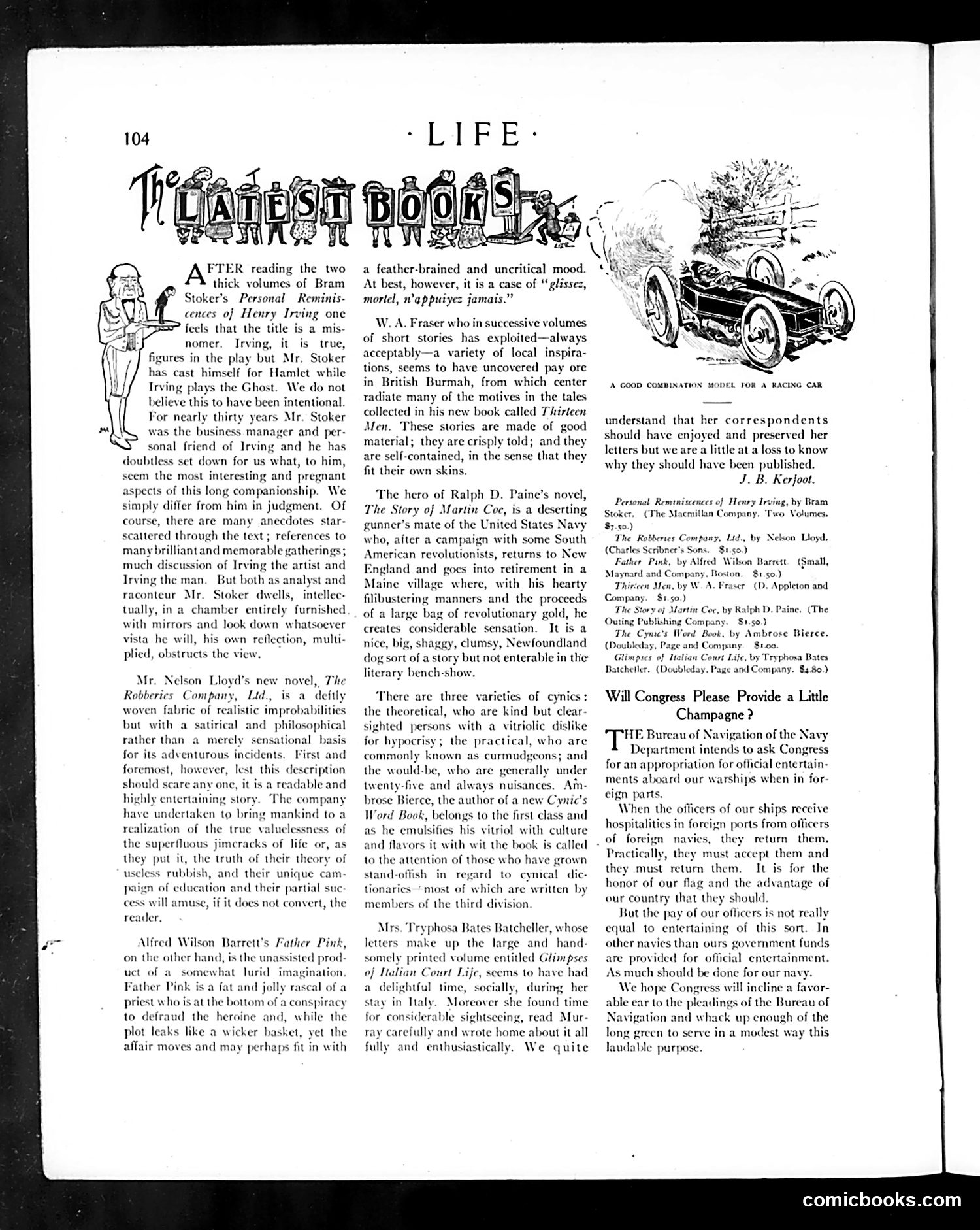
This is a **book review section**, not a political cartoon. The page features a stylized header illustration showing a racing car—likely referencing a book being reviewed—but the content is primarily literary criticism. The reviewer discusses several new novels with frank, sometimes cutting assessments. Key targets include: - **Bram Stoker's memoir** of actor Henry Irving: criticized for being self-absorbed (Stoker casts himself as Hamlet while Irving plays the Ghost) - **Nelson Lloyd's novel** about a company spreading philosophy on life's uselessness: deemed entertaining but preachy - **Alfred Wilson Barrett's Father Pink**: dismissed as luridly imaginative but poorly plotted - **Ambrose Bierce's Cynic's Word Book**: praised for combining cynicism with culture and wit The tone is **witty and dismissive**, using barbed comparisons (one novel "leaks like a wicker basket"). The reviews reflect early 20th-century literary standards emphasizing character, structure, and intellectual substance over mere entertainment.
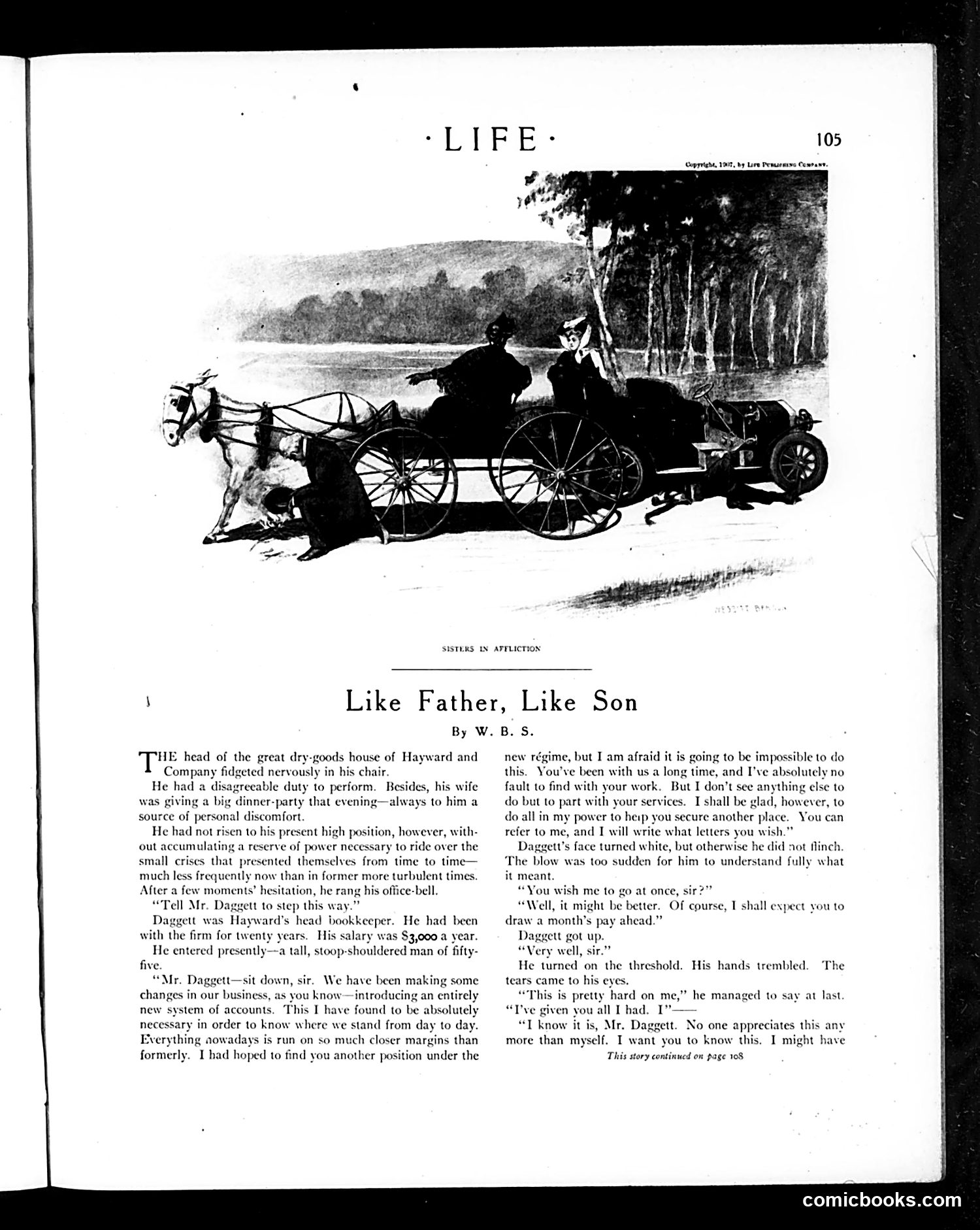
This is the opening of a serialized short story rather than a political cartoon. The illustration shows a horse-drawn carriage alongside an early automobile, symbolizing the clash between old and new technology. The story depicts a common late-19th/early-20th century social anxiety: modernization's human cost. A wealthy department store owner, Mr. Hayward, must fire his loyal 55-year-old bookkeeper of twenty years, Mr. Daggett, due to implementing new accounting systems that have made his position obsolete. The narrative explores how "progress"—tighter profit margins, modern business methods—requires sacrificing loyal employees. Daggett's emotional devastation ("tears came to his eyes") contrasts sharply with Hayward's polite but firm dismissal, exposing the emotional distance between capital and labor even when both parties act "civilly." The title suggests Daggett's son likely faces similar economic displacement, indicating this is a systemic rather than individual problem—the story continues on page 108.
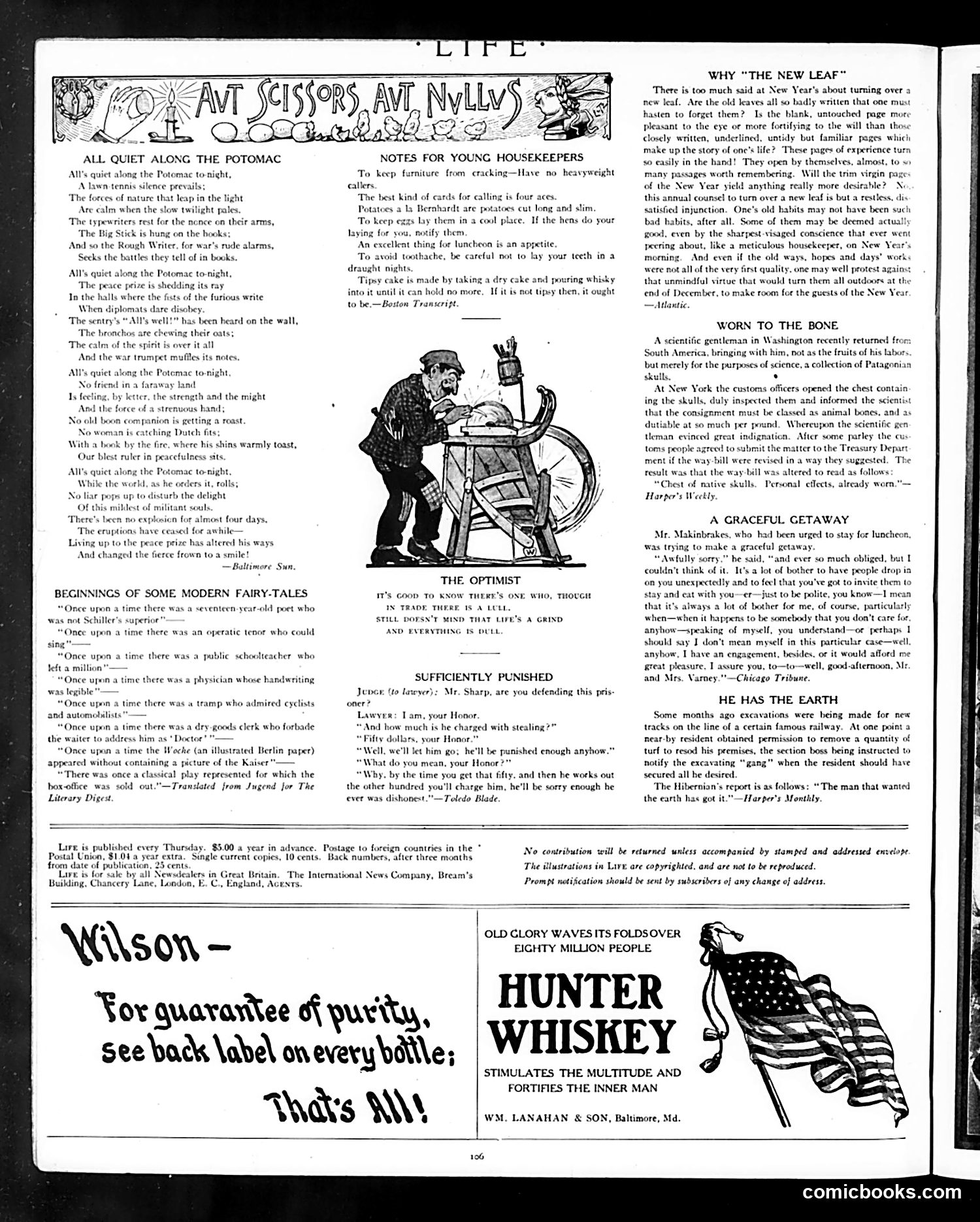
This page from *Life* magazine satirizes President Theodore Roosevelt's relatively peaceful period in office. **"All Quiet Along the Potomac"** is a poem mocking Roosevelt's departure from his famous "strenuous" activism. References to "the Big Stick" (his signature foreign policy approach) being "hung on the hooks" and the "Rough Writer" seeking "battles...in books" suggest he's retreated from vigorous leadership to a quiet, bookish life—presented as ironic given his public persona. The "Modern Fairy-Tales" section humorously lists absurd impossibilities (a poet better than Schiller, a legible physician's handwriting, a play that sold out), satirizing contemporary shortcomings. **"The Optimist"** cartoon shows a businessman at a desk, likely mocking forced positivity during economic slowdown ("trade there is a lull"). The page reflects early 1900s political satire criticizing Roosevelt for appearing less combative than his reputation suggested, while also offering light social commentary on American life.
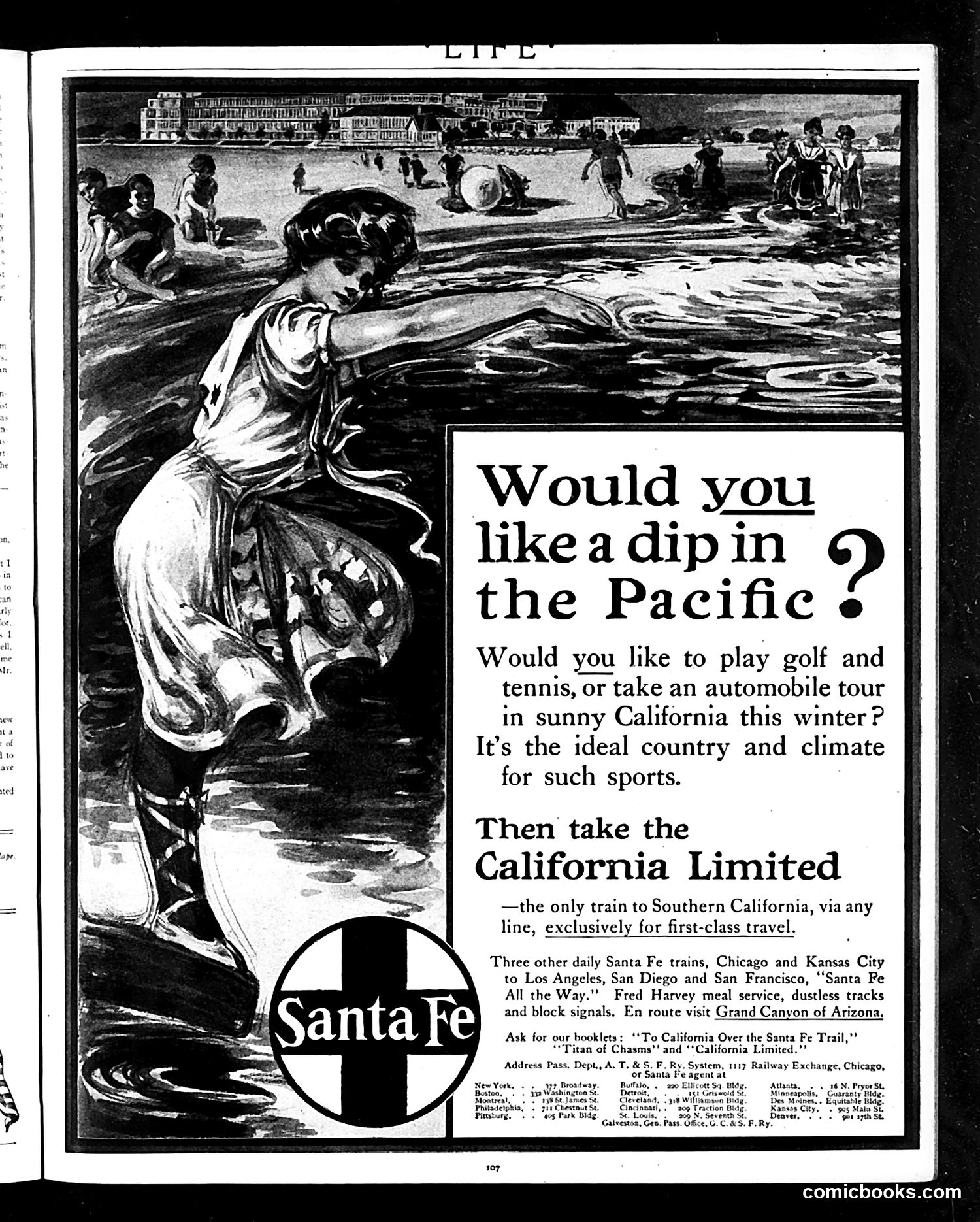
This is a **Santa Fe Railway advertisement**, not political satire. It promotes train travel to Southern California by appealing to leisure and recreation. The image shows a fashionable woman in an elegant dress wading into the Pacific Ocean, embodying the glamorous California lifestyle the ad promises. The text asks rhetorical questions about desirable winter activities—golf, tennis, automobile tours—in "sunny California," then pitches the "California Limited" train as the means to reach these pleasures. The ad emphasizes exclusivity ("exclusively for first-class travel") and convenience, mentioning amenities like Fred Harvey meal service and scenic stops at the Grand Canyon. For a modern reader: this represents early 20th-century luxury travel marketing, targeting affluent Americans seeking winter escape from harsh northern climates. The elegant female figure was a common advertising device of the era to convey sophistication and desirability.
This page presents a short story depicting the stark contrast between industrial-era wealth inequality. Daggett, a long-serving factory employee, is fired by his employer Hayward—a decision presented as inevitable "business" necessity despite Daggett's twenty years of loyalty and family obligations (mortgage, children's education). The satire emerges through Bertie, Hayward's son—a privileged youth who casually offers Daggett a ride in his expensive imported automobile while discussing his multiple racing machines and leisure pursuits. This juxtaposition is biting: Bertie represents inherited wealth and careless excess, while Daggett faces financial ruin. Bertie's obliviousness to Daggett's desperate situation (he's just been fired) highlights how the wealthy were insulated from workers' economic suffering during this period. The story critiques both corporate indifference to worker welfare and the generational perpetuation of class privilege through inherited wealth.
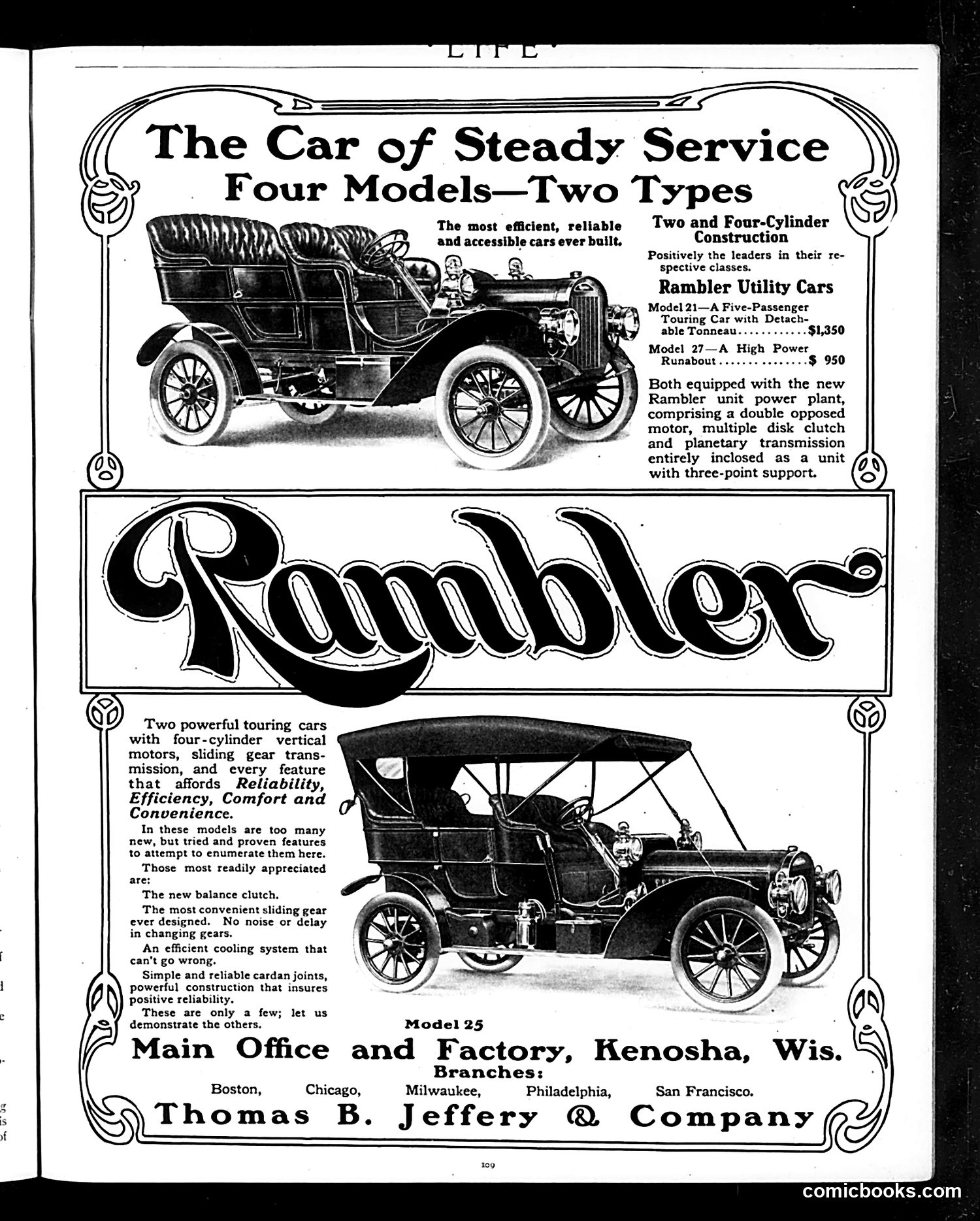
This is a **automobile advertisement**, not satire or political commentary. It promotes Rambler cars manufactured by Thomas B. Jeffery Company, based in Kenosha, Wisconsin. The page showcases four car models in two categories: two and four-cylinder vehicles. The "Rambler" brand name is prominently displayed in decorative lettering. Two vintage automobiles are illustrated—an open-air touring car (top) and a Model 25 with a canopy top (bottom). The advertisement emphasizes reliability and "steady service," highlighting technical features like the "new balance clutch," planetary transmission, and efficient cooling system—innovations that would have appealed to early 1900s consumers skeptical of automobile reliability. The ornamental borders and formal layout reflect typical period advertising design. This is a straightforward product pitch, not editorial content with hidden meaning.
This page presents a serialized fiction story about **Josephine Daggett**, a young woman who disguises herself as a man to support her family after her father loses his bookkeeping job. The narrative is social commentary on early 1900s economic hardship and gender constraints. **Key social references:** - A discharged bookkeeper cannot find work, forcing family financial crisis - A young woman's "schooling" ends due to poverty—education was a luxury - Josephine must resort to cross-dressing to gain employment in the male-dominated automotive industry - She attends automobile training school and works as a mechanic/demonstrator—cutting-edge industrial work of the era **The satire/point:** The story critiques both class mobility barriers and rigid gender roles. Josephine can only escape her family's poverty by literally becoming male, suggesting the absurdity of women's economic limitations. The detailed description of her transformation (cutting hair, roughening hands, masculine clothing) underscores how artificial these gender distinctions were—she succeeds professionally merely by appearing male. This appears to be earnest melodrama rather than satirical cartoon.
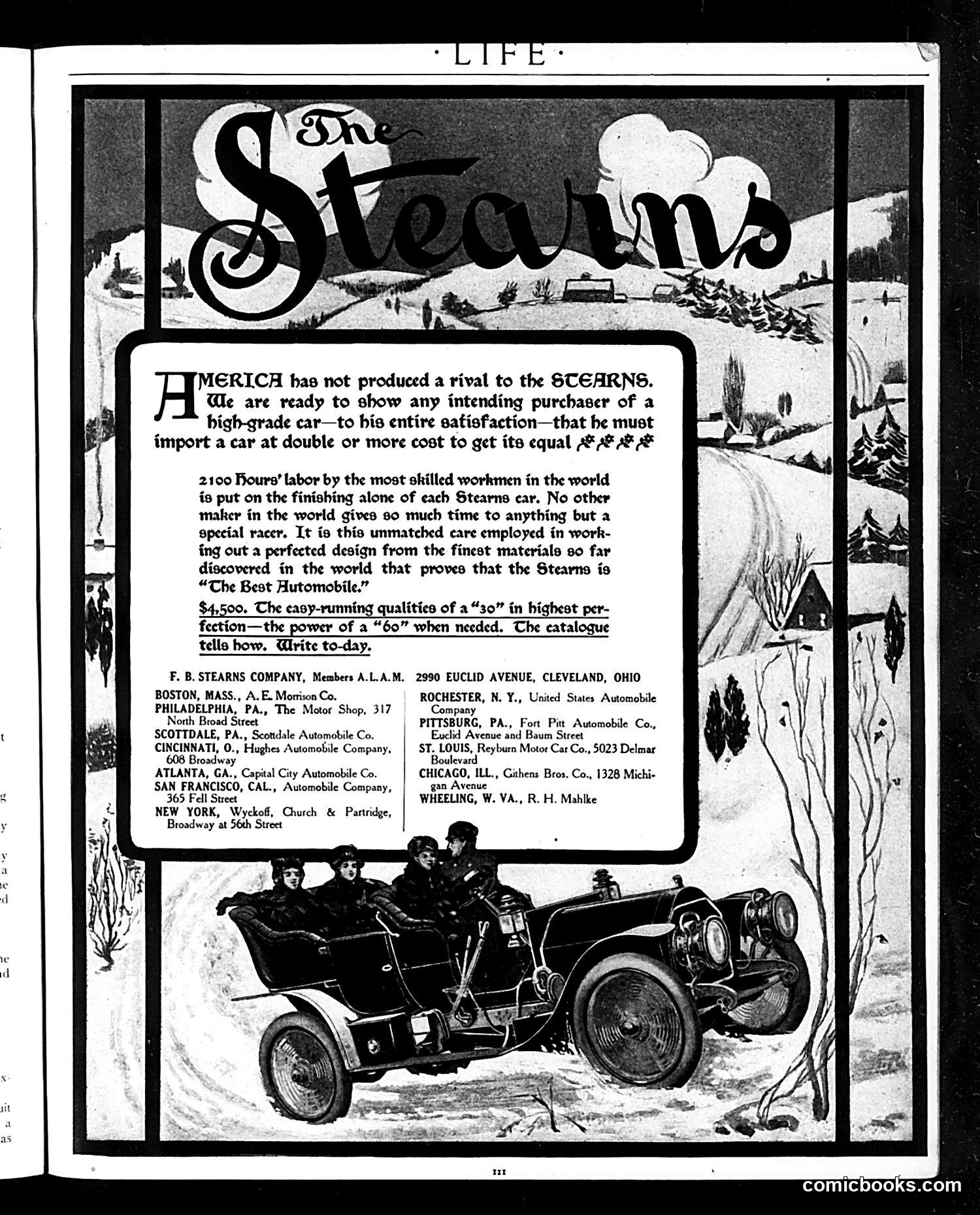
This is primarily a **product advertisement**, not political satire. It promotes the Stearns automobile, manufactured by F.B. Stearns Company in Cleveland, Ohio. The ad's central claim: America has produced no rival to the Stearns; competing cars cost double or more for equivalent quality. The advertisement emphasizes craftsmanship—2,100 hours of skilled labor on finishing alone—and technical specifications (a "30" with "60" power when needed). The illustrated car shows passengers enjoying a winter drive, positioned as aspirational imagery of leisure and modernity. The text lists numerous dealers across major American cities (Boston, Philadelphia, Pittsburgh, Chicago, New York, etc.), indicating broad market distribution. This reflects early 1900s automotive competition, when American manufacturers were establishing their reputations against imported European vehicles. The Stearns brand positioned itself as the American-made luxury alternative.
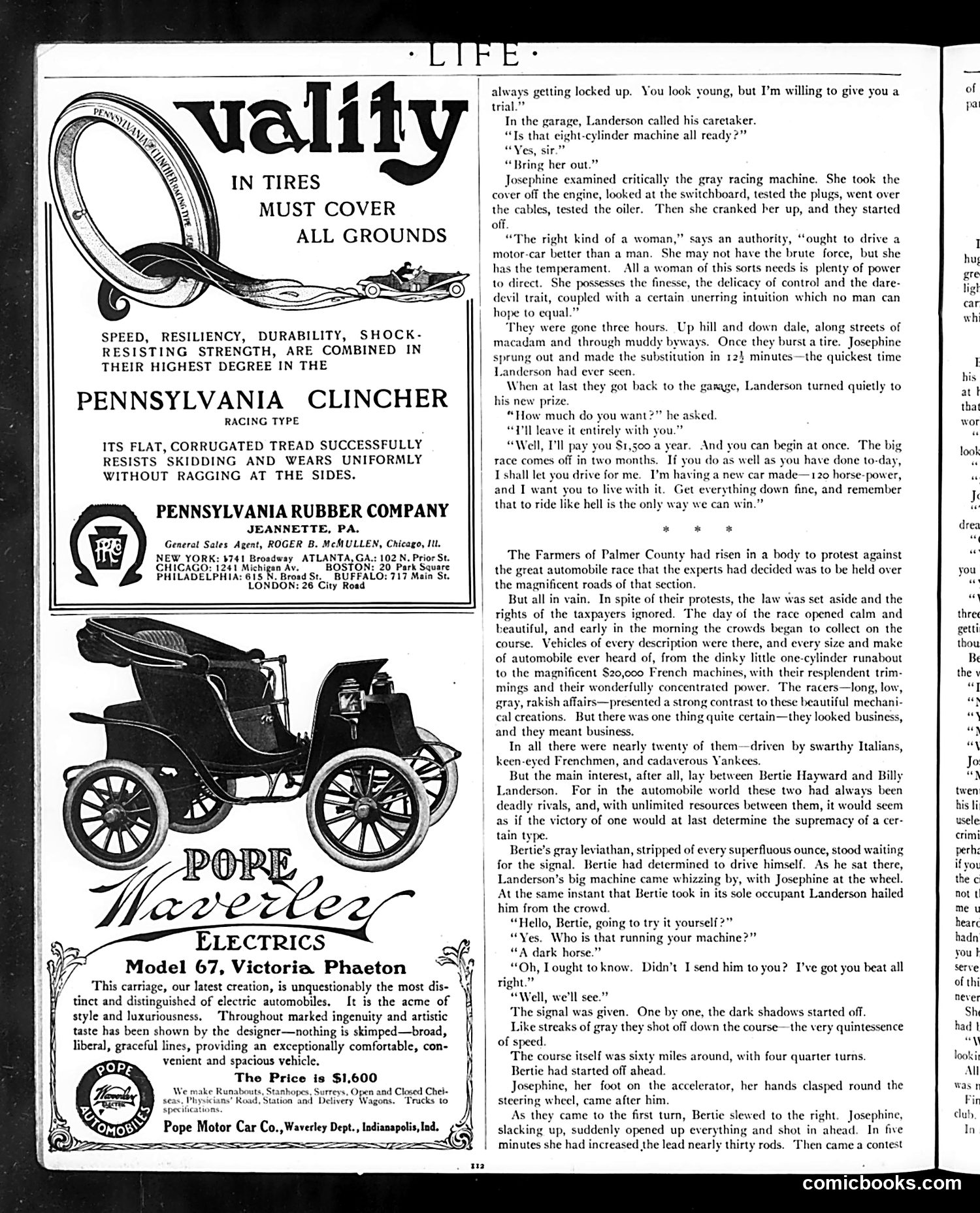
This page is primarily **advertising** for automobiles and tires, with an embedded serialized fiction story about automobile racing. The advertisements showcase early 1900s automotive technology: Pennsylvania Clincher racing tires and Pope electric automobiles (Model 67 Victoria Phaeton at $1,600). The fictional narrative describes a woman named Josephine competing in a major automobile race. The story reflects contemporary gender debates—it includes a quote defending women as superior drivers due to their "finesse" and "delicacy of control," contrasting with men's "brute force." This was timely commentary: early 1900s automobiles were novel, and women's participation in motoring challenged traditional gender roles. The race narrative involves international drivers and expensive French racing machines, suggesting this depicts an actual or realistic high-stakes competition. The story appears designed to showcase the featured automobiles while exploring progressive (for the era) attitudes about women's capabilities in mechanical and competitive domains.
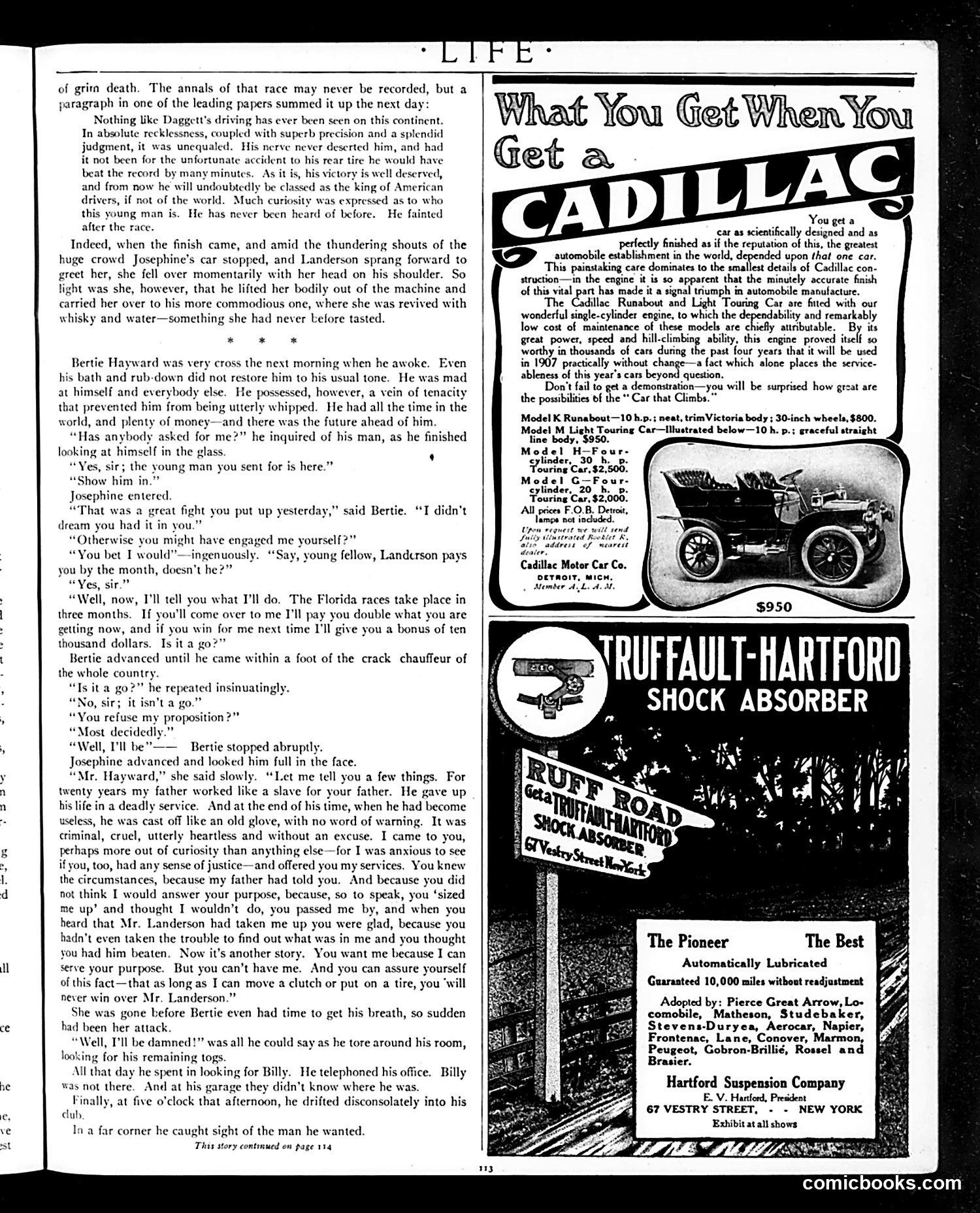
This page is primarily **narrative fiction** rather than political satire or editorial cartoon. It concludes a serialized story about Josephine, a skilled automobile driver, and her interactions with two wealthy men: Landerson (her current employer) and Bertie Hayward (who previously rejected her services). The passage depicts Josephine's confrontation with Hayward after she wins a major car race. She refuses his lucrative job offer, explaining that her father once worked for Hayward's father and was discarded without compensation. Josephine uses this moment to assert her dignity and independence—she'll only work for those who value her, not those who dismissed her. The page's right side contains **period automobile advertisements** (Cadillac, Ruffault-Hartford shock absorber, Hartford Suspension Company), typical of early 20th-century Life magazine. The story reflects **Gilded Age themes**: class conflict, employer exploitation, and individual agency. Josephine's refusal to be "bought" by the highest bidder represents a modern assertion of personal worth over financial incentive.
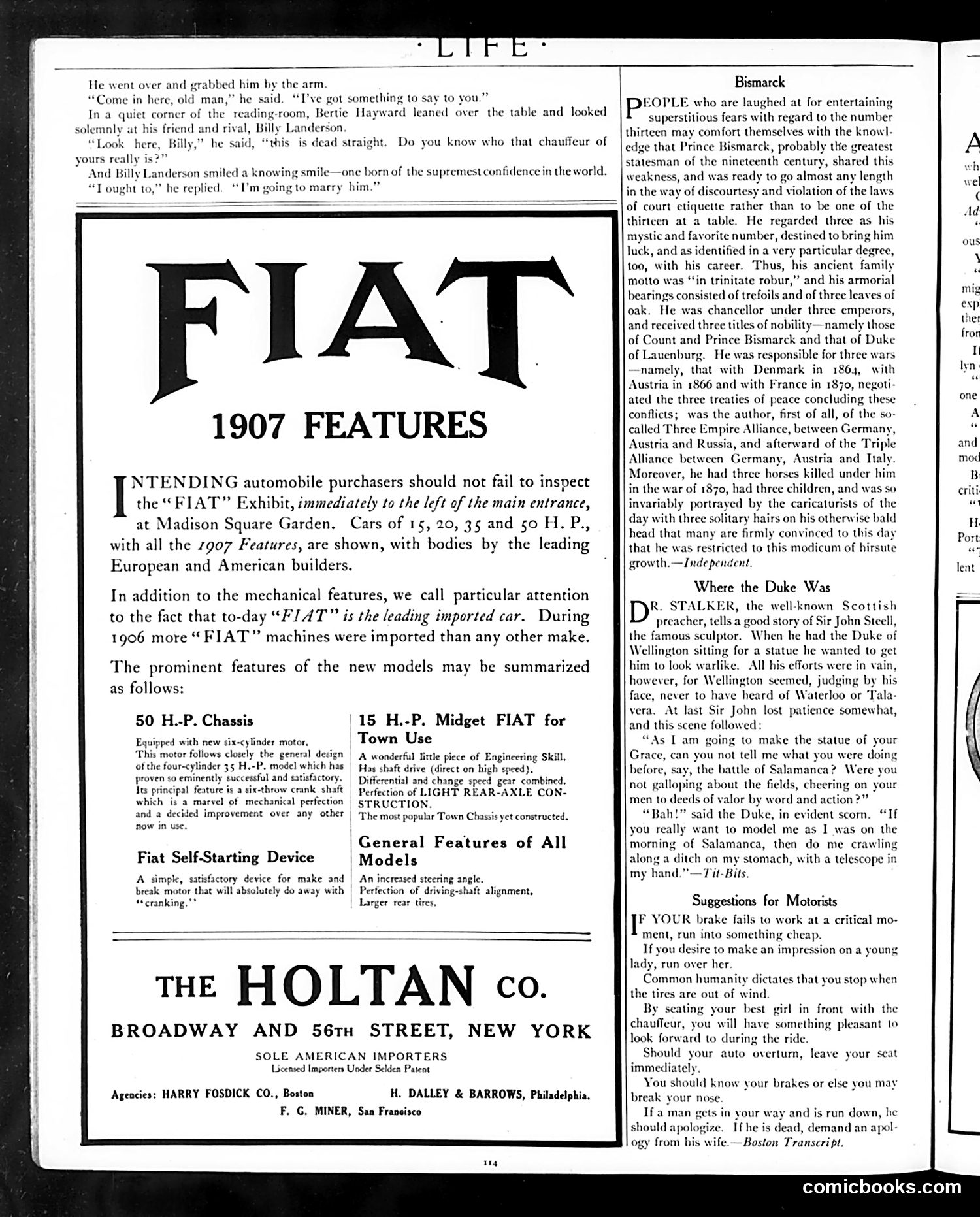
This page combines two distinct elements: a serialized fiction story and automobile advertising. **The Story**: The visible excerpt shows a dramatic confrontation between two men—Bertie Hayward and Billy Landerson—apparently rivals. Billy reveals he intends to marry "the chauffeur" (his rival's employee), suggesting a scandalous class transgression. The "knowing smile" indicates Billy expects this announcement to shock or wound Bertie. **The Advertising**: The dominant content is a FIAT automobile advertisement promoting 1907 models displayed at Madison Square Garden. It emphasizes that FIAT was "the leading imported car" in 1906, detailing mechanical features like the six-cylinder motor and shaft drive. **The Bismarck Article**: A right-column essay about Prince Bismarck's superstitious attachment to the number three, documenting his three wars, titles, and horses killed in battle—demonstrating how numerology influenced even history's great statesmen. This is primarily a **commercial publication page** rather than satirical commentary.
This page satirizes wildly contradictory critical reception of a novel called *The Silent War* by John Ames Mitchell. Life magazine presents side-by-side reviews from major American newspapers and journals—some calling it "absorbing" and "strong," others deeming it "rot" and "disappointing." The satire's point: critics fundamentally disagree about the same book, suggesting either critical incompetence or that the work itself is mediocre enough to support any interpretation. The piece mocks journalistic pretension by exposing how reviewers manufacture opposite conclusions about identical material. The advertisements below are period product placements unrelated to the satire.
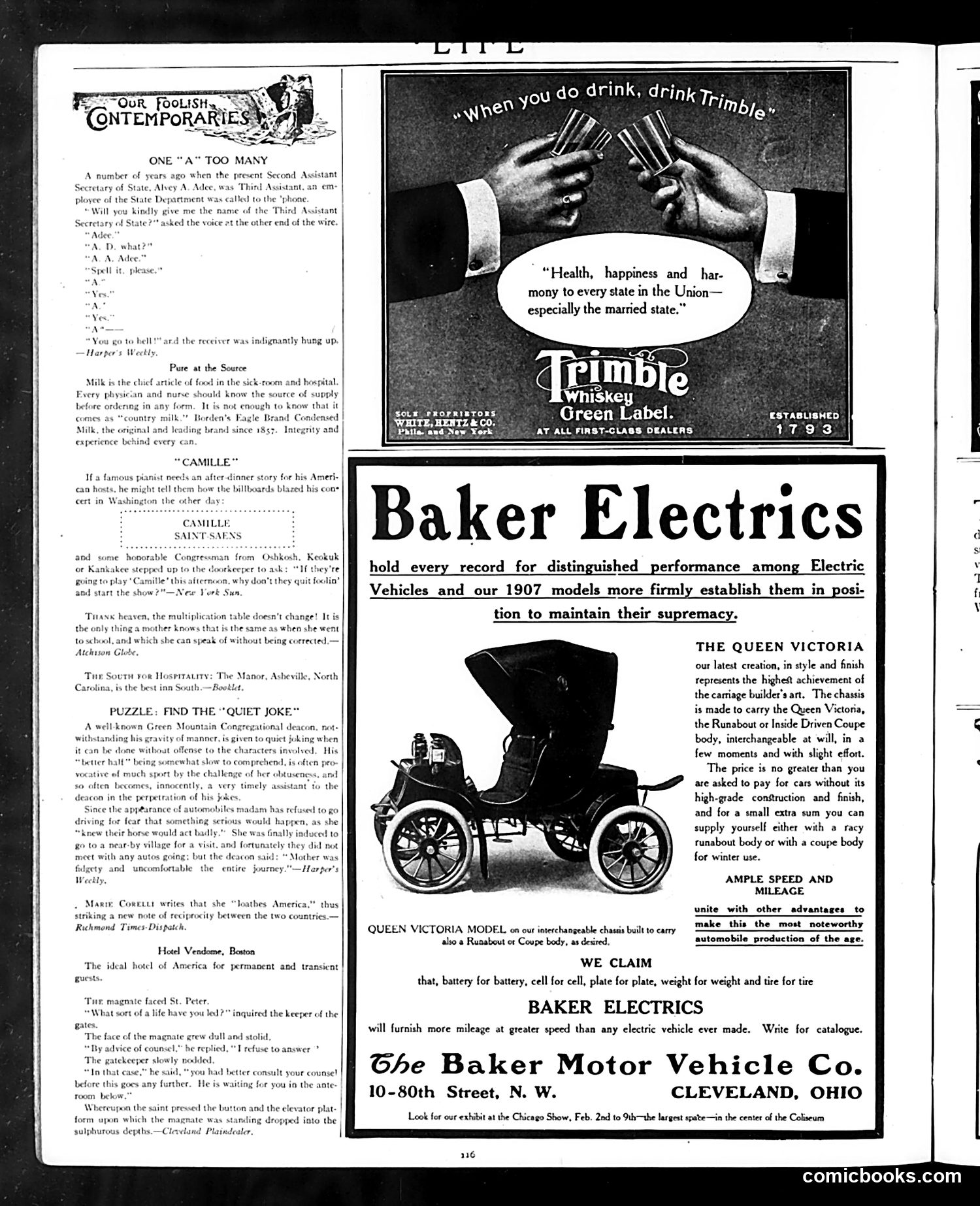
This page combines satirical humor with period advertising. The left side features "Our Foolish Contemporaries," a recurring Life column mocking contemporary absurdities: **"One 'A' Too Many"** jokes about State Department bureaucracy—a clerk hangs up on a caller demanding information about officials, apparently frustrated by the circular naming (multiple "A's"). **"Camille"** satirizes pretentious concert-goers who attend performances to seem cultured rather than for genuine appreciation. **Other brief anecdotes** mock hypocrisy: a magnate facing St. Peter; a woman claiming to "loathe America" while living there; a deacon's difficulty with honesty. The right side features two advertisements: **Trimble Whiskey** (offering toasts to state "happiness," with marital innuendo) and **Baker Electrics** (promoting the "Queen Victoria" electric vehicle, emphasizing speed, mileage, and battery performance—technology-forward marketing for 1907). The page reflects early 1900s concerns: bureaucratic incompetence, cultural pretension, and enthusiasm for emerging automotive technology.
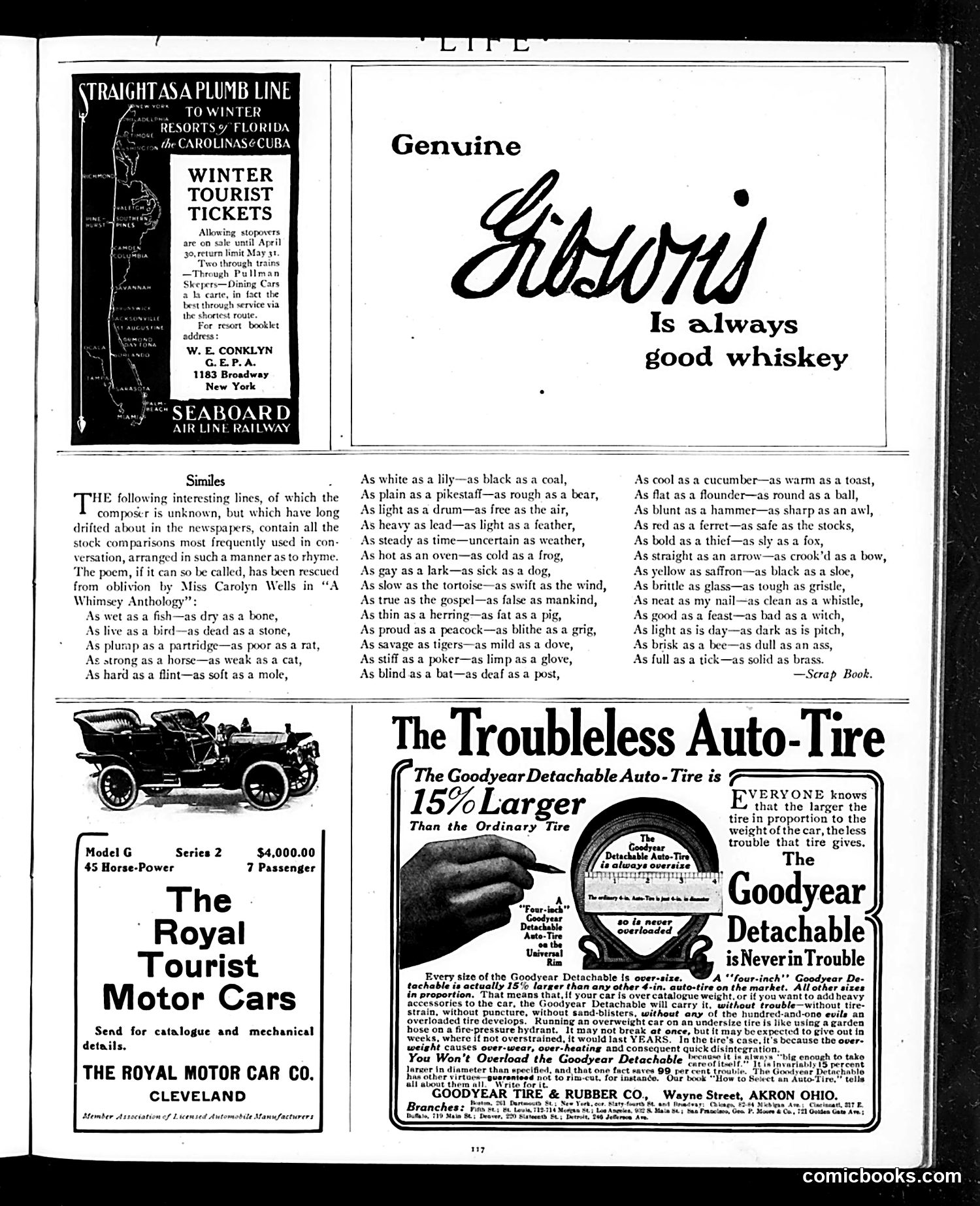
This page is primarily **advertising**, not satire or political commentary. The top features a **Gibson Girl-style "Similes" poem**—a collection of common comparative phrases arranged to rhyme (e.g., "as wet as a fish—as dry as a bone"). This was a popular parlor entertainment of the era, credited to poet Carolyn Wells. It contains no political meaning, merely showcasing witty wordplay typical of early 1900s humor magazines. The advertisements include: - A **Seaboard Air Line Railway** ad promoting winter tourist travel to Florida and the Carolinas - A **Gibson's Whiskey** endorsement (straightforward product placement) - **Royal Tourist Motor Cars** (Cleveland-made automobiles) - **Goodyear Detachable Auto-Tires**, emphasizing their 15% larger size compared to competitors These are standard commercial advertisements without satirical intent. The page reflects Life's dual nature as both satirical magazine and advertising vehicle during this period.
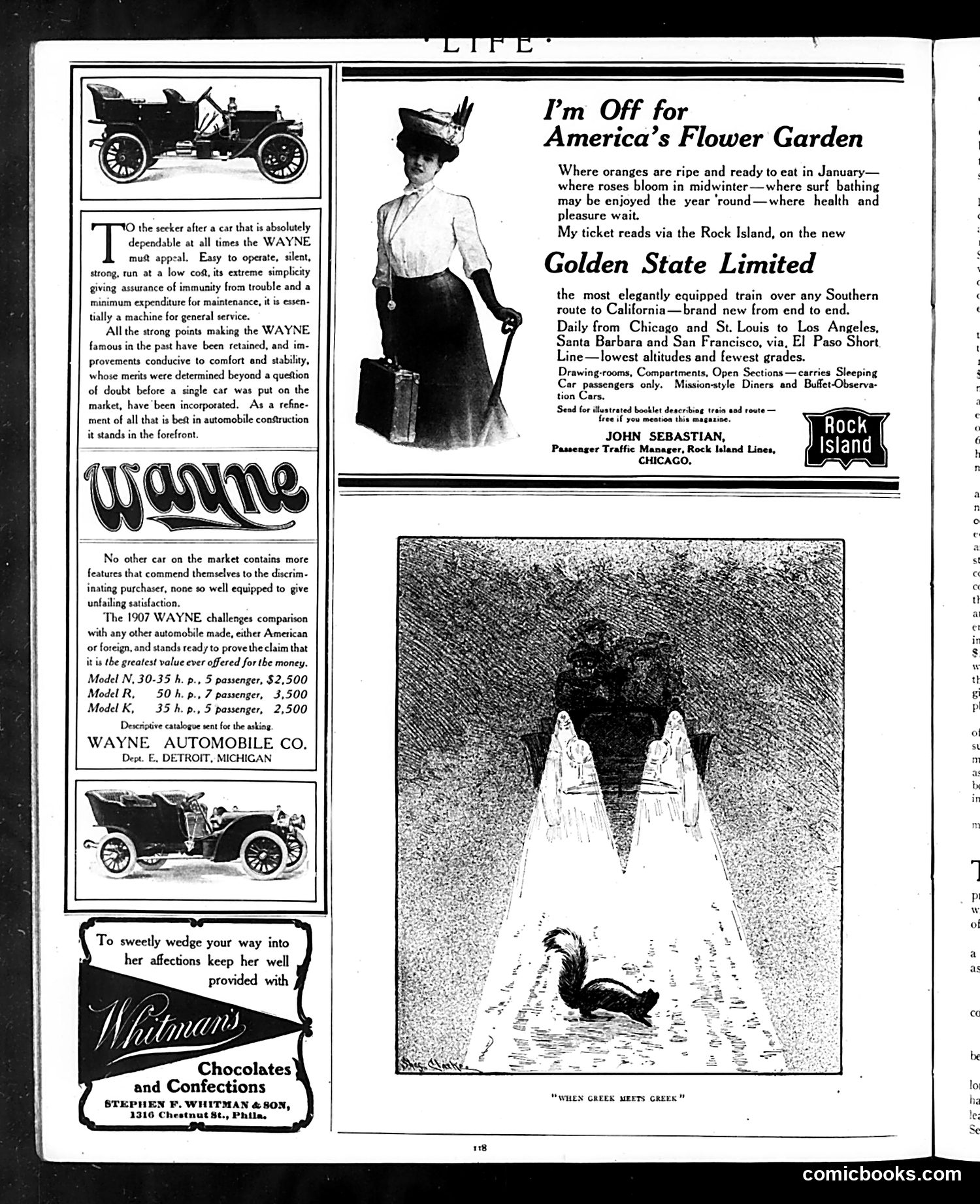
This page consists primarily of **advertisements** rather than satirical content. The main elements are: 1. **Wayne Automobile ads** (left): Promoting 1907 Wayne cars from Detroit, emphasizing reliability, simplicity, and value for "general service." Lists three models ranging from $2,500-$3,500. 2. **Golden State Limited train ad** (center-right): Features a fashionable woman promoting California travel via Rock Island railroad, highlighting year-round pleasant weather, oranges, roses, and surf bathing—appealing to leisure travelers seeking health and pleasure. 3. **Whitman's Chocolates ad** (bottom left): A romantic pitch suggesting chocolates as a courting tool to "wedge your way into her affections." 4. **Cartoon illustration** (bottom right): Titled "When Greek Meets Greek," depicts what appears to be a skunk encounter on a road—likely a humorous commentary on unexpected or unpleasant meetings, though the specific satire remains unclear. The page reflects early 1900s consumer culture and gender dynamics, with advertisements targeting both practical (automotive) and romantic/leisurely interests.
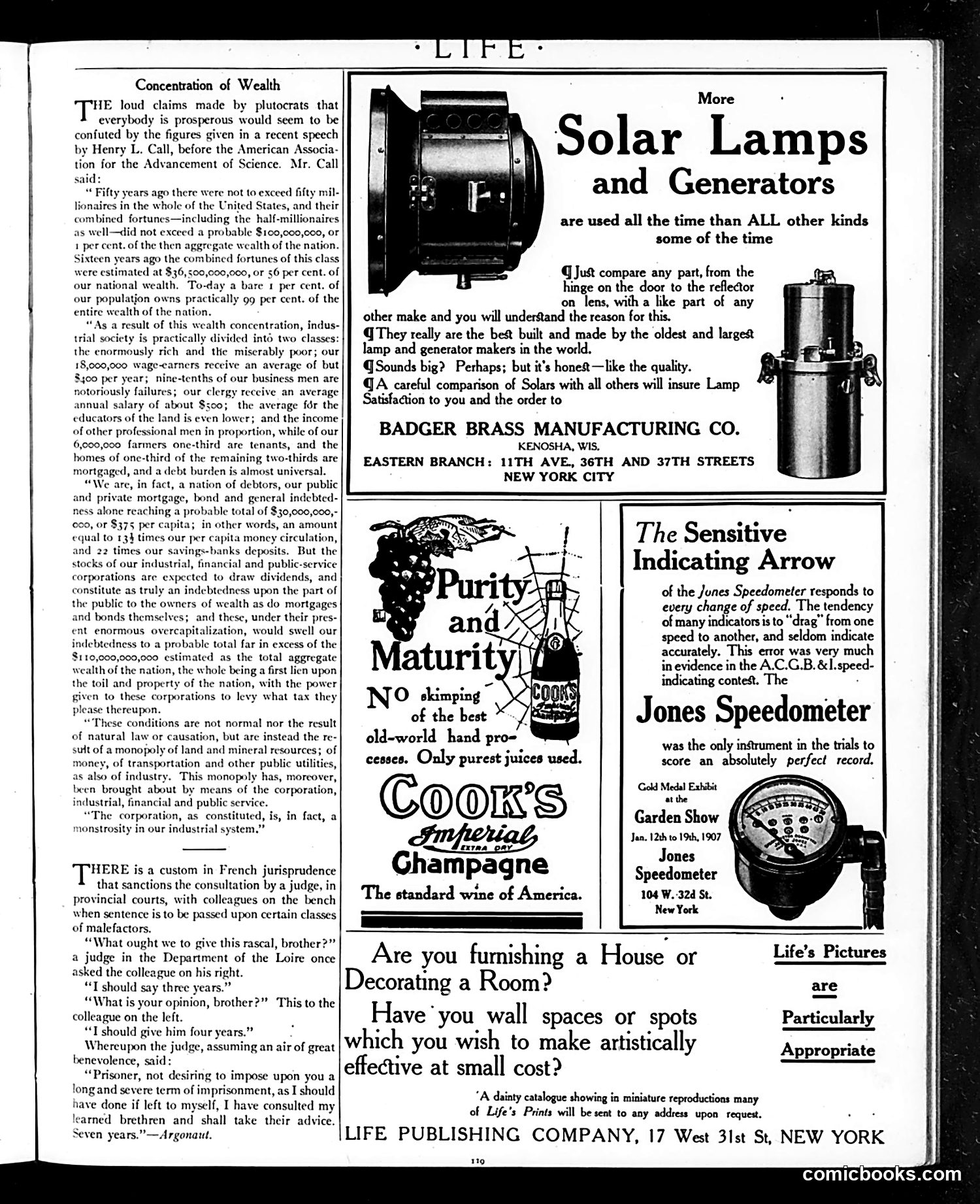
This page's main content is **not a cartoon but a serious argument**, presented as an editorial piece. Henry L. Call, speaking to the American Association for the Advancement of Science, documents massive wealth inequality: fifty years prior, the richest 1% owned perhaps 1% of national wealth; currently, they own 99%. Call's argument identifies the culprit: monopolistic control of land, minerals, money, transportation, utilities, and industry—all enabled by the corporation as a legal entity, which he calls "a monstrosity in our industrial system." The page also includes a separate French legal anecdote (unrelated to the wealth piece) about judicial consultation, suggesting ironic or absurd outcomes from consensus. **For modern readers:** This 1907 Life editorial documents early Progressive Era anxiety about gilded-age inequality, corporate power, and the inadequacy of wages for workers, clergy, and farmers—concerns that motivated subsequent antitrust movements and labor reforms.
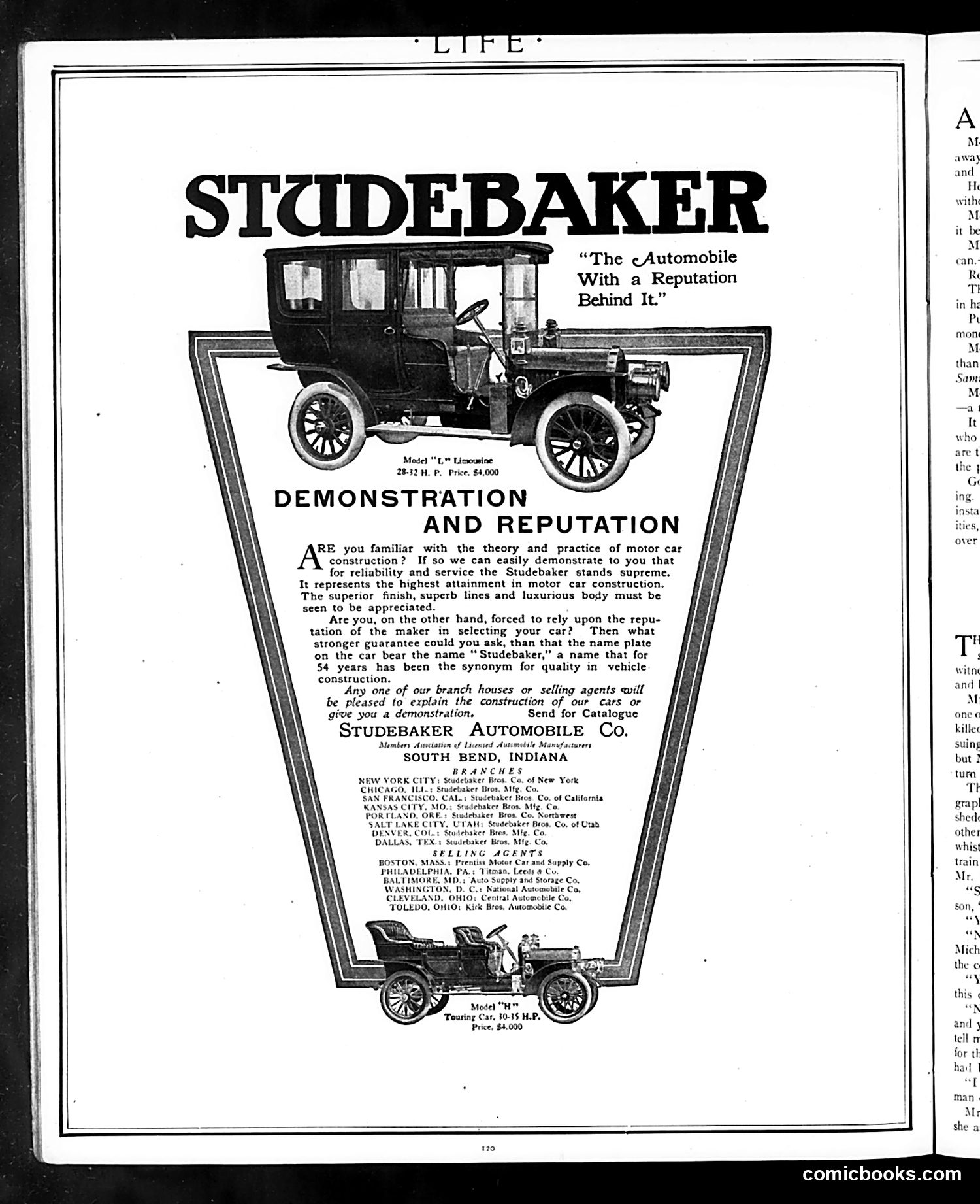
This is **not a cartoon or satire** — it's a straightforward advertisement for Studebaker automobiles, placed in *Life* magazine (likely early 1900s based on the vehicle designs and price points). The ad promotes two Studebaker models: a luxury limousine and a touring car, both priced at $4,000. The marketing strategy appeals to two types of buyers: those who understand automotive mechanics (offering technical credibility) and those relying on brand reputation (emphasizing Studebaker's 54-year history as a quality manufacturer). The ad highlights the company's legitimacy by listing numerous branch offices and selling agents across America, positioning Studebaker as an established, trustworthy brand. The decorative frame and prominent display reflect the advertising conventions of the era. This represents ordinary commercial content rather than political or social satire — *Life* magazine ran such advertisements alongside its humor and commentary.
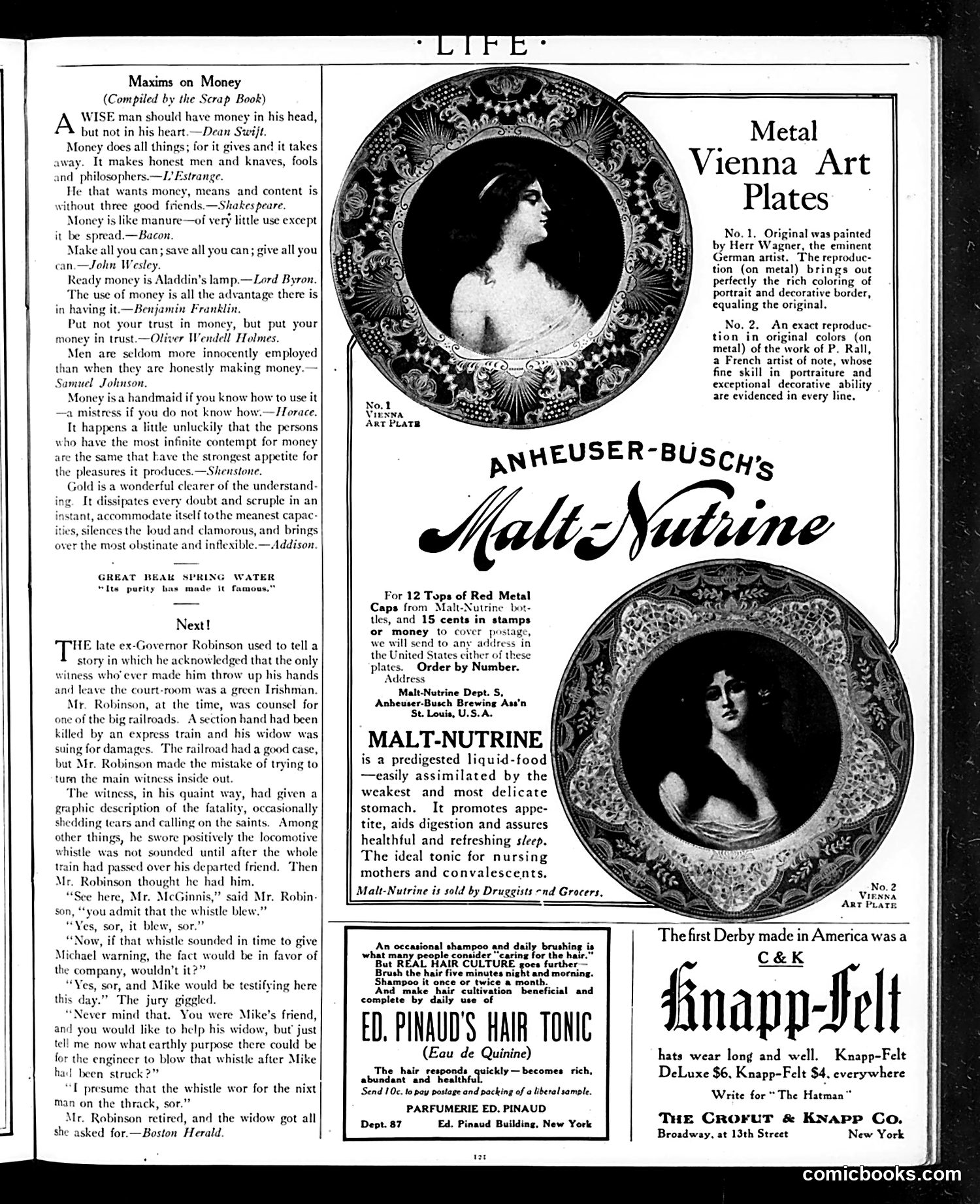
This page is primarily **advertising**, not political satire. The main content consists of: 1. **"Maxims on Money"** — a compilation of quotations about wealth from famous figures (Shakespeare, Bacon, Benjamin Franklin, etc.), presented as philosophical humor rather than satire. 2. **"Next!" anecdote** — a humorous legal story about ex-Governor Robinson cross-examining an Irish witness in a railroad injury case. The joke relies on Irish dialect humor (common in the era) and the witness's clever logic: when asked why the engineer would blow the whistle *after* hitting someone, the Irishman replies it must have been "for the nixt man on the track, sor." The widow wins her case. 3. **Product advertisements** — Anheuser-Busch's Malt-Nutrine (a "predigested liquid-food" tonic), Vienna Art Plates, Ed. Pinaud's Hair Tonic, and Knapp-Felt hats. The page reflects early 20th-century advertising aesthetics and period attitudes (including ethnic humor). There is no political cartoon or significant satire here—it's a standard Life magazine page mixing light humor with commercial promotions.
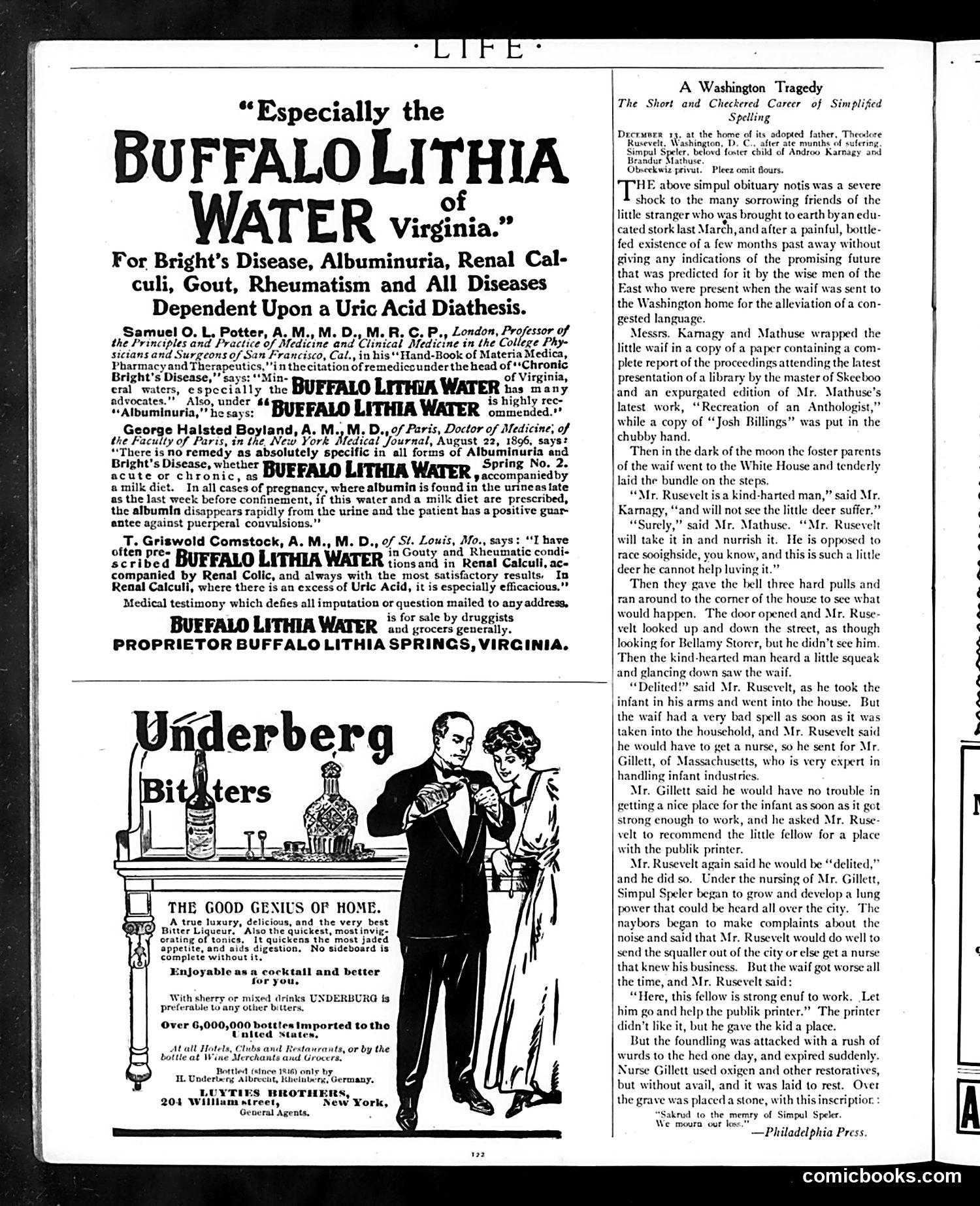
This Life magazine page contains two separate items: **Left side:** Advertisements for Buffalo Lithia Water (a mineral spring product) and Underberg Bitters, presented as medical remedies. These include endorsements from doctors claiming the water cures kidney disease, gout, and rheumatism. This reflects the era's patent medicine advertising, before FDA regulation—products made dubious health claims without evidence. **Right side:** "A Washington Tragedy" satirizes the "Simplified Spelling" reform movement. The satirical obituary—written in deliberately misspelled English ("Simpal Speler," "litle," "Obscekwiz")—mocks the movement by presenting "Simplified Spelling" as a dead child adopted by Theodore Roosevelt and supported by Andrew Carnegie and Brander Mathews (real advocates). The joke: the movement failed and deserved to die. The exaggerated funeral treatment lampoons the reformers' earnest efforts to change English orthography, which the magazine clearly found ridiculous and pretentious.
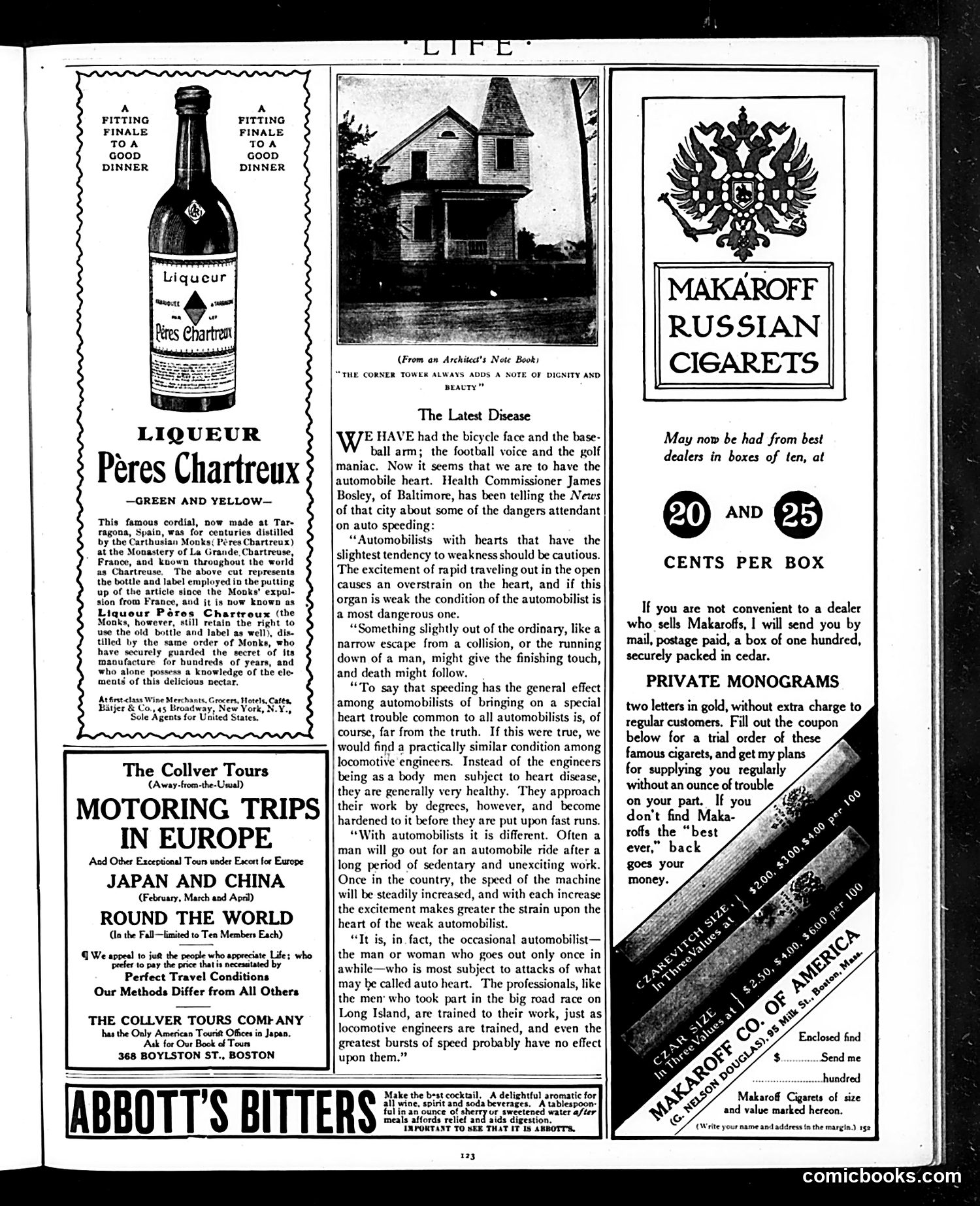
This page is primarily **advertisements and commercial content**, not political satire. The main article, "The Latest Disease," discusses "automobile heart"—a genuine health concern from the early 1900s when automobiles were new. **The Article's Point:** Baltimore's Health Commissioner warns that rapid automobile travel strains weak hearts, particularly affecting occasional drivers who lack the conditioning of professional drivers and locomotive engineers. The excitement and sudden acceleration of early motoring could trigger cardiac problems in sedentary people unused to such exertion. **Period Context:** This reflects genuine medical anxiety about automobiles as dangerous new technology. The piece calmly explains that professionals (like race drivers) adapt safely, but casual weekend drivers face real risk. **The Advertisements** include French liqueur, Russian cigarettes, and tour companies—luxury goods marketed to the wealthy readers who could afford automobiles, matching Life magazine's upper-class audience. There is **no political cartoon** on this page—the Victorian house illustration simply accompanies architectural commentary about corner towers.
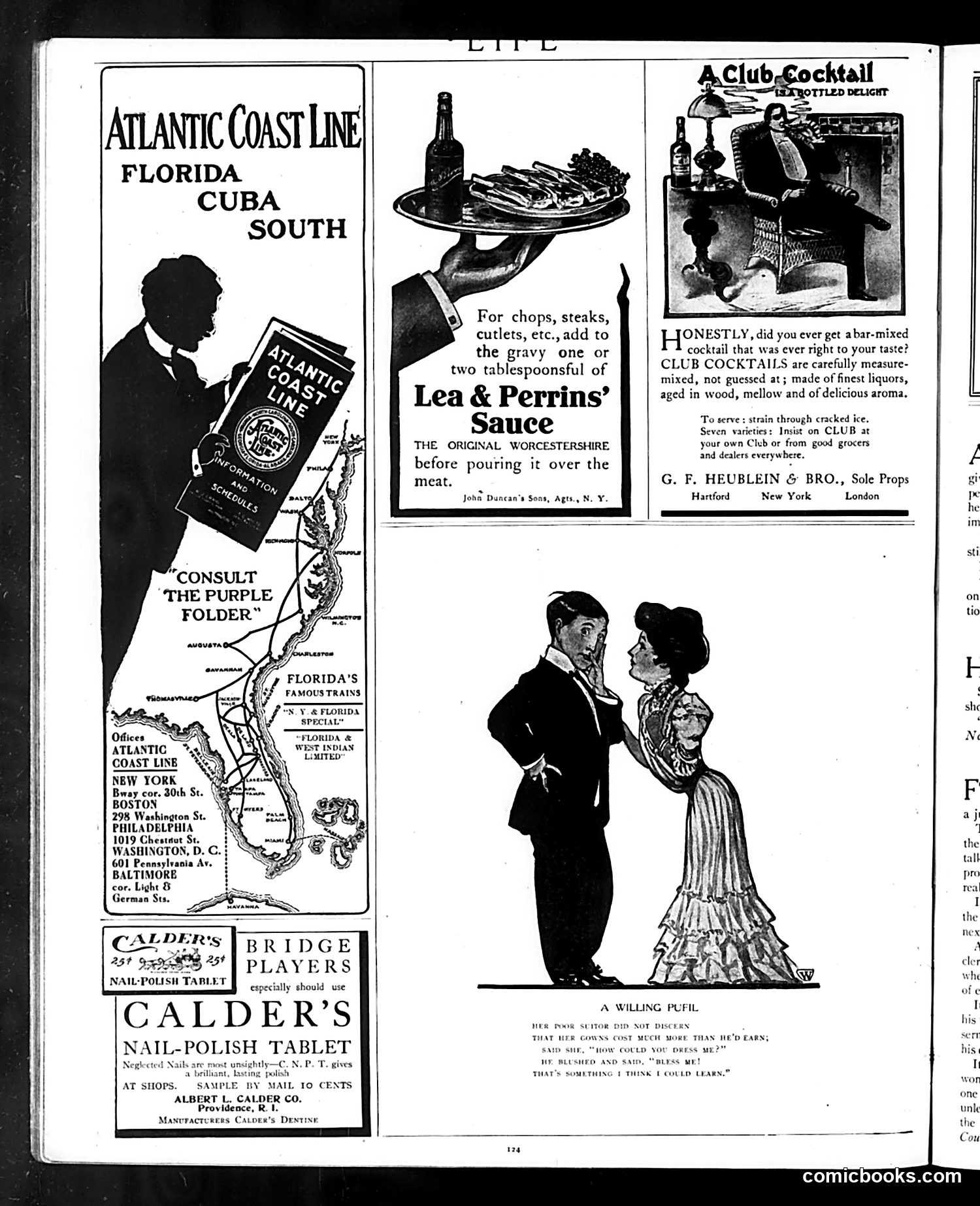
This page is primarily **advertising**, not political satire. It contains five distinct commercial advertisements typical of early 20th-century magazines: 1. **Atlantic Coast Line Railroad** — promoting travel to Florida and Cuba with office locations listed 2. **Lea & Perrins' Sauce** — the original Worcestershire sauce for cooking 3. **Club Cocktails** — pre-mixed cocktails by Heublein & Bros., emphasizing quality and consistency 4. **Calder's Nail-Polish Tablet** — a cosmetic product for manicures 5. **Bridge Players** advertisement and **Calder's Nail-Polish Tablet** again at bottom The single **cartoon illustration** ("A Willing Pupil") shows a man and woman in period dress with accompanying verse about courtship and marriage economics — a common humor format in Life, but not political satire. The advertisements reflect consumer goods and leisure activities marketed to middle and upper-class readers of the era.
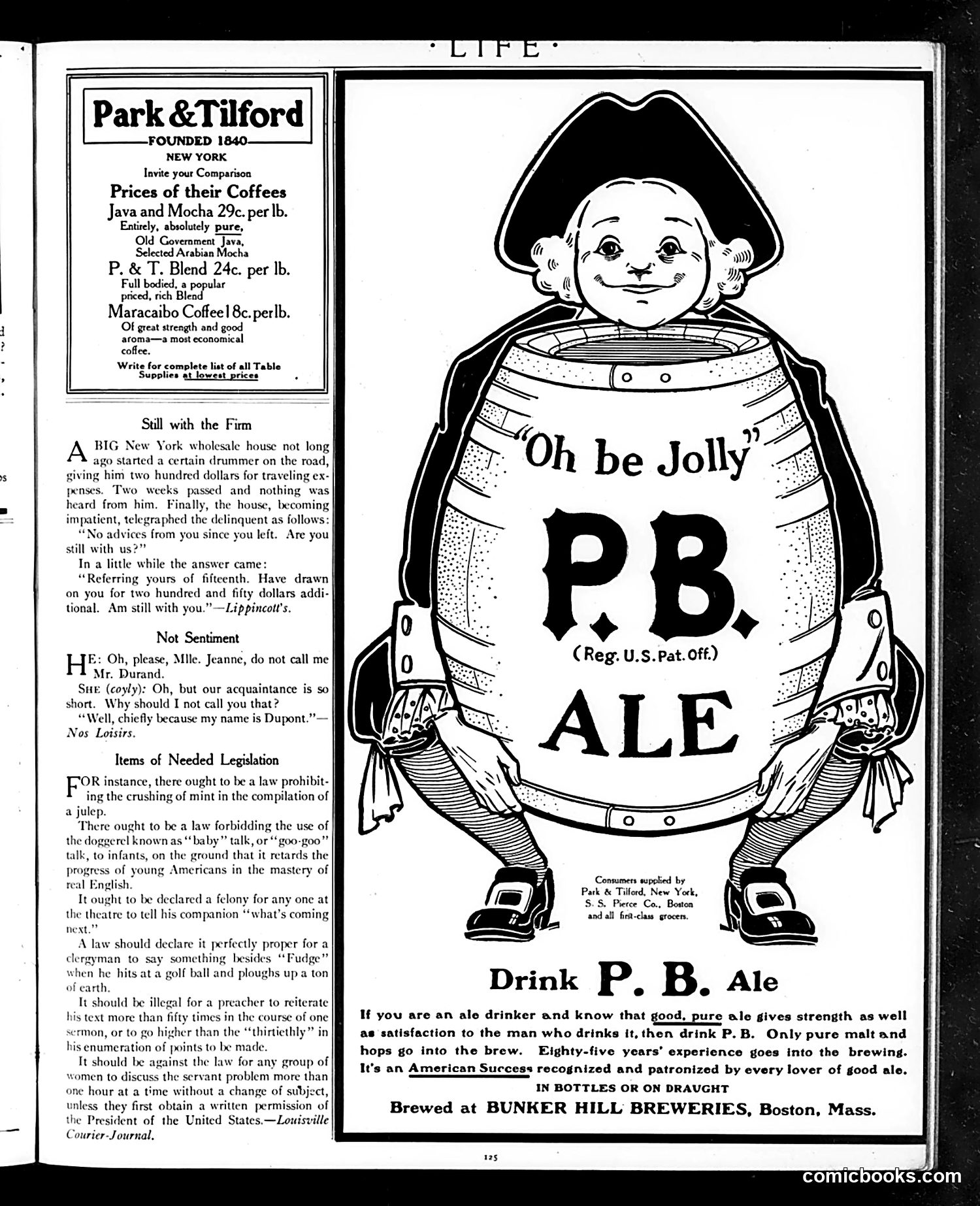
This page combines advertisements with satirical humor pieces typical of early-20th-century Life magazine. **Main Content:** The large illustration is a P.B. Ale advertisement featuring a rotund, jolly figure in period dress (colonial-style coat and hat). The "Oh be Jolly" branding uses this cheerful character to market ale as an "American Success." **Humor Pieces:** Three brief satirical stories appear on the left: 1. **"Still with the Firm"**: A traveling salesman asks for expense money, then requests *more* while claiming loyalty—poking fun at salesmen's dubious honesty. 2. **"Not Sentiment"**: A woman addresses a man formally; he objects, revealing his name is actually "Dupont" (not the formal "Mr. Durand" she used)—wordplay on mistaken identity. 3. **"Items of Needed Legislation"**: Humorous mock-legislation satirizing social annoyances (baby-talk to infants, theater spoilers, clergy saying "fudge" while golfing, women's endless servant complaints). This gently mocks contemporary manners and gender stereotypes. The page is primarily commercial, with satire serving as filler content alongside product promotions for coffee and ale.
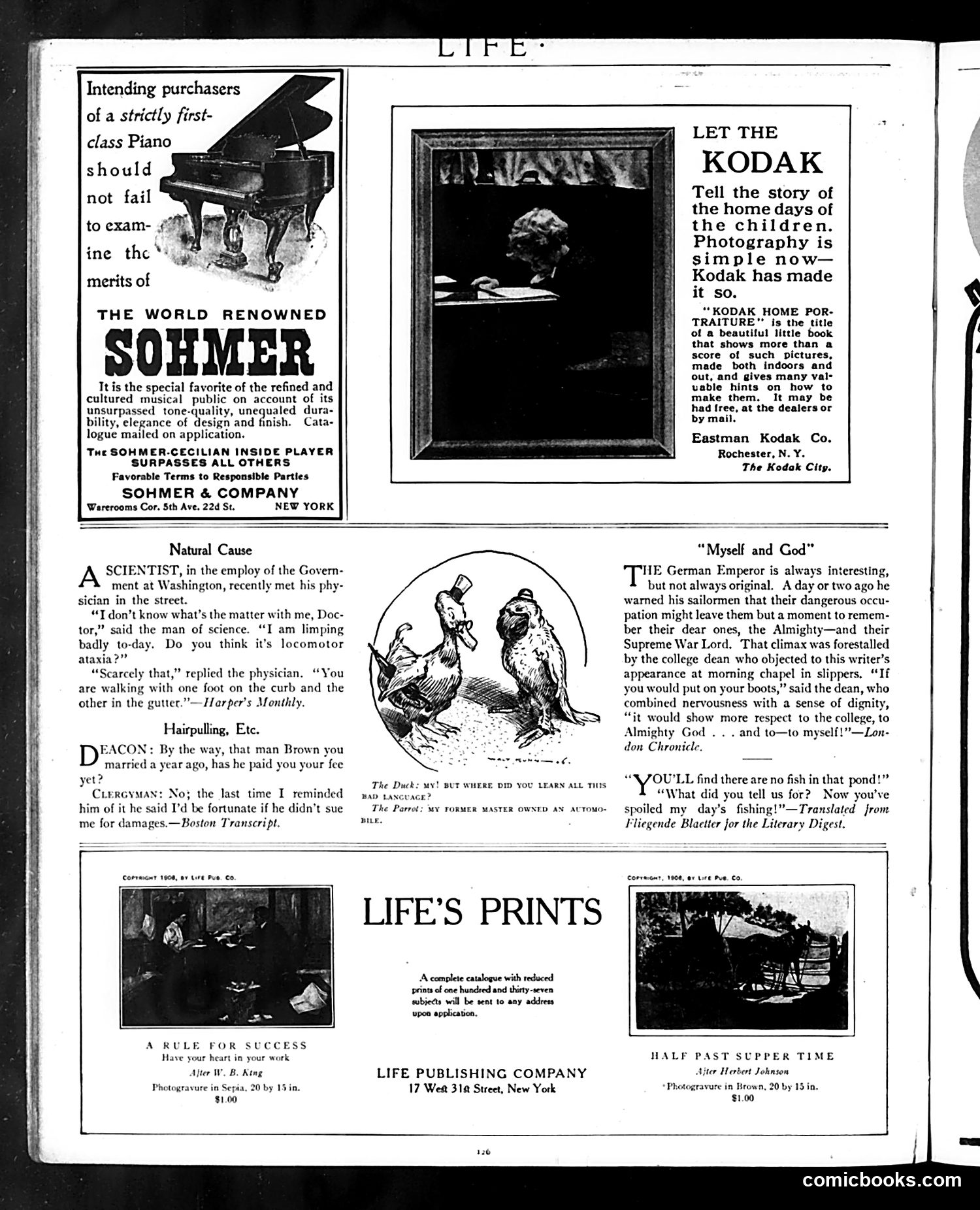
This page is primarily **advertising with brief humorous anecdotes**. The main content includes: **Advertisements:** - Sohmer pianos (luxury goods marketed to refined audiences) - Kodak cameras (encouraging home photography of children) **Satirical Anecdotes:** 1. "Natural Cause"—a scientist complains of limping; the doctor observes he's literally walking with one foot in the gutter, making the "problem" self-inflicted rather than medical. 2. "Hairpulling, Etc."—a clergyman notes a parishioner (Brown) sued him for collecting a wedding fee, inverting expectations of gratitude. 3. "Myself and God"—satirizes the German Emperor for ranking himself alongside God and the Almighty in importance to sailors. A college dean is mocked for similar vanity, demanding students wear boots to show "respect" to himself before God. 4. A fishing anecdote about spoiled expectations. **Life's Prints** section advertises photogravure reproductions for purchase. The humor throughout reflects early 1900s American satirical sensibilities—mocking pretension, vanity, and ironic reversals.
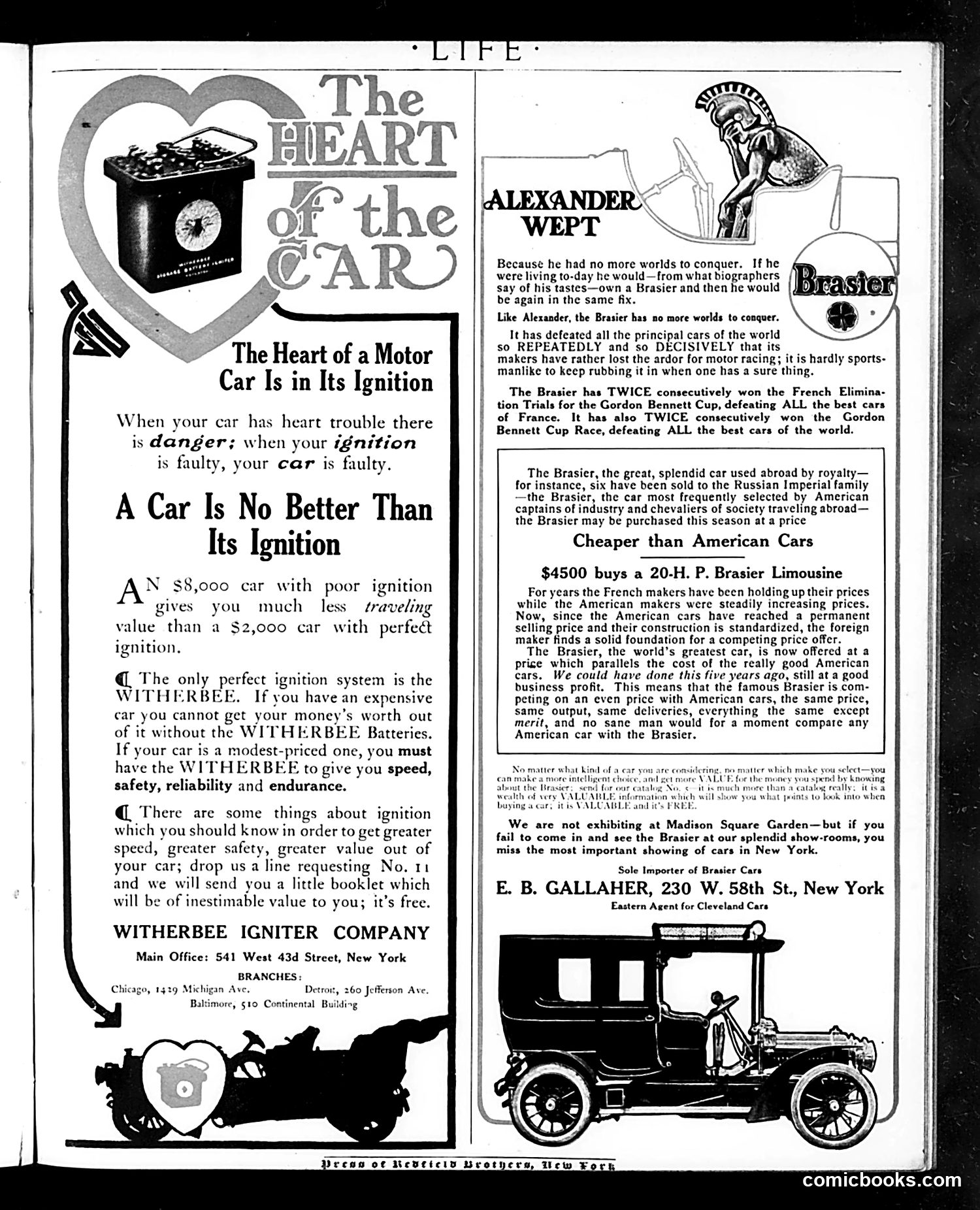
This page contains two car advertisements rather than political satire. **Left side (Witherbee Igniter Company):** A straightforward advertisement using the metaphor that a car's ignition is its "heart." The pitch claims that ignition quality matters more than purchase price—an $8,000 car with poor ignition is worth less than a $2,000 car with perfect ignition. They encourage readers to request a free booklet. **Right side (Brasier automobile):** A more elaborate advertisement claiming the French-made Brasier is superior to American cars. It uses a classical allusion: like Alexander the Great who "had no more worlds to conquer," the Brasier has defeated all competitors so decisively that racing it would be unsporting. The ad emphasizes the car's racing victories and royal/wealthy ownership abroad, then highlights its new competitive American pricing ($4,500). The closing argument: it's identical to American cars in price and output, "except merit." Both ads reflect early automotive marketing—emphasizing technical reliability and prestige ownership.
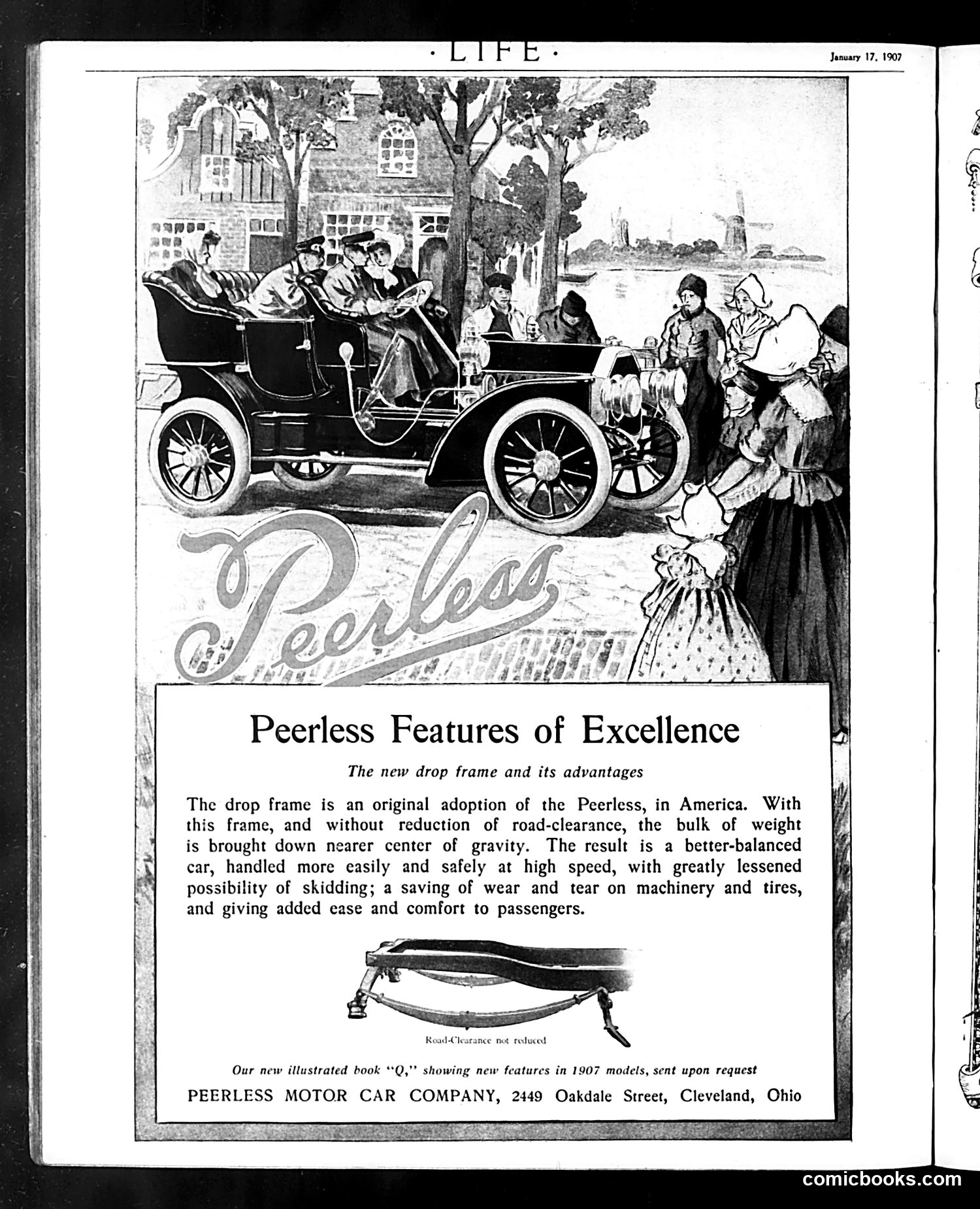
This is a **full-page advertisement**, not satire or political commentary. It promotes the Peerless Motor Car Company's 1907 automobile model. The illustration shows an elegant early motorcar with well-dressed passengers and onlookers in Edwardian-era clothing, establishing an aspirational, luxury image. The accompanying text highlights the "drop frame" innovation—lowering the vehicle's center of gravity while maintaining road clearance, improving stability, handling, and comfort. The advertisement emphasizes engineering superiority as a selling point to affluent buyers. The phrase "Peerless Features of Excellence" plays on the brand name. This reflects the early automobile era when technical specifications and engineering advances were key marketing strategies, targeting wealthy consumers who could afford such vehicles. There is no satire present—this is straightforward period advertising.