
Life, 1907-01-17 · page 9 of 60
Life — January 17, 1907 — page 9: what you’re looking at
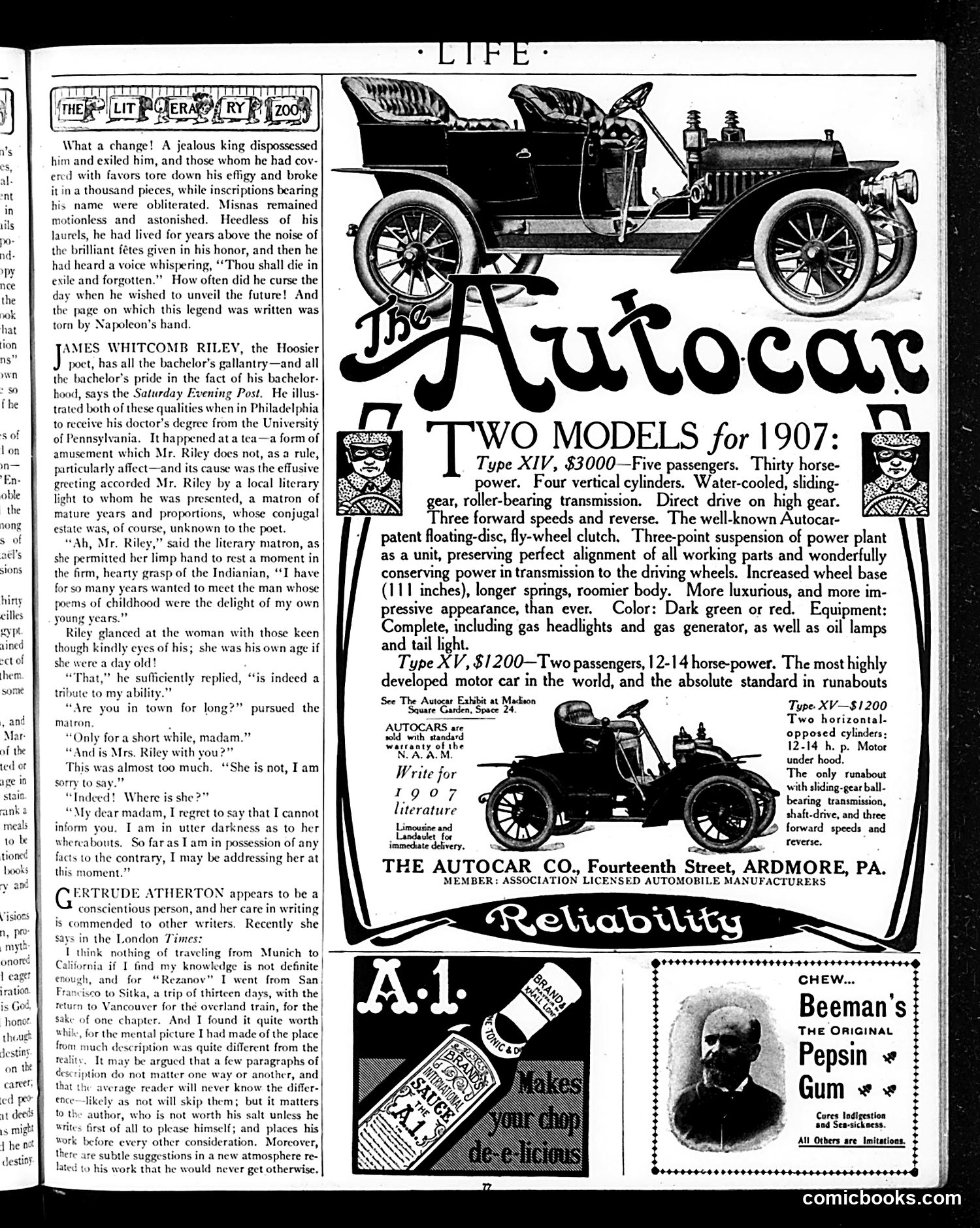
What you’re looking at
This page is **primarily advertising**, not political satire. The dominant content is a large advertisement for the Autocar automobile company, promoting two 1907 models (Type XIV at $3,000 and Type XV at $1,200). The ad emphasizes technical features like "water-cooled, sliding-gear" transmission and "floating-disc, fly-wheel clutch"—selling points meaningful to early automobile buyers. The upper portion contains literary content about James Whitcomb Riley (a Hoosier poet) and Gertrude Atherton (a writer), with anecdotal stories. A small advertisement for Beeman's Pensin Gum appears at the bottom. There is **no significant political cartoon or satire** on this page—it's a standard issue mixing editorial content with period advertising and consumer product promotion.
📄 Transcribed text from this page (OCR, searchable)
Machine-transcribed from the original scan — historical spelling and the odd misread are preserved.
hiny cilles to le tioned books ne Visions n, Pro “myth onored 1 caget TUTTI Io Tae tir [meer BAER fot & s rs What a change! A jealous king dispossessed him and exiled him, and those whom he had cov- ered with favors tore down his effigy and broke it ina thousand pieces, while inscriptions bearing his name were obliterated. Misnas remained motionless and astonished. Heedless of his laurels, he had lived for years above the noise of the brilliant fétes given in his honor, and then he had heard a voice whispering, ‘Thou shall die in exile and forgotten.” How often did he curse the day when he wished to unveil the future! And the page on which this legend was written was torn by Napoleon’s hand. AMES WHITCOMB RILEY, the Hoosier poct, has all the bachelor’s gallantry—and all the bachelor’s pride in the fact of his bachelor- hood, says the Saturday Evening Post. He illus- trated both of these qualities when in Philadelphia to receive his doctor’s degree from the University of Pennsylvania. It happened ata tea—a form of amusement which Mr. Riley does not, as a rule, particularly affect—and its cause was the effusive greeting accorded Mr. Riley by a local literary light to whom he was presented, a matron of mature years and proportions, whose conjugal estate was, of course, unknown to the poet. “Ah, Mr. Riley,” said the literary matron, as she permitted her limp hand to rest a moment in the firm, hearty grasp of the Indianian, “I have for so many vanted to meet the man whose poems of childhood were the delight of my own young, Be Riley glanced at the woman with those keen though kindly eyes of his; she was his own age if she were a day old That,” he sufficiently replied, “is indeed a| tribute to my ability.” “Are you in town for long?” pursued the matron . “Only fora short while, madam.” “And is Mrs. Riley with you?” This was almost too much. “She is not, Iam sorry to say.” “Indeed! Where is she?” “My dear madam, I regret to say that I cannot inform you. Tam in utter darkness as to her whereabouts, So far as Tam in pos: facts to the contrary, I may be addressi this moment.” ERTRUDE ATHERTON appears to be a conscientious person, and her care in writing is commended to other writers. Recently she says in the London Times: I think nothing of traveling from Munich to California if I find my knowledge is not definite | and for “Rezanov" I went from San, 0 to Sitka, a trip of thirteen days, with the | return to Vancouver for thé overland train, for the| sake of one chapter. And I found it quite worth “hile, for the mental picture I had made of the place | from much description was quite different from the | reality. It may be argued that a few paragraphs of écscription do not matter one way or another, and that the average reader will never know the differ- foce—-likely as not will skip them; but it matters to the author, who is not worth his salt unless he Writes t of all to please himself; and places his work before every other consideration. Moreover, th subtle suggestions in a new atmosphere re- to his work that he would never get otherwise. “TS MODELS for 1907: Type XIV, $3000—Five passengers. Thirty horse- power. Four vertical cylinders. Water-cooled, sliding- gear, roller-bearing transmission. Direct drive on high gear. Gye Three forward speeds and reverse. The well-known Autocar- 7 patent floating-disc, fly-wheel clutch. Three-point suspension of power plant as a unit, preserving perfect alignment of all working parts and wonderfully conserving power in transmission to the driving wheels. Increased wheel base (111 inches), longer springs, roomier body. More luxurious, and more im- pressive appearance, than ever. Color: Dark green or red. Equipment: Complete, including gas headlights and gas generator, as well as oil lamps and tail light. Type XV, $1200—Two passengers, | 2-14 horse-power. The most highly developed motor car in the world, and the absolute standard in runabouts se TO Elna Siaee ee Type. XV—$1200 = = no Two horizontal. po Atet pepe v1 opposed cylinders; wacraety of the \ 1214 bp Motor aS ae . under hood. Write for 2 . The only runabout 7 OOF yo é with sliding-gear ball- Wf Cd i BST bearing transmission, literature — } : : fy shaft-drive, and three Limousine and A forward speeds and Landaulet for y immechate delivery, © a . reverse. THE AUTOCAR CO., Fourteenth Street, ARDMORE, PA. MEMBER: ASSOCIATION LICENSED AUTOMOBILE MANUFACTURERS CHEW... Beeman’s THE LENS ' Pepsin Gum » Cures Indigestion nd Sea-sickness. All Others sre_Imitations. comicbooks.com