
Life, 1907-01-17 · page 6 of 60
Life — January 17, 1907 — page 6: what you’re looking at
What you’re looking at
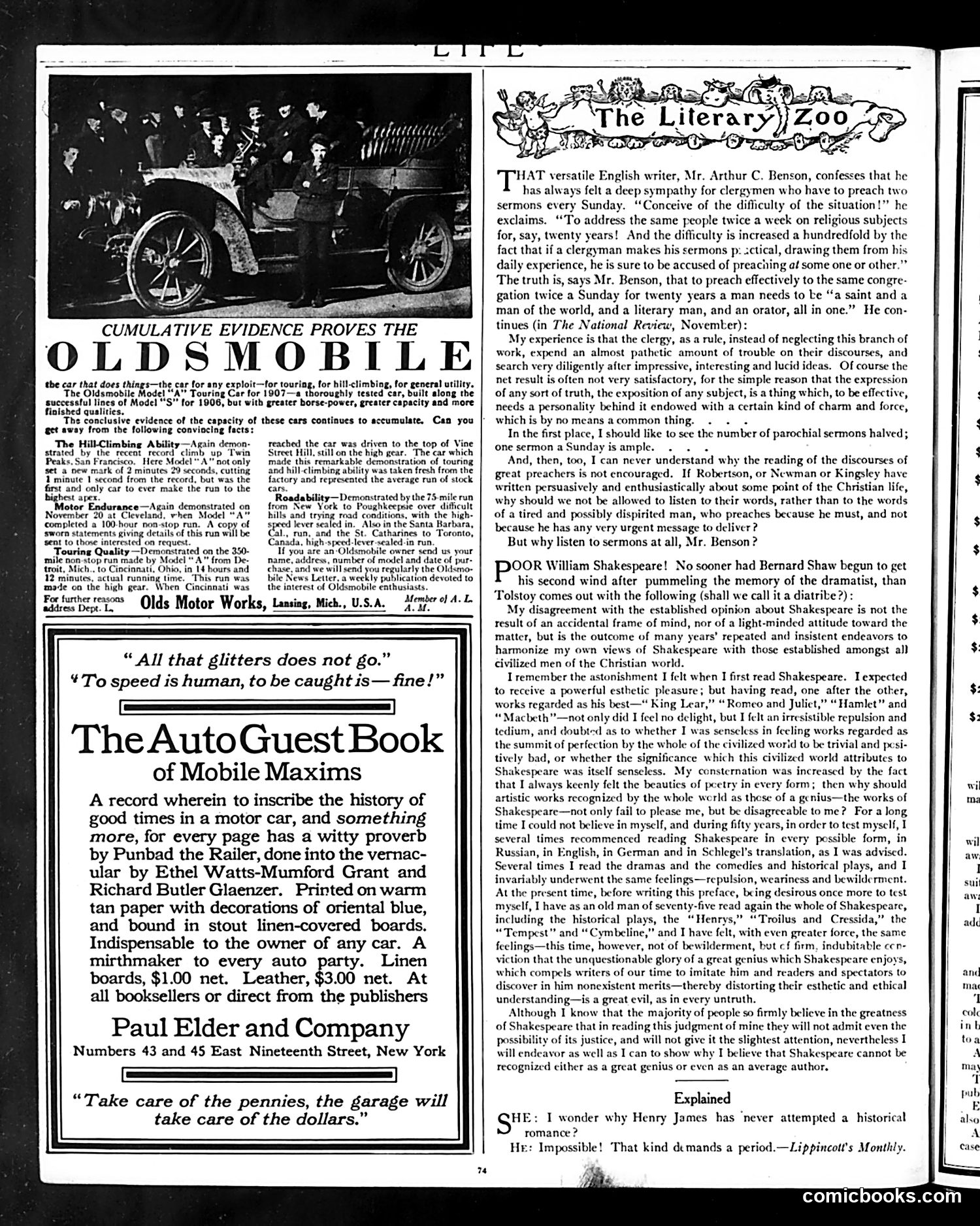
This page consists primarily of **advertisements and editorial content rather than political satire**. The main feature, "The Literary Zoo," is a **humorous essay by Arthur C. Benson about the challenges clergy face preaching sermons weekly**. Benson uses theatrical language to describe how preachers must constantly draw from personal experience while maintaining effectiveness—a relatable complaint about repetitive public speaking. The essay then pivots to **criticizing Shakespeare's reputation as an unquestionably great author**, questioning whether he deserves such universal acclaim. The author argues Shakespeare may be overrated. The page also includes multiple **commercial advertisements** for automobiles (Olds Motor Works) and "The AutoGuest Book of Mobile Maxims"—typical of Life's revenue model combining satire with advertising.
📄 Transcribed text from this page (OCR, searchable)
Machine-transcribed from the original scan — historical spelling and the odd misread are preserved.
CUMULATIVE EVIDENCE PROVES THE OLDSMOBILE the car that does things—th The Oldsmobile Mod successful ft Model finished qualitie: for any exploit—for touring, for hill-climbing, for general utility. Touring Car for 1907—a thoroughly tested car, built along the for 1906, but with greater borse-power, greater capacity and more Ths conclusive evidence of the capacity of these cars continues to accumulate, Can you get away from the following convincing facts: The Hill-Climbing Ability—Again demon- strated by the recent record climb up Twin Peaks. San Francisco. Here Model "A" not only seta pew mark of 2 minutes 29 seconds, cutting 1 minute 1 second from the record, but ‘was the first and only car to ever make the run to the ighest apex. lotor Endurance —Again demonstrated on November 20 at Cleveland, hen Model "A" completed a 100-hour non-stop run. A copy of sworn statements giving details of this run will be sent to those interested on request. Touring Quality —Demonstrated on the 350- mile non-stop run made by Model "A" from De- troit, Mich... to Cincinnati, Ohio, in 14 hours and 12 minutes. actual running time. ‘This run was mode oa the high gear. When Cincinnati was reached the car was driven to the top of Vine Street Hill, still on the high gear. ‘The car which made this remarkable demonstration of touring and hill-climbing ability was taken fresh from the factory and represented the average run of stock cars. Roadability— Demonstrated by the 75-mile run from New York to Poughkeepsie over difficult hills and trying road conditions, with the high speed lever sealed in. Also in the Santa Barbara, Cal., run, and the St. Catharines to Toronto, Canada, high-speed-lever-sealed-in run, If you are an‘Oldsmobile owner send us your name, addres, number of model and date of pur- and we will send you regularly the Oldsmo- bile News Leiter. a weetly publication devoted to the interest of Oldsmobile enthusiasts. Fes furtyse reasons QIds Motor Works, Lansing, Mich., U.S.A, {fuer 4-E “All that glitters does not go.” * To speed is human, to be caught is— fine!” ———————) The AutoGuest Book of Mobile Maxims A record wherein to inscribe the history of good times in a motor car, and something more, for every page has a witty proverb by Punbad the Railer, done into the vernac- ular by Ethel Watts-Mumford Grant and Richard Butler Glaenzer. Printed on warm tan paper with decorations of oriental blue, and bound in stout linen-covered boards. Indispensable to the owner of any car. A mirthmaker to every auto party. Linen boards, $1.00 net. Leather, $3.00 net. At all booksellers or direct from the publishers Paul Elder and Company Numbers 43 and 45 East Nineteenth Street, New York —S “Take care of the pennies, the garage will take care of the dollars.” THAT versatile English writer, Mr. Arthur C. Benson, confesses that he has always felt a deep sympathy for clergymen who have to preach two sermons every Sunday. ‘Conceive of the difiiculty of the situation!” he exclaims. “To address the same people twice a week on religious subjects for, say, twenty years! And the difficulty is increased a hundredfold by the fact that if a clergyman makes his sermons p: .ctical, drawing them from his daily experience, he is sure to be accused of preaching af some one or other.” The truth is, says Mr. Benson, that to preach effectively to the same congre- gation twice a Sunday for twenty years a man needs to ke “a saint and a man of the world, and a literary man, and an orator, all in one.” He con- tinues (in The National Review, November): My experience is that the clergy, as a rule, instead of neglecting this branch of work, expend an almost pathetic amount of trouble on their discourses, and search very diligently after impressive, interesting and lucid ideas. Of course the net result is often not very satisfactory, for the simple reason that the expression of any sort of truth, the exposition of any subject, is a thing which, to be effective, needs a personality behind it endowed with a certain kind of charm and force, which is by no means acommon thing. 2. In the first place, I should like to sce the number of parochial sermons halved ; one sermon a Sunday isample. 2. And, then, too, I can never understand why the reading of the discourses of great preachers is not encouraged. If Robertson, or Newman or Kingsley have written persuasively and enthusiastically about some point of the Christian life, why should we not be allowed to listen to their words, rather than to the words of a tired and possibly dispirited man, who preaches because he must, and not because he has any very urgent message to deliver? But why listen to sermons at all, Mr. Benson ? poor William Shakespeare! No sooner had Bernard Shaw begun to get his second wind after pummeling the memory of the dramatist, than Tolstoy comes out with the following (shall we call it a diatribe?) : My disagreement with the established opinion about Shakespeare is not the result of an accidental frame of mind, nor of a light-minded attitude toward the matter, but is the outcome of many years’ repeated and insistent endeavors to harmonize my own views of Shakespeare with those established amongst all civilized men of the Christian world. I remember the astonishment I felt when I first read Shakespeare. Iexpected to receive a powerful esthetic pleasure; but having read, one after the other, works regarded as his best—“ King Lear,” “ Romeo and Juliet,” “Hamlet” and “ Macbeth”—not only did I feel no delight, but I felt an irresistible repulsion and tedium, and doubted as to whether I was senseless in feeling works regarded as the summit of perfection by the whole of the civilized worid to be trivial and pesi- tively bad, or whether the significance which this civilized world attributes to Shakespeare was itself senseless. My consternation was increased by the fact that I always keenly felt the beauties of peetry in every form; then why should artistic works recognized by the whole werld as these of a genius—the works of Shakespeare—not only fail to please me, but be disagreeable to me? For a long. time I could not believe in myself, and during fifty years, in order to test myself, I several times recommenced reading Shakespeare in every possible form, in Russian, in English, in German and in Schlegel’s translation, as I was advised. Several times I read the dramas and the comedies and historical plays, and I invariably underwent the same feelings—repulsion, weariness and bewilderment. At the present time, before writing this preface, bcing desirous once more to test myself, I have as an old man of seventy-five read again the whole of Shakespeare, including the historical plays, the “Henrys,” “Troilus and Cressida,” the “Tempest” and “Cymbeline,” and I have felt, with even greater force, the same feelings—this time, however, not of bewilderment, but cf firm, indubitable cen- viction that the unquestionable glory of a great genius which Shakespeare enjoys, which compels writers of our time to imitate him and readers and spectators to discover in him nonexistent merits—thereby distorting their esthetic and ethical understanding—is a great evil, as in every untruth. Although I know that the majority of people so firmly believe in the greatness of Shakespeare that in reading this judgment of mine they will not admit even the possibility of its justice, and will not give it the slightest attention, nevertheless I will endeavor as well as I can to show why I believe that Shakespeare cannot be recognized cither as a great genius or even as an average author. Explained HE: I wonder why Henry James has ‘never attempted a historical romance ? He: Impossible! That kind demands a period.—Lippincott’s Monthly. comicbooks.com