
Life, 1907-01-17 · page 29 of 60
Life — January 17, 1907 — page 29: what you’re looking at
What you’re looking at
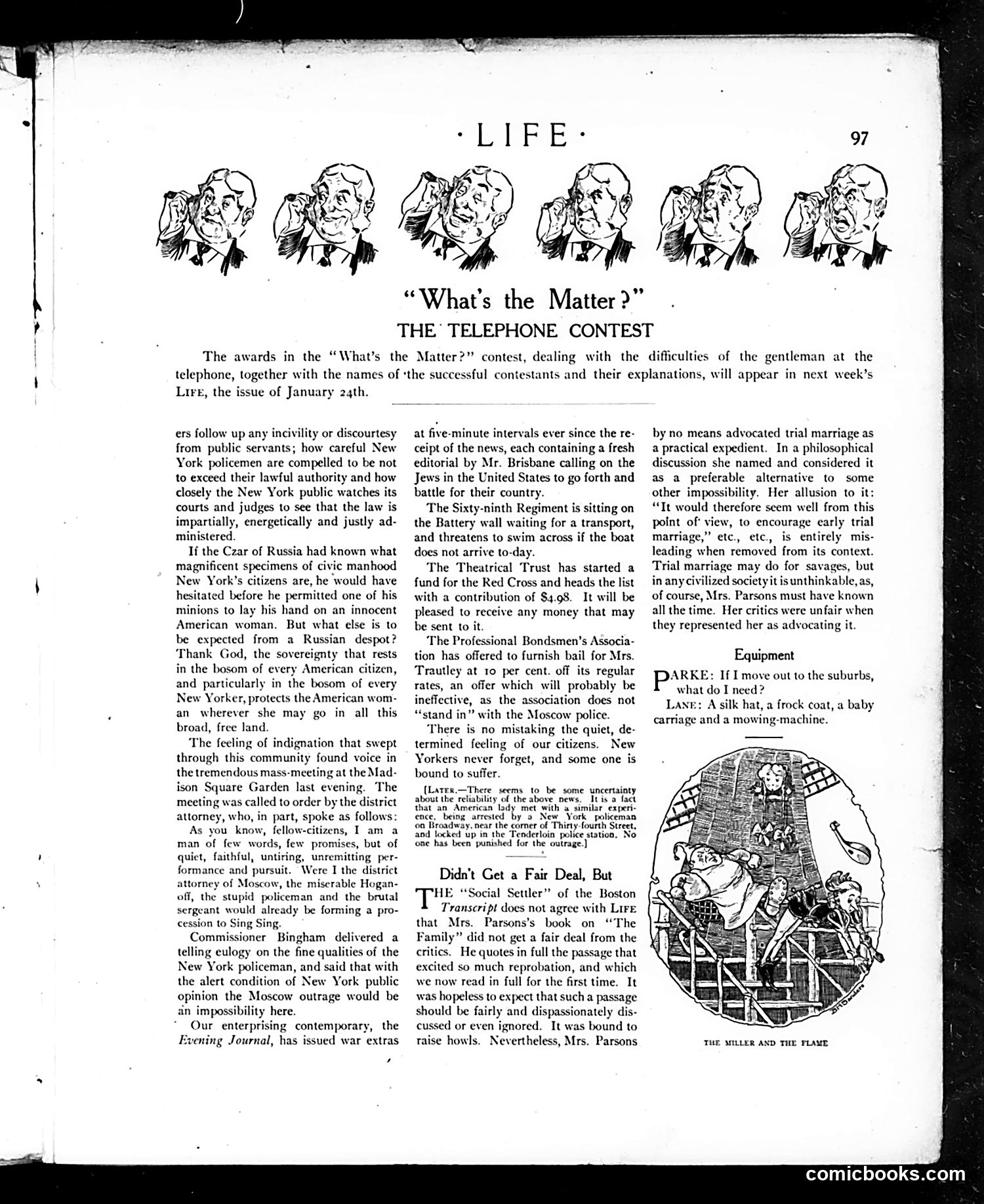
This page announces a **telephone contest** featuring six identical cartoon drawings of a bewildered man at a telephone—the visual joke is repeated to emphasize frustration with telephone difficulties, a then-modern technology. The bulk of the page satirizes American **overreaction to a real incident**: a Russian official allegedly assaulted an American woman. Life mocks New York's grandiose response—mass meetings, the 69th Regiment mobilizing, newspapers issuing "war extras," theatrical producers donating trivial sums—as absurdly disproportionate patriotic theater. The satire targets **American self-righteousness**: politicians praising NYC police virtue while ignoring that a NYC policeman similarly arrested an American woman on Broadway (noted in the editor's correction at bottom). The piece exposes hypocrisy—Americans perform moral outrage at Russian brutality while tolerating identical conduct domestically.
📄 Transcribed text from this page (OCR, searchable)
Machine-transcribed from the original scan — historical spelling and the odd misread are preserved.
“What's the Matter >” THE’ TELEPHONE CONTEST The awards in the “What’s the Matter?” contest, dealing with the difficulties of the gentleman at the telephone, together with the names of ‘the successful contestants and their explanations, will appear in next week’s Lire, the issue of January 24th. ers follow up any incivility or discourtesy from public servants; how careful New York policemen are compelled to be not to exceed their lawful authority and how closely the New York public watches its courts and judges to see that the law is impartially, energetically and justly ad- ministered. Ii the Czar of Russia had known what magnificent specimens of civic manhood New York’s citizens are, he would have hesitated before he permitted one of his minions to lay his hand on an innocent American woman. But what else is to be expected from a Russian despot? Thank God, the sovereignty that rests in the bosom of every American citizen, and particularly in the bosom of every New Yorker, protects the American wom- an wherever she may go in all this broad, free land. The feeling of indignation that swept through this community found voice in the tremendous mass-meeting at the Mad- ison Square Garden last evening. The meeting was called to order by the district attorney, who, in part, spoke as follows: As you know, fellow-citizens, I am a man of few words, few promises, but of quiet, faithful, untiring, unremitting per- formanc id pursuit. Were I the district attorney of Moscow, the miserable Hogan- off, the stupid policeman and the brutal sergeant would already be forming a pro- cession to Sing Sing. Commissioner Bingham delivered a telling eulogy on the fine qualities of the New York policeman, and said that with the alert condition of New York public opinion the Moscow outrage would be ain impossibility here. * Our enterprising contemporary, the Evening Journal, has issued war extras at five-minute intervals ever since the re- ceipt of the news, each containing a fresh editorial by Mr. Brisbane calling on the Jews in the United States to go forth and battle for their country. ‘The Sixty-ninth Regiment is sitting on the Battery wall waiting for a transport, and threatens to swim across if the boat does not arrive to-day. The Theatrical Trust has started a fund for the Red Cross and heads the list with a contribution of $4.98. It will be pleased to receive any money that may be sent to it. ‘The Professional Bondsmen’s Associa- tion has offered to furnish bail for Mrs. Trautley at 10 per cent. off its regular rates, an offer which will probably be ineffective, as the association does not “stand in” with the Moscow police. There is no mistaking the quiet, de- termined feeling of our citizens. New Yorkers never forget, and some one is bound to suffer. (Latee.—There seems to be some uncertainty about the reliability of the above news. It is a fact that an American Lady met with a similar experi- ence, being arrested by a New York policeman 0 Hroadway. near the comer of Thirty-fourth Street, and locked up in the Tenderloin police station, No one has been punished for the outrage.) Didn't Get a Fair Deal, But T' “Social Settler” of the Boston Transcript does not agree with Lire that Mrs. Parsons’s book on “The Family” did not get a fair deal from the critics. He quotes in full the passage that excited so much reprobation, and which we now read in full for the first time. It was hopeless to expect that such a passage should be fairly and dispassionately dis- cussed or even ignored. It was bound to taise howls. Nevertheless, Mrs. Parsons by no means advocated trial marriage as a practical expedient. In a philosophical discussion she named and considered it as a preferable alternative to some other impossibility. Her allusion to it: “Tt would therefore seem well from this point of view, to encourage early trial marriage,” etc., etc, is entirely mis- leading when removed from its context. Trial marriage may do for savages, but in any civilized society it is unthinkable, as, of course, Mrs. Parsons must have known all the time. Her cri were unfair when they represented her as advocating it. Equipment ARKE: If I move out to the suburbs, what do I need? Asilk hat, a frock coat, a baby THE MILLER AND THE FLAME comicbooks.com