
Life, 1907-01-17 · page 21 of 60
Life — January 17, 1907 — page 21: what you’re looking at
What you’re looking at
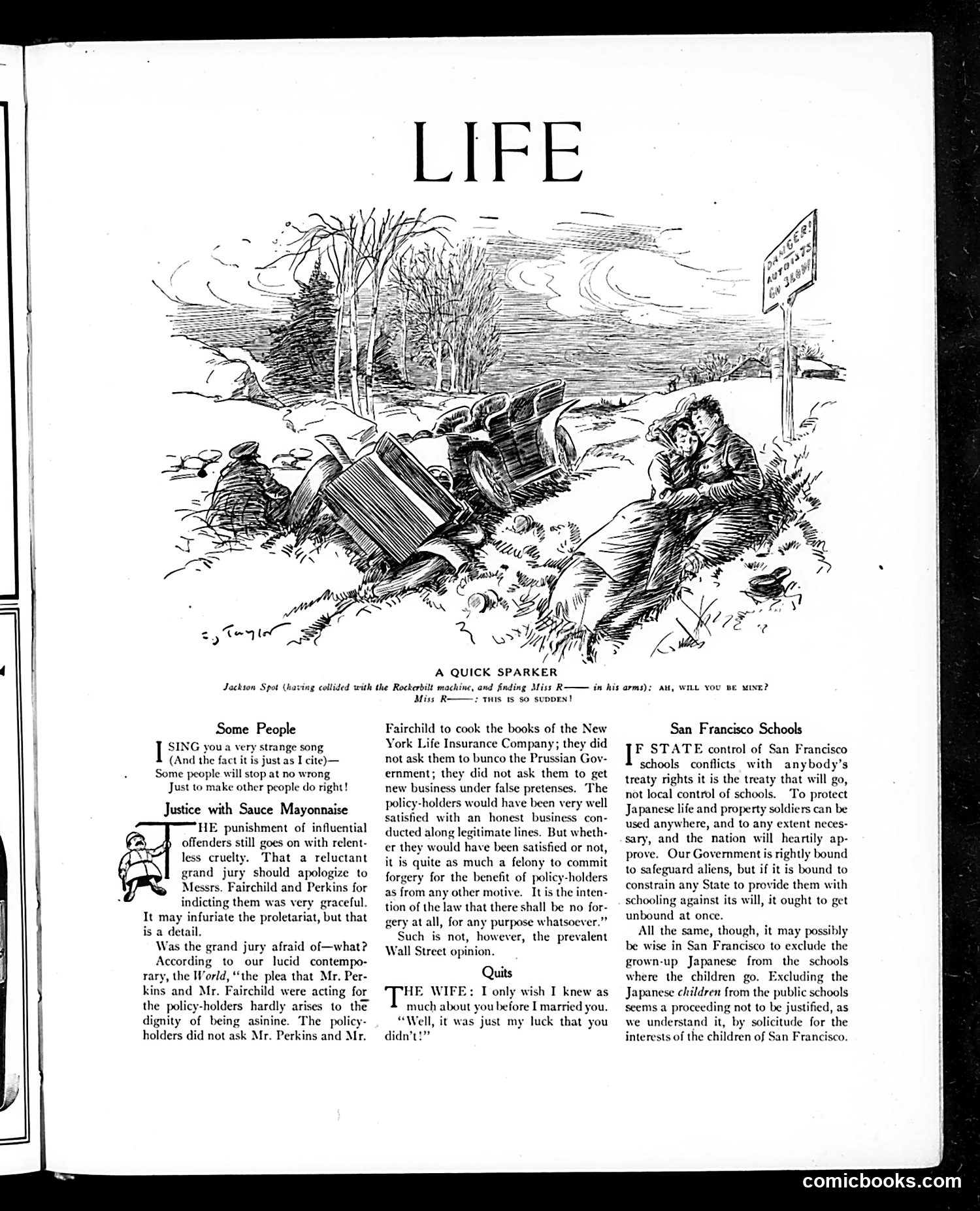
This page contains several satirical pieces critiquing corruption and hypocrisy: **"A Quick Sparker"** (top cartoon): A car accident illustration accompanying commentary on the New York Life Insurance scandal. Insurance executives Perkins and Fairchild faced indictment for fraud (forging documents, bribing foreign officials) yet received apologies from grand juries. The satire attacks the "Wall Street opinion" that committing crimes *for* policyholders somehow differs morally from other crimes. **"Some People"** and **"Justice with Sauce Mayonnaise"**: Verses mocking the protection wealthy offenders receive while ordinary people face strict punishment—the grand jury apologizing to the accused represents this double standard. **"Quits"**: A brief joke about marriage deception. **"San Francisco Schools"**: Commentary on 1906-era tensions over Japanese student exclusion from public schools, questioning whether excluding Japanese *children* truly protects American children's interests, while noting the government can deploy military force to protect Japanese adults' property rights. The page criticizes elite immunity from prosecution and inconsistent application of law based on wealth and power.
📄 Transcribed text from this page (OCR, searchable)
Machine-transcribed from the original scan — historical spelling and the odd misread are preserved.
Jackson Spot (having collided with the Rockerbilt machine, and finding Miss R’ Some People I SING you a very strange song (And the fact it is just as I cite)— Some people will stop at no wrong Just to make other people do right! Justice with Sauce Mayonnaise HE punishment of influential offenders still goes on with relent- less cruelty. That a reluctant grand jury should apologize to Messrs. Fairchild and Perkins for indicting them was very graceful. It may infuriate the proletariat, but that is a detail. Was the grand jury afraid of—what? According to our lucid contempo- rary, the World, “the plea that Mr. Per- kins and Mr. Fairchild were acting for the policy-holders hardly arises to the dignity of being asinine. The policy- holders did not ask Mr. Perkins and Mr. A QUICK SPARKER Miss R- 2 THIS 1S SO SUDDEN! Fairchild to cook the books of the New York Life Insurance Company; they did not ask them to bunco the Prussian Gov- ernment; they did not ask them to get new business under false pretenses, ‘The policy-holders would have been very well satisfied with an honest business con- ducted along legitimate lines. But wheth- er they would have been satisfied or not, it is quite as much a felony to commit forgery for the benefit of policyholders as from any other motive. It is the inten- tion of the law that there shall be no for- gery at all, for any purpose whatsoever.” Such is not, however, the prevalent Wall Street opinion. Quits 'HE WIFE: I only wish I knew as much about you before I married you. “Well, it was just my luck that you didn’t!” in his arms); au, WiLL you BE Minn? San Francisco Schools F STATE control of San Francisco schools conflicts. with anybody’s treaty rights it is the treaty that will go, not local control of schools. To protect Japanese life and property soldiers can be used anywhere, and to any extent neces- sary, and the nation will heartily ap- prove. Our Government is rightly bound to safeguard aliens, but if it is bound to constrain any State to provide them with schooling against its will, it ought to get unbound at once. All the same, though, it may possibly be wise in San Francisco to exclude the grown-up Japanese from the schools where the children go. Excluding the Japanese children from the public schools seems a proceeding not to be justified, as we understand it, by solicitude for the interests of the children of San Francisco. comicbooks.com