
Life, 1907-01-17 · page 35 of 60
Life — January 17, 1907 — page 35: what you’re looking at
What you’re looking at
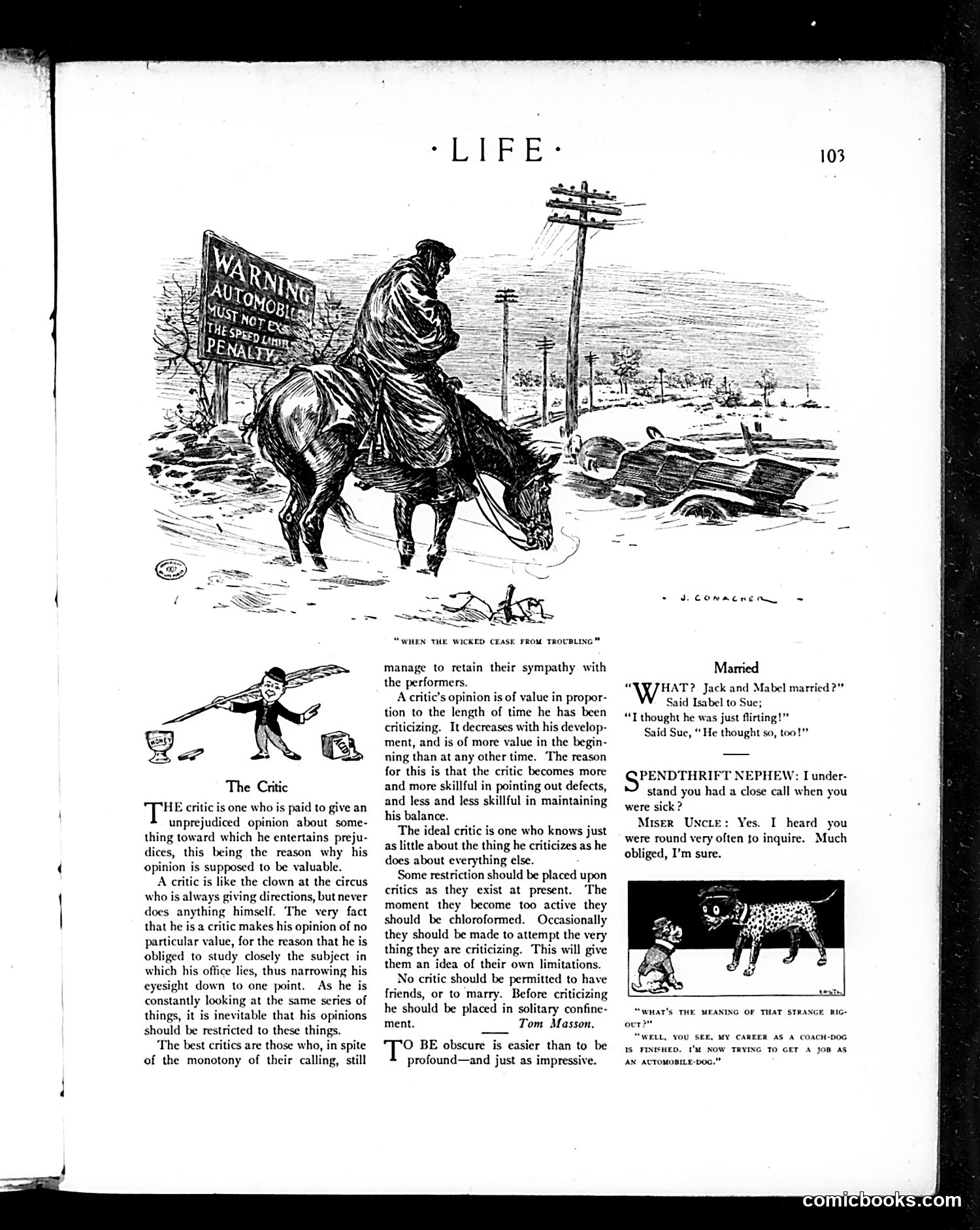
This page combines satirical commentary with humorous vignettes typical of early 20th-century Life magazine. **Main content:** A lengthy essay by Tom Masson titled "The Critic" mocks professional critics as fundamentally contradictory figures—paid to give "unprejudiced opinions" while harboring prejudices. Masson argues critics become less valuable as they develop expertise (paradoxically), and ironically suggests the ideal critic knows nothing about their subject. The piece satirizes the critical establishment's pretension and circular logic. **Cartoons:** 1. **Top illustration** (by J. Comacher): A cowboy on horseback passes a warning sign about automobiles, with abandoned car wreckage visible—satirizing the rural/automotive clash of the era. 2. **Small jokes below**: Brief humorous exchanges about marriage ("Jack and Mabel married?") and wordplay involving a "coach-dog" seeking work as an "automobile-dog"—playing on the transition from horse-drawn to motorized transportation. The page reflects pre-WWI American anxieties about modernization and urbanization.
📄 Transcribed text from this page (OCR, searchable)
Machine-transcribed from the original scan — historical spelling and the odd misread are preserved.
J Js The Critic THe critic is one who is paid to give an unprejudiced opinion about some- thing toward which he entertains preju- dices, this being the reason why his opinion is supposed to be valuable. A critic is like the clown at the circus who is always giving directions, but never does anything himself. The very fact that he is a critic makes his opinion of no particular value, for the reason that he is obliged to study closely the subject in which his office lies, thus narrowing his eyesight down to one point. As he is constantly looking at the same series of things, it is inevitable that his opinions should be restricted to these things. ‘The best critics are those who, in spite of the monotony of their calling, still “WHEN THE WICKED CEASE FROM TROUBLING” manage to retain their sympathy with the performers. A critic’s opinion is of value in propor- tion to the length of time he has been criticizing. It decreases with his develop- ment, and is of more value in the begin- ning than at any other time. The reason for this is that the critic becomes more and more skillful in pointing out defects, and less and less skillful in maintaining his balance. The ideal critic is one who knows just as little about the thing he criticizes as he does about everything else. Some restriction should be placed upon critics as they exist at present. The moment they become too active they should be chloroformed. Occasionally they should be made to attempt the very thing they are criticizing. This will give them an idea of their own limitations. No critic should be permitted to have friends, or to marry. Before criticizing he should be placed in solitary confine- ment. Tom Masson. 'O BE obscure is easier than to be profound—and just as impressive. Married “NYJHAT? Jack and Mabel married ?” Said Isabel to Sue; “1 thought he was just flirting!” Said Sue, “He thought so, too!” PENDTHRIFT ‘PHEW: I under- stand you had a close call when you were sick ? Miser Uncie: Yes. I heard you were round very often fo inquire. Much obliged, I’m sure. “WHAT'S THE MEANING OF THAT STRANGE RIG: ovr?" “WELL, YOU SEE, MY CAREER AS A COACH-DOG IS FINISHED, I'M NOW TRYING TO GET A JoB AS AN AUTOMOBILE-Doc."