
Life, 1907-01-17 · page 40 of 60
Life — January 17, 1907 — page 40: what you’re looking at
What you’re looking at
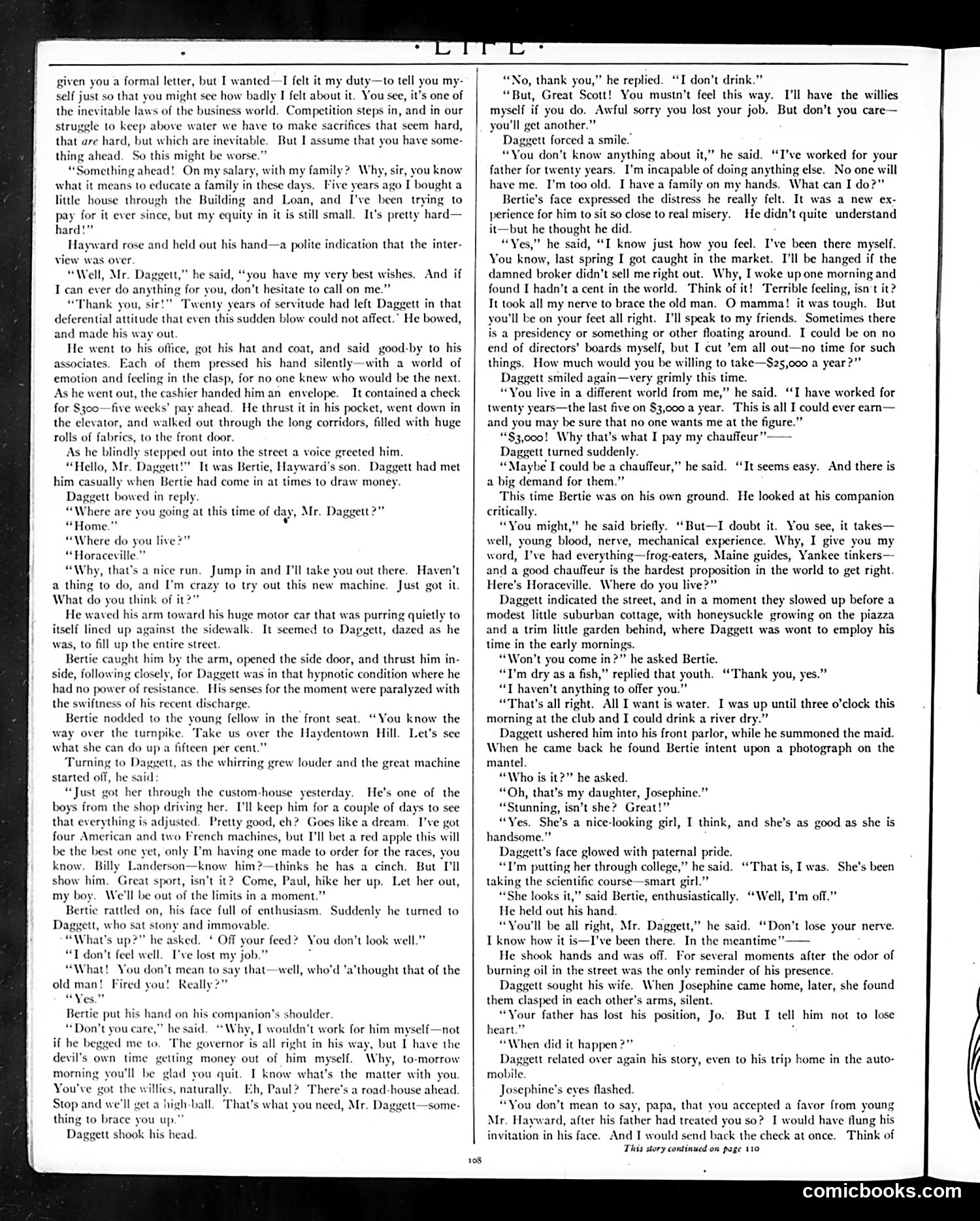
This page presents a short story depicting the stark contrast between industrial-era wealth inequality. Daggett, a long-serving factory employee, is fired by his employer Hayward—a decision presented as inevitable "business" necessity despite Daggett's twenty years of loyalty and family obligations (mortgage, children's education). The satire emerges through Bertie, Hayward's son—a privileged youth who casually offers Daggett a ride in his expensive imported automobile while discussing his multiple racing machines and leisure pursuits. This juxtaposition is biting: Bertie represents inherited wealth and careless excess, while Daggett faces financial ruin. Bertie's obliviousness to Daggett's desperate situation (he's just been fired) highlights how the wealthy were insulated from workers' economic suffering during this period. The story critiques both corporate indifference to worker welfare and the generational perpetuation of class privilege through inherited wealth.
📄 Transcribed text from this page (OCR, searchable)
Machine-transcribed from the original scan — historical spelling and the odd misread are preserved.
given you a formal letter, but I wanted—I felt it my duty—to tell you my- the inevitable laws of the business world. Competition steps in, and in our struggle to keep above water we have to make sacrifices that seem hard, that ave hard, but which are inevitable. But I assume that you some- thing ahead. So this might be worse.” omething ahead! On my salary, with my family ’, sir, you know what it means to educate a family in these days. Five years ago I bought a little house through the Building and Loan, and I’ve been trying to pay for it ever since, but my equity in it is still small. It’s pretty hard— hard!” Hayward rose and held out his hand—a polite indication that the inter- view was over “Well, Mr. Daggett,” he said, ‘you have my very best wishes. And if I can ever do anything for you, don’t hesitate to call on me.” “Thank you, sir!” Twenty years of servitude had left Daggett in that deferential attitude that even this sudden blow could not affect.” He bowed, and made his way out He went to his office, got his hat and coat, and said yood-by to his associates. Each of them pressed his hand silently—with a world of emotion and feeling in the clasp, for no one knew who would be the next. As he went out, the cashier handed him an envelope. It contained a check for $300—five weeks’ pay ahead. He thrust it in his pocket, went down in the elevator, and walked out through the long corridors, filled with huge rolls of fabrics, to the front door. As he blindly stepped out into the street a voice greeted him. “Hello, Mr. Dag It was Bertie, Hayward’s son. Daggett had met him casually when ‘Bertie had come in at times to draw money. Daggett bowed in reply. “Where are you going at this time of day, Mr. Daggett?” “Home.” “Where do you live?” “Horaceville.” “Why, that’s a nice run. Jump in and I'll take you out there. Haven't a thing to do, and I'm crazy to try out this new machine. Just got it. What do you think of it?” He waved his arm toward his huge motor car that wa itself lined up against the sidewalk. It seemed to D; was, to fill up the entire street Bertie caught him by the arm, opened the side door, and thrust him in- side, following closely, for Daggett was in that hypnotic condition where he had no power of resistance. His senses for the moment were paralyzed with the swiftness of his recent discharge. Bertie nodded to the young fellow in the front seat. “You know the way over the turnpike. Take us over the Haydentown Hill, Let’s see what she can do up a fifteen per cent.” Turning to Daggett, as the whirring grew louder and the great machine Ss purring quietly to tt, dazed as he started off, he said: “Just got her through the custom-house yesterday. He's one of the boys from the shop driving her. 'll keep him for a couple of days to see that everything is adjusted. Pretty good, ch? Goes like a dream. I’ve got four American and two French machines, but I'll bet a red apple this will be the best one yet, only I’m having one made to order for the races, you Landerson—know him?—thinks he has a cinch. But I'll show him. Great sport, isn’t it? Come, Paul, hike her up. Let her out, my boy. We'll be out of the limits in a moment.”” Bertie rattled on, his face full of enthusiasm. Suddenly he turned to Daggett, who sat stony and immovable. “What's up?” he asked. ‘ Off your feed? You don’t look well.’” “T don't feel well. I've lost my job.” “What! You don’t mean to say that—well, who'd ‘a’thought that of the old man! Fired you! Really?” Bertie put his hand on his companion’s shoulder “Don’t you care,” he said. “Why, I wouldn’t work for him myself—not if he begged me to. The governor is all right in his way, but I have the devil’s own time getting money out of him myself. Why, to-morrow morning you'll be glad you quit. I know what’s the matter with you You've got the willics, naturally. Eh, Paul? There's a road-house ahead Stop and we'll get a high-ball. That’s what you need, Mr. Daggett—some- thing to brace you up. know. Billy Daggett shook his head “No, thank you,” he replied. “I don’t drink.” “But, Great Scott! You mustn’t feel this way. I'll have the willies myself if you do. Awful sorry you lost your job. But don’t you care— you'll get another.” Daggett forced a smile. “You don’t know anything about it,” he said. “I’ve worked for your father for twenty years. I’m incapable of doing anything else. No one will have me. I’m too old. I have a family on my hands. What can I do?” Bertie’s face expressed the distress he really felt. It was a new ex- perience for him to sit so close to real misery. He didn’t quite understand it—but he thought he did. “Yes,” he said, “I know just how you feel. I’ve been there myself. You know, last spring I got caught in the market. I'll be hanged if the damned broker didn’t sell me right out. Why, I woke up one morning and found I hadn’t a cent in the world. Think of it! Terrible feeling, isn't it? It took all my nerve to brace the old man. O mamma! it was tough. But you'll be on your feet all right. I'll speak to my friends. Sometimes there is a presidency or something or other floating around. I could be on no end of directors’ boards myself, but I cut ’em all out—no time for such things. How much would you be willing to take—$25,000 a year?” Daggett smiled again—very grimly this time. “You live in a different world from me,” he said. ‘I have worked for twenty years—the last five on $3,000 a year. This is all I could ever earn— and you may be sure that no one wants me at the figure.”” “$3,000! Why that’s what I pay my chauffeur” Daggett turned suddenly. “Maybe I could be a chauffeui a big demand for them.” This time Bertie was on his own ground. He looked at his companion critically. “You might,” he said briefly. ““But—I doubt it. You see, it takes— well, young blood, nerve, mechanical experience. Why, I give you my word, I've had everything—frog-eaters, Maine guides, Yankee tinkers— and a good chauffeur is the hardest proposition in the world to get right Here’s Horaceville. Where do you live?” Daggett indicated the street, and in a moment they slowed up before a modest little suburban cottage, with honeysuckle growing on the piazza and a trim little garden behind, where Daggett was wont to employ his time in the early mornings. “Won't you come in?” he asked Bertie. ‘I'm dry as a fish,” replied that youth. “Thank you, yes.” “T haven't anything to offer you.” “That's all right. All I want is water. I was up until three o’clock this morning at the club and I could drink a river dry.” Daggett ushered him into his front parlor, while he summoned the maid. When he came back he found Bertie intent upon a photograph on the mantel. “Who is it?” he asked. “Oh, that’s my daughter, Josephine.” “Stunning, isn’t she? Great!” “Yes. She’s a nice-looking girl, I think, and she’s as good as she is handsome.” Daggett’s face glowed with paternal pride. “T’'m putting her through college,” he said. “That is, Iwas. She's been taking the scientific course—smart girl.” “She looks it,” said Bertie, enthusiastically. “Well, I’m off.” He held out his hand. “You'll be all right, Mr. Daggett,” he said. “Don’t lose your nerve. I know how it is—I’ve been there. In the meantime”—— He shook hands and was off. For several moments after the odor of burning oil in the street was the only reminder of his presence. Daggett sought his wife. When Josephine came home, later, she found them clasped in each other's arms, silent. “Your father has lost his position, Jo. But I tell him not to lose heart.” . “When did it happen?” Daggett related over again his story, even to his trip home in the auto- mobile. Josephine’s eyes flashed “You don’t mean to say, papa, that you accepted a favor from young Mr. Hayward, after his father had treated you so? I would have flung his invitation in his face. And I would send back the check at once. Think of This story continued on page 110 he said. “It seems easy. And there is comicbooks.com —_