
Life, 1907-01-17 · page 22 of 60
Life — January 17, 1907 — page 22: what you’re looking at
What you’re looking at
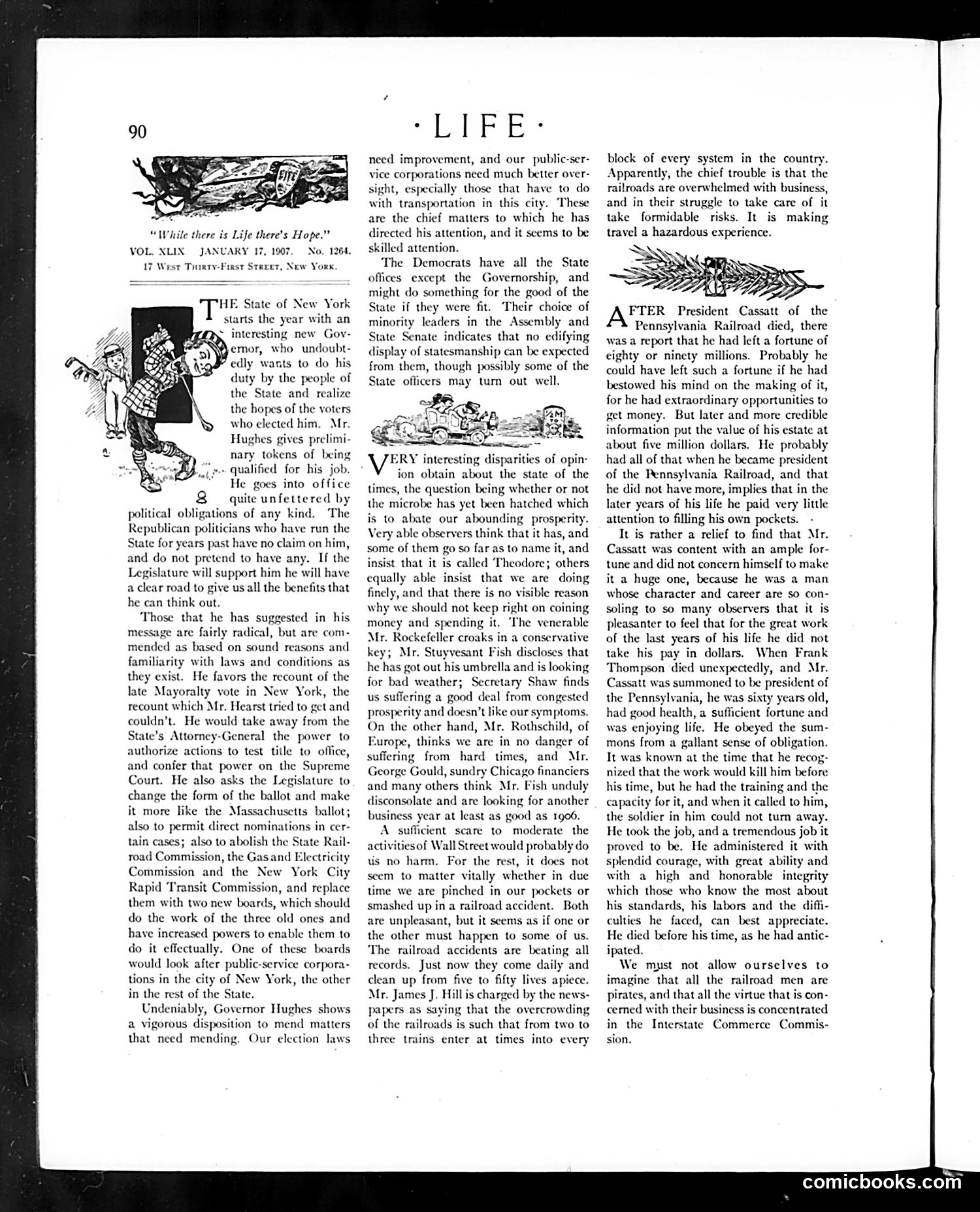
This page celebrates New York's new Governor Charles Evans Hughes, praising his independence from Republican machine politicians and his reform proposals—recount of the mayoral election, civil service changes, and better regulation of transportation corporations. The satirical edge targets the Democrats, dismissed as unfit to govern despite holding most state offices. The second section mocks contradictory predictions about economic prosperity. Named figures (Rockefeller, Stuyvesant Fish, Secretary Shaw) represent competing views: some warn of recession while others insist prosperity will continue. The satire suggests these financial elites are simply guessing, their disagreements equally valid/invalid. The veiled reference to "Theodore" likely alludes to President Theodore Roosevelt's trust-busting policies, blamed by some for economic instability.
📄 Transcribed text from this page (OCR, searchable)
Machine-transcribed from the original scan — historical spelling and the odd misread are preserved.
“While there is Life there’s Hope.” VOL. XLIX JANUARY 17, 1907, No. 1264. 17 West Trorty-First Steert, New Yorx. HE State of New York starts the year with an interesting new Gov- emor, who undoubt- edly wants to do his duty by the people of the State and realize the hopes of the voters who elected him. Mr. Hughes gives prelimi- nary tokens of being « qualified for his job. He goes into office quite unfettered by political obligations of any kind. The Republican politicians who have run the State for years past have no claim on him, and do not pretend to have any. If the Legislature will support him he will have ar road to give us all the benefits that he can think out. ‘Those that he has suggested in his message are fairly radical, but are com- mended as based on sound reasons and familiarity with laws and conditions as they exist. He favors the recount of the late Mayoralty vote in New York, the recount which Mr. Hearst tried to get and couldn’t. He would take away from the State’s Attorney-General the power to authorize actions to test title to office, and confer that power on the Supreme Court. He also asks the Legislature to change the form of the ballot and make it more like the Massachusetts ballot; also to permit direct nominations in cer- Commission and the New York City Rapid Transit Commission, and replace them with two new boards, which should do the work of the three old ones and have increased powers to enable them to do it effectually. One of these boards would look after public-service corpora- tions in the city of New York, the other in the rest of the State. Undeniably, Governor Hughes shows a vigorous disposition to mend matters that need mending. Our election laws “LIFE: need improvement, and our public-ser- vice corporations need much better over- sight, especially those that have to do with transportation in this city. ‘These are the chief matters to which he has directed his attention, and it seems to be skilled attention. The Democrats have all the State offices except the Governorship, and might do something for the good of the State if they were fit. Their choice of minority leaders in the Assembly and State Senate indicates that no edifying display of statesmanship can be expected from them, though possibly some of the State officers may tum out well. ERY interesting disparities of opin- ion obtain about the state of the times, the question being whether or not the microbe has yet been hatched which to abate our abounding prosperity. Very able observers think that it has, and some of them go so far as to name it, and insist that it is called Theodore; others equally able insist that we are doing finely, and that there is no visible reason why we should not keep right on coining money and spending it. ‘The venerable Mr. Rockefeller er in a conservative key; Mr. Stuyvesant Fish discloses that he has got out his umbrella and is looking for bad weather; Secretary Shaw finds us suffering a good deal from congested prosperity and doesn’t like our symptoms. On the other hand, Mr. Rothschild, of rope, thinks we are in no danger of suffering from hard times, and Mr. George Gould, sundry Chicago financiers and many others think Mr. Fish unduly disconsolate and are looking for another business year at least as good as 1906. A sufficient. scare to moderate the activitiesof Wall Street would probably do us no harm. For the rest, it does not seem to matter vitally whether in due time we are pinched in our pockets or smashed up ina railroad accident. Both are unpleasant, but it seems as if one or the other must happen to some of us. The railroad accidents are beating all records. Just now they come daily and clean up from five to fifty lives apiece. Mr. James J. Hill is charged by the news- papers as saying that the overcrowding of the railroads is such that from two to three trains enter at times into every block of every system in the country. Apparently, the chief trouble is that the railroads are overwhelmed with business, and in their struggle to take care of it take formidable risks. It is making travel a hazardous experience. >», FTER President Cassatt of the Pennsylvania Railroad died, there was a report that he had left a fortune of eighty or ninety millions. Probably he could have left such a fortune if he had bestowed his mind on the making of it, for he had extraordinary opportunities to get money. But later and more credible information put the value of his estate at about five million dollars. He probably had all of that when he became president of the Pennsylvania Railroad, and that he did not have more, implies that in the later years of his life he paid very little attention to filling his own pockets. It is rather a relief to find that Mr. Cassatt was content with an ample for- tune and did not concern himself to make it a huge one, because he was a man whose character and career are so con- soling to so many observers that it is pleasanter to feel that for the great work of the last years of his life he did not take his pay in dollars. When Frank Thompson died unexpectedly, and Mr. Cassatt was summoned to be president of the Pennsylvania, he was sixty years old, had good health, a sufficient fortune and was enjoying life. He obeyed the sum- mons from a gallant sense of obligation. It was known at the time that he recog- ized that the work would kill him before time, but he had the training and the capacity for it, and when it called to him, the soldier in him could not tum away. He took the job, and a tremendous job it proved to be. He administered it with splendid courage, with great ability and with a high and honorable integrity which those who know the most about his standards, his labors and the diffh- culties he faced, can best appreciate. He died before his time, as he had antic- ipated. We must not allow ourselves to imagine that all the railroad men are pirates, and that all the virtue that is con- cerned with their business is concentrated in the Interstate Commerce Commis- sion. comicbooks.com