
Life, 1907-01-17 · page 36 of 60
Life — January 17, 1907 — page 36: what you’re looking at
What you’re looking at
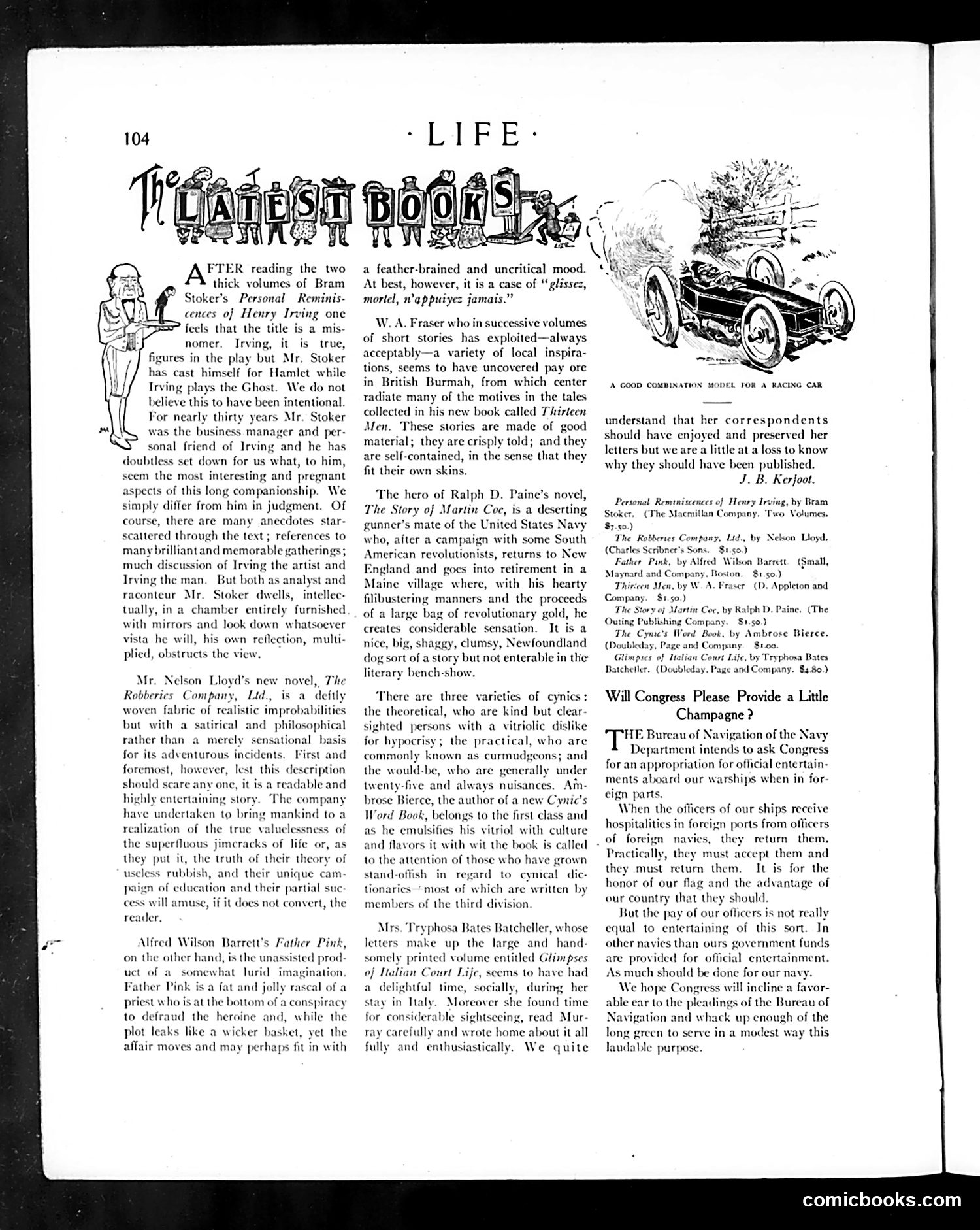
This is a **book review section**, not a political cartoon. The page features a stylized header illustration showing a racing car—likely referencing a book being reviewed—but the content is primarily literary criticism. The reviewer discusses several new novels with frank, sometimes cutting assessments. Key targets include: - **Bram Stoker's memoir** of actor Henry Irving: criticized for being self-absorbed (Stoker casts himself as Hamlet while Irving plays the Ghost) - **Nelson Lloyd's novel** about a company spreading philosophy on life's uselessness: deemed entertaining but preachy - **Alfred Wilson Barrett's Father Pink**: dismissed as luridly imaginative but poorly plotted - **Ambrose Bierce's Cynic's Word Book**: praised for combining cynicism with culture and wit The tone is **witty and dismissive**, using barbed comparisons (one novel "leaks like a wicker basket"). The reviews reflect early 20th-century literary standards emphasizing character, structure, and intellectual substance over mere entertainment.
📄 Transcribed text from this page (OCR, searchable)
Machine-transcribed from the original scan — historical spelling and the odd misread are preserved.
FTER reading the two thick volumes of Bram Stoker’s Personal Reminis- cences of Henry Irving one feels that the title is a mis- nomer. Irving, it is true, figures in the play but Mr. Stoker has cast himself for Hamlet while Irving plays the Ghost. We do not believe this to have been intentional. For nearly thirty years Mr. Stoker was the business manager and per- sonal friend of Irving and he has doubtless set down for us what, to him, seem the most interesting and pregnant aspects of this long companionship. We simply differ from him in judgment. Of course, there are many anecdotes star- scattered through the text; references to many brilliantand memorable gatherings; much discussion of Irving the artist and Irving the man. But both as analyst and raconteur Mr. Stoker dwells, intellec- tually, ina chamber entirely furnished with mirrors and look down whatsoever vista he will, his own reflection, multi- plied, obstructs the view. Mr. Nelson Lloyd's new novel, The Robberies Company, Ltd., is a deftly woven fabric of realistic improbabilities but with a satirical and_ philosophical rather than a merely sensational basis for its adventurous incidents. First and foremost, however, lest this description should seare any one, it is a readable and highly entertaining story. The company have undertaken to bring mankind to a realization of the true valuclessness of the superfluous jimeracks of life or, as they put it, the truth of their theory of useless rubbish, and their unique cam paign of education and their partial suc- cess will amuse, if it does not convert, the reader, Aired Wilson Barrett's Father Pink, on the other hand, is the unassisted prod- uct of a somewhat lurid imagination. Father Pink is a fat and jolly rascal of a priest who is at the bottom of a conspiracy to defraud the heroine and, while the plot leaks like a wicker basket, yet the affair moves and may perhaps fit in with a feather-brained and uncritical mood. At best, however, it is a case of ‘‘glissez, mortel, n’appuiyes jamais.” W. A. Fraser who in successive volumes of short stories has exploited—always acceptably—a variety of local inspira- tions, seems to have uncovered pay ore in British Burmah, from which center radiate many of the motives in the tales collected in his new book called Thirteen Men. These stories are made of good material; they are crisply told; and the are self-contained, in the sense that they fit their own skins. The hero of Ralph D. Paine’s novel, The Story oj Martin Coe, is a deserting gunner’s mate of the United States Navy who, after a campaign with some South American revolutionists, returns to New England and goes into retirement in a Maine village where, with his hearty filibustering manners and the proceeds of a large bag of revolutionary gold, he creates considerable sensation. It is a nice, big, shaggy, clumsy, Newfoundland dog sort of a story but not enterable in the literary bench-show. There are three varicties of cynics the theoretical, who are kind but clear- sighted persons with a vitriolic dislik for hypocrisy; the practical, who are commonly known as curmudgeons; and the would-be, who are generally under twenty-five and always nuisances. Ain- brose Bierce, the author of a new Cynic’s Word Book, belongs to the first class and as he emulsifies his vitriol with culture and flavors it with wit the book is called to the attention of those who have grown stand-offish in regard to cynical dic tionaries~ most of which are written by members of the third division Mrs. Tryphosa Bates Batcheller, whose letters make up the large and hand- somely printed volume entitled Glimpses of Italian Court Lije, seems to have had a delightful time, socially, during her stay in Italy. Moreover she found time for considerable sightseeing, read Mur- ray carefully and wrote home about it all fully and enthusiastically, We quite A GOOD COMDINATION MODEL FOR A RACING CAR understand that her correspondents should have enjoyed and preserved her letters but we are a little at a loss to know why they should have been published. J.B. Kerfoot. Personal Reminiscences of Henry Irving, by Bram Stoker. (T millan Company. Two Volumes. $7.50.) The Robberies Company, Lid. by N (Charles Scribner's Sons. $1.50.) Father Pink, by Alfred Wilson Barrett Maynard and Company. Boston. $1.50.) Thirteen Men, by WA. Fraser (D. Appleton and Company. $1.50.) The Story o} Martin Coc, by Ralph D. Paine. (The Outing Pub! $1.50.) The Cyne's Word Book, by Ambrose Bierce. (Doubleday, Page and Company. $1.00. pres of Holian Court Life, by Tryphosa Bates Batcheller. (Doubleday, Page and Company. $480.) Will Congress Please Provide a Little Champagne ? HE Bureau of Navigation of the Navy Department intends to ask Congress for an appropriation for official entertain- ments aboard our warships when in for- eign parts. When the officers of our ships receive hospitalitics in foreiyn ports from officers of foreign navies, they return them, Practically, they must accept them and they must return them. It is for the honor of our flag and the advantage of our country that they should. But the pay of our officers is not really equal to entertaining of this sort. In other navies than ours government funds are provided for official entertainment. As much should be done for our navy. We hope Congress will incline a favor- able ear to the pleadings of the Bureau of Navigation and whack up cnough of the long green to serve in a modest way this laudable purpose. 0 Lloyd. (Small, hing Company comicbooks.com