
Life, 1907-01-17 · page 32 of 60
Life — January 17, 1907 — page 32: what you’re looking at
What you’re looking at
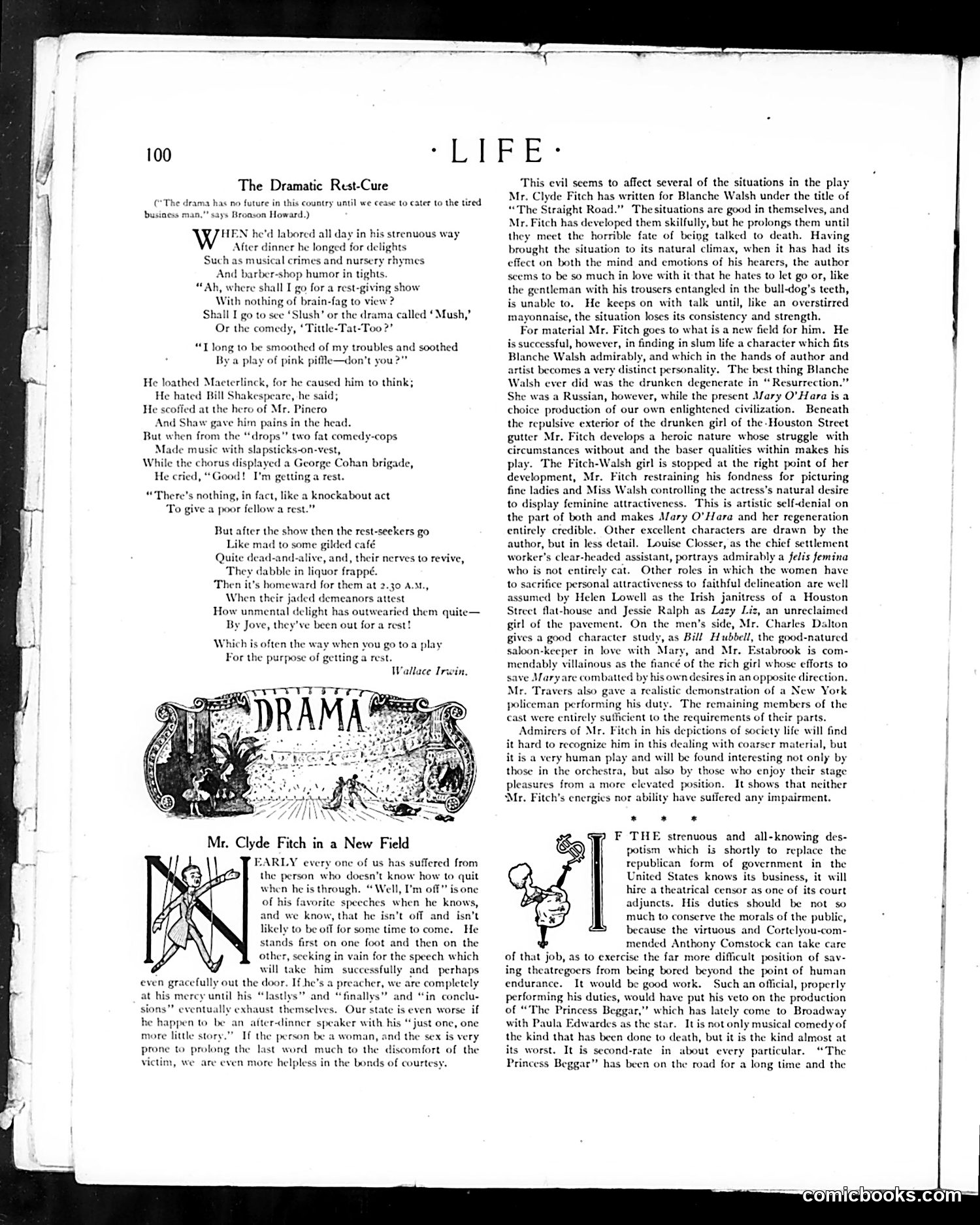
This page satirizes both American theater audiences and playwriting practices circa early 1900s. **The Main Cartoon (by Wallace Irwin):** Mocks tired businessmen who seek "rest" at the theater but choose mindless entertainment—"Slush," "Mush," slapstick comedies with "George Cohan brigades"—over intellectually demanding drama. The joke's punchline: they then exhaust themselves further at late-night cafés, defeating the purpose of rest. **The Drama Critique:** Reviews Clyde Fitch's play "The Straight Road" starring Blanche Walsh. The critic praises Walsh's portrayal of a degraded slum character but faults Fitch for *overextending* scenes past their natural climax through excessive dialogue, causing emotional impact to dissipate—compared unflattering to Walsh's earlier role in "Resurrection." **The Context:** Reflects tensions between "high" drama (Shakespeare, Maeterlinck, Shaw) and popular entertainment, plus Edwardian frustration with social convention—here, people unable to gracefully exit conversations or end dramatic moments.
📄 Transcribed text from this page (OCR, searchable)
Machine-transcribed from the original scan — historical spelling and the odd misread are preserved.
The Dramatic Rest-Cure drama has no future in this country until we cease to cater to the tired n Howard.) HEN he'd labored all day in his strenuous way After dinner he longed for delights Such as musical crimes and nursery rhymes And barber-shop humor in tights , where shall I go for a rest-givin With nothing of brain-fag to view ? Shall I go to see ‘Slush’ or the drama called ‘Mush,’ Or the comedy, ‘Tittle-Tat-Too ?” “T long to be smoothed of my troubles and soothed By a play of pink piffle—don’t you?” show He loathed Macterlinck, for he caused him to think; He hated Bill Shakespeare, he said; He scoffed at the hero of Mr. Pinero And Shaw gave him pains in the head. But when from the “drops”? two fat comedy: Made music with slapsticks-on-vest, While the chorus displayed a George Cohan brigade, He cried, “Good! I'm getting a rest. cops, “There's nothing, in fact, like a knockabout act To give a poor fellow a rest.” But after the show then the rest-seekers go Like mad to some gilded café Quite di They dabble in liquor frappé. ‘Then it's homeward for them at 2.30 A.A, When their jaded demeanors attest How unmental delight has outwearied them quite— By Jove, they've been out for a rest! nerves to revive, Which is often the way when vou go to a play For the purpose of getting a rest. Wallace Irwin, EARLY every one of us has suffered from the person who doesn’t know how to quit when he is through. “Well, I'm off" is one of his favorite speeches when he knows, and we know, that he isn’t off and isn’t likely to be off for some time to come, He stands first on one foot and then on the other, secking in vain for the speech which will take him successfully and perhaps even gracefully out the door. If he’s a preacher, we are completely at his mercy until his “lastlys” and “finallys" and “in conclu- sions” eventually exhaust themselves. Our state is even worse if he happen to be an after-dinner speaker with his “just one, one more little story.” If the person be a woman, and the sex is very prone to prolong the last word much to the discomfort of the victim, we are even more helpless in the Londs of courtesy. ‘LIFE This evil seems to affect several of the situations in the play Mr. Clyde Fitch has written for Blanche Walsh under the title of The Straight Road.” Thesituations are good in themselves, and Mr. Fitch has developed them skilfully, but he prolongs them until they meet the horrible fate of being talked to death. Having brought the situation to its natural climax, when it has had its effect on both the mind and emotions of his hearers, the author scems to be so much in love with it that he hates to let go or, like the gentleman with his trousers entangled in the bull-dog’s teeth, is unable to. He keeps on with talk until, like an overstirred mayonnaise, the situation loses its consistency and strength. ‘or material Mr. Fitch goes to what is a new field for him. He is successful, however, in finding in slum life a character which fits Blanche Walsh admirably, and which in the hands of author and artist becomes a very distinct personality. The best thing Blanche Walsh ever did was the drunken degenerate in “ Resurrection.” She was a Russian, however, while the present Mary O'Hara is a choice production of our own enlightened civilization. Beneath the repulsive exterior of the drunken girl of the Houston Street gutter Mr. Fitch develops a heroic nature whose struggle with ‘umstances without and the baser qualities within makes his y. The Fitch-Walsh girl is stopped at the right point of her development, Mr. Fitch restraining his fondness for picturing fine ladies and Miss Walsh controlling the actress's natural desire to display feminine attractiveness. This is artistic self-denial on the part of both and makes Mary O'Hara and her regeneration entirely credible. Other excellent characters are drawn by the author, but in less detail. Louise Closser, as the chief settlement worker's clear-headed assistant, portrays admirably a felis femina who is not entirely cat. Other roles in which the women have to sacrifice personal attractiveness to faithful delineation are well assumed by Helen Lowell as the Irish janitress of a Houston Strect flat-house and Jessie Ralph as Lazy Lis, an unreclaimed girl of the pavement. On the men’s side, Mr. Charles Dalton gives a good character study, as Bill Hubbell, the good-natured saloon-keeper in love with ™ and Mr. Estabrook is com- mendably villainous as the fiancé of the rich girl whose efforts to save Mary are combatted by his own desires in an opposite direction, Mr. Travers also gave a realistic demonstration of a New York policeman performing his duty. The remaining members of the cast were entirely sufficient to the requirements of their parts. Admirers of Mr. Fitch in his depictions of society life will find it hard to recognize him in this dealing with coarser material, but it is a very human play and will be found interesting not only by those in the orchestra, but also by those who enjoy their stage pleasures from a more clevated position. It shows that neither Mr. Fitch’s energies nor ability have suffered any impairment. * 8 F THE strenuous and all-knowing des- 9) potism which is shortly to replace the republican form of government in the United States knows its business, it will II) hire a theatrical censor as one of its court II) adjuncts. His dutics should be not so a much to conserve the morals of the public, because the virtuous and Cortelyou-com- mended Anthony Comstock can take care of that job, as to exercise the far more difficult position of sav- ing theatregoers from being bored beyond the point of human endurance. It would be good work. Such an official, properly performing his duties, would have put his veto on the production of “The Princess Beggar,”” which has lately come to Broadway with Paula Edwardes as the star. It is not only musical comedy of the kind that has been done to death, but it is the kind almost at its worst. It is second-rate in about every particular. “The Princess Beggar” has been on the road for a long time and the