
Life, 1907-01-17 · page 37 of 60
Life — January 17, 1907 — page 37: what you’re looking at
What you’re looking at
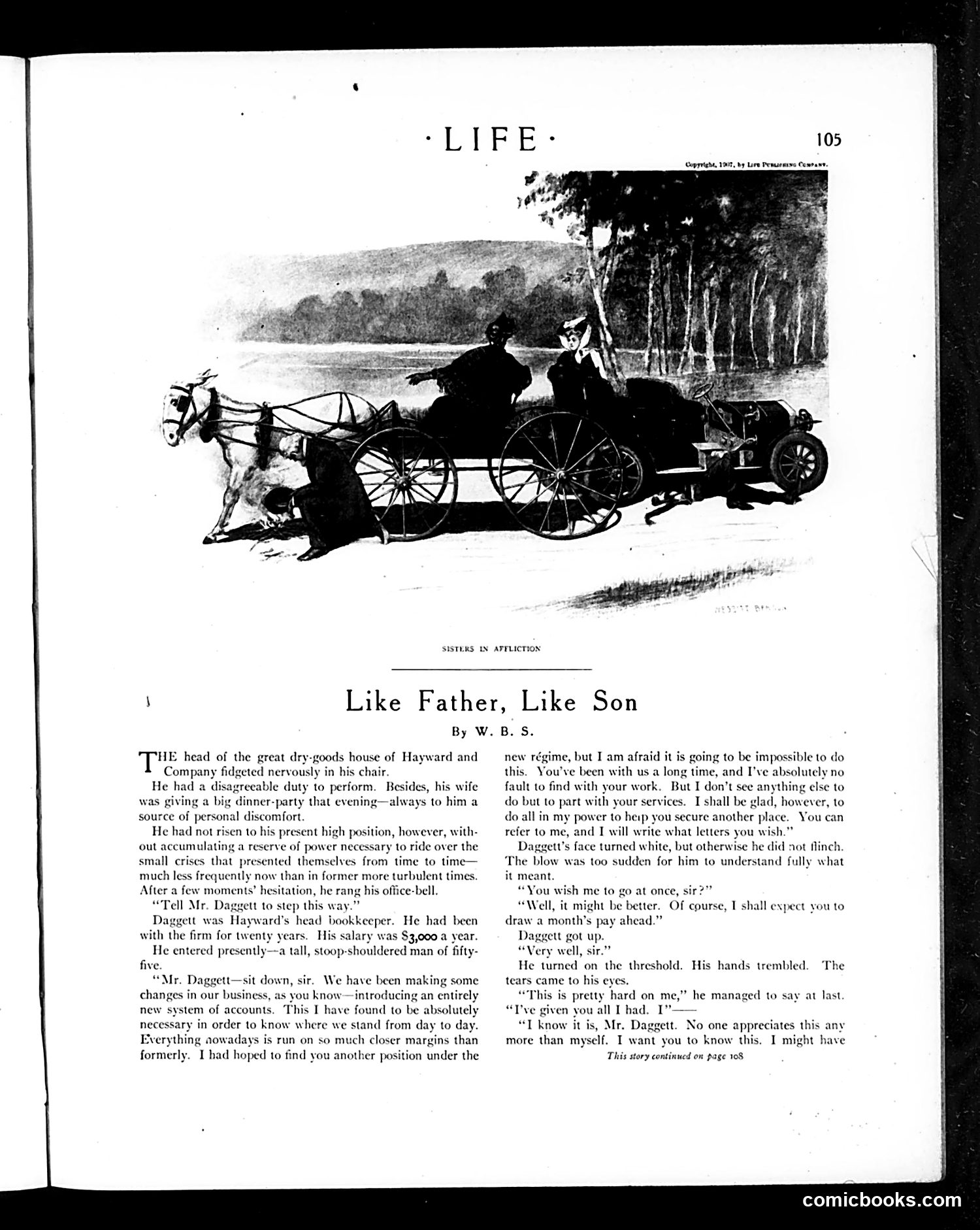
This is the opening of a serialized short story rather than a political cartoon. The illustration shows a horse-drawn carriage alongside an early automobile, symbolizing the clash between old and new technology. The story depicts a common late-19th/early-20th century social anxiety: modernization's human cost. A wealthy department store owner, Mr. Hayward, must fire his loyal 55-year-old bookkeeper of twenty years, Mr. Daggett, due to implementing new accounting systems that have made his position obsolete. The narrative explores how "progress"—tighter profit margins, modern business methods—requires sacrificing loyal employees. Daggett's emotional devastation ("tears came to his eyes") contrasts sharply with Hayward's polite but firm dismissal, exposing the emotional distance between capital and labor even when both parties act "civilly." The title suggests Daggett's son likely faces similar economic displacement, indicating this is a systemic rather than individual problem—the story continues on page 108.
📄 Transcribed text from this page (OCR, searchable)
Machine-transcribed from the original scan — historical spelling and the odd misread are preserved.
SISTERS IN AFTLICTION Like Father, Like Son By W. B.S. T! E head of the great dry-goods house of Hayward and Company fidgeted nervously in his chair. He had a disagreeable duty to perform. Besides, his wife was giving a big dinner-party that evening—always to him a source of personal discomfort He had not risen to his present high position, however, with- out accumulating a reserve of power necessary to ride over the small crises that presented themselves from time to time— much less frequently now than in former more turbulent times. After a few moments’ hesitation, he rang his office-bell. “Tell Mr. Daggett to step this way.” Daggett was H. ard’s head bookkeeper. He had been with the firm for twenty years. His salary was $3,000 a year. He entered presently—a tall, stoop-shouldered man of fifty- five. “Mr. Daggett—sit down, sir. We have been making some changes in our business, as you know—introducing an entirely new system of accounts. This I have found to be absolutely necessary in order to know where we stand from day to day. Everything aowadays is run on so much closer margins than formerly. I had hoped to find you another position under the new régime, but I am afraid it is going to be impossible to do this. You've been with us a long time, and I've absolutely no. fault to find with your work. But I don’t see anything else to do but to part with your services. I shall be glad, however, to do all in my power to heip you secure another place. You can refer to me, and I will write what letters you wish.” Daggett’s face turned white, but otherwise he did not flinch. The blow was too sudden for him to understand fully what it meant. “You wish me to go at once, sir?” “Well, it might be better. Of course, T shall expect you to draw a month’s pay ahead.” Daggett got up. “Very well, si He turned on the threshold. His hands trembled. The tears came to his eyes. “This is pretty hard on me,” he managed to say at last “T’ve given you all I had. I”’— “T know it is, Mr. Daggett. No one appreciates this any more than myself. I want you to know this. I might have This story continued on page 108 comicbooks.com