
A complete issue · 44 pages · 1923
Judge — November 17, 1923
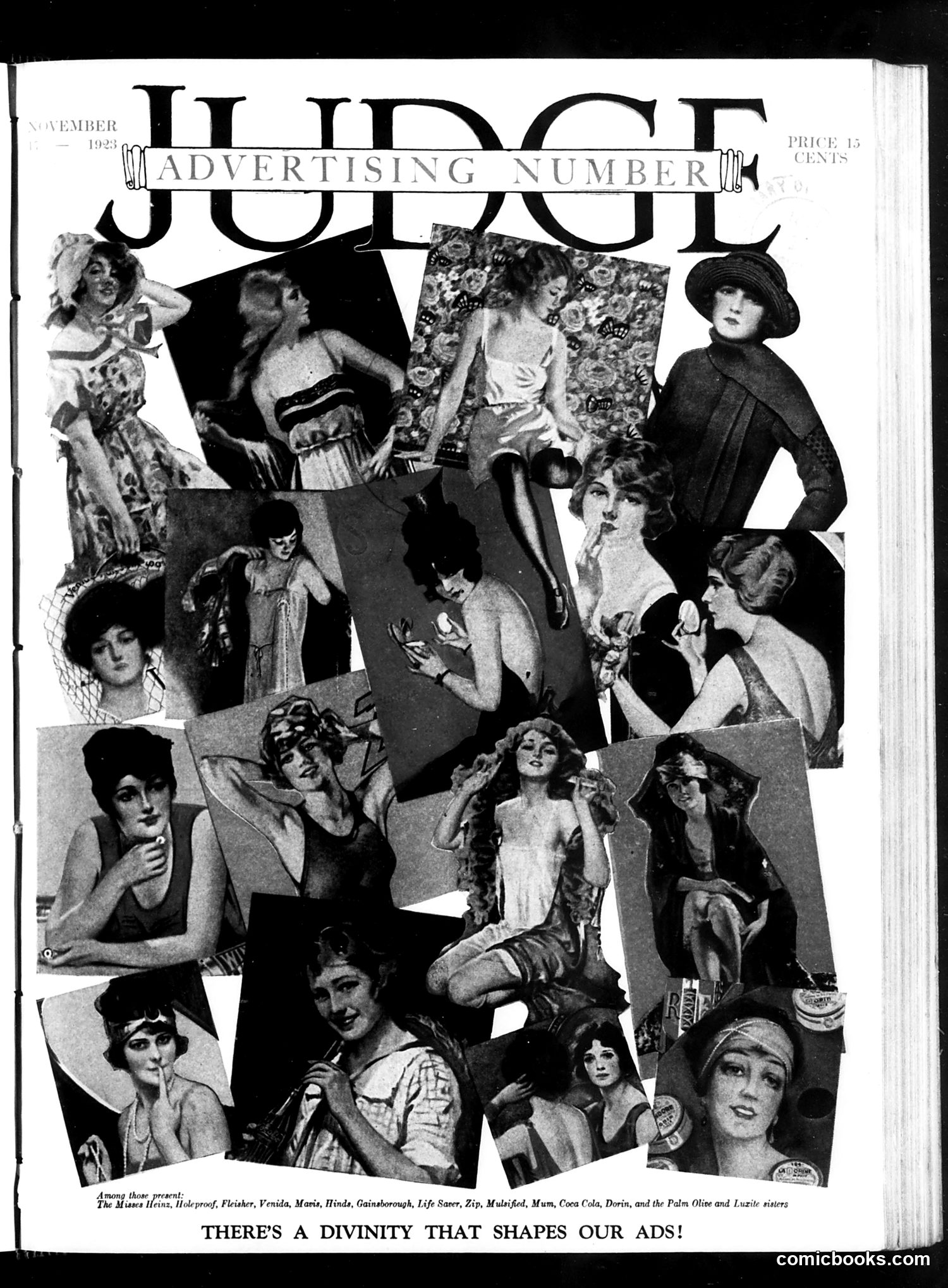
This is the **November 1923 advertising number** of *Judge* magazine (price 15 cents). The page is **primarily advertising content**, not political satire. The cover features a collage of glamorous women's photographs arranged around the large "JUDGE" masthead, with the tagline "THERE'S A DIVINITY THAT SHAPES OUR ADS!" The caption identifies these as "The Mmes Harris, Haleproof, Fletcher, Venida, Munto, Hindo, Gainsborough, Life Savor, Zip, Maidford, Mum, Coco Cola, Doerio, and the Palm Olive and Inglis sisters." These appear to be **brand mascots or advertising spokespersons** for various consumer products (cosmetics, hygiene items, beverages). The satire gently mocks advertising's reliance on feminine imagery and celebrity endorsement—suggesting that advertising creates an almost religious devotion to branded products embodied by idealized women.
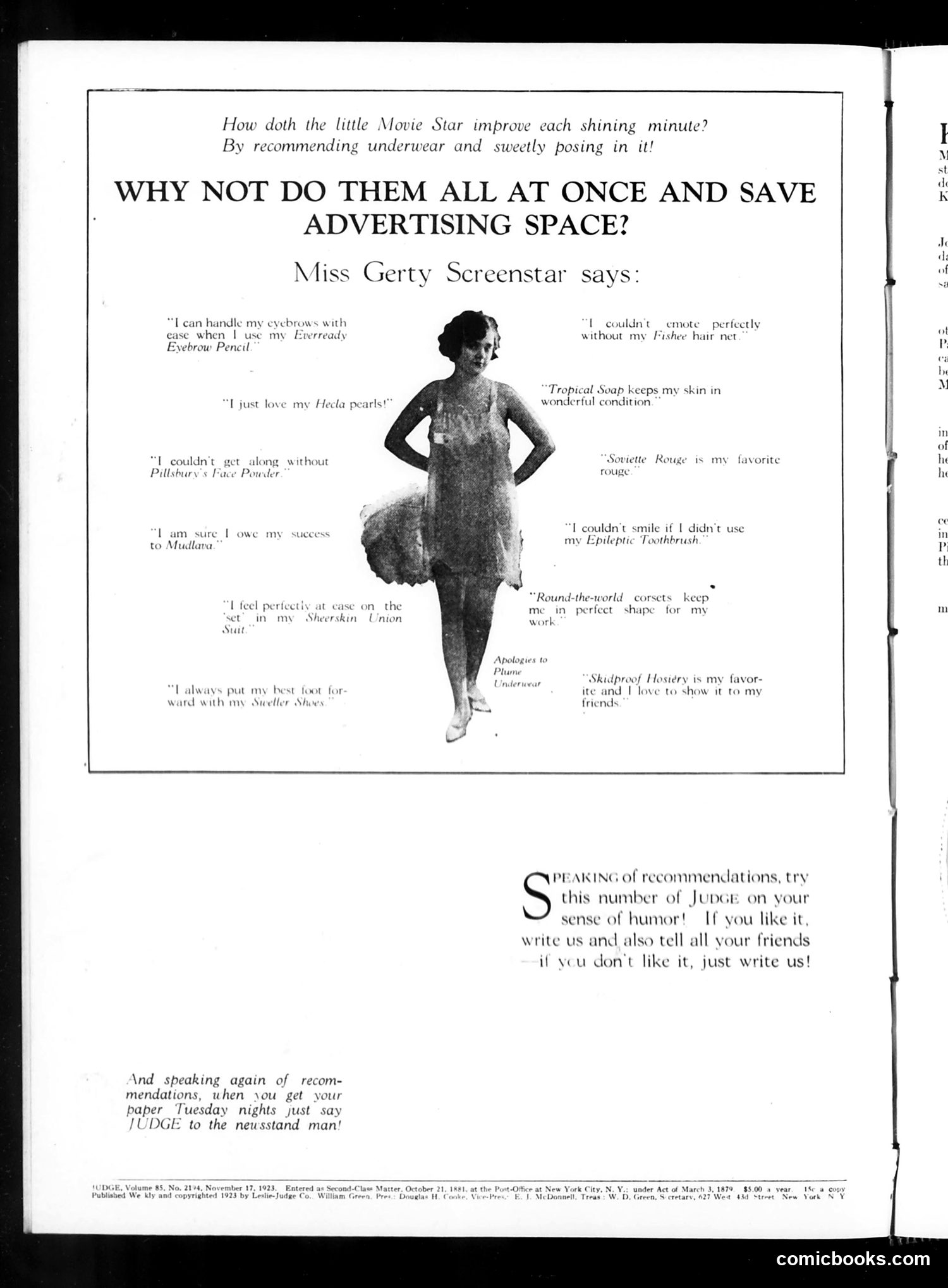
This page is primarily **advertising disguised as satire**. The headline sarcastically asks why celebrities don't endorse all products at once to save advertising space. "Miss Gerty Screenstar" — a fictional movie actress — is surrounded by endorsements for various consumer products (toothbrush, hair net, soap, rouge, corsets, shoes, powder, etc.), each with a quoted testimonial. The satire targets how **celebrities lent credibility to commercial products through endorsements**, a growing marketing practice in the 1920s. The footnote's tongue-in-cheek tone ("write us and tell your friends if you don't like it") further emphasizes the absurdity: one person endorsing dozens of unrelated products would be transparently false advertising. This reflects era concerns about celebrity influence and commercial manipulation.
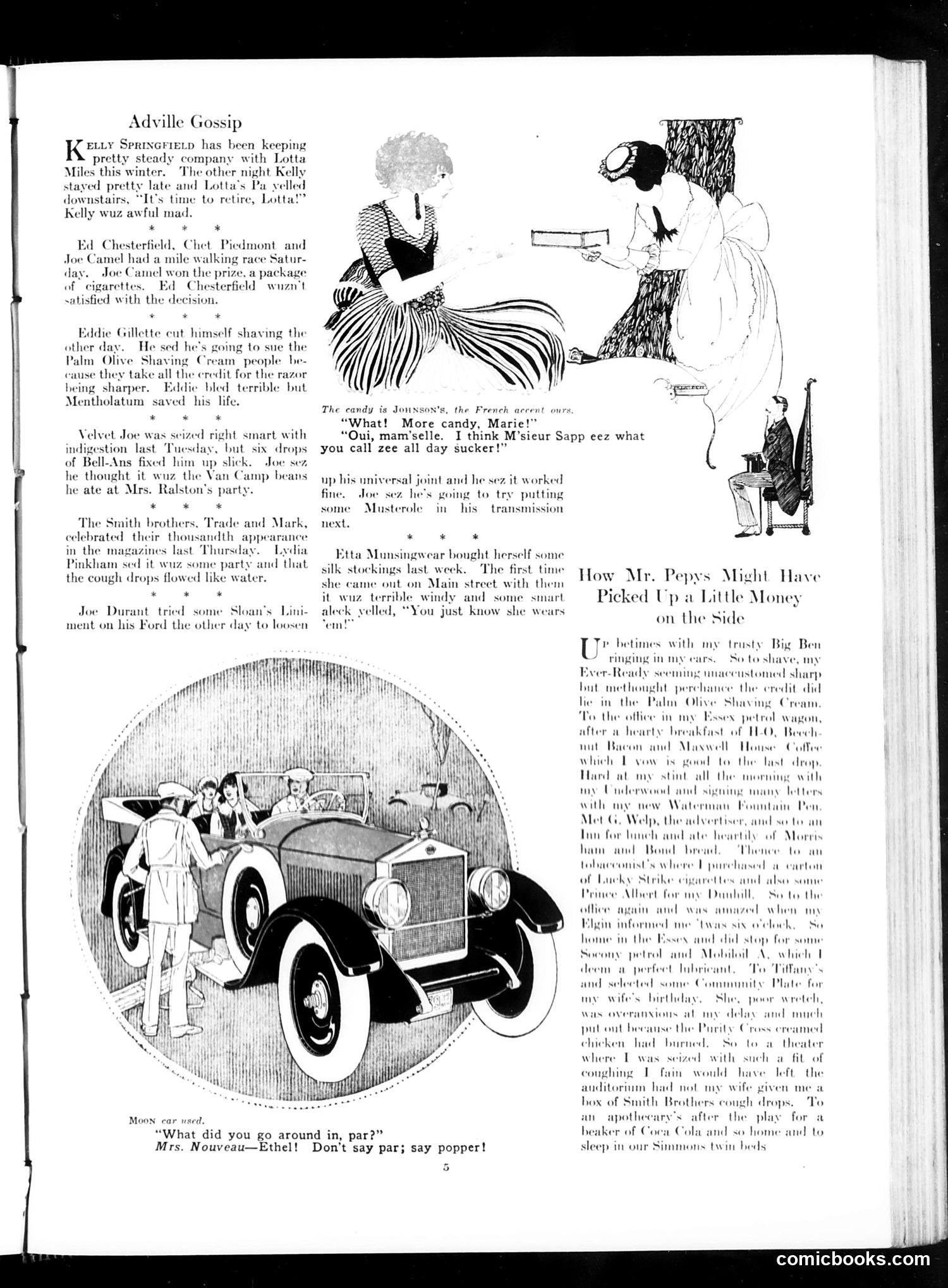
This page contains "Adville Gossip" (social commentary) and two unrelated cartoons. The top section mocks local social figures with small-town scandal: Kelly Springfield staying with Lotta Miles, Ed Chesterfield losing a cigarette package, Eddie Gillett needing a razor blade, and Joe Durant modifying his Ford. These appear to be inside jokes for Judge's contemporary readership. The main cartoon depicts a car with the caption "What did you go around in, par?" / "Mrs. Nouveau—Ethel! Don't say par; say popper!" This satirizes nouveau riche (newly wealthy) pretension—specifically someone mispronouncing "par" (golf term) as "popper," mocking social climbers' affected speech and their ostentatious automobiles. The right column, "How Mr. Pepys Might Have Picked Up a Little Money on the Side," appears to be a separate piece about a character's various small commercial ventures.
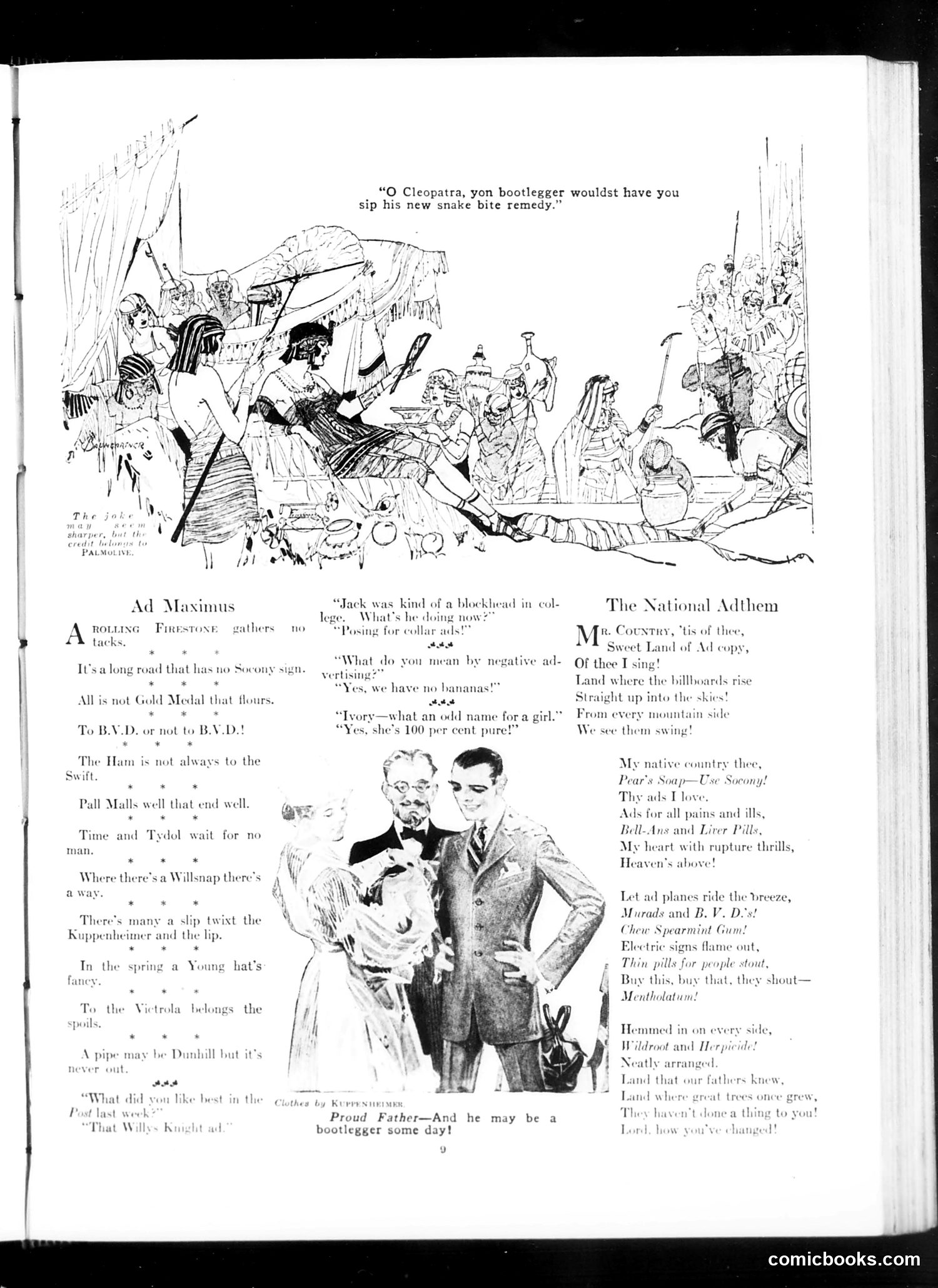
This page contains satirical poetry and advertisements rather than political cartoons. **"Ad Maximus"** is humorous verse mocking advertising culture—critiquing empty slogans ("All is not Gold Medal that flours"), absurd brand names, and consumer gullibility. References like "B.V.D." (a underwear brand) and "Willsnap" suggest early 20th-century products. **"The National Anthem"** parodies patriotic sentiment, sarcastically celebrating America while listing consumer goods ("Billboards," "Pills") as national symbols rather than ideals. The irony suggests commercialism has replaced genuine patriotism. The illustration shows a well-dressed older man with a younger man, captioned about being a "bootlegger"—referencing Prohibition-era illegal alcohol sales. The overall theme critiques American materialism and commercialism masquerading as civic values.
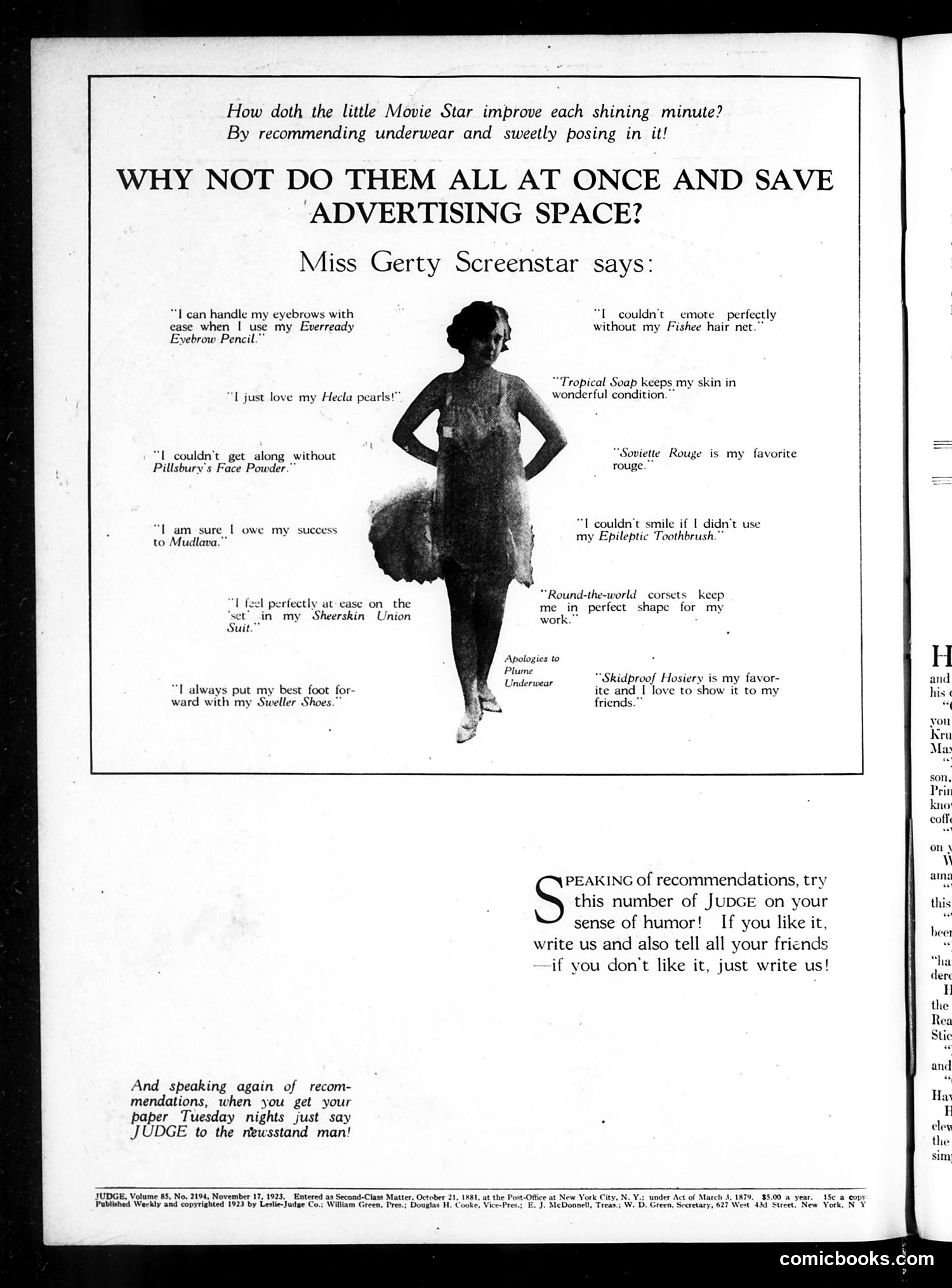
This page satirizes celebrity endorsement advertising through a mock testimonial by "Miss Gerty Screenstar." The central image shows a woman in 1920s fashion surrounded by quotes praising various products—Everready Eyebrow Pencil, Hecla pearls, Pillsbury Face Powder, Mudhora cosmetics, Fishee hair nets, Tropical Soap, Soviette Rouge, Epileptic Toothbrush, Sheerskin Union Suit, Sweller Shoes, and Skidproof Hosiery. The satire targets the absurdity of celebrities endorsing *every* consumer product imaginable to maximize advertising revenue. The headline sarcastically asks why she doesn't endorse everything simultaneously. The joke ridicules how celebrities lend credibility to unrelated products and the growing commercialization of celebrity culture in the 1920s.
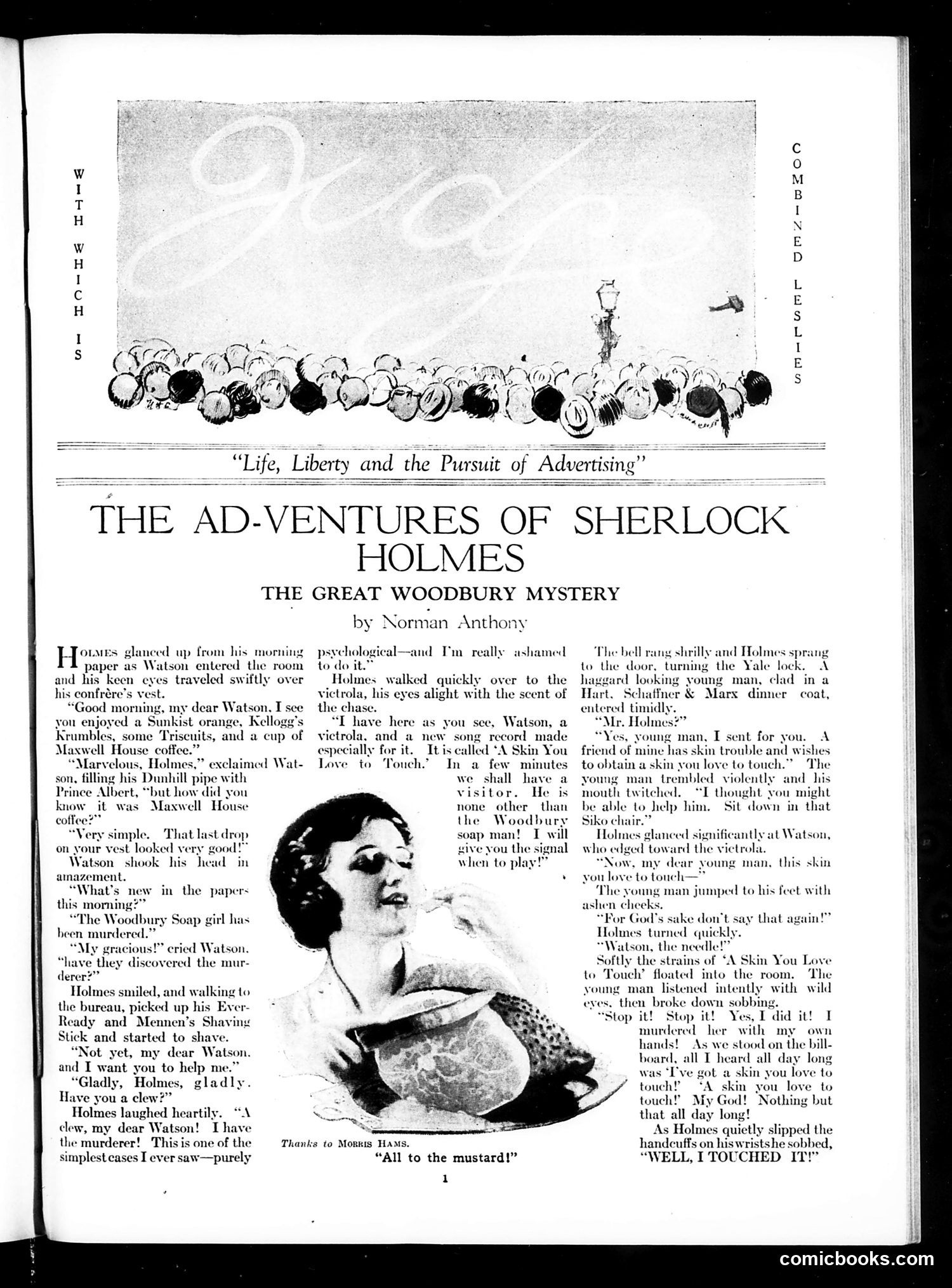
This is a parody of Arthur Conan Doyle's Sherlock Holmes detective stories, satirizing the aggressive advertising that saturated 1920s American media. The joke: Holmes demonstrates his deductive prowess by identifying Watson's breakfast from product placement alone (Sunkist oranges, Kellogg's cereal, Triscuits, Maxwell House coffee, Dunhill pipes, Prince Albert tobacco, Mennen's shaving cream). The "mystery" is solved when a young man confesses to murder because the advertising jingle "A Skin You Love to Touch" (for Woodbury soap) drove him to madness—he heard it constantly everywhere. The satire targets how pervasive and inescapable commercial advertising had become, particularly beauty product ads that promised transformation. The punchline—"WELL, I TOUCHED IT!"—suggests the absurdity of products making exaggerated claims about their effects on consumers. Norman Anthony critiques consumerism itself as invasive and psychologically damaging.
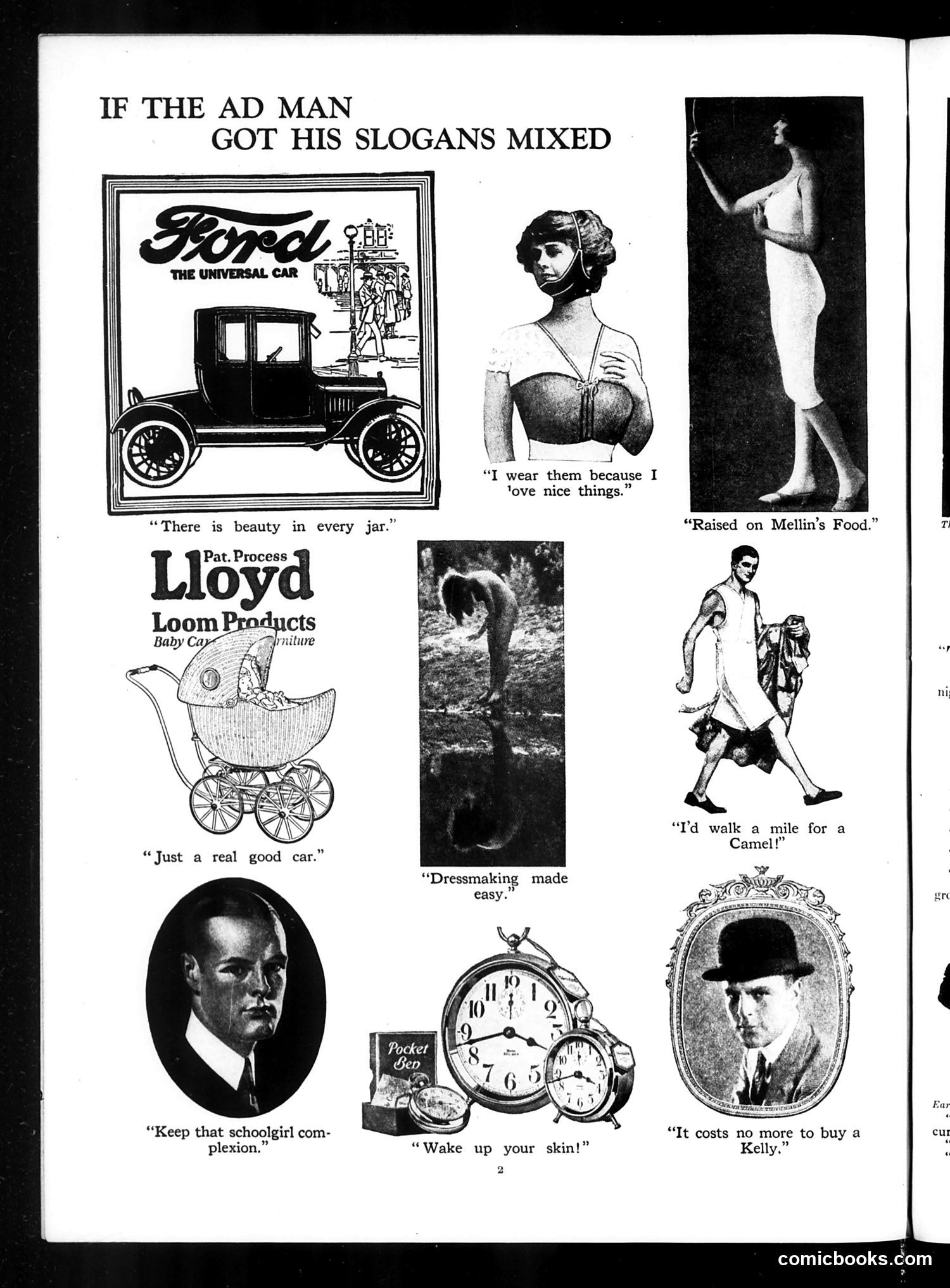
This satire imagines what would happen if famous advertising slogans were randomly reassigned to the wrong products. For instance, Ford automobiles' slogan "There is beauty in every jar" (meant for jars of something) is crossed with Lloyd baby carriages getting "Just a real good car." A woman in a corset receives Mellin's Food's slogan "Raised on Mellin's Food," while Camel cigarettes' famous "I'd walk a mile for a Camel" goes to a man in athletic wear. The joke satirizes how mechanical and interchangeable advertising language had become—slogans were so generic and emotionally manipulative that they could absurdly fit any product. It's a critique of aggressive early-20th-century advertising's vapid, mass-produced appeal and the era's acceptance of such marketing tactics.
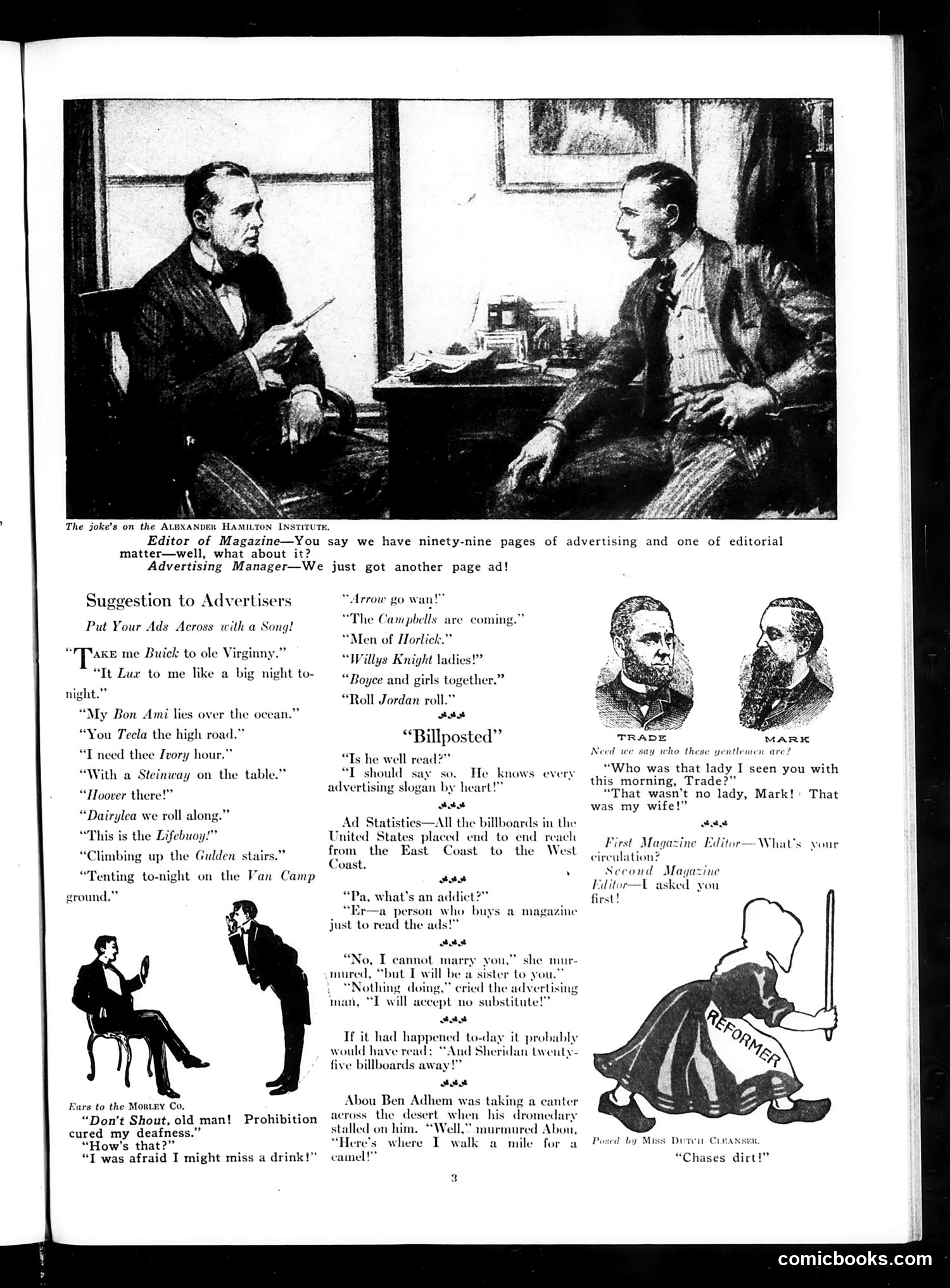
This page satirizes the advertising industry's dominance in American magazines during the early 20th century. The top cartoon jokes that the Alexander Hamilton Institute magazine now has 99 pages of ads but only 1 page of actual editorial content—and they've just sold another ad page, making the ratio even worse. Below, "Suggestion to Advertisers" mocks how advertising slogans have infiltrated popular culture so completely that they've replaced traditional songs and phrases. The "Billposted" section ridicules an advertising addict—someone who buys magazines *solely* to read advertisements. "Ad Statistics" exaggerates the ubiquity of billboards, suggesting they'd stretch coast-to-coast if laid end-to-end. Throughout, the satire targets advertising's cultural saturation and magazines' willingness to sacrifice editorial integrity for ad revenue—a concern that remains relevant today about media business models.
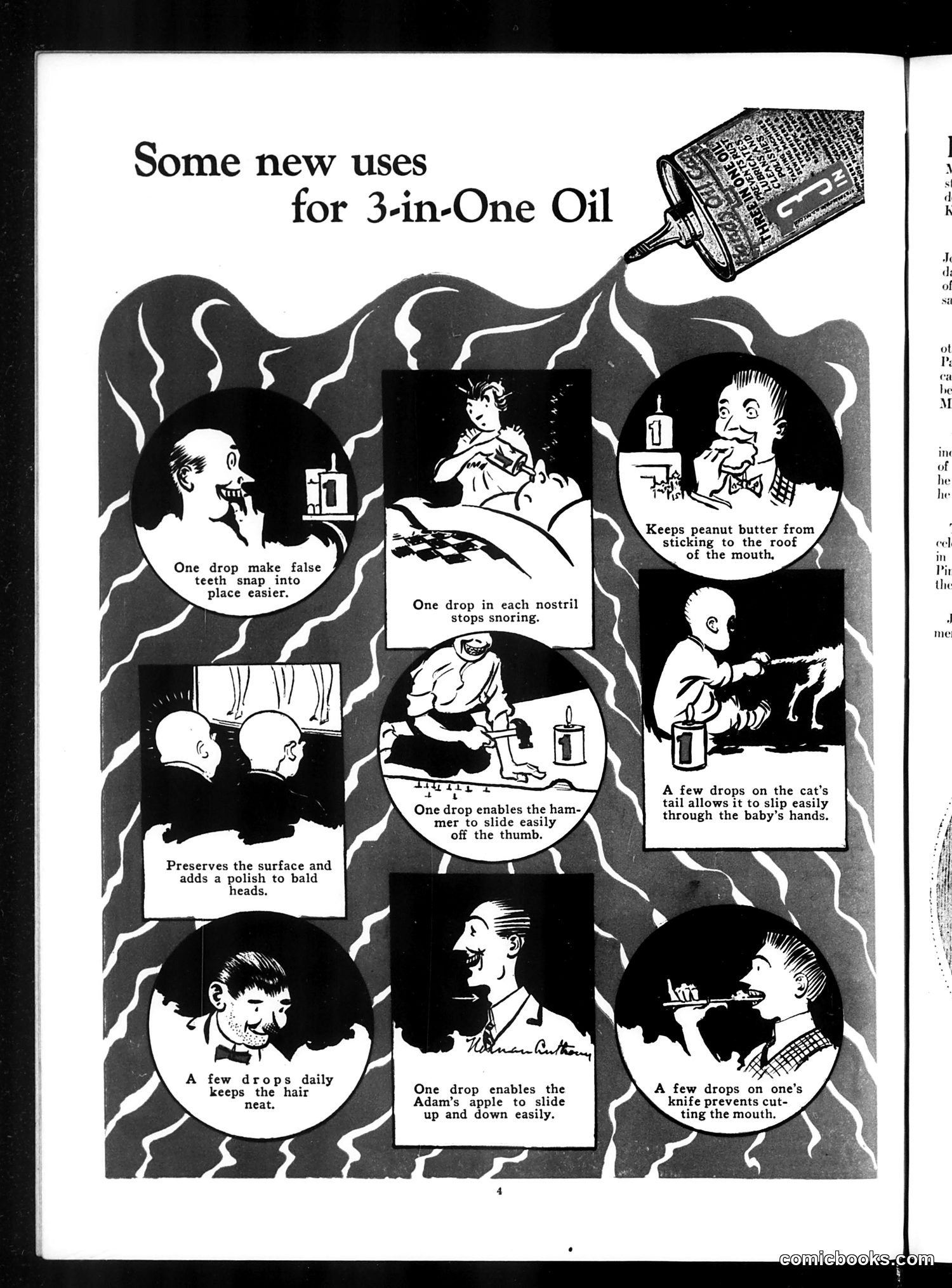
This is a satirical advertisement parody mocking 3-in-One Oil's marketing claims about universal utility. The cartoon presents absurdist "new uses" for the product by applying it to increasingly ridiculous scenarios: Physical comedy targets everyday annoyances (false teeth, snoring, hair care, Adam's apples) alongside genuinely dangerous applications (lubricating knives to prevent cutting one's mouth; making cat tails slippery around babies). The humor relies on the contrast between the product's actual modest purpose and the exaggerated, nonsensical solutions proposed. The satire likely responds to aggressive early-20th-century patent medicine and household product advertising that made extravagant claims about curing virtually any ailment or problem. By taking such marketing logic to absurd extremes—suggesting oil could solve anatomical and behavioral issues—Judge mocks the credulous consumer culture and dubious advertising practices of the era.
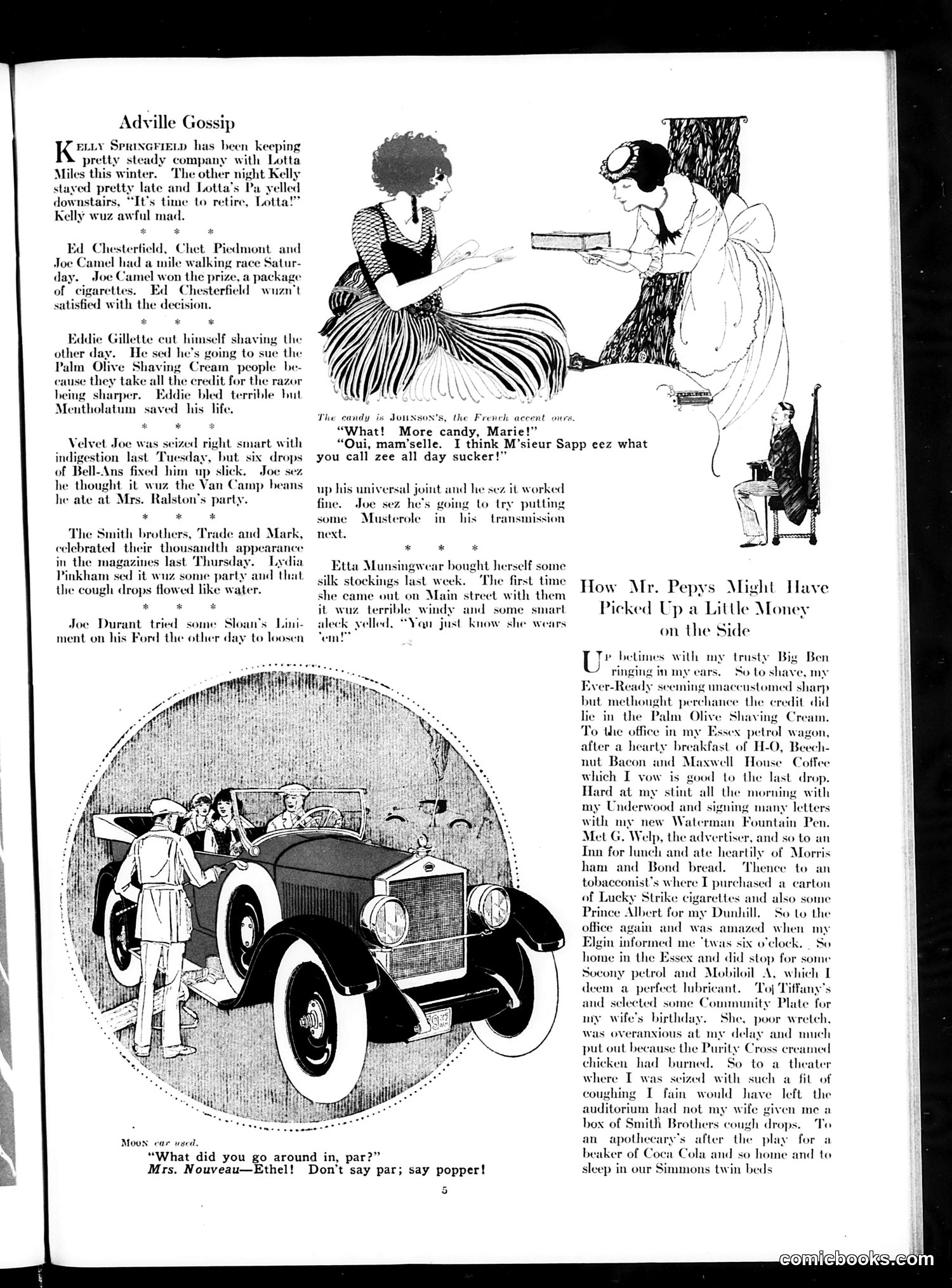
This page contains satirical "gossip" items and advertisements disguised as editorial content—a common Judge magazine format mocking both small-town social pretension and consumer advertising. **The "Adville Gossip" section** is satirizing how product names had infiltrated everyday American speech. Characters with brand names (Eddie Gillette, Joe Camel, Etta Munsingwear, Chet Piedmont) appear in absurd scenarios where the products are hilariously central to their lives. The jokes rely on readers recognizing cigarette, razor, and undergarment brands. **The cartoon** shows a woman asking "What did you go around in, par?" about a car, with the punchline correcting her French pronunciation ("par" → "popper"), satirizing pretentious social climbers. **"How Mr. Pepys Might Have Picked Up Money"** parodies Samuel Pepys's famous diary by having a modern man's day saturated with brand-name product placements—suggesting advertisers essentially pay for product mentions disguised as genuine life narrative. The satire targets both consumer culture's ubiquity and advertising's invasive colonization of language and thought.
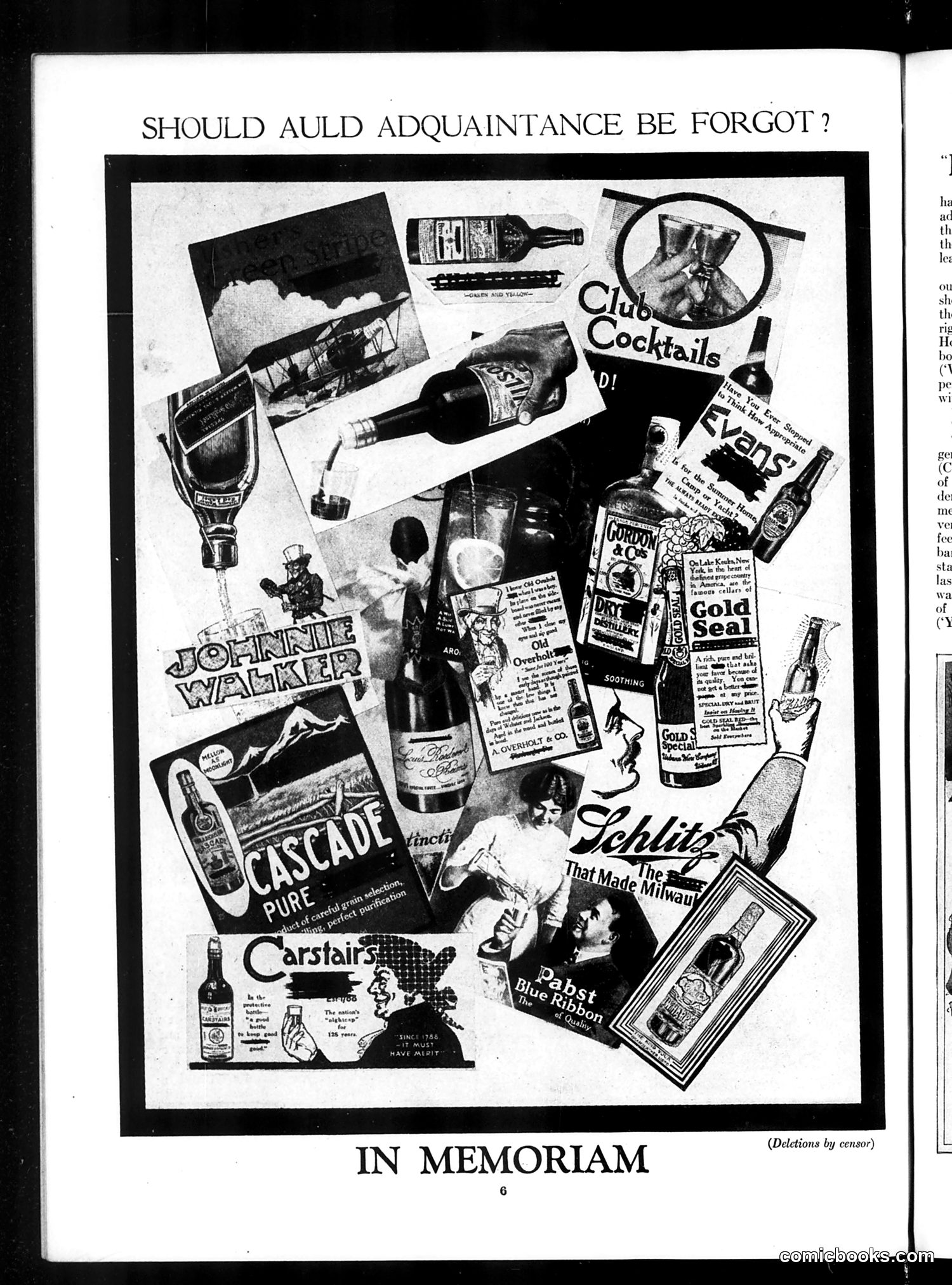
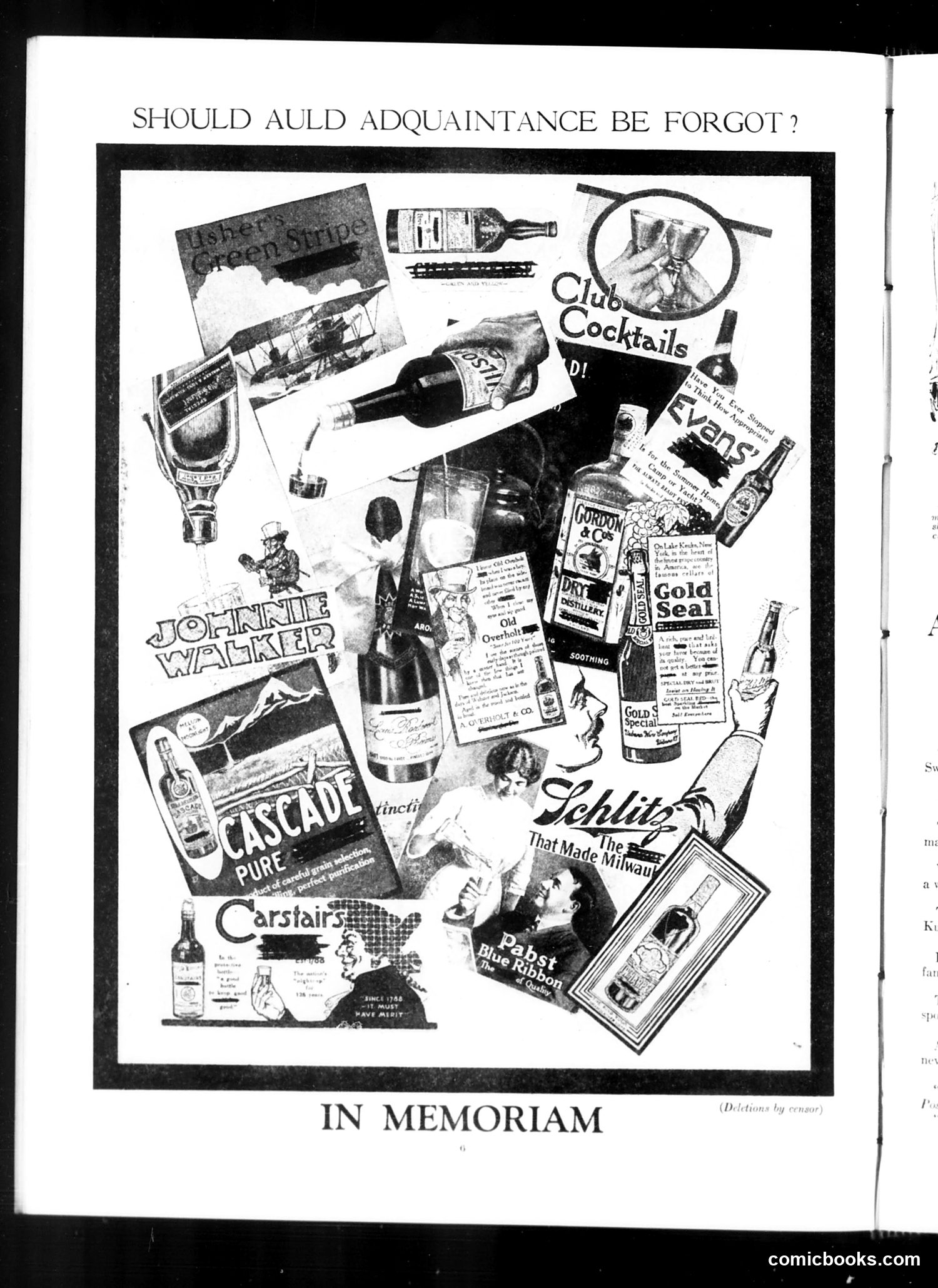
This is a satirical collage mourning the end of Prohibition (1920-1933). The heading "Should Auld Acquaintance Be Forgot?" references the Scottish song "Auld Lang Syne," traditionally sung at farewells. The image displays various alcohol brands—Schlitz, Pabst Blue Ribbon, Cascade, Carstairs, Gordon & Co., and others—arranged as if in a funeral memorial. The presence of champagne glasses, cocktail imagery, and vintage liquor advertisements creates an ironic "in memoriam" tribute to alcoholic beverages that were newly legal again. The parenthetical note "(Deletions by censor)" suggests some content was removed, likely references deemed too risqué or politically sensitive for the era. This page celebrates the repeal of Prohibition through mock-mourning for the "good old days" of prohibition's restrictions.
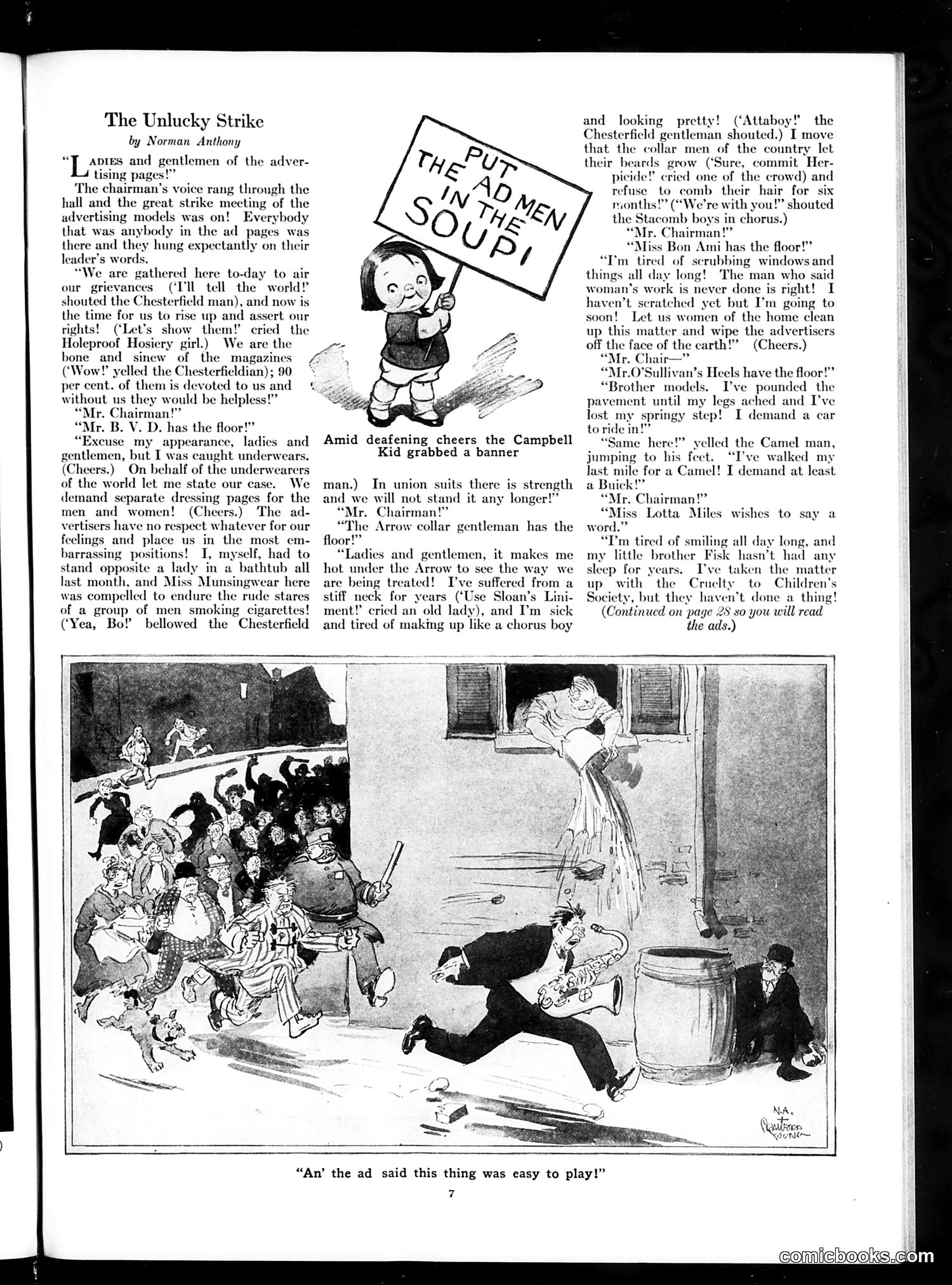
This satirical piece mocks advertising models and mascots who stage a labor strike for better treatment. The cartoon depicts famous brand characters (Chesterfield man, B.V.D. underwear, Arrow collar man, Bon Ami cleaning woman, O'Sullivan heels man, Camel cigarette man, and Fisk the sleeping child) demanding dignity: separate dressing areas, no stiff necks, freedom from constant smiling, reasonable working hours, and transportation. The satire targets both the models' complaints and the advertising industry itself. The joke is that these are fictional characters complaining about conditions that only exist in advertisements—they have no real labor rights because they aren't real workers. The final caption ("An' the ad said this thing was easy to play!") and the page's note to "read the ads" suggest advertisers themselves are the real subjects of ridicule for their unrealistic, exploitative portrayals of work and lifestyle.
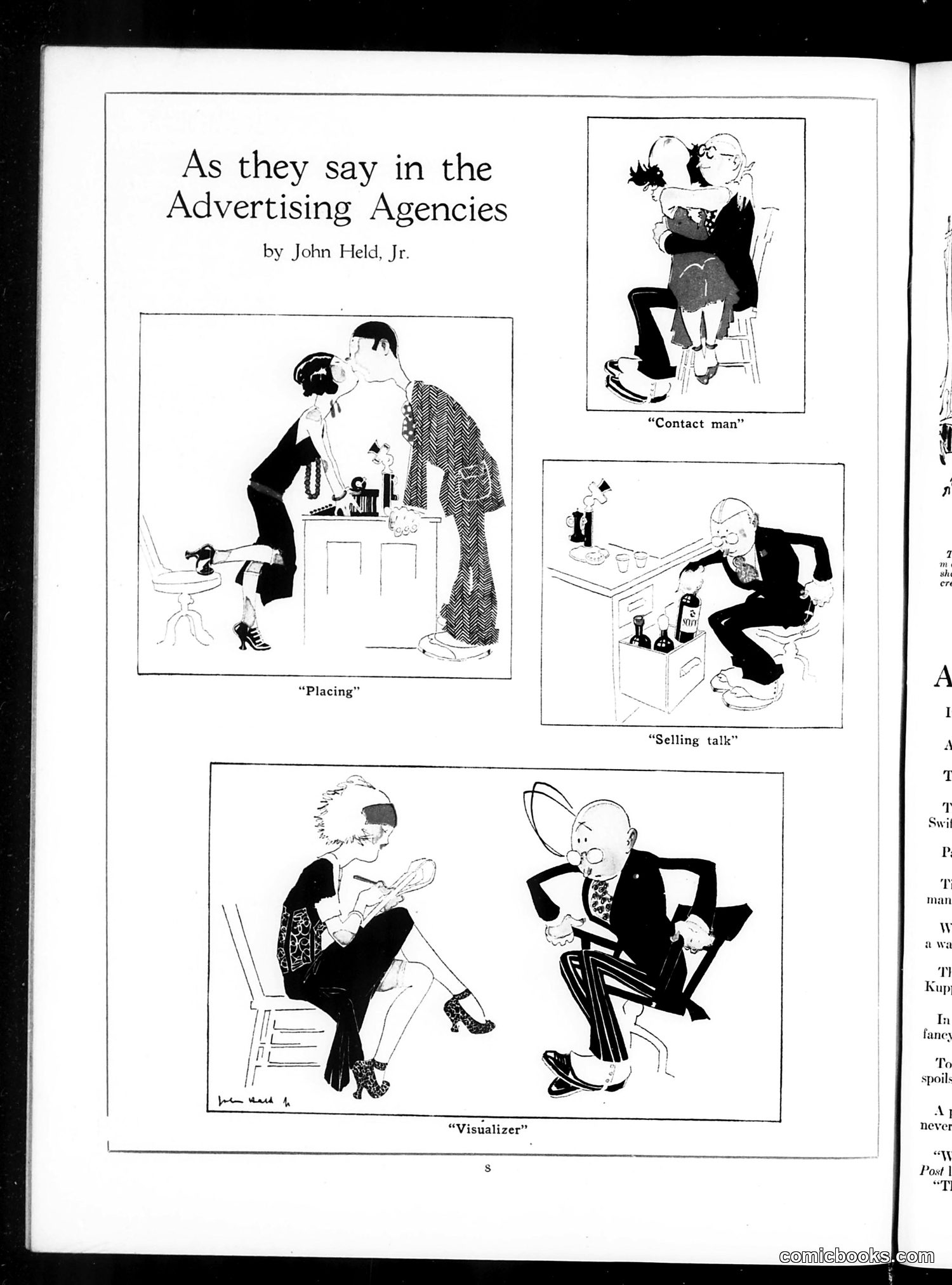
This page by John Held Jr. satirizes advertising agency jargon and professional types circa the 1920s-30s. Four cartoon panels labeled with advertising industry terms mock workplace stereotypes: "Placing" shows a woman pitching to a male executive. "Contact man" depicts someone juggling clients. "Selling talk" shows aggressive persuasion. "Visualizer" portrays creative types gesturing theatrically. The humor lies in exaggerating these roles' pretentious terminology and affected behavior—the industry's self-important jargon masking ordinary office work. Held's caricatures suggest advertising professionals as superficial hustlers using flowery language to sell campaigns. The satire reflects broader 1920s-30s skepticism toward advertising as a manipulative, fast-talking industry populated by types more concerned with appearance than substance.
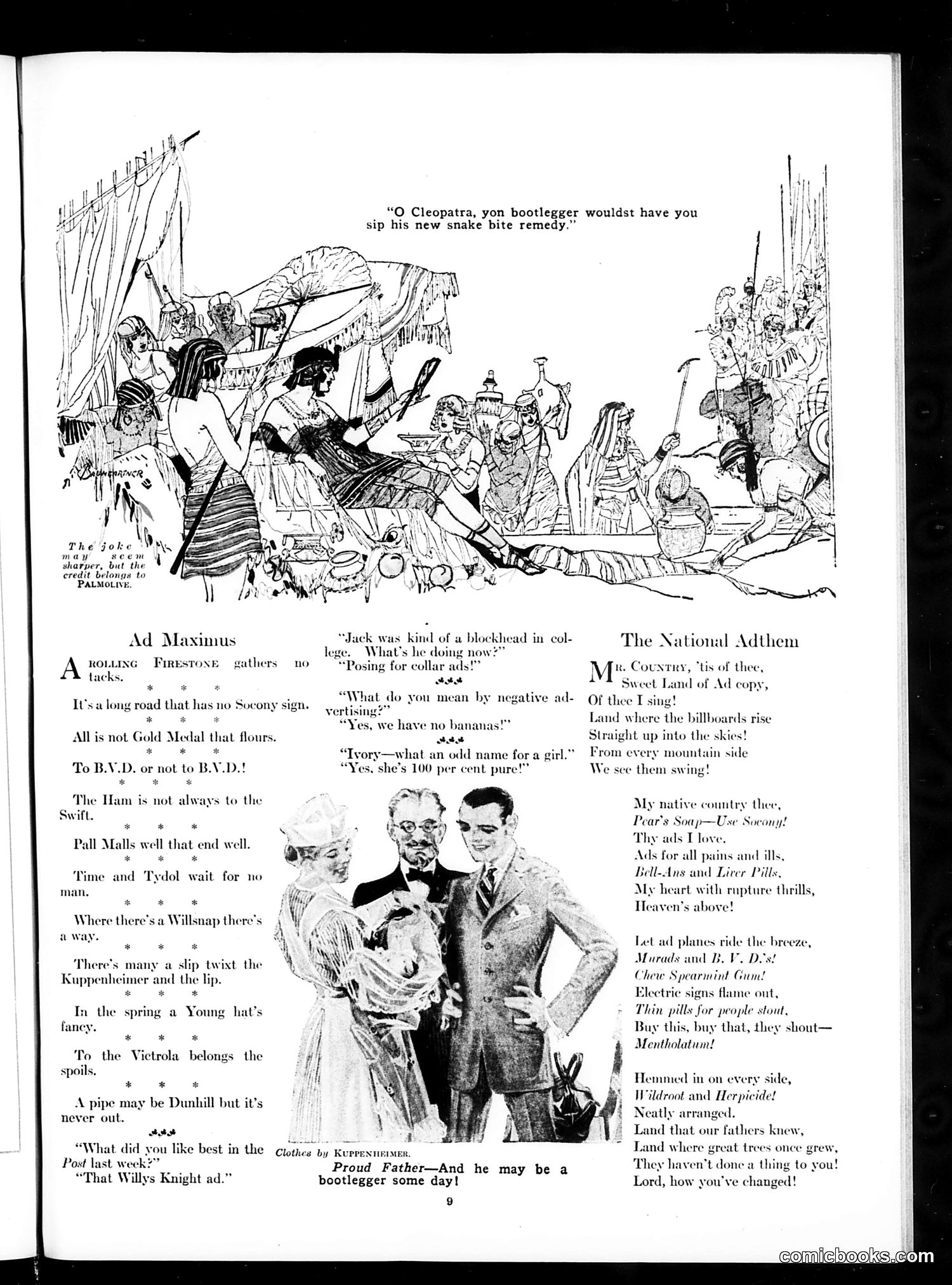
This page from Judge satirizes **advertising's pervasive intrusion into American culture** during the early 20th century (likely 1920s). **The Main Satire:** The top cartoon mocks Cleopatra's era being rewritten as an advertisement—even ancient history now features product placements ("snake bite remedy"). **"Ad Maximus"** section parodies famous sayings by replacing key words with brand names (Socony gasoline, B.V.D. underwear, Palmolive soap, Willys Knight cars, Victrola phonographs). This exposes how advertising language has colonized everyday speech. **"The National Anthem"** is the page's centerpiece: a patriotic song rewritten to celebrate not America's ideals but its **consumer goods**. References to billboards, electric signs, and brands (Pear's Soap, Spearmint Gum, Mentholatum) replacing natural landscape and patriotic values. The final stanza's lament—"Land that our fathers knew... They haven't done a thing to you! Lord, how you've changed!"—expresses nostalgic anxiety about commercialism eroding traditional American values. The satire targets the advertising industry's aggressive expansion into every aspect of culture and speech.
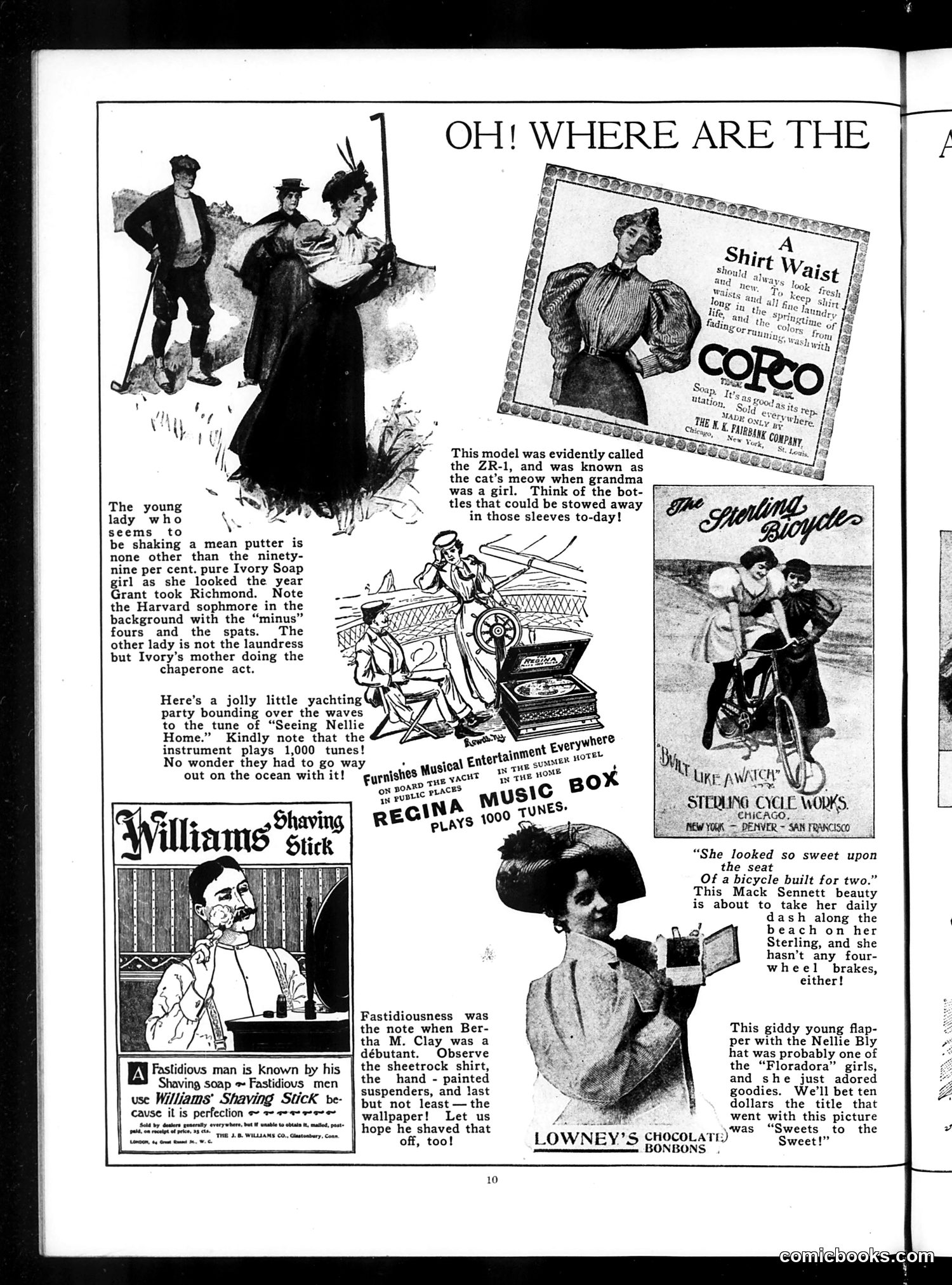
This page is primarily **advertising disguised as satirical commentary** on fashion and social trends. The main cartoon (top) mocks outdated styles by imagining Prohibition-era women in absurdly old-fashioned clothing—specifically referencing the "ZR-1" model (a historical airship, used here as a fashion joke) with exaggerated puffy sleeves that could hide liquor bottles. The satire targets the contrast between modern "flappers" and their Victorian/Edwardian grandmothers' fashion. References to "ninety-nine per cent. pure Ivory Soap girl" and "Harvard sophomore" in outdated "minus fours" (golf knickers) and spats mock elderly fashion sense. The surrounding advertisements for **Coro jewelry, Sterling bicycles, Williams Shaving Stick, and Lowney's chocolates** use similar period-costume imagery to humorously pitch products to young, modern consumers—suggesting these brands appeal to the stylish present, not the dowdy past. The overall message: Progress in fashion equals progress in taste and lifestyle.
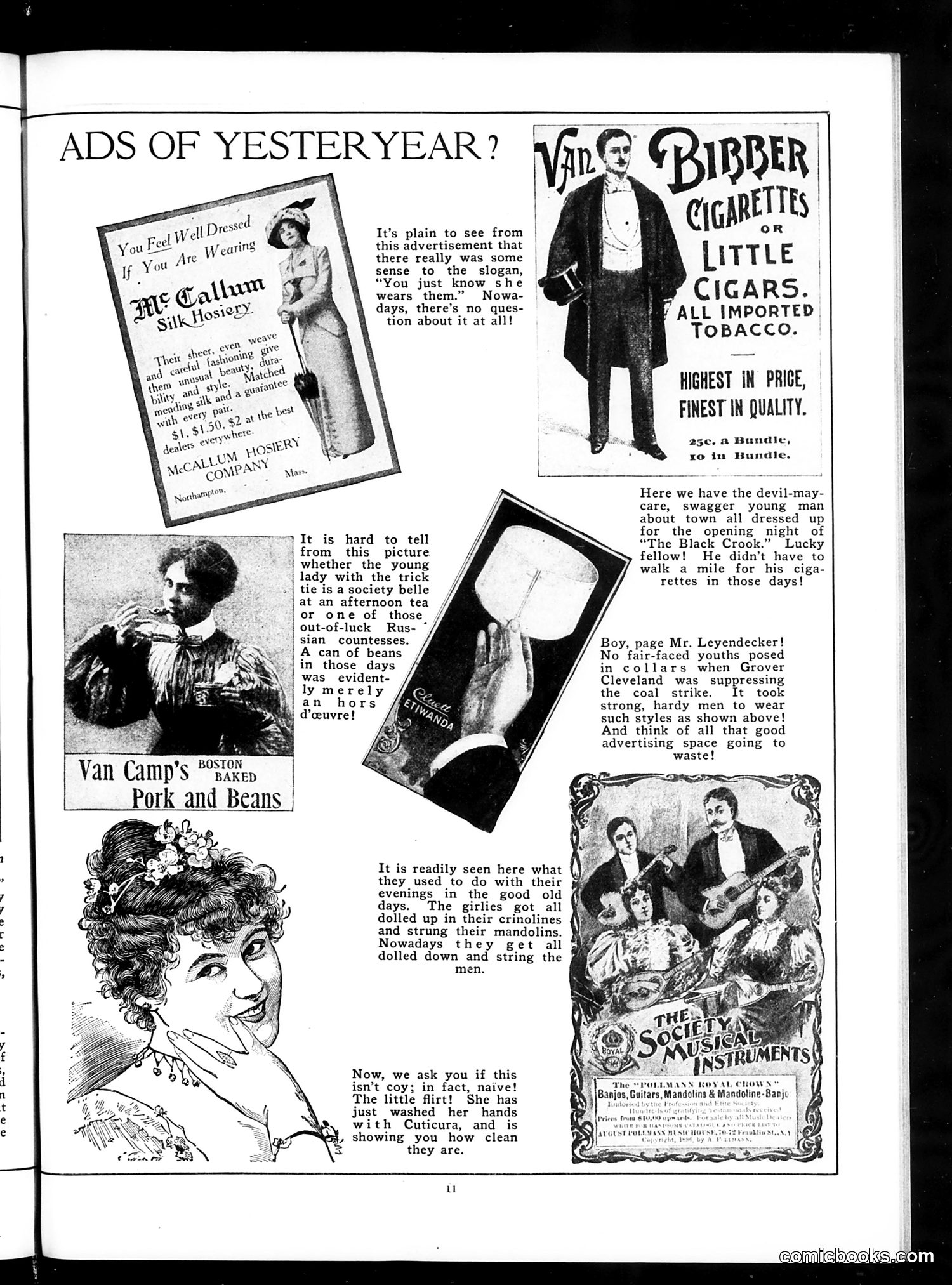
This page satirizes outdated advertising by juxtaposing old product ads with modern commentary mocking their claims and styles. The magazine critiques how advertising has changed since the "good old days." Key targets include: - **McCallum Silk Hosiery**: The text notes the old slogan "You just know she wears them" required faith; now it's plainly obvious. - **Van Camp's Beans**: Sarcastically compares whether the advertised woman is a society lady or impoverished Russian countess—highlighting class pretension in vintage ads. - **Musical instruments ad**: Mocks how women once "dolled up" for evenings playing mandolins; now they "string the men" instead, suggesting modern women are manipulative. - **Cuticura soap**: Ridicules the coy premise of showing clean hands after washing. - **Vail Bibber Cigarettes**: The commentary suggests such premium products required walking miles to obtain, implying modern convenience has diminished their value. The overall satire suggests early advertising relied on naive sentimentality and implausible claims that modern readers would find absurd.
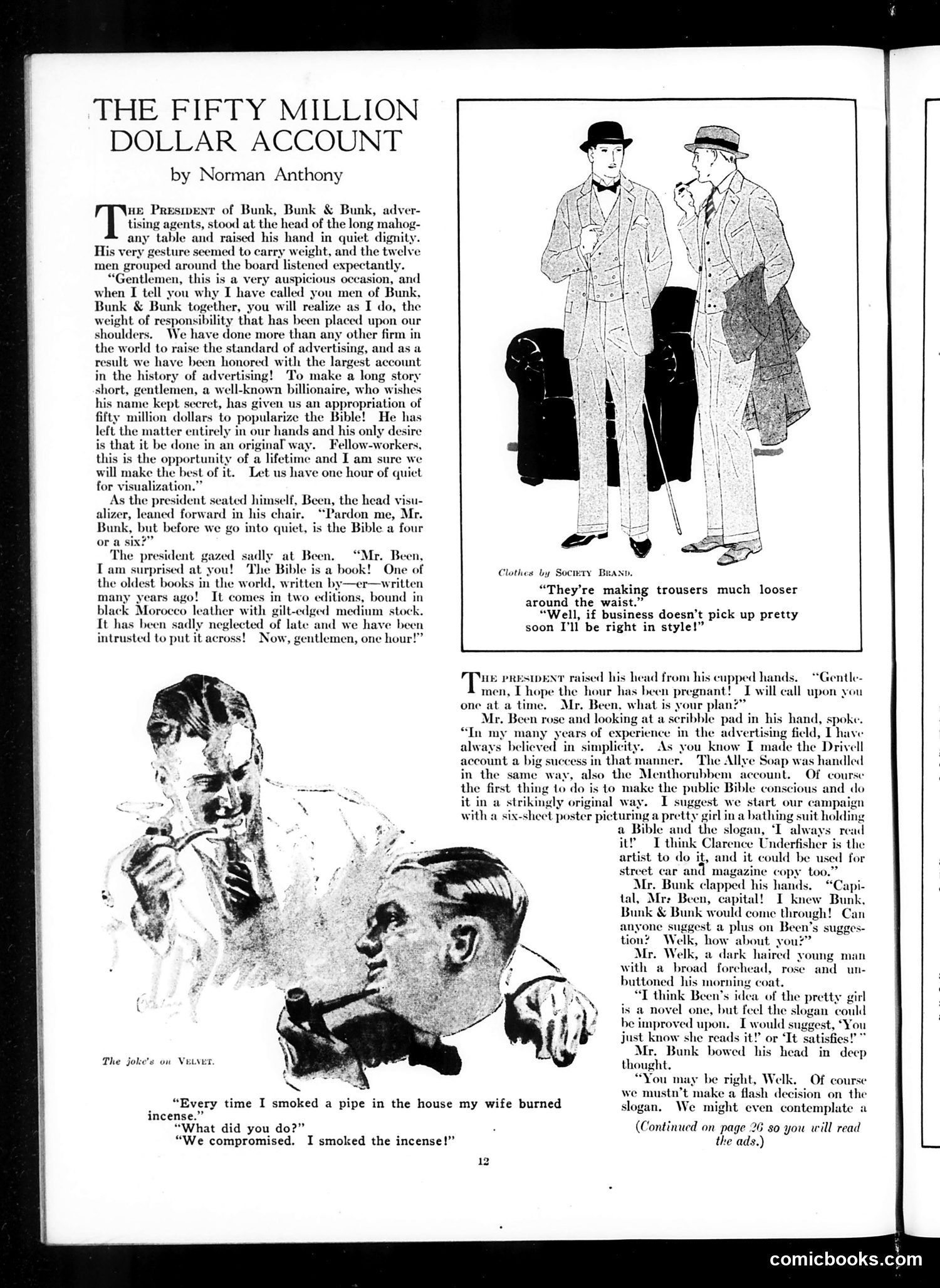
This is a satirical story by Norman Anthony mocking advertising agencies' approach to promoting the Bible. The setup: a prestigious ad firm (Bunk, Bunk & Bunk) receives a $50 million contract from an anonymous billionaire to "popularize" the Bible. The satire targets how advertisers treated any product—even sacred texts—as commodities requiring gimmicky marketing. The proposed campaigns exemplify this: selling the Bible through a pretty girl in a bathing suit with slogans like "I always read it!" (mimicking soap advertisements). The small cartoon below shows a joke about compromise—when a man smoked a pipe indoors, his wife burned incense; they "compromised" by him smoking incense instead. This likely underscores the story's theme: advertising agencies splitting differences on questionable ideas rather than addressing fundamental problems. The page satirizes both advertising's superficiality and the era's discomfort with treating religion as a commercial product to be "sold" like consumer goods.
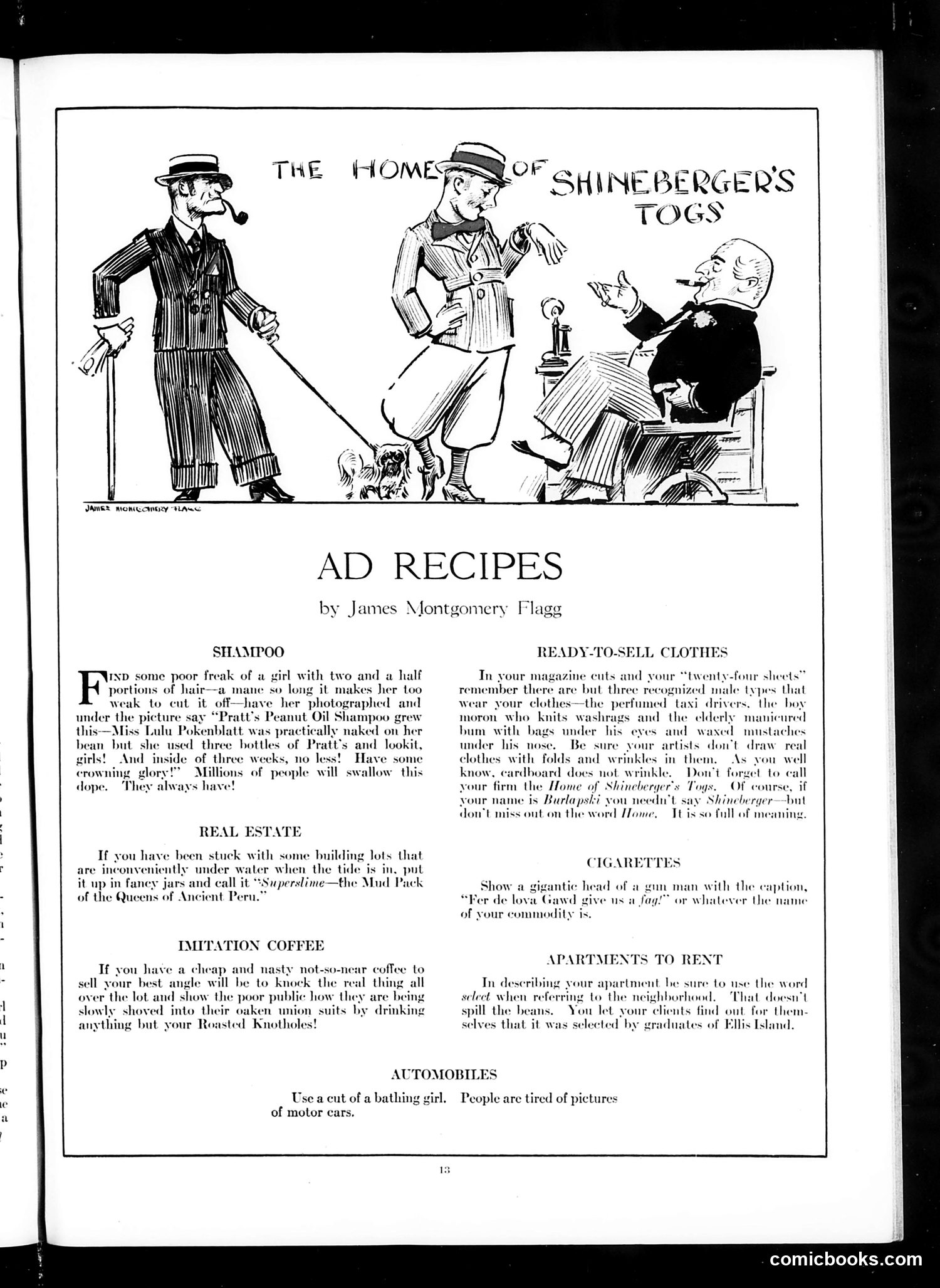
This satirical piece by James Montgomery Flagg mocks deceptive advertising practices of the era. The cartoon shows three well-dressed men (appearing to represent ad men or salespeople) discussing marketing schemes. The "recipes" that follow expose common advertising frauds: using before-and-after photos to sell shampoo, marketing waterlogged real estate as luxury "mud packs," attacking competitor products to sell cheap coffee substitutes, and using clichéd imagery (bathing girls for cars, gun-wielders for cigarettes) rather than honest product depiction. The title mocks one specific advertiser's use of "Home" in their brand name ("Shineberger's Togs"), suggesting the word was purely manipulative marketing jargon meant to sound wholesome while concealing poor quality. Flagg's satire exposes how early-20th-century advertisers deliberately misled consumers through exaggeration, celebrity endorsement, and distraction rather than honest product information.
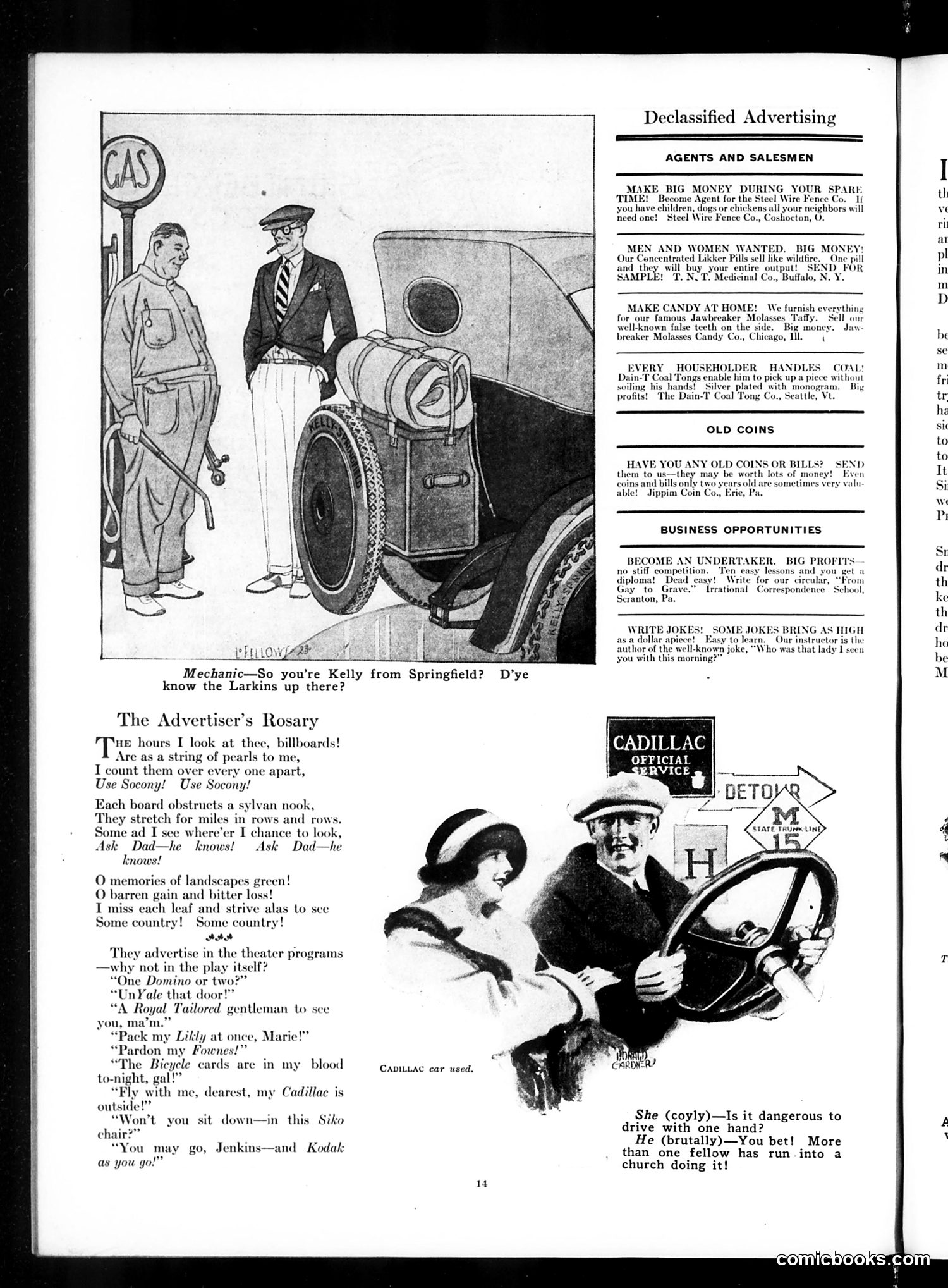
The main cartoon (top) shows a gas station attendant greeting a customer, illustrating a commonplace social interaction of the automobile age. The humor relies on recognizing "Kelly from Springfield" as an unremarkable person—the joke is the attendant's casual familiarity despite likely never meeting this customer. "The Advertiser's Rosary" is satire mocking aggressive advertising saturation. The poem parodies Catholic prayer (a "rosary") while complaining that billboards now obscure natural landscapes everywhere. It then satirizes how advertising has infiltrated entertainment—imagining product placements embedded within theater dialogue itself (mentioning Domino, Cadillac, Kodak, etc.). The bottom Cadillac advertisement contains period-typical flirtation: a woman coyly asks if one-handed driving is dangerous; the man responds brutally that yes, "more than one fellow has run into a church doing it"—dark humor about automobile accidents, then a novel concern. The page is primarily declassified advertising and satirical commentary on consumer culture and advertising's invasiveness.
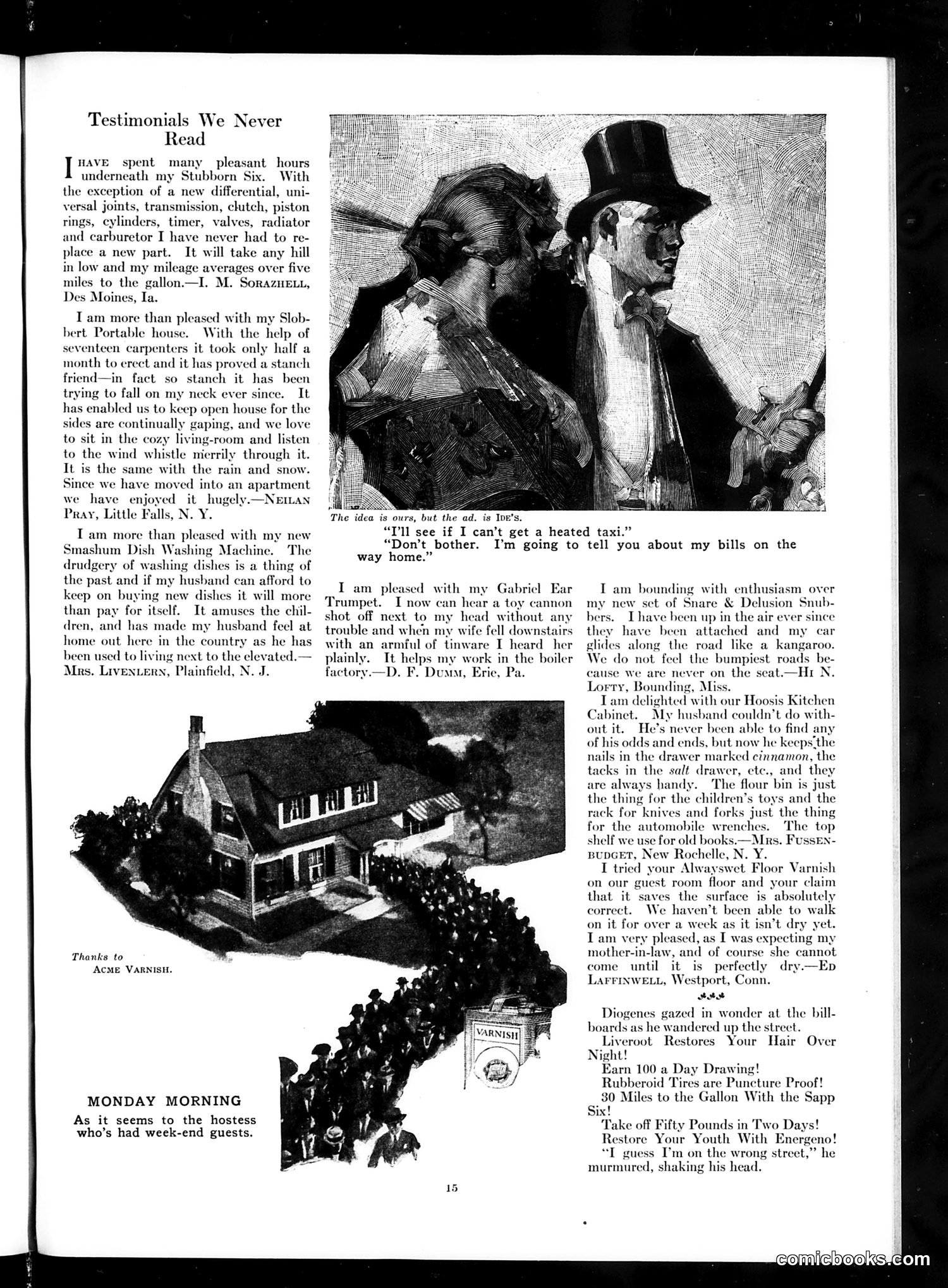
This is a satirical piece mocking exaggerated advertising testimonials of the 1920s. Judge magazine presents fake customer endorsements where the "praise" is actually damning—revealing products' actual failures while maintaining superficially positive language. Examples include: a car requiring multiple major component replacements despite claiming reliability; a portable house so poorly constructed it's "trying to fall on my neck"; a dish washer that breaks dishes faster than it washes them; and floor varnish so slow-drying that guests cannot walk on it for a week. The accompanying cartoon of Diogenes (the ancient Greek philosopher famous for seeking an honest man) wandering past absurd billboard claims ("Earn 100 a Day Drawing!" "Restore Your Youth!") reinforces the satire's point: advertising in this era is fundamentally dishonest. The satire targets the advertising industry's widespread use of fabricated testimonials and outrageous product claims that pervaded early 20th-century American consumer culture.
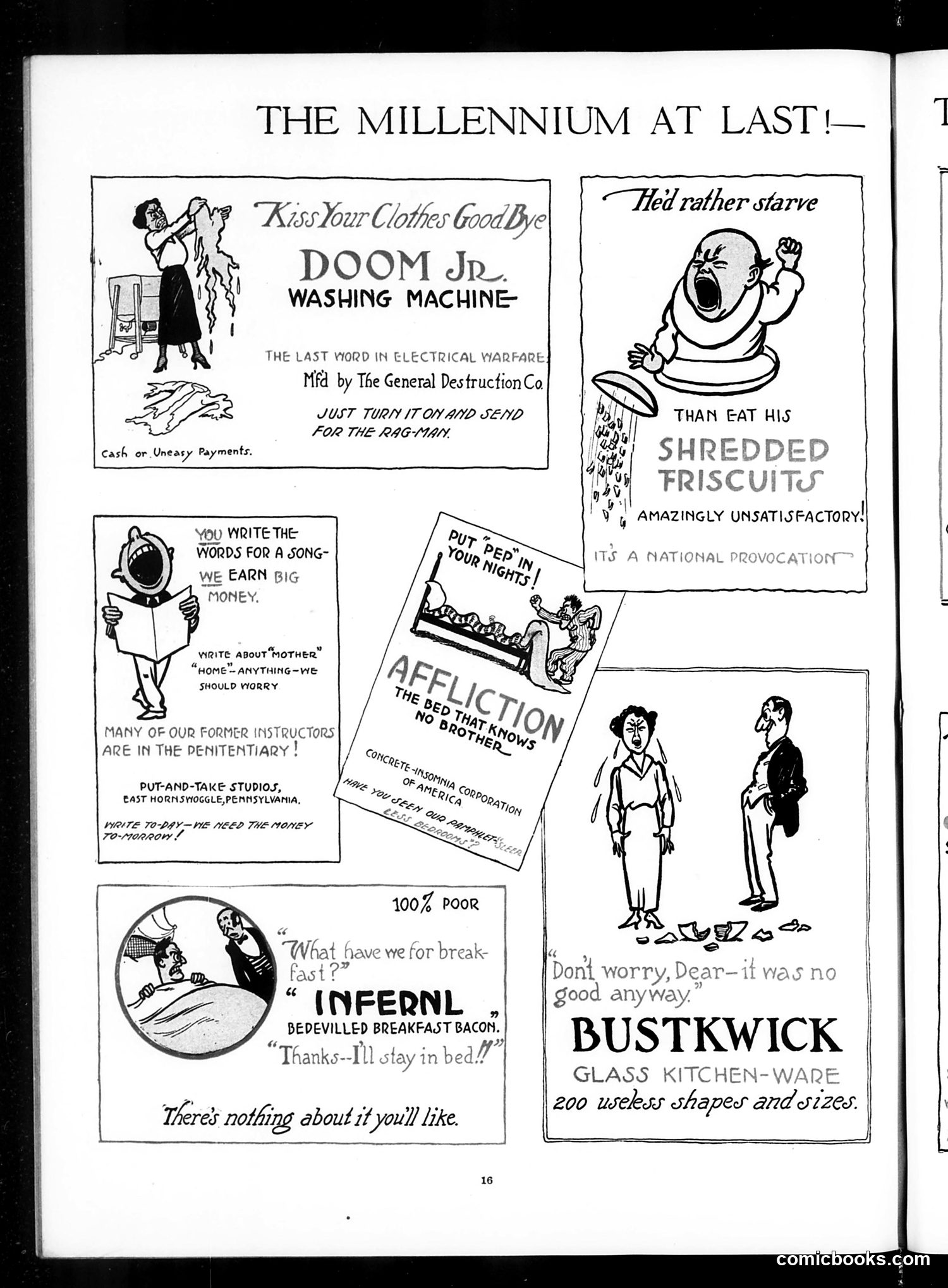
This page mocks emerging 1920s consumer culture and get-rich-quick schemes through fake advertisements. The satirical ads include: - **"Doom Jr. Washing Machine"** (by "General Destruction Co."): Absurdist humor suggesting modern appliances destroy rather than help - **"Put-and-Take Studios"**: Ridicules songwriting mills where anyone could submit lyrics for payment—a real but disreputable industry practice - **"Neerni Breakfast Bacon"**: A product ad where a couple prefers staying in bed to eating breakfast, mocking consumerism's hollow promises - **"Affliction" bed ad**: References a real product; the satire suggests it causes marital problems rather than comfort - **"Bustwick Glass Kitchen-Ware"**: The final joke shows a woman saying broken dishes "were no good anyway"—satirizing low-quality goods marketed as solutions The page title "The Millennium at Last!" ironically suggests these products represent progress. Instead, Judge criticizes widespread fraud, poor manufacturing, and consumer gullibility during this era of rapid commercialization.
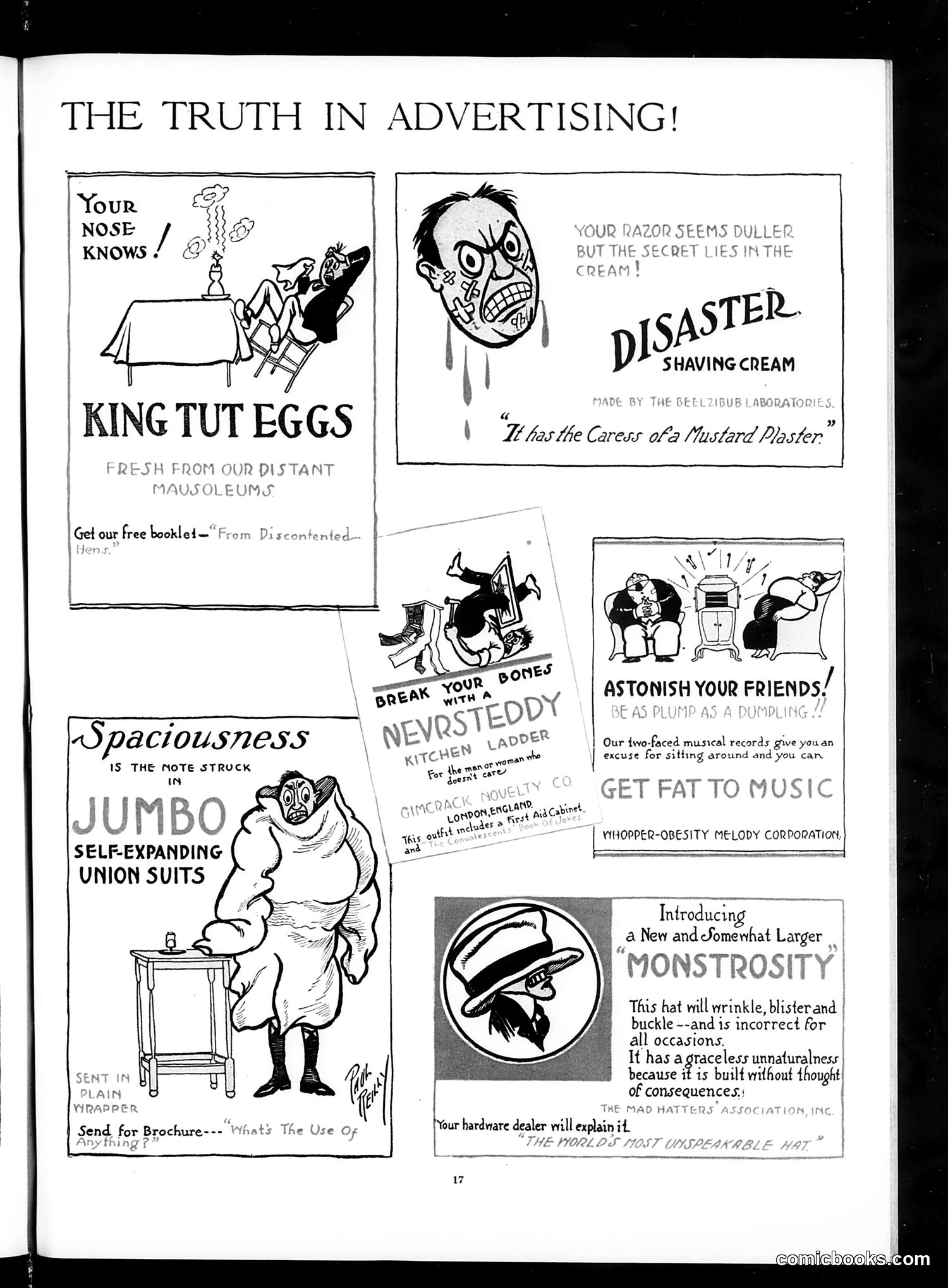
This page satirizes deceptive advertising practices of the era through mock product ads. Each fake advertisement absurdly inverts marketing claims to expose actual product flaws: - **King Tut Eggs**: Mocks exotic marketing by claiming eggs from "distant mausoleums" - **Disaster Shaving Cream**: Admits the cream causes the problem it claims to solve - **Jumbo Self-Expanding Union Suits**: Honest admission that the garment makes wearers fat - **Nevrsteddy Kitchen Ladder**: Designed to break bones - **Get Fat to Music**: Records that encourage weight gain - **Monstrosity Hat**: Explicitly states it's poorly made and unflattering The satire's point is clear: real advertisements make outrageous, false claims with straight faces. By "telling the truth," Judge exposes how absurd actual advertising copy is—using humor to critique consumer manipulation and false promises common in early 20th-century marketing.
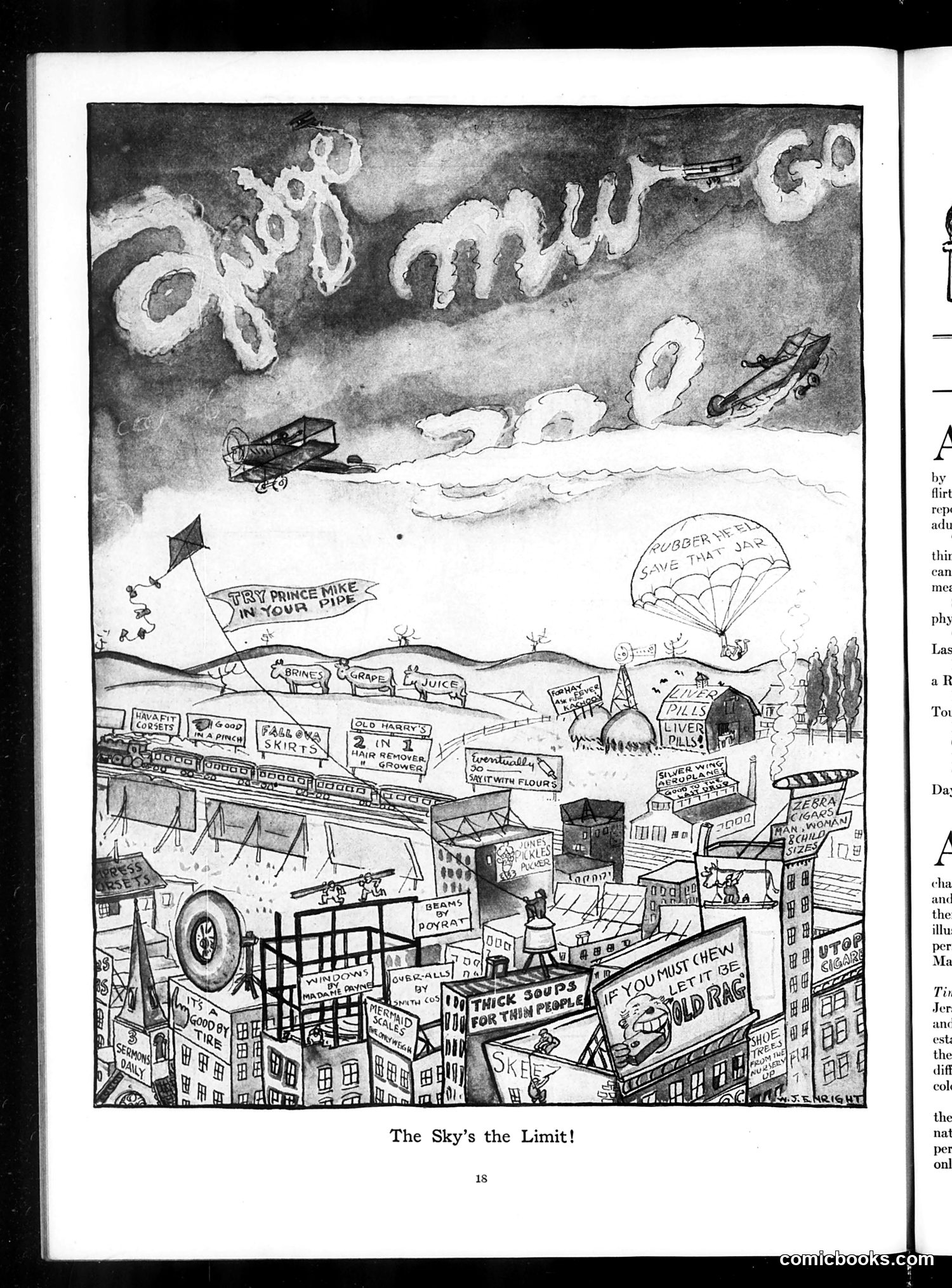
This is a satirical illustration of an exaggerated consumer culture landscape. The cityscape is crowded with commercial advertisements and product signs stacked impossibly high—visible text includes "Old Rag," "Soups for Thin People," "Pills," and various brand names on buildings and billboards. Above the city, airplanes engage in aerial advertising, with one banner reading "Rubber Heels Save the Jar" and another "Try Prince Hike in Your Pipe." The composition suggests unbridled commercialism literally reaching skyward. The cartoon's title and chaotic stacking of goods and advertisements satirize American consumer culture's explosive growth and advertising saturation, likely from the 1920s-1930s economic boom era. The joke: commercial ambition knows no bounds—quite literally, "the sky's the limit" for advertising and consumption.
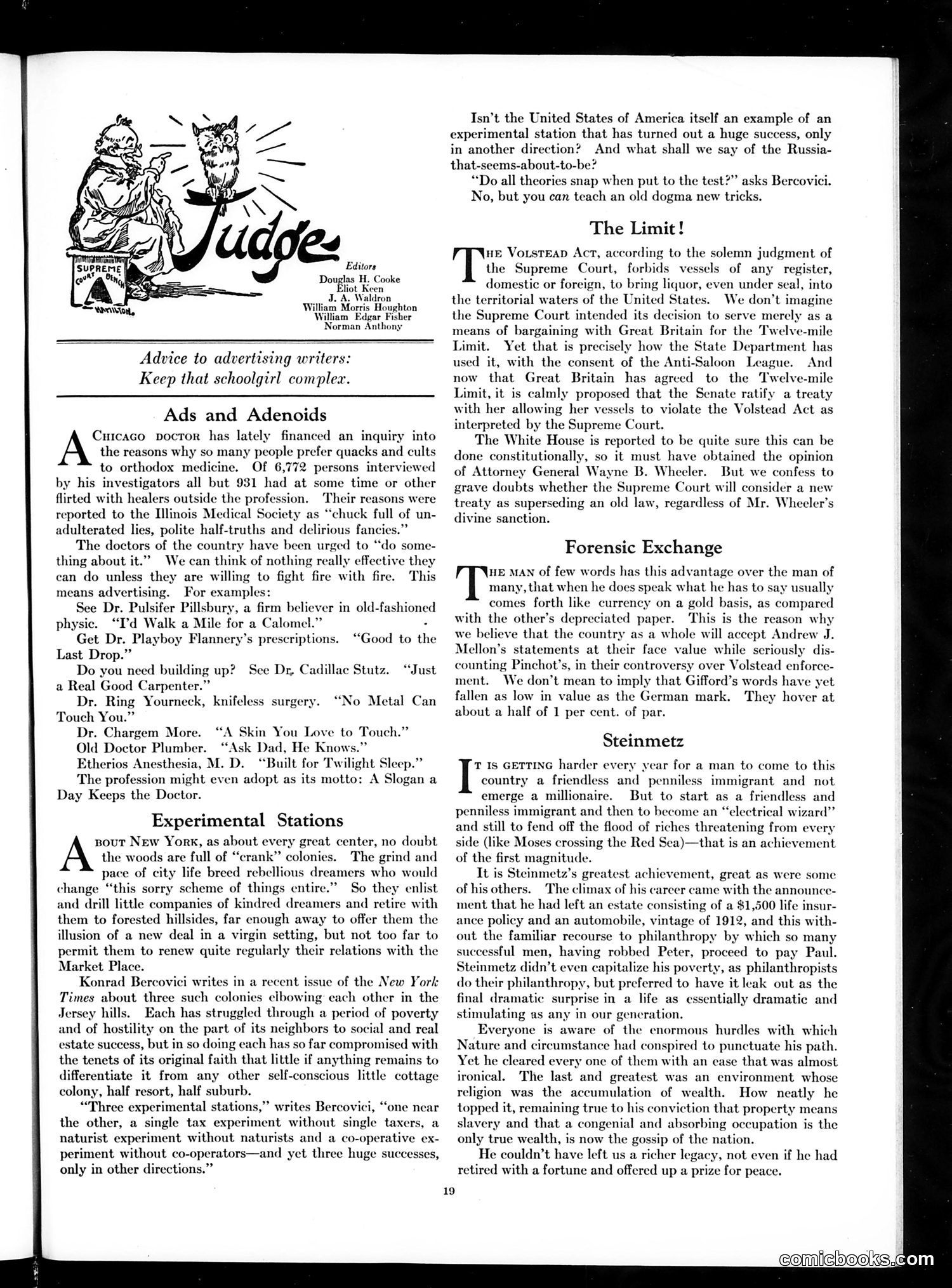
The page contains three satirical articles mocking American society. **"Ads and Adenoids"** ridicules both quack doctors and the medical profession's inability to compete. It sarcastically suggests legitimate doctors adopt advertising slogans mimicking patent medicine claims ("I'd Walk a Mile for a Calomel"). The humor targets the public's gullibility and medicine's marketing failures. **"Experimental Stations"** critiques utopian communes in New Jersey hills. Writer Konrad Bercovici observed that these idealistic communities (single-tax experiments, naturist colonies) eventually compromised their principles to achieve financial success, becoming indistinguishable from ordinary resort towns. The article ironically notes the USA itself is an "experimental station" that succeeded, and questions whether Russia's revolution will fare similarly. **"The Limit!"** addresses Prohibition enforcement (the Volstead Act). It satirizes how the State Department used Supreme Court rulings about territorial waters as a bargaining chip with Great Britain over the "Twelve-mile Limit," rather than enforcing Prohibition genuinely. All three pieces reflect 1920s-era skepticism toward institutions, idealism, and government integrity.
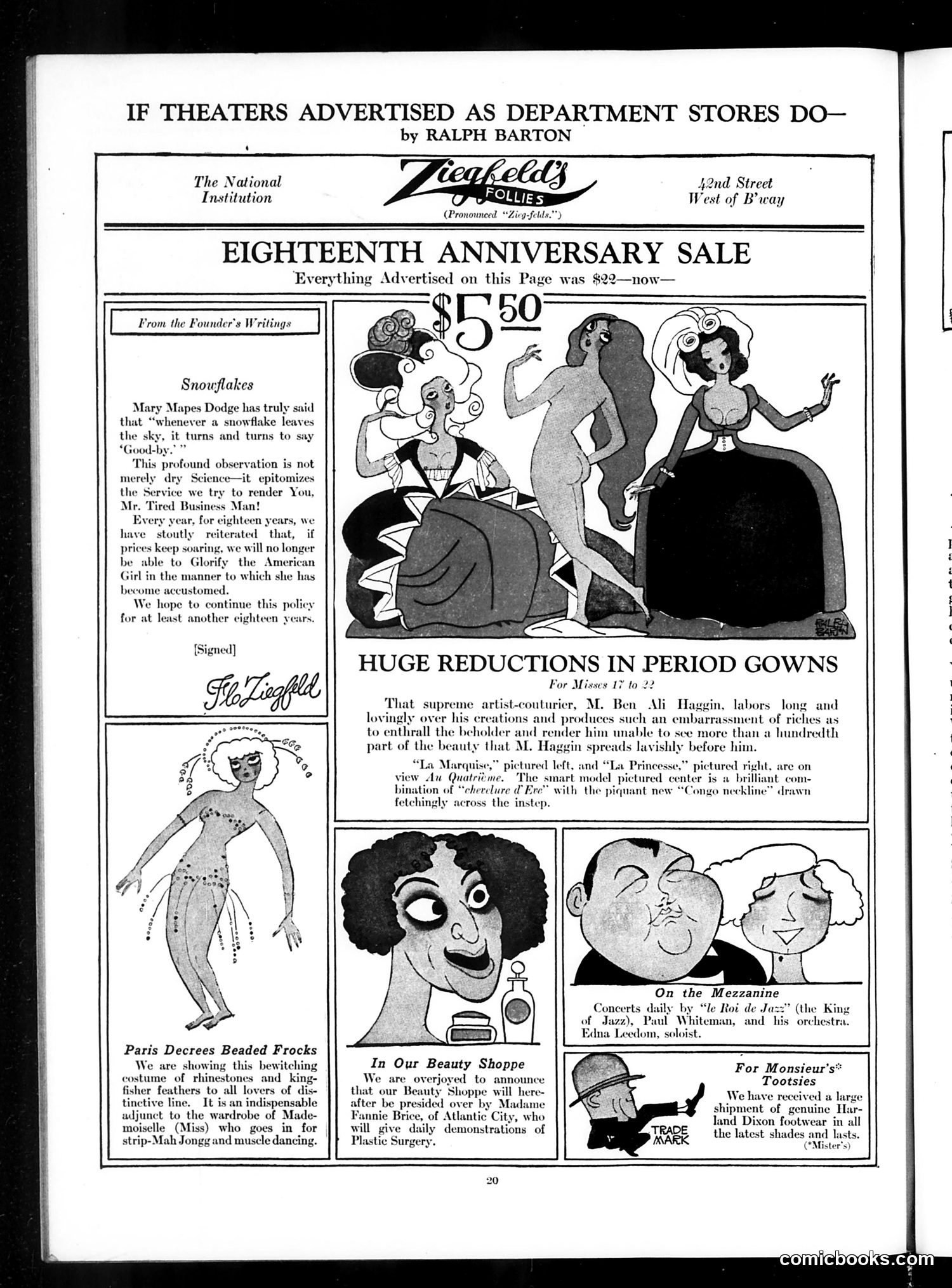
This page satirizes how theatrical promotions mimicked department store advertising in the 1920s. Ralph Barton's cartoon parodies the exaggerated marketing language of both industries—inflated claims, fake urgency ("Eighteenth Anniversary Sale"), and absurd product descriptions. The "Ziegfeld Follies" reference frames this: the famous theatrical revue was known for elaborate costumes and beauty. The mockery targets how theaters borrowed department store tactics: calling beauty treatments "huge reductions," describing gowns with pseudo-sophisticated names ("La Marquise," "Congo neckline"), and treating performers as merchandise. References to "Fanny Brice" (vaudeville/Follies star) and the "Mezzanine" reinforce the theatrical setting. The caricatured "Beauty Shoppe" and "Plastic Surgery" advertisements parody both theatrical vanity and retail sales-speak. Essentially: Barton ridicules how American entertainment had become commercialized, borrowing the hard-sell tactics of department stores to promote performers and shows as consumer products rather than art.
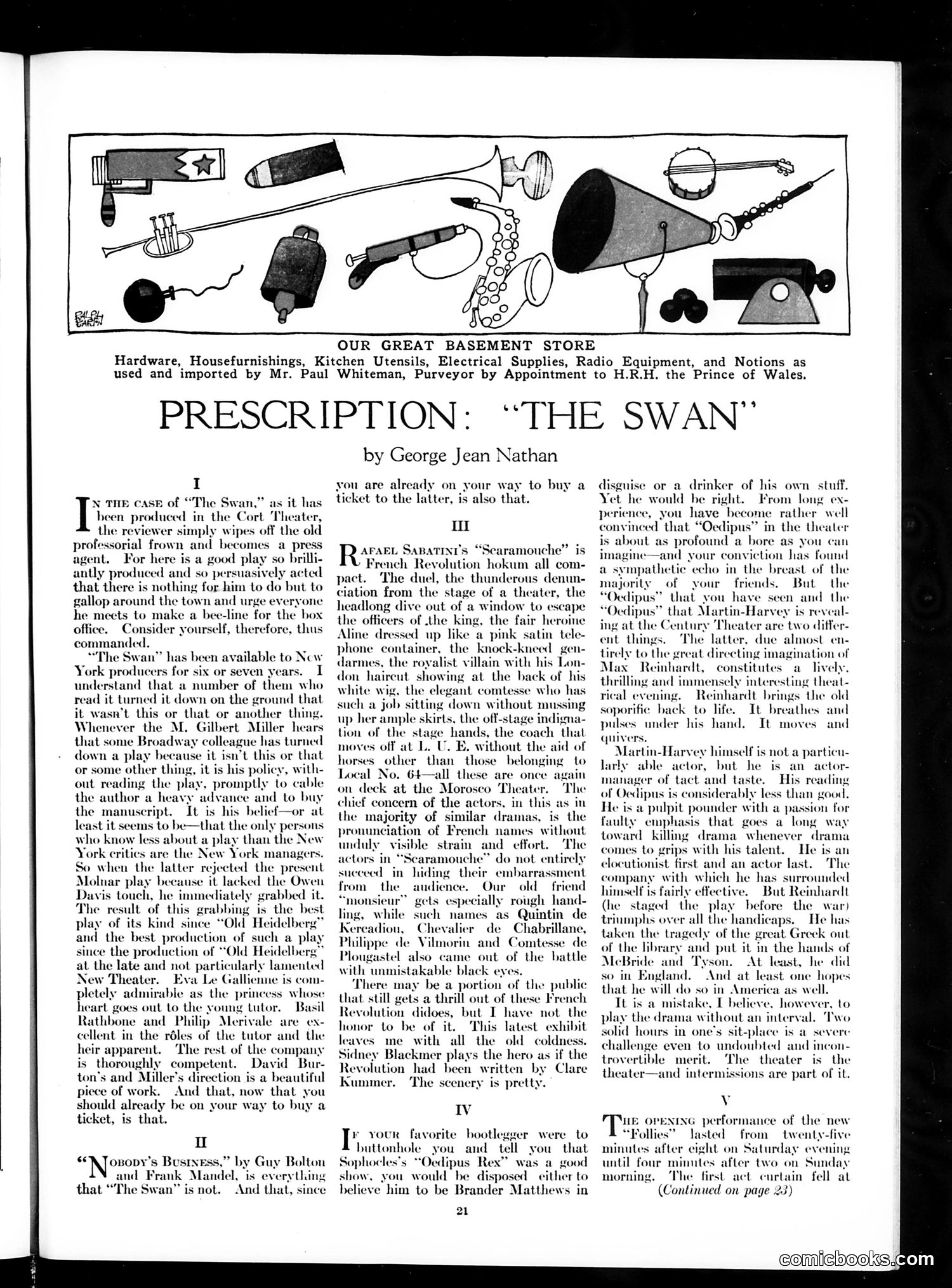
This page from *Judge* magazine contains theater reviews by George Jean Nathan rather than political cartoons. The whimsical header illustration showing various objects (musical instruments, household items, weapons) is decorative framing for the content. Nathan reviews three Broadway productions: *The Swan* (which he enthusiastically praises as excellent), *Nobody's Business* (briefly mentioned), and *Scaramouche* (which he criticizes as tired French Revolution melodrama). The header's reference to "Mr. Paul Whiteman, Purveyor by Appointment to H.R.H. the Prince of Wales" is satirical—Whiteman was a famous jazz bandleader, and the joke is listing absurd items (hardware, radio equipment) as if they were prestigious imports, mocking overwrought society advertisements of the era. The page is primarily **theater criticism**, not political satire. It reflects 1920s Broadway culture and Nathan's sharp, dismissive wit toward formulaic theatrical productions.
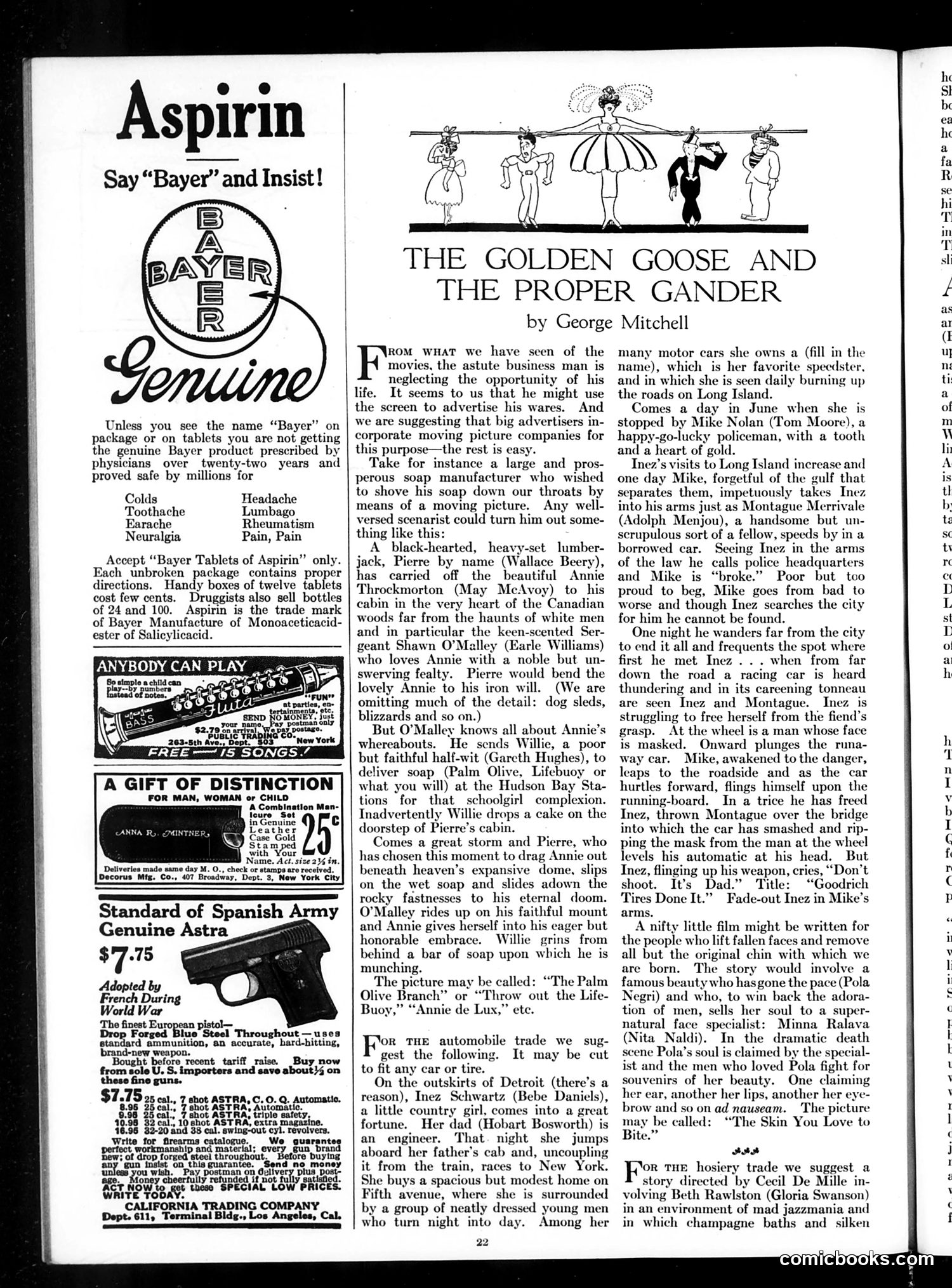
This page contains **advertisements and satirical fiction**, not political cartoons. **The ads** promote Bayer Aspirin (emphasizing the brand name), a Spanish Astra pistol, and other products—typical 1920s magazine advertising. **The main content** is "The Golden Goose and the Proper Gander" by George Mitchell, a satirical short story mocking how corporations could exploit cinema for advertising. Mitchell proposes absurd scenarios where soap and automobile manufacturers could embed their products into melodramatic films. For example: a lumberjack villain meets his doom by slipping on soap, allowing the hero to win the heroine. The satire targets **corporate advertising overreach**—suggesting big business was dangerously eager to colonize entertainment with commercial messaging. This reflects 1920s anxieties about commercialism's expanding influence. Mitchell's exaggerated plot summaries ("Annie de Lux," "Throw out the Life-Buoy") ridicule how transparent and cynical such product placement would be.
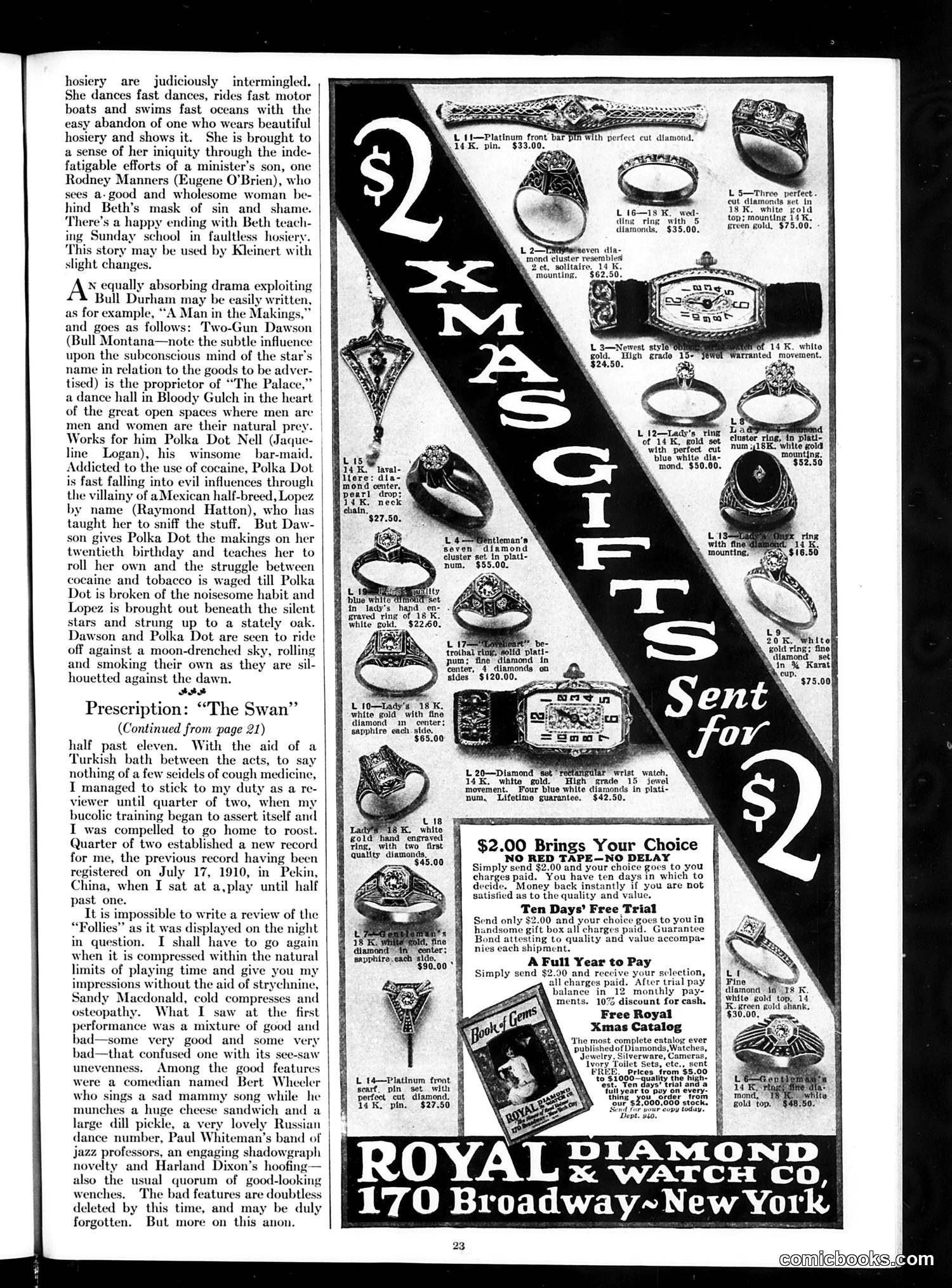
This page is primarily **advertising for Royal Diamond & Watch Co.**, not political satire. The bulk of the content showcases luxury jewelry and watches with prices ranging from $22.60 to $75.00—positioned as "Sent for $2," emphasizing installment purchasing. The upper text discusses film reviews, including satire of how movies use product placement. One example mocks how a film called "A Man in the Makings" could advertise Bull Durham tobacco by naming the protagonist "Two-Gun Dawson" (played by Bull Montana) and incorporating smoking scenes. The reviewer notes this subtle psychological marketing influence. The "Prescription" section reviews a theatrical production called "The Swan," with the critic humorously noting he fell asleep before it ended. **For modern readers**: This page demonstrates early 20th-century awareness of product placement in entertainment and installment-plan consumer credit marketing—concepts we associate with modern advertising but which clearly existed then.
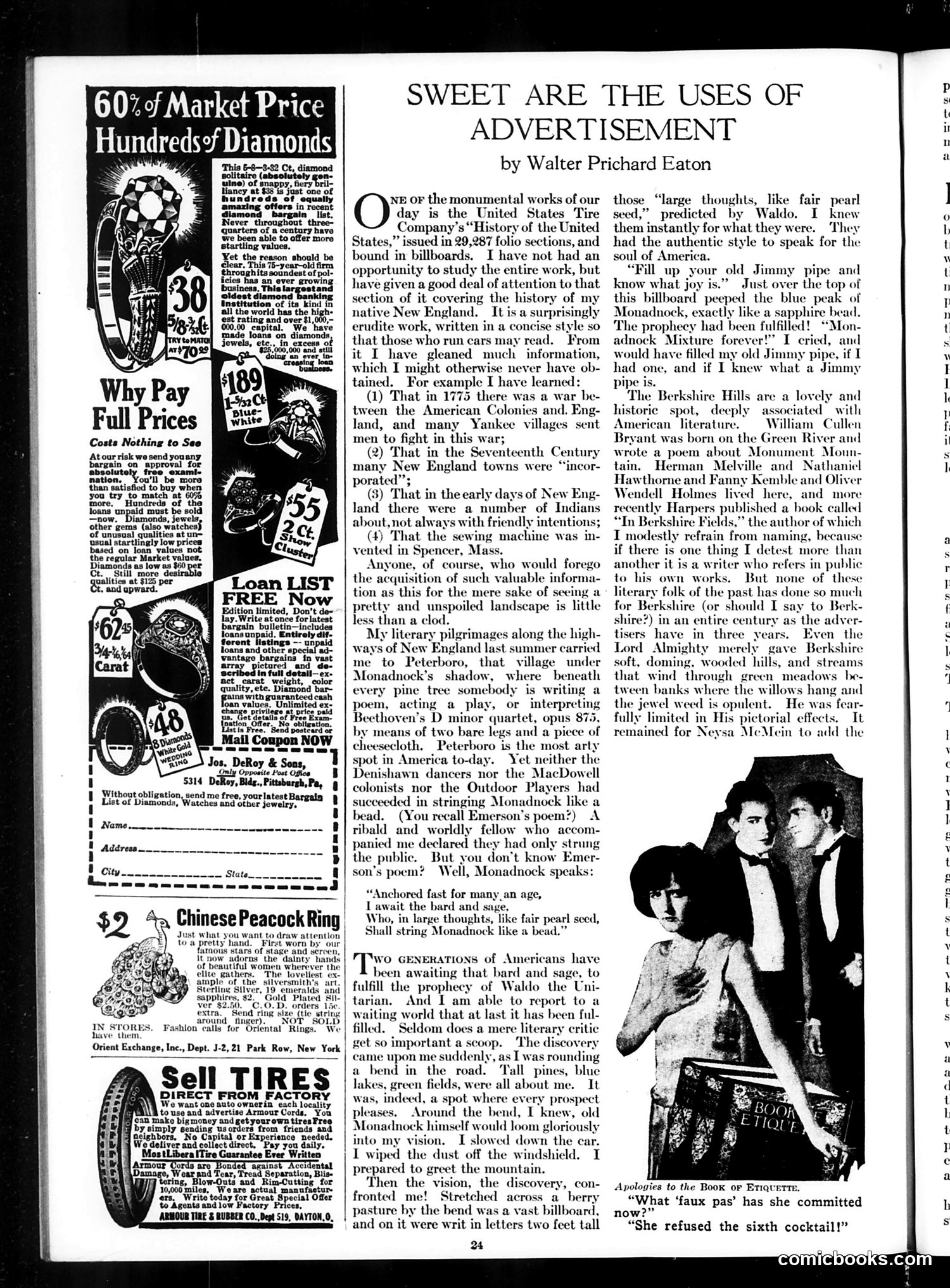
This page satirizes corporate advertising masquerading as cultural content. Walter Prichard Eaton's essay mocks the **U.S. Tire Company's "History of the United States"**—a corporate "history" published as billboard advertisements rather than genuine scholarship. Eaton's satire targets how advertisements colonize public spaces and discourse. He notes sardonically that he "learned" American history from tire company billboards (the 1775 war, indigenous peoples, sewing machines), then describes visiting Peterboro, New Hampshire—an arts colony beneath Mount Monadnock—where artists seek inspiration. He references Emerson's poem about Monadnock awaiting a "bard and sage" to string it "like a bead." The joke: corporate America has already "strung" the landscape with billboards, commodifying even America's natural and cultural heritage. The essay critiques how advertising infiltrates and corrupts authentic experience, turning history, nature, and art into marketing vehicles. The surrounding advertisements (diamonds, tires, jewelry) ironically reinforce his point about commercial saturation.
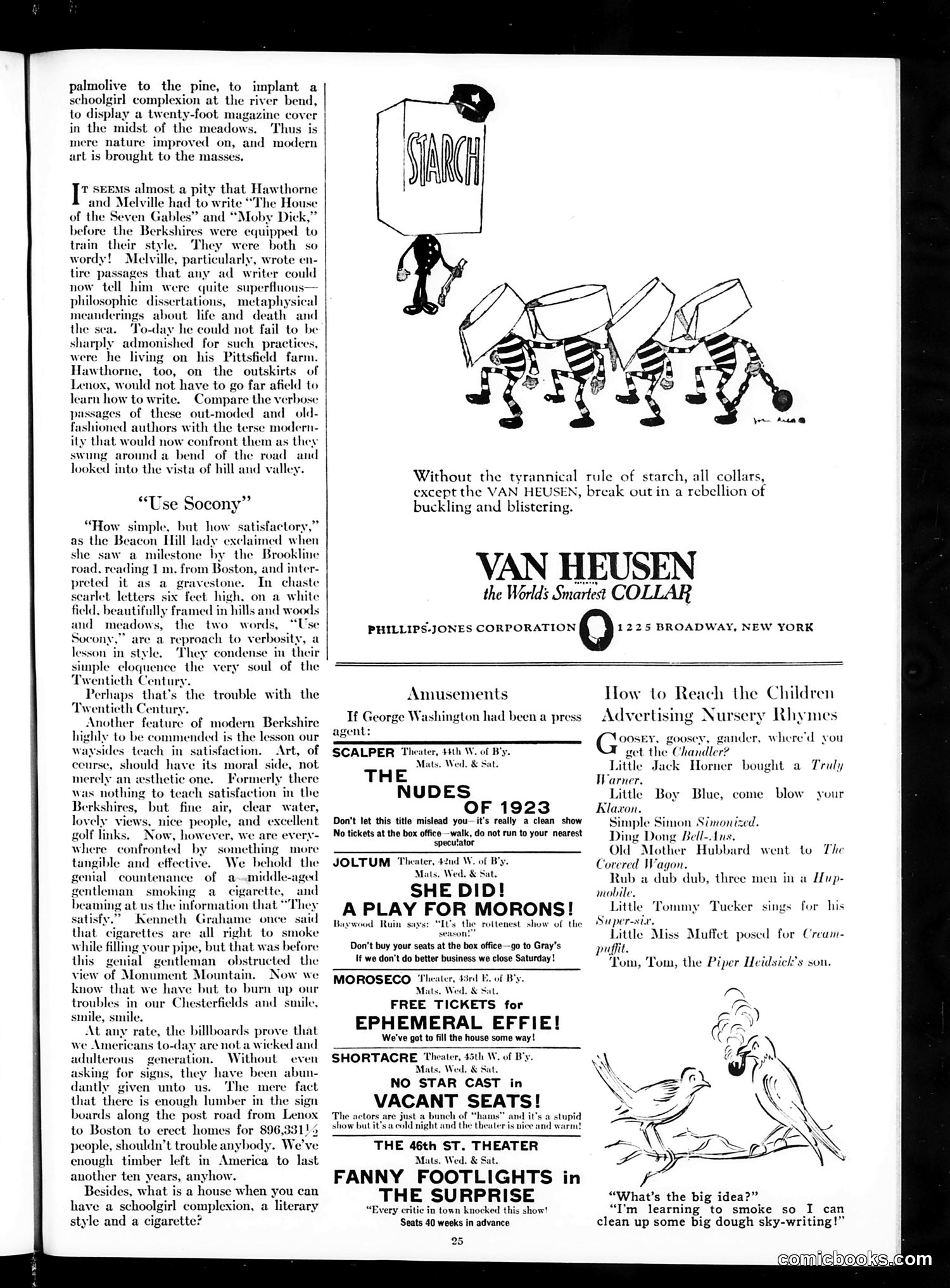
This page satirizes early 20th-century advertising's invasion of American natural landscapes. The author mocks how billboard advertisements—particularly a "Use Socony" (oil company) sign—now intrude upon the Berkshire Mountains, previously celebrated by classic authors like Hawthorne and Melville. The main joke contrasts "verbose" 19th-century literature with modern advertising's "terse modernity." The author sarcastically notes that today's efficient ad-copy style would shame the old masters. The cartoon itself (visible at top) shows marching figures resembling pencils or advertising placards, reinforcing how commercial messaging now dominates even pristine countryside. The piece criticizes American materialism: we've traded natural beauty and genuine satisfaction for consumer products and advertising promises. The closing rhetorical question—"what is a house when you can have a schoolgirl complexion, a literary style and a cigarette?"—drips with irony, exposing how absurd modern priorities have become.
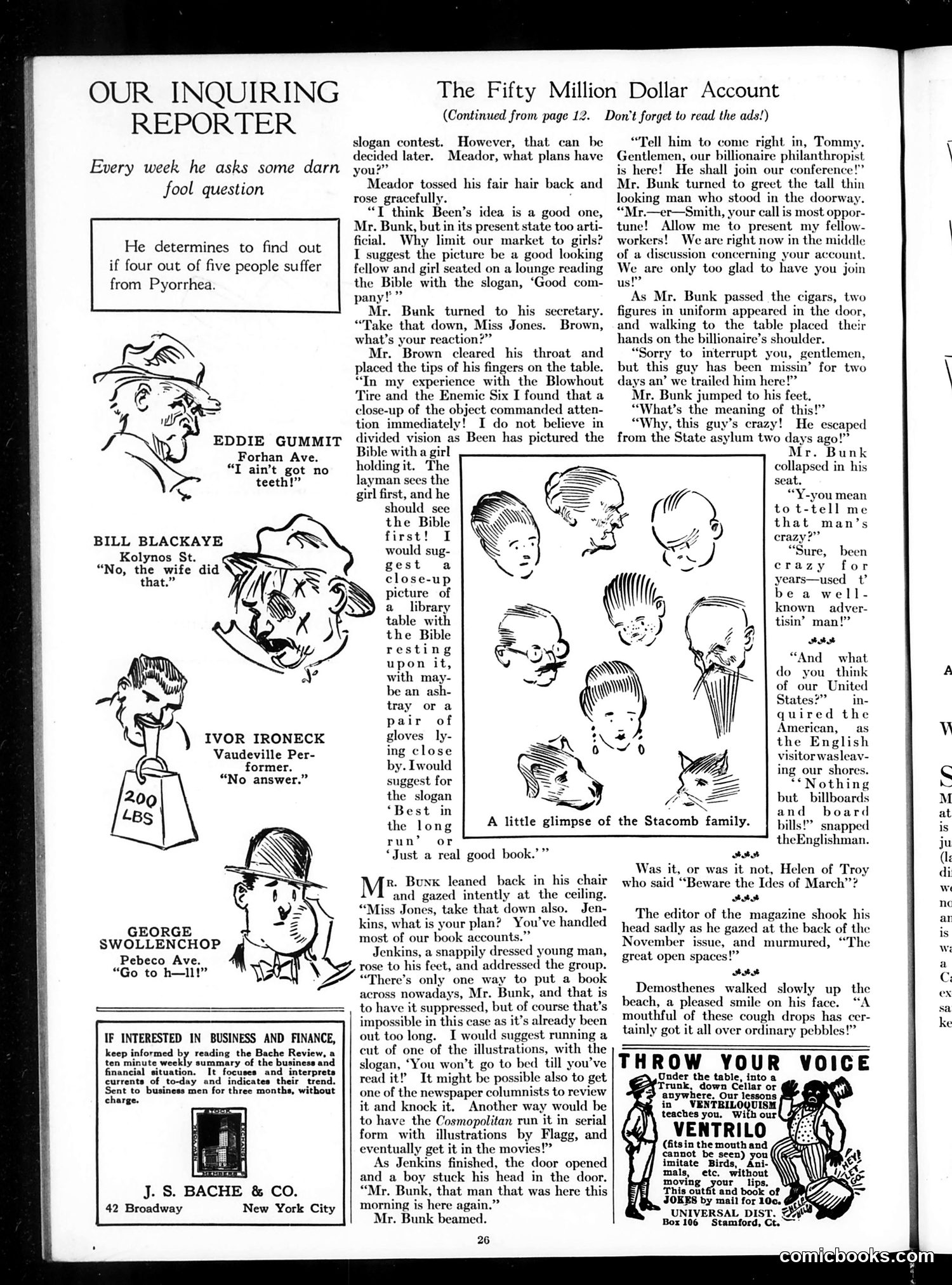
This page contains two distinct elements: **"Our Inquiring Reporter"** is a humorous recurring feature where a journalist asks random people a silly question—in this case, whether four of five people suffer from pyorrhea (gum disease). The responses are absurdist jokes from named individuals, each tied to toothpaste brand advertisements (Forhan, Kolynos, Pebeco). The humor relies on non-sequiturs and wordplay rather than political satire. **"The Fifty Million Dollar Account"** is the main narrative, depicting advertising executives pitching Bible promotion strategies to a wealthy philanthropist. The satire mocks 1920s advertising culture—how professionals overcomplicate simple messages and employ manipulative tactics (suppression, scandal, serialization) to sell even wholesome products. The sudden arrival of police officers suggests the "philanthropist" is actually a fugitive, deflating the preceding business discussion with absurdist irony. Both sections exemplify *Judge* magazine's satirical approach: mocking American commercialism, advertising excess, and business pretension through exaggeration and unexpected comedic reversals.
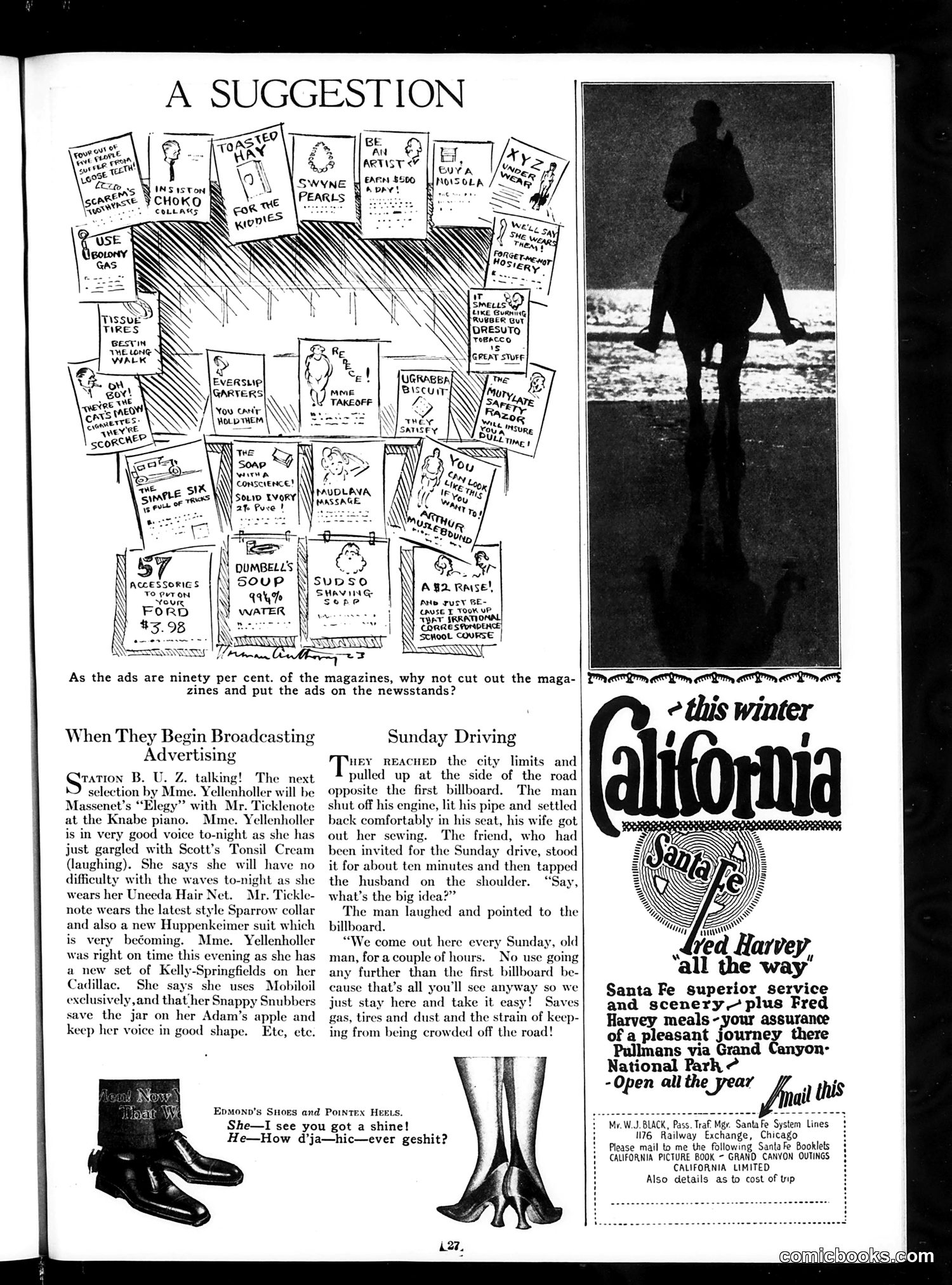
**"A Suggestion"** is a satire on magazine advertising saturation. The cartoon depicts dozens of product ads crammed together—hair nets, soup, shoes, correspondence courses, automobiles—mimicking how cluttered 1920s magazines had become. The caption's sardonic point: magazines are now 90% advertisements, so why not eliminate the editorial content entirely and just sell ad space directly on newsstands? It's social criticism of commercialism run amok. **"When They Begin Broadcasting Advertising"** satirizes radio's emerging ad model, imagining a concert interrupted by constant product placement (Tonsil Cream, Kelly-Springfields tires, Mobiloil). The humor lies in absurdist product integration into high-culture programming. **"Sunday Driving"** mocks billboard culture—a family drives out only to park at the first billboard and never venture further, treating the advertisement itself as the Sunday destination. All three pieces critique 1920s-30s consumer culture and advertising's invasive reach into American life.
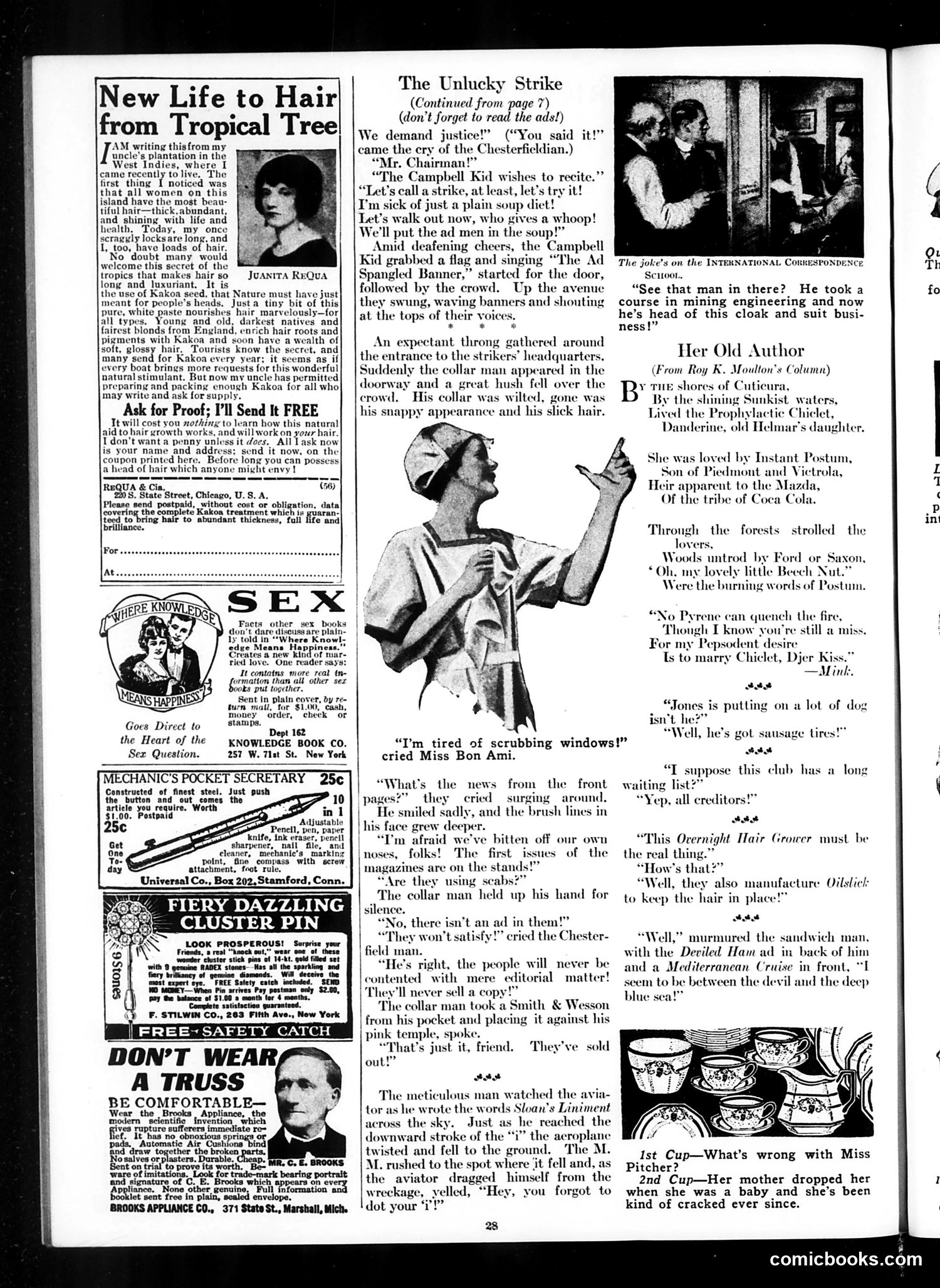
This page continues a satirical story mocking famous advertising mascots of the era—the Campbell Kid, Miss Bon Ami, the Collar Man, and others—who rebel against their corporate overlords and strike for better treatment. The humor targets early 20th-century advertising culture: these fictional characters, created to sell products, demand justice and threaten to unionize. The irony is sharp—mascots meant to promote consumption become labor activists. When they attempt their strike, it backfires: the magazines featuring them hit newsstands anyway, and the Collar Man's appearance literally deteriorates (his collar wilts, his hair loses its shine), symbolizing that their value depends entirely on maintaining corporate perfection. The satire critiques both exploitative advertising practices and the absurdity of treating commercial mascots as autonomous beings deserving rights. It's a tongue-in-cheek commentary on how advertising creates artificial personas divorced from reality.
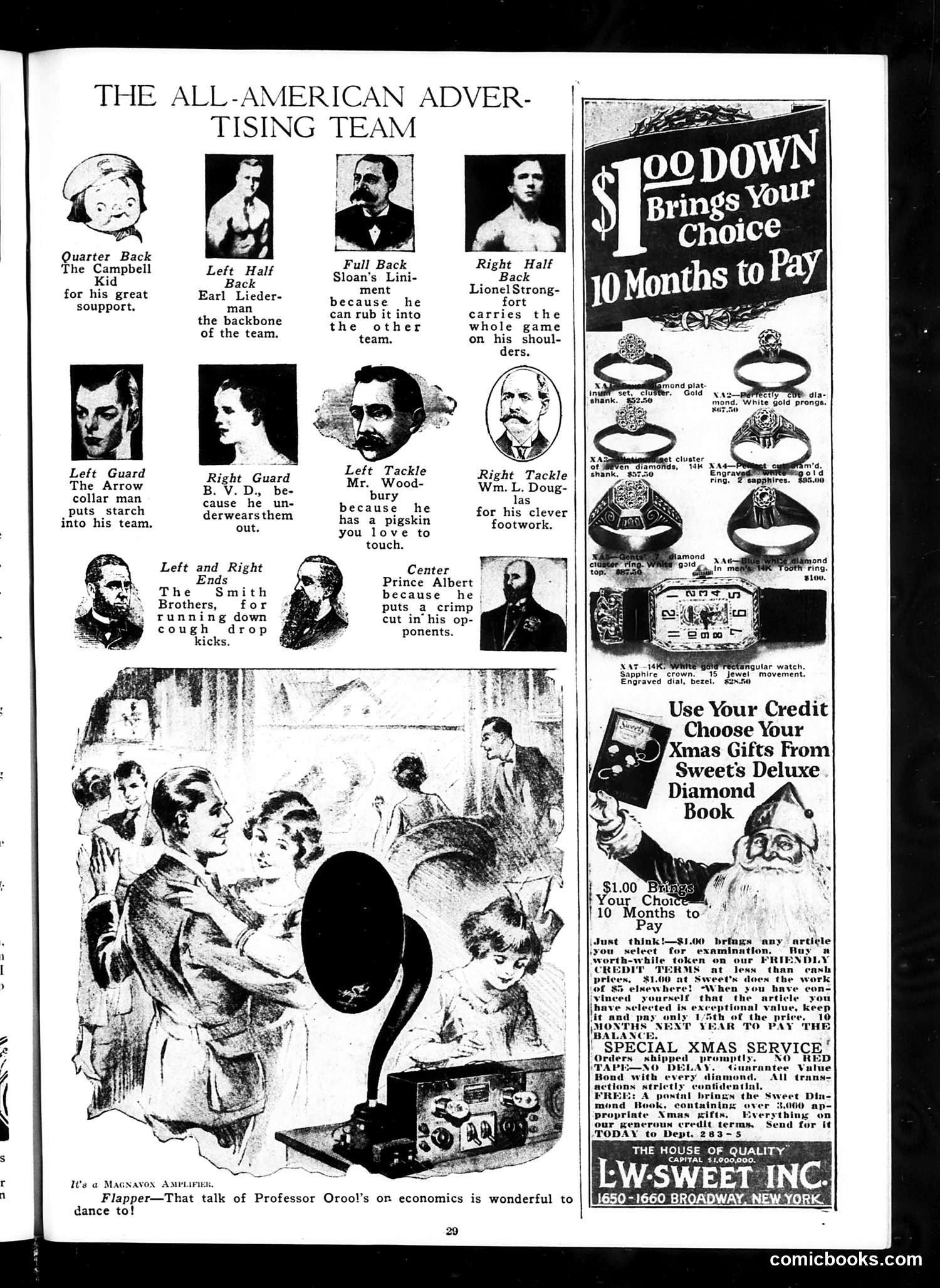
This page satirizes how American advertising co-opts patriotic and sports imagery to sell consumer goods. The left side presents a fake football "team" where each position represents a brand: Campbell (soup), Arrow (shirts), Earl Liederman (bodybuilding), Lionel Strongfort (fitness), the Smith Brothers (cough drops), and Prince Albert (tobacco). Each gets a humorous "reason" for their spot—playing on the product's actual use or marketing claim. The satire mocks how advertisers dress up mundane products in exciting language and associate them with American vitality and strength. The right side reinforces this with jewelry and watch advertisements using similar aspirational appeals. The bottom cartoon about a "flapper" finding economics "wonderful to dance to" while listening to a Magnavox amplifier extends the joke: even serious topics become entertainment vehicles for selling consumer goods.
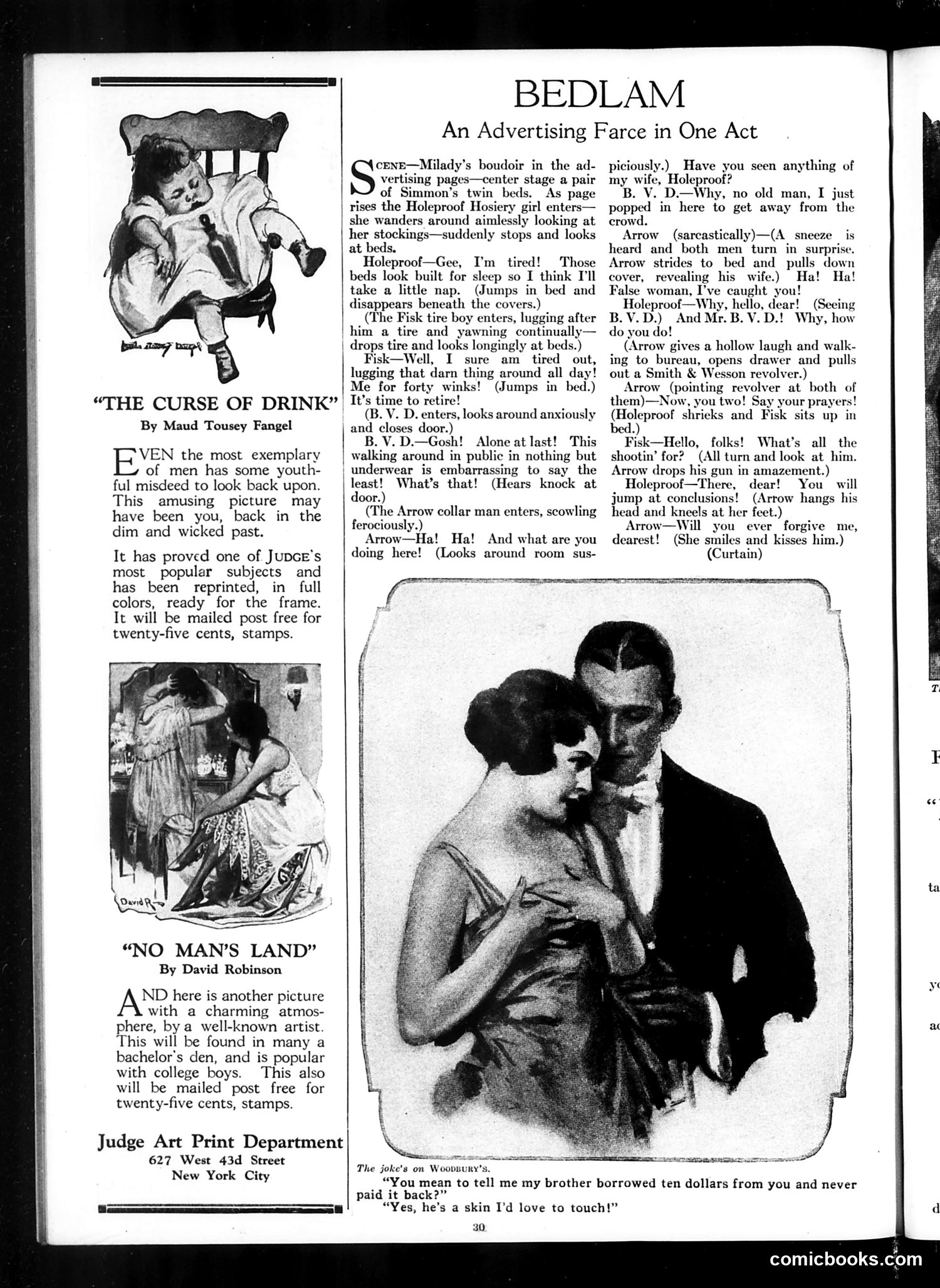
This is a theatrical sketch satirizing advertising and consumer culture. The plot involves a woman ("Holeproof") being chased by a man (representing "Arrow" collar brand) through various bedroom scenarios involving tired men and hosiery products. The sketch mocks how aggressive advertising intrudes into intimate spaces, with brand mascots literally pursuing consumers. The humor targets early-20th-century advertising's absurdity: anthropomorphized products (the Arrow collar man, Holeproof hosiery girl) invading private moments. The final photograph joke ("You mean to tell me my brother borrowed ten dollars...") suggests advertisement-induced gullibility—believing false promises because of slick marketing. The page also advertises Judge Art Print Department reproductions of satirical illustrations for twenty-five cents.
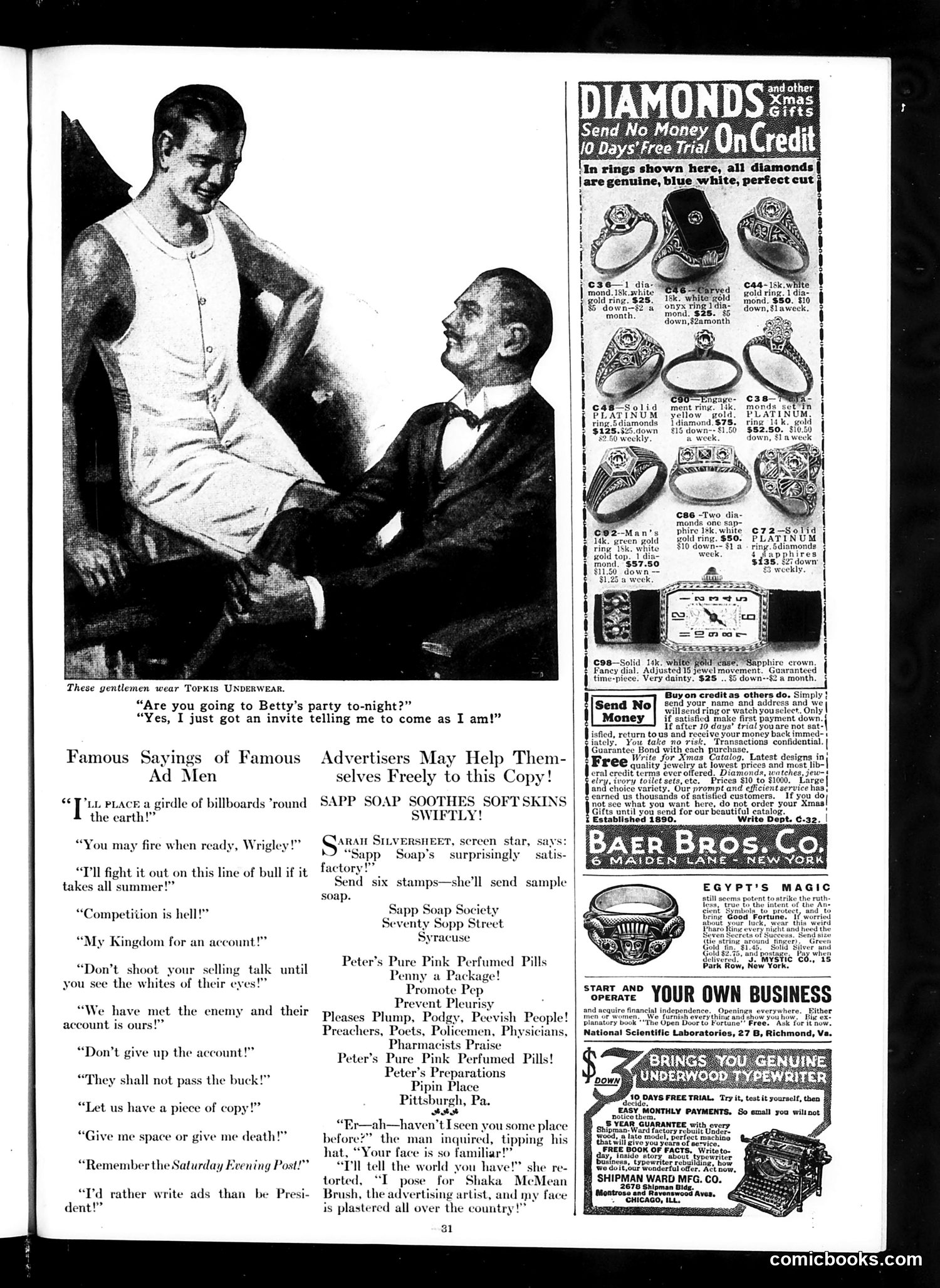
This page from *Judge* magazine is primarily **advertising with light satirical framing**. The main cartoon shows two men in Torkis Underwear, with dialogue about a party invitation saying "come as I am"—a gentle joke about comfortable underwear. The "Famous Sayings of Famous Ad Men" section parodies well-known historical quotes (Napoleon, Wrigley's gum slogan, etc.) repurposed as advertising industry humor—mocking how aggressive ad men are about acquiring accounts and promoting their work. The bulk of the page is **paid advertising**: Sapp Soap, Peter's Pink Perfumed Pills, diamond rings on credit (Baer Bros.), typewriters, and Egypt's Magic products. These ads use exaggerated claims and alliteration typical of early 20th-century marketing. The small anecdote at bottom jokes that an advertising artist's model's face is "plastered all over the country"—commentary on how omnipresent advertising has become. The page reflects how *Judge* monetized itself through advertiser-friendly content, blending satire with commercial copy.
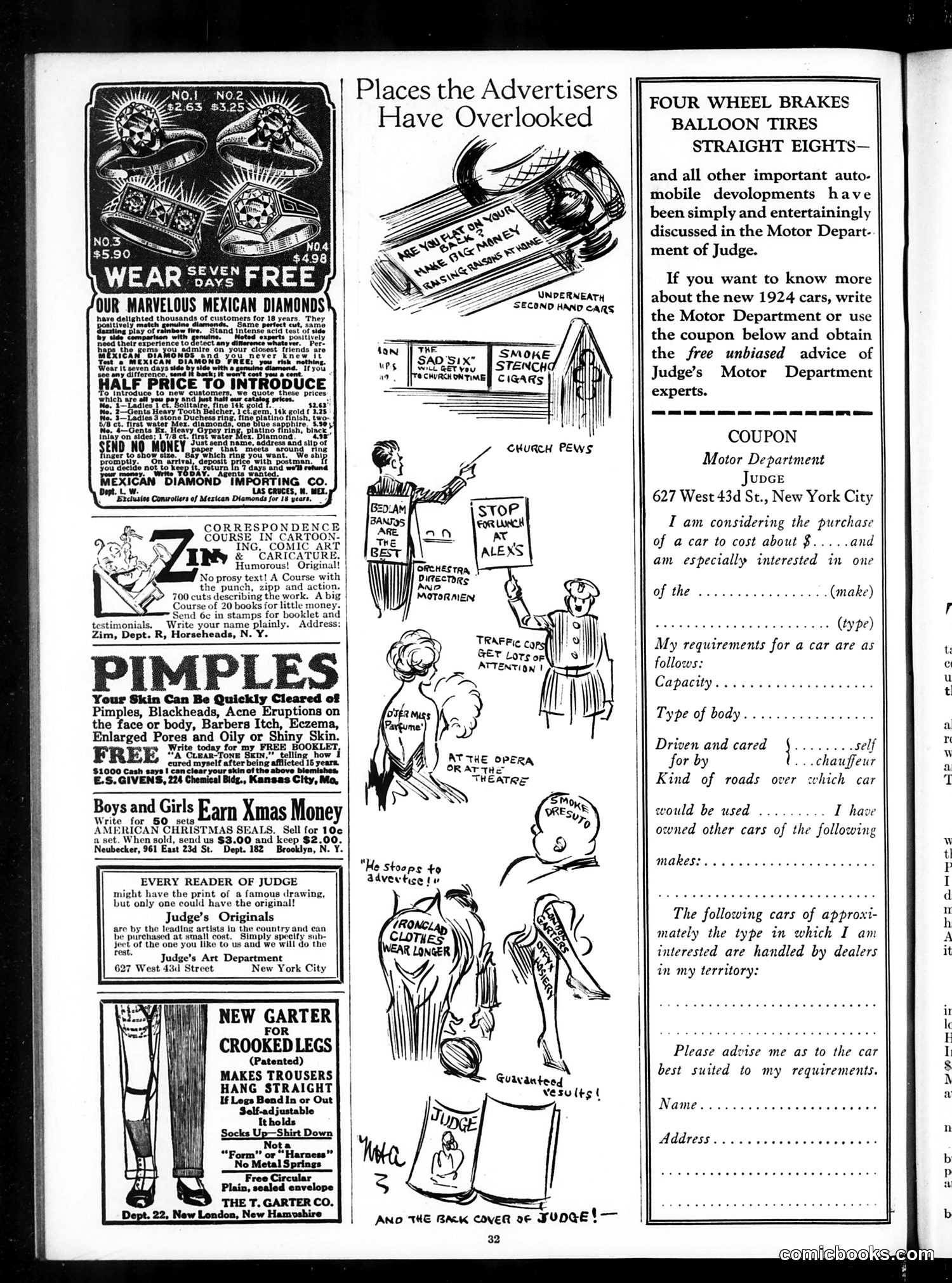
This page is primarily **advertising and promotional content** from Judge magazine, circa 1924 (based on the "new 1924 cars" reference). The central cartoon depicts various labeled locations around a city—church pews, opera house, orchestra pit, traffic, secondhand car dealers—with the caption "Places the Advertisers Have Overlooked" and "underneath second hand cars." The joke appears to be that advertisers have saturated most public spaces but oddly neglect one particular venue for promoting used cars. The cartoon is satirical commentary on **aggressive advertising ubiquity** in 1920s America—suggesting that ads appear everywhere except where you might logically expect them. It's a mild jab at both advertisers' blind spots and the pervasiveness of commercialism itself. The page otherwise contains typical period ads: Mexican diamonds, acne treatments, Christmas seals fundraisers, and Judge's own Motor Department coupon promoting automotive expertise. These ads reveal common consumer concerns of the era: personal grooming, money-making schemes for youth, and automobile enthusiasm.
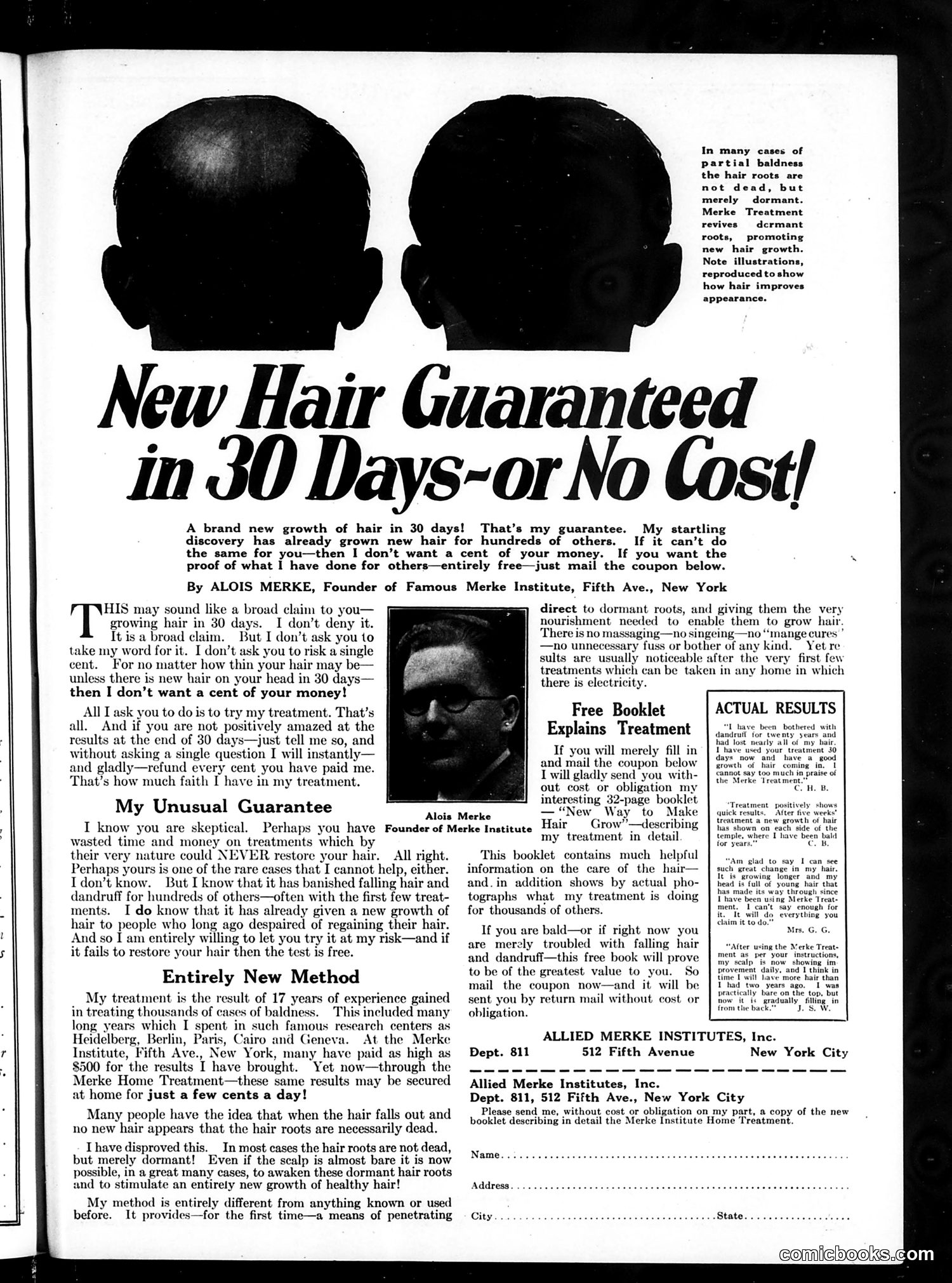
This page is primarily a **commercial advertisement**, not satire or political commentary. It promotes the "Merke Home Treatment" for baldness, marketed by Alois Merke of the Merke Institute on Fifth Avenue, New York. The advertisement uses aggressive marketing tactics typical of early 20th-century mail-order medicine: bold guarantees ("New Hair Guaranteed in 30 Days—or No Cost!"), appeals to skepticism ("I know you are skeptical"), testimonials from satisfied customers, and a free booklet offer requiring only a mailed coupon. The key claim—that dormant (not dead) hair roots can be "revived" through treatment—attempts to address customer doubts about baldness being permanent. The inclusion of before-and-after silhouettes of bald heads reinforces the promise of visible results. This reflects an era when such hair-restoration treatments were heavily advertised in popular magazines, often making claims that modern medicine would consider exaggerated or unsubstantiated.
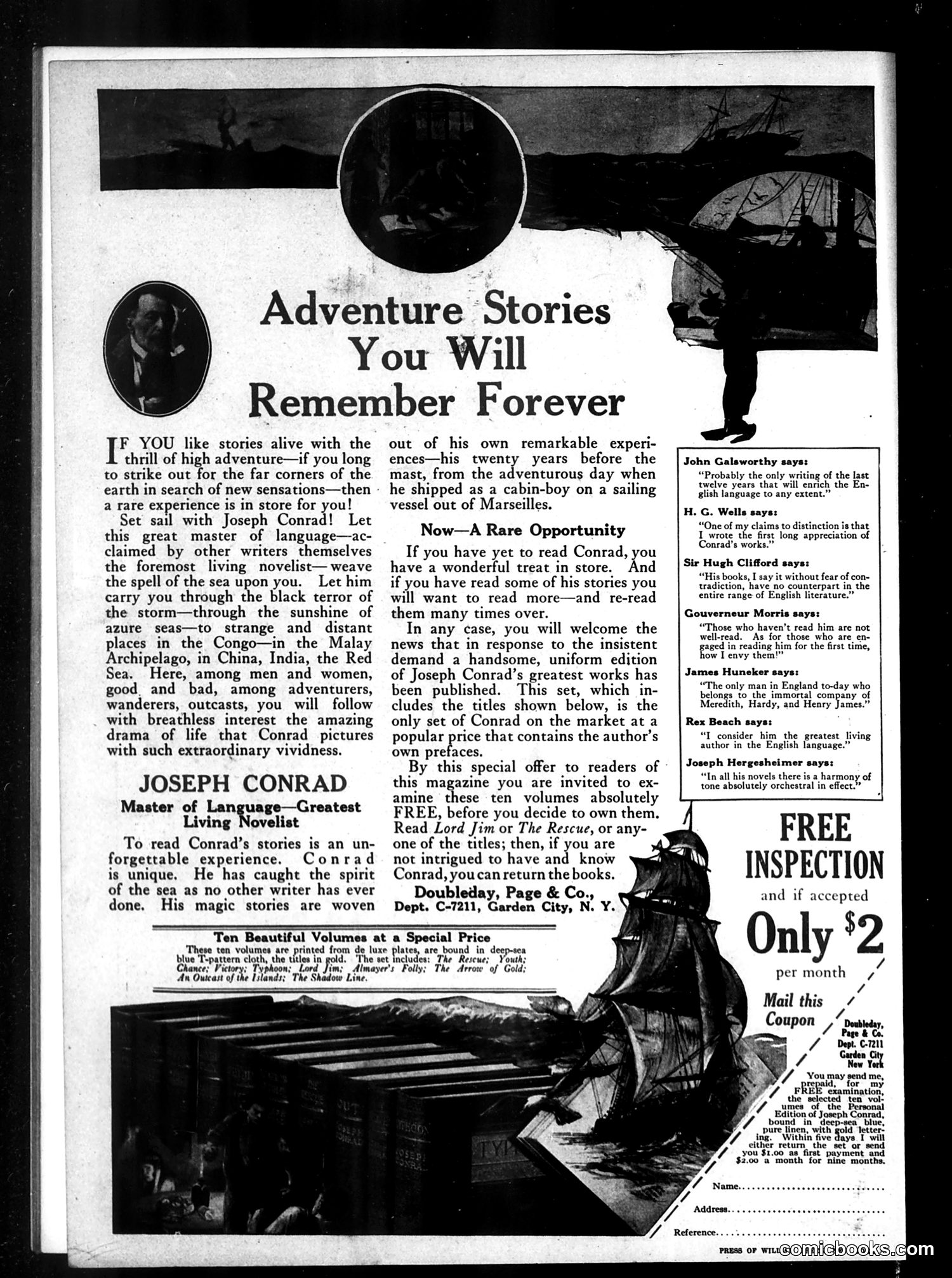
This is a **book advertisement**, not a political cartoon. It promotes Joseph Conrad's collected works through *Judge* magazine. The page exploits Conrad's literary prestige by quoting endorsements from celebrated contemporary writers—H.G. Wells, John Galsworthy, James Huneker, and others—establishing him as a major author worthy of ownership. The strategy targets educated, aspirational readers by associating book-buying with cultural sophistication. The "free inspection" offer was a common mail-order sales tactic: send books risk-free, then commit to monthly payments ($2/month mentioned). This made expensive sets accessible to middle-class households. Conrad himself is presented as the main attraction—described as "Greatest Living Novelist" with exotic sea credentials (twenty years before the mast)—rather than any particular political message. The dramatic maritime imagery supports the adventure-story marketing angle.
I can see this is a page from *Judge* magazine (indicated by the watermark), but the image is almost entirely black or severely degraded, making it impossible to discern any cartoon content, caricatures, text, or satirical commentary. The visible OCR text only shows "comicbooks.com" at the bottom, which appears to be a website watermark rather than original page content. Without a legible image, I cannot identify the figures, political or social references, or explain the satire intended. To properly analyze this *Judge* page, a clearer or higher-contrast scan would be needed. I'd recommend checking the original source for a better-quality reproduction.
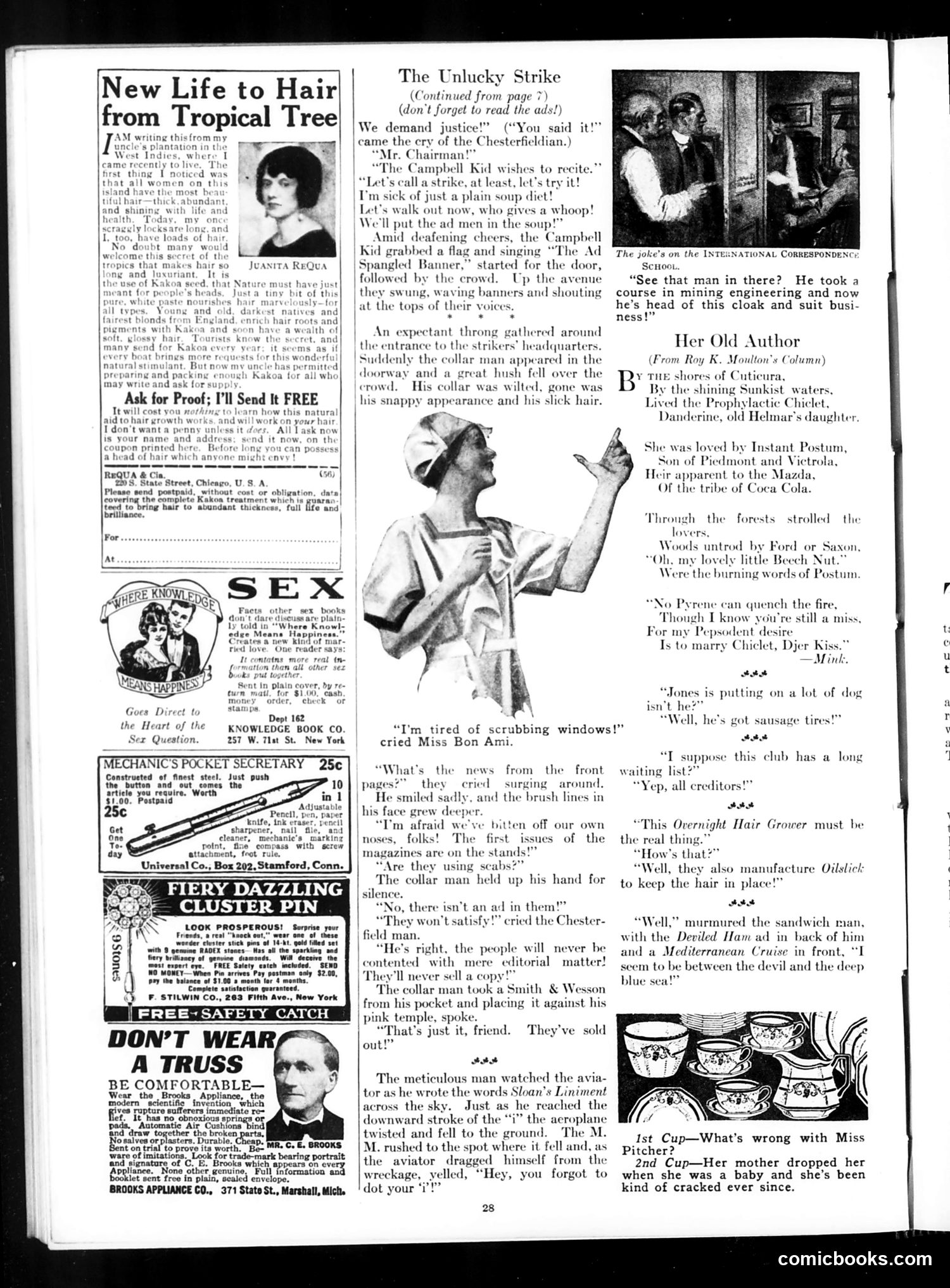
This Judge magazine page satirizes American consumer culture and labor activism circa the 1920s. "The Unlucky Strike" (continued story) mocks a strike by the "Campbell Kid" (a branded advertising mascot) and other product characters demanding better treatment. The joke: even the iconic figures used to sell consumer goods are rebelling against exploitative working conditions—yet their complaints are trivial ("plain soup diet"). The accompanying advertisements (Danderine hair product, sex education books, etc.) underscore the satire: manufacturers peddle solutions to insecurities while treating workers poorly. "Her Old Author" parodies overwrought romantic poetry by replacing traditional nature imagery with brand names (Cuticura, Postum, Ford, Coca-Cola, Djer Kiss). The humor lies in advertising's ubiquity—even literary expression cannot escape commercialism. The page overall critiques both labor unrest and rampant consumerism as equally absurd features of modern American life.
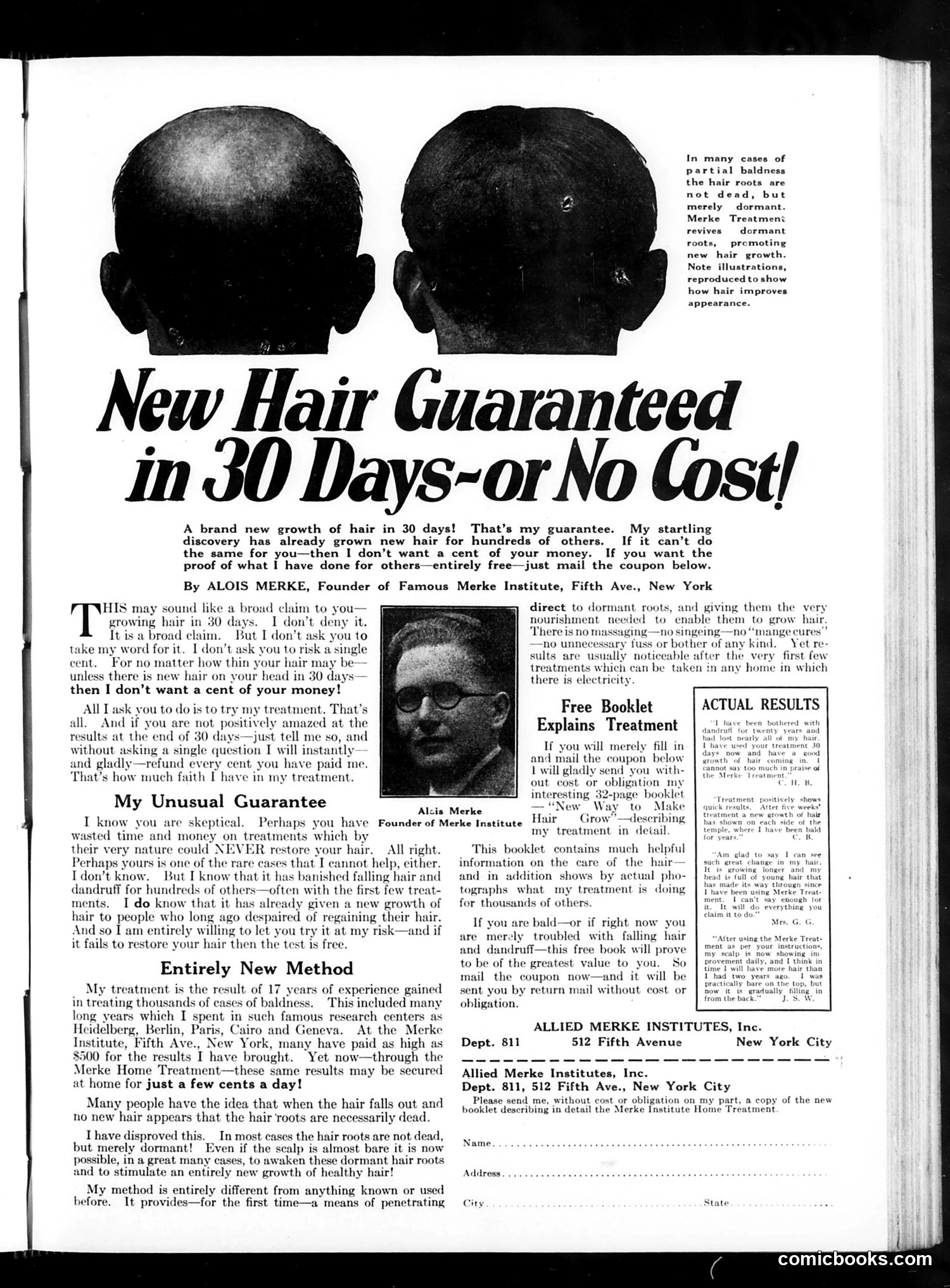
The page is a commercial advertisement for the "Merke Treatment," a hair-growth remedy promoted by Alois Merke of the Merke Institute on Fifth Avenue in New York. The images show before-and-after photographs of a bald man's head to demonstrate claimed results. The ad uses aggressive marketing tactics typical of early-to-mid 20th century patent medicine promotion: bold guarantees ("New Hair Guaranteed in 30 Days—or No Cost!"), appeals to skepticism, testimonials, claims of scientific backing (references to research in European cities), and a free information coupon. The central claim is that hair loss results from "dormant" rather than dead hair roots, which the treatment allegedly revives through electrical stimulation. While presented as "entirely new," the treatment appears to be a standard commercial product making exaggerated medical claims—the kind of dubious therapeutic merchandise that was common in American advertising before modern FDA regulations.
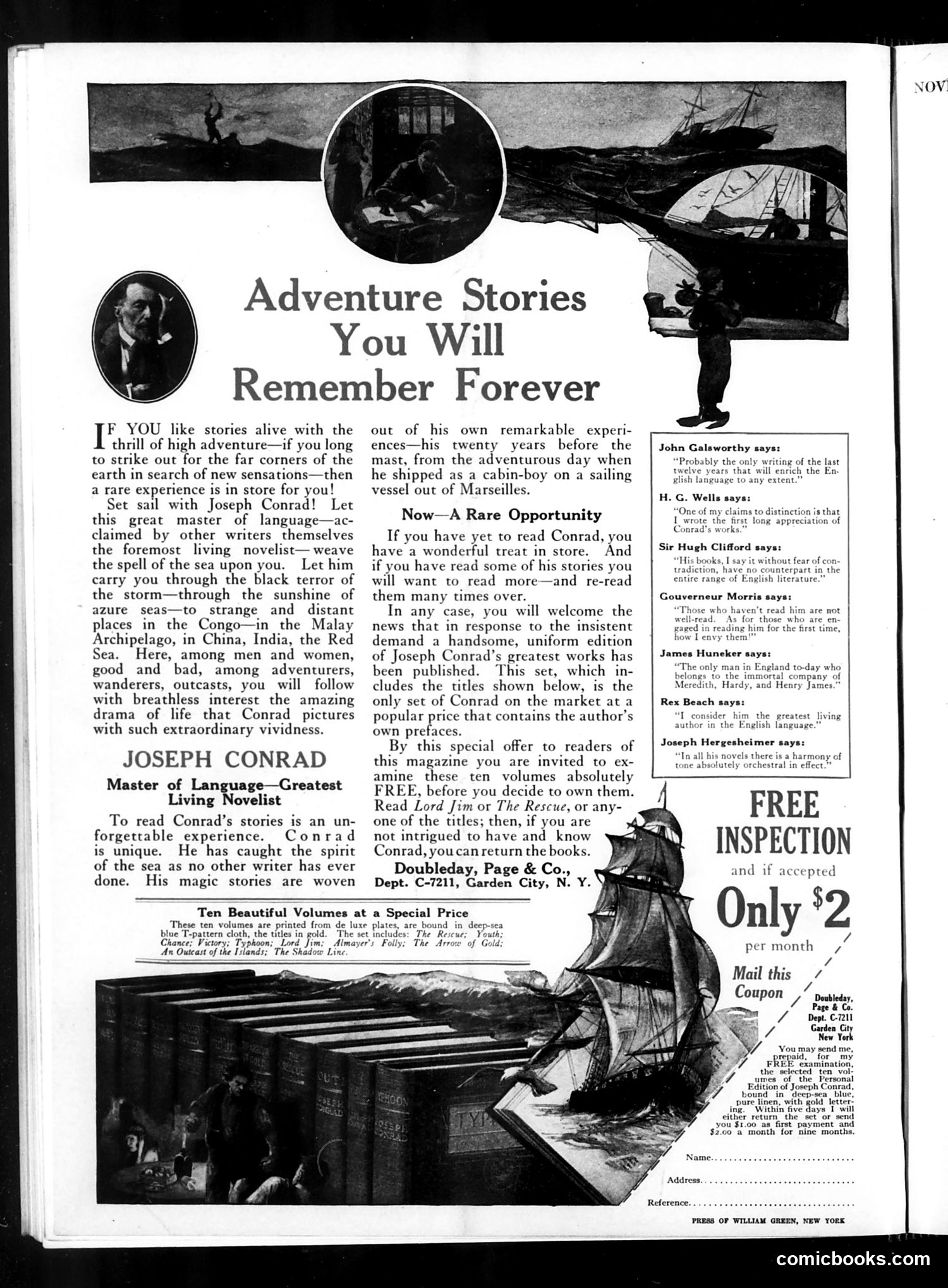
This page is **not a political cartoon or satirical content**—it's primarily an **advertisement** for a uniform edition of Joseph Conrad's novels, placed in Judge magazine. The page features endorsements from prominent literary figures (John Galsworthy, H.G. Wells, Sir Hugh Clifford, and others) praising Conrad as "Master of Language" and "Greatest Living Novelist." The advertisement emphasizes Conrad's authentic sea experience—twenty years before the mast—and promises readers adventure through exotic locations (Congo, Malay Archipelago, China, India). The sales pitch offers a "free inspection" of ten volumes at $2 monthly after a $1 first payment. The decorative maritime imagery (sailing ships, sea scenes) reinforces the adventure theme. **For modern readers:** This represents early 20th-century literary marketing—using celebrity endorsements and serial payment plans to sell canonical literature. There's no satire here; Judge simply ran advertisements alongside humorous content.