
Judge, 1923-11-17 · page 30 of 44
Judge — November 17, 1923 — page 30: what you’re looking at
What you’re looking at
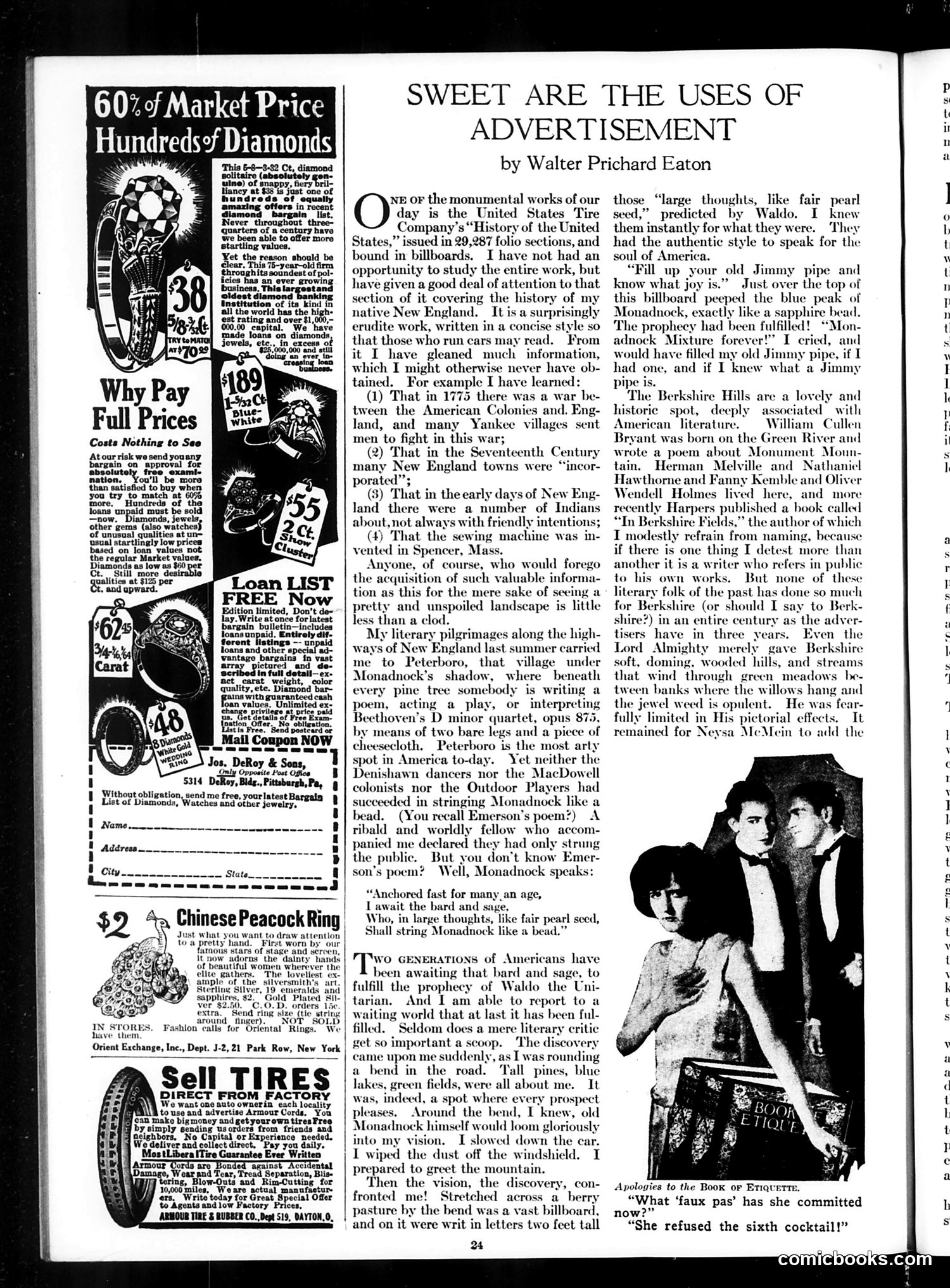
This page satirizes corporate advertising masquerading as cultural content. Walter Prichard Eaton's essay mocks the **U.S. Tire Company's "History of the United States"**—a corporate "history" published as billboard advertisements rather than genuine scholarship. Eaton's satire targets how advertisements colonize public spaces and discourse. He notes sardonically that he "learned" American history from tire company billboards (the 1775 war, indigenous peoples, sewing machines), then describes visiting Peterboro, New Hampshire—an arts colony beneath Mount Monadnock—where artists seek inspiration. He references Emerson's poem about Monadnock awaiting a "bard and sage" to string it "like a bead." The joke: corporate America has already "strung" the landscape with billboards, commodifying even America's natural and cultural heritage. The essay critiques how advertising infiltrates and corrupts authentic experience, turning history, nature, and art into marketing vehicles. The surrounding advertisements (diamonds, tires, jewelry) ironically reinforce his point about commercial saturation.
📄 Transcribed text from this page (OCR, searchable)
Machine-transcribed from the original scan — historical spelling and the odd misread are preserved.
60%of Market Price Hundreds Diamonds This &-6-9-82 Ct, diamond solitaire ene ine) ote ‘snappy, fiery is just one of startling values. et the reason should be lear. This 76-year-old firm Pipaghits soundest of pol- ica hag ane Business, This largestand mond ing institution of its kind in fll the world has the high est rating and over $1,( pital. We ‘have Costs Nothing to See Atour risk wosend youany ain on approval for lutely free examl- ‘ou'll_be more ied oF lues the regular Market values, Diamonds as low as DeRoy & Sons, Gppedis Ft Oe 5314 ey Bldg.,Pittabargh,Pa, Without oblisation, send me free, Bargain List of Diamonds, Watches and ‘olner jewaleys ' Addresa———___- City, —— State. Chinese es t you want to draw 4 pretty hand. Fis MOUs stars of 81 it now adorns th extra, “Send riny ind finger). " NOT STORES, Fashlon'cally for Oriental Rings We | ines lee Orient Exchange, Inc., Dept. J-2,21 Park Row, New York | Sell TIRES DIRECT FROM FACTORY We want one auto ownerin each locality a to use and advertise Armour Cords. You dost mako bigmoney and get your own tires Free of by simply eending uscorderg from friends and FA aeighbors, No Capital or Experience needed. We deliver and collect direct. Pay you daily. ‘a ITire Guarantee Ever Written ‘are Bonded against Accidental az and Tear, Tread Separation, Blise ww-Outs and Rim-Cutting for Write today for Great Spe bs o Agents ‘and low Factory ARMOUR TIRE & RUBBER CO.,Dept 519, DAYTON.O, SWEET ARE THE USES OF ADVERTISEMENT by Walter Prichard Eaton E OF the monumental works of our day is the United States Tire Company’s “History of the United States,” issued in 29,287 folio sections, and bound in billboards. I have not had an opportunity to study the entire work, but have given a good deal of attention to that section of it covering the history of my native New England. It is a surprisingly erudite work, written in a concise style so that those who run cars may read. From it I have gleaned much information, which I might otherwise never have ob- tained. For example I have learned: (1) That in 1775 there was a war be- tween the American Colonies and. Eng- land, and many Yankee villages sent men to fight in this war; (2) That in the Seventeenth Century many New England towns were “incor- porated”; (3) That in the early days of New Eng- land there were a number of Indians about,not always with friendly intentions; (4) That the sewing machine was in- vented in Spencer, Mass. Anyone, of course, who would forego the acquisition of such valuable informa- tion as this for the mere sake of seeing a pretty and unspoiled landscape is little less than a clod. My literary pilgrimages along the high- ways of New England last summer carried me to Peterboro, that village under Monadnock’s shadow, where beneath every pine tree somebody is writing a poem, ing a play, or interpreting Beethoyen’s D minor quartet, opus 875. by means of two bare legs and a piece of cheesecloth. Peterboro is the most arty spot in America to-day. Yet neither the Denishawn dancers nor the MacDowell colonists nor the Outdoor Players had succeeded in stringing Monadnoc bead. (You recall Emerson’s poem?) A ribald and worldly fellow who accom- panied me declared they had only strung the public. But you don’t know Emer- son’s poem? Well, Monadnock speaks: “Anchored fast for many, an age, await the bard and sage, Who, in large thoughts, like fair pearl sced, Shall string Monadnock like a bead.” WO GENERATIONS of Americans have been awaiting that bard and sage, to fulfill the prophecy of Waldo the Uni- tarian. And I am able to report to a | waiting world that at last it has been ful- filled. Seldom does a mere literary critic get so important a scoop. The discovery came upon me suddenly, as I was rounding bend in the road. ‘Tall pines, blue Ss, green. fic lds, were all about me. It Y prospect ‘Around, the bend, I knew, old Monadnock himself would loom gloriously into my vision. I slowed down the car. | 1 wiped the dust off the windshield. I prepared to greet the mountain. Then the vision, the discovery, con- fronted me! Stretched across a berry pasture by the bend was a vast billboard, ‘and on it were writ in letters two feet tall 24 those “large thoughts, like fair pearl seed,” predicted by Waldo. I knew them instantly for what they were. ‘They had the authentic style to speak for the soul of America. “Fill up your old Jimmy pipe and know what joy is.” Just over the top of this billboard peeped the blue peak of Monadnock, exactly like a sapphire bead. The prophecy had been fulfilled! ““Mon- adnock Mixture forever!” I cried, and would have filled my old Jimmy pipe, if I had one, and if I knew what a Jimmy pipe is. The Berkshire Hills are a lovely and historic spot, deeply ass ed with American literature. 2 Cullen Bryant was born on the Green River and wrote a poem about Monument Moun- tain. Herman Melville and Nathaniel Hawthorme and Fanny Kemble and Oliver Wendell Holmes lived here, and more recently Harpers published a book called “In Berkshire Fields,” the author of which T mode: refrain from naming, because if there is one thing I detest more than another it is a writer who refers in public to his own works. But none of these literary folk of the past has done so much for Berkshire (or should I say to Berk- shire?) in an entire century as the adver- tisers have in three years. Even the Lord Almighty merely gave Berkshire soft, doming, wooded hills, and streams that wind through green meadows be- tween banks where the willows hang and the jewel weed is opulent. He was fear- fully limited in His pictorial effects. It remained for Neysa MceMein to add the Apologies to the Book oF ETIQve: “What ‘faux pas’ has she committed now?” “She refused the sixth cocktail!”