
Judge, 1923-11-17 · page 27 of 44
Judge — November 17, 1923 — page 27: what you’re looking at
What you’re looking at
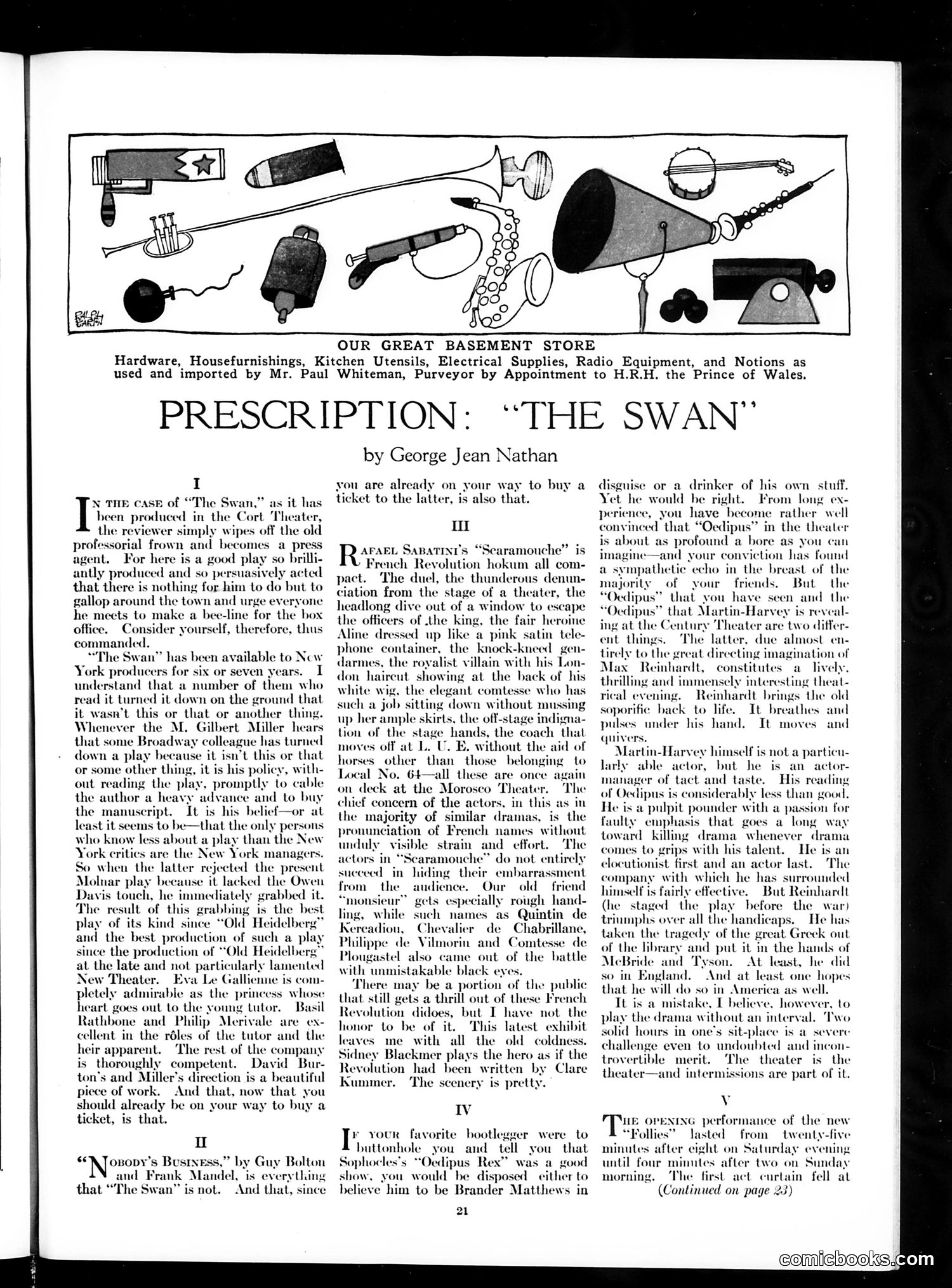
This page from *Judge* magazine contains theater reviews by George Jean Nathan rather than political cartoons. The whimsical header illustration showing various objects (musical instruments, household items, weapons) is decorative framing for the content. Nathan reviews three Broadway productions: *The Swan* (which he enthusiastically praises as excellent), *Nobody's Business* (briefly mentioned), and *Scaramouche* (which he criticizes as tired French Revolution melodrama). The header's reference to "Mr. Paul Whiteman, Purveyor by Appointment to H.R.H. the Prince of Wales" is satirical—Whiteman was a famous jazz bandleader, and the joke is listing absurd items (hardware, radio equipment) as if they were prestigious imports, mocking overwrought society advertisements of the era. The page is primarily **theater criticism**, not political satire. It reflects 1920s Broadway culture and Nathan's sharp, dismissive wit toward formulaic theatrical productions.
📄 Transcribed text from this page (OCR, searchable)
Machine-transcribed from the original scan — historical spelling and the odd misread are preserved.
OUR GREAT BASEMENT STORE Hardware, Housefurnishings, Kitchen Utensils, Electrical Supplies, Radio Equipment, and Notions as used and imported by Mr. Paul Whiteman, Purveyor by Appointment to H.R.H. the Prince of Wales. PRESCRIPTION : I N THE CASE of “The Swan,” as it has heen produced in the Cort Theater, the reviewer simply wipes off the old rial frown and becomes a pi For here is a good play so brilli- antly produced and so persuasively acted that there is nothing for him to do but to gallop around the town and urge everyone he mects to make a be ne for the box office. Consider yourself, therefore, thus commanded. “The Swan” has been available to Now York producers for six or seven years. I understand that a number of them who read it turned it down on the ground that it wasn’t this or that or another thing Whenever the M. Gilbert Miller hears that some Broadway colleague has turned down a play because it isn’t this or that or some other thing, it is his policy, with- out reading the play, promptly to cable the author a heavy advance and to buy the manuscript. It is his belief—or at least it seems to be—that the only persons who know less about a play than the New York crit e the New York managers. So when the latter rejected the present Molnar play because it lacked the Owen Davis touch, he immediately grabbed it. The result of this grabbing is the best play of its kind since “Old Heidelberg” and the best production of such a y since the production of “Old Heidelberg at the late and not ticularly lamented New Theater. Eva Le Gallienne is com- pletely admirable as heart goes out to the young tutor. Rathbone and Philip Merivale are ex- cellent in the réles of the tutor and the the princess whose Basil heir apparent. The rest of the company is thoroughly competent. David Bur- ton’s and Miller's direction is a beautiful piece of work. And that, now that you should already be on your way to buy a ticket, is that. 6X Toxopy’s Busi ” by Guy Bolton N and F Ma every thing And that, since by George Jean Nathan you are already on your way to buy a ticket to the latter, is also that. tt AFAEL Sapatinr's “Scaramouche” is French Revolution hokum all com- pi The duel, the thunderous denun- ciation from the stage of a theater, the headlong dive out of a window to escape the officers of the king, the fair h Aline dressed up like a pink satin tel phone container, the knock-kneed gen- darmes, the royalist villain with his Lon- don haircut showing at the back of his white wig, the elegant comtesse who has such a job sitting down without mussing up her ample skirts, the off-stage indigna- tion of the stage hands, the coach that moves off at L. U. E. without the aid of horses other than those belonging to Local No. 64—all these are once again on deck at the Morosco Theater. The chief concern of the actors, in this as in the majority of similar dramas, is the pronunciation of French names without unduly visible strain and effort. ‘The actors in “Scaramouche” do not entirely succeed in hiding their embarrassment from the audience. Our old friend “monsie gets especially rough hand- i while such names as Quintin de liou, Chevalier de Chabrillane, Philippe de Vilmorin and Comtesse de Plougastel also came out of the battle with unmi: able black eyes. There may be a portion of the public that still gets a thrill out of these French Revolution didoes, but I have not the honor to be of it. This latest exhibit ves me with all the old coldness. Sidney Blackmer plays the hero as if the Revolution had been written by Clare Kummer. The scenery is pretty. IV F your favorite bootlegger were to buttonhole you and tell you that Sophocles's “Oedipus R 1s a good show, you would be disposed either to believe him to be Brander Matthews in 21 “THE SWAN" disguise or a drinker of his own stuff. Yet he would be right. From long ex- i you have become rather well need that ‘ “Oedipus” in the theater is about as profound a bore as you can imagine—and your conviction has found a sympathetic echo in the breast of the majority of your friends. But the “Oedipus” that you have seen and the “Oedipus” that Martin-H. ing at the Century Theate r ent things. The latter, due almost’ en- at directing imagination of constitutes a lively, y interesting theat- hardt brings the old soporific back to life. It breathes and pulses under his hand. It moves and quivers. Martin-Harvey himself is not a particu- larly able actor, but he is an actor- manager of tact and taste. His reading of Oedipus is considerably less than good. He is a pulpit pounder with a passion for faulty emphasis that goes a long way toward killing drama whenever drama comes to grips with his talent. He is an clocutionist first and an actor last. The company with which he has surrounded himself is fairly effective. But Reinhardt (he staged the play before the war) triumphs over all the handicaps. He has taken the tragedy of the great Greek out of the library and put it in the hands of McBride and Tyson. At least, he did so in England. “And at least one hopes that he will do so in America as well. It is a mistake, [ belie however, to play the drama without an interval. ‘Two solid hours in one’s sit-place is a severe challenge even to undoubted and incon- trovertible merit. The theater is the theater—and intermissions are part of it. y ME OPENING performance of the new “Follies” lasted from twenty-five minutes after cight on Saturday evening until four minutes after two on Sunday morning. The first act curtain fell at (Continued on page 23) comichooks elu)