
A complete issue · 38 pages · 1918
Judge — March 16, 1918
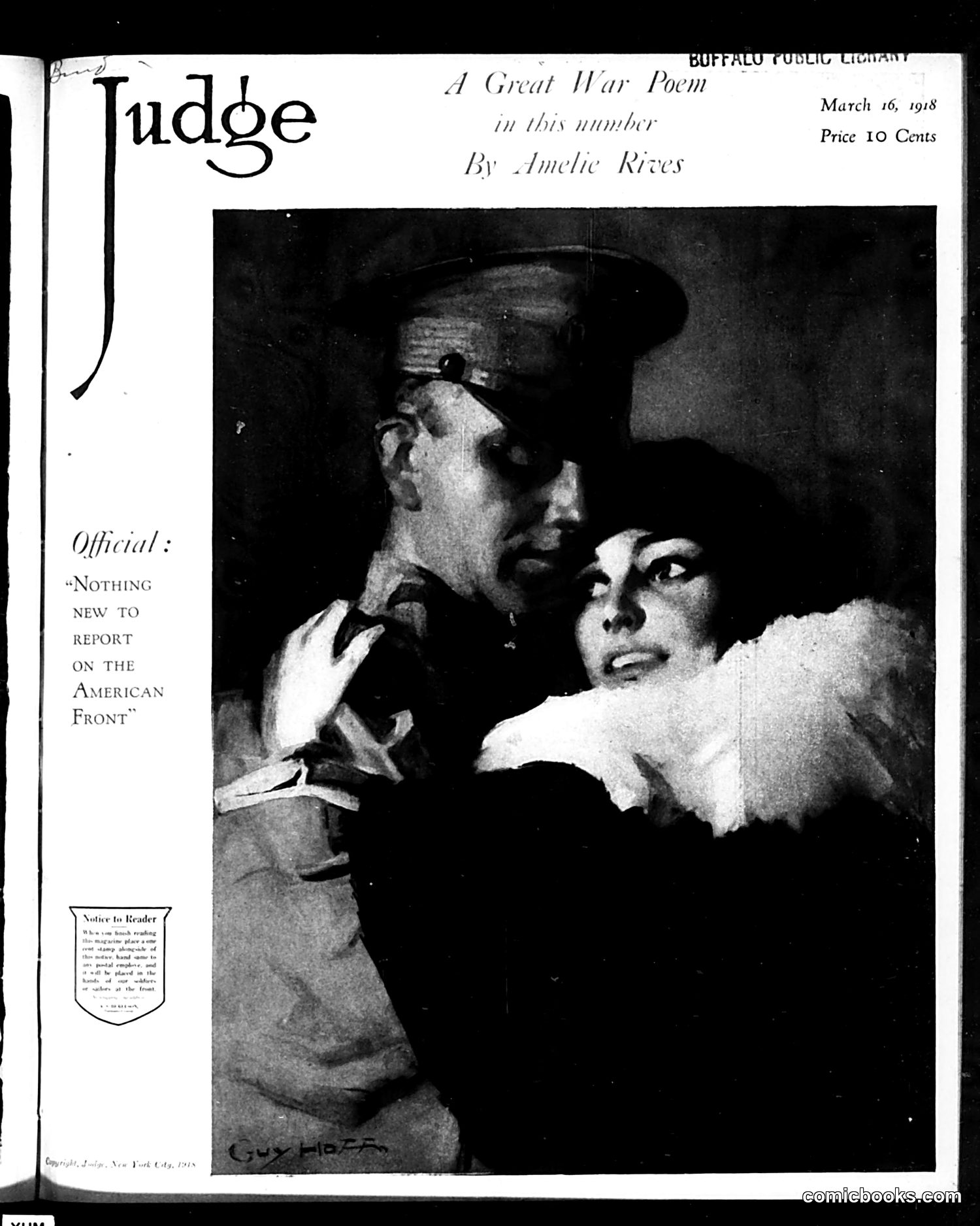
This March 16, 1918 Judge cover features "A Great War Poem" by Amelia Rives. The image shows two figures in what appears to be a dramatic wartime scene—a soldier in military uniform and a woman in period dress, depicted in an intimate or emotional moment. The official notation states: "Nothing new to report on the American Front," suggesting dark irony about the stalemate or lack of action in American WWI engagement at that time. The poem likely uses this domestic emotional scene to comment on the broader war experience. The cover appears to blend home-front sentiment with military reality—a common Judge theme during WWI—using romantic/dramatic imagery to explore American attitudes toward the ongoing European conflict in 1918.
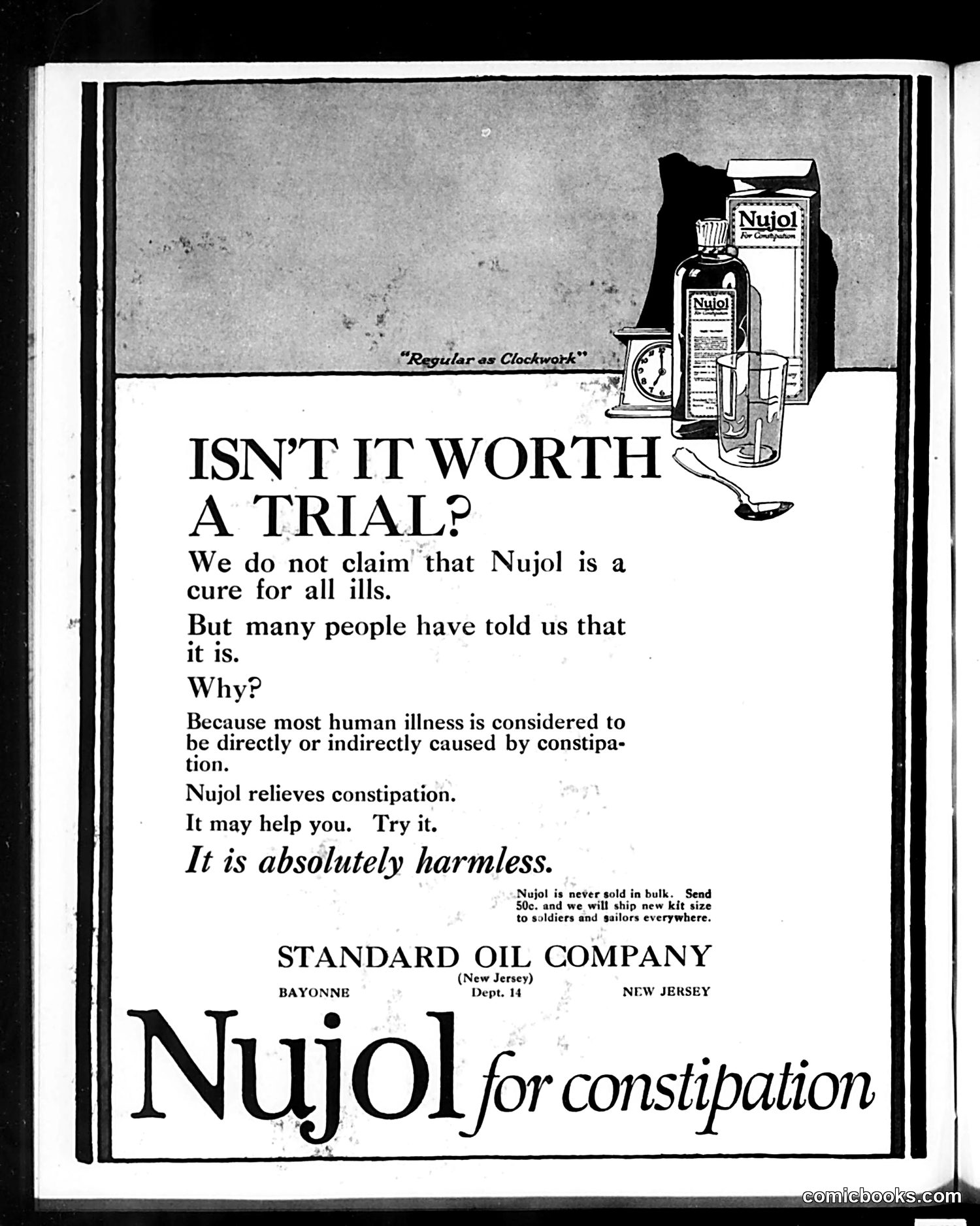
This page is primarily a **product advertisement**, not satire or political commentary. It promotes Nujol, a laxative manufactured by Standard Oil Company (New Jersey), based in Bayonne. The ad's messaging reflects early 20th-century patent medicine marketing: it claims Nujol relieves constipation and suggests most human illness stems from digestive issues. The phrase "Regular as Clockwork" (visible at top) was common advertising language for laxatives. The text emphasizes the product is "absolutely harmless"—a selling point that appears defensive, likely addressing skepticism about patent medicines, which were increasingly scrutinized during this era. There is no political cartoon or satire here—this is straightforward (if dubious by modern standards) commercial advertising from Judge magazine's pages.
This page contains a serious poem rather than satirical content. "Whom the Gods Love," by Amelia Rives (Princess Troubetzkoy), is a World War I elegy mourning young soldiers who died in combat. The poem's title references the classical maxim "whom the gods love die young." The work celebrates fallen soldiers as England's "flower," arguing they achieved noble escape through death—freed from life's suffering and gaining immortality through sacrifice. The repeated final line "Whom the Gods love die young!—die young!—die young!" emphasizes this romantic idealization of youthful military death. Rather than satire, this represents Judge magazine's patriotic wartime content, offering consolatory rhetoric about sacrifice and honor to readers grieving the war's casualties. The accompanying angelic illustration reinforces this solemn, commemorative tone.
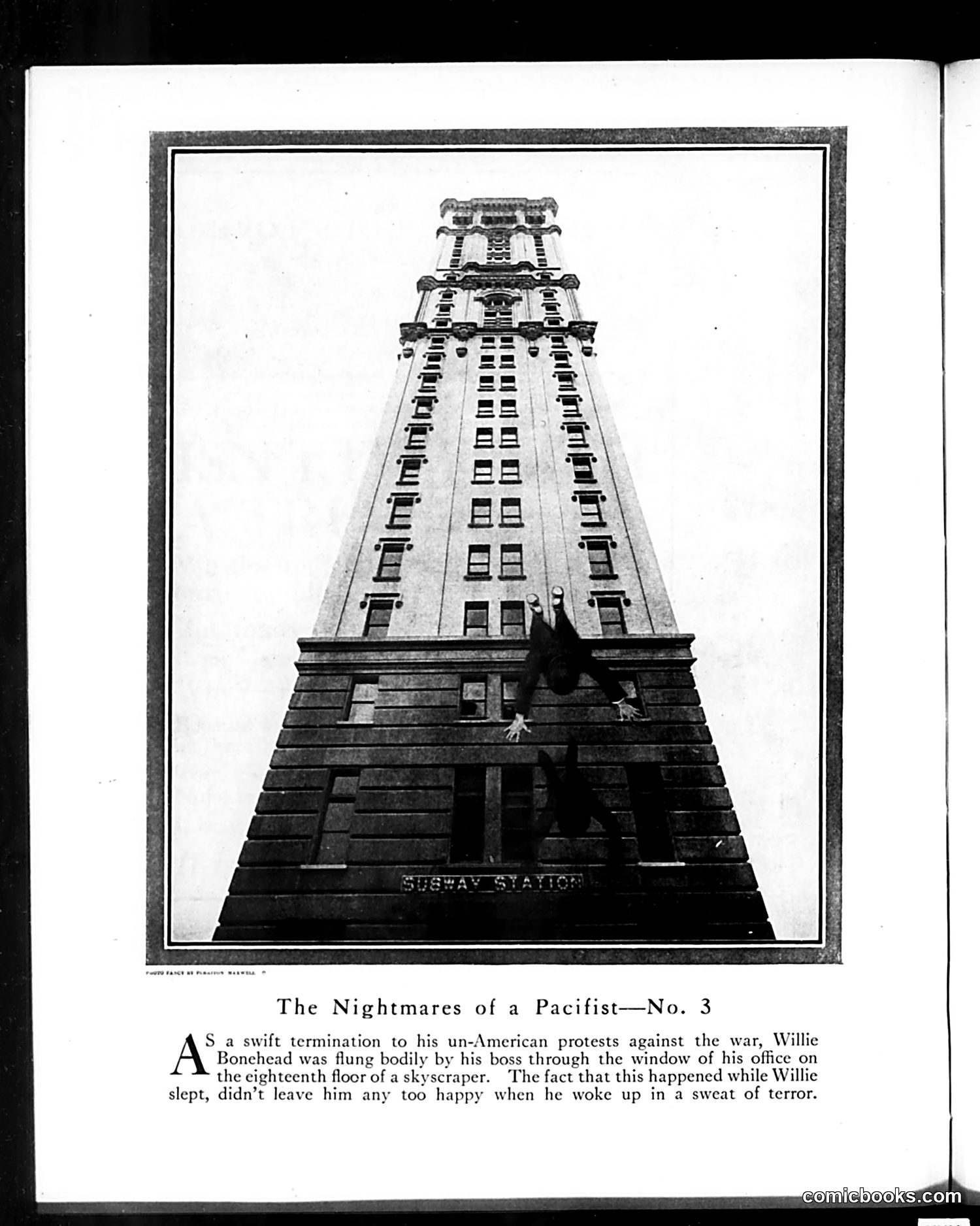
This is a satirical cartoon mocking anti-war activism during World War I. The caption describes Willie Bonehead—apparently a pacifist protester—being thrown out an eighteenth-floor office window by his boss as punishment for his "un-American protests against the war." The image shows a figure falling from a tall skyscraper (labeled "Subway Station"), viewed from below to emphasize the height and danger. The satire targets pacifists as unpatriotic during wartime, suggesting their anti-war stance deserves extreme punishment. This reflects the intense pro-war sentiment and hostility toward war resisters that characterized American public opinion during WWI. Judge magazine used humor to delegitimize opposition to the war effort.
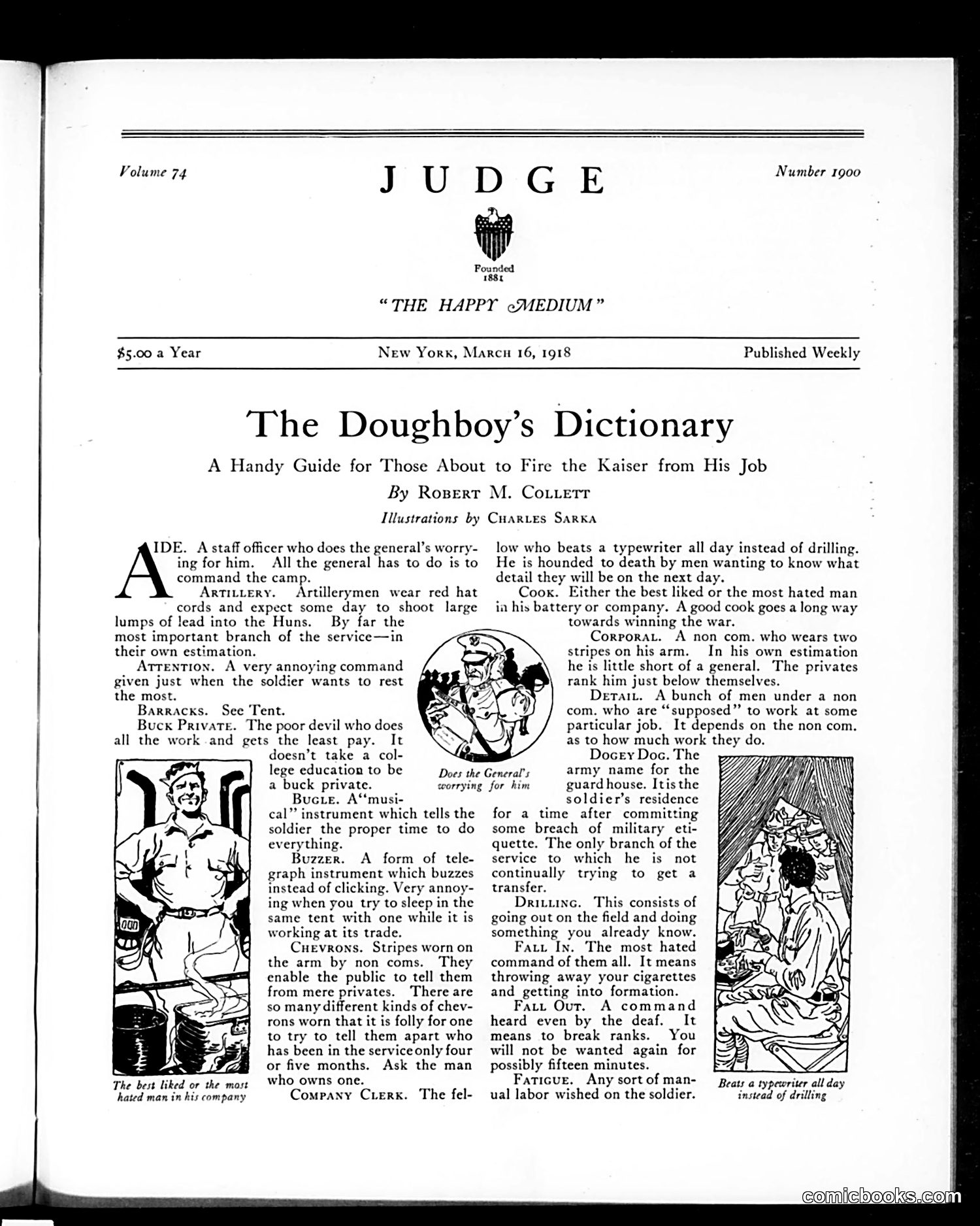
This is a satirical glossary defining military terms for American soldiers preparing to fight in World War I (the U.S. entered in 1917). The humor targets the gap between official military terminology and soldiers' actual experiences. Entries like "Buck Private" (describing thankless work), "Bugle" (an annoying wake-up device), and "Drilling" (repetitive, pointless field work) mock military life's tedium and hierarchy. "Fall In" and "Fall Out" joke about discipline and the constant threat of punishment. The illustrations show frustrated soldiers experiencing these indignities—a private doing menial labor, another beaten down by routine. The satire criticizes the disconnect between what soldiers are told versus what they endure, using humor to express working-class resentment toward military authority and wartime sacrifice.
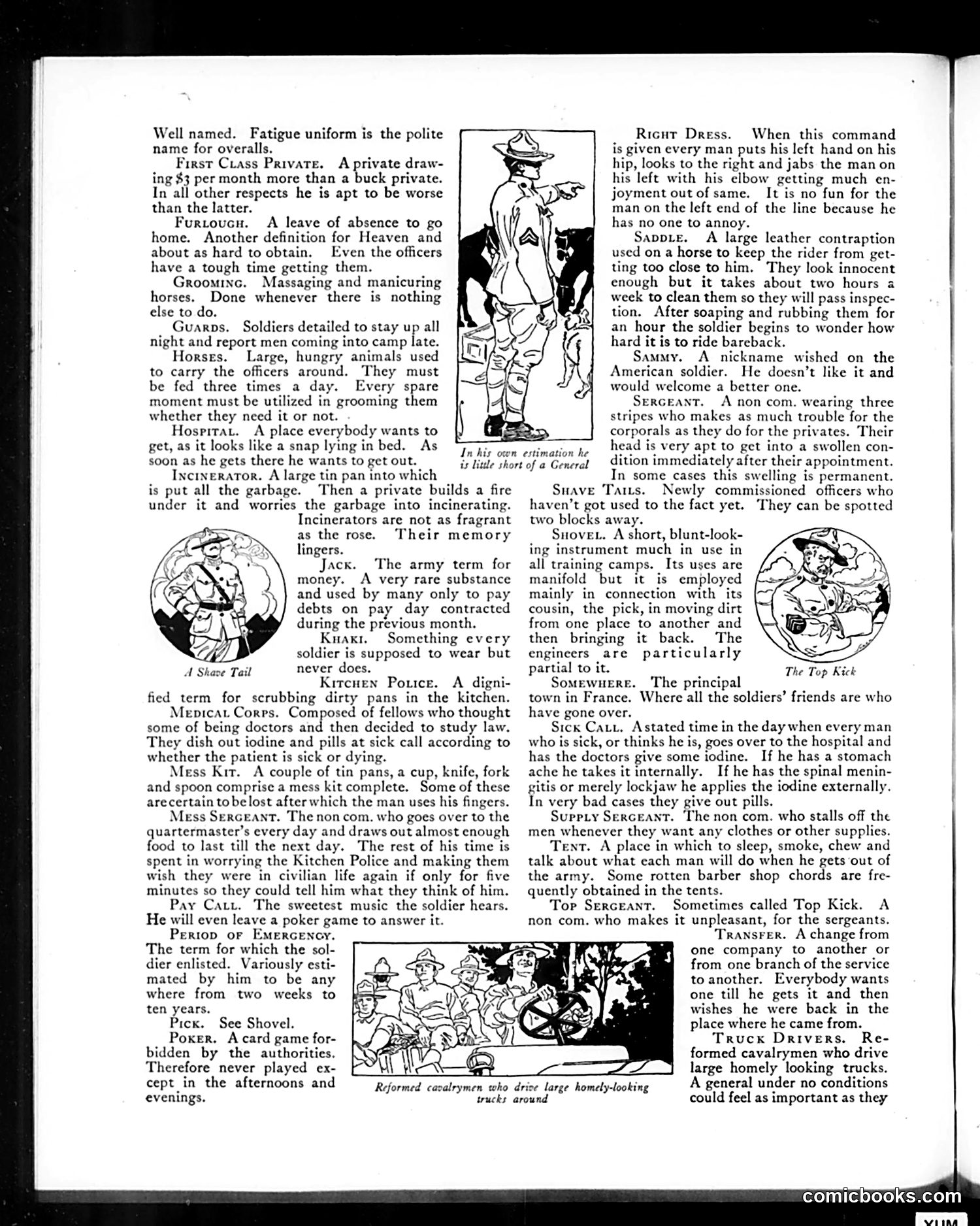
This page is a **glossary of WWI military slang and camp terminology**, not a political cartoon. It defines soldier jargon like "Fatigue Uniform," "Furlough," "Jack" (money), and "Top Sergeant." The illustrations are **humorous vignettes showing soldiers' daily experiences**—grooming horses, dealing with uncomfortable equipment (the saddle), and reformed cavalrymen driving trucks instead of riding. The satire is **gentle**: it mocks the discomforts of military life (ill-fitting uniforms, awkward saddles, the transition from cavalry to motorized transport) and soldiers' complaints about regulations. The humor assumes readers are familiar with WWI army life, likely targeting both servicemen and civilians supporting the war effort. This is essentially **educational entertainment**—making military terminology accessible through humor.
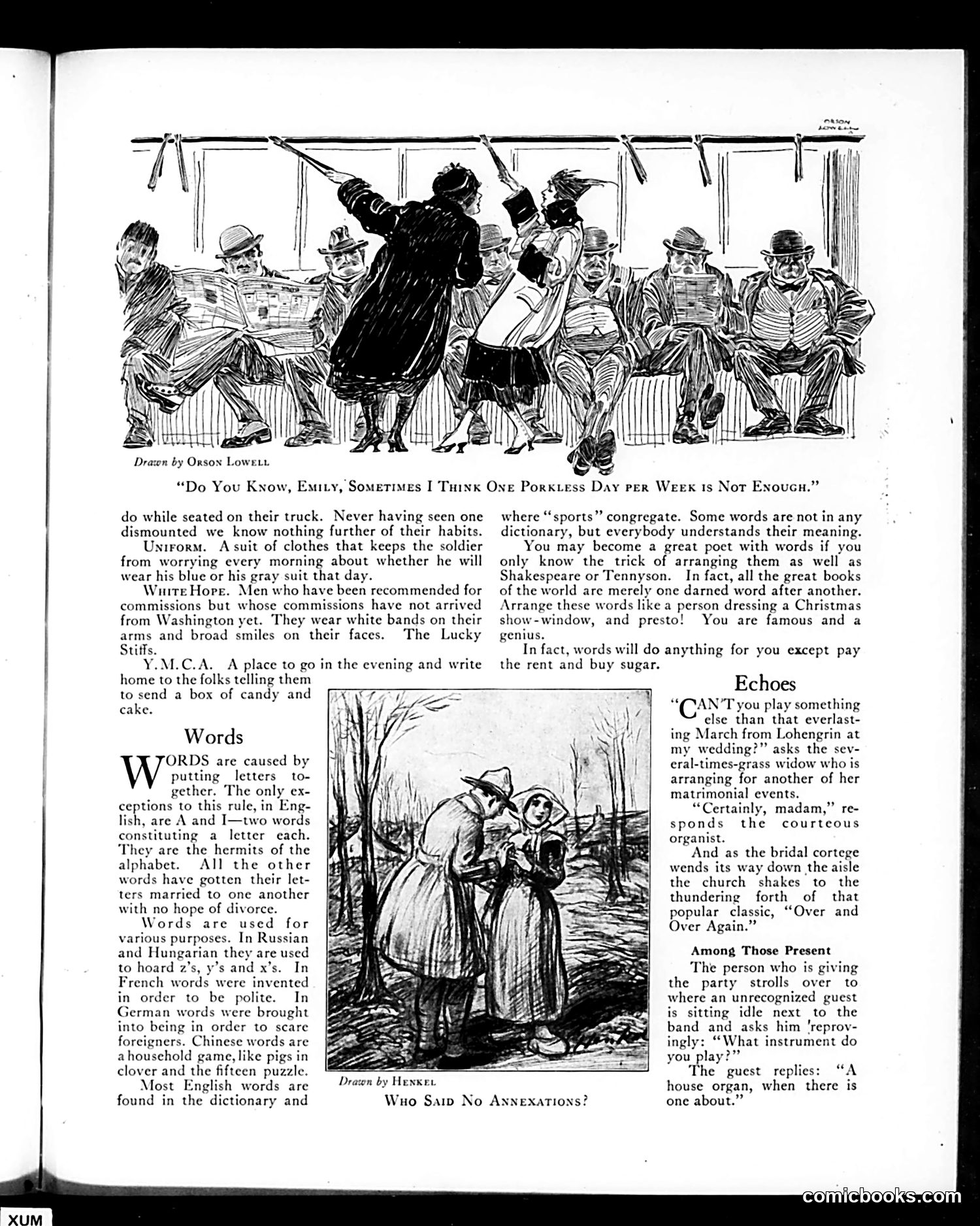
**Top Cartoon (Orson Lowell):** Depicts WWI soldiers on a truck discussing rationing. The joke references "meatless days"—wartime conservation efforts requiring Americans to abstain from meat one day weekly. The caption's exaggerated complaint satirizes civilian grumbling about minor sacrifices while soldiers endure actual hardship. **"Words" Section:** Humorous faux-dictionary definitions mocking various subjects. Notable: Russian and Hungarian languages allegedly used for hoarding unusual letters; German invented "to scare foreigners"; Chinese compared to household games. This reflects period ethnic stereotyping common in early-20th-century American humor. **Bottom Cartoon (Henkel):** "Who Said No Annexations?" references WWI peace negotiations and Woodrow Wilson's Fourteen Points, which opposed territorial annexation. The image appears to show domestic conflict—possibly labor or political dispute—ironically asking who opposes annexation while internal conflicts rage. **"Echoes" Section:** Humorous anecdotes about wedding music and party guests, offering light social satire about predictable rituals and awkward social situations.
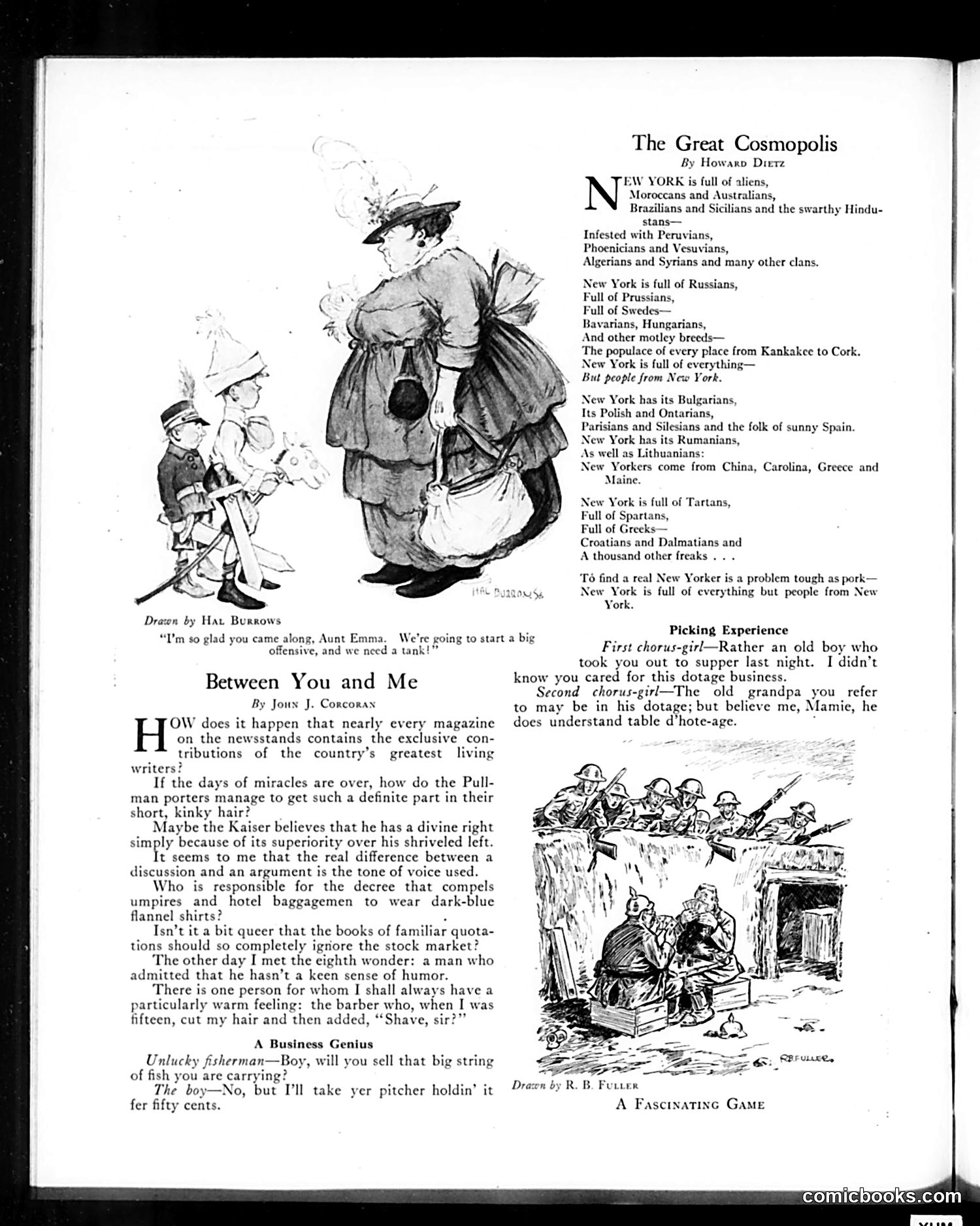
This Judge magazine page contains several satirical pieces reflecting early 20th-century American concerns: **"The Great Cosmopolis"** (poem): A humorous critique of New York City's immigrant population. The piece catalogs countless foreign nationalities and ethnic groups—Moroccans, Russians, Prussians, Poles, Greeks, etc.—concluding that you can find "everything" in New York "but people from New York." This satirizes the city's rapidly changing demographics and the anxiety some native-born Americans felt about mass immigration, a major political issue of the era. **The tank cartoon**: References World War I's Western Front warfare, where tanks were recently introduced as military innovations. The joke plays on the term "tank" (the military vehicle) and domestic language. **Minor pieces**: "Between You and Me" offers disconnected social observations; "Picking Experience" contains a dated joke about an older man dating a chorus girl. The overall tone reflects period anxieties about immigration, modern warfare, and changing social norms.
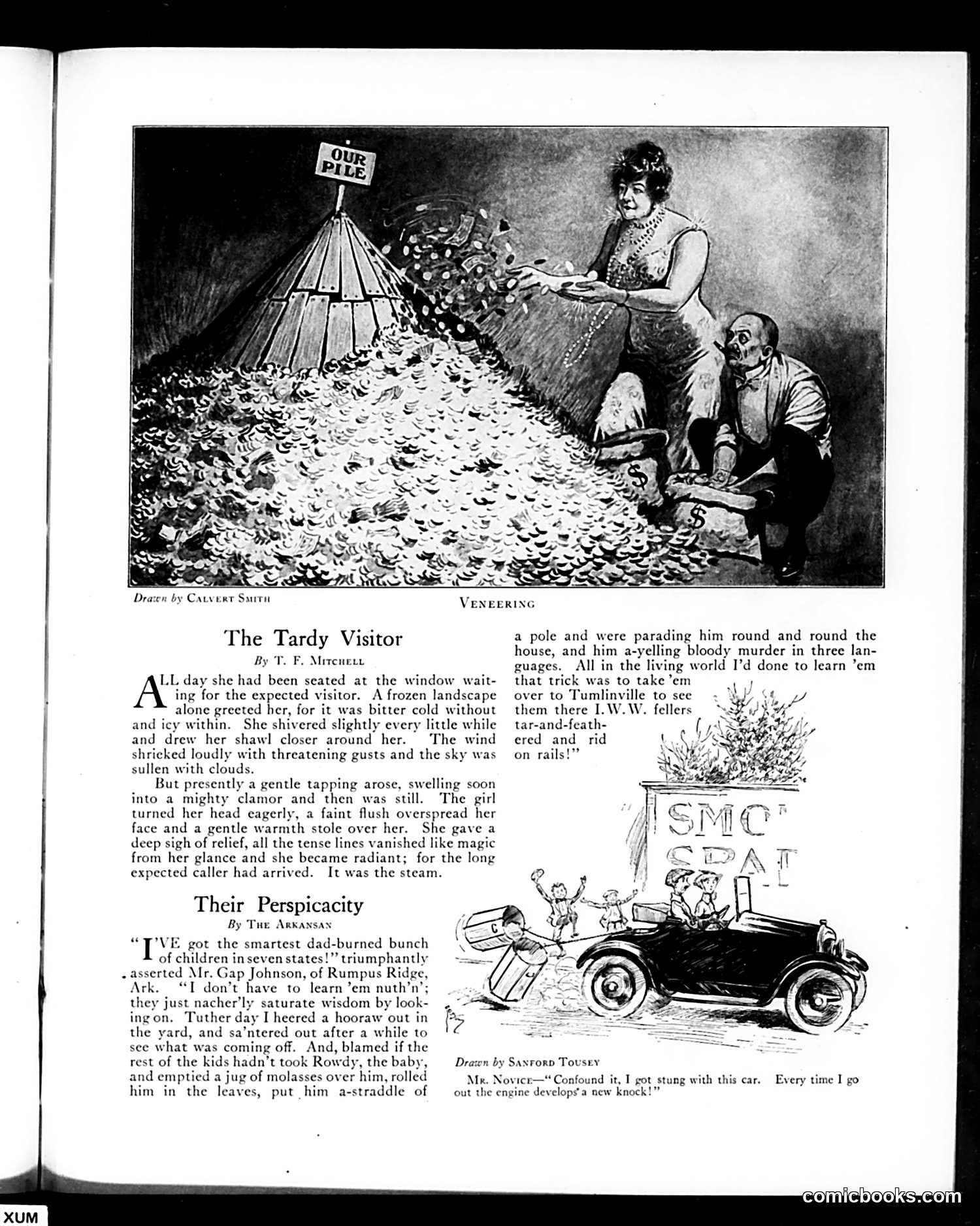
**"The Tardy Visitor"** depicts a woman waiting anxiously for a visitor in freezing weather. The punchline—"It was the steam"—suggests she mistook steam (likely from a radiator or heating system) for an actual person arriving, making her emotional relief absurd and humorous. **"Their Perspicacity"** satirizes rural folk wisdom. Mr. Gap Johnson boasts his children are naturally intelligent without formal education. He recounts how they "tar-and-feathered" the baby by covering him in molasses and leaves—a reference to the violent mob punishment historically inflicted on unpopular figures. The joke mocks his pride: the children's "cleverness" is actually dangerous foolishness, yet he celebrates it as innate wisdom. Both pieces rely on period-appropriate rural dialect and stereotypes typical of Judge's satirical humor targeting rural Americans.
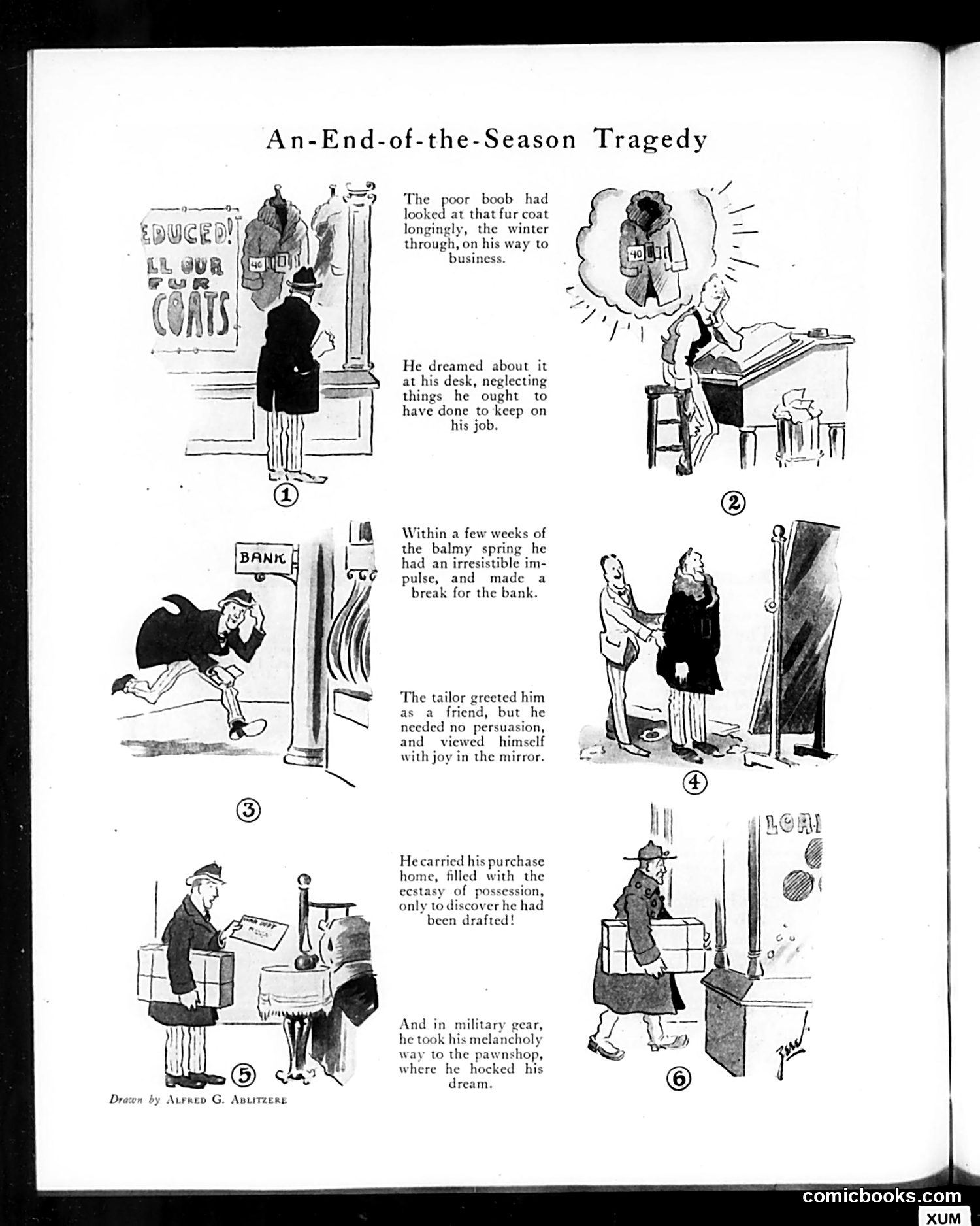
This six-panel satirical comic by Alfred G. Ablitzer depicts a working man's financial downfall during what appears to be the World War I era. The protagonist obsesses over an expensive fur coat all winter, neglecting work duties. When spring arrives, he impulsively withdraws money from the bank to purchase it from a tailor. He admires himself in the mirror, thrilled with his acquisition. However, the punchline arrives when he's drafted into military service. Unable to afford both the coat and his new obligations, he must pawn his prized "dream" to a pawnshop. The satire mocks consumer vanity and poor financial judgment—the boob's desire for status symbols overrides both work responsibility and financial prudence, leaving him worse off when circumstances change. It's also a commentary on how military conscription disrupted civilian life and priorities during WWI.
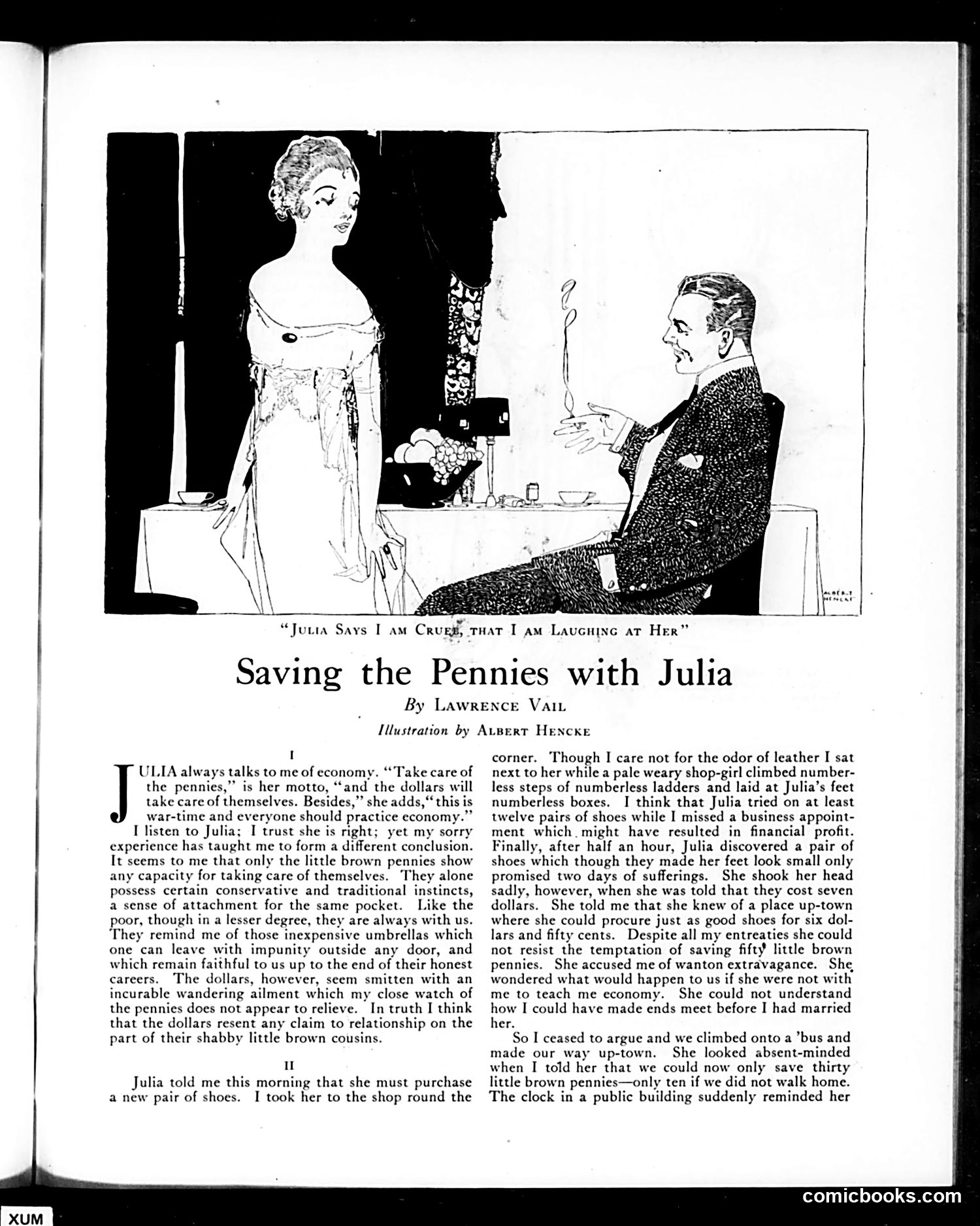
This is a humorous domestic satire by Lawrence Vail, illustrated by Albert Hencke, likely from WWI-era Judge magazine (note the "war-time" reference). The joke concerns a wife, Julia, who obsessively practices penny-pinching economy—"take care of the pennies and the dollars will take care of themselves"—but whose frugality actually *costs* money. The illustration shows Julia lecturing her husband during what appears to be a formal dinner. The accompanying story describes Julia insisting they travel across town to save fifty cents on shoes, then debating whether to walk home to save thirty more pennies—all while the husband misses a profitable business appointment. The satire mocks women's domestic financial management and suggests that excessive thriftiness—particularly concerning trivial amounts—defeats its own purpose by wasting time, opportunity, and transportation costs. It's a period-typical joke about female financial irrationality and nagging domesticity.
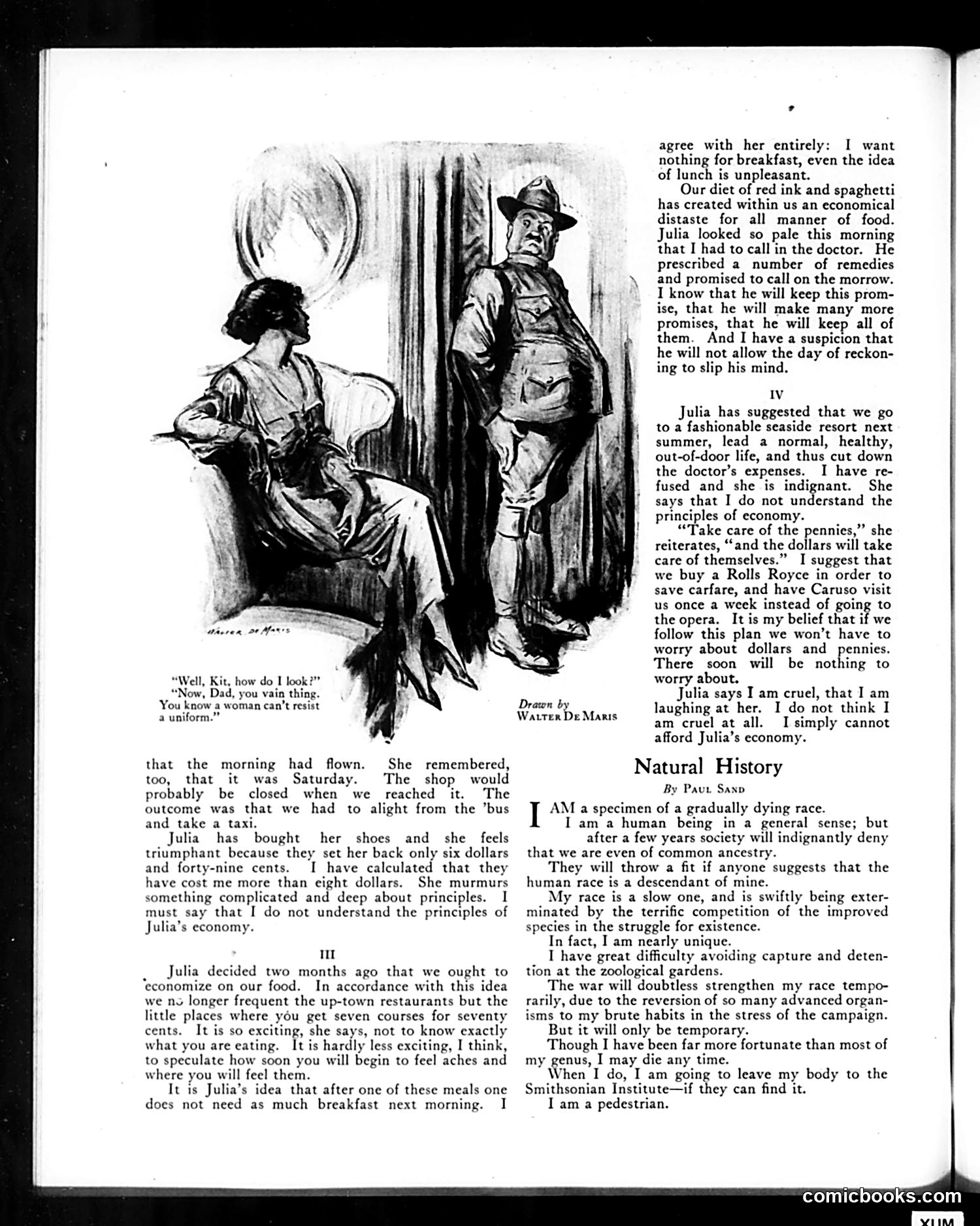
This page contains two separate satirical pieces mocking early 20th-century middle-class anxieties. **The cartoon** (drawn by Walter De Maris) shows a woman admiring a man in military uniform, with the caption joking that women find uniforms irresistible—likely referencing WWI-era military recruitment or the appeal of soldiers. **The main narrative** satirizes a husband's frustration with his wife Julia's contradictory "economy" schemes. She buys expensive shoes but claims savings; she insists on cheap seven-course meals that make them ill; she suggests costly seaside vacations to save on doctor visits. The humor lies in her illogical reasoning and the narrator's exasperated recognition that her penny-pinching costs him more money overall. **"Natural History"** by Paul Sand is a darkly comic monologue from a pedestrian claiming to be an "dying race" being "exterminated" by modern competition—a bitter commentary on automobiles replacing pedestrians in cities, using pseudo-scientific evolutionary language for humorous effect. Both pieces satirize modern life's absurdities and economic anxieties of the period.
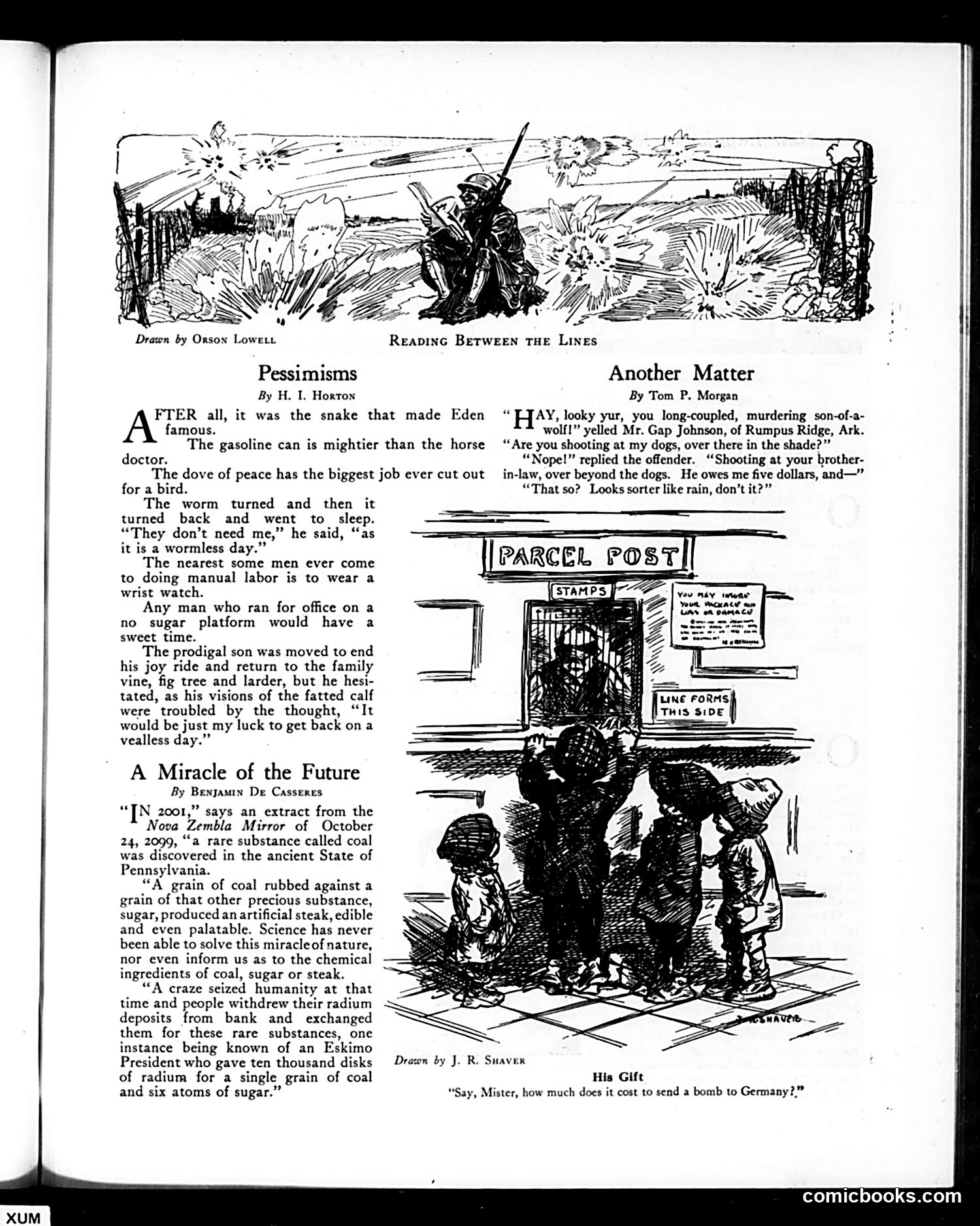
This page contains three satirical pieces reflecting early 20th-century anxieties: **"Pessimisms"** offers cynical one-liners mocking modern life—comparing gasoline cans to horses, suggesting worms lack ambition, and implying industrial progress creates meaningless labor (wearing a wristwatch as "manual labor"). **"Another Matter"** depicts rural hillbilly dialect humor common to the era, showing backwoods folk casually discussing shooting at relatives over money debts, with indifference to violence. **"A Miracle of the Future"** satirizes resource scarcity by imagining coal and sugar as precious commodities by 2001—extrapolating current anxieties about depleted resources. The final cartoon's caption ("how much does it cost to send a bomb to Germany?") references World War I, depicting a child's innocent question about wartime costs, highlighting the period's militarization. The overall tone reflects pre-WWI American skepticism about progress, modernity, and industrialization.
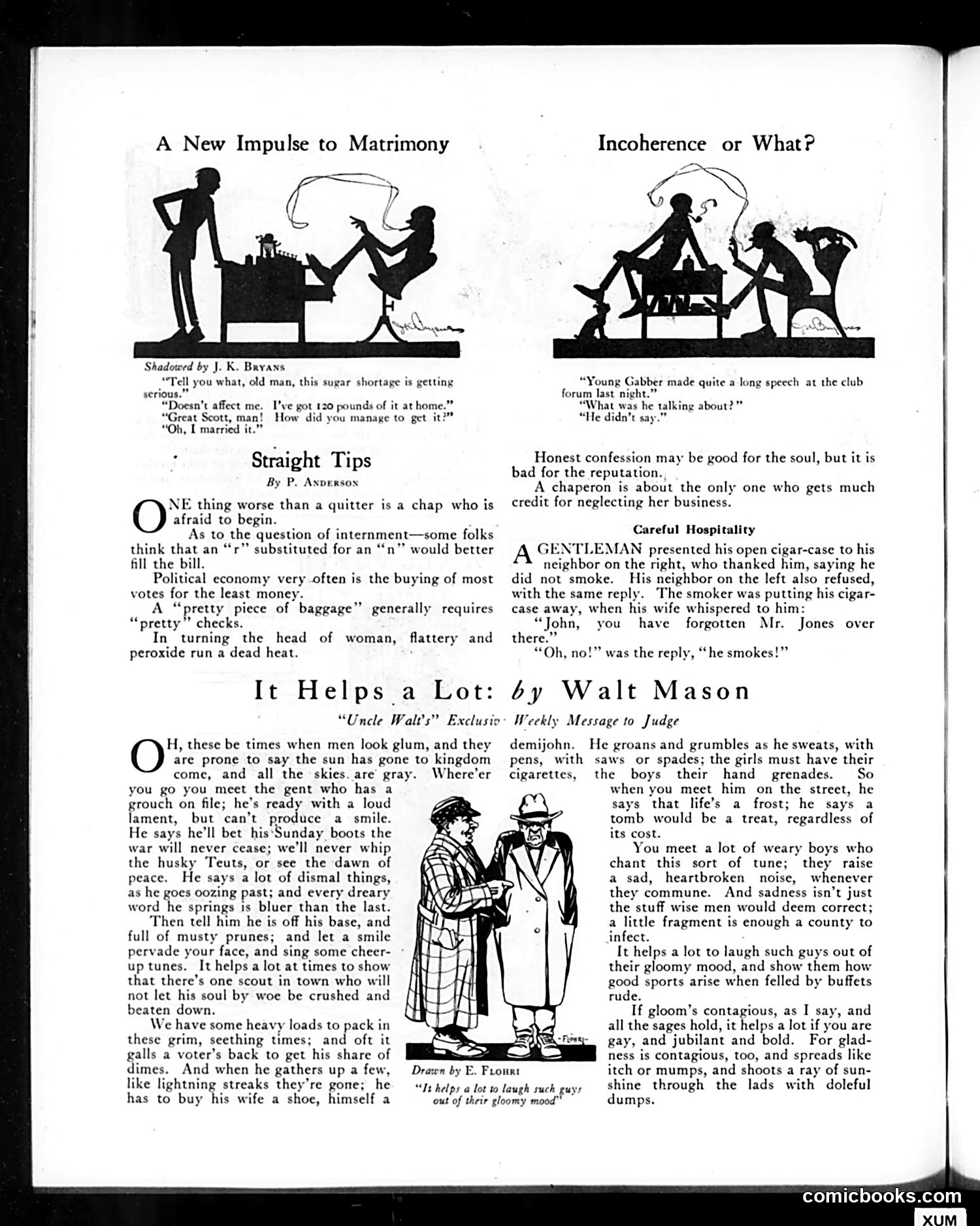
This page contains early-20th-century satirical commentary on American social and domestic life, likely from WWI-era (references to "Teuts" and war weariness suggest this timing). **Top cartoons:** The left cartoon jokes about sugar hoarding during wartime shortages—a man claims to have 120 pounds at home because he "married it," implying his wife hoarded supplies. The right cartoon mocks verbose speakers who say nothing of substance ("Young Gabber made quite a long speech...He didn't say"). **"Straight Tips"** offers cynical social observations: critiques of quitters, political corruption (buying votes cheaply), and gender dynamics (flattery and peroxide equally sway women). **"It Helps a Lot"** by Walt Mason advocates combating wartime gloom through cheerfulness and optimism—a morale-boosting message urging readers to counter the pervasive pessimism of anxious times with good humor. Minor humorous anecdotes address hypocrisy (confessions harm reputation) and social awkwardness (the cigar-case story about forgetting an actual smoker).
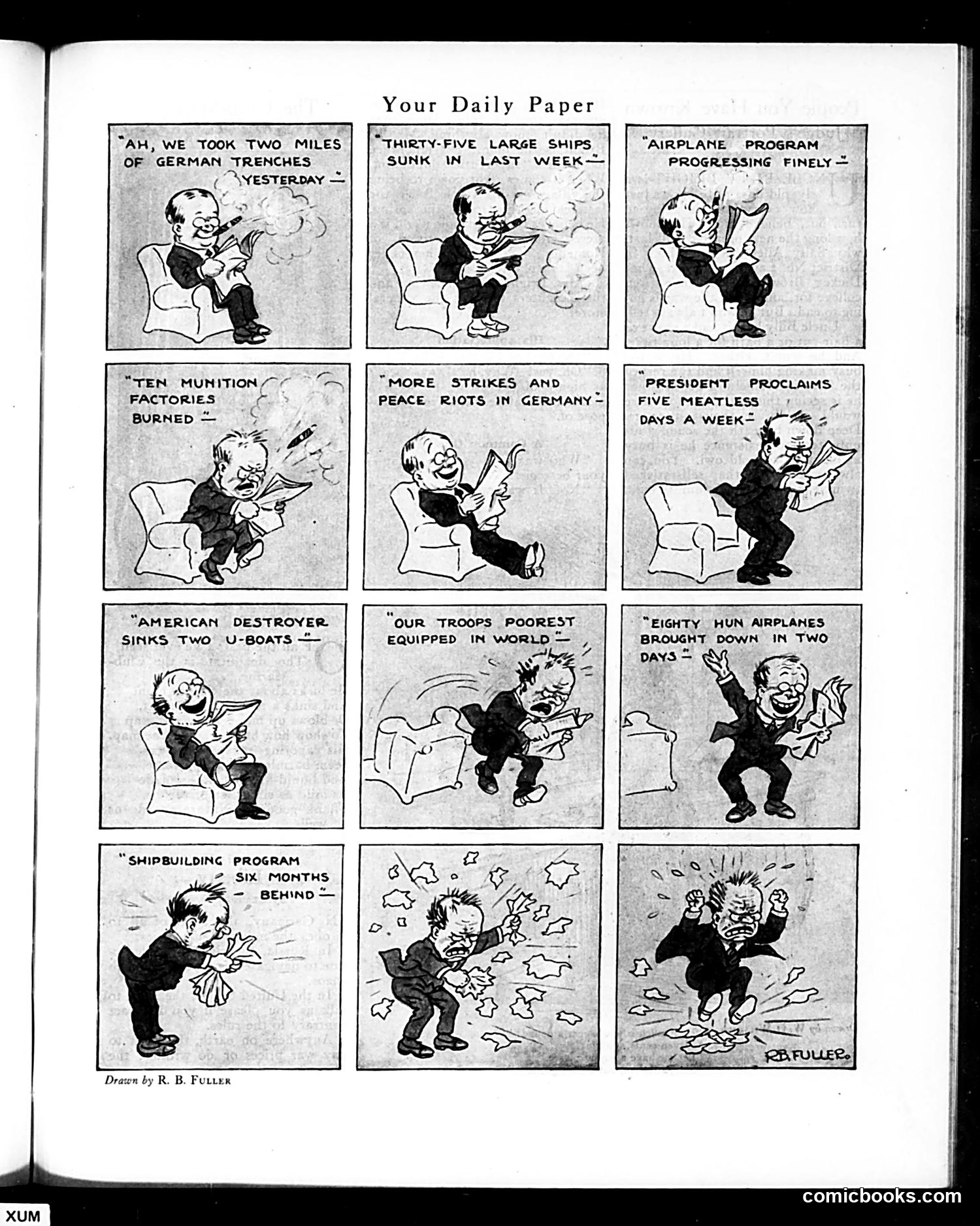
This R.B. Fuller cartoon satirizes WWI newspaper headlines and wartime propaganda. The same caricatured figure (likely representing a politician or military official) reacts with exaggerated cheerfulness to increasingly contradictory war reports. The joke: headlines announce both military successes (trenches taken, ships sunk, planes downed) *and* serious failures (ships lost, factories burned, troops poorly equipped, production delays). The character's unchanging smile mocks how officials spin bad news as good, or how newspapers present chaotic wartime reality as a coherent narrative. The final three panels show the figure increasingly unraveling under the weight of these contradictions—literally falling apart—suggesting this propaganda approach is unsustainable. The cartoon critiques both government messaging and media credibility during WWI.
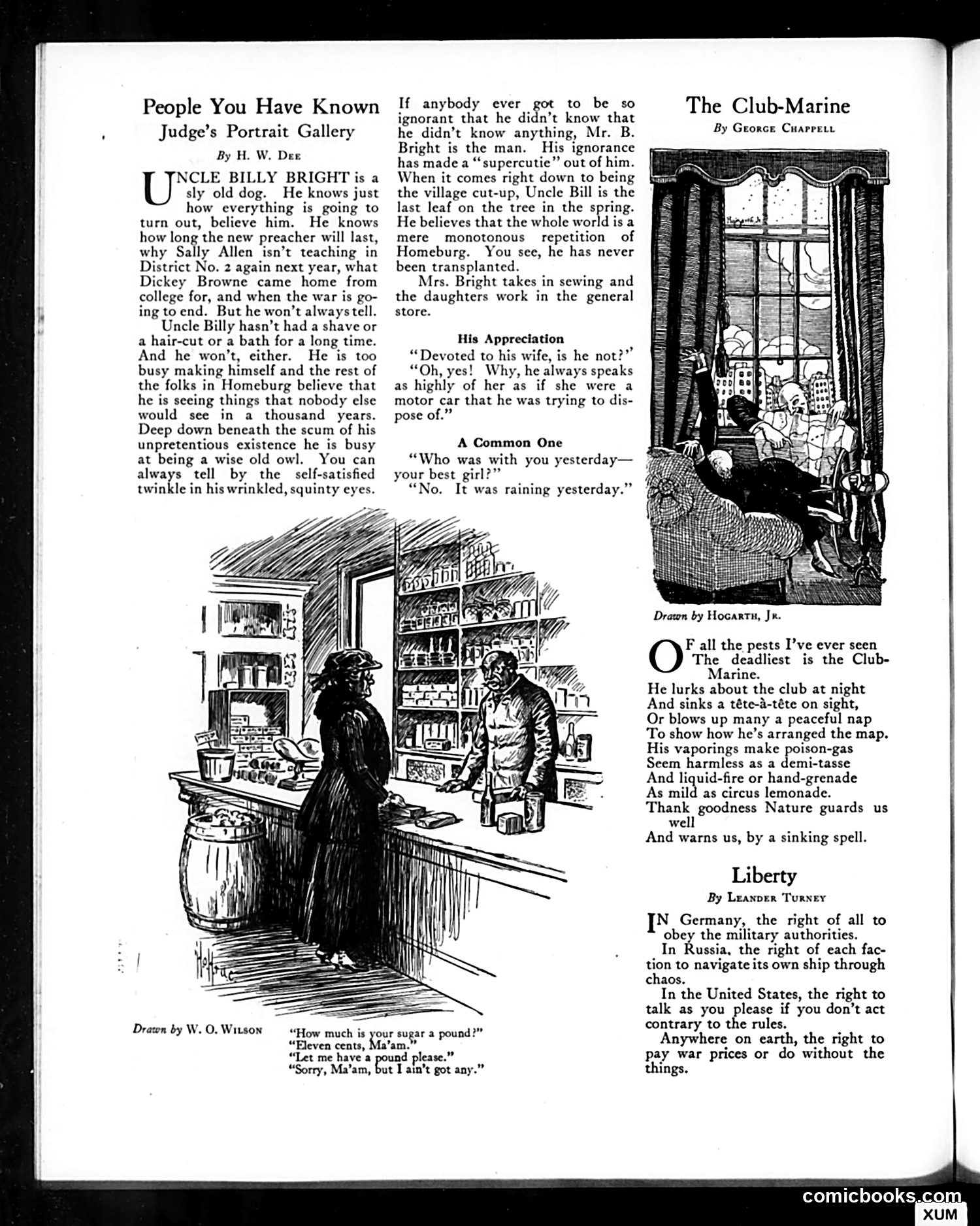
This page contains three separate satirical pieces typical of Judge's early 20th-century social commentary: **"Uncle Billy Bright"** (portrait sketch): A character study mocking a small-town know-it-all who claims omniscience about local gossip while avoiding basic hygiene. The satire targets rural pretentiousness and busybodies who fancy themselves wise observers. **"The Club-Marine"** (verse with illustration): Satirizes a club member who monopolizes conversations with tedious war stories and map discussions, disrupting others' peace. The humor lies in comparing his boring monologues to chemical weapons. **"Liberty"** (prose commentary): A comparative definition joke contrasting freedom across nations—Germany's obedience, Russia's chaotic factionalism, America's conditional free speech, and everywhere's wartime price gouging. This appears to reference WWI-era contexts (likely written during or shortly after the war). The page exemplifies Judge's blend of character mockery, domestic humor, and political commentary aimed at educated middle-class readers.
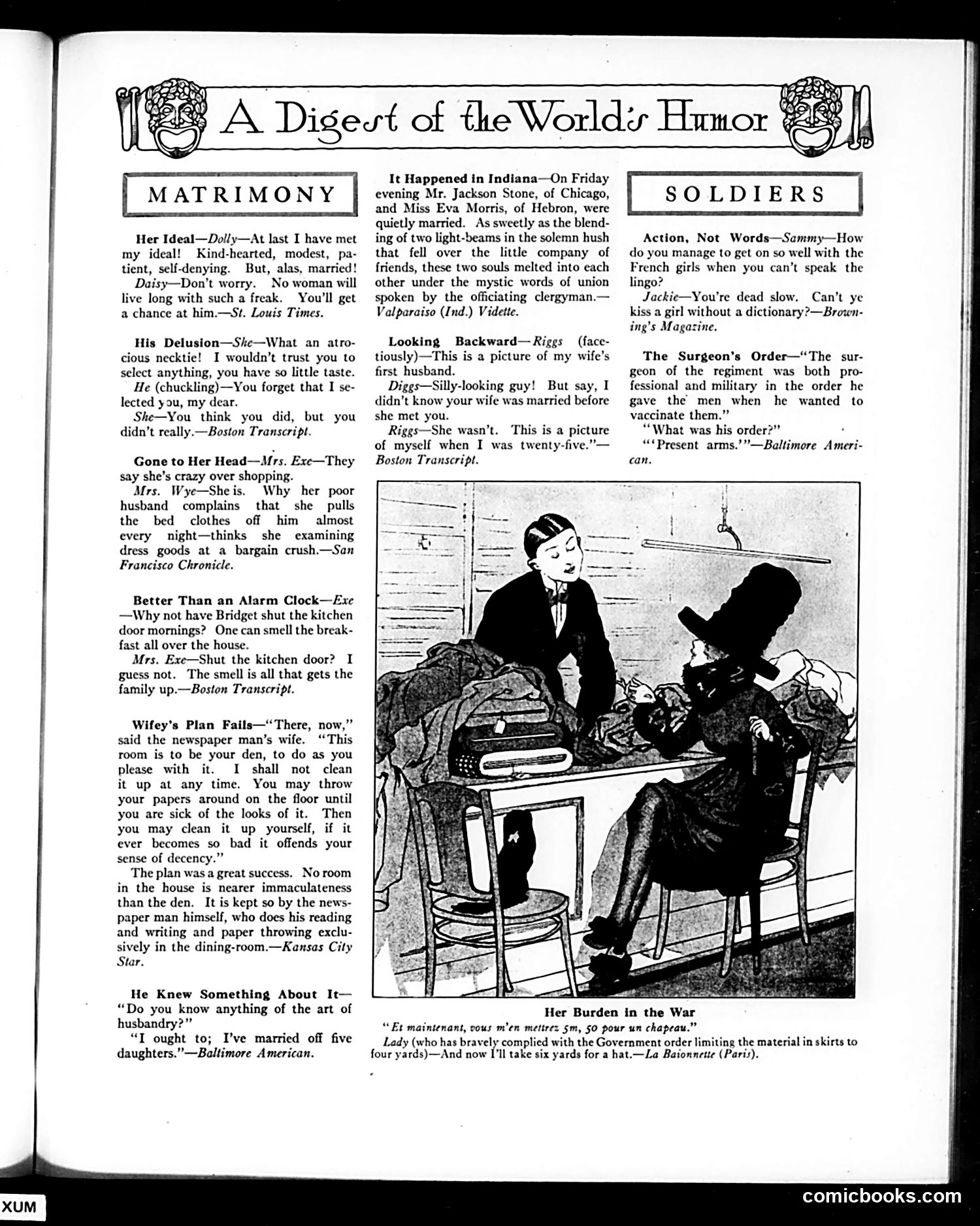
This page collects brief humorous anecdotes organized by topic (Matrimony, Soldiers). The jokes are mostly domestic humor playing on marriage stereotypes and gender roles typical of early-20th-century American magazines. The main cartoon depicts a woman shopping for fabric or clothing. The caption references a French government wartime order limiting skirt material to four yards (likely WWI-era rationing). The joke: a lady who patriotically complied with this restriction now wants six yards of material—for a hat, implying frivolous excess despite wartime sacrifice. The smaller anecdotes use similar marital and gender themes: wives who obsess over shopping, husbands with poor taste, women's irrationality. One military joke references vaccination orders phrased militarily as "present arms." The overall tone reflects pre-modern attitudes toward women as spenders and homemakers, presented as good-natured ribbing rather than serious critique.
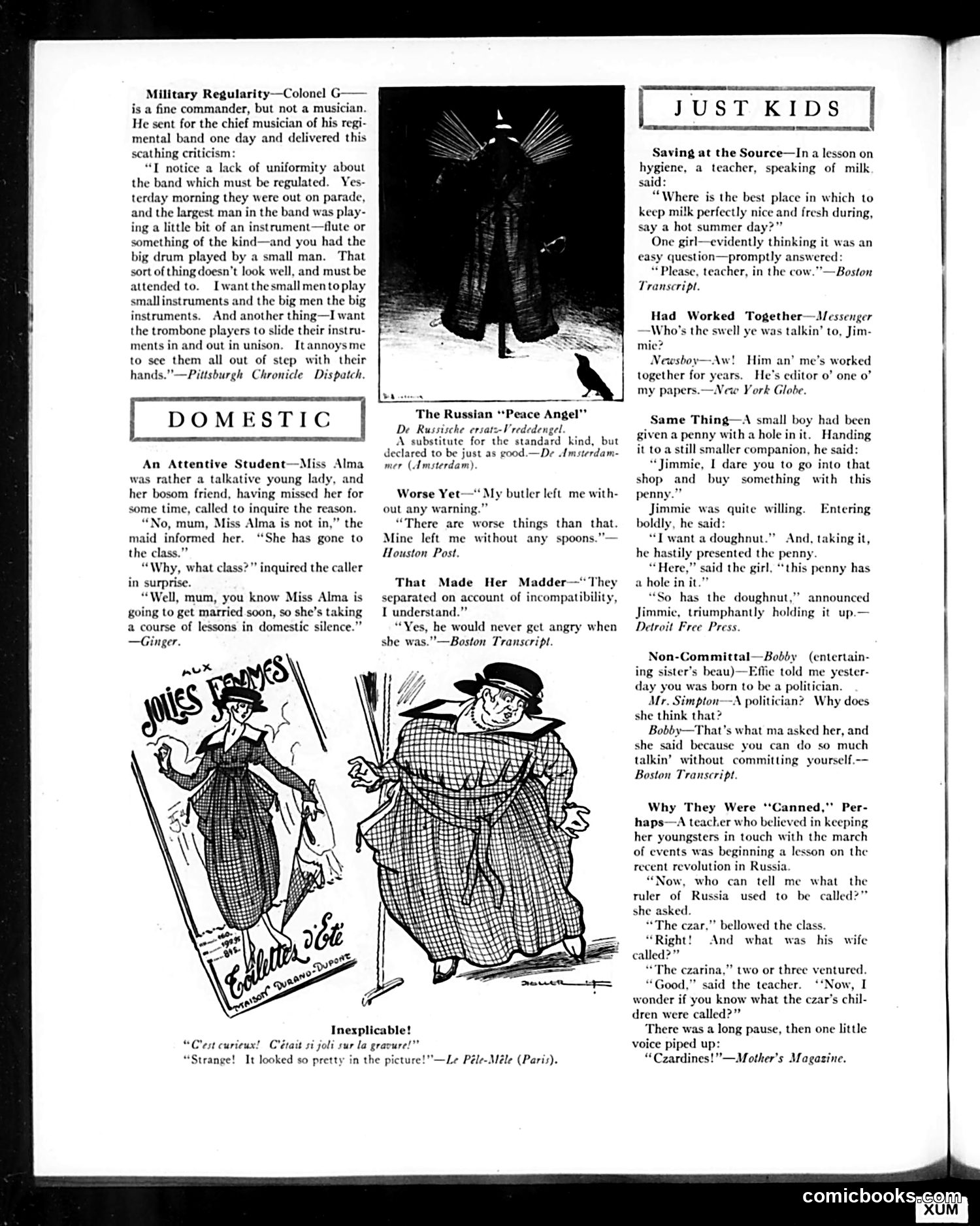
This page from Judge contains several short humorous anecdotes satirizing early 20th-century American life and society. **"Military Regularity"** mocks a rigid military commander obsessed with matching instrument size to musician stature—a absurd interpretation of "uniformity" that sacrifices musical quality for appearance. **"The Russian Peace Angel"** is a Dutch cartoon referencing Russia's failed 1917 peace efforts during WWI, sarcastically calling Russia's substitute peace attempt "just as good" as genuine peace—biting commentary on Russia's unstable diplomatic position. The **"Domestic"** section contains light domestic humor: Miss Alma taking "lessons in domestic silence" before marriage (satirizing women's expected submission); servants leaving without warning; and the "Inexplicable" cartoon showing something looking better in an engraving than in reality. **"Just Kids"** features children's innocent logic—a girl suggesting milk be kept "in the cow," and a boy using a hole-filled penny to buy a hole-filled doughnut. These celebrate children's unintentional wit. The page reflects pre-WWI American periodical humor: gender politics, class dynamics, and gentle mockery of social institutions.
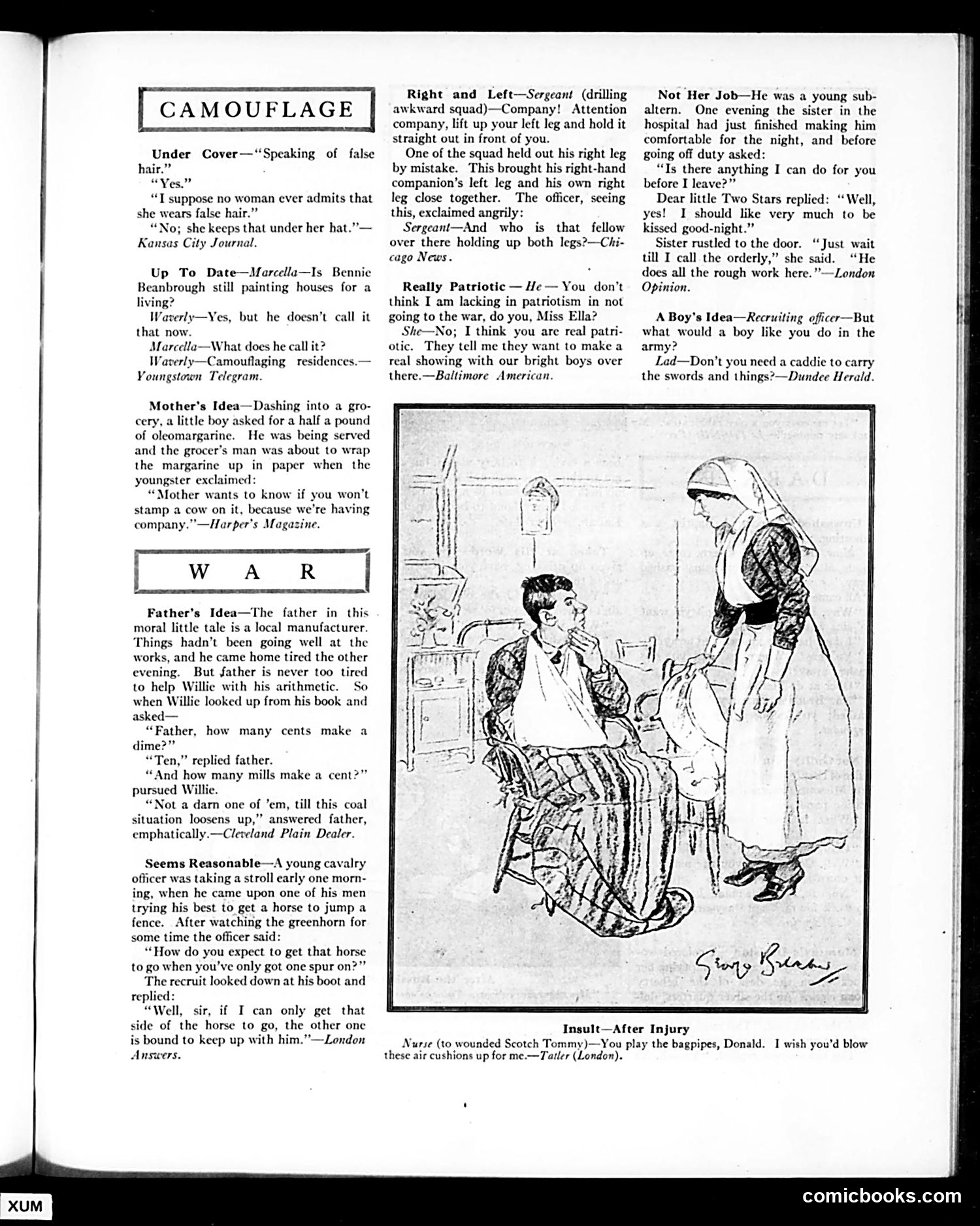
This page from Judge collects brief satirical anecdotes and jokes typical of WWI-era American humor. Key observations: **War Section**: Multiple jokes reference World War I, reflecting America's engagement. "Really Patriotic" mocks men avoiding military service by praising their "patriotism"—obvious sarcasm. "A Boy's Idea" jokes about a boy joining the army as a "caddie" carrying swords, satirizing childish misunderstandings of war. "Insult—After Injury" references a wounded Scottish soldier and bagpipes. **The main cartoon** (signed by Cesare Blewes) depicts a nurse attending a wounded soldier in bed—connected to the "Not Her Job" anecdote about a nurse's refusal to kiss a patient goodnight, redirecting him to an orderly for "rough work." **Other jokes** use contemporary references: oleomargarine stamped with cow images (food culture), "camouflaging residences" (painting houses using military terminology), and coal shortages affecting manufacturing. The humor reflects wartime anxieties, domestic rationing, and gender roles of the 1910s-20s.
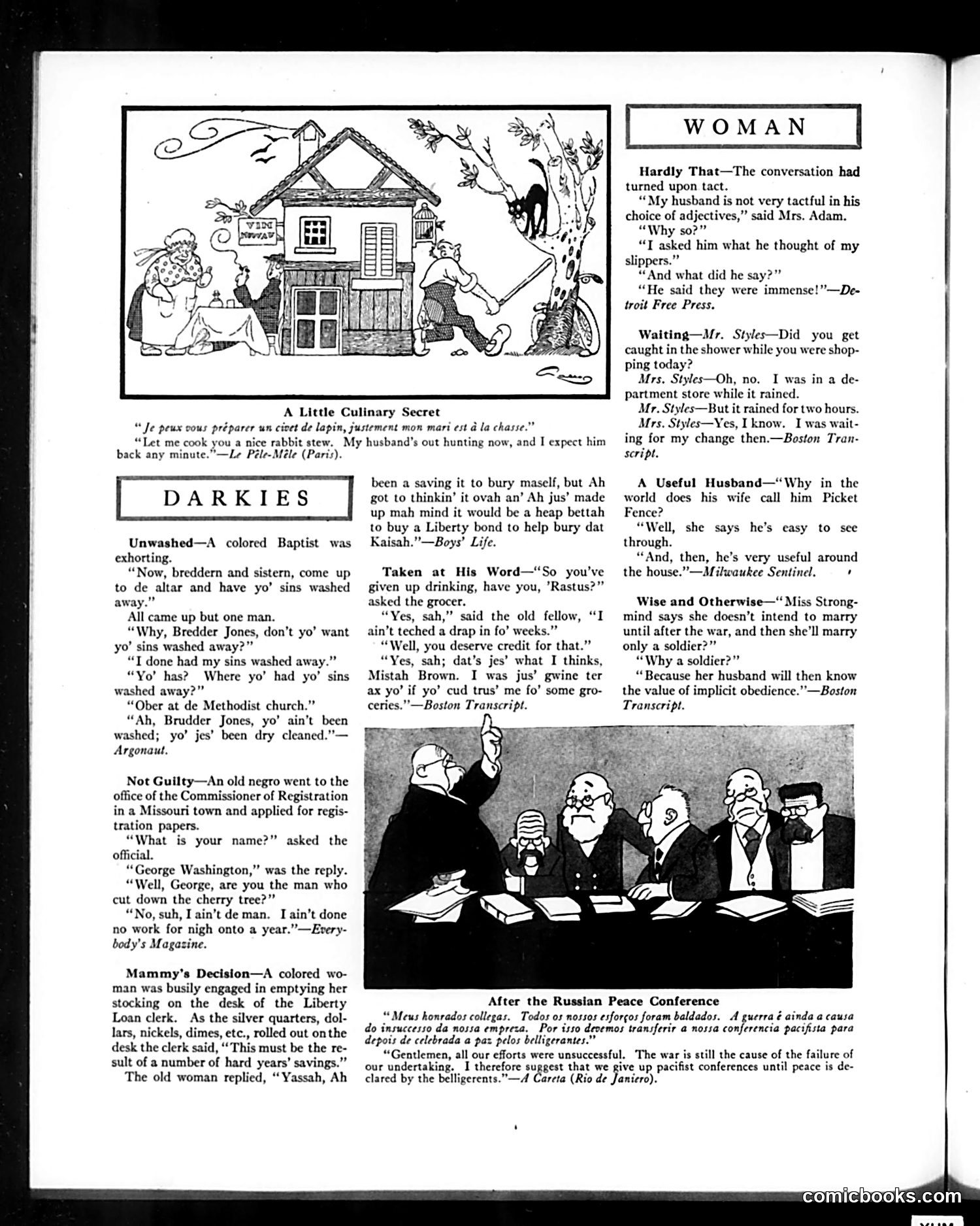
This page contains humorous anecdotes and one political cartoon, mostly employing racial stereotypes common to early 20th-century American humor. **The anecdotes** feature African American characters in dialect, presenting jokes about religious practices, financial patriotism (Liberty Loan bonds during WWI), and sobriety. **The main cartoon** ("After the Russian Peace Conference") depicts what appears to be diplomats at a peace conference table. The Portuguese caption translates to diplomats admitting their peace efforts failed because "war is still the cause of our failure," suggesting they abandon pacifist conferences until the war actually ends. This references the unsuccessful Russian peace negotiations during World War I, satirizing the futility of diplomatic conferences while the war continues. **The "Woman" section** contains brief jokes about marriage and gender relations, featuring white, middle-class characters discussing husbands' tactlessness and wives' shopping delays. The page reflects WWI-era American attitudes, including support for war bonds and skepticism toward peace negotiations.
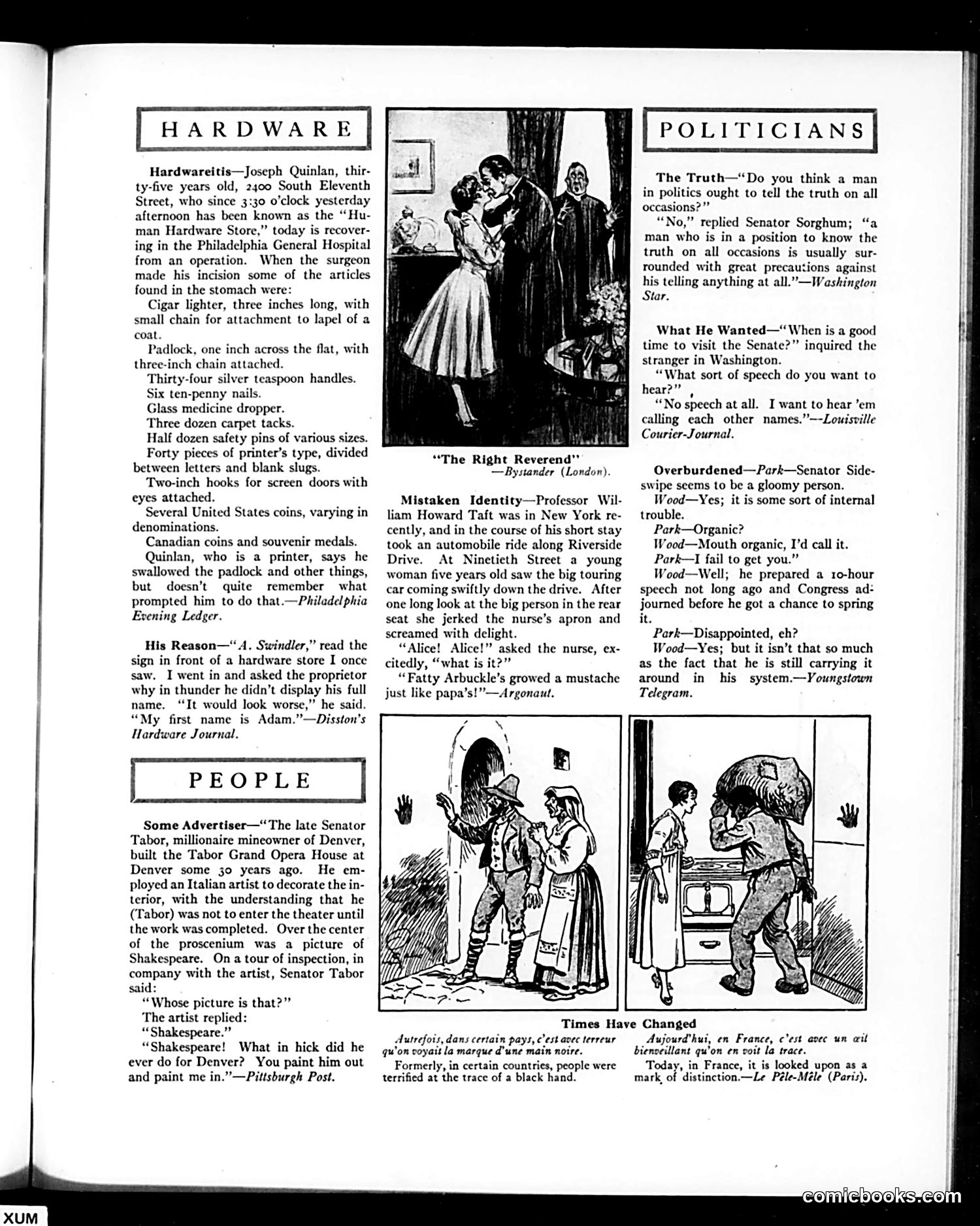
This satirical page from Judge magazine contains several humorous anecdotes mocking American politics and society. The **"Hardwareitis"** story ridicules a printer who swallowed various metal objects—a darkly comedic exaggeration suggesting obsession with one's profession. The **"Mistaken Identity"** anecdote jokes that a young child mistakes President William Howard Taft for "Fatty" Arbuckle (a silent-film comedian), implying Taft's considerable girth was widely recognized and mocked. The **political jokes** satirize Congress: one depicts senators as preferring insults to speeches; another mocks Senator Sorghum for claiming politicians shouldn't tell truth when positioned to know it—cynical commentary on political dishonesty. The **final cartoon** titled "Times Have Changed" contrasts past superstitions (fearing a black hand's mark) with modern society, though its specific contemporary reference remains unclear from the visible text. Overall, the page exemplifies Judge's formula: mixing absurdist humor with biting political critique about corruption, vanity, and incompetence in government and public life.
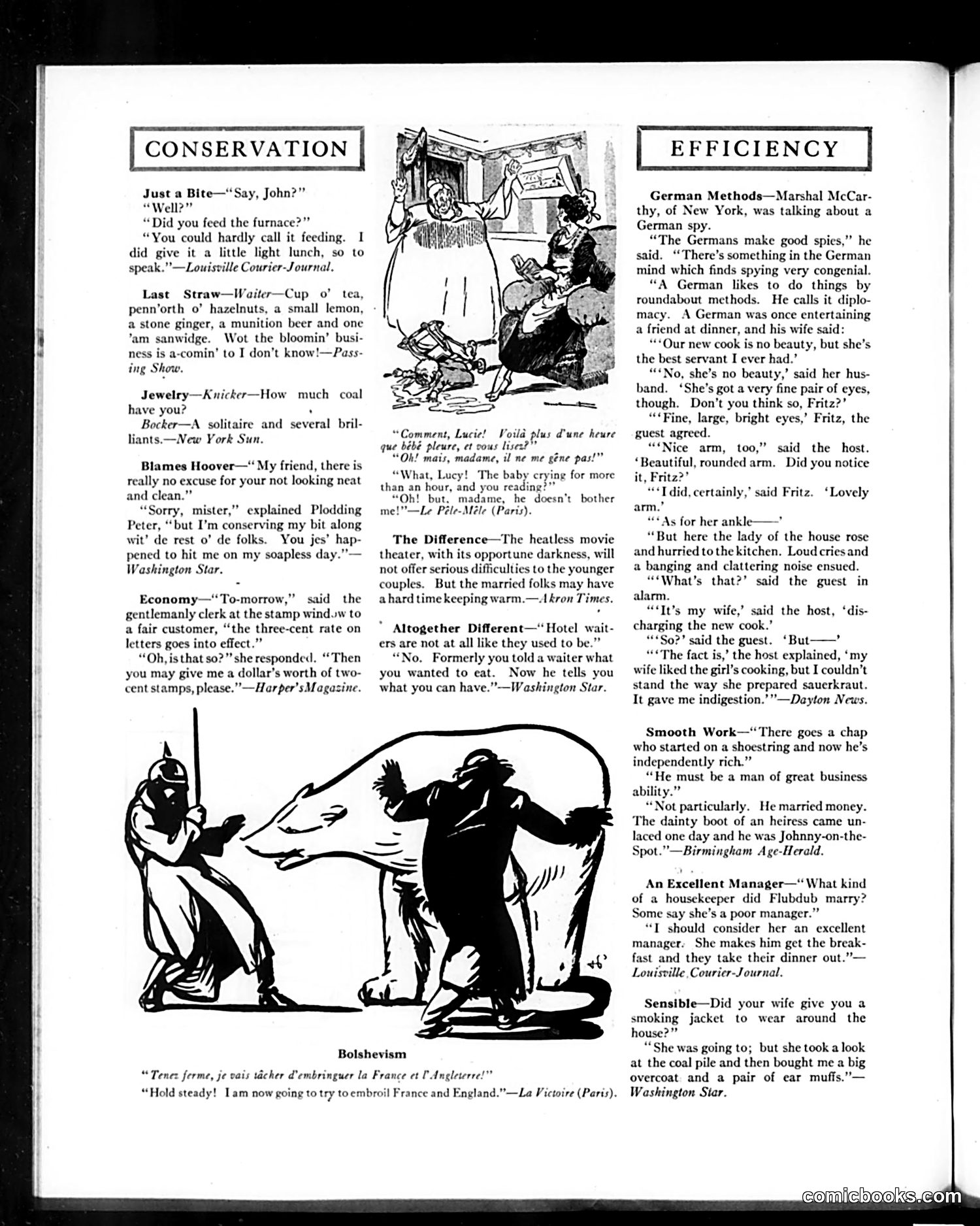
This page contains multiple satirical jokes and one political cartoon, all commenting on WWI-era conservation efforts and social issues. The **Bolshevism cartoon** (bottom left) depicts a figure attempting to manipulate a large mass of people, with French text roughly translating to "Hold steady! I am now going to try to embroil France and England." This reflects post-WWI anxiety about Bolshevik influence and propaganda spreading discord among Allied nations. The remaining content comprises short humorous anecdotes mocking: - **Conservation efforts**: Citizens reluctant to conserve fuel and resources during wartime (the "soapless day" reference) - **German efficiency/spying**: Depicting Germans as methodical and deceptive, using elaborate conversational tactics - **Wartime shortages**: Hotel waiters now telling customers what's *available* rather than taking orders The page reflects American attitudes during/shortly after WWI: suspicion of foreign (particularly German and Bolshevik) influence, while poking fun at domestic conservation compliance and changing social norms during resource scarcity.
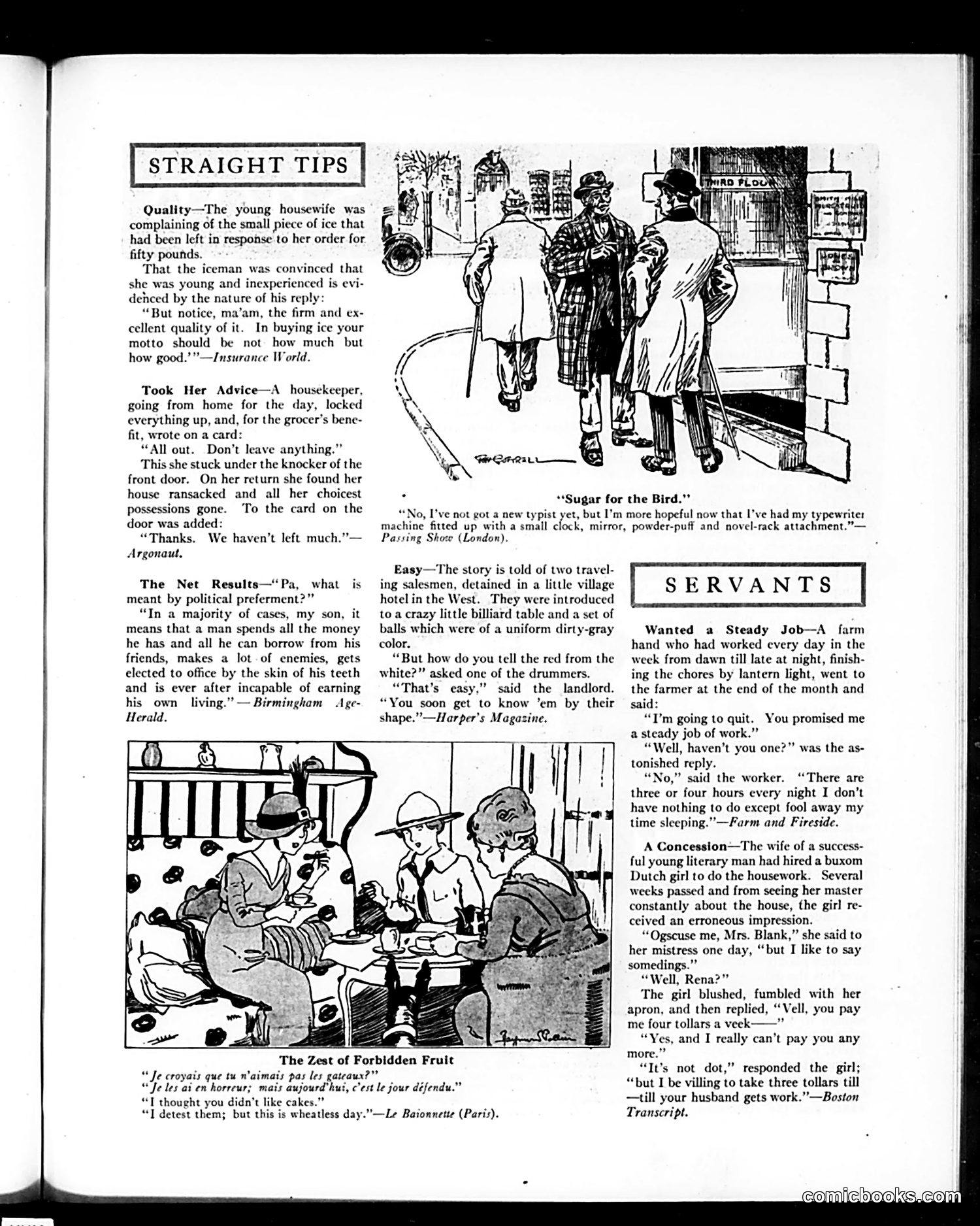
This page from *Judge* collects brief humorous anecdotes satirizing everyday life and human nature rather than specific political figures. The main cartoons mock: 1. **Consumer naiveté**: An iceman dupes a young housewife with quality-over-quantity reasoning when she complains about receiving less ice than ordered. 2. **Ironic consequences**: A housekeeper's overly cautious "don't leave anything" note to her grocer becomes an invitation for burglars, who sarcastically thank her. 3. **Political corruption**: A father explains that political "preferment" requires spending all one's money, making enemies, barely winning office—then becoming unable to earn independently. 4. **Wartime sacrifice**: A French anecdote plays on WWI rationing: a woman who "detests" cakes eats them eagerly on "wheatless days" (government-mandated meatless/wheatless days). 5. **Labor exploitation and immigrant humor**: A farm hand wants "steady work"; a Dutch maid's accent-laden plea suggests accepting reduced wages until "your husband gets work"—implying the literary man's actual employment is uncertain.
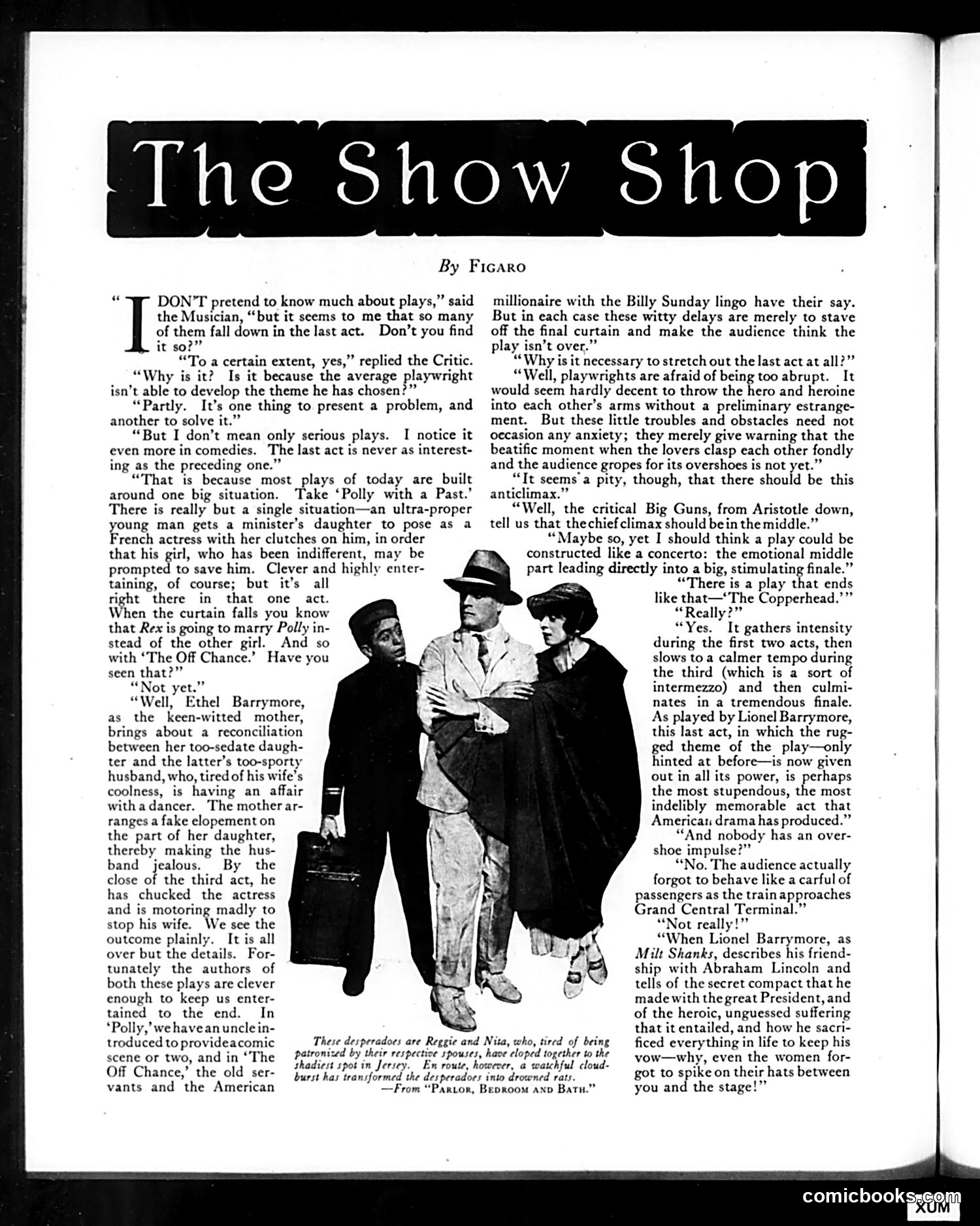
This article by Figaro discusses theatrical structure, specifically the weakness of final acts in contemporary Broadway comedies. The dialogue between a Musician and Critic critiques plays like *Polly with a Past* and *The Off Chance* (featuring Ethel Barrymore), arguing that their climaxes occur too early, forcing authors to artificially pad the third act with minor complications to delay resolution. The photograph shows three men in period costume, apparently from one of the discussed plays, depicting a comedic scene of romantic entanglement. The satire targets playwrights' structural failings: rather than building intensity throughout, they compress their dramatic climax into Act Two, then awkwardly prolong Act Three with unnecessary obstacles. Figaro praises *The Copperhead* (featuring Lionel Barrymore) as an exception—a play structured like a musical concerto, maintaining dramatic momentum to a powerful final act. The piece is theater criticism, not political satire, addressing early-1920s Broadway's formulaic construction problems.
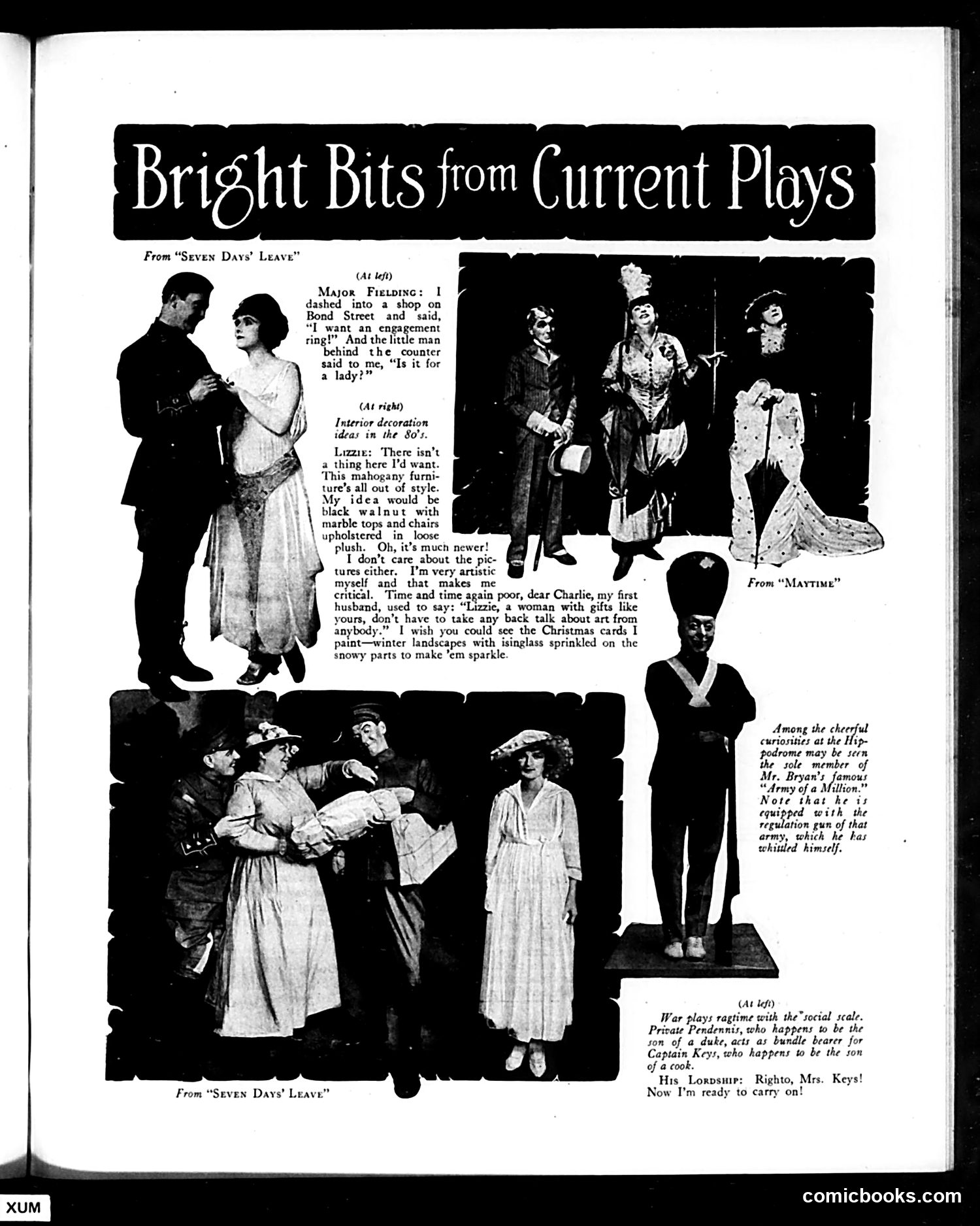
This page presents humorous excerpts from contemporary theatrical productions. The content satirizes early 20th-century social pretensions and manners: **"Seven Days' Leave"** scenes mock romantic and domestic foolishness—a major impulsively buying an engagement ring, then asking if it's "for a lady," and a woman named Lizzie complaining that period furniture is outdated while boasting of her own artistic superiority. **"Mattime"** features an absurdist costume piece with an Egyptian-style headdress, likely parodying elaborate theatrical design trends. **"Army of a Million"** references William Jennings Bryan's famous political slogan, showing a lone soldier with a whittled gun—satirizing the grandiosity of political rhetoric versus reality. The final scene from "Seven Days' Leave" jokes about wartime's social upheaval: a private from an aristocratic family serves as a bundle carrier for a captain whose father was a cook—inverting class hierarchies and suggesting war democratizes society.
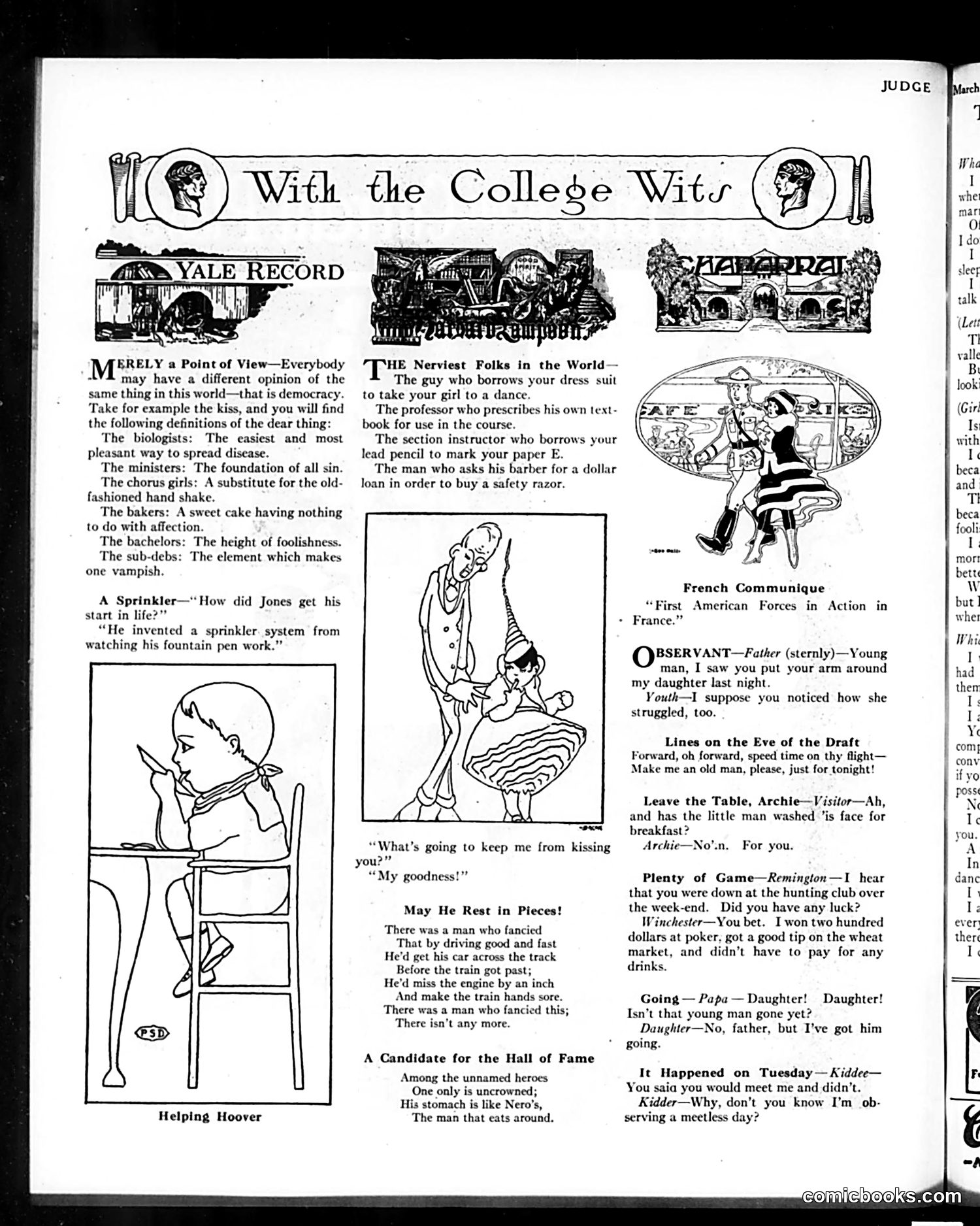
This page collects humorous observations and jokes targeting early 20th-century social types and behaviors. The "Nerviest Folks in the World" section satirizes academic and social parasites: professors who assign their own textbooks for profit, instructors borrowing pencils, men taking advantage of women (borrowing their dress suits for dates). The cartoons mock everyday absurdities: "Helping Hoover" shows a woman at a desk, likely referencing Herbert Hoover's food conservation campaigns during WWI, where citizens were asked to economize. The "Sprinkler" joke plays on observation-based innovation. Social commentary emerges in pieces like "Observant—Father," which ironically accepts his daughter's struggle against a young man's advances as natural. Multiple jokes about avoiding responsibility ("Meetless day," draft avoidance in "Lines on the Eve of the Draft") suggest wartime anxieties. The overall tone mocks both social pretension and youthful misbehavior through gentle satire typical of 1910s-20s humor magazines.
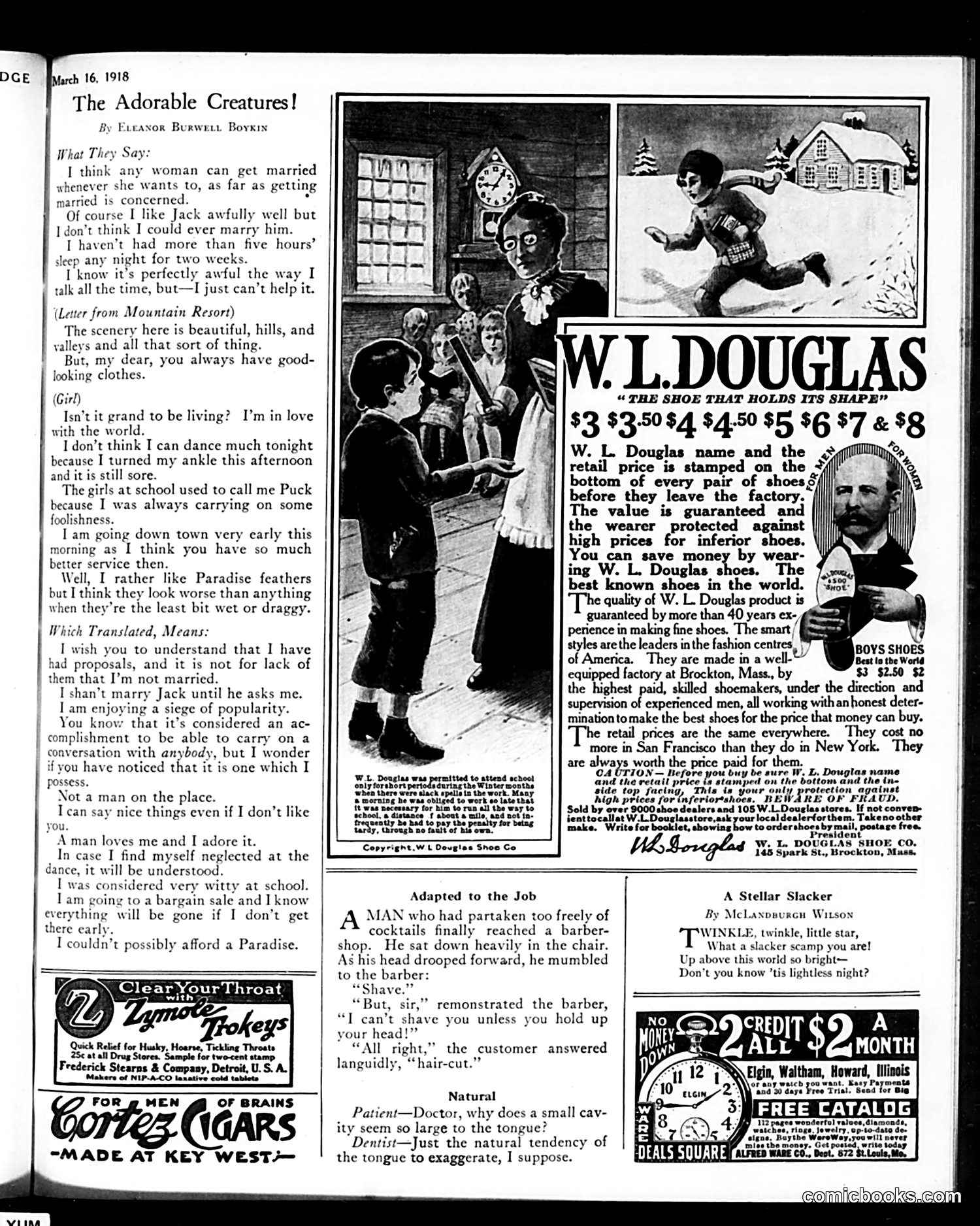
This page satirizes young women's contradictory behavior and speech. The column by Eleanor Burwell Boykin presents statements women make ("What They Say") alongside their actual meanings ("Which Translated, Means"). The satire exposes the gap between women's claims and reality: a woman says she could never marry someone she likes, then reveals she's waiting for a proposal; she claims to dislike talking but admits she talks constantly; she says she can't dance due to injury while actually fishing for sympathy. The humor targets female vanity, manipulation, and inauthenticity—portraying women as calculating, self-interested, and dishonest in social interactions. This reflects 1918 gender attitudes viewing women's speech and motives with suspicion. The remainder of the page consists primarily of advertisements (W.L. Douglas shoes, cigars, patent medicines), typical for Judge magazine. The "Stellar Slacker" poem at bottom appears unrelated to the main feature.
This page is primarily a **theatre review and advertising section** for Broadway shows, with minimal political satire. The left side contains theatrical advertisements and light humor; the right side offers detailed capsule reviews of current New York productions. The small jokes ("A Million in It" about untying shoelaces, the husband "hardened" to his wife's singing) are typical period vaudeville-style humor—not political satire. The "Fifty Millionaires Answer Vital Questions" and B.C. Forbes book advertisement reflect **early 20th-century American business culture**, celebrating wealthy industrialists as public figures worth consulting. This reflects the era's admiration for self-made millionaires before the Great Depression shifted public sentiment. The theatre reviews themselves reference current shows starring established performers like Lionel Barrymore and Laurette Taylor, providing contemporary entertainment coverage. Several reviews mention **WWI-related content** ("khaki," "Red Cross," "Over There"), indicating this page dates to America's wartime period (1917-1918).
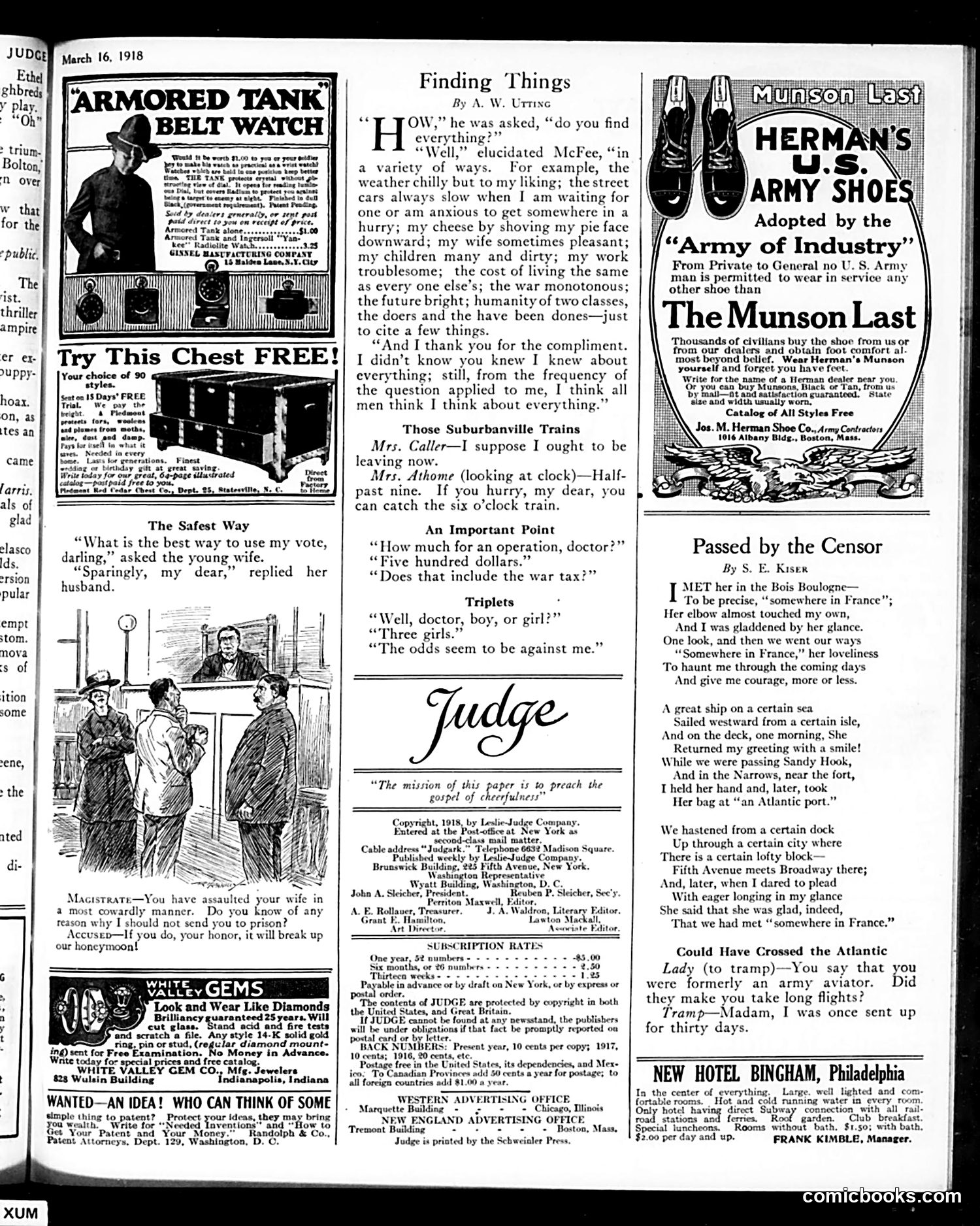
This page is primarily **advertisements and filler humor** with several short joke items typical of Judge's satirical style. The main cartoons mock marriage and marital authority: "The Safest Way" satirizes wives' limited political power (voting "sparingly"), while the magistrate panel jabs at domestic violence as an acceptable honeymoon disruption—dark comedy reflecting historical attitudes toward spousal abuse. "Finding Things" by A. W. Lirsch offers cynical observational humor: a character lists ironies he finds—slow streetcars when rushing, expensive living, the war's monotony—concluding everyone merely pretends knowledge. It's pessimistic wartime commentary. "Those Suburbanville Trains" jokes about suburban train schedules' unreliability (a 9:30pm visitor can't catch a 6 o'clock train). Other brief gags target doctors' war-tax profiteering and the statistical odds against having triplets. The heavy advertising—Armored Tank watches, Munson Army shoes, synthetic gems—reflects 1918 wartime commerce.
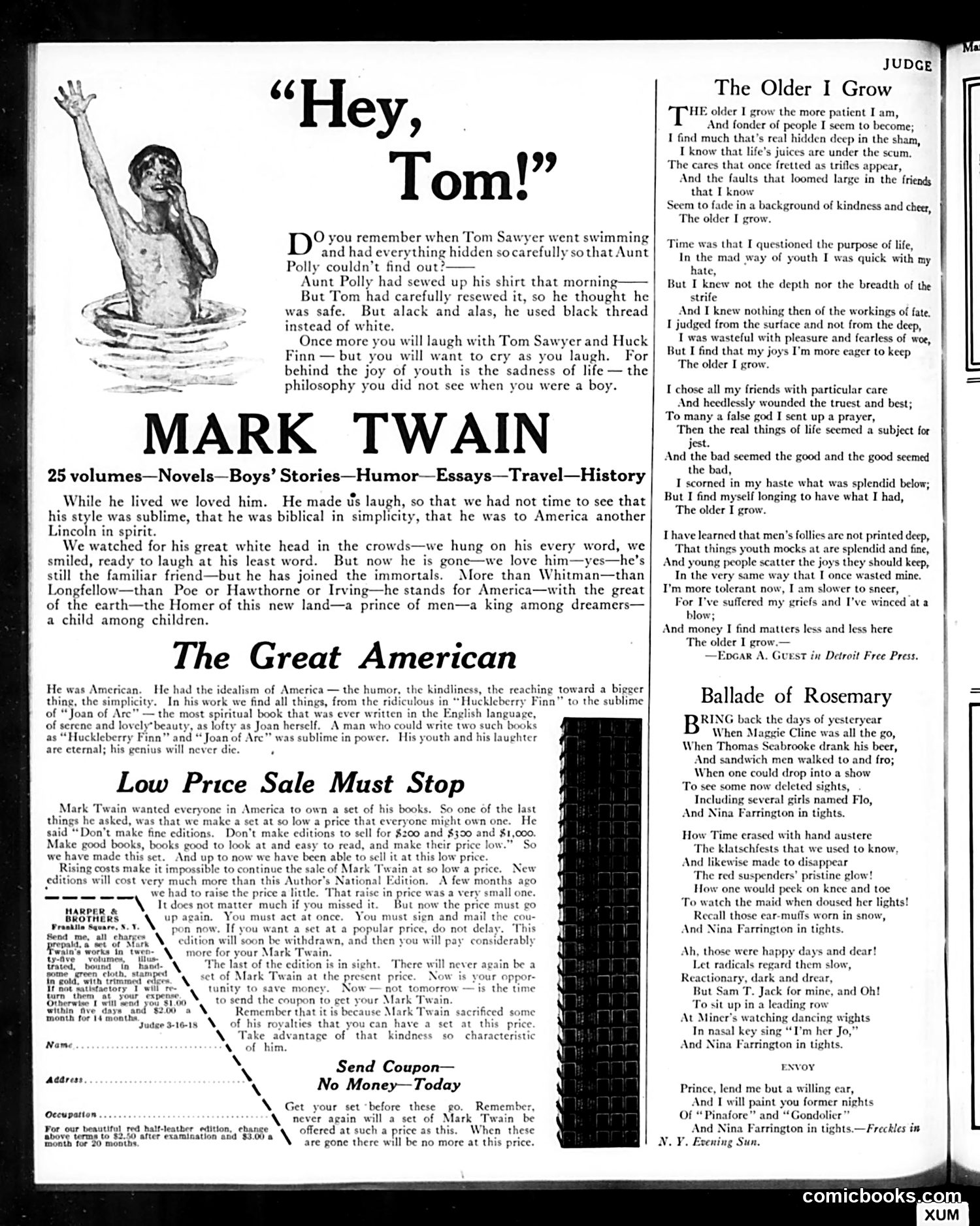
This page is primarily **advertising and promotional content** for a Mark Twain book set, framed within a tribute to the recently deceased author (Twain died in 1910). The small cartoon at top left shows a boy in water—illustrating the famous Tom Sawyer swimming scene referenced in the text below it. This serves as nostalgic branding for the product. The bulk of the page is **eulogy mixed with sales pitch**. It praises Twain as "The Great American"—comparing him to Lincoln, Homer, Whitman—emphasizing his distinctly American humor, kindness, and spiritual depth. The text contrasts his accessibility ("a child among children") with his literary sublimity. The "Low Price Sale Must Stop" section uses Twain's own stated wishes (affordable editions for ordinary people) as selling pressure: prices are rising due to increased production costs, so readers must order "now" before the cheap edition disappears forever. This is vintage marketing psychology—artificial scarcity and deadline urgency—disguised as honoring the author's democratic ideals about book accessibility.
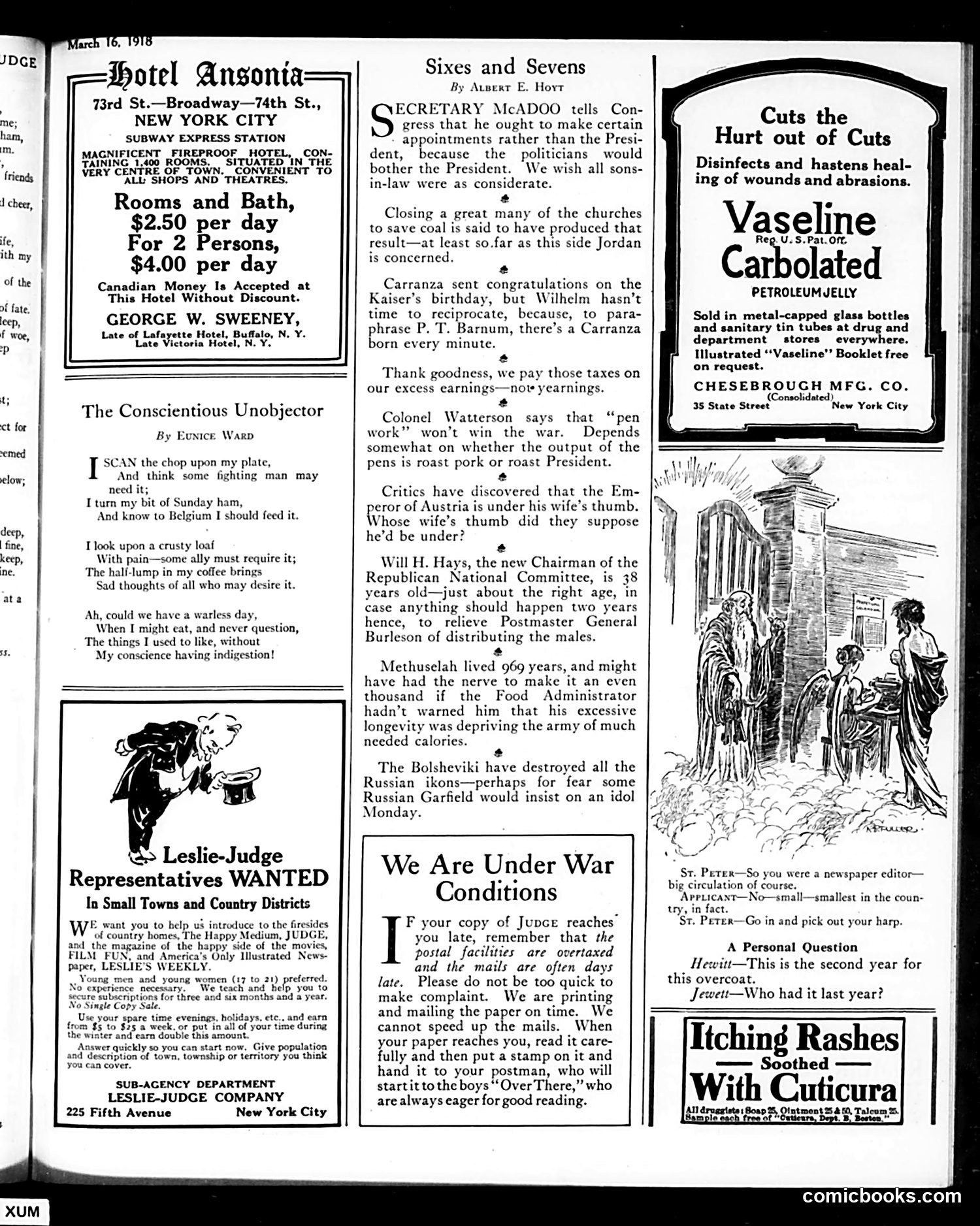
This Judge magazine page from March 1918 contains satirical commentary on WWI-era politics and social conditions: **"The Conscientious Objector"** poem mocks someone wracked with guilt over eating while soldiers starve—a dig at pacifists or those opposing the war effort who nonetheless enjoy comforts. **"Sixes and Sevens"** column offers political jabs: Secretary McAdoo's appointment power is compared to meddlesome sons-in-law; Colonel Watterson's claim that "pen work won't win the war" is twisted to mock either pacifist writers or those producing propaganda; Methuselah's longevity is satirized as wasteful of food needed for the army. **References include**: Kaiser Wilhelm (Germany's leader), Carranza (Mexican president), and the Food Administrator (wartime rationing official). The page largely reflects home-front WWI anxieties—food shortages, postal delays, and tensions between civilian life and military necessity. The humor relies on readers' familiarity with contemporary political figures and wartime rationing debates.
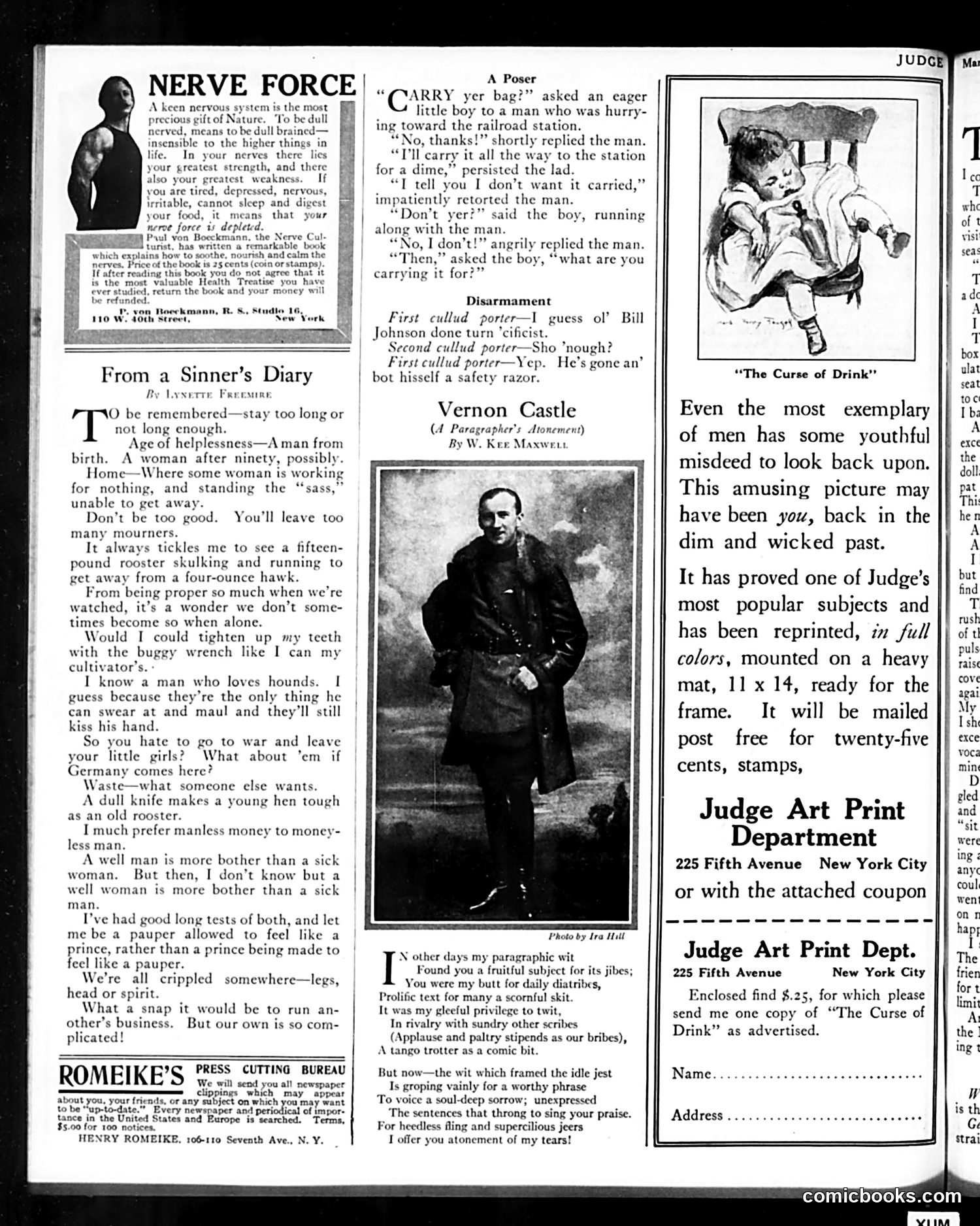
This page from *Judge* contains several satirical pieces reflecting early 20th-century American concerns: **"From a Sinner's Diary"** offers cynical observations on marriage, war preparedness (referencing Germany's threat), and human nature—typical of the magazine's irreverent social commentary. **"A Poser"** is a humorous anecdote about a persistent boy trying to carry a man's bag, playing on the absurdity of unwanted persistence. **"Vernon Castle" poem** appears to be a sincere apology to the famous dancer Vernon Castle (1887-1918), whom the author had previously mocked in satirical pieces. The shift from mockery to reverence suggests Castle's death, as he died in a plane crash during WWI service. **"The Curse of Drink"** advertises a popular cartoon print available for purchase, depicting childhood mischief related to alcohol—suggesting temperance-era moral messaging. The page predominantly mixes lighthearted satire with advertisements for "nerve force" tonics and clipping services, reflecting *Judge*'s blend of humor and commercial interests.
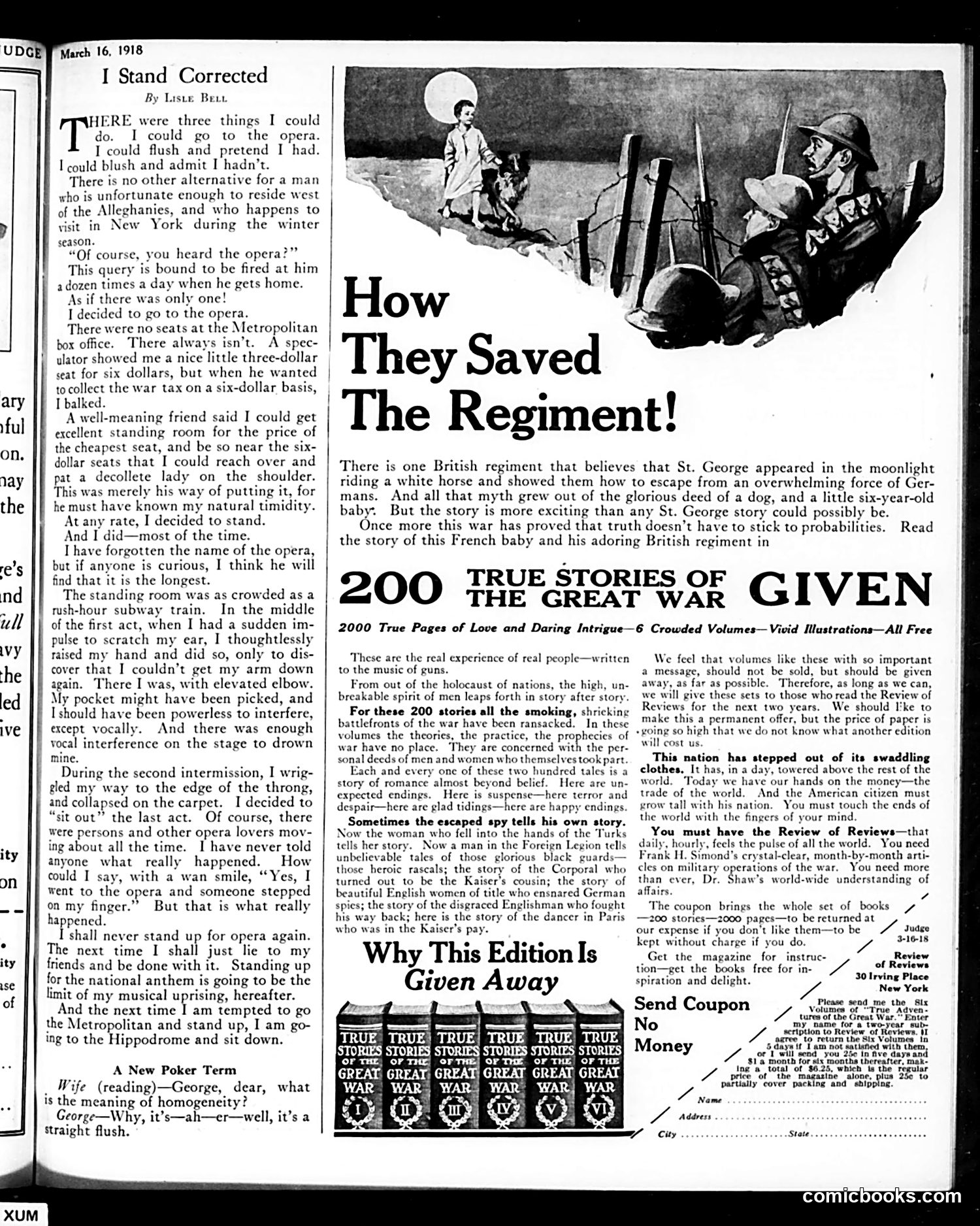
**"I Stand Corrected"** is a humorous essay satirizing the social pretense of attending opera in 1918 New York. The author mocks the mandatory cultural posturing required of visitors—where attending the opera has become a status symbol and social obligation rather than genuine entertainment. The joke culminates in physical comedy: standing-room crowds are so packed that the narrator's raised arm becomes trapped, ultimately resulting in his finger being stepped on. The satire targets several things: scalpers' war profiteering (adding war taxes to inflated ticket prices), the pretentiousness of New York's cultural elite, and the absurd social pressure to lie about attending rather than admit disinterest. The page also advertises a book series, **"200 True Stories of the Great War,"** promoting wartime narratives as patriotic reading material. This juxtaposes sharply with the satirical essay above—serious wartime propaganda sitting beneath lighthearted social comedy on the same page.
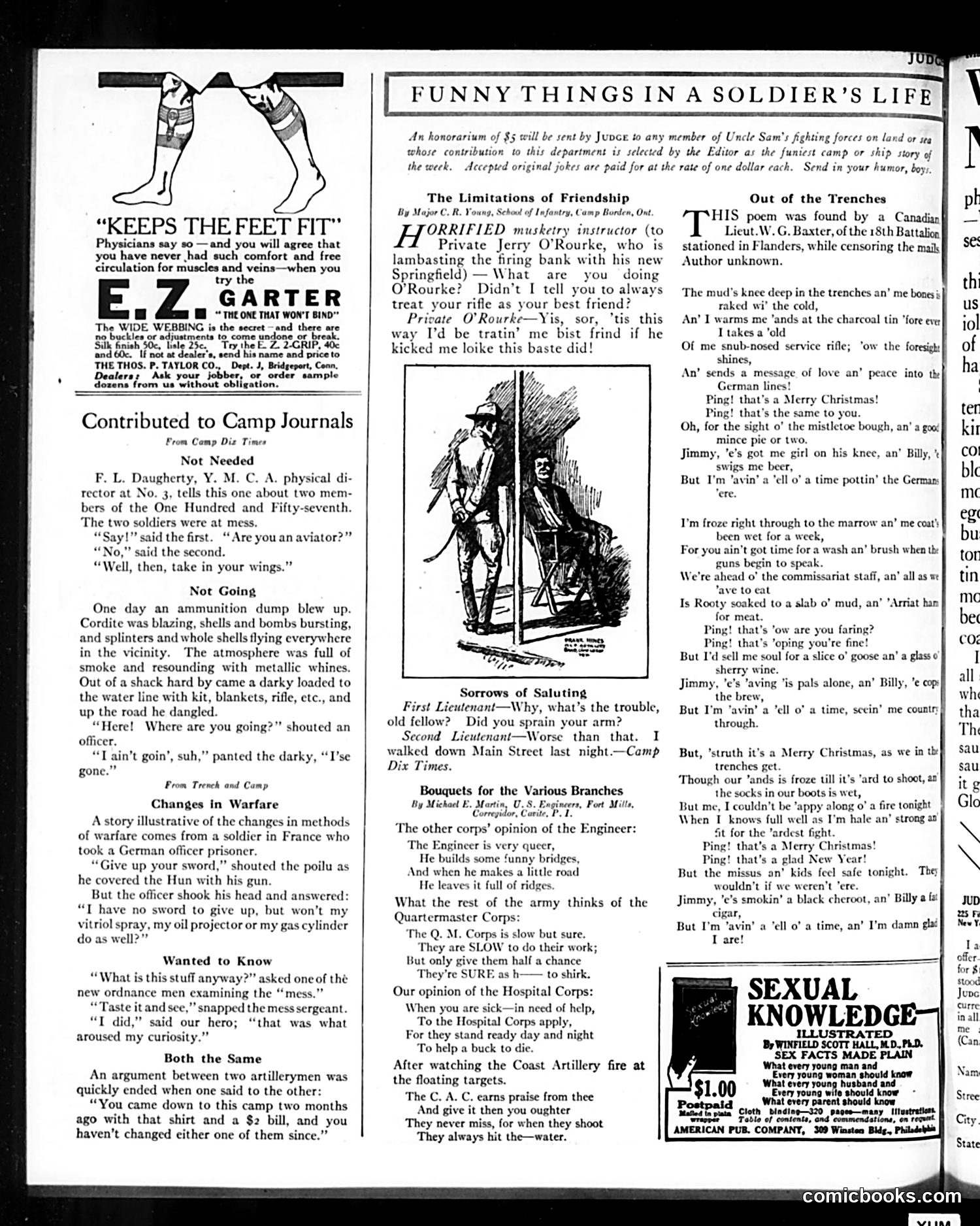
This page from *Judge* magazine features WWI-era military humor contributions from soldiers. The main content includes several jokes about camp life: **"The Limitations of Friendship"** satirizes a musketry instructor's metaphor—he tells Private O'Rourke to treat his rifle like a best friend, but O'Rourke argues that if his friend kicked him, he'd beat it exactly as he's beating the rifle. The humor relies on taking the metaphor literally. **"Sorrows of Saluting"** jokes about a second lieutenant spraining his arm saluting—apparently from saluting so many times while walking down Main Street, implying officers must constantly acknowledge civilians or each other. Other brief anecdotes mock various military branches' stereotypes and poke fun at soldier incompetence and military absurdities. The left side advertises E.Z. garters for soldiers' comfort. At bottom right is an advertisement for a sexual knowledge book—typical of period magazines targeting young servicemen. The overall tone is lighthearted ribbing of military life, encouraging soldiers to submit their own jokes for five-dollar payments.
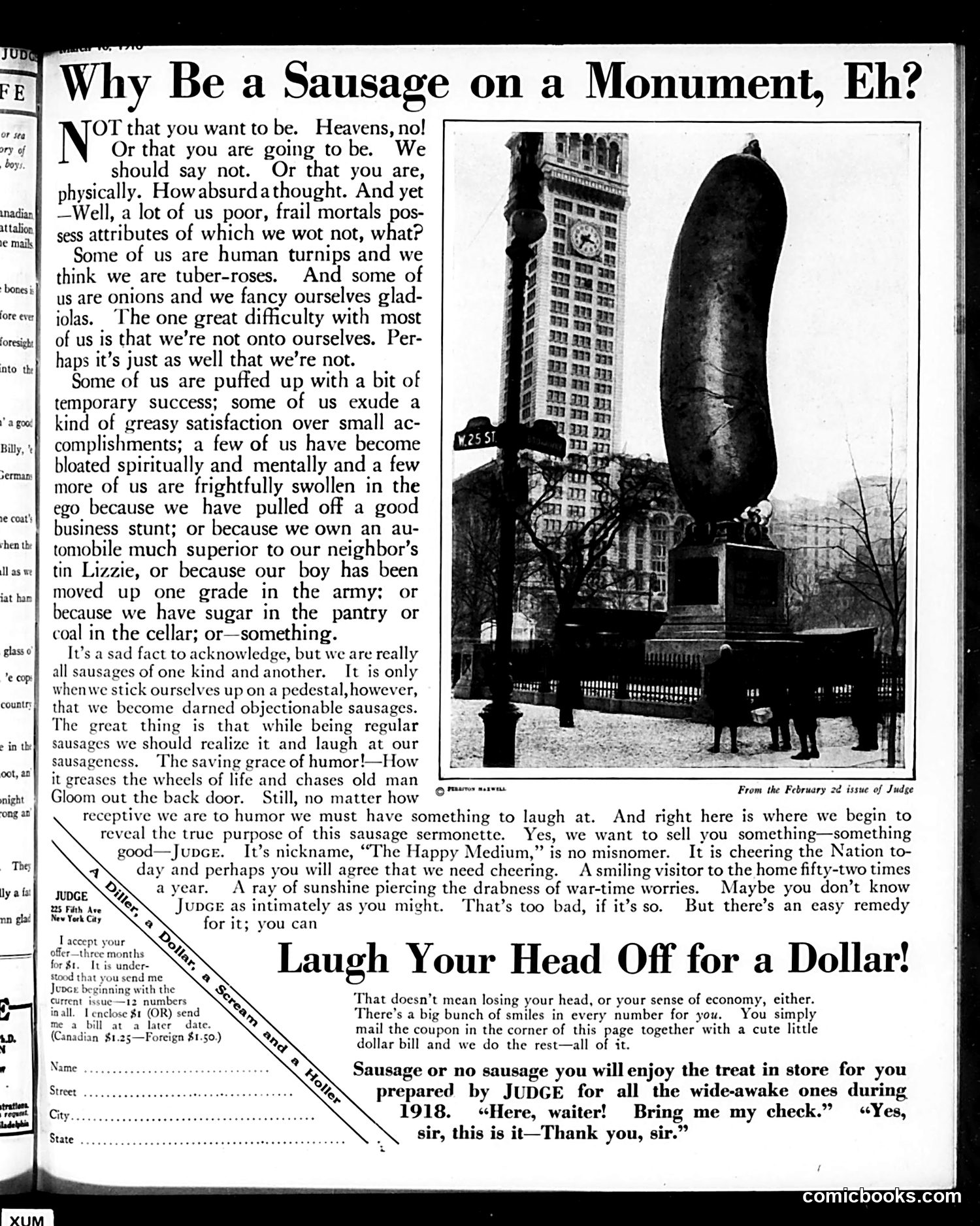
This 1918 *Judge* magazine page combines editorial commentary with advertising for a subscription offer. **The Main Essay & Satire:** The article titled "Why Be a Sausage on a Monument, Eh?" uses "sausage" as a metaphor for ordinary people who are deluded about their own importance. The author argues we're all essentially commonplace ("sausages"), yet we puff ourselves up over minor achievements—a better car than neighbors, a child's school promotion, wartime success. The satire targets human ego and self-deception. The referenced photograph shows a giant sausage monument/statue in an urban setting, literally illustrating the absurd premise of elevating something mundane to monumental status. **The Advertisement:** Below, *Judge* pivots to selling subscriptions by positioning the magazine itself as "The Happy Medium"—a source of humor and cheer during WWI's "drabness." For one dollar, readers receive three months of smiles. **The Point:** The piece uses self-deprecating social commentary to sell subscriptions, arguing that recognizing our collective ordinariness and finding humor in it is therapeutic—especially during wartime.
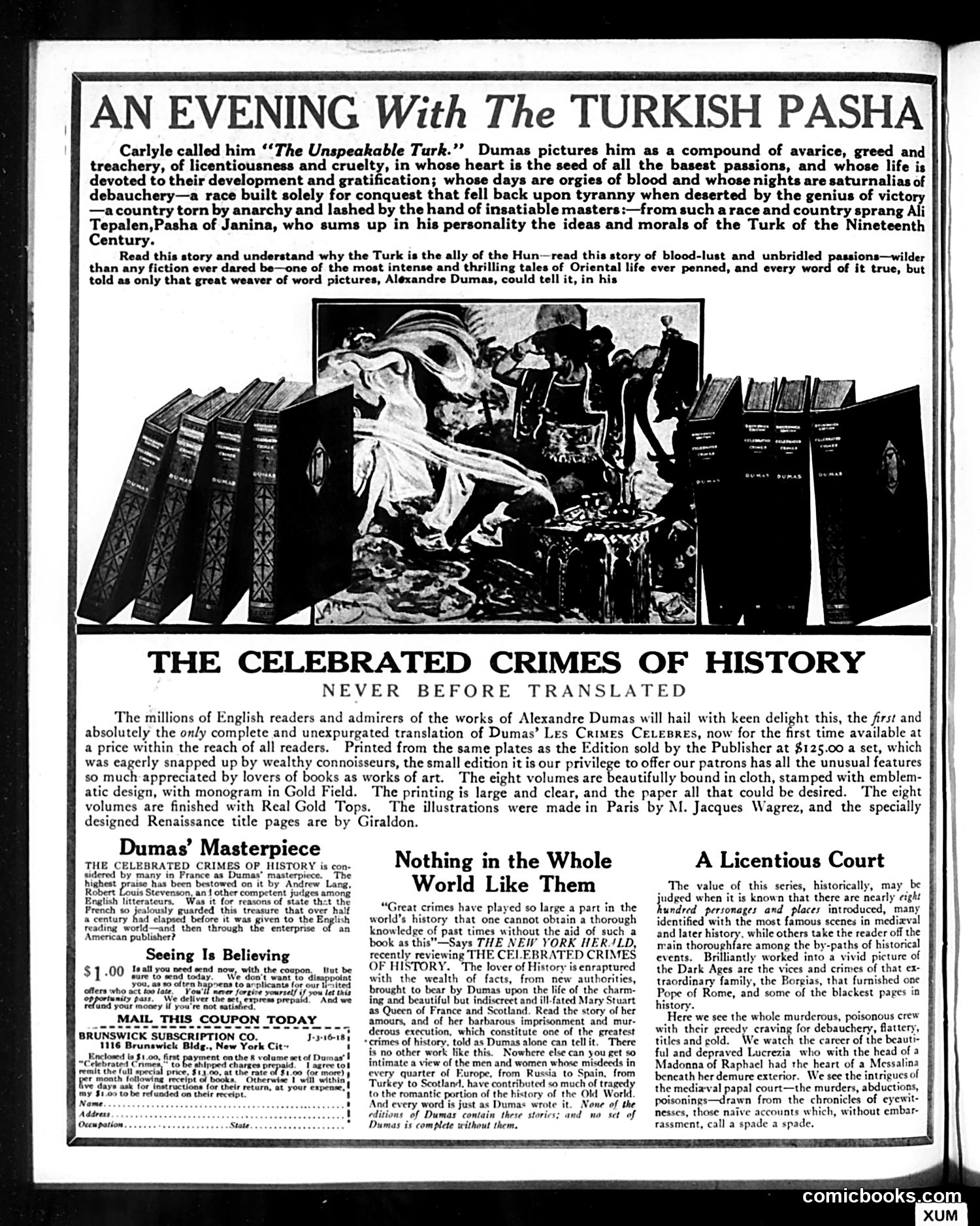
This is primarily **advertising**, not satire. Judge magazine is promoting Alexandre Dumas's "Celebrated Crimes of History"—a newly translated, affordable eight-volume set. The page uses **Orientalist stereotyping** common in the 1890s-1900s: it frames a Turkish historical figure (Tepelen Pasha of Janina) as embodying inherent Ottoman brutality, cruelty, and despotism. The text explicitly links "the Turk" to negative traits—"avarice, greed and treachery"—and invokes the then-contemporary phrase "the ally of the Hun" (likely referencing German-Ottoman alliance concerns during WWI era). The dramatic illustration shows violent court scenes designed to entice readers hungry for sensational historical narratives about "Oriental" excess and criminality. **The point**: this marketing exploits existing Western prejudices about Turkey/the Ottoman Empire to sell Dumas's crime histories as thrillingly authentic glimpses of inherent Eastern depravity. It's commercial exploitation of geopolitical anxiety and racial stereotyping.
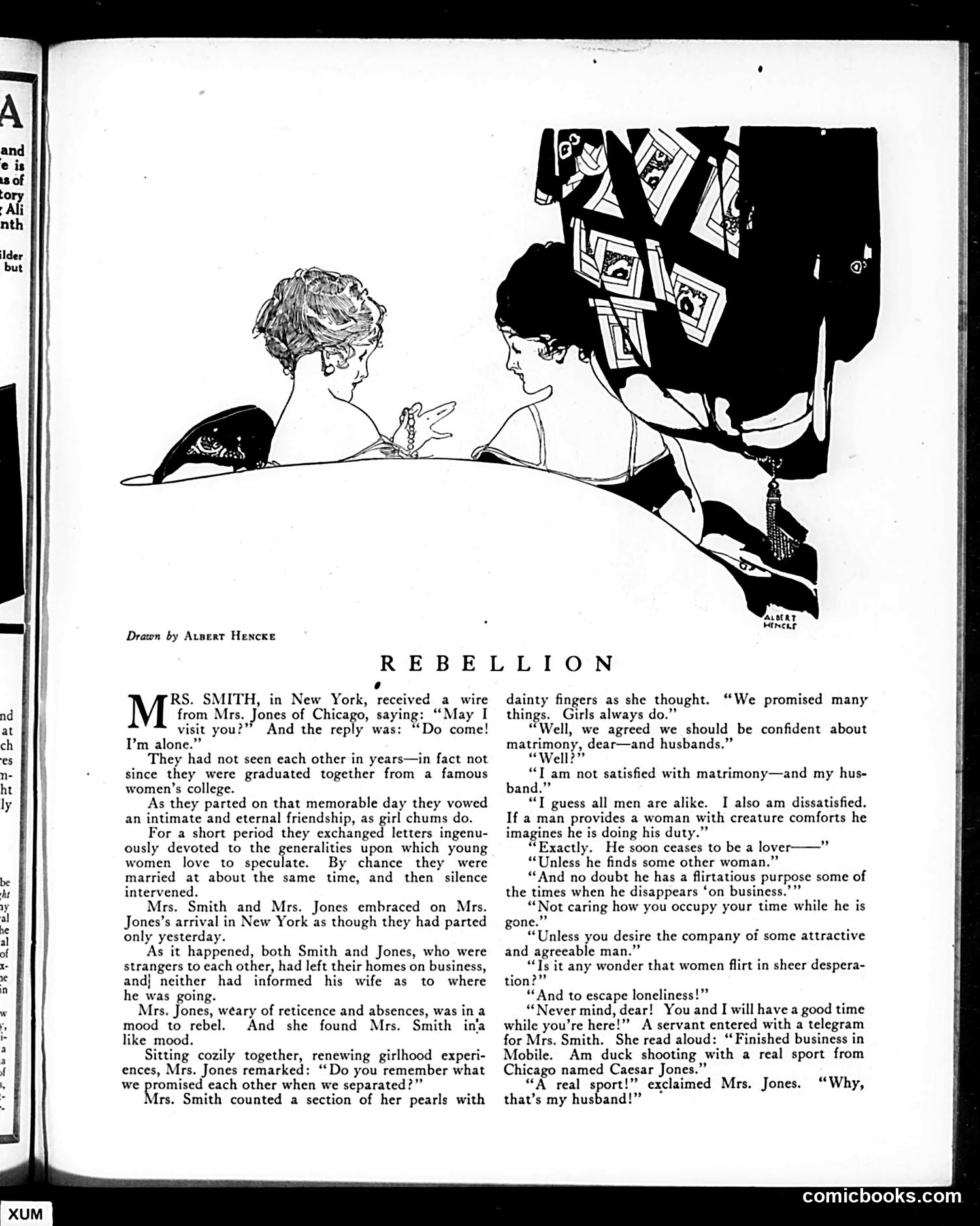
This Henckel cartoon satirizes early 20th-century wives' dissatisfaction with marriage. Two college friends—Mrs. Smith and Mrs. Jones—reunite in New York and commiserate about their absent husbands, who claim to be on business but are actually hunting together in Mobile, Chicago. The satire targets both spouses: husbands who neglect emotional connection while providing "creature comforts," and wives who flirt "in sheer desperation" to escape loneliness. The ironic twist—that both women's husbands are together enjoying leisure activities—exposes how men's friendships and freedom contrast with women's confined domestic roles. The title "Rebellion" refers to women's quiet defiance: considering affairs and social company as escape from loveless, neglectful marriages. This reflects early-1900s anxieties about changing gender relations and marital expectations.
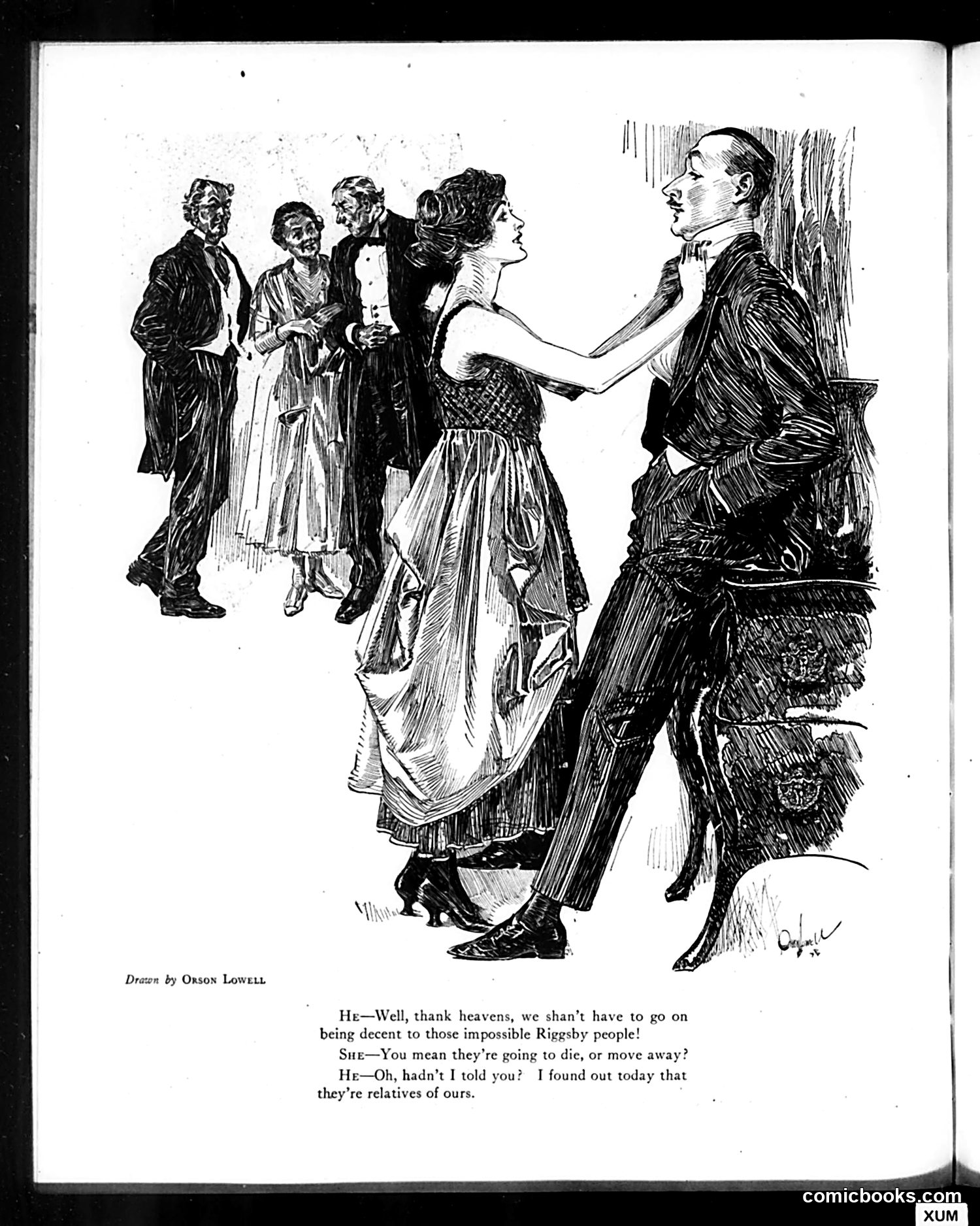
This cartoon by Orson Lowell satirizes class-conscious social hypocrisy. A well-dressed couple learns that their neighbors, the "impossible Riggsby people" (whom they've been tolerating out of propriety), are actually their relatives. The husband's relief—that they can now stop "being decent" to them—exposes how upper-class civility is conditional and performative. The couple maintained politeness only because social obligation required it, not from genuine regard. Once familial connection is established, they feel entitled to drop the pretense. The joke mocks the arbitrary nature of social courtesy among the wealthy, suggesting that family bonds somehow justify abandoning the very decency they grudgingly extended to non-relatives. It's commentary on class snobbery and the hollow nature of forced social cordiality.