
Judge, 1918-03-16 · page 21 of 38
Judge — March 16, 1918 — page 21: what you’re looking at
What you’re looking at
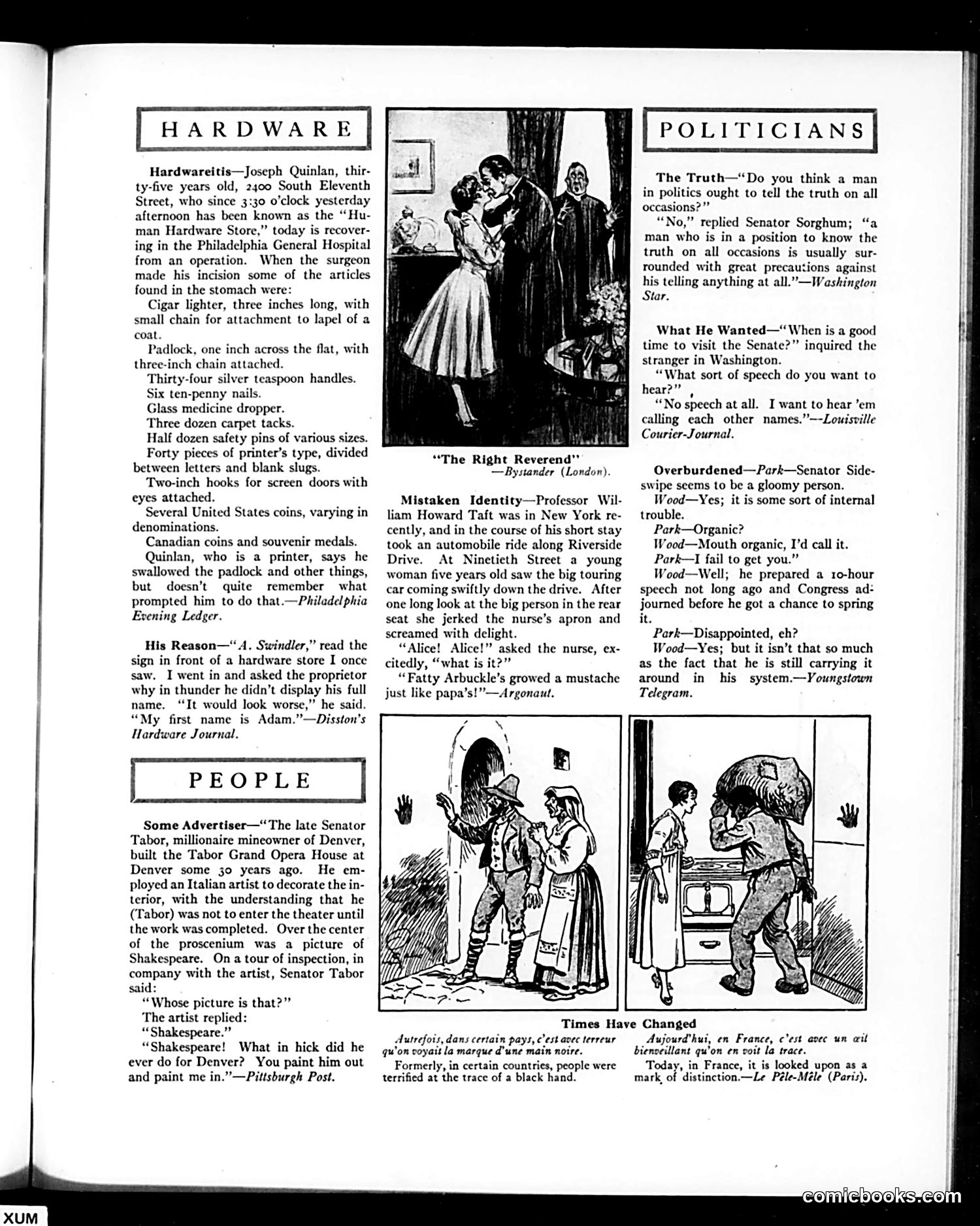
This satirical page from Judge magazine contains several humorous anecdotes mocking American politics and society. The **"Hardwareitis"** story ridicules a printer who swallowed various metal objects—a darkly comedic exaggeration suggesting obsession with one's profession. The **"Mistaken Identity"** anecdote jokes that a young child mistakes President William Howard Taft for "Fatty" Arbuckle (a silent-film comedian), implying Taft's considerable girth was widely recognized and mocked. The **political jokes** satirize Congress: one depicts senators as preferring insults to speeches; another mocks Senator Sorghum for claiming politicians shouldn't tell truth when positioned to know it—cynical commentary on political dishonesty. The **final cartoon** titled "Times Have Changed" contrasts past superstitions (fearing a black hand's mark) with modern society, though its specific contemporary reference remains unclear from the visible text. Overall, the page exemplifies Judge's formula: mixing absurdist humor with biting political critique about corruption, vanity, and incompetence in government and public life.
📄 Transcribed text from this page (OCR, searchable)
Machine-transcribed from the original scan — historical spelling and the odd misread are preserved.
Hardwareitis—Joseph Quinlan, thir- ty-five years old, 2400 South Eleventh Street, who since 3:30 o’clock yesterday afternoon has been known as the “Hu- man Hardware Store,” today is recover- ing in the Philadelphia General Hospital from an operation. When the surgeon made his incision some of the articles found in the stomach were: Cigar lighter, three inches long, with small chain for attachment to lapel of a coat. Padlock, one inch across the flat, with three-inch chain attached. Thirty-four silver teaspoon handles. Six ten-penny nails Glass medicine dropper. Three dozen carpet tacks. Half dozen safety pins of various sizes. Forty pieces of printer’s type, divided between letters and blank slugs. Two-inch hooks for screen doors with eyes attached. Several United States coins, varying in denominations. Canadian coins and souvenir medals. Quinlan, who is a printer, says he swallowed the padlock and other things, but doesn’t quite remember what prompted him to do that.—Philadel phia Evening Ledger. His Reason—“ A. Swindler,” read the sign in front of a hardware store I once saw. I went in and asked the proprietor why in thunder he didn’t display his full name. “It would look worse,” he said. “My first name is Adam.”—Disston’s Hardware Journal. | PEOPLE Some Advertiser—‘“The late Senator Tabor, millionaire mineowner of Denver, built the Tabor Grand Opera House at Denver some 30 years ago. He em- ployed an Italian artist to decorate the in- terior, with the understanding that he (Tabor) was not to enter the theater until the work was completed. Over the center of the proscenium was a picture of Shakespeare. On a tour of inspection, in company with the artist, Senator Tabor said: “Whose picture is that?” The artist replied: “Shakespeare.” “Shakespeare! What in hick did he ever do for Denver? You paint him out and paint me in.”—Pittsburgh Post. “The Right Reverend” —Bystander (London). Mistaken Identity—Professor Wil- liam Howard Taft was in New York re- cently, and in the course of his short stay took an automobile ride along Riverside Drive. At Ninetieth Street a young woman five years old saw the big touring car coming swiftly down the drive. After one long look at the big person in the rear seat she jerked the nurse’s apron and screamed with delight. “Alice! Alice!” asked the nurse, ex- citedly, “what is it?” “Fatty Arbuckle’s growed a mustache just like papa’s!”—Argonaut. hh Lay h HE Hy Times Have Changed Autrefois, dans certain pays, c'est avec terreur qu'on coyait la marque d'une main noire. Formerly, in certain countries, people were terrified at the trace of a black hand. The Truth—“Do you think a man in politics ought to tell the truth on all | occasions?” a “No,” replied Senator Sorghum; “a man who is in a position to know the truth on all occasions is usually sur- rounded with great precautions against his telling anything at all.”"—Washington Star. | What He Wanted—“ When is a good time to visit the Senate?” inquired the stranger in Washington. “What sort of speech do you want to hear?” | “No speech at all. I want to hear ’em calling each other names.”—-Louisville Courier-Journal. Overburdened—Park—Senator Side- swipe seems to be a gloomy person. Wood—Yes; it is some sort of internal trouble. Park—Organic? Wood—Mouth organic, I’d call it. Park—I fail to get you.” | Wood—Well; he prepared a 10-hour speech not long ago and Congress ad: journed before he got a chance to spring it. Park—Disappointed, eh? Wood—Yes; but it isn’t that so much as the fact that he is still carrying it around in his system.—Youngstown Telegram. Aujourd’hui, en France, c'est aoee un ail bienoeillant qu'on en voit la trace. Today, in France, it is looked upon as a mark, of ‘distinction.—Le Péle-Méle (Paris).