
Judge, 1918-03-16 · page 5 of 38
Judge — March 16, 1918 — page 5: what you’re looking at
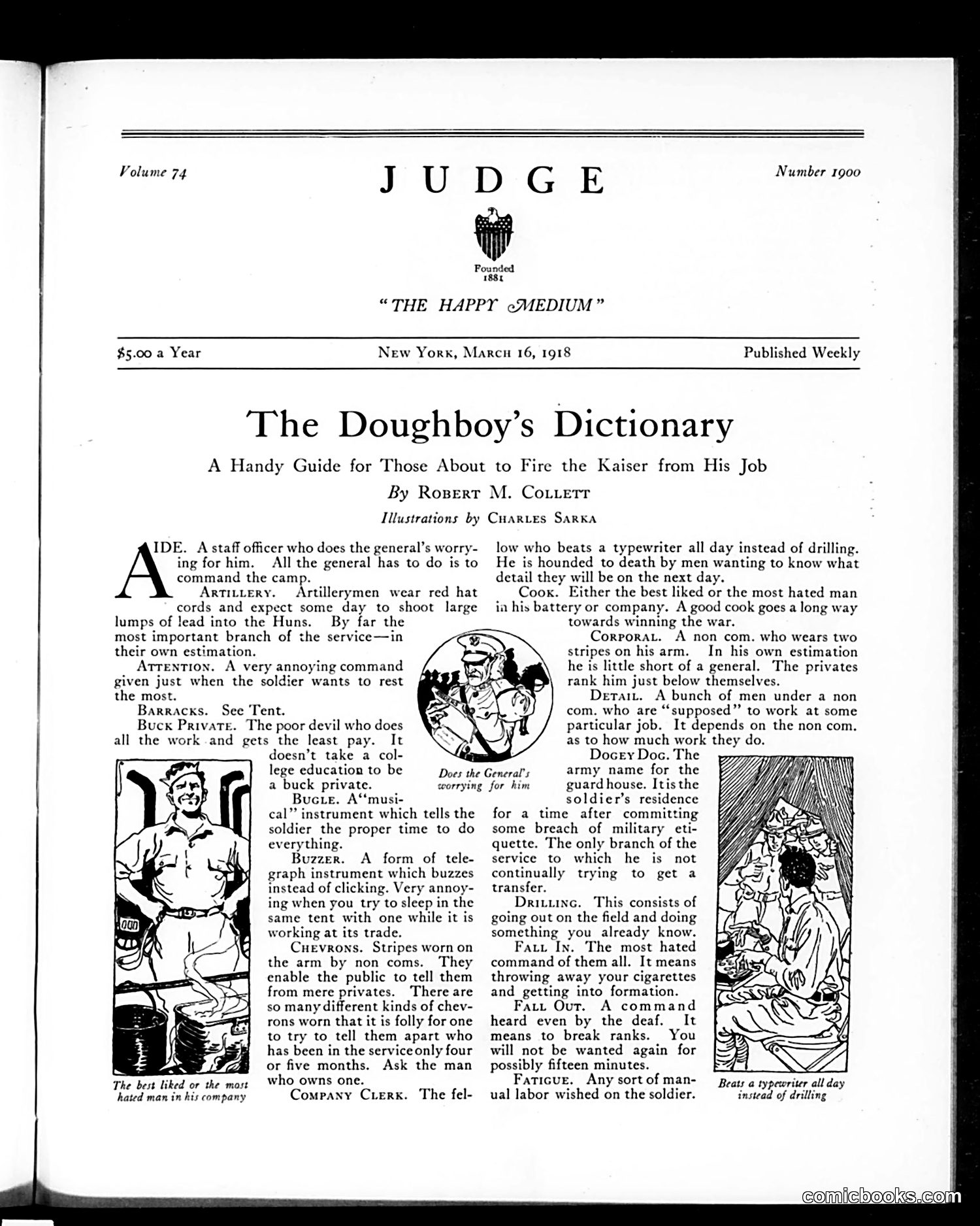
What you’re looking at
This is a satirical glossary defining military terms for American soldiers preparing to fight in World War I (the U.S. entered in 1917). The humor targets the gap between official military terminology and soldiers' actual experiences. Entries like "Buck Private" (describing thankless work), "Bugle" (an annoying wake-up device), and "Drilling" (repetitive, pointless field work) mock military life's tedium and hierarchy. "Fall In" and "Fall Out" joke about discipline and the constant threat of punishment. The illustrations show frustrated soldiers experiencing these indignities—a private doing menial labor, another beaten down by routine. The satire criticizes the disconnect between what soldiers are told versus what they endure, using humor to express working-class resentment toward military authority and wartime sacrifice.
📄 Transcribed text from this page (OCR, searchable)
Machine-transcribed from the original scan — historical spelling and the odd misread are preserved.
Volume 74 Number 1900 JUDGE Founded 1881 “THE HAPPY cMEDIUM” New York, Marcu 16, 1918 Published Weekly $5.00 a Year The Doughboy’s Dictionary A Handy Guide for Those About to Fire the Kaiser from His Job By Rosertr M. Couietr Illustrations by Cuartes Sarka low who beats a typewriter all day instead of drilling. He is hounded to death by men wanting to know what detail they will be on the next day. Cook. Either the best liked or the most hated man in his battery or company. A good cook goes a long way towards winning the war. Corporat. A non com. who wears two stripes on his arm. In his own estimation he is little short of a general. The privates rank him just below themselves. Detait. A bunch of men under a non com. who are “supposed” to work at some particular job. It depends on the non com. as to how much work they do. Docey Doc. The army name for the guard house. Itis the soldier’s residence IDE. A staff officer who does the general’s worry- ing for him. All the general has to do is to command the camp. Artittery. Artillerymen wear red hat cords and expect some day to shoot large lumps of lead into the Huns. By far the most important branch of the service—in their own estimation. Attention. A very annoying command given just when the soldier wants to rest the most. Barracks. See Tent. Buck Private. The poor devil who does all the work and gets the least pay. It doesn’t take a col- lege education to be a buck private. Bucte. A‘‘musi- Does the General's worrying for him The best liked or the most hated man in his company cal” instrument which tells the soldier the proper time to do everything. Buzzer. A form of tele- graph instrument which buzzes instead of clicking. Very annoy- ing when you try to sleep in the same tent with one while it is working at its trade. Cuevrons. Stripes worn on the arm by non coms. They enable the public to tell them from mere privates. There are so many different kinds of chev- rons worn that it is folly for one to try to tell them apart who has been in the serviceonly four or five months. Ask the man who owns one. Company Crerx. The fel- for a time after committing some breach of military eti- quette. The only branch of the service to which he is not continually trying to get a transfer. Drituinc. This consists of going out on the field and doing something you already know. Fatt In. The most hated command of them all. It means throwing away your cigarettes and getting into formation. Fatt Our. A command heard even by the deaf. It means to break ranks. You will not be wanted again for possibly fifteen minutes. Faticue. Any sort of man- ual labor wished on the soldier. Beats a typewriter all day instead of drilling