
Judge, 1918-03-16 · page 12 of 38
Judge — March 16, 1918 — page 12: what you’re looking at
What you’re looking at
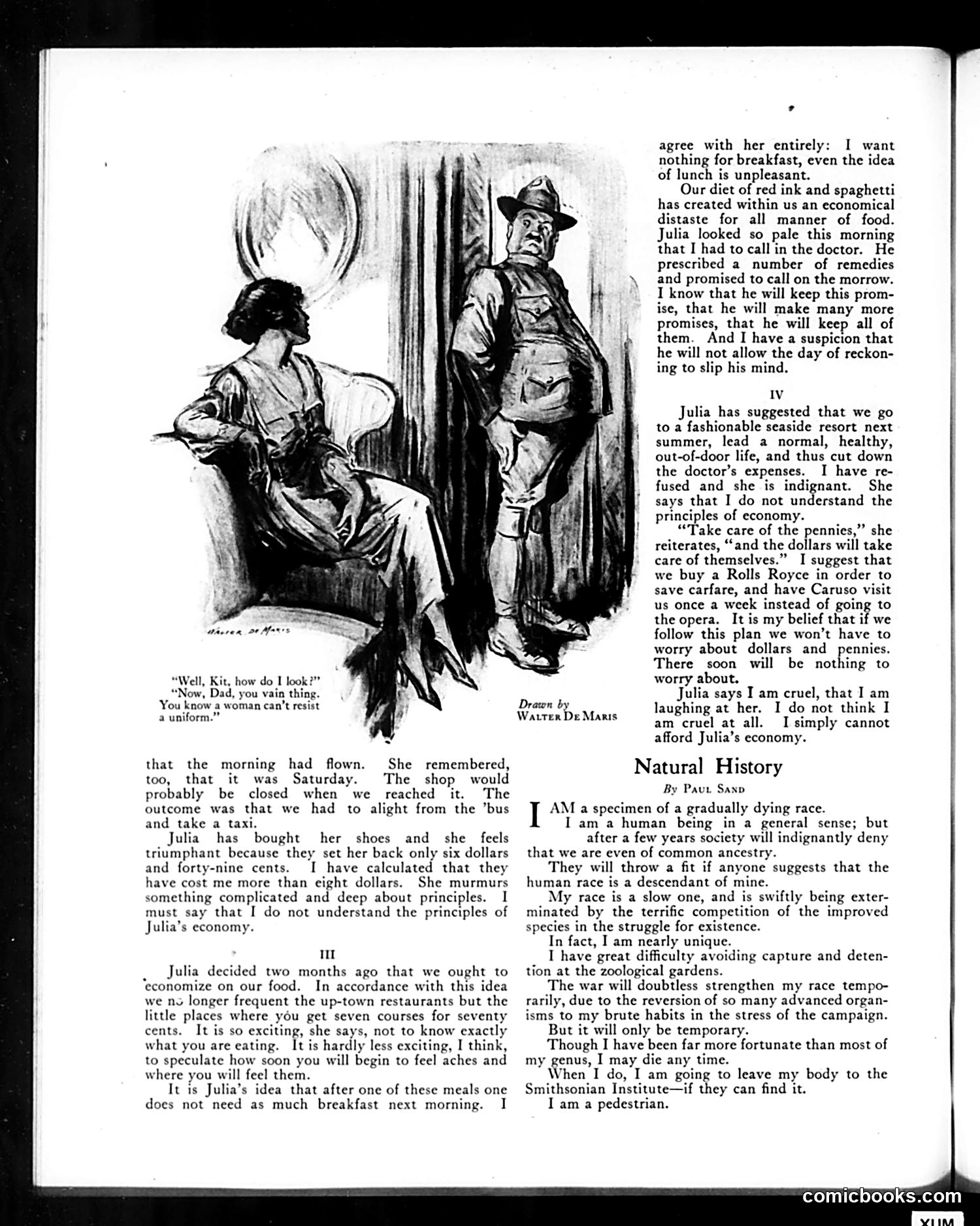
This page contains two separate satirical pieces mocking early 20th-century middle-class anxieties. **The cartoon** (drawn by Walter De Maris) shows a woman admiring a man in military uniform, with the caption joking that women find uniforms irresistible—likely referencing WWI-era military recruitment or the appeal of soldiers. **The main narrative** satirizes a husband's frustration with his wife Julia's contradictory "economy" schemes. She buys expensive shoes but claims savings; she insists on cheap seven-course meals that make them ill; she suggests costly seaside vacations to save on doctor visits. The humor lies in her illogical reasoning and the narrator's exasperated recognition that her penny-pinching costs him more money overall. **"Natural History"** by Paul Sand is a darkly comic monologue from a pedestrian claiming to be an "dying race" being "exterminated" by modern competition—a bitter commentary on automobiles replacing pedestrians in cities, using pseudo-scientific evolutionary language for humorous effect. Both pieces satirize modern life's absurdities and economic anxieties of the period.
📄 Transcribed text from this page (OCR, searchable)
Machine-transcribed from the original scan — historical spelling and the odd misread are preserved.
“Well, Kit, how do I look?” “Now, Dad, you vain thing. You know a woman can’t resist a uniform.” that the morning had flown. She remembered, too, that it was Saturday. The shop would probably be closed when we reached it. The outcome was that we had to alight from the ’bus and take a taxi. Julia has bought her shoes and she feels triumphant because they set her back only six dollars and forty-nine cents. I have calculated that they have cost me more than eight dollars. She murmurs something complicated and deep about principles. I must say that I do not understand the principles of Julia’s economy. 111 Julia decided two months ago that we ought to ‘economize on our food. In accordance with this idea we no longer frequent the up-town restaurants but the little places where you get seven courses for seventy cents. It is so exciting, she says, not to know exactly what you are eating. It is hardly less exciting, I think, to speculate how soon you will begin to feel aches and where you will feel them. It is Julia’s idea that after one of these meals one does not need as much breakfast next morning. I agree with her entirely: I want nothing for breakfast, even the idea of lunch is unpleasant. Our diet of red ink and spaghetti has created within us an economical distaste for all manner of food. Julia looked so pale this morning that I had to call in the doctor. He prescribed a number of remedies and promised to call on the morrow. I know that he will keep this prom- ise, that he will make many more promises, that he will keep all of them. And I have a suspicion that he will not allow the day of reckon- ing to slip his mind. IV Julia has suggested that we go to a fashionable seaside resort next summer, lead a normal, healthy, out-of-door life, and thus cut down the doctor’s expenses. I have re- fused and she is indignant. She says that I do not understand the principles of economy. “Take care of the pennies,” she reiterates, “and the dollars will take care of themselves.” I suggest that we buy a Rolls Royce in order to save carfare, and have Caruso visit us once a week instead of goin; the opera. It is my belief that if we follow this plan we won’t have to worry about dollars and pennies. There soon will be nothing to worry about. Julia says I am cruel, that I am laughing at her. I do not think I am cruel at all. I simply cannot afford Julia’s economy. Drawn by Wauter De Maris Natural History By Paut Saxo I AM a specimen of a gradually dying race. I am a human being in a general sense; but after a few years society will indignantly deny that we are even of common ancestry. They will throw a fit if anyone suggests that the human race is a descendant of mine. My race is a slow one, and is swiftly being exter- minated by the terrific competition of the improved species in the struggle for existence. In fact, I am nearly unique. I have great difficulty avoiding capture and deten- tion at the zoological gardens. The war will doubtless strengthen my race tempo- rarily, due to the reversion of so many advanced organ- isms to my brute habits in the stress of the campaign. But it will only be temporary Though I have been far more fortunate than most of my genus, I may die any time. When I do, I am going to leave my body to the Smithsonian Institute—if they can find it. I am a pedestrian. comicbooks.com