
Judge, 1918-03-16 · page 24 of 38
Judge — March 16, 1918 — page 24: what you’re looking at
What you’re looking at
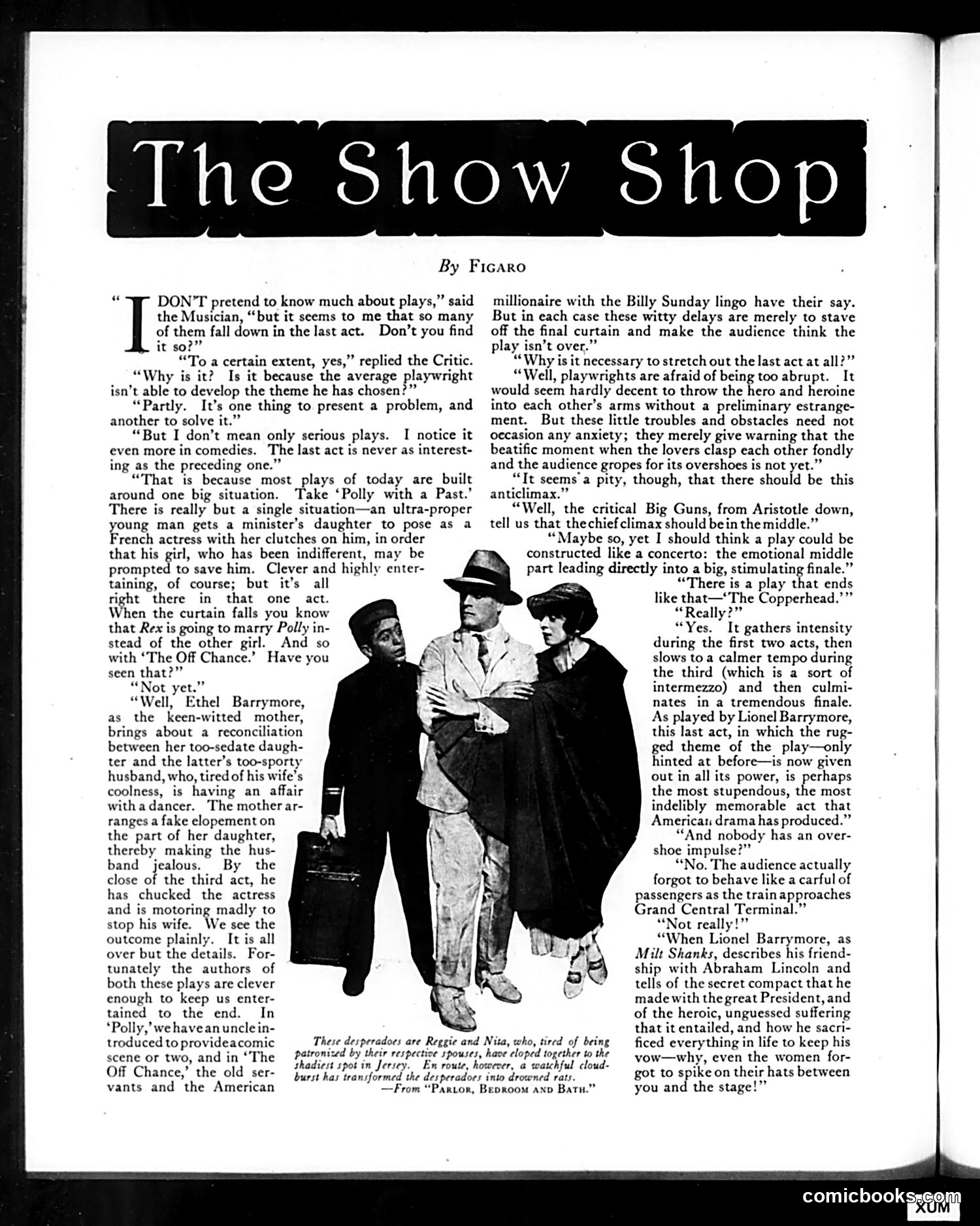
This article by Figaro discusses theatrical structure, specifically the weakness of final acts in contemporary Broadway comedies. The dialogue between a Musician and Critic critiques plays like *Polly with a Past* and *The Off Chance* (featuring Ethel Barrymore), arguing that their climaxes occur too early, forcing authors to artificially pad the third act with minor complications to delay resolution. The photograph shows three men in period costume, apparently from one of the discussed plays, depicting a comedic scene of romantic entanglement. The satire targets playwrights' structural failings: rather than building intensity throughout, they compress their dramatic climax into Act Two, then awkwardly prolong Act Three with unnecessary obstacles. Figaro praises *The Copperhead* (featuring Lionel Barrymore) as an exception—a play structured like a musical concerto, maintaining dramatic momentum to a powerful final act. The piece is theater criticism, not political satire, addressing early-1920s Broadway's formulaic construction problems.
📄 Transcribed text from this page (OCR, searchable)
Machine-transcribed from the original scan — historical spelling and the odd misread are preserved.
* DON’T pretend to know much about plays,” said the Musician, “but it seems to me that so many of them fall down in the last act. Don’t you find it so?” “To a certain extent, yes,” replied the Critic. “Why is it? Is it because the average playwright isn’t able to develop the theme he has chosen?” “Partly. It’s one thing to present a problem, and another to solve it.” “But I don’t mean only serious plays. I notice it even more in comedies. The last act is never as interest- ing as the preceding one.” “That is because most plays of today are built around one big situation. Take ‘Polly with a Past.’ There is really but a single situation—an ultra-proper oung man gets a minister’s daughter to pose as a rench actress with her clutches on him, in order that his girl, who has been indifferent, may be prompted to save him. Clever and highly enter- taining, of course; but it’s all right there in that one act. When the curtain falls you know that Rex is going to marry Polly in- stead of the other girl. And so with “The Off Chance.’ Have you seen that?” “Not yet.” “Well, Ethel Barrymore, as the keen-witted mother, brings about a reconciliation between her too-sedate daugh- ter and the latter’s too-sporty husband, who, tired of his wife’s coolness, is having an affair withadancer. The mother ar- ranges a fake elopement on the part of her daughter, thereby making the hus- band jealous. By the close of the third act, he has chucked the actress and is motoring madly to stop his wife. We see the outcome plainly. It is all over but the details. For- tunately the authors of both these plays are clever enough to keep us enter- tained to the end. In ‘Polly,’ we havean uncle in- troduced to provideacomic scene or two, and in ‘The Off Chance,’ the old ser- vants and the American shadiest spot in Jersey. The Show Shop By Ficaro These desperadoes are Reggie and Nita, who, tired of being patronized by their respectice spouses, have eloped together to the En route, however, a watchful cloud- burst has transformed the desperadoes into drowned rats. —From “Panton, Beoroos axp Batu.” millionaire with the Billy Sunday lingo have their say. But in each case these witty delays are merely to stave off the final curtain and make the audience think the play isn’t over.” “Why is it necessary to stretch out the last act at all?” “Well, playwrights are afraid of being too abrupt. It would seem hardly decent to throw the fer and heroine into each other’s arms without a preliminary estrange- ment. But these little troubles and obstacles need not occasion any anxiety; they merely give warning that the beatific moment when the lovers clasp each other fondly and the audience gropes for its overshoes is not yet.” “It seems a pity, though, that there should be this anticlimax.”” “Well, the critical Big Guns, from Aristotle down, tell us that thechief climax should bein the middle.” “Maybe so, yet I should think a play could be constructed like a concerto: the emotional middle part leading directly into a big, stimulating finale.” “There is a play that ends like that—*The Copperhead.’” “Really?” “Yes. It gathers intensity during the first two acts, then slows to a calmer tempo during the third (which is a sort of intermezzo) and then culmi- nates in a tremendous finale. As played by Lionel Barrymore, this last act, in which the rug- ged theme of the play—only hinted at before—is now given out in all its power, is perhaps the most stupendous, the most indelibly memorable act that American drama has produced.” “And nobody has an over- shoe impulse?” “No. The audience actually forgot to behave like a carful of passengers as the train approaches Grand Central Terminal.” “Not really!” “When Lionel Barrymore, as Milt Shanks, describes his friend- ship with Abraham Lincoln and tells of the secret compact that he madewith the great President, and of the heroic, unguessed suffering that it entailed, and how he sacri- ficed everything in life to keep his vow—why, even the women for- got to spike on their hats between 19 you and the stage! comicbooksseoip