
Judge, 1918-03-16 · page 11 of 38
Judge — March 16, 1918 — page 11: what you’re looking at
What you’re looking at
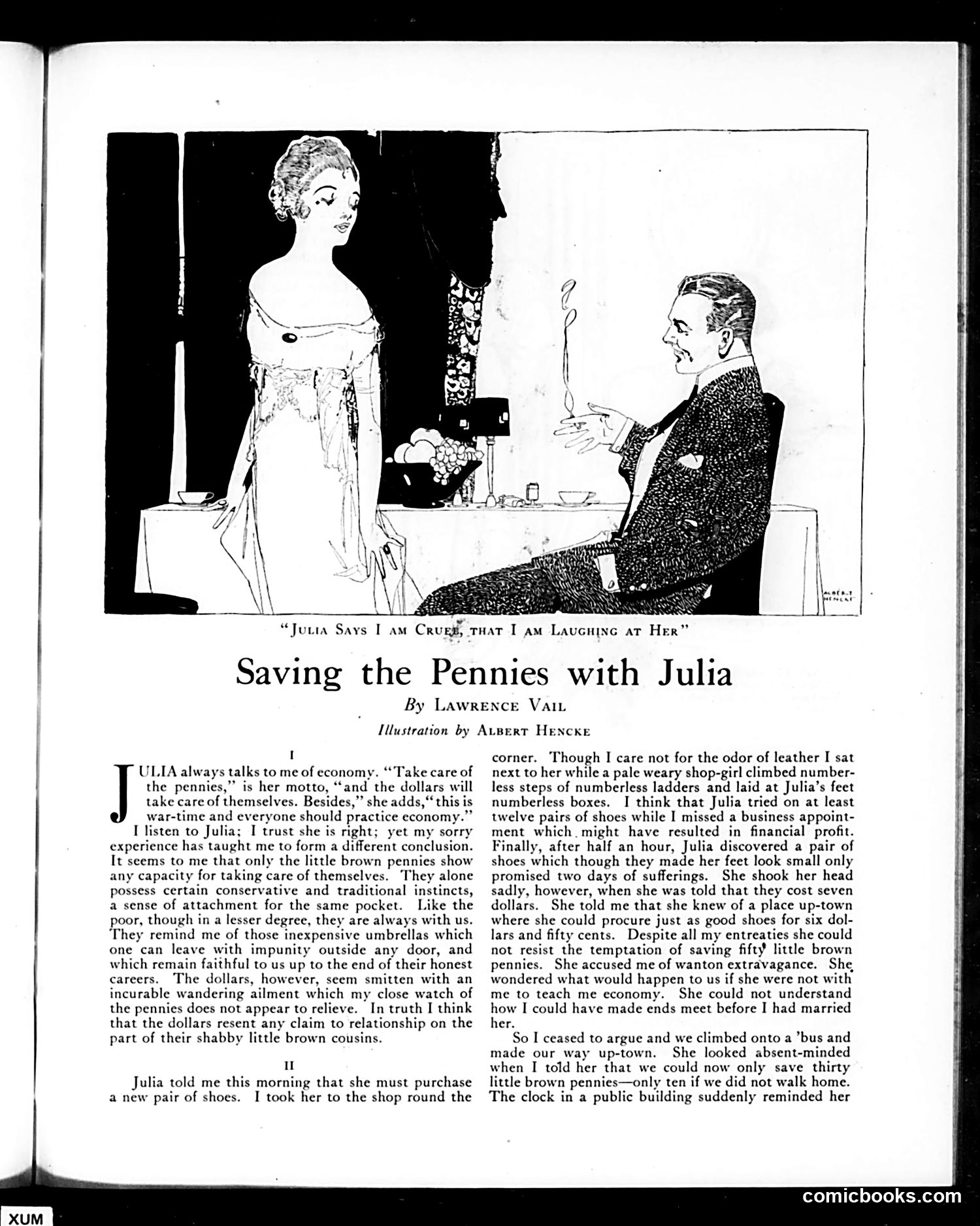
This is a humorous domestic satire by Lawrence Vail, illustrated by Albert Hencke, likely from WWI-era Judge magazine (note the "war-time" reference). The joke concerns a wife, Julia, who obsessively practices penny-pinching economy—"take care of the pennies and the dollars will take care of themselves"—but whose frugality actually *costs* money. The illustration shows Julia lecturing her husband during what appears to be a formal dinner. The accompanying story describes Julia insisting they travel across town to save fifty cents on shoes, then debating whether to walk home to save thirty more pennies—all while the husband misses a profitable business appointment. The satire mocks women's domestic financial management and suggests that excessive thriftiness—particularly concerning trivial amounts—defeats its own purpose by wasting time, opportunity, and transportation costs. It's a period-typical joke about female financial irrationality and nagging domesticity.
📄 Transcribed text from this page (OCR, searchable)
Machine-transcribed from the original scan — historical spelling and the odd misread are preserved.
XUM “Jutta Says I am Cruegg, THAT I am Laucuinc at Her Saving the Pennies with Julia By Lawrence VaiL Illustration by Aubert Hen I ULIA always talks to me of economy. “Take care of the pennies,” is her motto, “and the dollars will take care of themselves. Besides,” she adds,“ this is war-time and everyone should practice economy.” I listen to Julia; I trust she is right; yet my sorry experience has taught me to form a different conclusion. It seems to me that only the little brown pennies show any capacity for taking care of themselves. They alone possess certain conservative and traditional instincts, a sense of attachment for the same pocket. Like the poor, though in a lesser degree, they are always with us. They remind me of those inexpensive umbrellas which one can leave with impunity outside any door, and which remain faithful to us up to the end of their honest careers. The dollars, however, seem smitten with an incurable wandering ailment which my close watch of the pennies does not appear to relieve. In truth I think that the dollars resent any claim to relationship on the part of their shabby little brown cousins. IL Julia told me this morning that she must purchase a new pair of shoes. I took her to the shop round the KE corner. Though I care not for the odor of leather I sat next to her while a pale weary shop-girl climbed number- less steps of numberless ladders and laid at Julia’s feet numberless boxes. I think that Julia tried on at least twelve pairs of shoes while I missed a business appoint- ment which. might have resulted in financial profit. Finally, after half an hour, Julia discovered a pair of shoes which though they made her feet look small only promised two days of sufferings. She shook her head sadly, however, when she was told that they cost seven dollars. She told me that she knew of a place up-town where she could procure just as good shoes for six dol- lars and fifty cents. Despite all my entreaties she could not resist the temptation of saving fifty little brown pennies. She accused me of wanton extravagance. She wondered what would happen to us if she were not with me to teach me economy. She could not understand how I could have made ends meet before I had married her. So I ceased to argue and we climbed onto a ’bus and made our way up-town. She looked absent-minded when I told her that we could now only save thirty little brown pennies—only ten if we did not walk home. The clock in a public building suddenly reminded her comicbooks.com