
Judge, 1918-03-16 · page 7 of 38
Judge — March 16, 1918 — page 7: what you’re looking at
What you’re looking at
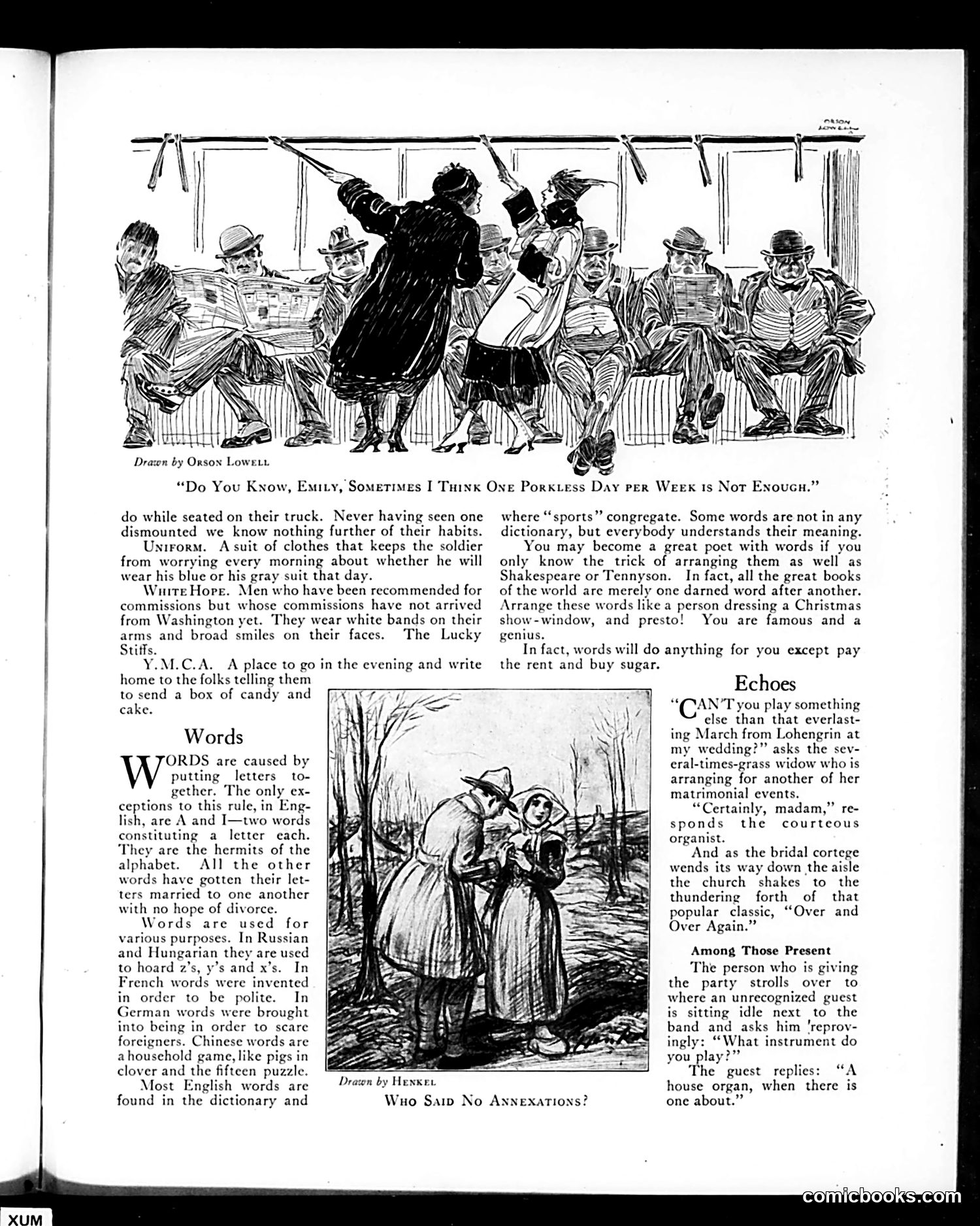
**Top Cartoon (Orson Lowell):** Depicts WWI soldiers on a truck discussing rationing. The joke references "meatless days"—wartime conservation efforts requiring Americans to abstain from meat one day weekly. The caption's exaggerated complaint satirizes civilian grumbling about minor sacrifices while soldiers endure actual hardship. **"Words" Section:** Humorous faux-dictionary definitions mocking various subjects. Notable: Russian and Hungarian languages allegedly used for hoarding unusual letters; German invented "to scare foreigners"; Chinese compared to household games. This reflects period ethnic stereotyping common in early-20th-century American humor. **Bottom Cartoon (Henkel):** "Who Said No Annexations?" references WWI peace negotiations and Woodrow Wilson's Fourteen Points, which opposed territorial annexation. The image appears to show domestic conflict—possibly labor or political dispute—ironically asking who opposes annexation while internal conflicts rage. **"Echoes" Section:** Humorous anecdotes about wedding music and party guests, offering light social satire about predictable rituals and awkward social situations.
📄 Transcribed text from this page (OCR, searchable)
Machine-transcribed from the original scan — historical spelling and the odd misread are preserved.
Drawon by Onsox Lowen. “Do You Know, Emity, Sometimes I Tuink One Porktess Day per Week 1s Not Enoucu.” do while seated on their truck. Never having seen one dismounted we know nothing further of their habits. Unirorm. A suit of clothes that keeps the soldier from worrying every morning about whether he will wear his blue or his gray suit that day. Wuite Hore. Men who have been recommended for commissions but whose commissions have not arrived from Washington yet. They wear white bands on their arms and broad smiles on their faces. The Lucky Stitfs. Y.M.C.A. A place to go in the evening and write home to the folks telling them where “sports” congregate. Some words are not in any dictionary, but everybody understands their meaning. You may become a great poct with words if you only know the trick of arranging them as well as Shakespeare or Tennyson. In fact, all the great books of the world are merely one darned word after another. Arrange these words like a person dressing a Christmas show-window, and presto! You are famous and a genius. In fact, words will do anything for you except pay the rent and buy sugar. Echoes to send a box of candy and cake. Words ORDS are caused by putting letters to- gether. The only ex- ceptions to this rule, in Eng- lish, are A and I—two words constituting a letter each. ‘They are the hermits of the alphabet. All the other words have gotten their let- ters married to one another with no hope of divorce. Words are used for various purposes. In Russian and Hungarian they are used to hoard 2’s, y’s and x’s. In French words were invented in order to be polite. In German words were brought into being in order to scare foreigners. Chinese words are ahousehold game, like pigs in ‘C AN’T you play something else than that everlast- ing March from Lohengrin at my wedding?” asks the sev- eral-times-grass widow who is arranging for another of her matrimonial events. “Certainly, madam,” re- sponds the courteous organist. And as the bridal cortege wends its way down the aisle the church shakes to the thundering forth of that popular classic, “Over and Over Again.” Among Those Present The person who is giving the party strolls over to where an unrecognized guest is sitting idle next to the band and asks him 'reprov- ingly: “What instrument do you play?” The guest replies: “A clover and the fifteen puzzle. Most English words are found in the dictionary and Drawn by Hexxer Wuo Sain No ANNExations? house organ, when there is one about.”