
Judge, 1918-03-16 · page 37 of 38
Judge — March 16, 1918 — page 37: what you’re looking at
What you’re looking at
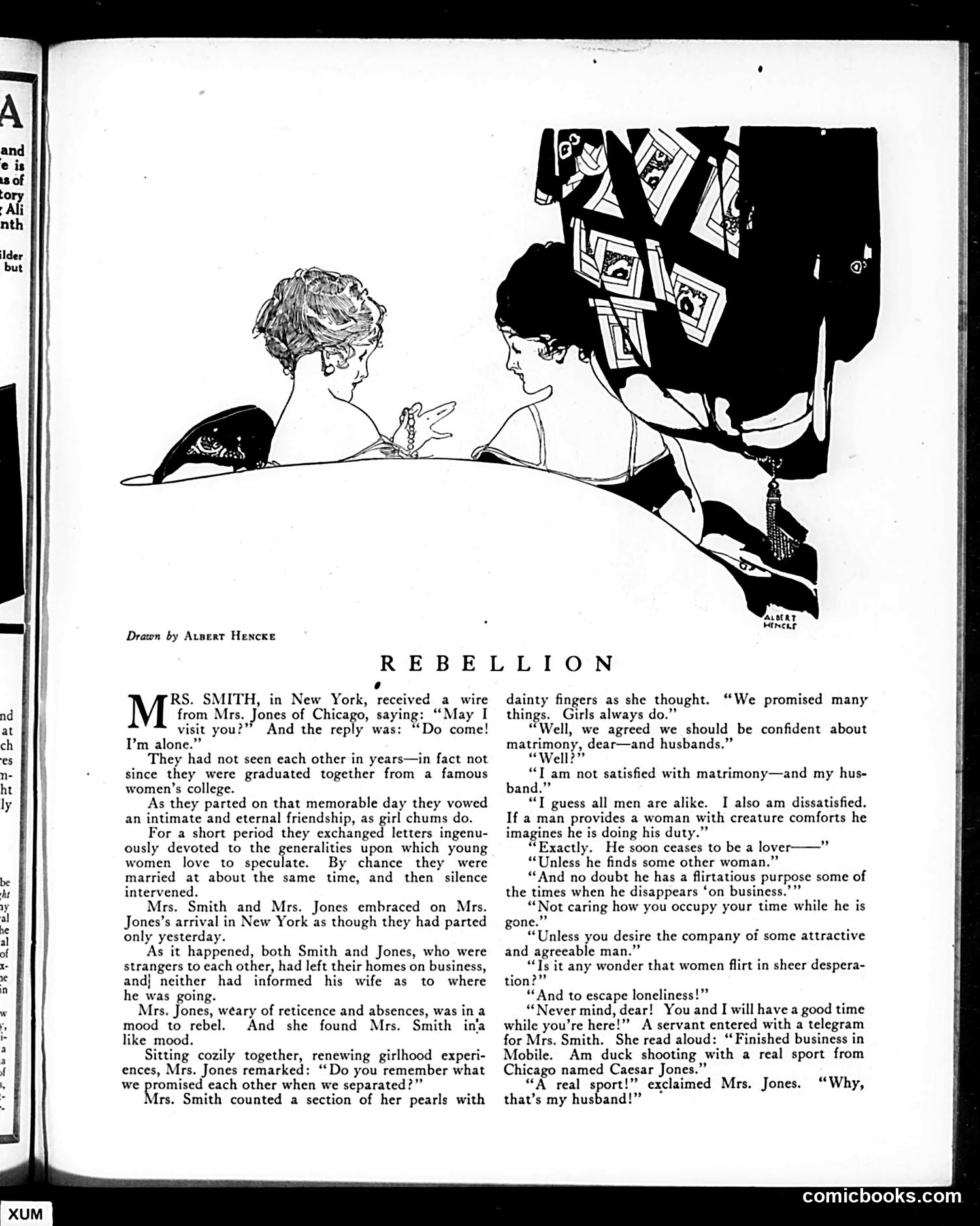
This Henckel cartoon satirizes early 20th-century wives' dissatisfaction with marriage. Two college friends—Mrs. Smith and Mrs. Jones—reunite in New York and commiserate about their absent husbands, who claim to be on business but are actually hunting together in Mobile, Chicago. The satire targets both spouses: husbands who neglect emotional connection while providing "creature comforts," and wives who flirt "in sheer desperation" to escape loneliness. The ironic twist—that both women's husbands are together enjoying leisure activities—exposes how men's friendships and freedom contrast with women's confined domestic roles. The title "Rebellion" refers to women's quiet defiance: considering affairs and social company as escape from loveless, neglectful marriages. This reflects early-1900s anxieties about changing gender relations and marital expectations.
📄 Transcribed text from this page (OCR, searchable)
Machine-transcribed from the original scan — historical spelling and the odd misread are preserved.
Drawn by Avpert Hencke Av otRy HONcne REBELLION o RS. SMITH, in New York, received a wire from Mrs. Jones of Chicago, saying: “May I visit you?”’ And the reply was: “Do come! I’m alone.” They had not seen each other in years—in fact not since they were graduated together from a famous women’s college. As they parted on that memorable day they vowed an intimate and eternal friendship, as girl chums do. For a short period they exchanged letters ingenu- ously devoted to the generalities upon which young women love to speculate: By chance they were married at about the same time, and then silence intervened. Mrs. Smith and Mrs. Jones embraced on Mrs. Jones’s arrival in New York as though they had parted only yesterday. As it happened, both Smith and Jones, who were strangers to each other, had left their homes on business, and} neither had informed his wife as to where he was going. Mrs. Jones, weary of reticence and absences, was in a mood to rebel. And she found Mrs. Smith in‘a like mood. Sitting cozily together, renewing girlhood experi- ences, Mrs. Jones remarked: ‘Do you remember what we promised each other when we separated?” Mrs. Smith counted a section of her pearls with dainty fingers as she thought. “We promised many things. Girls always do.” “Well, we agreed we should be confident about matrimony, dear—and husbands.” “Well?” “T am not satisfied with matrimony—and my hus- band.” “T guess all men are alike. I also am dissatisfied. If a man provides a woman with creature comforts he imagines he is doing his duty.” “Exactly. He soon ceases to be a lover ” “Unless he finds some other woman.” “And no doubt he has a flirtatious purpose some of the times when he disappears ‘on business.’” “Not caring how you occupy your time while he is gone.” “Unless you desire the company of some attractive and agreeable man.” “Ts it any wonder that women flirt in sheer despera- tion?” “And to escape loneliness!” “Never mind, dear! You and I will have a good time while you’re here!” A servant entered with a telegram for Mrs. Smith. She read aloud: “Finished business in Mobile. Am duck shooting with a real sport from Chicago named Caesar Jones.” “A real sport!” exclaimed Mrs. Jones. ‘Why, that’s my husband!” comicbooks.com