
Judge, 1918-03-16 · page 23 of 38
Judge — March 16, 1918 — page 23: what you’re looking at
What you’re looking at
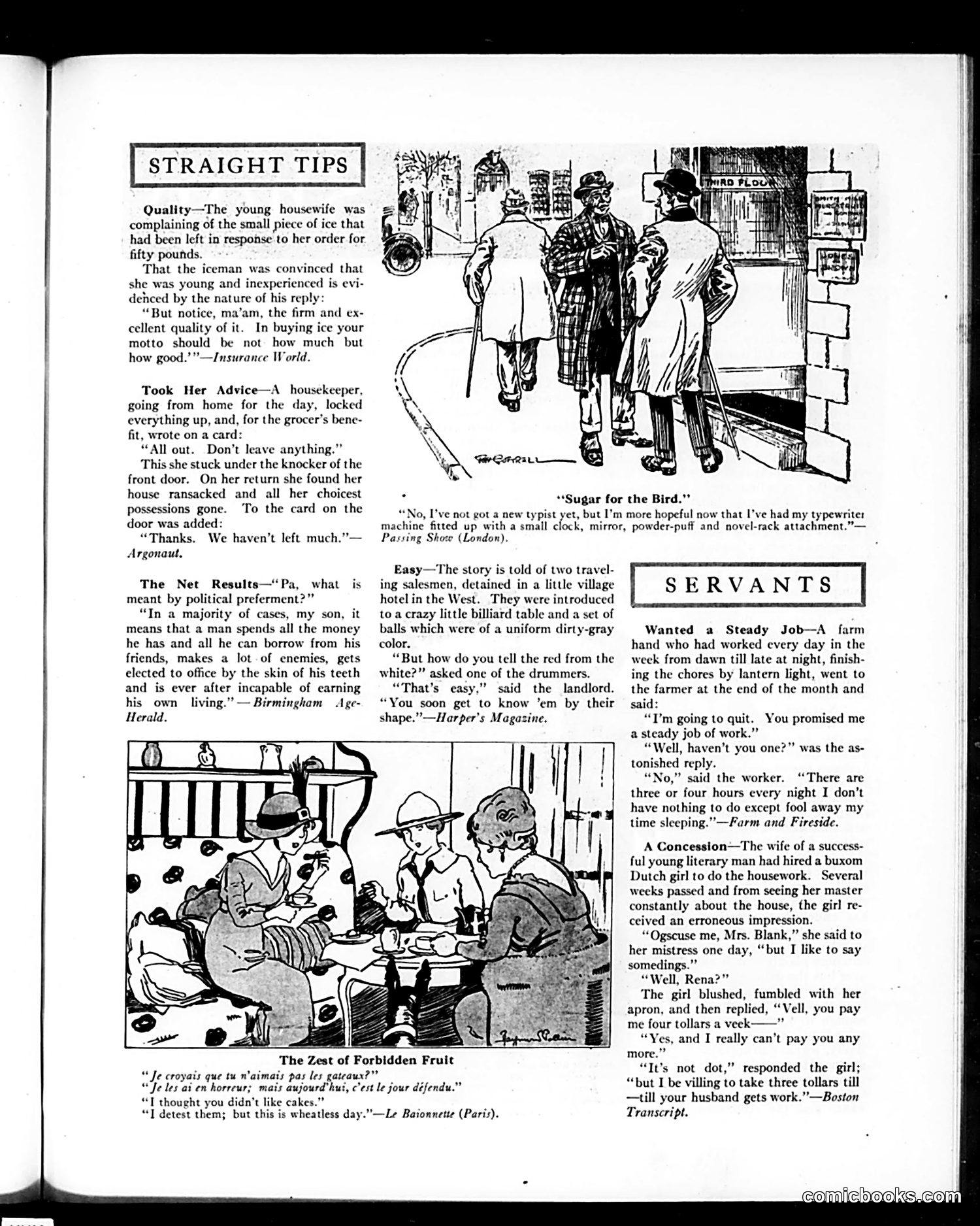
This page from *Judge* collects brief humorous anecdotes satirizing everyday life and human nature rather than specific political figures. The main cartoons mock: 1. **Consumer naiveté**: An iceman dupes a young housewife with quality-over-quantity reasoning when she complains about receiving less ice than ordered. 2. **Ironic consequences**: A housekeeper's overly cautious "don't leave anything" note to her grocer becomes an invitation for burglars, who sarcastically thank her. 3. **Political corruption**: A father explains that political "preferment" requires spending all one's money, making enemies, barely winning office—then becoming unable to earn independently. 4. **Wartime sacrifice**: A French anecdote plays on WWI rationing: a woman who "detests" cakes eats them eagerly on "wheatless days" (government-mandated meatless/wheatless days). 5. **Labor exploitation and immigrant humor**: A farm hand wants "steady work"; a Dutch maid's accent-laden plea suggests accepting reduced wages until "your husband gets work"—implying the literary man's actual employment is uncertain.
📄 Transcribed text from this page (OCR, searchable)
Machine-transcribed from the original scan — historical spelling and the odd misread are preserved.
STRAIGHT TIPS Quality—The young housewife was complaining of the small piece of ice that had been left in response to her order for. fifty pounds. That the iceman was convinced that she was young and inexperienced is evi- dehced by the nature of his reply: “But notice, ma’am, the firm and ex- cellent quality of it. In buying ice your motto should be not how much but how good.’”—Insurance World. Took Her Advice—A_ housekeeper, going from home for the day, locked everything up, and, for the grocer’s bene- fit, wrote on a card: “All out. Don’t leave anything.” This she stuck under the knocker of the front door. On her return she found her house ransacked and all her choicest possessions gone. To the card on the door was added: “Thanks. We haven't left much,”— Argonaut, The Net Results—‘Pa, what is meant by political preferment?” “In a majority of cases, my son, it means that a man spends all the money he has and all he can borrow from his friends, makes a lot of enemies, gets elected to office by the skin of his teeth and is ever after incapable of earning his own living.””— Birmingham Age- Herald. “Sugar for the Bird.’ “No, I’ve not got a new typist yet, but I'm more hopeful now that I’ve had my typewriter machine fitted up with a small clock, mirror, powder-puff and novel-rack attachment.”— Passing Shove (London). Easy—The story is told of two travel- ing salesmen, detained in a little village hotel in the West. They were introduced toa crazy little billiard table and a set of balls which were of a uniform dirty-gray color. “But how do you tell the red from the white?” asked one of the drummers. “That’s easy,” said the landlord. “You soon get to know ’em by their shape.”"—Harper's Magazine. The Zest of Forbidden Fruit “Je croyais que tu n'aimais pas les gateaux?” “Je les ai en horreur; mais aujourd'hui, c'est le jour défendu.” “T thought you didn’t like cakes.” “I detest them; but this is wheatless day.”—Le Baionnette (Paris). Wanted a Steady Job—A farm hand who had worked every day in the week from dawn till late at night, finish- ing the chores by lantern light, went to the farmer at the end of the month and said: “I’m going to quit. You promised me a steady job of work.” “Well, haven’t you one?” was the as- tonished reply. “No,” said the worker. “There are three or four hours every night I don’t have nothing to do except fool away my time sleeping.” —Farm and Fireside. A Concession—The wife of a success- ful young literary man had hired a buxom Dutch girl to do the housework. Several weeks passed and from seeing her master constantly about the house, the girl re- ceived an erroneous impression. “Ogscuse me, Mrs. Blank,” she said to her mistress one day, “but I like to say somedings.”” “Well, Rena?” The girl blushed, fumbled with her apron, and then replied, “Vell, you pay me four tollars a veek——” Yes, and I really can’t pay you any “It’s not dot,” responded the girl; “but I be villing to take three tollars till —till your husband gets work.”—Boston Transcript.