
A complete issue · 36 pages · 1918
Judge — February 9, 1918
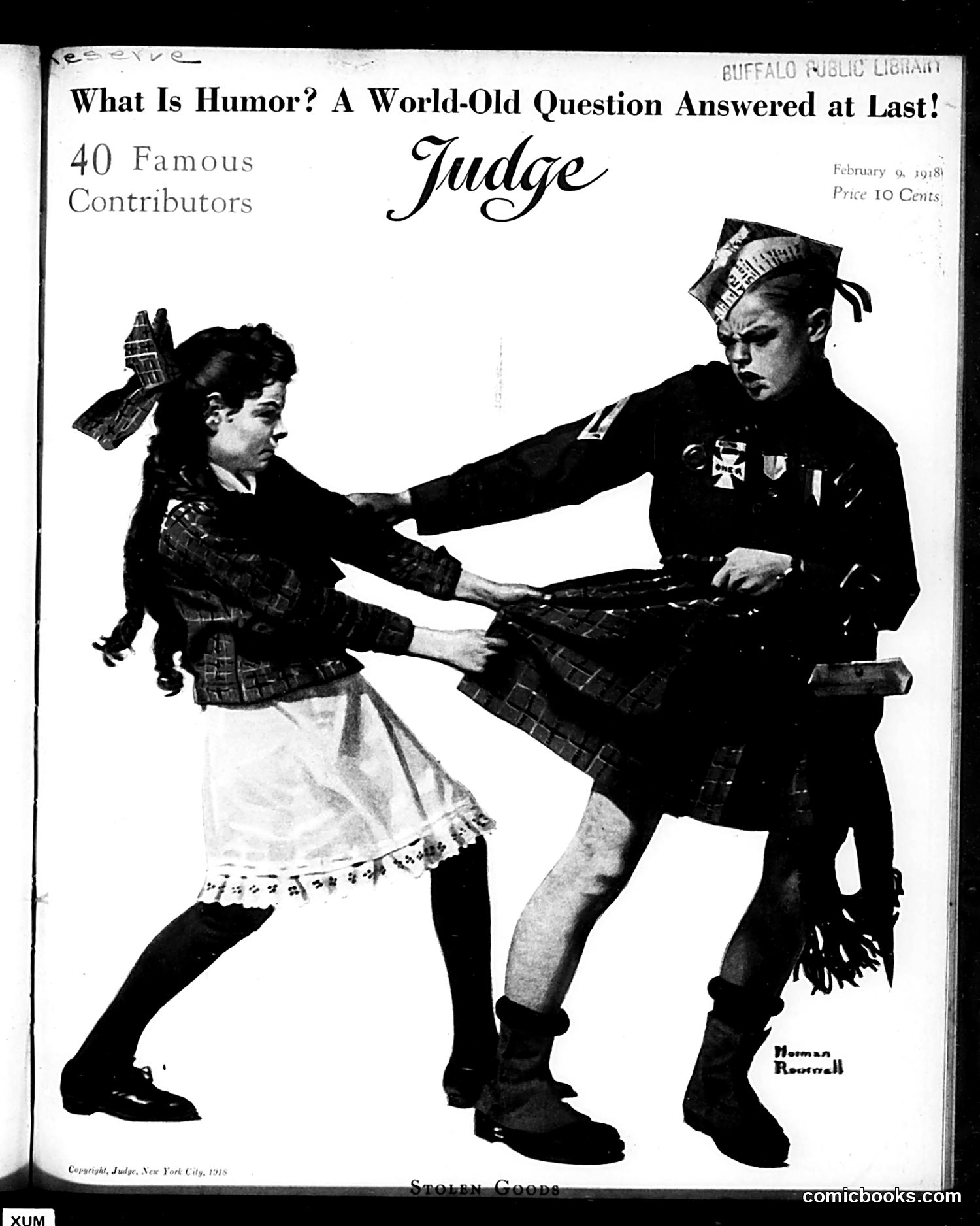
This cover illustrates "Stolen Goods"—a satirical commentary on World War I. The cartoon depicts a German military officer (identifiable by the spiked helmet, Iron Cross medal, and military uniform) forcibly taking a Scottish woman's tartan skirt. The woman wears traditional Scottish dress including the plaid skirt and cap. The satire likely references German military aggression and the violation of neutral or allied territories during WWI. Scotland's tartan represents national identity and sovereignty being "stolen" by German militarism. The title "Stolen Goods" suggests Germany's territorial conquests and looting during the war. This was published during active American involvement in WWI (1918), making the anti-German message timely propaganda for the home front.
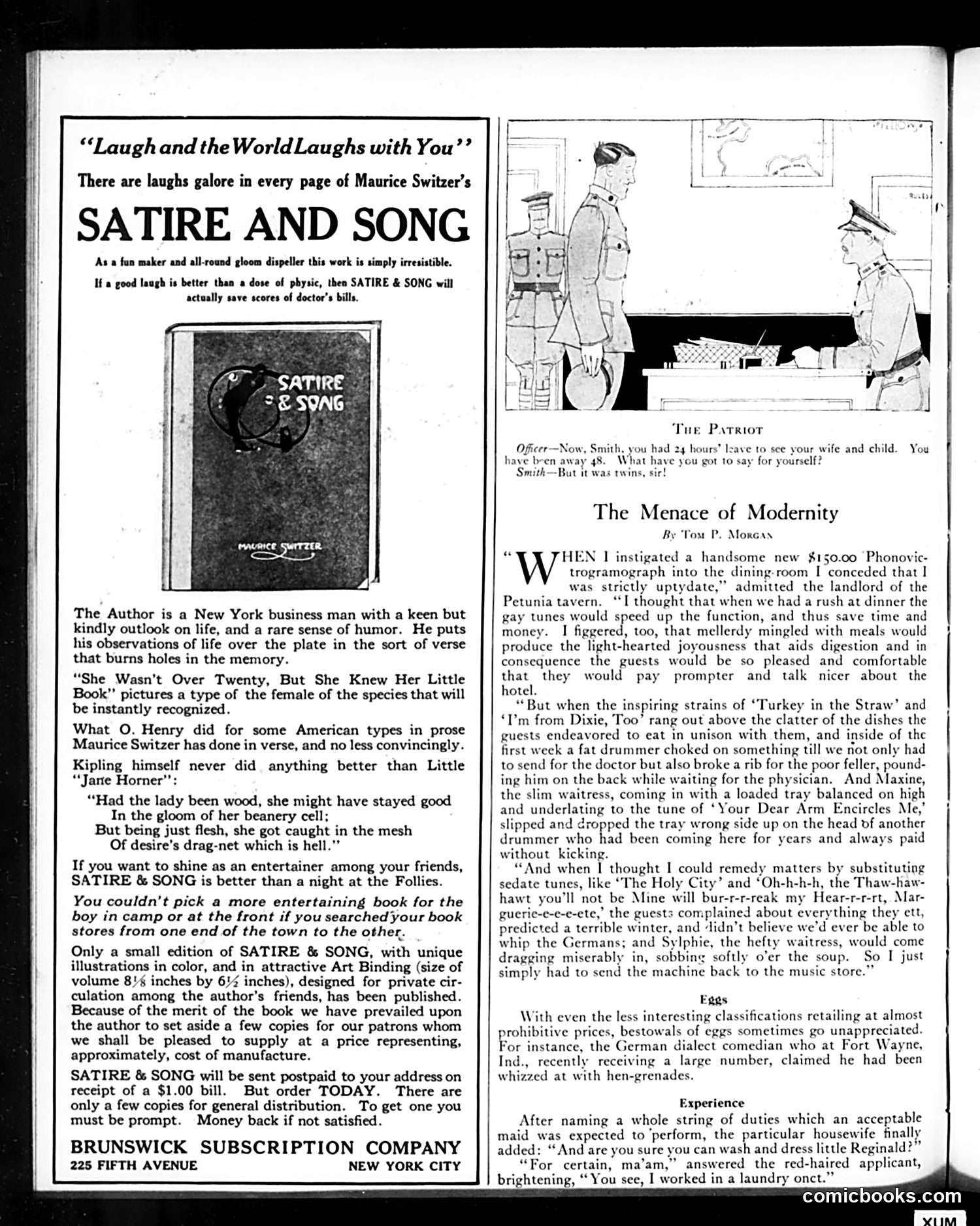
**Main Content:** The left side is a book advertisement for Maurice Switzer's *Satire and Song*, promoting it as humorous entertainment. The ad claims the work rivals O. Henry and Kipling in quality, targeting readers seeking witty social commentary. **Right Side Cartoon & Articles:** The cartoon titled "The Patriot" depicts a military officer confronting another soldier about abandoning his wife and child for 24 hours, asking what excuse he has. This satirizes soldiers prioritizing military duty over family obligations—a likely WWI-era commentary on military service demands. Below this, "The Menace of Modernity" by Tom P. Morgan mocks upscale dining rooms and their modern conveniences, suggesting that newfangled phonographs and modern entertainment disrupt traditional dining. The satire criticizes excessive modernization in social spaces.
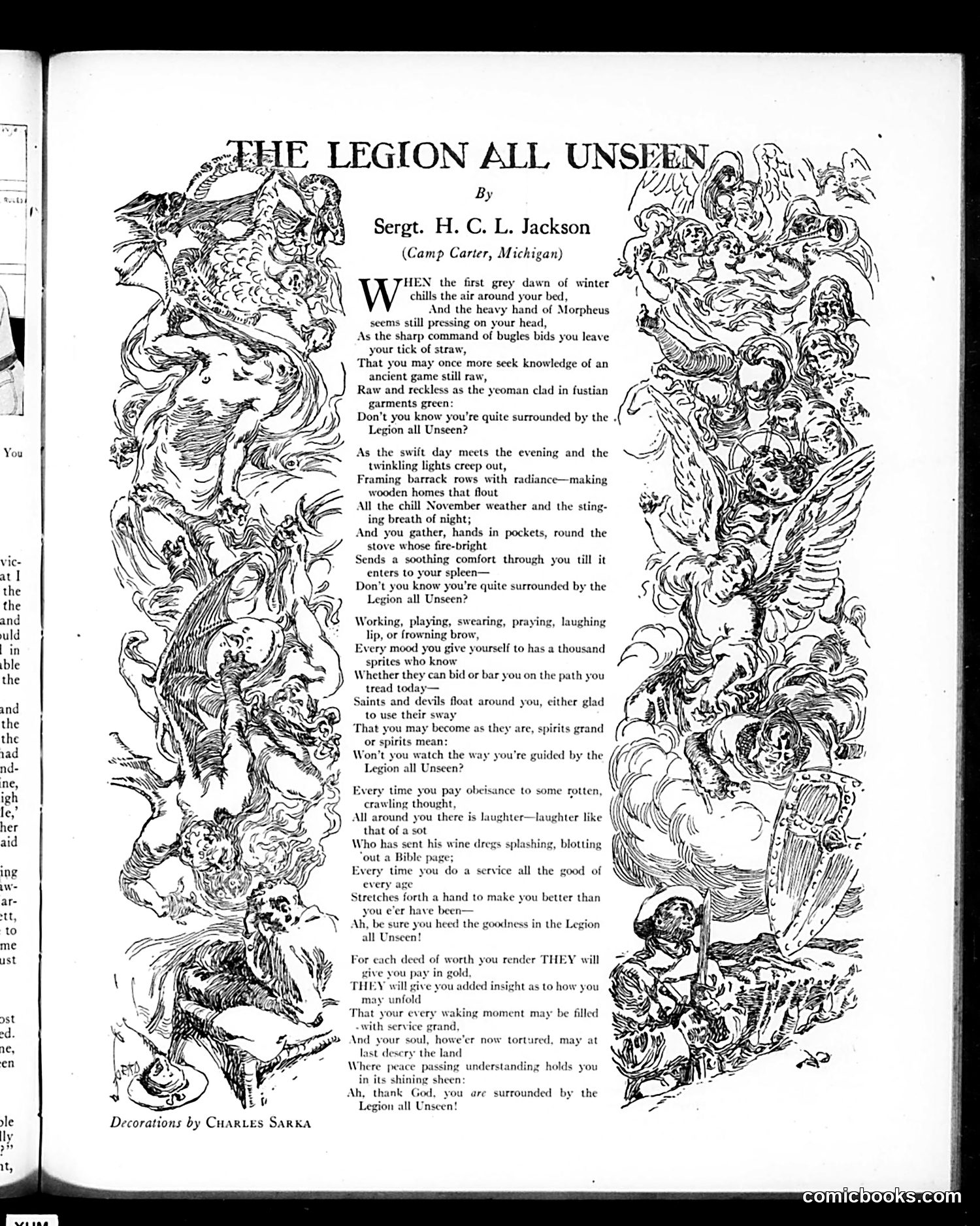
This is a poem by Sergeant H.C.L. Jackson (Camp Carter, Michigan) illustrated by Charles Sarka. The work appears to be WWI-era propaganda or morale content, likely from a soldiers' publication. The decorative borders—featuring angels, spirits, and supernatural figures—visualize the poem's central metaphor: that soldiers are surrounded by an invisible "Legion" of spiritual presences (saints, good forces, divine guidance) protecting them through the hardships of military life and combat. The poem addresses soldiers directly, referencing winter conditions, barracks life, and spiritual comfort during wartime. It's designed to boost morale by suggesting divine protection and meaning in military service—a common rhetorical strategy during WWI.
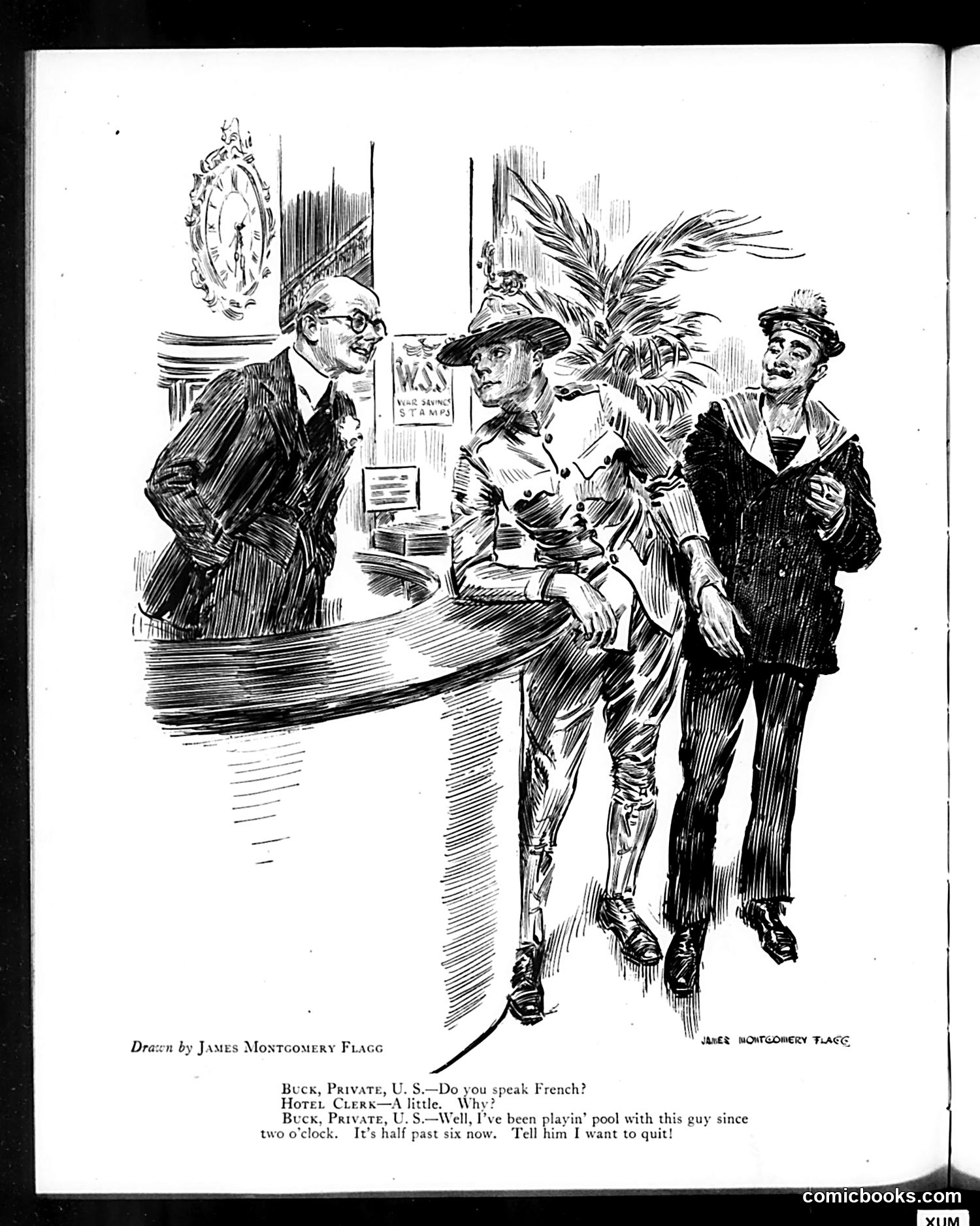
This cartoon by James Montgomery Flagg depicts a scene in a hotel, likely during World War I era (based on the soldier's uniform). A U.S. private soldier seeks help from a hotel clerk, asking if anyone speaks French. When told to ask another guest, the soldier explains he's been playing pool with that guest since two o'clock and now wants to quit—but needs French speakers to negotiate his exit. The satire mocks the soldier's desperation to escape a tedious pool game. The elaborate setup—involving a hotel clerk and potentially French-speakers—suggests the private views leaving a game as requiring diplomatic negotiation, humorously exaggerating social awkwardness around politely declining leisure activities.
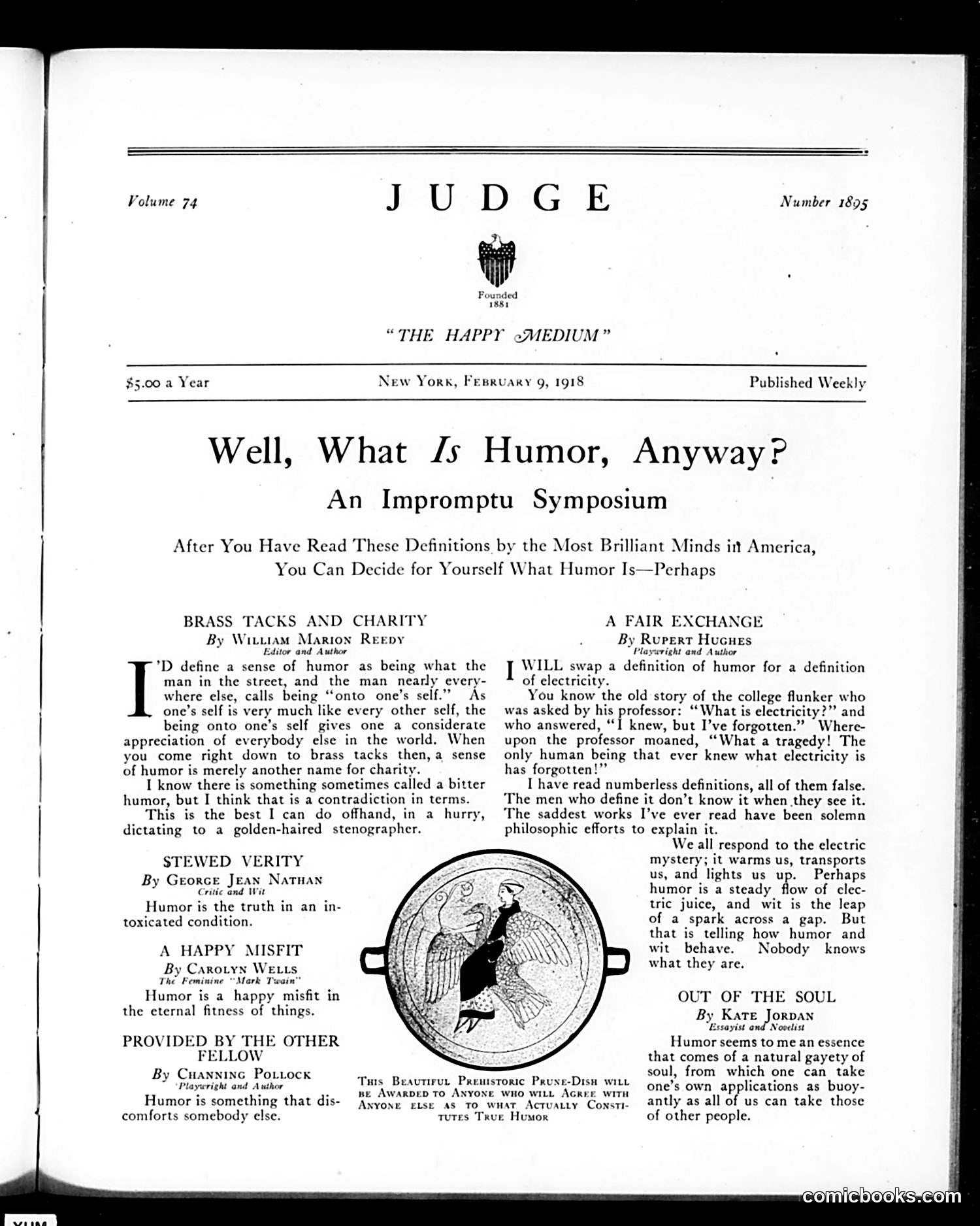
This page features a humorous "symposium" where prominent American writers and editors offer competing definitions of humor. Contributors include William Dean Howells, George Jean Nathan, Carolyn Wells, Channing Pollock, Rupert Hughes, and Kate Jordan—all recognized literary figures of the era. The central image shows a prehistoric bird or creature, captioned as a "beautiful Prehistoric Puns-Dish" that will be awarded to whoever best defines true humor. Rather than political satire, this is meta-humor: the page ironically addresses the impossibility of defining humor itself. Each contributor provides contradictory definitions, illustrating that humor resists simple explanation—a self-aware joke about the magazine's own satirical purpose. The symposium format gently mocks pretentious literary criticism.
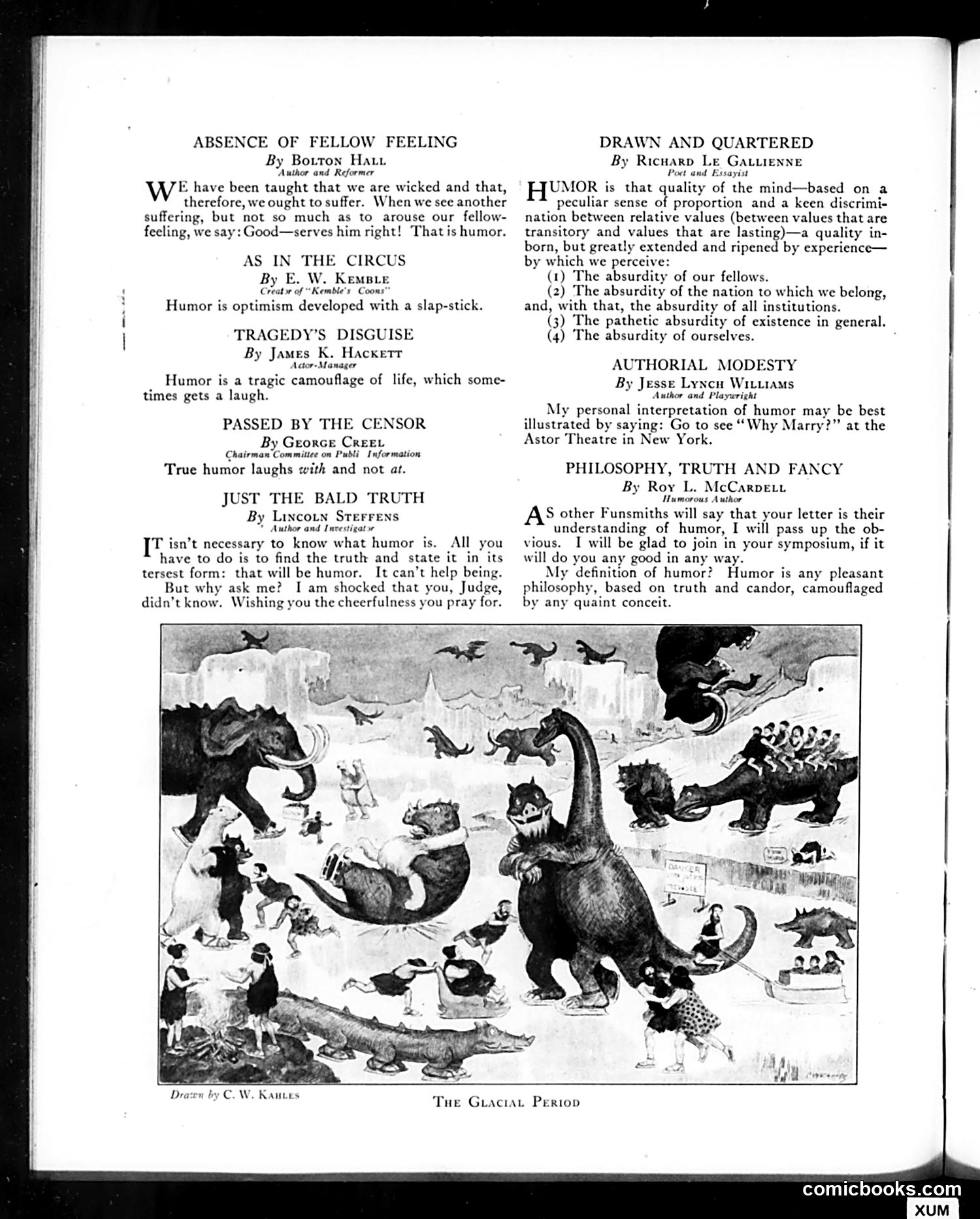
The cartoon depicts a chaotic prehistoric scene with dinosaurs and early humans coexisting—which is scientifically impossible, as dinosaurs went extinct roughly 66 million years ago, long before humans appeared. The satire appears to mock either: 1. **Creationists** who believed humans and dinosaurs coexisted based on literal biblical interpretation 2. **Popular misconceptions** about prehistory circulating in early 20th-century media The absurdist humor—showing humans casually interacting with massive dinosaurs amid complete disorder—exaggerates the logical impossibility to comedic effect. The accompanying essays on this page discuss humor as "tragic camouflage" and emphasize stating "bald truth," suggesting Judge used satire to highlight scientific illiteracy or flawed reasoning about natural history. The drawing's title, "The Glacial Period," further confuses timelines intentionally for comic effect.
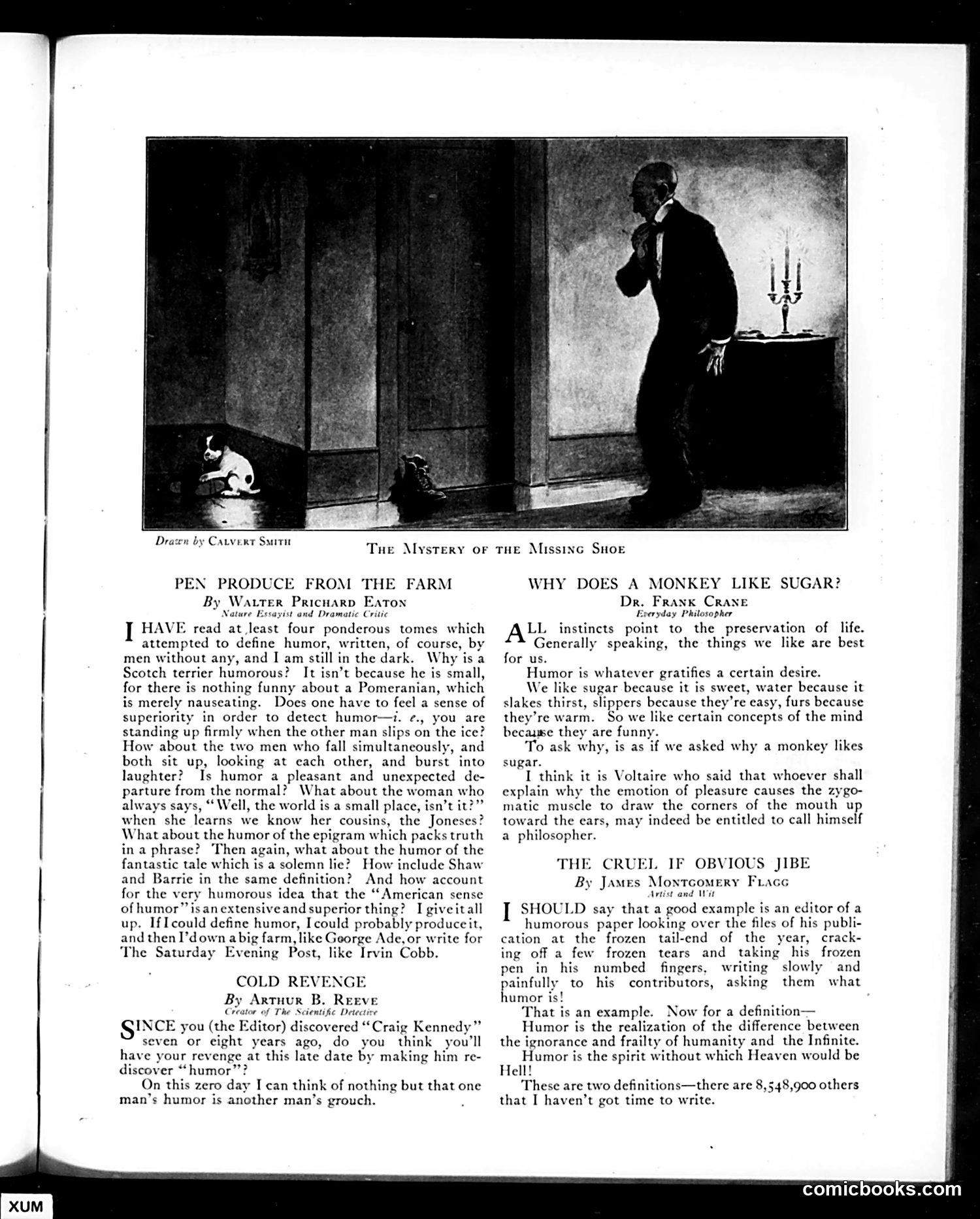
This page explores **what humor actually is**—a question apparently vexing to the magazine's contributors. The top illustration by Calvert Smith, titled "The Mystery of the Missing Shoe," shows a silhouetted figure discovering a shoe missing from a table; the joke's meaning is now obscure without additional context. Below, four writers attempt to define humor: - **Walter Prichard Eaton** admits he's read four books on humor and still doesn't understand it—mocking the pretentiousness of defining something fundamentally subjective. - **Arthur B. Reeve** offers a cutting meta-joke: the editor discovered "Craig Kennedy" (Reeve's famous detective character) years ago; now he'll get "revenge" by making Kennedy discover what humor is—implying it's impossible. - **Dr. Frank Crane** uses pseudo-philosophy, comparing humor to sugar: we like both because they satisfy natural desires. - **James Montgomery Flagg** delivers the cruelest barb: the real joke is an exhausted humor editor begging contributors to explain humor itself—a self-aware jab at editorial desperation. The satire targets pretentious over-analysis of something inherently simple.
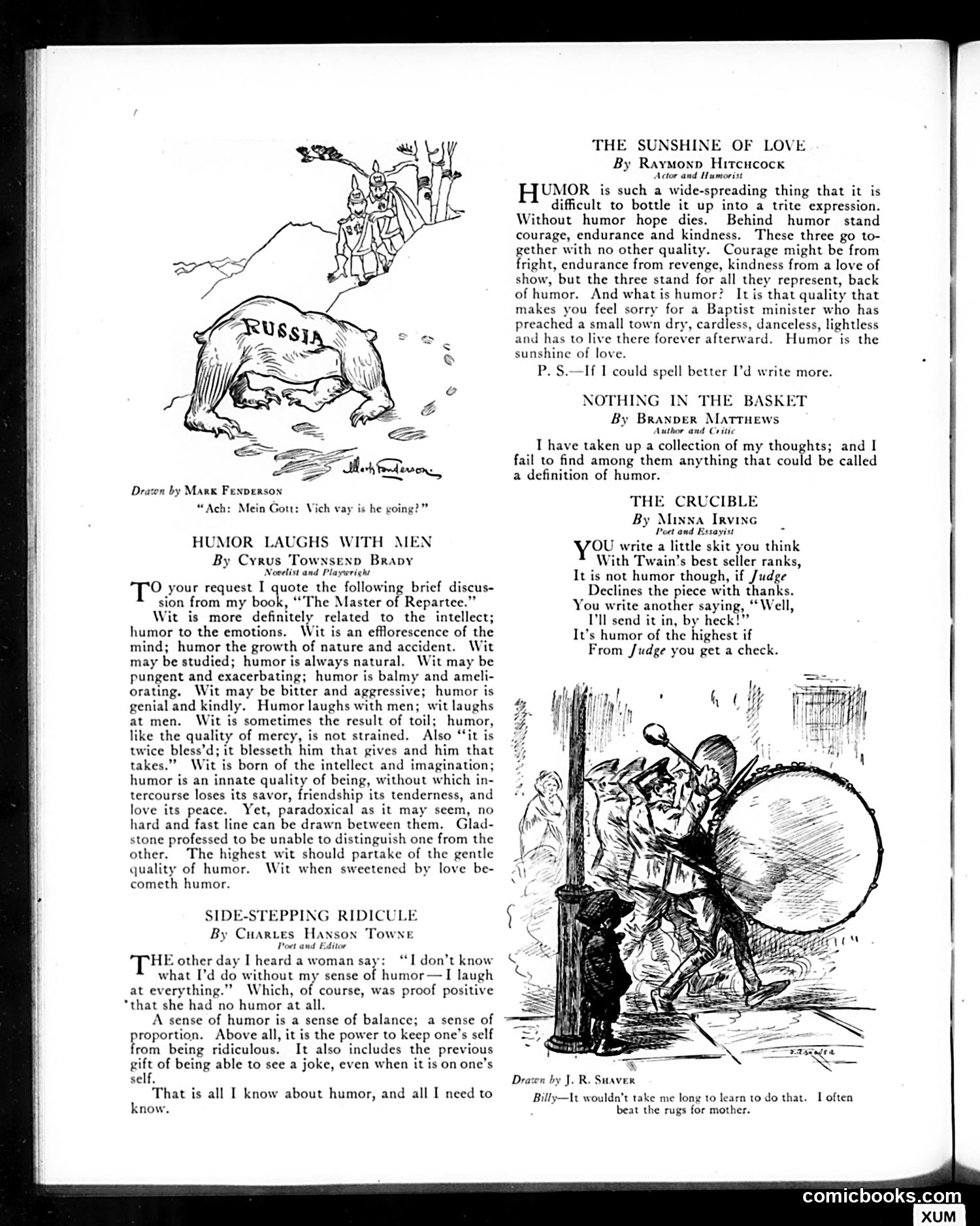
This page is a collection of essays and illustrations about humor, not a political cartoon. The main visual is Mark Fenderson's drawing labeled "Ach: Mein Gott: Vich vay is he going?"—a caricature of Russia depicted as a wounded, suffering bear, with German-speaking figures above (likely representing Germany or Central Powers looking down at Russia's plight). The context appears to reference **Russia's desperate situation during World War I** (likely 1916-1917), when the country faced military collapse, internal chaos, and eventual revolution. The German dialogue and Russia's prostrate position suggest commentary on Germany's advantage or Russia's vulnerability during the conflict. The surrounding text consists of literary definitions of humor by various American writers, separate from the political imagery. The cartoons accompanying these essays ("The Crucible" by Shaver) are unrelated satirical commentary on editors' treatment of submitted work.
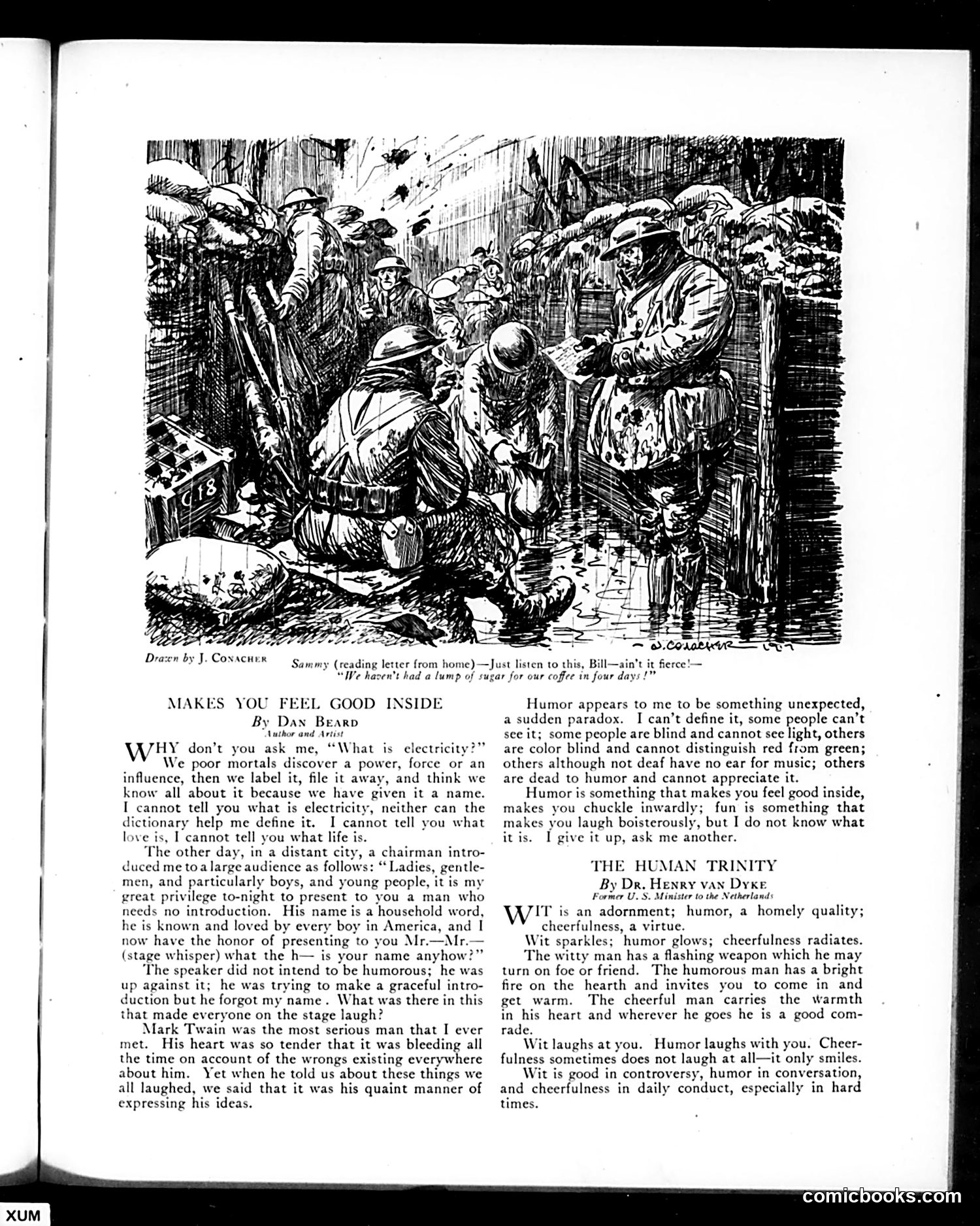
**The Cartoon:** The top illustration shows soldiers in a trench during wartime (likely WWI, given the military uniforms and trench setting). One soldier reads a letter from home to his companion "Bill," expressing concern that they haven't received sugar for their coffee in four days—a stark contrast to the soldiers' life-or-death circumstances. The caption reads "ain't it fierce!" **The Satire:** The joke mocks the disconnect between civilians' trivial complaints on the home front and soldiers' actual hardships in combat. Civilians complaining about sugar rationing or minor inconveniences appear absurdly self-pitying compared to soldiers enduring trenches and warfare. It's satirizing both wartime civilian complaints and the soldiers' wry, darkly humorous response to such complaints. **The Surrounding Text:** Essays by Dan Beard and Dr. Henry van Dyke philosophically distinguish between wit, humor, and cheerfulness—suggesting humor as a coping mechanism and virtue, which contextualizes why soldiers maintain humor despite dire circumstances.
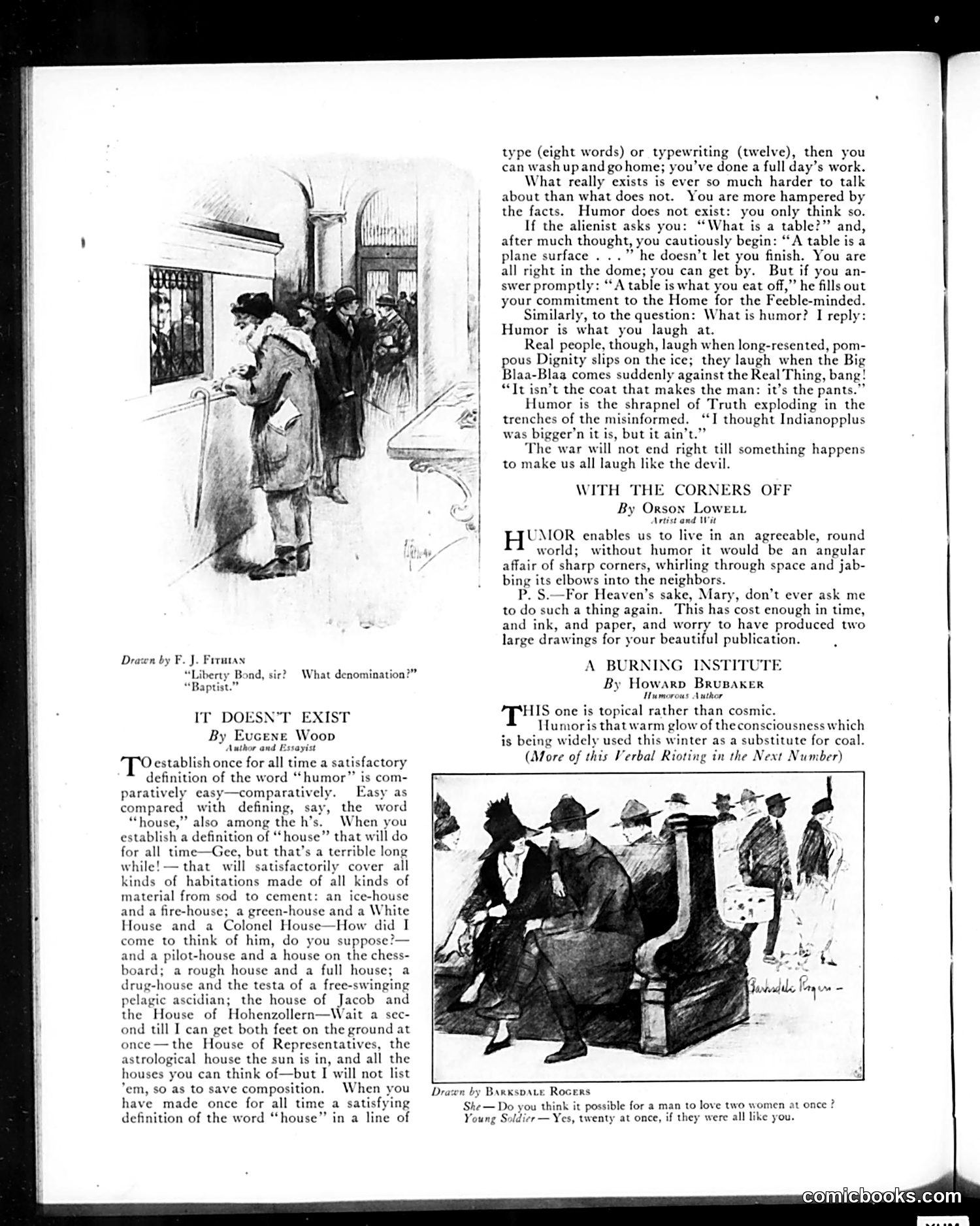
This page contains three humorous essays on defining abstract concepts, particularly humor itself. **"It Doesn't Exist"** by Eugene Wood satirizes philosophical over-intellectualization. Wood argues that defining "humor" is as impossible as defining "house"—the term covers too many variations. He mocks psychiatrists ("alienists") who reject simple, practical answers in favor of absurd precision, committing people to asylums for common sense. The piece suggests that humor simply *is what makes people laugh*—when dignity falls or pretense meets reality. **"With the Corners Off"** by Orson Lowell offers a brief philosophical take: humor smooths life's sharp edges and prevents us from jabbing neighbors with our angular concerns. A postscript humorously complains about the labor of producing illustrations. **"A Burning Institute"** by Howard Brubaker makes a topical joke: during wartime coal shortages (likely WWI era), people use "humor" as a substitute fuel for warmth—treating it as a literal commodity rather than an abstract concept. The lower cartoon shows soldiers discussing romance, likely contrasting youthful idealism with wartime reality.
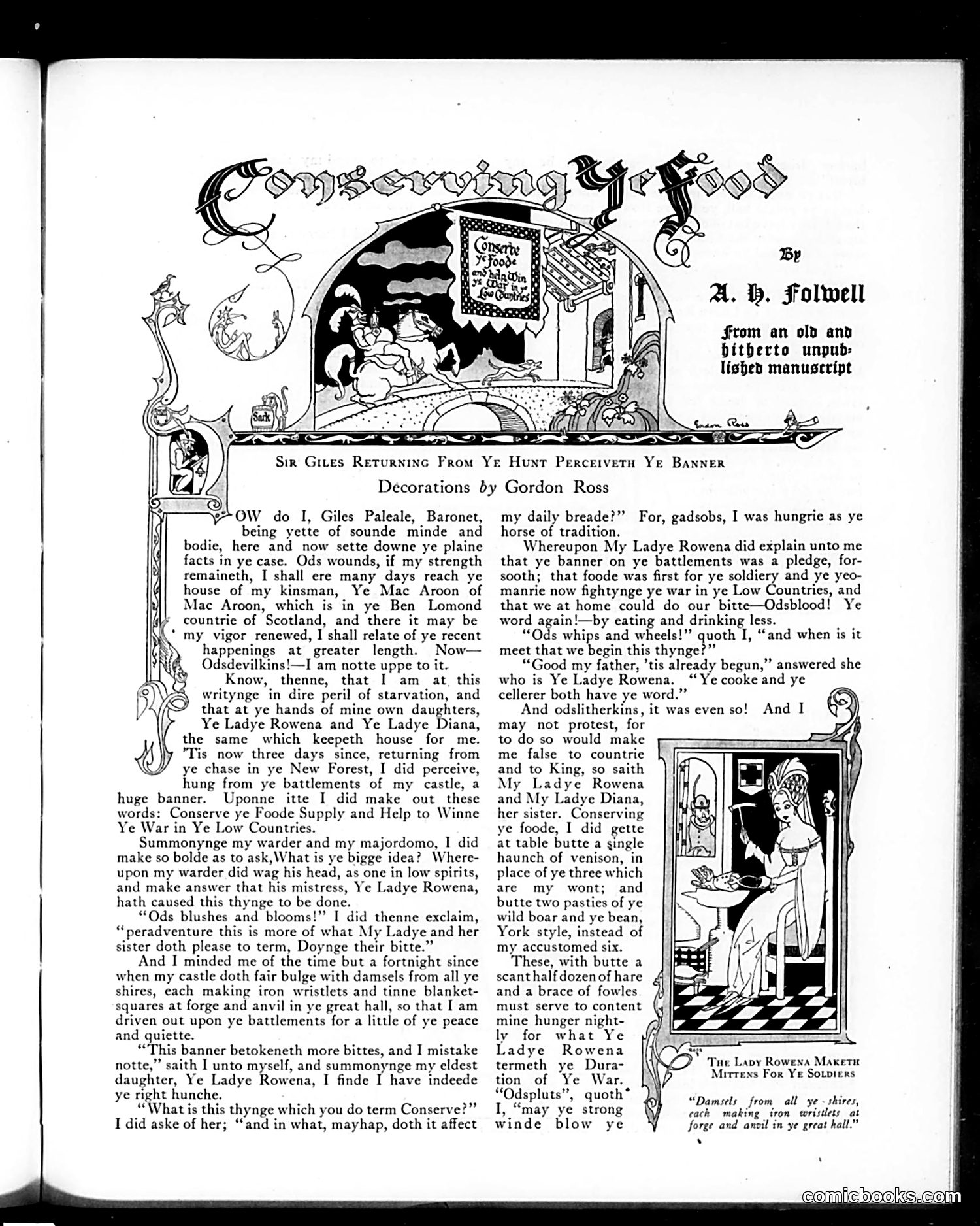
This is a humorous satire on wartime food rationing, written in faux-archaic English. The story depicts an English baronet returning home to find his daughters have hung a banner pledging food conservation for soldiers fighting in "ye Low Countries"—a reference to World War I combat zones. The joke centers on the baronet's hunger and bewilderment as his daughters enforce rationing on the household. What once meant lavish meals (three haunches of venison, six boar pasties) is reduced to meager portions. The baronet is trapped—he cannot protest without appearing unpatriotic to "countrie and to King." The satire mocks both patriotic women's "war work" (shown in the illustration of women making supplies) and the hardship rationing imposed on the home front. The absurdist medieval-speak emphasizes how serious—and annoying—civilian sacrifice had become during the war effort.
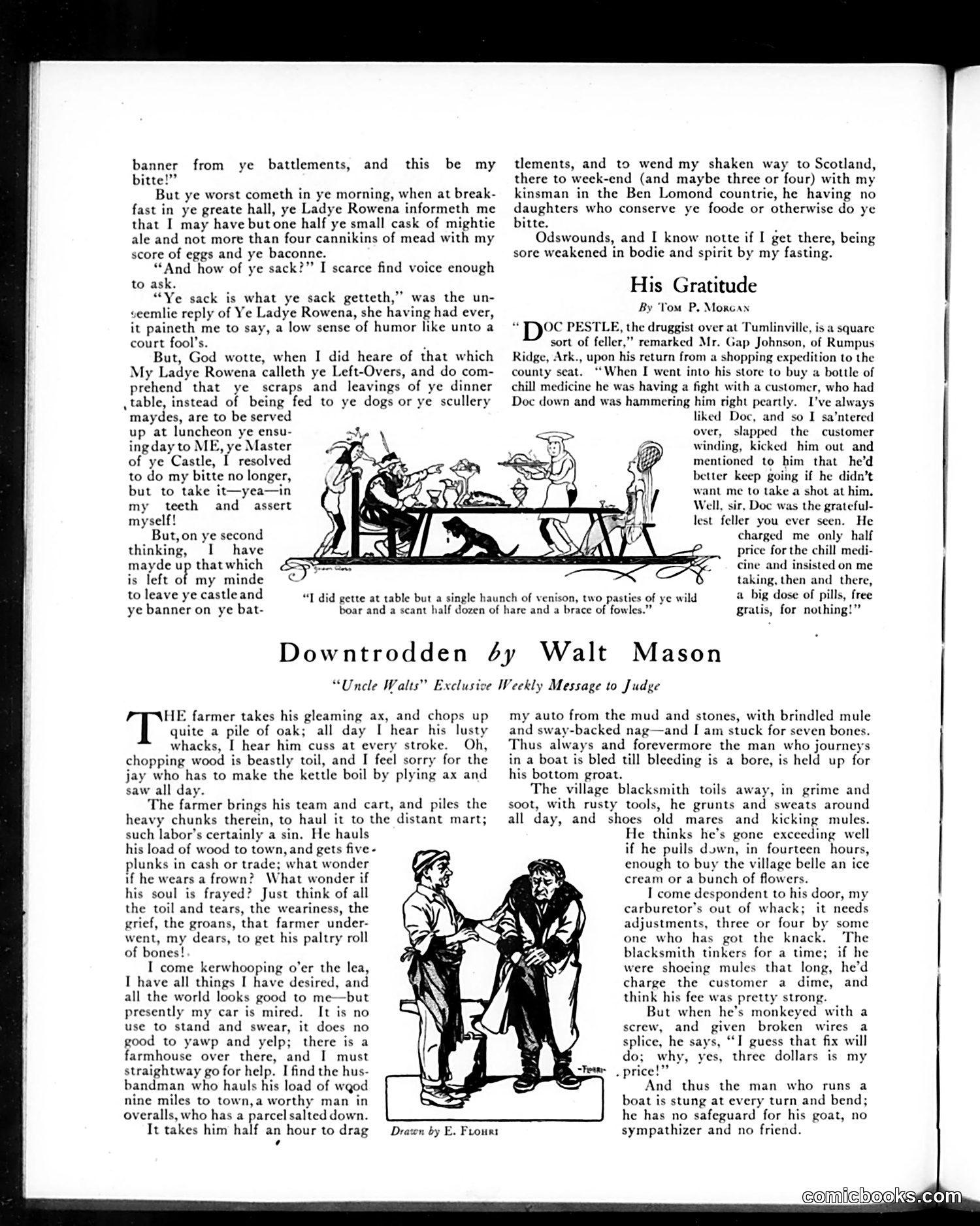
This page contains three distinct satirical pieces: **"Ye Greate Castle" (top left):** A medieval pastiche mocking domestic economy and marital discord. A lord complains that his wife Lady Rowena rations his food and serves "left-overs"—a domestic indignity he finds unbearable. The satire targets upper-class wives' household management and the absurdity of a nobleman's wounded pride over mere meal restrictions. He threatens to flee to Scotland rather than endure this "hardship." **"His Gratitude" (right):** A short anecdote where Doc Pestle the druggist is rescued from a fight by a customer, then repays this favor with discount medicine—a joke about petty gratitude and small-town commerce. **"Downtrodden" by Walt Mason (bottom):** A sentimental poem contrasting a hardworking farmer's toil (chopping and hauling wood for meager pay) with the narrator's leisurely existence—until his car gets stuck in mud. The farmer then helps him, highlighting the irony that the supposedly "downtrodden" laborer possesses genuine worth the idle narrator lacks.
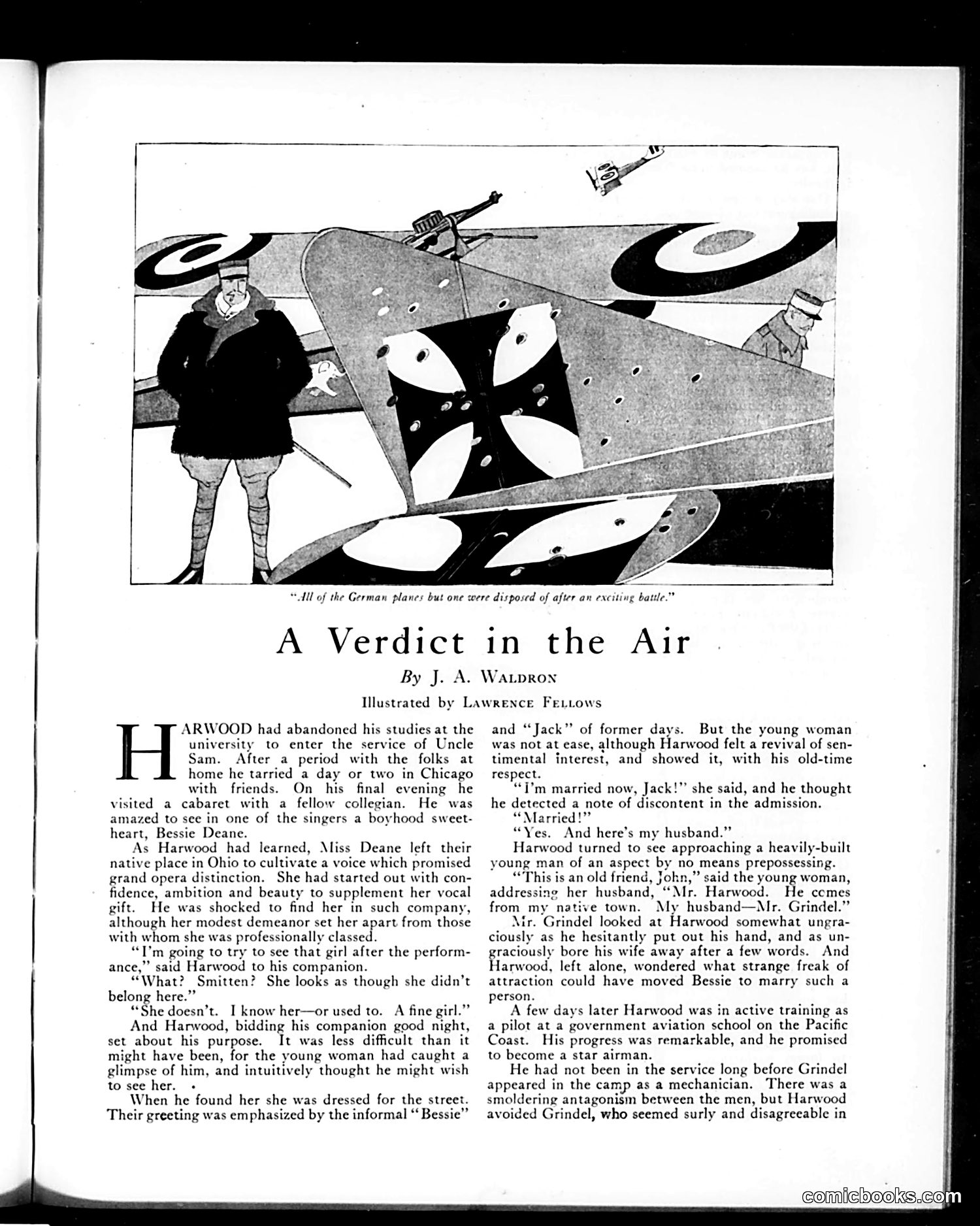
This page introduces a serialized story, not a political cartoon. The illustration shows a World War I military aircraft with mechanical details—likely satirizing the era's fascination with aviation technology. The narrative concerns Harwood, a university student-turned-pilot training on the Pacific Coast, who reconnects with a childhood sweetheart, Bessie Deane, now a cabaret singer married to an unappealing mechanic named Grindel. The story's dramatic tension centers on class decline (Bessie's fall from operatic ambitions to cabaret work) and romantic complications when both men end up at the same military aviation camp. The caption's reference to German planes being "disposed of" reflects WWI's air combat context. The story appears to build toward conflict between Harwood and Grindel, possibly involving Bessie—a common melodramatic plot device of the period. No specific political satire is evident on this page.
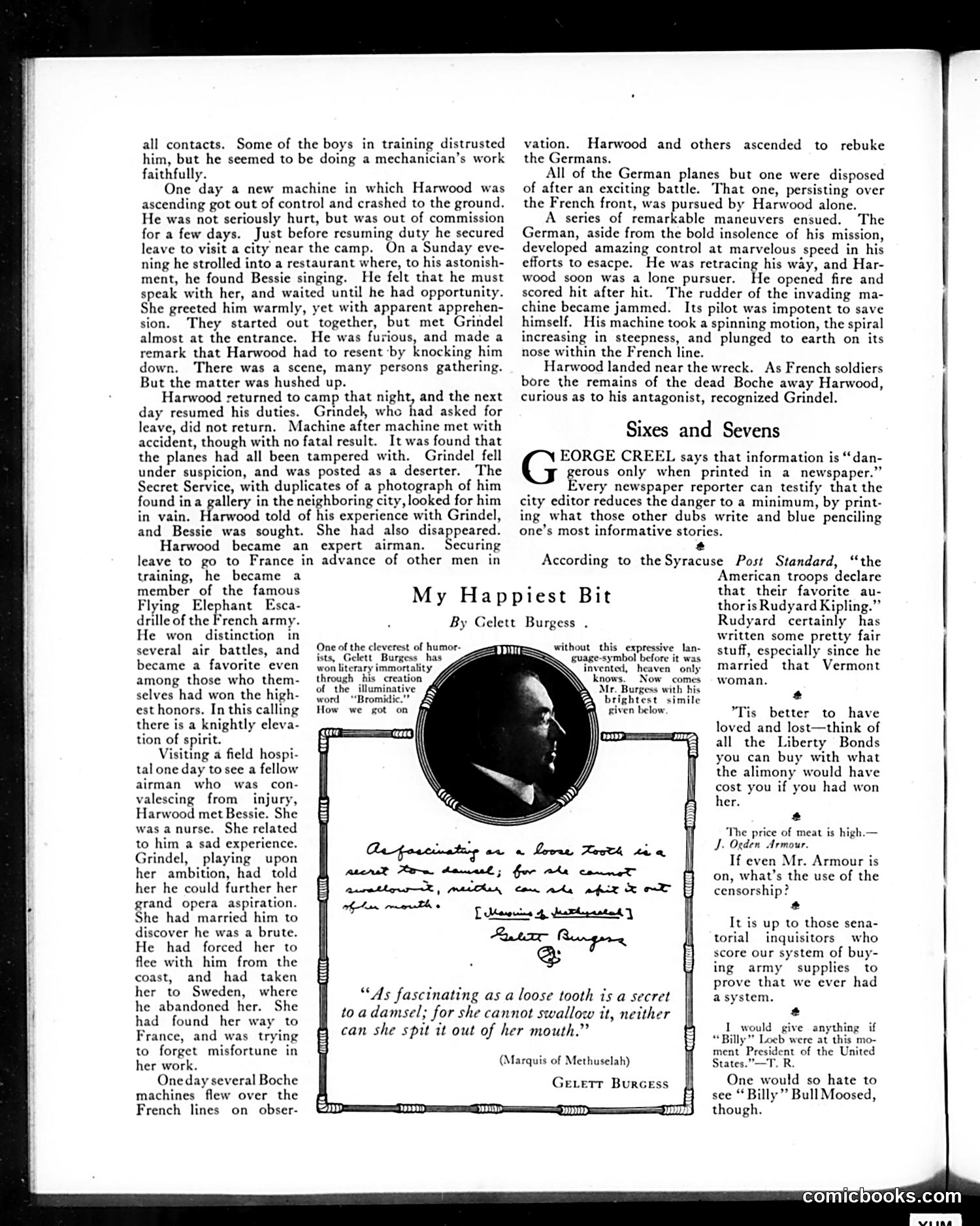
This page contains a serialized aviation adventure story interspersed with a humor section by writer Gelett Burgess. The main narrative follows airman Harwood, who discovers his rival Grindel—a saboteur and abusive husband to Harwood's love interest Bessie—is responsible for tampering with military aircraft. After becoming a decorated pilot in the French Flying Elephant Escadrille, Harwood pursues an enemy German plane in aerial combat. The climax reveals the German pilot is Grindel himself, who crashes to his death. The Burgess section offers witty aphorisms, including a quote attributed to the "Marquis of Methuselah" about secrets being difficult to conceal—clearly a humorous fabricated source. The page reflects WWI-era American entertainment: patriotic aviation heroics, romantic melodrama, and sophisticated humor targeting educated readers. The serialized format kept readers engaged across multiple issues.
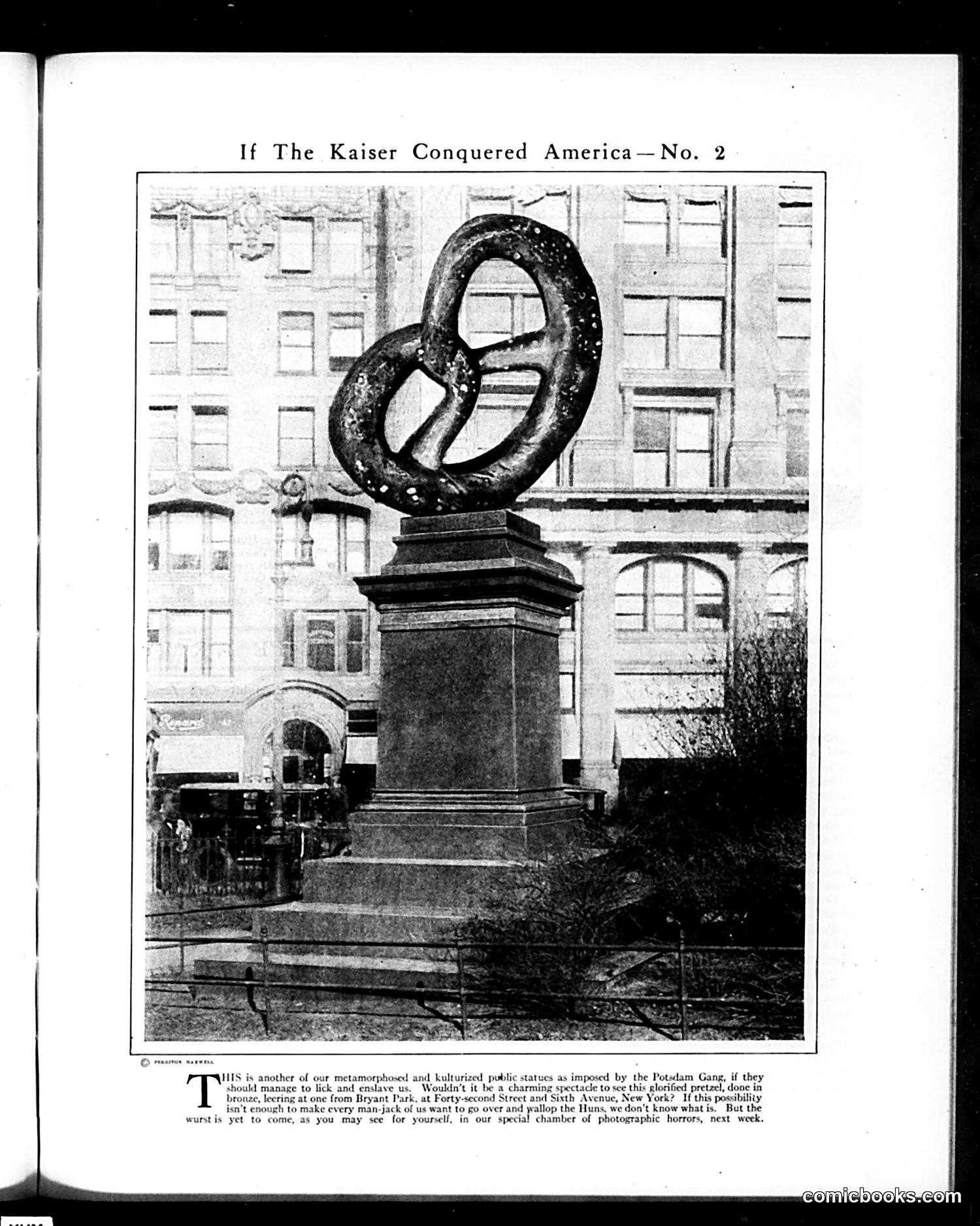
This is a wartime propaganda piece from Judge magazine (likely WWI-era, given references to "the Kaiser" and "the Huns"). The satire depicts an imaginary twisted pretzel sculpture—a grotesque, mockingly Germanic form—positioned where Bryant Park's statue currently stands in Manhattan. The joke is darkly humorous: if Germany's "Potsdam Gang" (the Kaiser's government) conquered America, they would replace American monuments with absurd German cultural symbols. The pretzel serves as a crude ethnic caricature, suggesting German culture as coarse and ridiculous. The text explicitly frames this as propaganda designed to motivate American readers to support military action ("make every man-jack of us want to go over and wallop the Huns"). It's part of a series titled "special chamber of photographic horrors," using exaggeration and fear-mongering to support the war effort through ridicule of Germans and the conquest scenario.
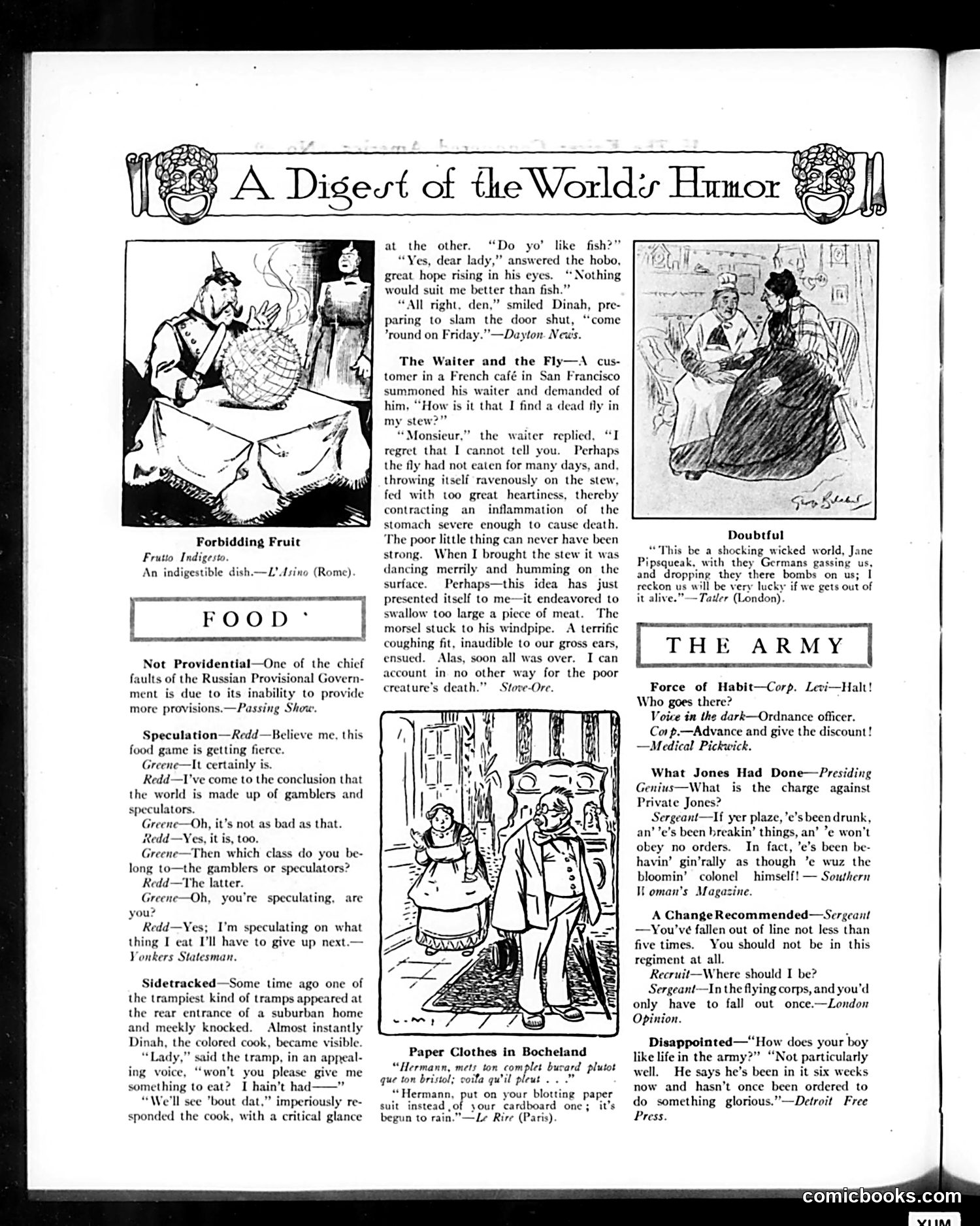
This page collects brief humorous anecdotes and jokes organized by theme (Food, The Army). The cartoons and text satirize WWI-era concerns: **Food section** mocks wartime scarcity and profiteering. One joke references Russia's Provisional Government's inability to provide food supplies (likely 1917, after the February Revolution). Other jokes play on rationing—a tramp told to return Friday for fish he's promised today, a waiter's absurd explanation for a fly in stew. **Army section** satirizes military life through soldier humor: a corporal's habitual offer of a "discount" instead of a challenge, Private Jones's insubordination, and a recruit's disappointment that army life hasn't been "glorious" despite six weeks of service. The "Paper Clothes" joke references German deprivation (people wearing cardboard suits in wartime). Overall, the page reflects American home-front attitudes toward Allied military service, food shortages, and enemy hardship during WWI.
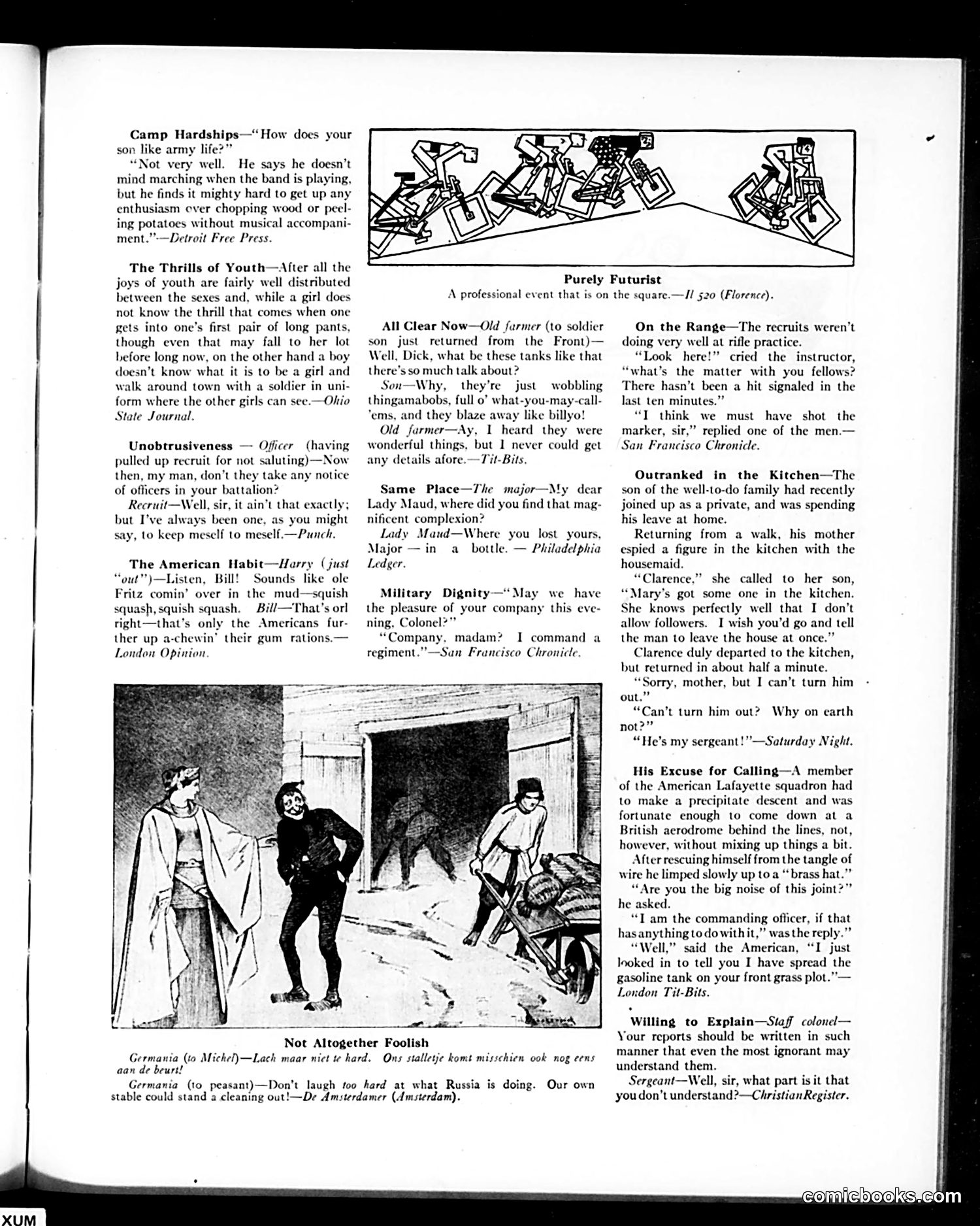
This page collects brief humorous anecdotes about soldiers and wartime, reflecting American WWI attitudes (likely 1917-1918). Key themes include: **Military Life's Hardships**: Soldiers missing creature comforts—one recruit wants musical accompaniment for camp chores. **Social Impact**: Young women excited about soldiers in uniform; a family's servant-turned-soldier outranks the young officer on leave. **Combat Technology**: Farmers bewildered by tanks; rifle recruits so poor that they've supposedly shot the target marker. **International Perspectives**: The cartoon "Not Altogether Foolish" depicts Germania (Germany) and Michel (Dutch representation), with Germany sarcastically noting its own instability mirrors Russia's chaos—a dark joke about internal collapse. **American Traits**: Americans chewing gum amid battlefield mud; an American pilot's casual irreverence toward British command. The humor assumes readers' familiarity with warfront realities while maintaining lighthearted tone about recruitment, class dynamics, and Allied operations.
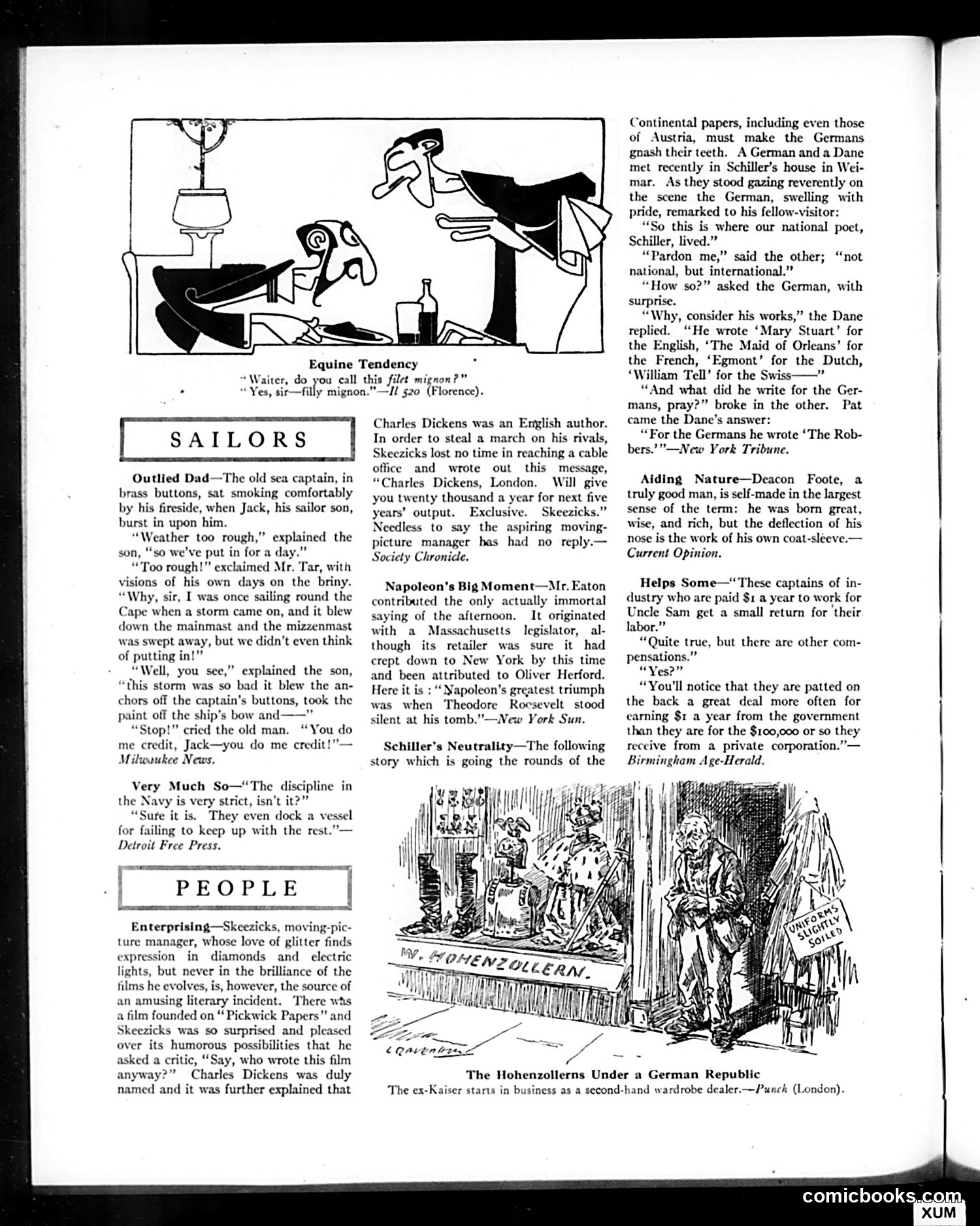
This page contains several brief satirical anecdotes and two cartoons satirizing early 20th-century American life: **Top cartoon** ("Equine Tendency"): A waiter serves a diner horse meat labeled as filet mignon—satirizing restaurants' food quality deception. **"Schiller's Neutrality"** anecdote: A German and Dane debate the playwright Schiller's national identity. The Dane notes Schiller wrote works for multiple countries, then quips that for Germans specifically, Schiller wrote "The Robbers"—a cutting joke implying Germans are thieves or morally deficient. This likely reflects pre-WWI Franco-German tensions and German territorial ambitions. **Bottom cartoon** ("The Hohenzollerns Under a German Republic"): Shows the ex-Kaiser reduced to selling second-hand clothes, mocking his fall from imperial power following Germany's WWI defeat and the 1918 revolution. Other brief jokes mock naval discipline, moving picture producers, and political corruption. The page reflects post-war American satirical attitudes toward Germany and contemporary social absurdities.
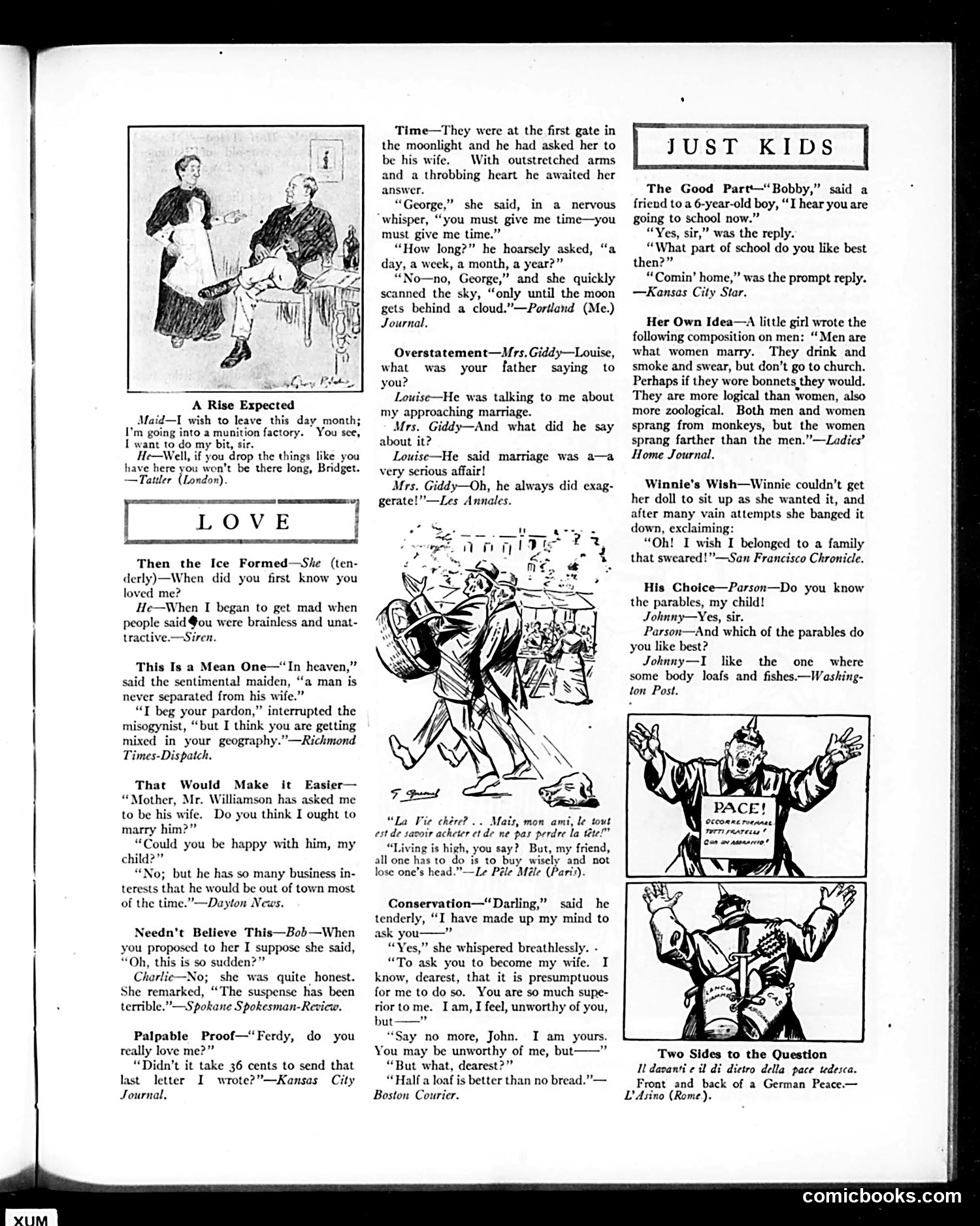
This page from the satirical magazine *Judge* collects brief humorous anecdotes and cartoons on themes of love, marriage, and courtship—typical early 20th-century humor. **Key content:** The main cartoons mock romantic conventions. "A Rise Expected" jokes about a maid joining munition factories during wartime (likely WWI), with the employer suggesting she'll fail due to clumsiness. The "Time" piece depicts a marriage proposal where the woman's hesitation is absurdly literal—she'll only agree until the moon hides behind a cloud. Other items satirize marriage's realities: women's practical views of husbands ("Half a loaf is better than no bread"), masculine shortcomings (a girl's composition notes men "drink and swear"), and the gap between romantic declarations and economic necessity. The French cartoon addresses wartime inflation ("Living is high"), advising wise purchasing. **Overall message:** The satire exposes the gap between romantic idealization and practical married life, with particular emphasis on women's unsentimental views of matrimony—a subversive theme for the era.
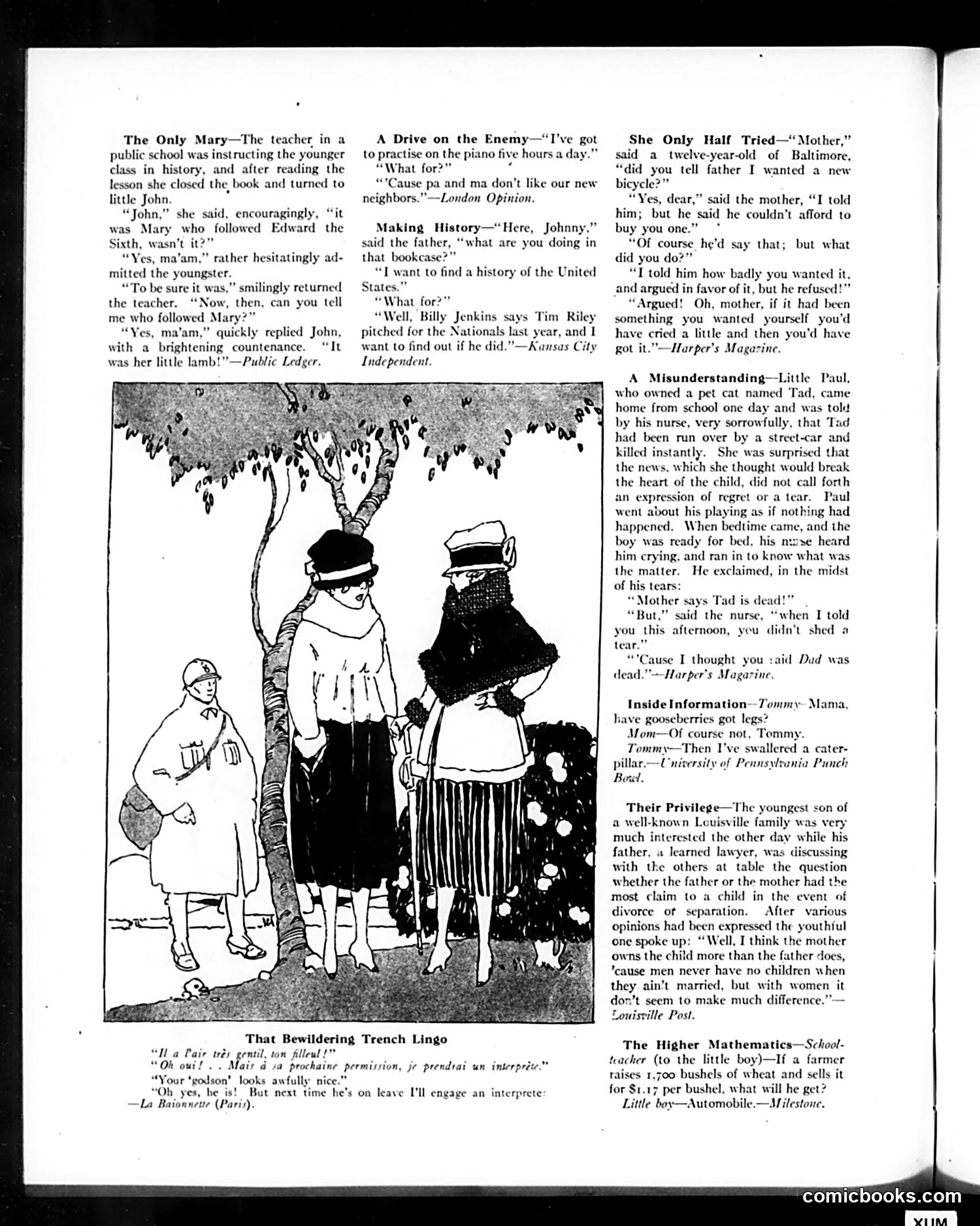
This page collects brief humorous anecdotes typical of early-20th-century Judge magazine. The content reflects period attitudes and concerns: **"The Only Mary"** plays on a child's literal interpretation: when asked who followed Mary I (the historical queen), the boy answers "her little lamb"—confusing the nursery rhyme with history. **"A Drive on the Enemy"** depicts piano practice as psychological warfare against disliked neighbors—suggesting middle-class social tensions and competitive musicality. **The trench lingo cartoon** references WWI communication difficulties, with a French soldier saying he'll hire an interpreter for his next leave—contemporary wartime humor. **"She Only Half Tried"** satirizes gender dynamics: a girl suggests her mother would succeed getting a bicycle through manipulation ("cry a little") where reasoning failed—critiquing both parental dynamics and female stereotypes. **Other items** (the misunderstanding about the cat, the gooseberries joke, the mathematics problem yielding "automobile") are simple children's logic gags popular in the era. The humor is genteel, family-friendly satire targeting domestic life, education, and social manners.
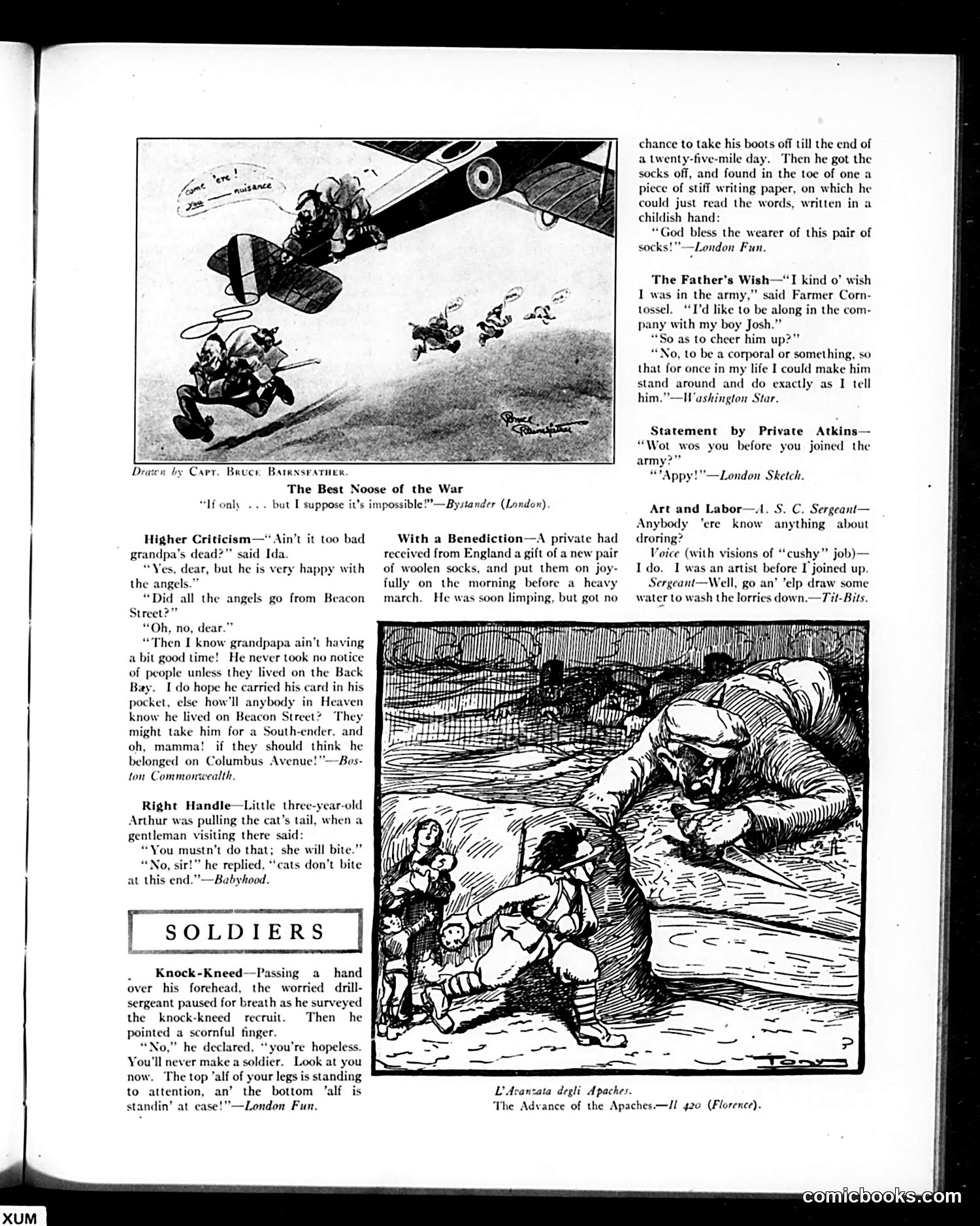
This page from *Judge* magazine contains WWI-era humor organized around soldiers and military life. **Top cartoon** ("The Best Noose of the War"): Shows an aerial combat scene with a German plane and Allied forces—the "noose" references hopes for the enemy's defeat. **Anecdotes below** include class-conscious Boston humor about afterlife social hierarchies, a child's logic joke about a cat, and several soldier vignettes: - A drill sergeant mocking a recruit's posture ("knock-kneed") - A touching story of a soldier receiving hand-knitted socks with a blessing note - A farmer wanting military rank to finally command his son's obedience - An artist conscripted into menial labor instead of drawing **Bottom illustration** ("The Advance of the Apaches") depicts street gangs or rough youth—likely referencing Parisian "Apaches," period slang for urban hooligans. The page emphasizes contrasts: military hierarchy, class pretension, domestic sentiment, and the gap between civilian expectations and wartime reality. The humor is gentle, patriotic satire reflecting home-front perspectives.
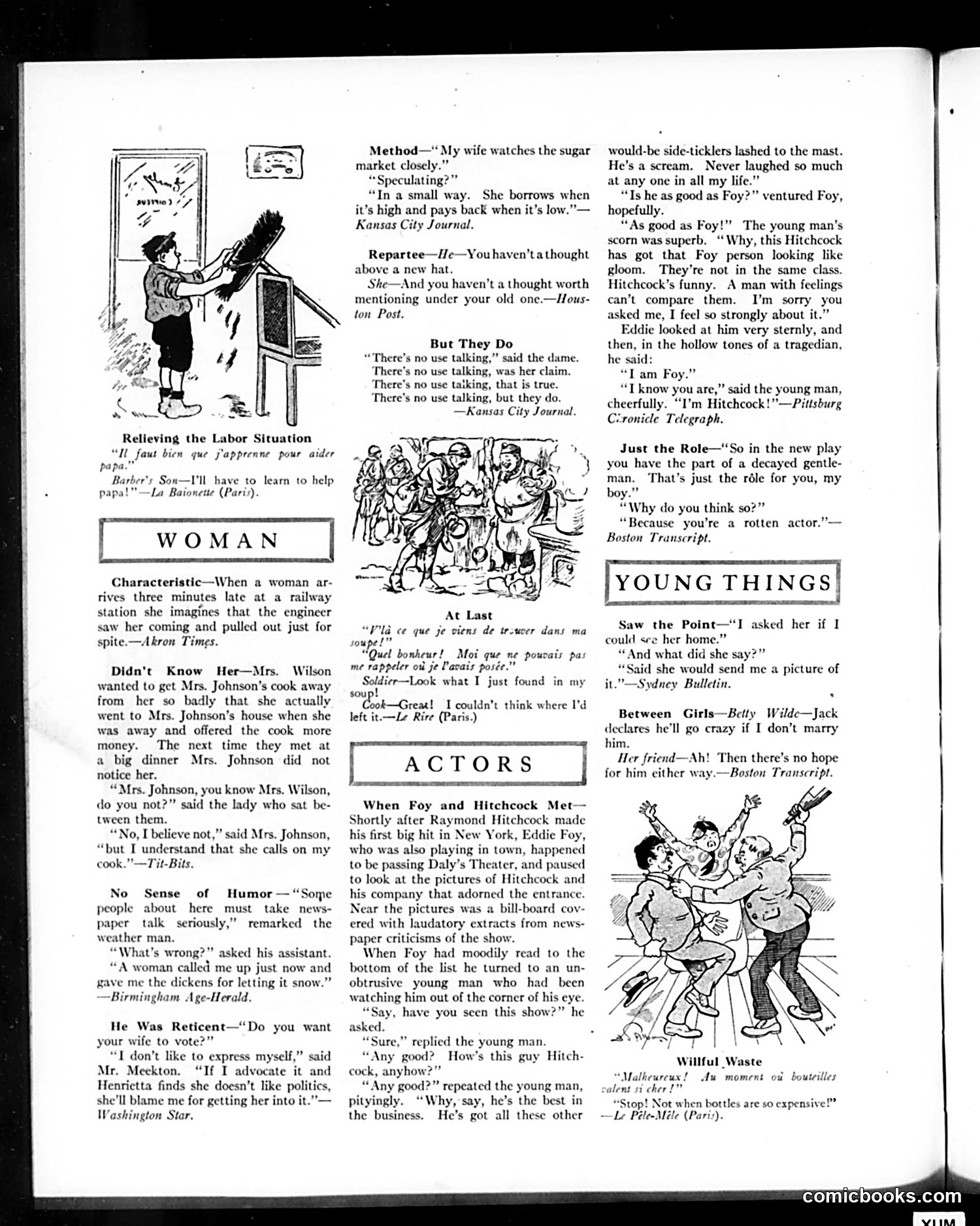
This page from *Judge* contains several short humorous anecdotes and cartoons reflecting early 20th-century American social attitudes. **"Relieving the Labor Situation"** shows a child learning his father's trade—referencing wartime labor shortages when families had to take on multiple occupations. **The "Woman" section** includes satirical observations about female behavior: women's vanity (blaming engineers for train departures), social snubbing, and lack of humor. The piece on wives voting reflects anxiety about women's suffrage—a man fears his wife will blame him regardless of which position he takes. **"When Foy and Hitchcock Met"** describes a famous anecdote about comedians Eddie Foy and Raymond Hitchcock. A stranger unknowingly praises Hitchcock while insulting Foy—revealing himself as Hitchcock—in a humorous reversal. This likely celebrates these popular vaudeville performers. The cartoons and jokes throughout reflect period preoccupations: gender roles, labor disputes, and entertainment personalities. The tone is lighthearted domestic satire aimed at middle-class readers.
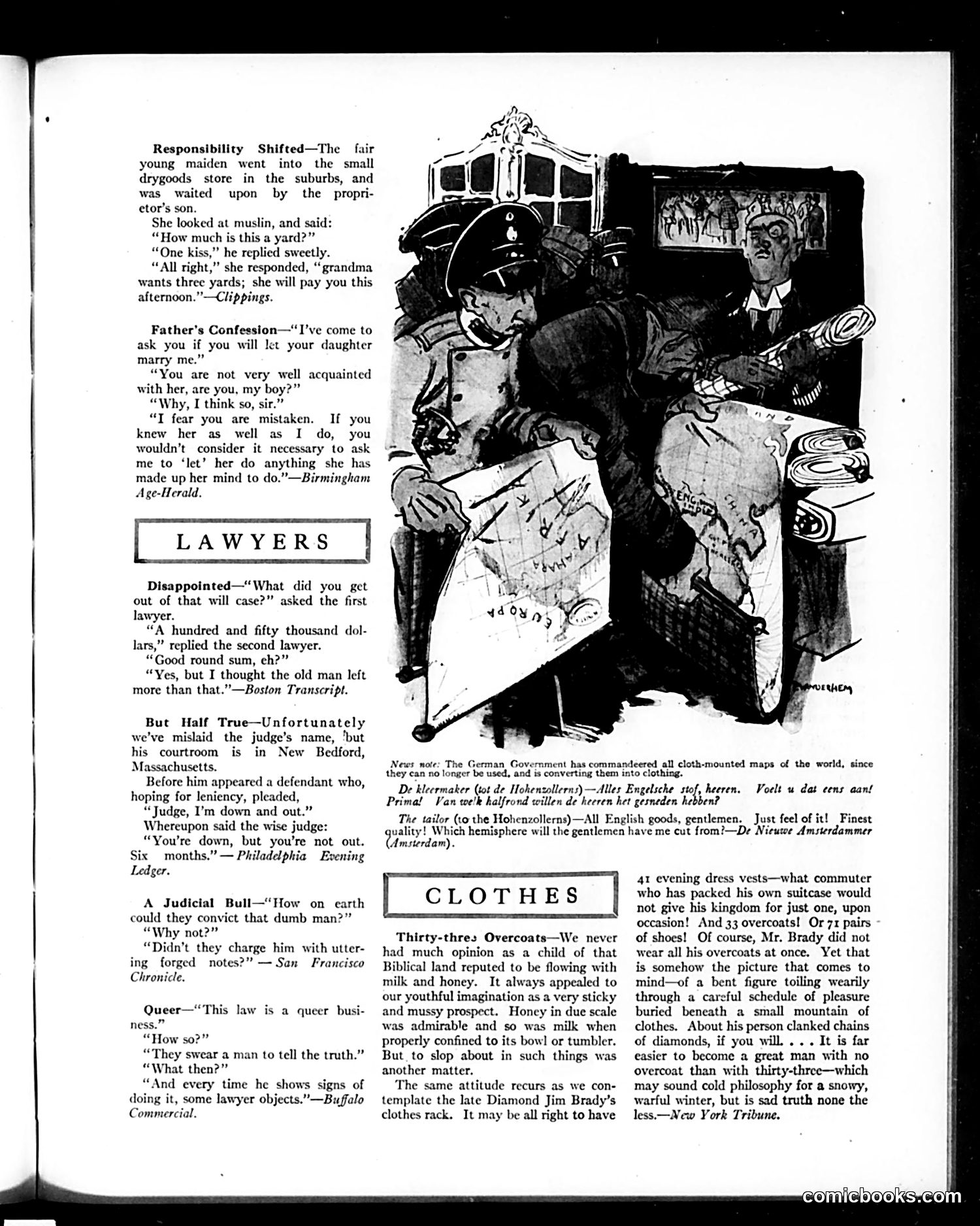
This page from Judge contains several satirical anecdotes mocking lawyers and judges, plus commentary on wealth excess. The **lawyers section** ridicules the profession through short jokes: one depicts a lawyer profiting enormously from a will case while suspecting the deceased left even more; another shows a judge sentencing a man who claims poverty, cynically noting he's "down" but not "out"; a third mocks lawyers for objecting whenever witnesses attempt to tell the truth. The **main cartoon** (upper right) depicts a German tailor showing cloth-mounted world maps—now commandeered by the German government and being converted into clothing for the Hohenzollerns (German royal family). This is WWI-era satire: Germany, presumably losing access to global maps due to Allied blockade, supposedly resorts to shredding them for fabric. The joke mocks German desperation and the absurdity of war shortages. The **clothes section** criticizes excessive wealth through Diamond Jim Brady's wardrobe (33 overcoats, 71 shoe pairs), suggesting that obscene accumulation reflects not success but spiritual emptiness—a cautionary note during wartime.
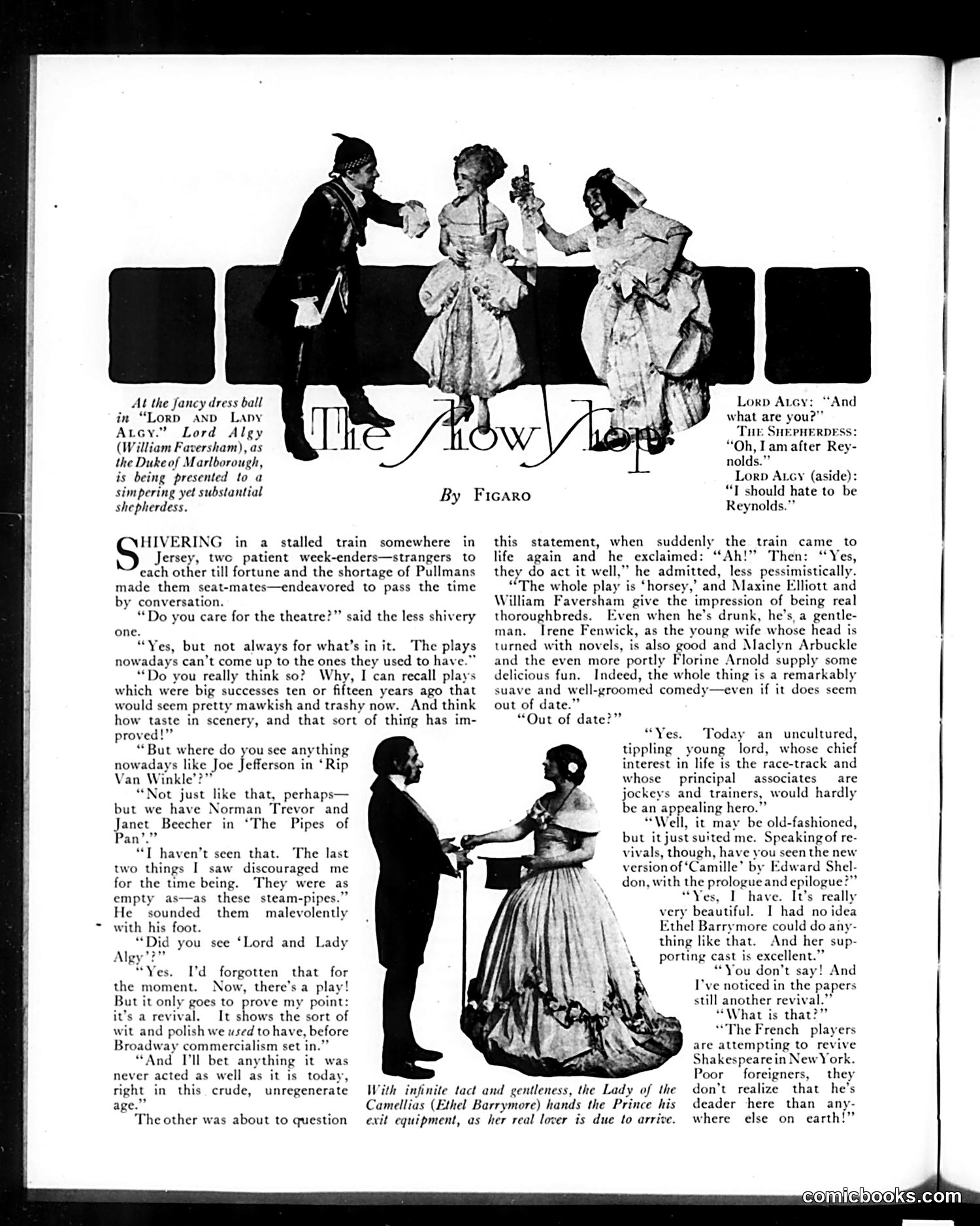
This page satirizes early 20th-century Broadway's nostalgia for older theatrical productions. Two train passengers debate whether modern plays compare to classics—a typical middlebrow conversation about cultural decline. The cartoon mocks contemporary tastes by featuring actual 1912-era stage revivals: *Lord and Lady Algy* (with actors William Faversham and Maxine Elliott) and Edward Sheldon's new *Camille* adaptation (with Ethel Barrymore). The sketch shows Lord Algy in costume at a fancy dress ball, accosting a shepherdess—illustrating the play's dated aristocratic frivolity. The satire's target: American audiences romanticizing "old-fashioned" British comedies while dismissing contemporary work, yet paradoxically proving such revivals successful. The closing dig at French attempts to revive Shakespeare in New York suggests European highbrow culture is irrelevant to American commercial theater—dead on arrival.
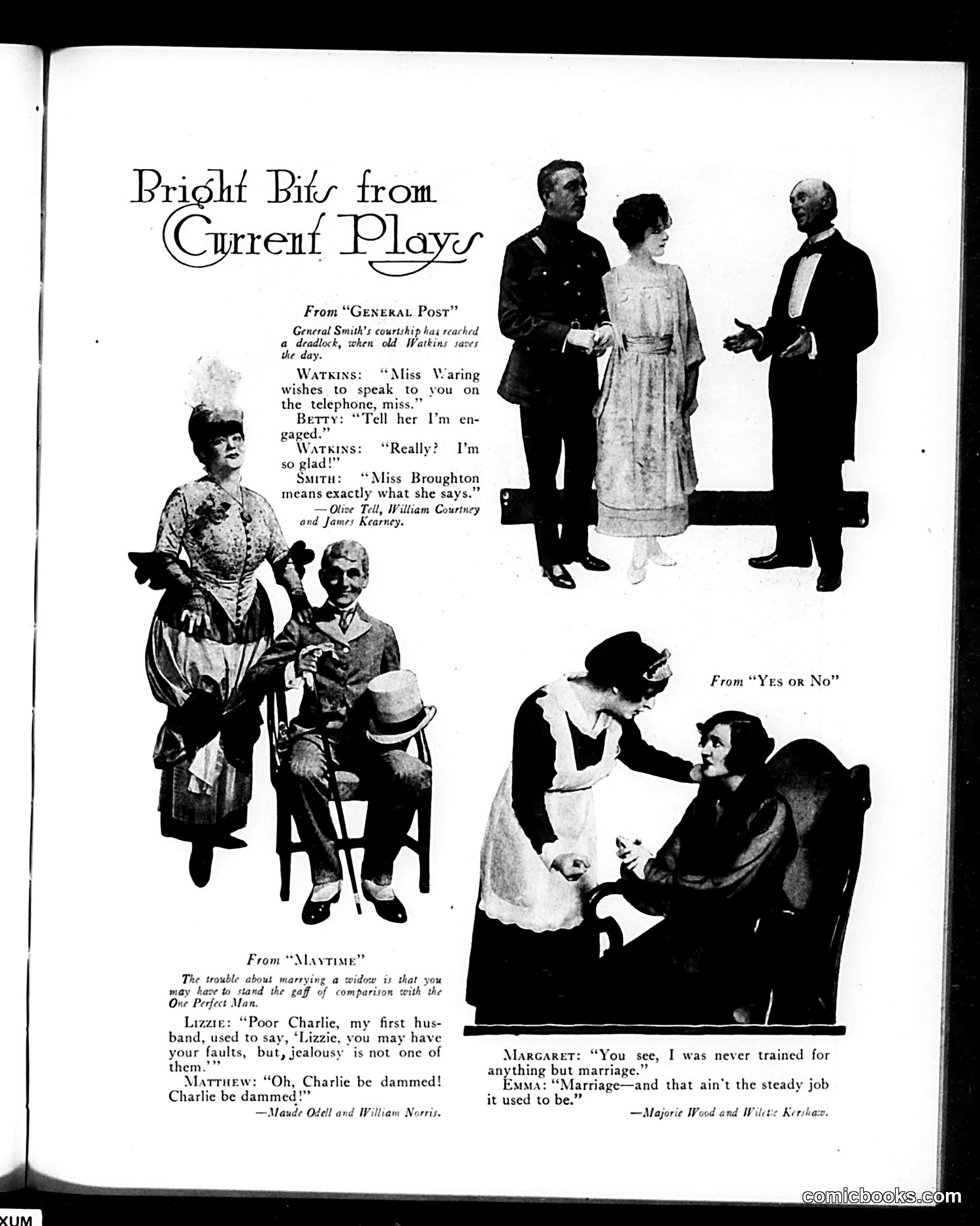
This page presents comedic excerpts from three theatrical productions, highlighting dialogue about romantic relationships and marriage—popular themes in early 20th-century stage comedy. The sketches mock courtship rituals and marital dynamics. In "General Post," a servant's misunderstanding of "engaged" (as in "busy") versus "engaged" (as in betrothed) resolves a romantic deadlock. "Maytime" jokes about the unfavorable comparison a widow's new husband faces against her idealized memory of her first. "Yes or No" satirizes marriage itself as unstable employment—the final quip that marriage "ain't the steady job it used to be" suggests women had fewer escape routes from unhappy marriages, making the institution feel like inescapable labor. The humor relies on wordplay, misunderstandings, and cynical observations about matrimony typical of Judge's satirical take on social conventions.
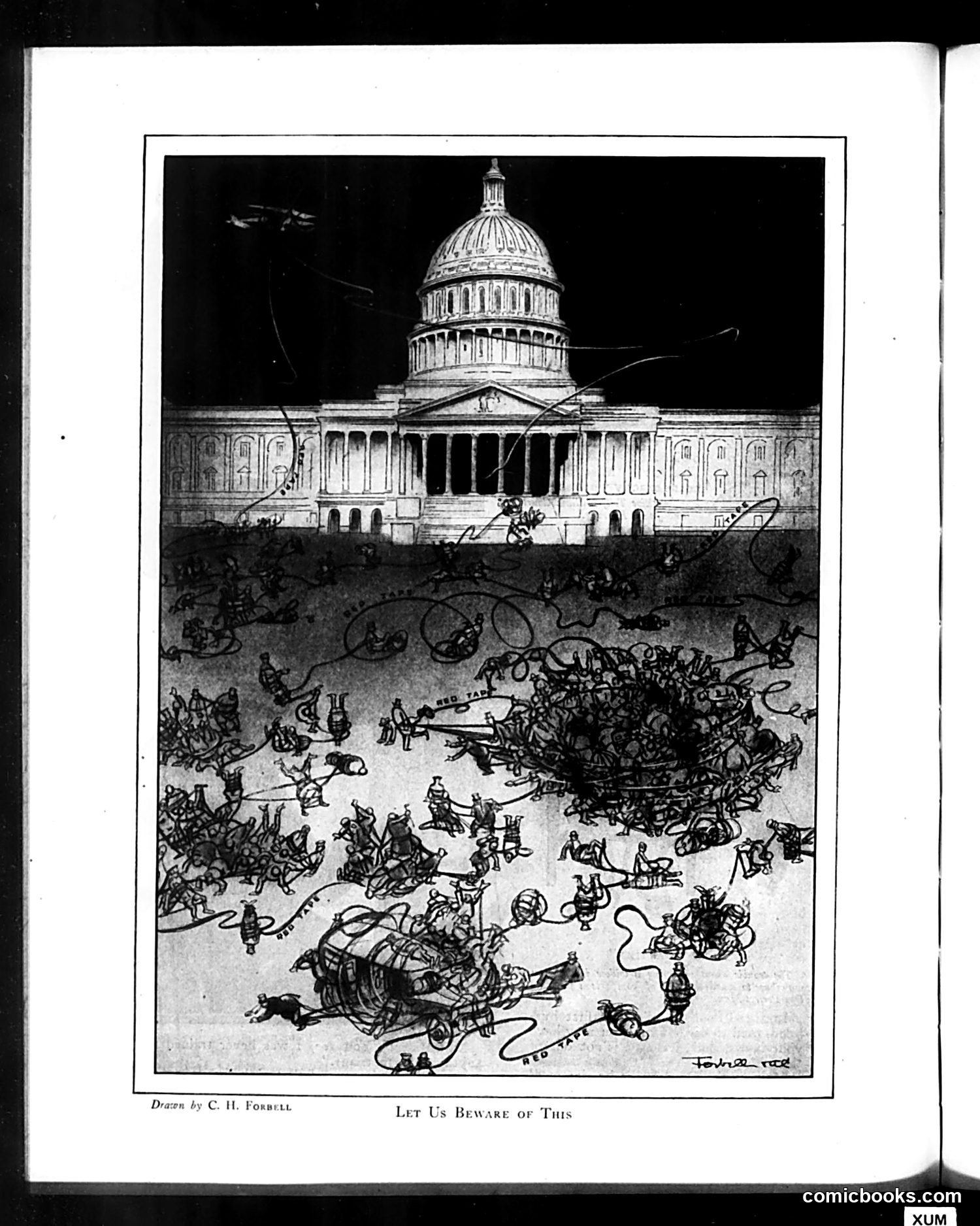
This cartoon by C.H. Forrell, titled "Let Us Beware of This," depicts the U.S. Capitol Building under siege by what appears to be chaotic, destructive forces emerging from the ground below. The imagery suggests internal threats to American democracy—likely representing political corruption, anarchism, or social upheaval that the cartoonist viewed as destabilizing the nation's government. The swirling mass of figures and "Red Tape" (visible in the lower portion) beneath the Capitol symbolizes bureaucratic entanglement and potentially radical elements threatening institutional stability. The ominous sky and dark tone reinforce the warning inherent in the title. Without the publication date visible, the exact historical context remains unclear, though the style suggests early-to-mid 20th century American anxieties about governmental integrity or revolutionary threats.
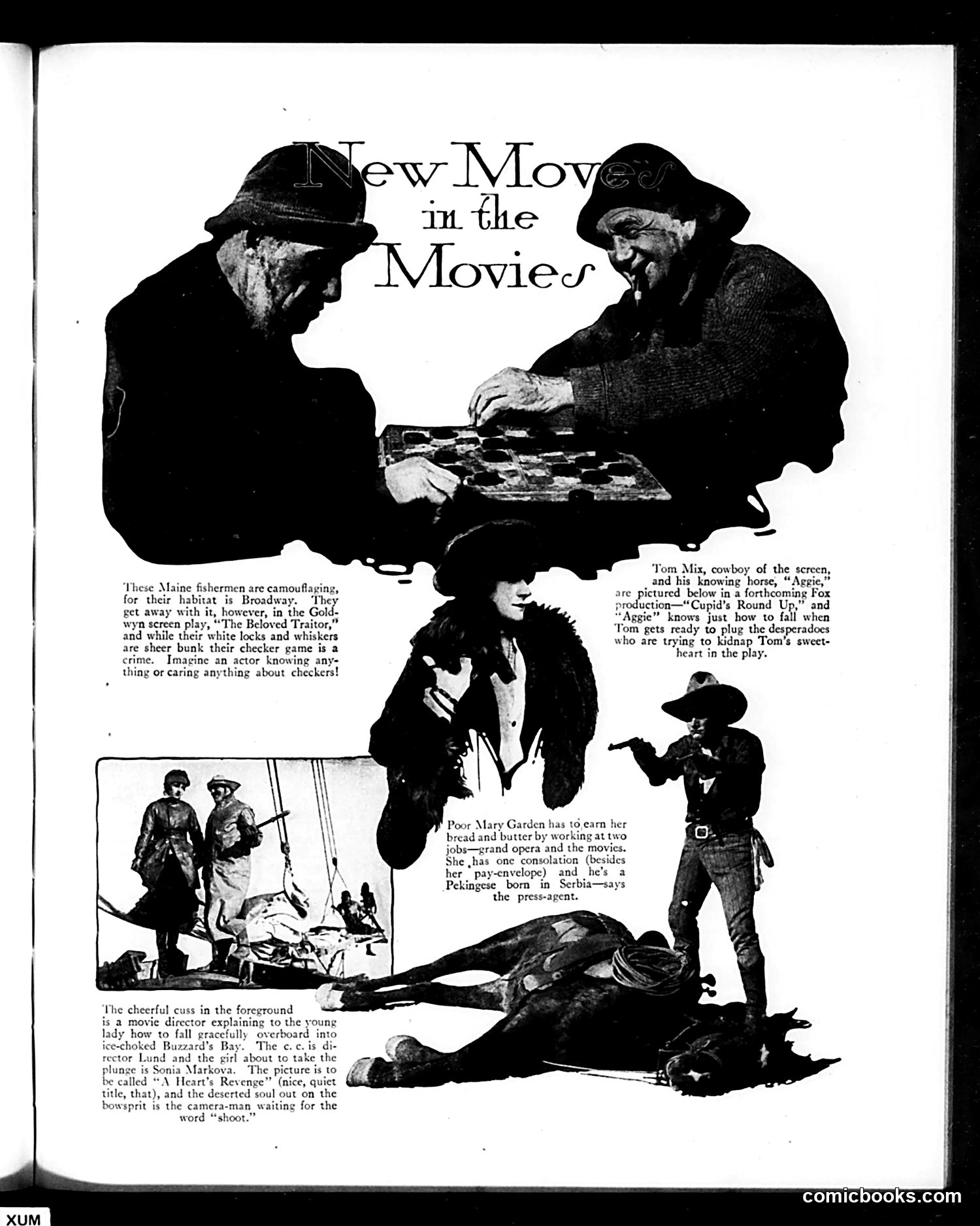
This Judge page satirizes early Hollywood's absurdity by mocking actors pretending to be things they're not. Maine fishermen pose as Broadway types in a Goldwyn film despite knowing nothing about checkers—the joke being that actors don't need actual knowledge of their roles. Similarly, the page ridicules a movie director teaching an actress to "fall gracefully overboard" for a film called "A Heart's Revenge," and notes that Tom Mix's horse "Aggie" somehow understands when to fall during gunfights. The satire targets the fakery of silent film acting: performers need only look the part, not understand it. A secondary joke mocks Mary Garden, an opera singer forced to work two jobs (grand opera *and* movies) for meager pay, consoled only by her Serbian-born Pekingese dog—highlighting Hollywood's exploitative wages even for established talent.
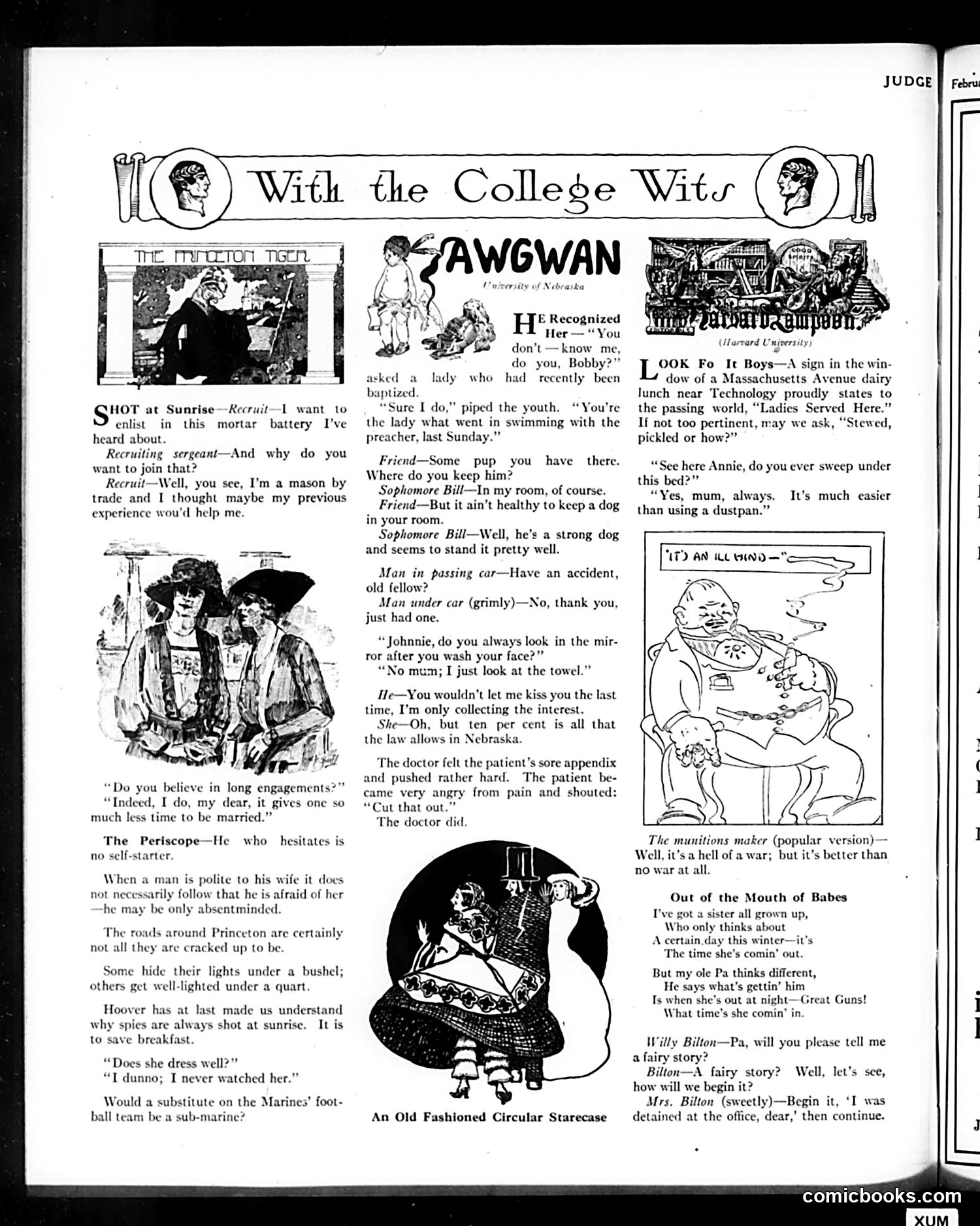
This page collects brief satirical jokes and cartoons targeting early-20th-century American social life. The humor reflects concerns of the era: **Military/War references**: Jokes about WWI-era recruitment and spies ("shot at sunrise to save breakfast") suggest wartime anxieties. **Gender relations**: Multiple jokes mock courtship and marriage — engagements as excuses to avoid wedlock, wives as figures of mild complaint, women's newfound social freedoms (swimming, staying out late). **Class/Education**: References to Princeton, Harvard, and MIT reveal collegiate humor aimed at educated readers. The "munitions maker" joke darkly satirizes profiteering from war. **Domestic life**: Jokes about housekeeping, doctor visits, and children's innocent remarks represent period domesticity humor. The cartoons and quips assume readers understand contemporary social conventions — particularly around courtship rituals, gender roles, and American attitudes toward war. The overall tone is light, conservative social satire typical of 1910s-20s middlebrow magazines.
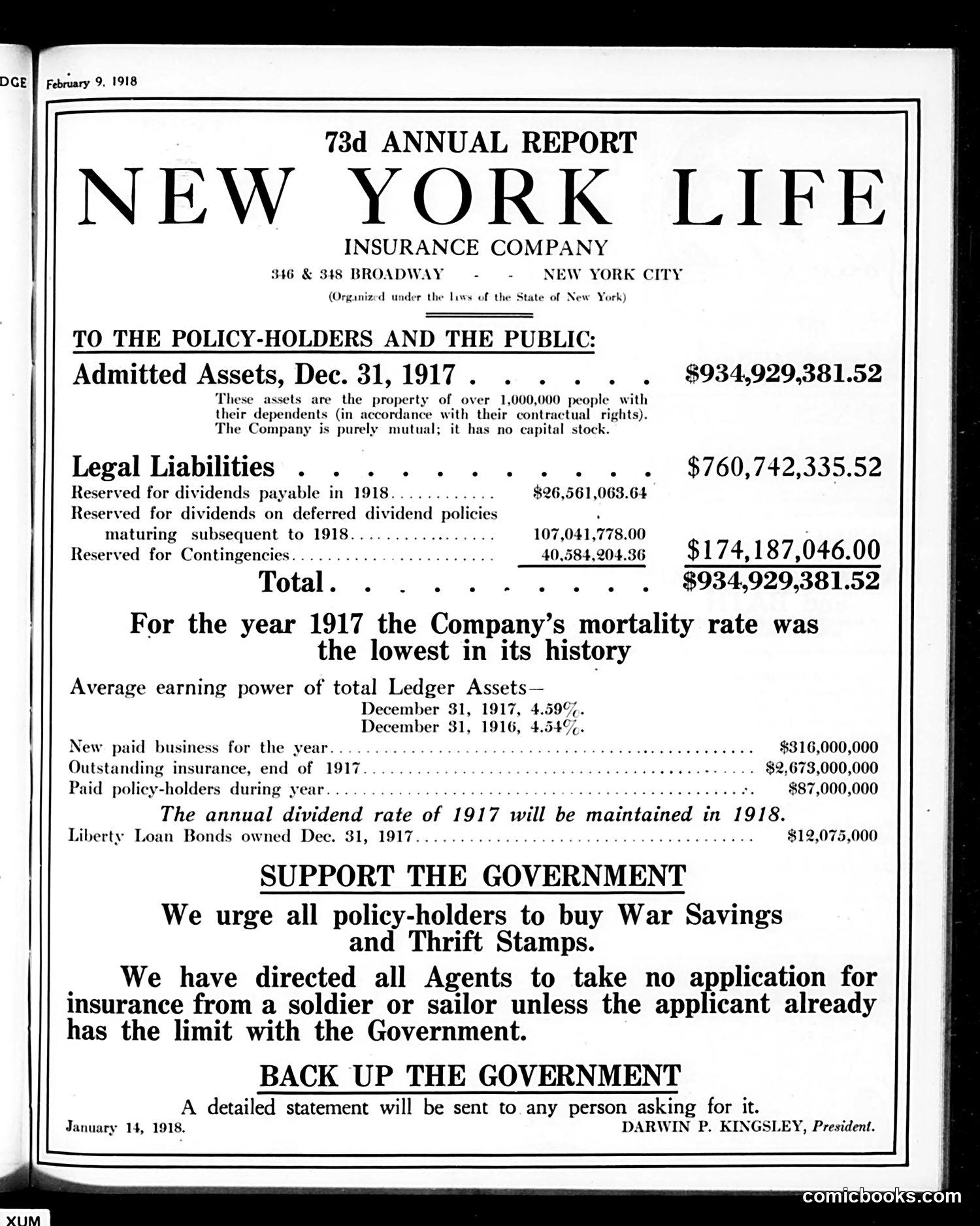
This is not a cartoon but a corporate advertisement disguised as a financial report. Published February 9, 1918—during America's involvement in World War I—it presents New York Life's financial strength ($934 million in assets) while pivoting to patriotic messaging. The key propaganda elements: the company urges policyholders to buy War Savings and Thrift Stamps, and notably directs agents to refuse insurance applications from soldiers and sailors unless they've already maxed out government-provided coverage. This positioning serves dual purposes—demonstrating corporate patriotism while protecting the company's bottom line by steering military applicants toward federal programs. The substantial Liberty Loan Bond holdings ($12 million) further signal the company's commitment to financing the war effort. The overall message: New York Life is financially sound, profitable, and patriotically aligned with government wartime priorities.
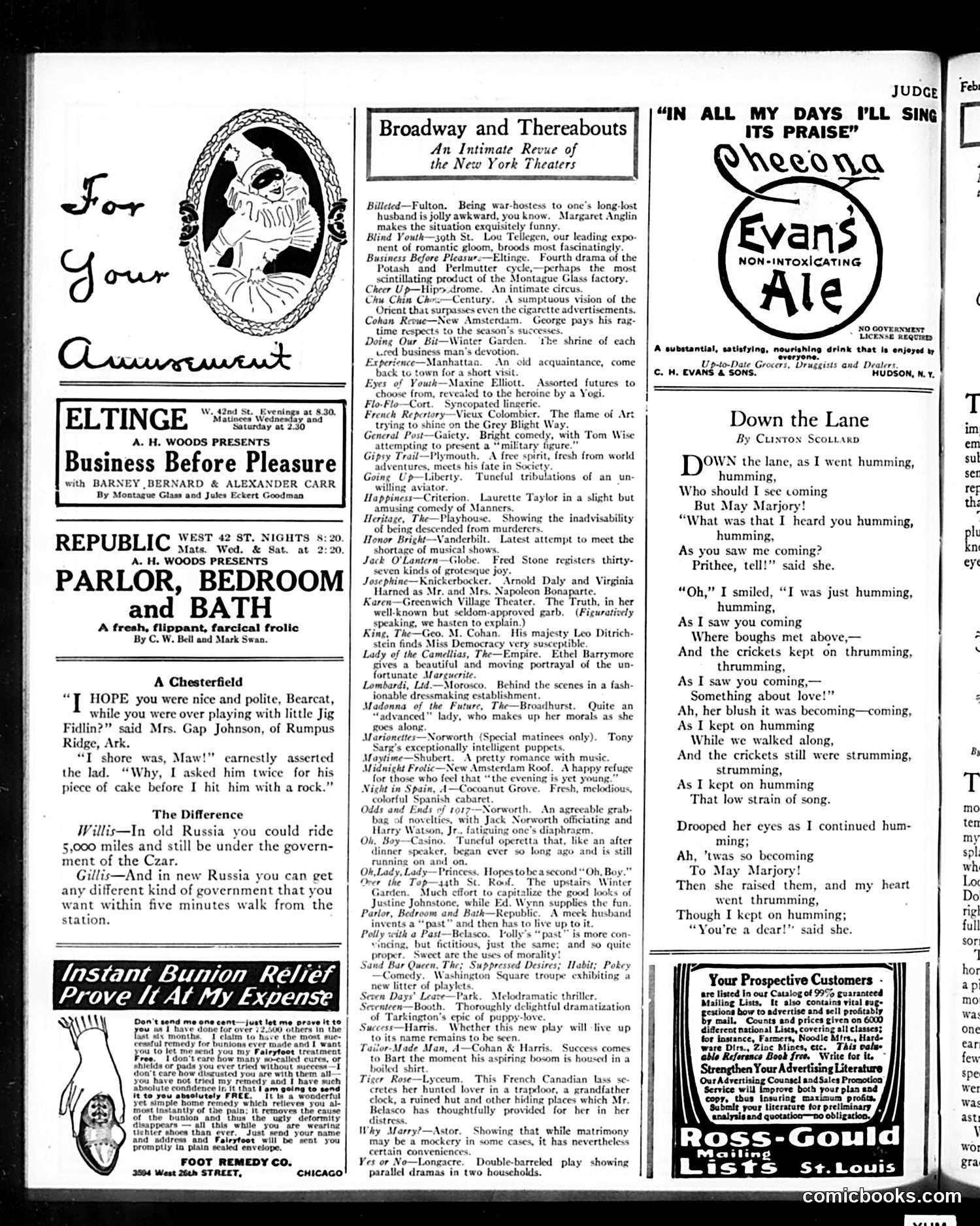
This page is primarily **advertising and theater reviews**, not political satire. The main content features: **Theater Section**: "Broadway and Thereabouts" lists current New York productions (1910s-era). Notable reviews reference popular shows and performers like Ethel Barrymore and Fred Stone. **Cartoons/Humor Sections**: - "A Chesterfield" depicts rural Southern manners—a boy claims politeness for asking twice before hitting his friend with a rock, satirizing backwoods etiquette misunderstandings. - "The Difference" jokes about pre- and post-Russian Revolution governance, suggesting the new Soviet system offers rapid political change compared to Czarist rule. **Advertisements** dominate: Broadway theater promotions, non-intoxicating ale, and a "Fairyfoot" bunion remedy claiming instant relief. The satire is light, social rather than political—typical of Judge's middle-class humor targeting contemporary urban life and entertainment.
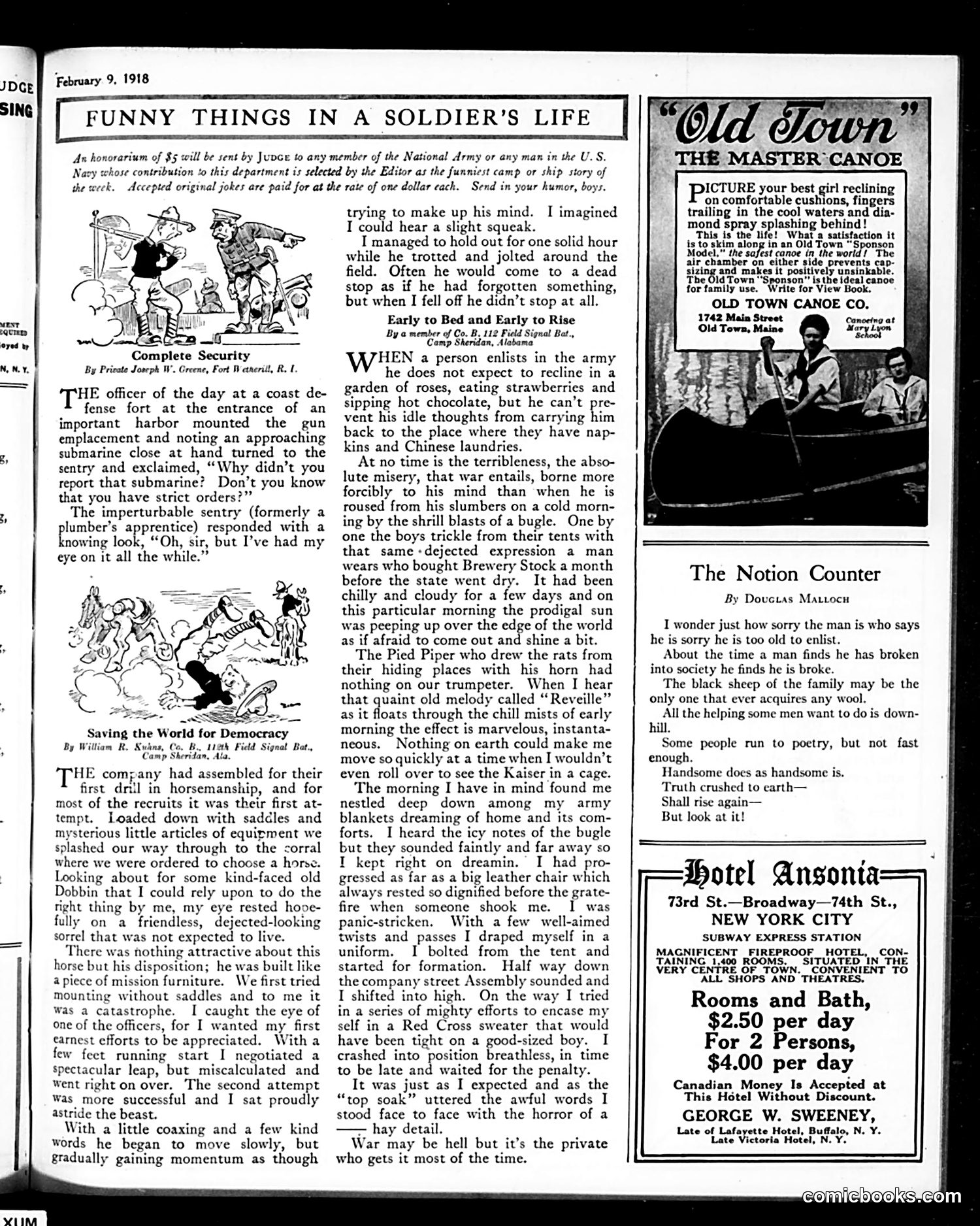
This page contains three humorous anecdotes from American soldiers during World War I, submitted to Judge's contest for funny military stories. **"Complete Security"** satirizes military incompetence: a fort officer demands to know why a sentry didn't report an approaching submarine, only to learn the sentry saw it all along—suggesting the chain of command is broken or orders are absurd. **"Saving the World for Democracy"** mocks the transition of civilians to soldiers through horseback riding training. The narrator's comical mishap—riding a decrepit, unreliable horse and falling off—undercuts the noble phrase "saving the world for democracy" by showing the mundane, undignified reality of army life. **"Early to Bed and Early to Rise"** contrasts soldiers' expectations (comfort) with harsh reality (freezing wake-up calls via bugle). The reference to "Brewery Stock" (purchased before Prohibition) humorously suggests the men's despair rivals stock market losses. Overall, these pieces use absurdist humor to critique military bureaucracy, physical hardship, and the gap between wartime patriotic rhetoric and soldiers' actual experiences.
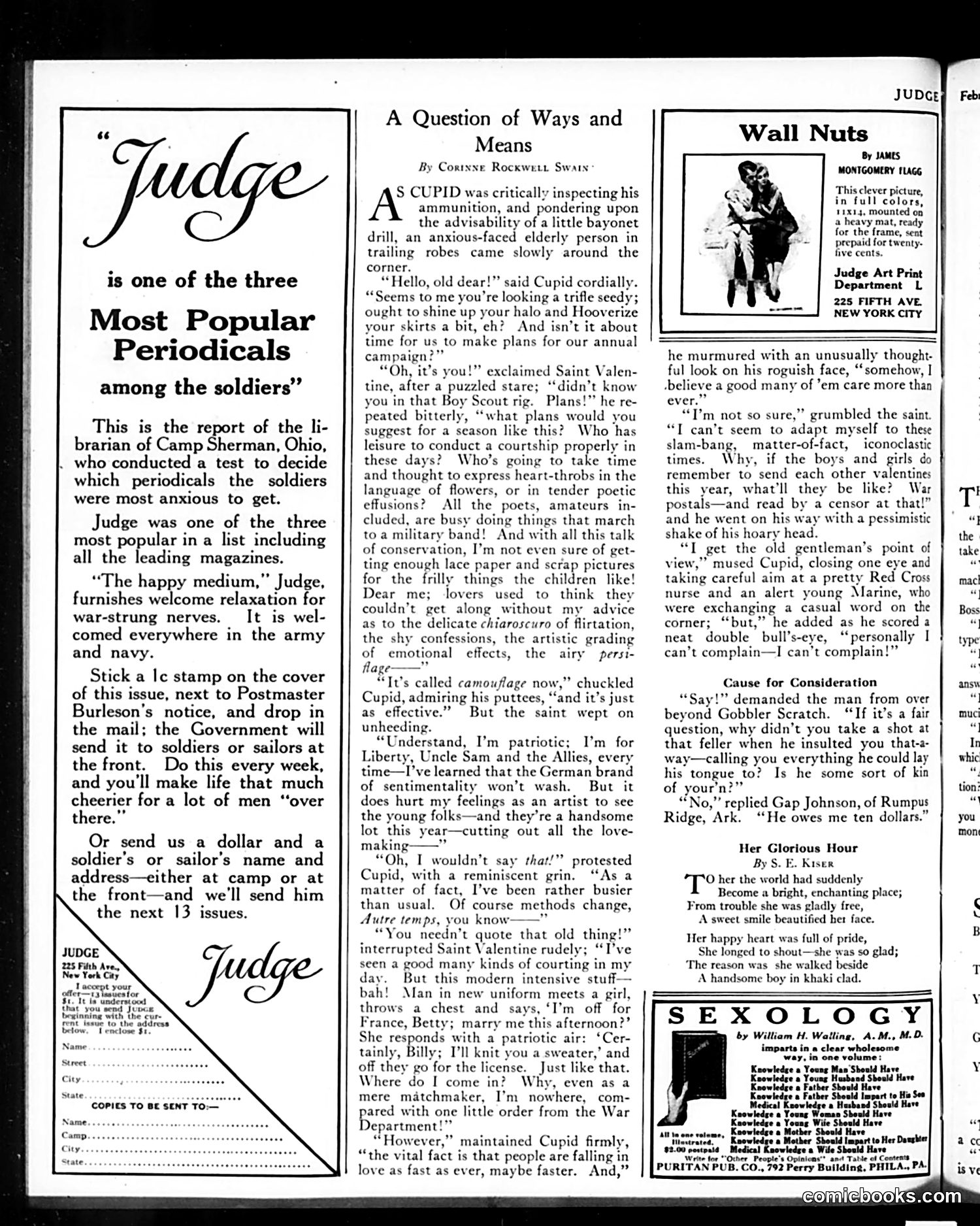
This page contains an advertisement for *Judge* magazine and a satirical dialogue titled "A Question of Ways and Means" by Corinne Rockwell Swain. The cartoon depicts **Cupid** (Roman god of love, shown in "Boy Scout rig" with military puttees) encountering **Saint Valentine** (identifiable by his halo and trailing robes). The satire addresses how **World War I has disrupted romance and courtship**. Saint Valentine complains that wartime priorities—military mobilization, material conservation ("Hooverize"), and patriotic duty—have eliminated the leisure for traditional romantic expression: poetry, flowers, elaborate flirtation ("chiaroscuro"). Modern courtship has become rushed and transactional: soldiers propose marriage as casual last requests before deployment; women respond with practical patriotism rather than romantic sentiment. Cupid counters that love persists despite these changes, using modern military terminology ("camouflage") instead of old romantic language. The satire ultimately mocks how **total war reshapes even intimate human relationships**, reducing romance to expedient wartime necessity.
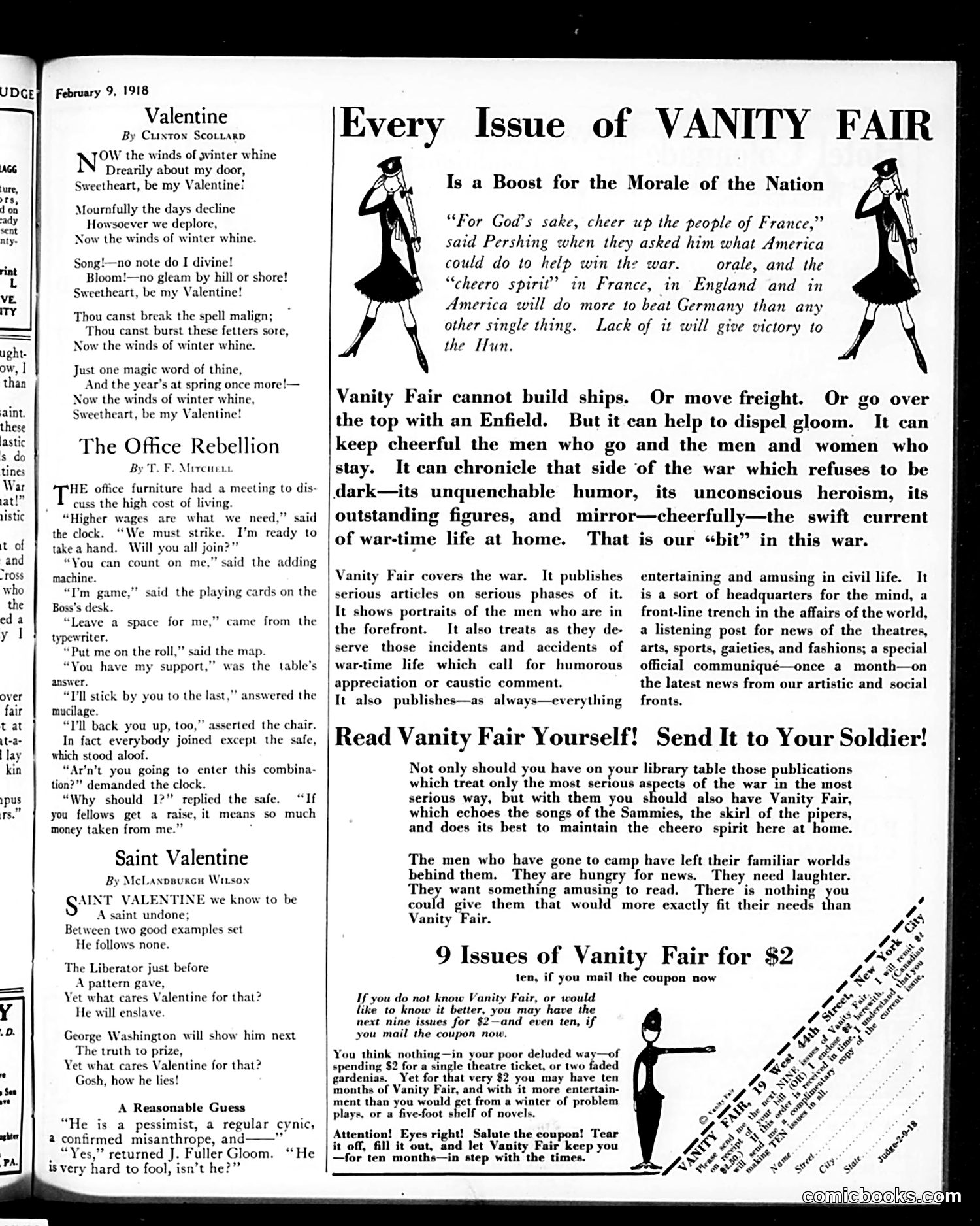
This page blends poetry, light humor, and wartime patriotic messaging. The three poems—"Valentine," "The Office Rebellion," and "Saint Valentine"—offer romantic and workplace satire unrelated to the war. The dominant content is a **Vanity Fair advertisement** quoting General Pershing, claiming morale matters as much as military hardware in defeating Germany. It argues that entertaining publications boost soldiers' and civilians' spirits during wartime—positioning Vanity Fair as contributing to the war effort through humor and human-interest stories rather than serious war coverage. The ad's rhetoric reflects 1918 American mobilization: selling magazines as patriotic duty ("our 'bit' in this war"), appealing to readers to send publications to soldiers, and framing entertainment as essential to maintaining "cheero spirit" on the home front and in camps. This is primarily **advertising dressed as editorial content**—using WWI patriotism to market a leisure magazine to civilians feeling obligated to support troops.
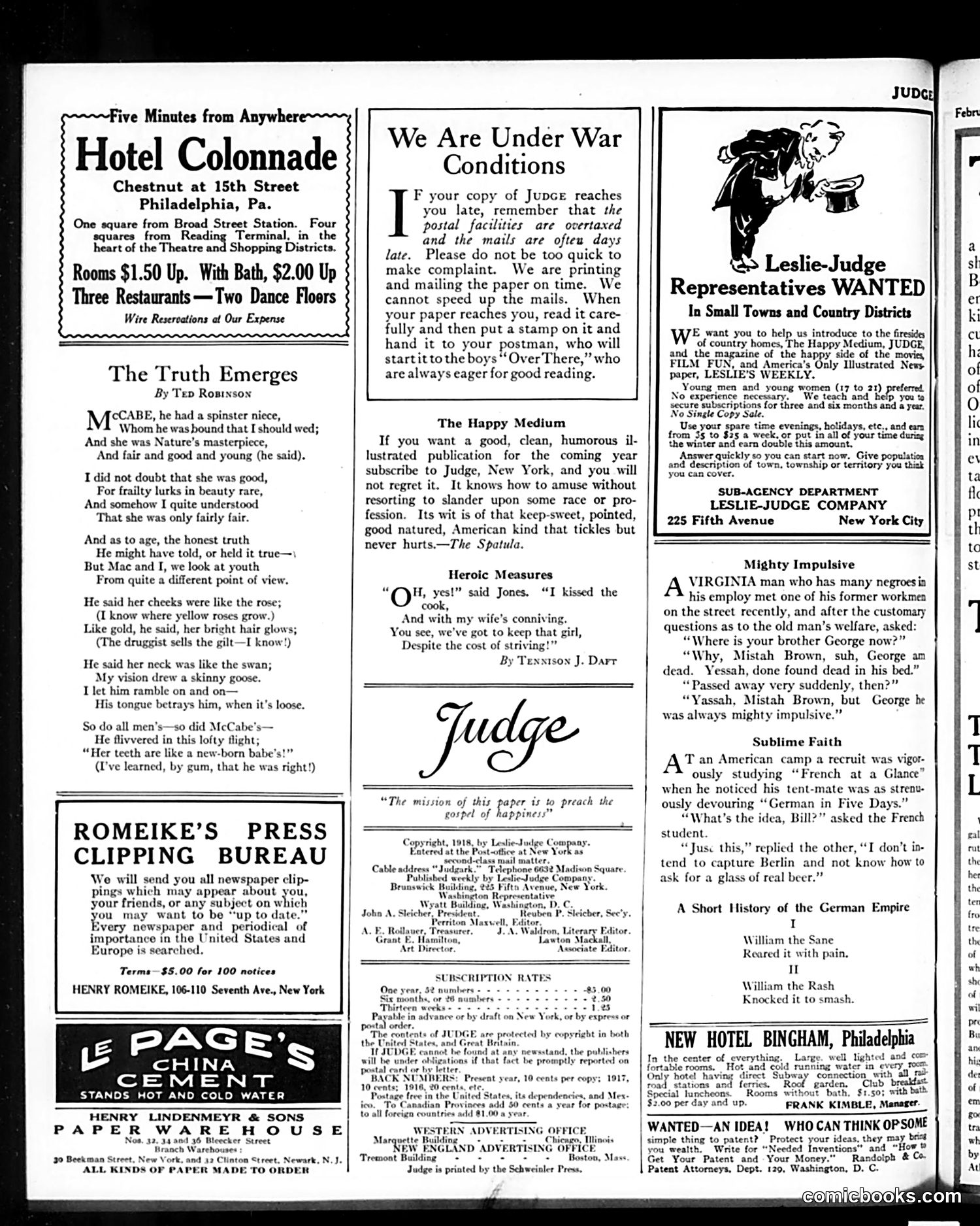
This page is primarily **advertising and editorial notices** for *Judge* magazine's wartime operations (note the disclaimer "We Are Under War Conditions" explaining mail delays). The only substantive satirical content is **"The Truth Emerges"** by Ted Robinson, a poem about courtship deception. A man named McCabe wants to marry off his niece, exaggerating her beauty ("cheeks like the rose," "hair like gold," "neck like a swan"). The narrator sees through the flattery—comparing her yellow-ish complexion, dull hair, and scrawny neck to unflattering truths. The joke's punchline reveals McCabe was accidentally correct about one thing: her teeth resemble a newborn baby's—presumably meaning they're small, weak, or poorly developed. The satirical point: men's flowery romantic language masks the truth, with humor derived from the gap between idealized description and physical reality. It's relatively gentle humor about male courtship exaggeration. The page also advertises *Judge*'s own editorial standards and classifieds for magazine representatives.
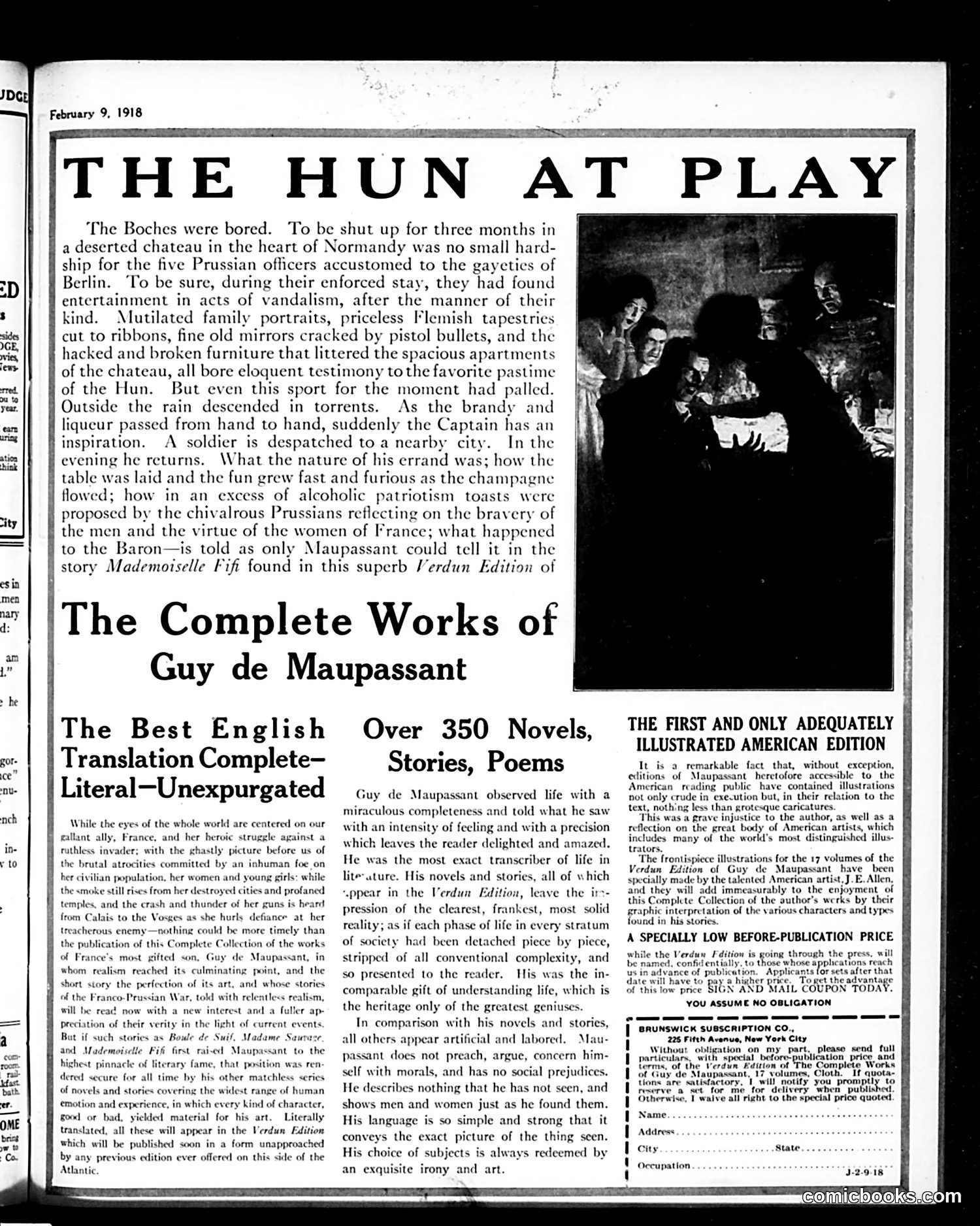
This page advertises *The Complete Works of Guy de Maupassant* while using a story excerpt to satirize German ("Hun") soldiers during World War I occupation. The text describes five bored Prussian officers confined in a Norman château, entertaining themselves through vandalism—destroying French art and furniture. The caption identifies them as "the Hun," period slang for Germans. When rain prevents outdoor activity, a captain orders a soldier to fetch something from a nearby city, leading to an evening of alcohol-fueled revelry with toasts mocking French women and culminating in an unspecified incident involving "the Baron." The satire works on two levels: it portrays German soldiers as crude, destructive vandals lacking refinement, while simultaneously advertising Maupassant's literary sophistication. The juxtaposition—crude Prussian "sport" versus the author's civilized brilliance—implicitly contrasts German and French culture. Published during WWI, this anti-German sentiment would resonate with American readers.
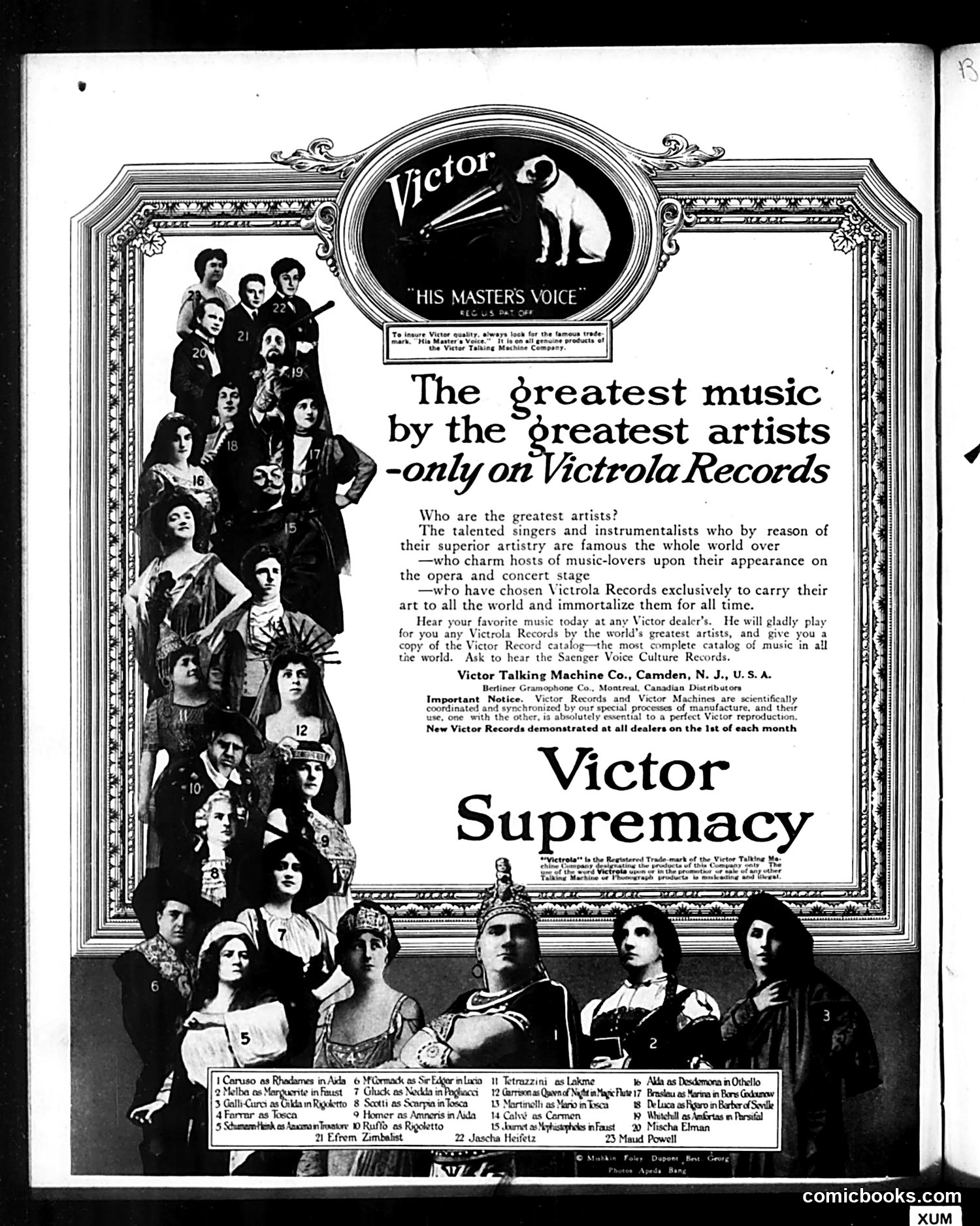
This is a **full-page advertisement**, not a political cartoon. It promotes Victor Talking Machines and Victrola Records as the premier source for classical music. The page features numbered photographs of famous opera singers and instrumentalists of the era—including Enrico Caruso, Nellie Melba, and violinists Jascha Heifetz and Efrem Zimbalist. The text claims Victor has exclusive contracts with "the world's greatest artists," positioning the company's supremacy in the emerging recorded-music market. The ornate frame design and celebrity photographs were typical advertising strategies of the 1910s-20s, leveraging famous performers' prestige to sell expensive phonographs and records to middle and upper-class consumers. The phrase "Victor Supremacy" emphasizes market dominance during the competitive early phonograph era.