
Judge, 1918-02-09 · page 9 of 36
Judge — February 9, 1918 — page 9: what you’re looking at
What you’re looking at
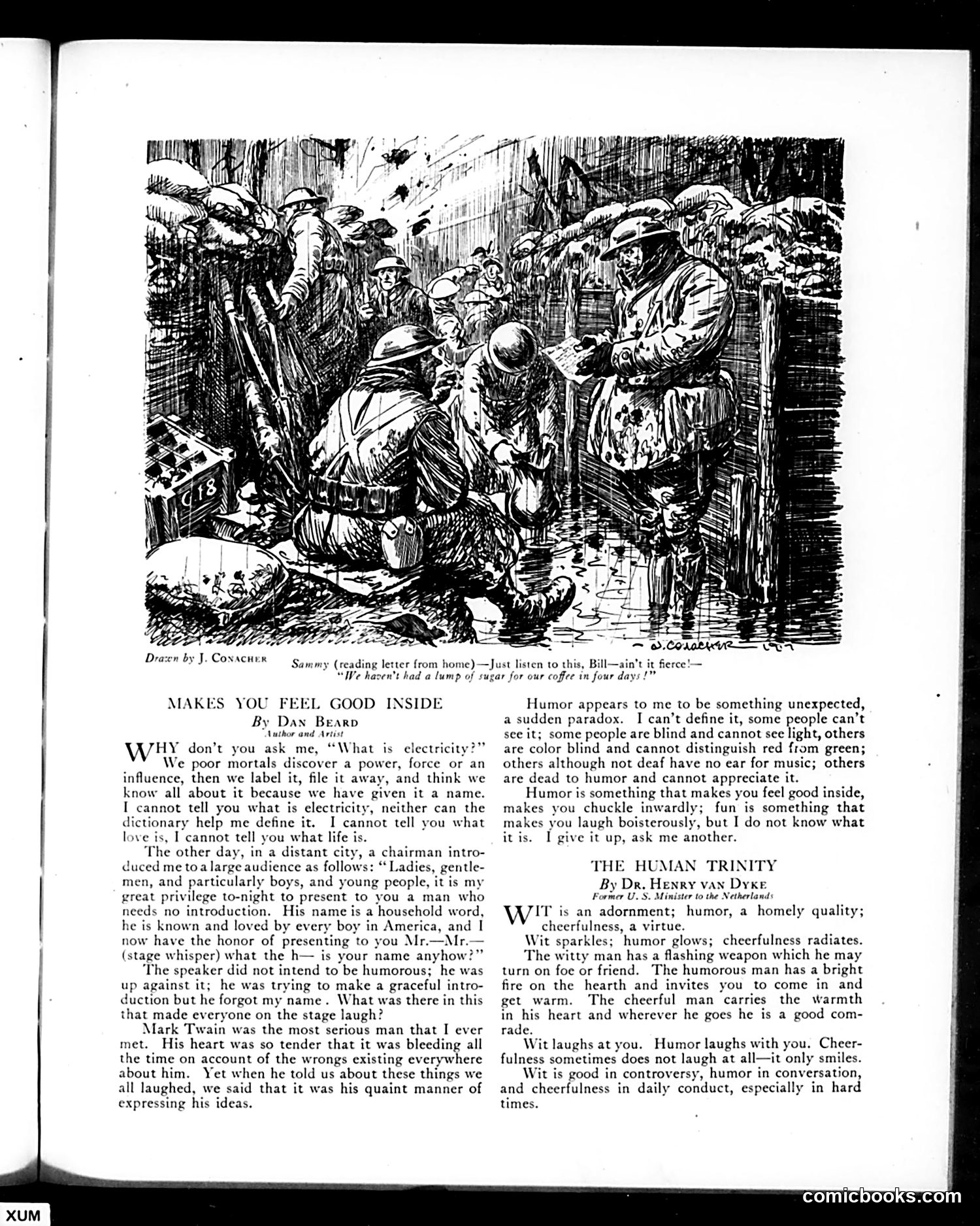
**The Cartoon:** The top illustration shows soldiers in a trench during wartime (likely WWI, given the military uniforms and trench setting). One soldier reads a letter from home to his companion "Bill," expressing concern that they haven't received sugar for their coffee in four days—a stark contrast to the soldiers' life-or-death circumstances. The caption reads "ain't it fierce!" **The Satire:** The joke mocks the disconnect between civilians' trivial complaints on the home front and soldiers' actual hardships in combat. Civilians complaining about sugar rationing or minor inconveniences appear absurdly self-pitying compared to soldiers enduring trenches and warfare. It's satirizing both wartime civilian complaints and the soldiers' wry, darkly humorous response to such complaints. **The Surrounding Text:** Essays by Dan Beard and Dr. Henry van Dyke philosophically distinguish between wit, humor, and cheerfulness—suggesting humor as a coping mechanism and virtue, which contextualizes why soldiers maintain humor despite dire circumstances.
📄 Transcribed text from this page (OCR, searchable)
Machine-transcribed from the original scan — historical spelling and the odd misread are preserved.
Drazen by J. Conacuen “We haven't had a lump of s YOU FEEL GOOD INSIDE By Dan Bearp Vuthor and Artist wy don’t you ask me, “What is clectricity? We poor mortals discover a power, force or an influence, then we label it, file it away, and think we know all about it because we have given it a name. I cannot tell you what is electricity, neither can the dictionary help me define it. I cannot tell you what love is, I cannot tell you what life is. The other day, in a distant city, a chairman intro- duced me toa large audience as follows: “Ladies, gentle- men, and particularly boys, and young people, it is my great privilege to-night to present to you a man who needs no introduction. His name is a household word, he is known and loved by every boy in America, and I now have the honor of presenting to you Mr.—M (stage whisper) what the h— is your name anyhow ‘The speaker did not intend to be humorous; he was up against it; he was trying to make a graceful intro- duction but he forgot my name. What was there in this that made everyone on the stage laugh? Mark Twain was the most serious man that I ever met. His heart was so tender that it was bleeding all the time on account of the wrongs existing everywhere about him. Yet when he told us about these things we all laughed, we said that it was his quaint manner of expressing his ideas. MAKES Sammy (reading letter from home) —J listen to this, Bill—ain’t it fierce !— gar for our coffee in four days!” Humor appears to me to be something unexpected, a sudden paradox. I can’t define it, some people can’t see it; some people are blind and cannot see light, others are color blind and cannot distinguish red from green; others although not deaf have no ear for music; others are dead to humor and cannot appreciate it. Humor is something that makes you feel good inside, makes you chuckle inwardly; fun is something that makes you laugh boisterously, but I do not know what I give it up, ask me another. THE HUMAN TRINITY By Dr. Henry van Dyke Former U.S. Minister to the Netherlands T is an adornment; humor, a homely quality; cheerfulness, a virtue. it is. W! Wit sparkles; humor glows; cheerfulness radiates. The witty man has a flashing weapon which he may turn on foe or friend. The humorous man has a bright fire on the hearth and invites you to come in and get warm. The cheerful man carries the warmth in his heart and wherever he goes he is a good com- rade. Wit laughs at you. Humor laughs with you. Cheer- fulness sometimes does not laugh at all—it only smiles. Wit is good in controversy, humor in conversation, and cheerfulness in daily conduct, especially in hard times.