
Judge, 1918-02-09 · page 13 of 36
Judge — February 9, 1918 — page 13: what you’re looking at
What you’re looking at
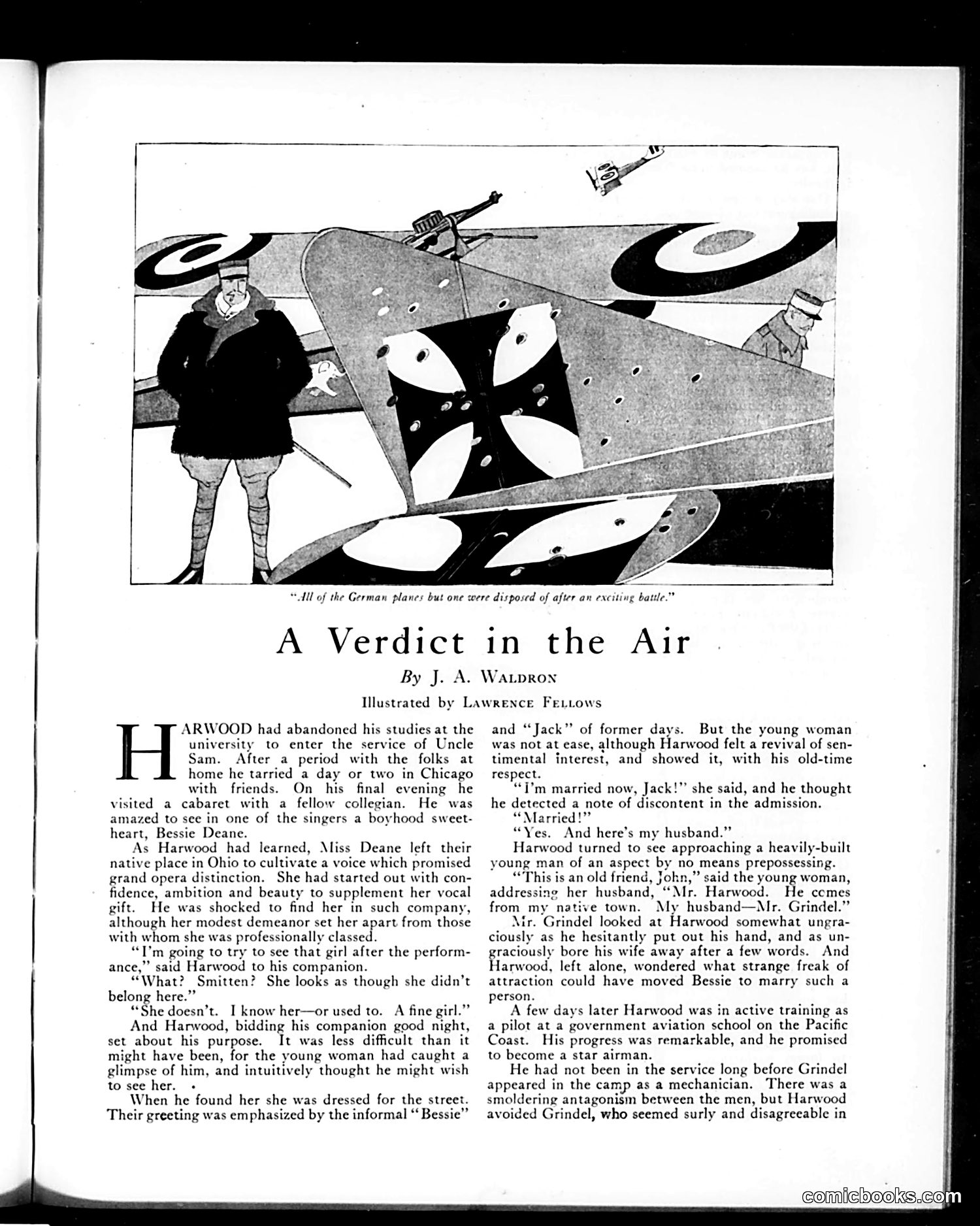
This page introduces a serialized story, not a political cartoon. The illustration shows a World War I military aircraft with mechanical details—likely satirizing the era's fascination with aviation technology. The narrative concerns Harwood, a university student-turned-pilot training on the Pacific Coast, who reconnects with a childhood sweetheart, Bessie Deane, now a cabaret singer married to an unappealing mechanic named Grindel. The story's dramatic tension centers on class decline (Bessie's fall from operatic ambitions to cabaret work) and romantic complications when both men end up at the same military aviation camp. The caption's reference to German planes being "disposed of" reflects WWI's air combat context. The story appears to build toward conflict between Harwood and Grindel, possibly involving Bessie—a common melodramatic plot device of the period. No specific political satire is evident on this page.
📄 Transcribed text from this page (OCR, searchable)
Machine-transcribed from the original scan — historical spelling and the odd misread are preserved.
“AU of the German planes but one were disposed of after an exciting battle.” A Verdict in the Air By J. A. Watpron Illustrated by Lawrence Fettows ARWOOD had abandoned his studies at the university to enter the service of Uncle Sam. After a period with the folks at home he tarried a day or two in Chicago with friends. On his final evening he visited a cabaret with a fellow collegian. He was amazed to see in one of the singers a boyhood sweet- heart, Bessie Deane. As Harwood had learned, Miss Deane left their native place in Ohio to cultivate a voice which promised grand opera distinction. She had started out with con- fidence, ambition and beauty to supplement her vocal gift. He was shocked to find her in such company, although her modest demeanor set her apart from those with whom she was professionally classed. “I’m going to try to see that girl after the perform- ance,” said Harwood to his companion. “What? Smitten? She looks as though she didn’t belong here.” “She doesn’t. I know her—or used to. A fine girl.” And Harwood, bidding his companion good night, set about his purpose. It was less difficult than it might have been, for the young woman had caught a glimpse of him, and intuitively thought he might wish to see her. + When he found her she was dressed for the street. Their greeting was emphasized by the informal “Bessie” and “Jack” of former days. But the young woman was not at ease, although Harwood felt a revival of sen- timental interest, and showed it, with his old-time respect. “j’m married now, Jack!” she said, and he thought he detected a note of discontent in the admission. “Married!” “Yes. And here’s my husband.” Harwood turned to see approaching a heavily-built young man of an aspect by no means prepossessing. “This is an old friend, John,” said the young woman, addressing her husband, “Mr. Harwood. He ccmes from my native town. My husband—Mr. Grindel.” Mr. Grindel looked at Harwood somewhat ungra- ciously as he hesitantly put out his hand, and as un- graciously bore his wife away after a few words. And Harwood, left alone, wondered what strange freak of attraction could have moved Bessie to marry such a person. A few days later Harwood was in active training as a pilot at a government aviation school on the Pacific Coast. His progress was remarkable, and he promised to become a star airman. He had not been in the service long before Grindel appeared in the camp as a mechanician. There was a smoldering antagonism between the men, but Harwood avoided Grindel, who seemed surly and disagreeable in comichooks.couy)