
Judge, 1918-02-09 · page 20 of 36
Judge — February 9, 1918 — page 20: what you’re looking at
What you’re looking at
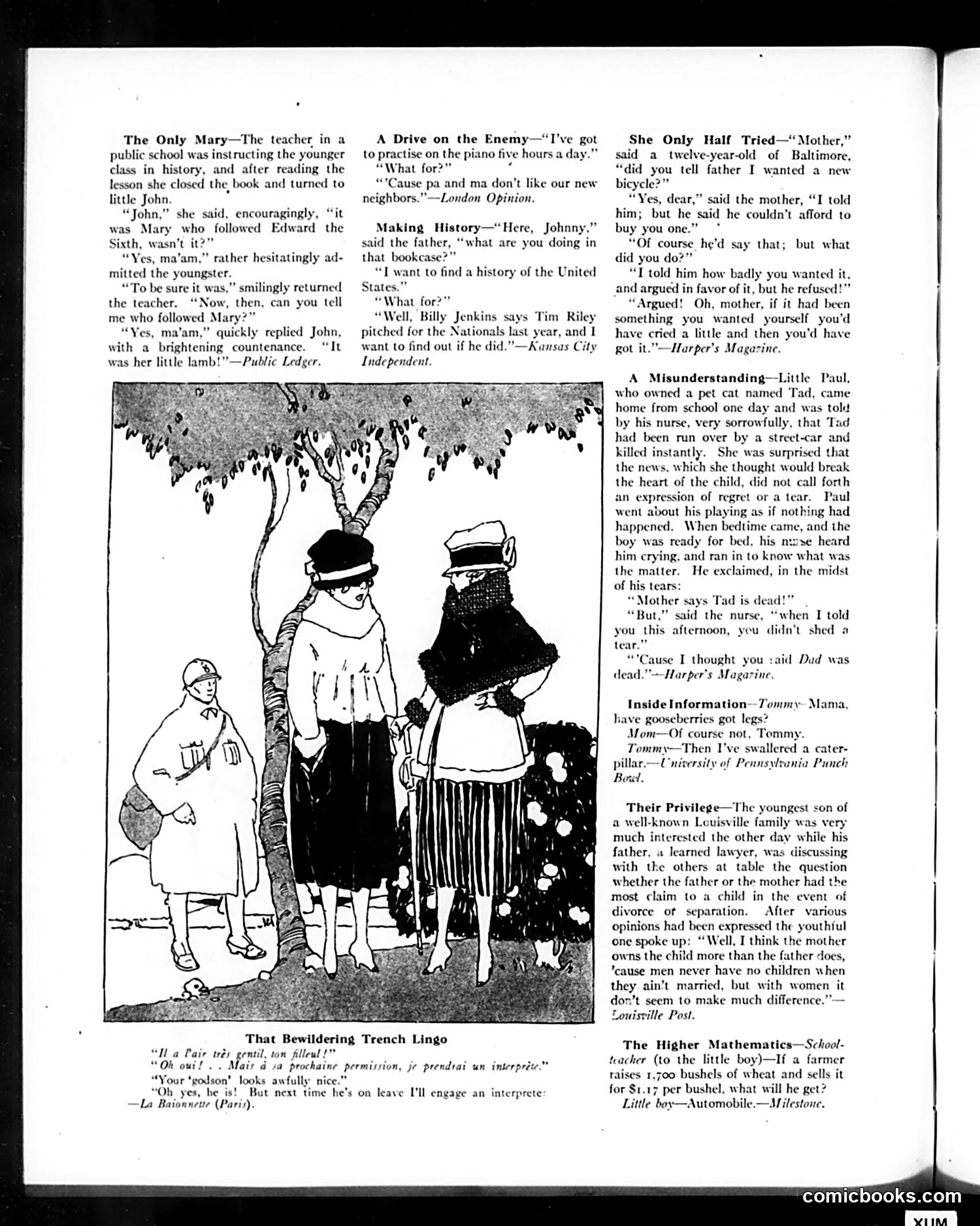
This page collects brief humorous anecdotes typical of early-20th-century Judge magazine. The content reflects period attitudes and concerns: **"The Only Mary"** plays on a child's literal interpretation: when asked who followed Mary I (the historical queen), the boy answers "her little lamb"—confusing the nursery rhyme with history. **"A Drive on the Enemy"** depicts piano practice as psychological warfare against disliked neighbors—suggesting middle-class social tensions and competitive musicality. **The trench lingo cartoon** references WWI communication difficulties, with a French soldier saying he'll hire an interpreter for his next leave—contemporary wartime humor. **"She Only Half Tried"** satirizes gender dynamics: a girl suggests her mother would succeed getting a bicycle through manipulation ("cry a little") where reasoning failed—critiquing both parental dynamics and female stereotypes. **Other items** (the misunderstanding about the cat, the gooseberries joke, the mathematics problem yielding "automobile") are simple children's logic gags popular in the era. The humor is genteel, family-friendly satire targeting domestic life, education, and social manners.
📄 Transcribed text from this page (OCR, searchable)
Machine-transcribed from the original scan — historical spelling and the odd misread are preserved.
The Only Mary—The teacher, in a public school was instructing the younger class in history, and after reading the lesson she closed the book and turned to little John. “John,” she said, encouragingly, “it was Mary who followed Edward the Sixth, wasn’t it?” “Yes, ma’am,” rather hesitatingly ad- mitted the youngste: “To be sure it was,” smilingly returned the teacher. “Now, then, can you tell me who followed M. “Yes, ma’am,” quickly replied John, with a brightening countenance. “It was her little lamb!"—Public Ledger. “Il a Pair trés gentil, ton filleul!” “Oh oui! .. A Drive on the Enemy—‘I've got to practise on the piano five hours a day.” What for?” ‘ “Cause pa and ma don't like our new neighbors."”—London Opinion. Making History—‘Here, Johnny,” said the father, “what are you doing in that bookca “T want to find a history of the United States.” “What for?” “Well, Billy Jenkins pitched for the Nation: want to find out if he did.” Independent. Tim Riley par, and I Kansas City That Bewildering Trench Lingo Mais d sa prochaine permission, je prendrai un interpréte.” our ‘godson’ looks awfully nice.” “Oh. yes, he is! But next time he’s on leave I'll engage an interprete La Baionnette (Paris). She Only Half Tried—*“ Mother,” said a twelve-year-old of Baltimore, a you tell father I wanted a new bicycle?” “Yes, dear,” said the mother, “I told him; but he said he couldn’t afford to buy you one.” “OF course he'd say that; but what did you do?” “T told him how badly you wanted it, and argued in favor of it, but he refused!” “Argued! Oh, mother, if it had been something you wanted yourself you'd have cried a little and then you'd have got it.”—Harper’s Magazine. A Misunderstanding—Little Paul, who owned a pet cat named Tad, came home from school one day and was told by his nurse, very sorrowfully, that Tad had been run over by a street-car and killed instantly. She was surprised that the news, which she thought would break the heart of the child, did not call forth an expression of regret or a tear. Paul went about his playing as if nothing had happened. When bedtime came, and the boy was ready for bed, his nwse heard him crying, and ran in to know what was the matter. He exclaimed, in the midst of his tears: “Mother says Tad is dead!” “But,” said the nurse, “when I told you this afternoon, yeu didn’t shed a tear.” “’Cause I thought you : dead.”"-—Harper’s. Magarine. aid Dad was Inside Information—7omm\~ Mama, have gooseberries got legs? Mom—Of course not, Tommy. Tommy—Then I've swallered a cater- illar.—Unitersity of Pennsylvania Punch Their Privilege—The youngest son of a well-known Louisville family was very much interested the other day while his father, « learned lawyer, was discussing with the others at table the question whether the father or the mother had the most claim to a child in the event of divorce of separation. After various opinions had been expressed the youthiul one spoke up: “Well, I think the mother owns the child more than the father doe *cause men never have no children when they ain’t married, but with women it don’t seem to make much difference.””-— Louisville Post. The Higher Mathematics—School- teacher (to the little boy)—If a farmer raises 1,700 bushels of wheat and sells it for $1.17 per bushel, what will he get? Little boy—Automobile.—M ilestone. comicbooks.com