
Judge, 1918-02-09 · page 21 of 36
Judge — February 9, 1918 — page 21: what you’re looking at
What you’re looking at
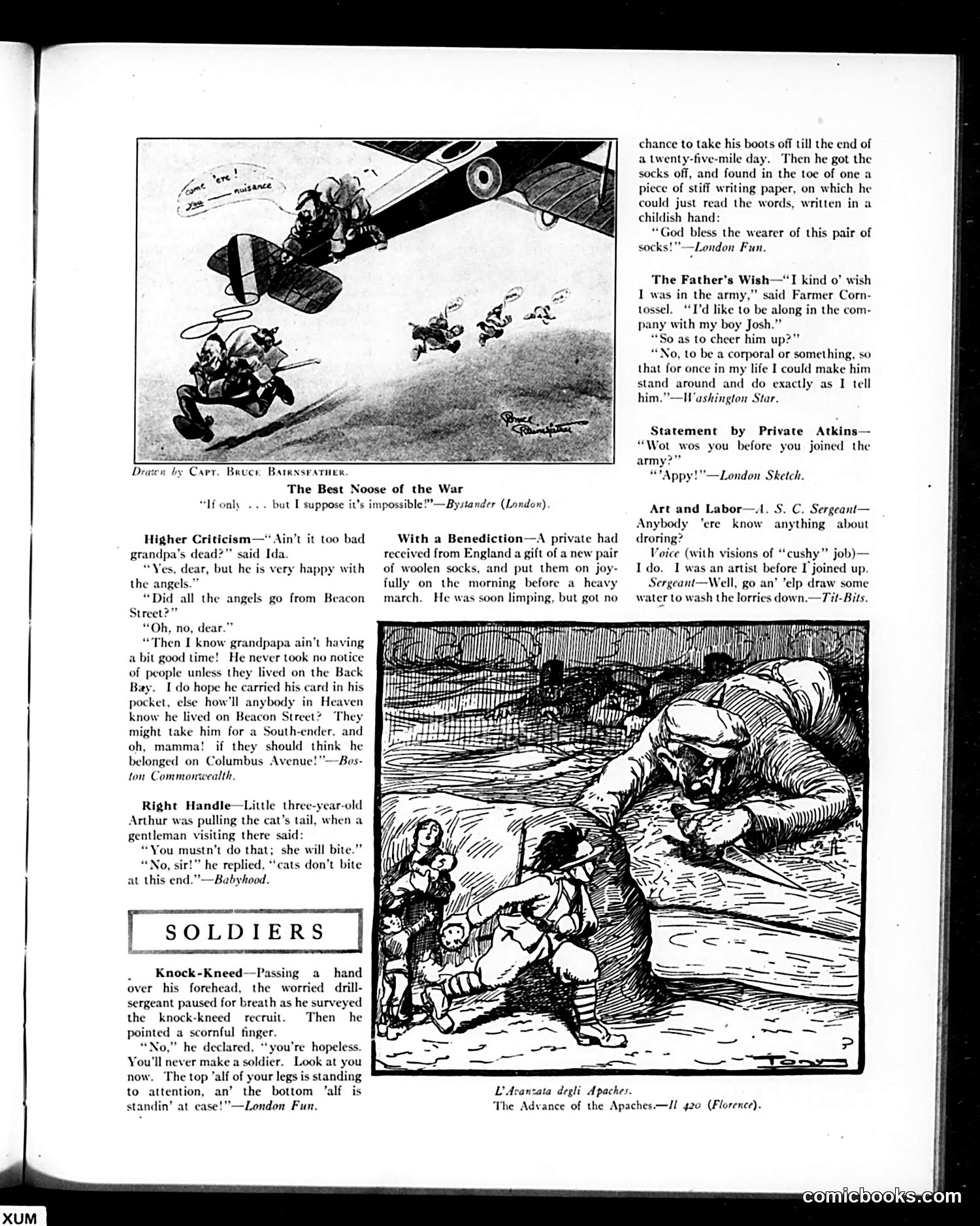
This page from *Judge* magazine contains WWI-era humor organized around soldiers and military life. **Top cartoon** ("The Best Noose of the War"): Shows an aerial combat scene with a German plane and Allied forces—the "noose" references hopes for the enemy's defeat. **Anecdotes below** include class-conscious Boston humor about afterlife social hierarchies, a child's logic joke about a cat, and several soldier vignettes: - A drill sergeant mocking a recruit's posture ("knock-kneed") - A touching story of a soldier receiving hand-knitted socks with a blessing note - A farmer wanting military rank to finally command his son's obedience - An artist conscripted into menial labor instead of drawing **Bottom illustration** ("The Advance of the Apaches") depicts street gangs or rough youth—likely referencing Parisian "Apaches," period slang for urban hooligans. The page emphasizes contrasts: military hierarchy, class pretension, domestic sentiment, and the gap between civilian expectations and wartime reality. The humor is gentle, patriotic satire reflecting home-front perspectives.
📄 Transcribed text from this page (OCR, searchable)
Machine-transcribed from the original scan — historical spelling and the odd misread are preserved.
y Carr. Bruce Barrnsratier, The Best Noose of the War “If only ... but I suppose it’s impossible !”—Bystander (London). Higher Criticism—* Ain't it too bad grandpa’s dead?” said Ida “Yes, dear, but he is very happy with Il the angels go from Beacon Street?” “Oh, no, dear. en I know grandpapa ain't having a bit good time! He never took no notice of people unless they lived on the Back Bay. I do hope he carried his card in his pocket, else how’ll anybody in Heaven know he lived on Beacon Street? They might take him for a South-ender, and oh, mamma! if they should think he belonged on Columbus Avenue!""—Bes- ton Commonwealth. Right Handle—Little thre Arthur was pulling the cat’s ta gentleman visiting the id: “You mi she will bite.” No, sir s don’t bite at this end.” SOLDIERS Knock-Kneed—Passing a hand over his forehead, the worried drill- sergeant paused for breath as he surveye the knock-kneed recruit. Then he pointed a scornful finger. “No,” he declared, “you're hopeless. You'll never make a soldier. Look at you now. The top ‘alf of your legs is standing to attention, an’ the bottom ‘alf is standin’ at ease!”—London Fun. Babyhood. With a Benediction—A private had received from England a gift of a new pair of woolen socks, and put them on joy- fully on the morning before a heavy march. He was soon limping, but got no ate L'Acanzata degli Apaches. ‘The Advance of the Apaches—/I 420 (Florence). chance to take his boots off till the end of a twenty-five-mile day. Then he got the socks off, and found in the toe of one a piece of stiff writing paper, on which he could just read the words, written in a childish hand: “God bless the wearer of this pair of socks!"’—London Fun. The Father's Wish—“I kind 0’ wish I was in the army,” said Farmer Corn- tossel. “I'd like to be along in the com- pany with my boy Josh.” as to cheer him up?” No, to be a corporal or something, so that for once in my life I could make him stand around and do exactly as I tell him.” —Washington Star. Statement by Private Atkins— Art and Labor—A. S. C. Sergeant— Anybody ‘ere know anything about droring? Voice (with visions of “cushy” job)— Ido. I was an artist before I joined up. Sergeant—Well, go an’ ’elp draw some water to wash the lorries down.—Tit-Bits. 3