
Judge, 1918-02-09 · page 5 of 36
Judge — February 9, 1918 — page 5: what you’re looking at
What you’re looking at
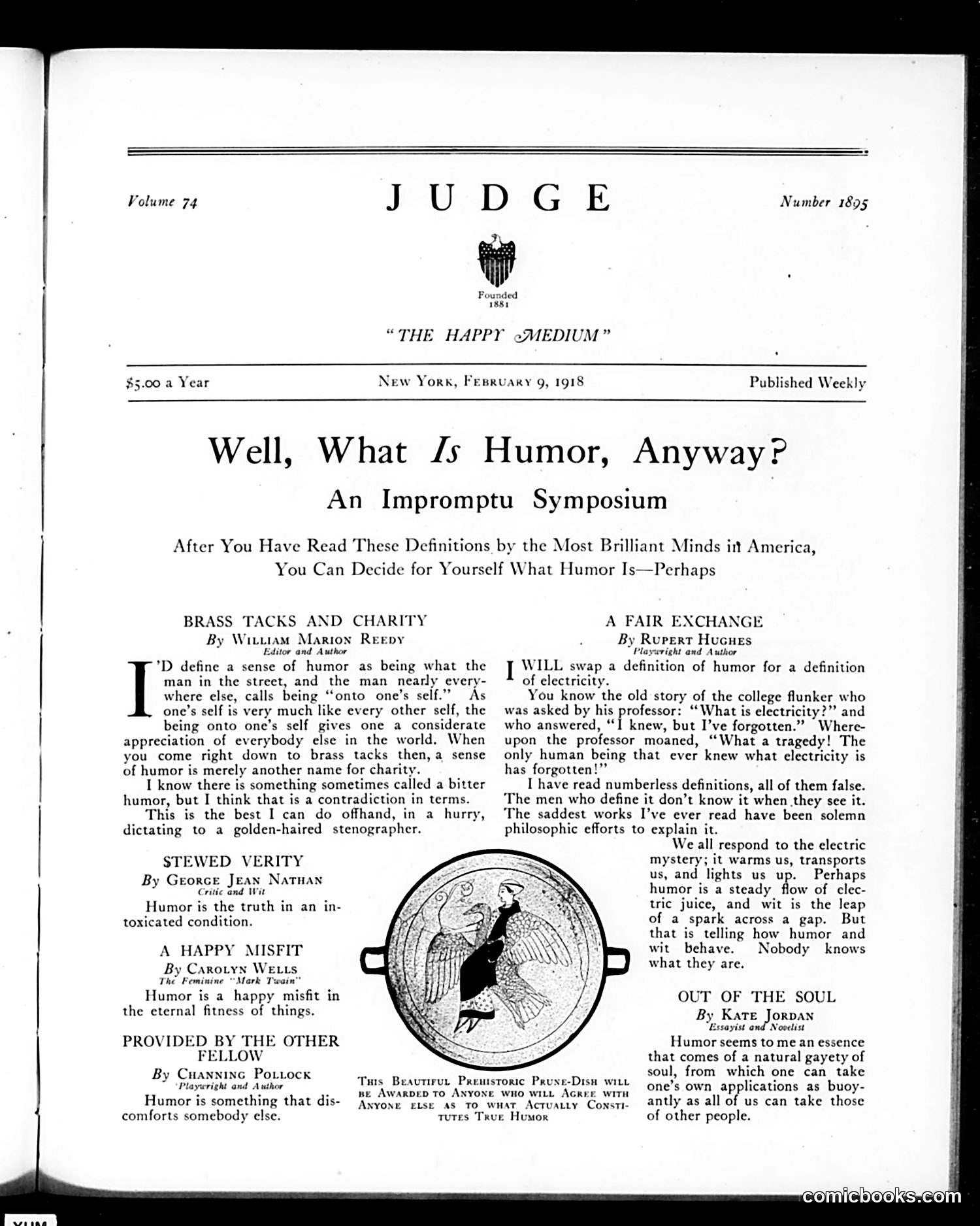
This page features a humorous "symposium" where prominent American writers and editors offer competing definitions of humor. Contributors include William Dean Howells, George Jean Nathan, Carolyn Wells, Channing Pollock, Rupert Hughes, and Kate Jordan—all recognized literary figures of the era. The central image shows a prehistoric bird or creature, captioned as a "beautiful Prehistoric Puns-Dish" that will be awarded to whoever best defines true humor. Rather than political satire, this is meta-humor: the page ironically addresses the impossibility of defining humor itself. Each contributor provides contradictory definitions, illustrating that humor resists simple explanation—a self-aware joke about the magazine's own satirical purpose. The symposium format gently mocks pretentious literary criticism.
📄 Transcribed text from this page (OCR, searchable)
Machine-transcribed from the original scan — historical spelling and the odd misread are preserved.
Number 1895 JUDGE Volume 74 $5.00 a Year New York, Fesruary 9, 1918 Published Weekly Well, What /s Humor, Anyway? An Impromptu Symposium After You Have Read These Definitions by the Most Brilliant Minds in America, You Can Decide for Yourself What Humor Is—Perhaps | Founded 1381 “THE HAPPY eMEDIUM” BRASS TACKS AND CHARITY By Wittiam Marion Reepy Editor and Author ’D define a sense of humor as being what the man in the street, and the man nearly every- where else, calls being ‘onto one’s self.” As one’s self is very much like every other self, the being onto one’s self gives one a considerate appreciation of everybody else in the world. When you come right down to brass tacks then, a sense of humor is merely another name for charity. I know there is something sometimes called a bitter humor, but I think that is a contradiction in terms. This is the best I can do offhand, in a hurry, dictating to a golden-haired stenographer. STEWED VERITY By Georce Jean Natuan Critic and Wit Humor is the truth in an in- toxicated condition. A HAPPY MISFIT By Carotyn WELLS The Feminine “Mark Twain” Humor is a happy misfit in the eternal fitness of things. PROVIDED BY THE OTHER FEI fj By Cuanninc Pottock Playwright and Author Humor is something that dis- 4; comforts somebody else. NE ELSE AS TO WHat ActuaLty ConstI- tutes True Humor A FAIR EXCHANGE By Rupert Hucues Playwright and Author WILL swap a definition of humor for a definition of electricity. You know the old story of the college flunker who was asked by his professor: “What is electricity?” and who answered, “I knew, but I’ve forgotten.” Where- upon the professor moaned, “What a tragedy! The only human being that ever knew what electricity is has forgotten!” I have read numberless definitions, all of them false. The men who define it don’t know it when they see it. The saddest works I’ve ever read have been solemn philosophic efforts to explain it. We all respond to the electric mystery; it warms us, transports us, and lights us up. Perhaps humor is a steady flow of clec- tric juice, and wit is the leap of a spark across a gap. But that is telling how humor and wit behave. Nobody knows what they are. OUT OF THE SOUL Novelist Humor seems to me an essence that comes of a natural gayety of soul, from which one can take Tus Beaurirut Prentstoric Prue-Disn witt tae ad ; ne Awarpep To Axvoxr wuo wit | one’s.own applications as buoy- GREE WITH antly as all of us can take those of other people.