
Judge, 1918-02-09 · page 22 of 36
Judge — February 9, 1918 — page 22: what you’re looking at
What you’re looking at
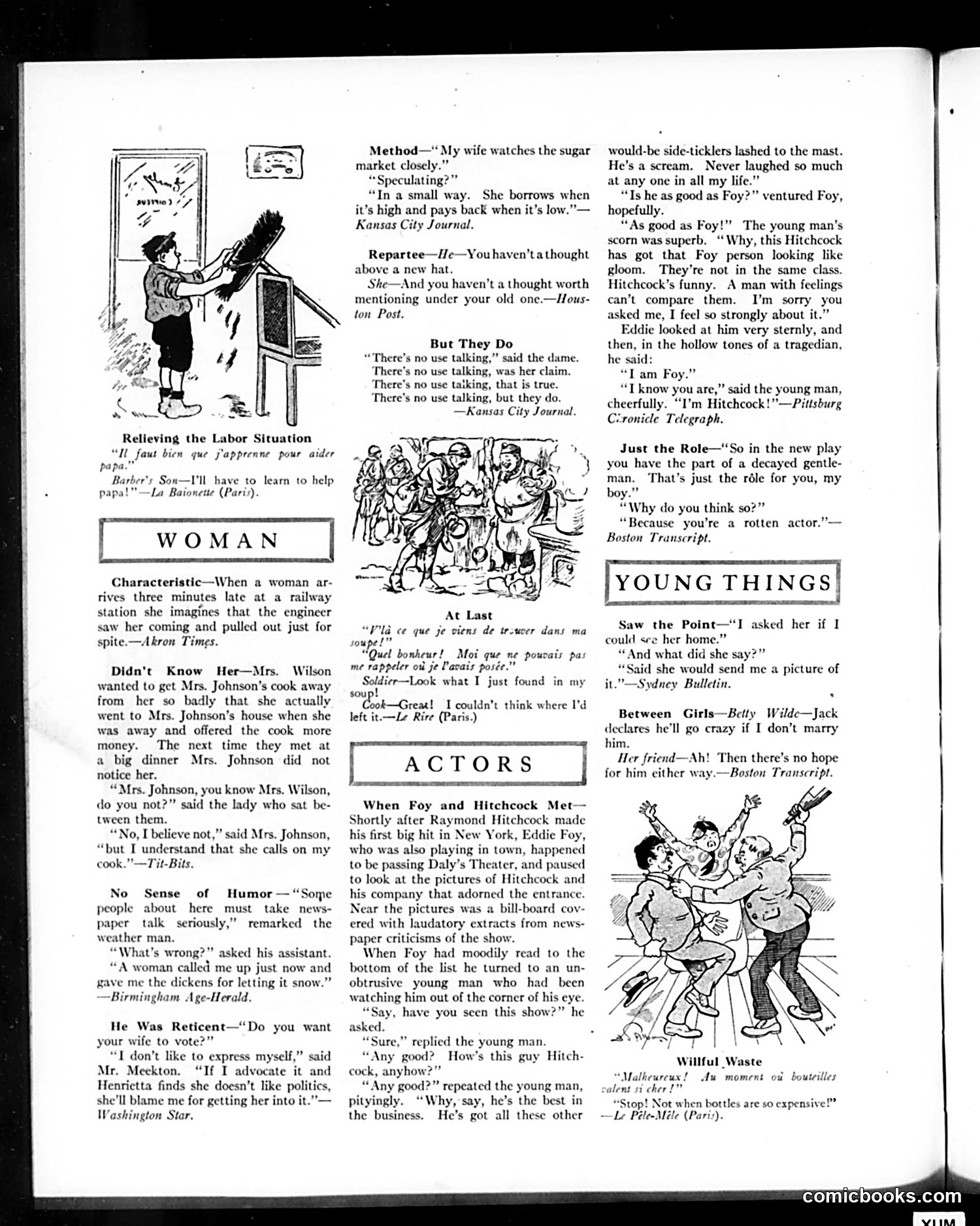
This page from *Judge* contains several short humorous anecdotes and cartoons reflecting early 20th-century American social attitudes. **"Relieving the Labor Situation"** shows a child learning his father's trade—referencing wartime labor shortages when families had to take on multiple occupations. **The "Woman" section** includes satirical observations about female behavior: women's vanity (blaming engineers for train departures), social snubbing, and lack of humor. The piece on wives voting reflects anxiety about women's suffrage—a man fears his wife will blame him regardless of which position he takes. **"When Foy and Hitchcock Met"** describes a famous anecdote about comedians Eddie Foy and Raymond Hitchcock. A stranger unknowingly praises Hitchcock while insulting Foy—revealing himself as Hitchcock—in a humorous reversal. This likely celebrates these popular vaudeville performers. The cartoons and jokes throughout reflect period preoccupations: gender roles, labor disputes, and entertainment personalities. The tone is lighthearted domestic satire aimed at middle-class readers.
📄 Transcribed text from this page (OCR, searchable)
Machine-transcribed from the original scan — historical spelling and the odd misread are preserved.
Relieving the Labor Situation “Il faut bien que j'apprenne pour aider papa.” Barber's Son—V'll have to learn to help papa!" —La Baionette (Paris). [ WOMAN | Characteristic—When a woman ar- rives three minutes late at a railway station she imagines that the engineer saw her coming and pulled out just for spite—A kron Times. Didn't Know Her—Mrs. Wilson wanted to get Mrs. Johnson’s cook away from her so badly that she actually went to Mrs. Johnson’s house when she was away and offered the cook more money. The next time they met at a big dinner Mrs. Johnson did not notice her. “Mrs. Johnson, you know Mrs. Wilson, do you not?” said the lady who sat be- tween them. “No, I believe not,” said Mrs. Johnson, erstand that she calls on my Bits. No Sense of Humor — “Some people about here must take news- paper talk seriously,” remarked the weather man. “What's wrong? asked his assistant. A woman called me up just now and gave me the dickens for letting it snow.” —Birmingham Age-Herald. He Was Reticent—“Do you want your wife to vote?” “I don’t like to express myself,” said Mr. Meekton. “If I advocate it Henrietta finds she doesn’t like politics, she'll blame me for getting her into it. Washington Star. Method—“ My wife watches the sugar market closely “Speculating?”” “In a small way. She borrows when it’s high and pays back when it’s low.” — Kansas City Journal. Repartee—He—You haven't a thought above a new hat. She—And you haven’t a thought worth mentioning under your old one.—Hous- ton Post. But They Do “There's no use talking,” said the dame. There's no use talking, was her claim. There's no use taiking, that is true. There's no use talking, but they do. —Kansas City Journal. At Last “Vlad ce que je viens de trewer dans ma soupe!” “Quel bonheur! Moi que ne poucais pas me rappeler owt je Pacais posée.” Soldier—Look what I just found in my soup! ‘ook—Great! I couldn't think where I'd left it.—Lz Rire (Paris.) a ACTORS | When Foy and Hitchcock Met— Shortly after Raymond Hitchcock made his first big hit in New York, Eddie Foy, who was also playing in town, happened to be passing Daly’s Theater, and paused to look at the pictures of Hitchcock and his company that adorned the entrance. Near the pictures was a bill-board cov- ered with laudatory extracts from news- paper criticisms of the show. When Foy had moodily read to the bottom of the list he turned to an un- obtrusive young man who had been watching him out of the corner of his eye. i , have you seen this show?” he replied the young man. , good? How’s this guy Hitch- cock, anyhow?” “Any good?” repeated the young man, pitying] “Why, say, he’s the best in the business. He’s got all these other would-be side-ticklers lashed to the mast. He's a scream. Never laughed so much at any onc in all my life.” “Ts he as good as Foy?” ventured Foy, hopefully. “‘As good as Foy!” The young man’s scorn was superb, “Why, this Hitchcock has got that Foy person looking like gloom. They’re not in the same class. Hitchcock’s funny. A man with feelings can’t compare them. I’m sorry you asked me, I feel so strongly about it.” Eddie looked at him very sternly, and then, in the hollow tones of a tragedian, he said: “Tam Foy.” “T know you are,” said the young man, cheerfully. “I'm Hitchcock!"—Pittsburg Cironicle Telegraph. Just the Role—So in the new play you have the part of a decayed gentle- man, That’s just the réle for you, my boy.” “Why do you think so?” “Because you’re a rotten actor.”— Boston Transcript. |yYouNG THINGS| Saw the Point—“I asked her if I could see her home.” “ And what did she say?” “Said she would send me a picture of "Sydney Bulletin. it. Between Girls—Betly Wilde—Jack declares he'll go crazy if I don’t marry him. Her friend—Ah! Then there’s no hope for him either way.—Boston Transcript. Willful Waste “Malheureux! Au moment ow bouteilles calent sicher!” “Stop! Not when bottles are so expensive!” —Le PéleeMéle (Paris). comicbooks.com