
Judge, 1918-02-09 · page 12 of 36
Judge — February 9, 1918 — page 12: what you’re looking at
What you’re looking at
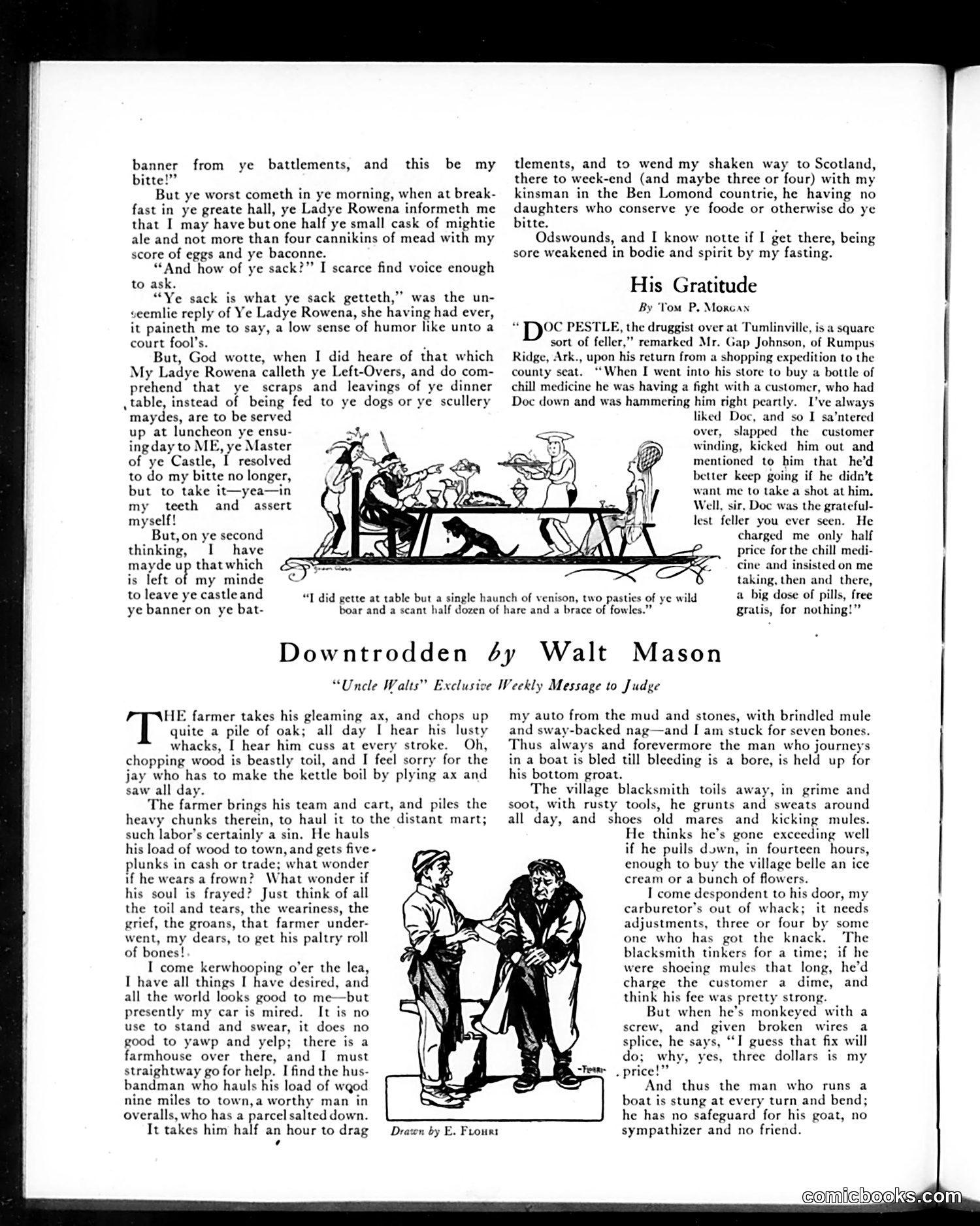
This page contains three distinct satirical pieces: **"Ye Greate Castle" (top left):** A medieval pastiche mocking domestic economy and marital discord. A lord complains that his wife Lady Rowena rations his food and serves "left-overs"—a domestic indignity he finds unbearable. The satire targets upper-class wives' household management and the absurdity of a nobleman's wounded pride over mere meal restrictions. He threatens to flee to Scotland rather than endure this "hardship." **"His Gratitude" (right):** A short anecdote where Doc Pestle the druggist is rescued from a fight by a customer, then repays this favor with discount medicine—a joke about petty gratitude and small-town commerce. **"Downtrodden" by Walt Mason (bottom):** A sentimental poem contrasting a hardworking farmer's toil (chopping and hauling wood for meager pay) with the narrator's leisurely existence—until his car gets stuck in mud. The farmer then helps him, highlighting the irony that the supposedly "downtrodden" laborer possesses genuine worth the idle narrator lacks.
📄 Transcribed text from this page (OCR, searchable)
Machine-transcribed from the original scan — historical spelling and the odd misread are preserved.
banner from ye battlements, and this be my bitte!” But ye worst cometh in ye morning, when at break- fast in ye greate hall, ye Ladye Rowena informeth me that I may have butone half ye small cask of mightiec ale and not more than four cannikins of mead with my score of eggs and ye baconne. “And how of ye sack?”’ I scarce find voice enough to ask. “Ye sack is what ye sack getteth,”” was the un- veemlie reply of Ye Ladye Rowena, she having had ever, it paineth me to say, a low sense of humor like unto a court fool’s. . But, God wotte, when I did heare of that which My Ladye Rowena calleth ye Left-Overs, and do com- prehend that ye scraps and leavings of ye dinner ,table, instead of being fed to ye dogs or ye scullery maydes, are to be served up at luncheon ye ensu- ing day to ME, ye Master 4 of ye Castle, I resolved to do my bitte no longer, but to take it—yea—in my teeth and assert myself! But, on ye second thinking, I have mayde up thatwhich is left of my minde to leave ye castleand ye banner on ye bat- “I did gette at table but a single haunch of venison, two pasties of ye wild boar and a scant half dozen of hare and a brace of fowles.” tlements, and to wend my shaken way to Scotland, there to week-end (and maybe three or four) with my kinsman in the Ben Lomond countrie, he having no daughters who conserve ye foode or otherwise do ye bitte. J Odswounds, and I know notte if I get there, being sore weakened in bodie and spirit by my fasting. His Gratitude By ‘Yom P. Morcan a OC PESTLE, the druggist over at Tumlinville, is a square sort of feller,” remarked Mr. Gap Johnson, of Rumpus Ridge, Ark., upon his return from a shopping expedition to the county seat. “When I went into his store to buy a bottle of chill medicine he was having a fight with a customer, who had Doc down and was hammering him right peartly. I’ve always liked Doc, and so I sa’ntered over, slapped the customer Gr winding, kicked him out and = ‘ mentioned to him that he'd Soy fp better keep going if he didn’t Z 1) want me to take a shot at him. - { Well, sir, Doc was the grateful- lest feller you ever seen. He charged me only half price for the chill medi- cine and insisted on me taking, then and there, a big dose of pills, free gratis, for nothing!” Downtrodden Jy Walt Mason “Uncle Walts” Exclusive Weekly Message to Judge HE farmer takes his gleaming ax, and chops up quite a pile of oak; all day I hear his lusty whacks, I hear him cuss at every stroke. Oh, chopping wood is beastly toil, and I feel sorry for the jay who has to make the kettle boil by plying ax and saw all day. The farmer brings his team and cart, and piles the heavy chunks therein, to haul it to the distant mart; such labor’s certainly a sin. He hauls his load of wood to town, and gets five- plunks in cash or trade; what wonder if he wears a frown? What wonder if his soul is frayed? Just think of all the toil and tears, the weariness, the grief, the groans, that farmer under- went, my dears, to get his paltry roll of bones! I come kerwhooping o’er the lea, I have all things I have desired, and all the world looks good to me—but presently my car is mired. It is no use to stand and swear, it does no good to yawp and yelp; there is a farmhouse over there, and I must straightway go for help. I find the hus- bandman who hauls his load of waod nine miles to town,a worthy man in overalls, who has a parcel salted down. It takes him half an hour to drag ‘ Drawn by E. Frours my auto from the mud and stones, with brindled mule and sway-backed nag—and I am stuck for seven bones. Thus always and forevermore the man who journeys in a boat is bled till bleeding is a bore, is held up for his bottom groat. The village blacksmith toils away, in grime and soot, with rusty tools, he grunts and sweats around all day, and shoes old mares and kicking mules. He thinks he’s gone exceeding well if he puils down, in fourteen hours, enough to buy the village belle an ice cream or a bunch of flowers. I come despondent to his door, my carburetor’s out of whack; it needs adjustments, three or four by some one who has got the knack. The blacksmith tinkers for a time; if he were shocing mules that long, he’d charge the customer a dime, and think his fee was pretty strong. But when he’s monkeyed with a screw, and given broken wires a splice, he says, “I guess that fix will do; why, y three dollars is my . price!” And thus the man who runs a boat is stung at every turn and bend; he has no safeguard for his goat, no sympathizer and no friend.