
Judge, 1918-02-09 · page 18 of 36
Judge — February 9, 1918 — page 18: what you’re looking at
What you’re looking at
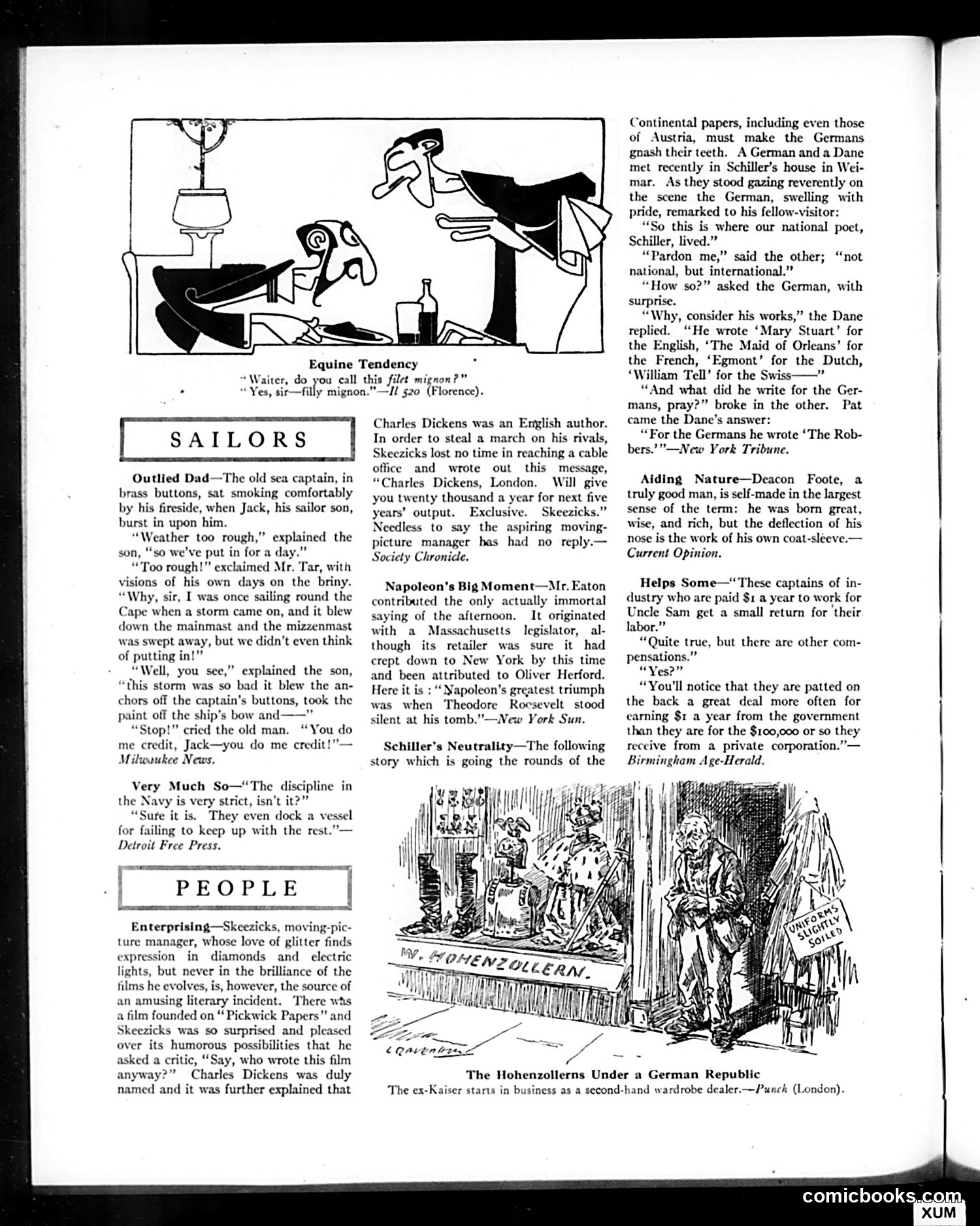
This page contains several brief satirical anecdotes and two cartoons satirizing early 20th-century American life: **Top cartoon** ("Equine Tendency"): A waiter serves a diner horse meat labeled as filet mignon—satirizing restaurants' food quality deception. **"Schiller's Neutrality"** anecdote: A German and Dane debate the playwright Schiller's national identity. The Dane notes Schiller wrote works for multiple countries, then quips that for Germans specifically, Schiller wrote "The Robbers"—a cutting joke implying Germans are thieves or morally deficient. This likely reflects pre-WWI Franco-German tensions and German territorial ambitions. **Bottom cartoon** ("The Hohenzollerns Under a German Republic"): Shows the ex-Kaiser reduced to selling second-hand clothes, mocking his fall from imperial power following Germany's WWI defeat and the 1918 revolution. Other brief jokes mock naval discipline, moving picture producers, and political corruption. The page reflects post-war American satirical attitudes toward Germany and contemporary social absurdities.
📄 Transcribed text from this page (OCR, searchable)
Machine-transcribed from the original scan — historical spelling and the odd misread are preserved.
Equine Tendency “Waiter, do bie call this filet mignon?” “Yes, sir—fil Outlied Dad he old sea captain, in brass buttons, sat smoking comfortably by his fireside, when Jack, his sailor son, burst in upon him. “Weather too rough,” explained the son, “so we've put in for a day. “Too rough!” exclaimed Mr. Tar, with visions of his own days on the briny. “Why, sir, I was once sailing round the Cape when a storm came on, and it blew down the mainmast and the mizzenmast was swept away, but we didn’t even think of putting in!” “Well, you see,” explained the son, “this storm was so bad it blew the an- chors off the captain’s buttons, took the paint off the ship’s bow and——” “Stop!” cried the old man. “You do me credit, Jack—you do me credit!”— Milwaukee News. Very Much So—‘The discipline in the y is very strict, isn’t it?” it is. They even dock a ve for ing to keep up with the rest.”— Detroit Free Press. | PEOPLE | Enterprising—Skeezicks, moving- ture manager, whose love of glitter finds expression in diamonds and_ electric lights, but never in the brilliance of the films he evolves, is, however, the source of an amusing literary incident. There was a film founded on “Pickwick Papers” and Skeezicks was so surprised and pleased its humorous possibilities that he ed a critic, “Say, who wrote this film ?” Charles Dickens was duly named and it was further explained that ly mignon.” —Il 520 (Florence). Charles Dickens was an English author. In order to steal a march on his rivals, Skeezicks lost no time in reaching a cable office and wrote out this message, “Charles Dickens, London. Will give you twenty thousand a year for next five years’ output. Exclusive. Skeezicks.”” Needless to say the aspiring moving- picture manager has had no reply.— Society Chronicle. Napoleon's Big Moment—Mrr. Eaton contributed the only actually immortal saying of the afternoon. It originated with a Massachusetts legislator, al- though its retailer was sure it had crept down to New York by this time and been attributed to Oliver Herford. Here it is : “ Napoleon's greatest triumph was when Theodore Roesevelt stood silent at his tomb.”—New York Sun. Schiller's Neutrality—The following story which is going the rounds of the Continental papers, including even those of Austria, must make the Germans gnash their teeth. A German anda Dane met recently in Schiller’s house in Wei- mar. As they stood gazing reverently on the scene the German, swelling with pride, remarked to his fellow-visitor: “So this is where our national poet, Schiller, lived.”” “Pardon me,” said the other; “not national, but international.” “How so?” asked the German, with surprise. “Why, consider his works,” the Dane replied. “He wrote ‘Mary Stuart’ for the English, ‘The Maid of Orleans’ for the French, ‘Egmont’ for the Dutch, ‘William Tell’ for the Swiss——” “And what did he write for the Ger- mans, pray?” broke in the other. Pat came the Dane’s answer: “For the Germans he wrote ‘The Rob- bers.’"—New York Tribune. Aiding Nature—Deacon Foote, a truly good man, is self-made in the largest sense of the term: he was born great, wise, and rich, but the deflection of his nose is the work of his own coat-sleeve.— Current Opinion. Helps Some—‘ These captains of in- dustry who are paid $1 a year to work for Uncle Sam get a small return for ‘their labor.” “Quite true, but there are other com- pensations.”” “Yes?” “You'll notice that they are patted on the back a great deal more often for earning $1 a year from the government than they are for the $100,000 or so they receive from a private corporation.”— Birmingham Age-Herald. The Hohenzollerns Under a German Republic The ex-Kaiser starts in business as a second-hand wardrobe dealer.—Punch (London). comicbooks,com,