
Judge, 1918-02-09 · page 14 of 36
Judge — February 9, 1918 — page 14: what you’re looking at
What you’re looking at
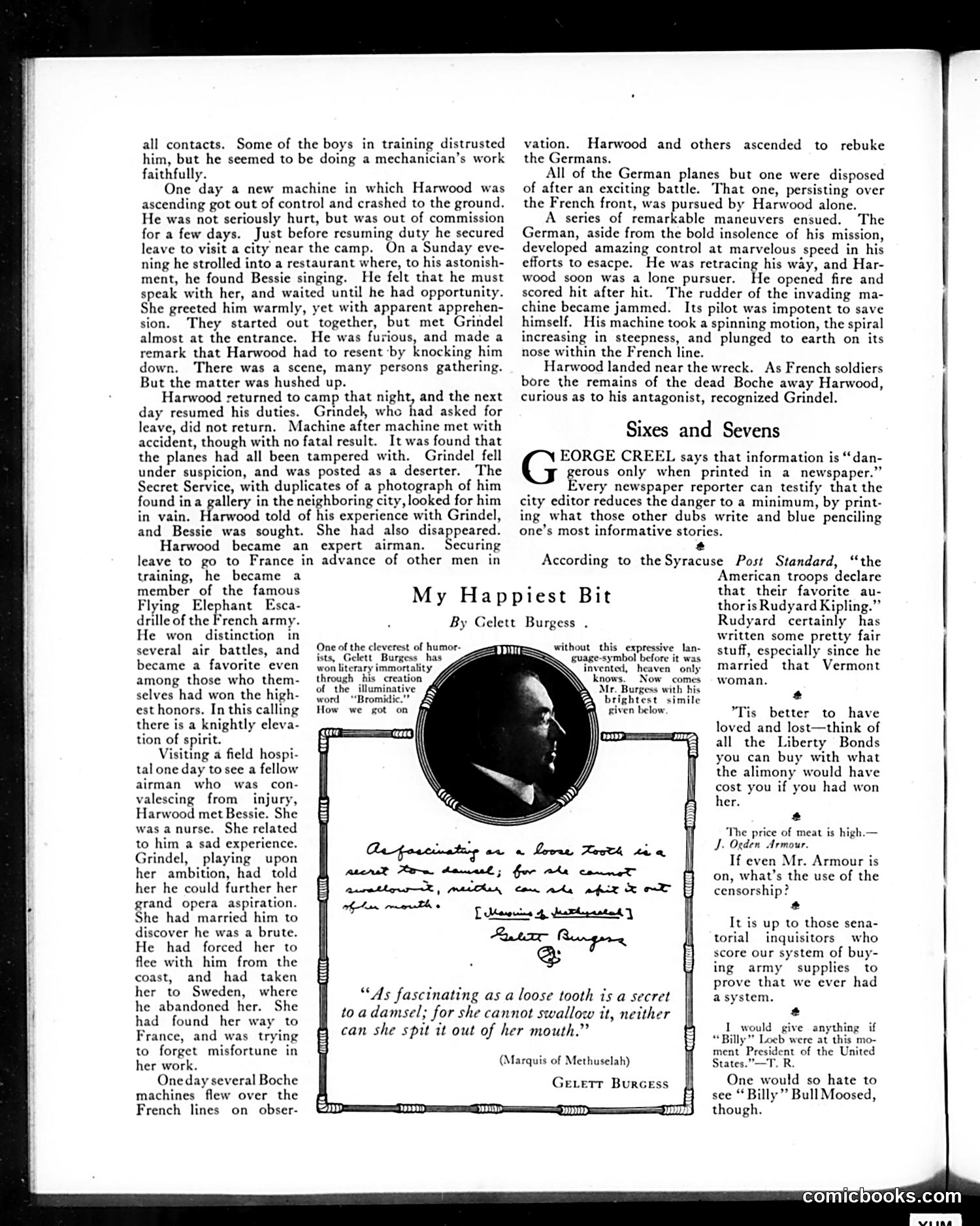
This page contains a serialized aviation adventure story interspersed with a humor section by writer Gelett Burgess. The main narrative follows airman Harwood, who discovers his rival Grindel—a saboteur and abusive husband to Harwood's love interest Bessie—is responsible for tampering with military aircraft. After becoming a decorated pilot in the French Flying Elephant Escadrille, Harwood pursues an enemy German plane in aerial combat. The climax reveals the German pilot is Grindel himself, who crashes to his death. The Burgess section offers witty aphorisms, including a quote attributed to the "Marquis of Methuselah" about secrets being difficult to conceal—clearly a humorous fabricated source. The page reflects WWI-era American entertainment: patriotic aviation heroics, romantic melodrama, and sophisticated humor targeting educated readers. The serialized format kept readers engaged across multiple issues.
📄 Transcribed text from this page (OCR, searchable)
Machine-transcribed from the original scan — historical spelling and the odd misread are preserved.
all contacts. Some of the boys in training distrusted him, but he seemed to be doing a mechanician’s work faithfully. One day a new machine in which Harwood was ascending got out of control and crashed to the ground. He was not seriously hurt, but was out of commission for a few days. Just before resuming duty he secured leave to visit a city near the camp. On a Sunday eve- ning he strolled into a restaurant where, to his astonish- ment, he found Bessie singing. He felt that he must speak with her, and waited until he had opportunity. She greeted him warmly, yet with apparent apprehen- sion. They started out together, but met Grindel almost at the entrance. He was furious, and made a remark that Harwood had to resent by knocking him down. There was a scene, many persons gathering. But the matter was hushed up. Harwood returned to camp that night, and the next day resumed his duties. Grindel, who had asked for leave, did not return, Machine after machine met with accident, though with no fatal result. It was found that the planes had all been tampered with. Grindel fell under suspicion, and was posted as a deserter. The Secret Service, with duplicates of a photograph of him found ina gallery in the neighboring city, looked for him in vain. Harwood told of his experience with Grindel, and Bessie was sought. She had also disappeared. Harwood became an expert airman. Securing leave to go to France in advance of other men in training, he became a member of the famous Flying Elephant Esca- drille of the French army. He won distinction in several air battles, and became a favorite even wonliterary immortality among those who them- through his creation selves had won the high- °%,,{he, jlluminative esthonors. In this calling How we got on there is a knightly eleva- tion of spirit. Visiting a field hospi- tal one day tosee a fellow airman who was con- valescing from injury, Harwood met Bessie. She was a nurse. She related to him a sad experience. Grindel, playing upon her ambition, had told her he could further her grand opera aspiration. She had married him to discover he was a brute. He had forced her to flee with him from the coast, and had taken her to Sweden, where he abandoned her. She had found her way to France, and was trying to forget misfortune in her work. One day several Boche machines flew over the French lines on obser- One of the cleverest of humor- ists, Gelett Burgess has My Happiest Bit By Gelett Burgess . “As fascinating as a loose tooth is a secret toadamsel; for she cannot swallow it, neither can she spit it out of her mouth.” (Marquis of Methuselah) vation. Harwood and others ascended to rebuke the Germans. All of the German planes but one were disposed of after an exciting battle. That one, persisting over the French front, was pursued by Harwood alone. A series of remarkable maneuvers ensued. The German, aside from the bold insolence of his mission, developed amazing control at marvelous speed in his efforts to esacpe. He was retracing his way, and Har- wood soon was a lone pursuer. He opened fire and scored hit after hit. The rudder of the invading ma- chine became jammed. Its pilot was impotent to save himself. His machine took a spinning motion, the spiral increasing in steepness, and plunged to earth on its nose within the French line. Harwood landed near the wreck. As French soldiers bore the remains of the dead Boche away Harwood, curious as to his antagonist, recognized Grindel. Sixes and Sevens EORGE CREEL says that information is “dan- gerous only when printed in a newspaper.” Every newspaper reporter can testify that the city editor reduces the danger to a minimum, by print- ing what those other dubs write and blue penciling one’s most informative stories. 2 According to theSyracuse Post Standard, “the American troops declare that their favorite au- thoris Rudyard Kipling.” Rudyard certainly has written some pretty fair . stuff, especially since he guage-symbol before it was 4 invented, heaven only Married that Vermont knows. Now comes woman. ‘Mr. Burgess with his “ brightest simile given below without this expressive lan- ‘Tis better to have loved and lost—think of all the Liberty Bonds you can buy with what the alimony would have cost you if you had won her. 2 ‘The price of meat is high.— J. Ogden Armour. If even Mr. Armour is on, what’s the use of the censorship? * It is up to those sena- torial inquisitors who score our system of buy- ing army supplies to prove that we ever had asystem. 2 I would give anything if “Billy” Loeb were at this mo- ment President of the United States.”—T. R. One would so hate to see “Billy” Bull Moosed, though. Gexetr Burcess comicbooks.com