
Judge, 1918-02-09 · page 33 of 36
Judge — February 9, 1918 — page 33: what you’re looking at
What you’re looking at
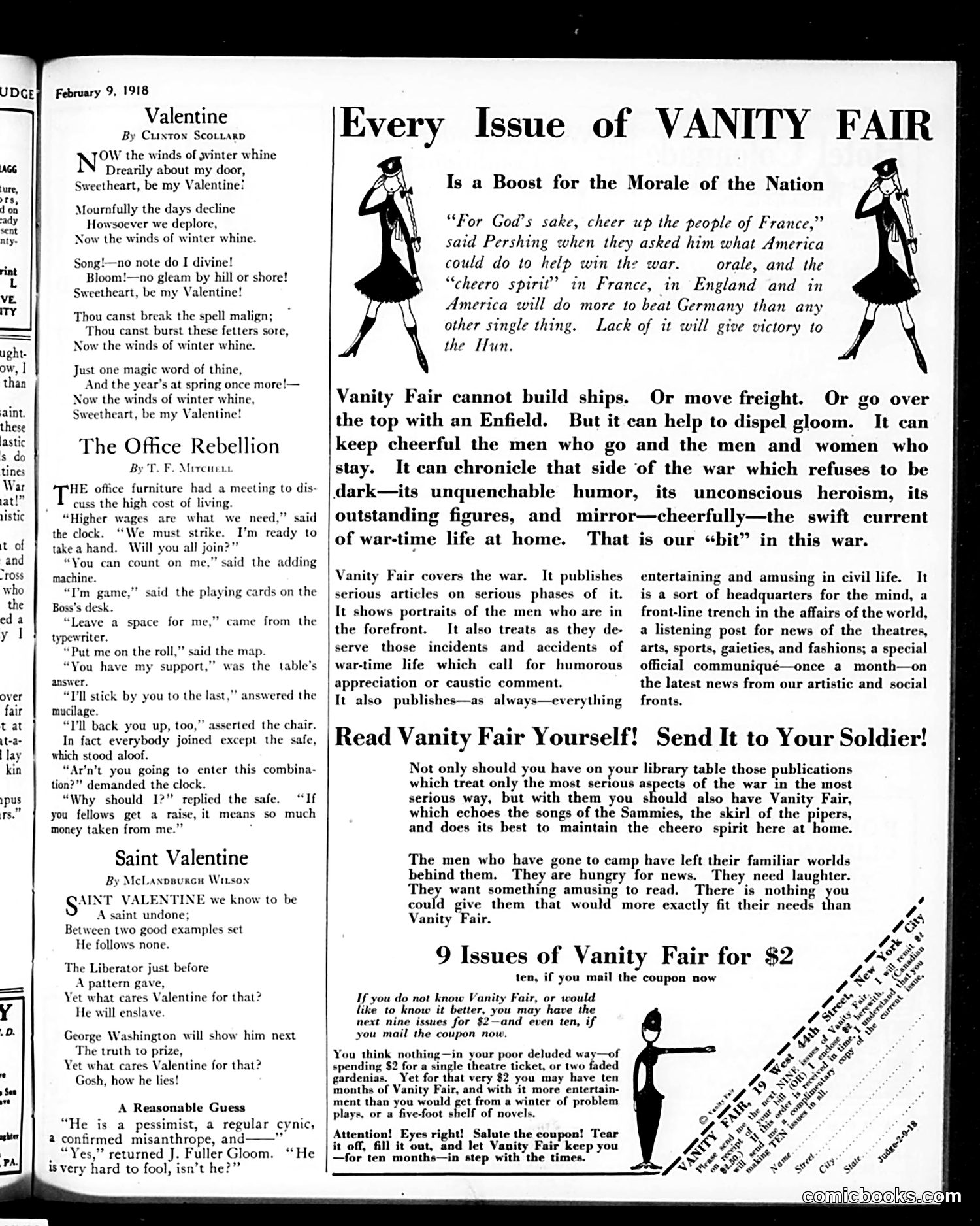
This page blends poetry, light humor, and wartime patriotic messaging. The three poems—"Valentine," "The Office Rebellion," and "Saint Valentine"—offer romantic and workplace satire unrelated to the war. The dominant content is a **Vanity Fair advertisement** quoting General Pershing, claiming morale matters as much as military hardware in defeating Germany. It argues that entertaining publications boost soldiers' and civilians' spirits during wartime—positioning Vanity Fair as contributing to the war effort through humor and human-interest stories rather than serious war coverage. The ad's rhetoric reflects 1918 American mobilization: selling magazines as patriotic duty ("our 'bit' in this war"), appealing to readers to send publications to soldiers, and framing entertainment as essential to maintaining "cheero spirit" on the home front and in camps. This is primarily **advertising dressed as editorial content**—using WWI patriotism to market a leisure magazine to civilians feeling obligated to support troops.
📄 Transcribed text from this page (OCR, searchable)
Machine-transcribed from the original scan — historical spelling and the odd misread are preserved.
ught- ow, I than aint. these astic s do tines War at!” istic it of and -TOSS who the eda February 9. 1918 Valentine By Cuxton Scontarp Now the winds of svinter whine Drearily about my door, Sweetheart, be my Valentine! Mournfully the days decline Howsoever we deplore, Now the winds of winter whine. Song!—no note do I divine! Bloom!—no gleam by hill or shore! Sweetheart, be my Valentine! Thou canst break the spell malign; Thou canst burst these fetters sore, Now the winds of winter whine. Just one magic word of thine, And the year’s at spring once more!— Now the winds of winter whine, Sweetheart, be my Valentine! The Office Rebellion By T. F. Mirenent HE office furniture had a meeting to dis- cuss the high cost of living. “Higher wages are what we need,” said the clock. ‘We must strike. I’m ready to takea hand. Will you all join?” “You can count on me,” said the adding machine. “I'm game,” said the playing cards on the Boss's desk. “Leave a space for me,” came from the typewriter. “Put me on the roll,” said the map. “You have my support,’ was the table's answer. “Vl stick by you to the last,” answered the mucilage. “T'll back you up, too, serted the chair. In fact everybody joined except the safe, which stood aloof. “Ar’n’t you going to enter this combina- tion?” demanded the clock. “Why should 1?” replied the safe. “If you fellows get a raise, it means so much money taken from me.” : Saint Valentine By McLaxpnurcn Witsos AINT VALENTINE we know to be A saint undon Between two good examples set He follows none. The Liberator just before A pattern gave, Yet what cares Valentine for that? He will enslave. George Washington will show him next The truth to prize, Yet what cares Valentine for that? Gosh, how he lies! A Reasonable Guess “He is a pessimist, a regular cynic, a confirmed misanthrope, and ” “Yes,” returned J. Fuller Gloom. ‘He is very hard to fool, isn’t he? Every Issue of VANITY FAIR Is a Boost for the Morale of the Nation “For God’s sake, cheer up the people of France,” said Pershing when they asked him what America could do to help win the war. orale, and the “‘cheero spirit” in France, in England and in America will do more to beat Germany than any other single thing. Lack of it will give victory to the Hun. Vanity Fair cannot build ships. Or move freight. Or go over the top with an Enfield. But it can help to dispel gloom. It can keep cheerful the men who go and the men and women who stay. It can chronicle that side of the war which refuses to be dark—its unquenchable humor, its unconscious heroism, its outstanding figures, and mirror—cheerfully—the swift current of war-time life at home. That is our “bit” in this war. Vanity Fair covers the war. It publishes entertaining and amusing in civil life. It serious articles on serious phases of it. is a sort of headquarters for the mind, a It shows portraits of the men who are in front-line trench in the affairs of the world, the forefront. It also treats as they de- a listening post for news of the theatres, serve those incidents and accidents of arts, sports, gaieties, and fashions; a special war-time life which call for humorous official communiqué—once a month—on appreciation or caustic comment. the latest news from our artistic and social It also publishes—as always—everything — fronts. Read Vanity Fair Yourself! Send It to Your Soldier! Not only should you have on your library table those publications which treat only the most serious aspects of the war in the most serious way, but with them you should also have Vanity Fair, which echoes the songs of the Sammies, the skirl of the pipers, and does its best to maintain the cheero spirit here at home. The men who have gone to camp have left their familiar worlds behind them. They are hungry for news. They need laughter. They want something amusing to read. There is nothing you could give them that would more exactly fit their needs than y Vanity Fair. 9 Issues of Vanity Fair for $2 ten, if you mail the coupon now If you do not know Vanity Fair, or would like to know it better, you may have the next nine issues for §: ind even ten, if you mail the coupon now. You think nothing—in your poor deluded way—of spending $2 for a single theatre ticket, or two faded gardenias. Yet for that very $2 you may have ten months of Vanity Fair, and with it more entertain- ment than you would get from a winter of problem plays, or a five-foot shelf of novels. Attention! Eyes right! Salute the coupon! Tear it off, fill it out, and let Vanity Fair keep you —for ten months—in step with the times.