
Judge, 1918-02-09 · page 23 of 36
Judge — February 9, 1918 — page 23: what you’re looking at
What you’re looking at
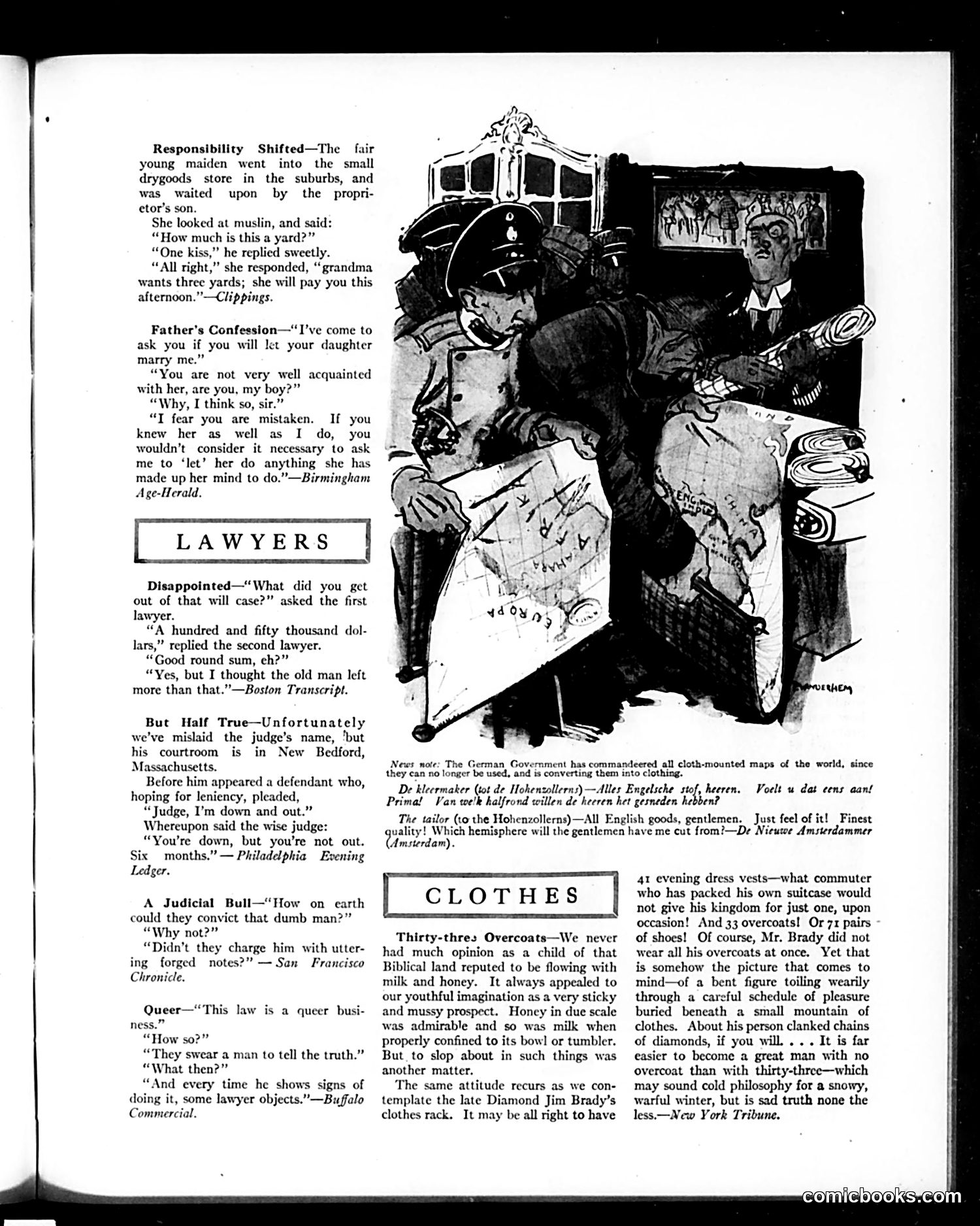
This page from Judge contains several satirical anecdotes mocking lawyers and judges, plus commentary on wealth excess. The **lawyers section** ridicules the profession through short jokes: one depicts a lawyer profiting enormously from a will case while suspecting the deceased left even more; another shows a judge sentencing a man who claims poverty, cynically noting he's "down" but not "out"; a third mocks lawyers for objecting whenever witnesses attempt to tell the truth. The **main cartoon** (upper right) depicts a German tailor showing cloth-mounted world maps—now commandeered by the German government and being converted into clothing for the Hohenzollerns (German royal family). This is WWI-era satire: Germany, presumably losing access to global maps due to Allied blockade, supposedly resorts to shredding them for fabric. The joke mocks German desperation and the absurdity of war shortages. The **clothes section** criticizes excessive wealth through Diamond Jim Brady's wardrobe (33 overcoats, 71 shoe pairs), suggesting that obscene accumulation reflects not success but spiritual emptiness—a cautionary note during wartime.
📄 Transcribed text from this page (OCR, searchable)
Machine-transcribed from the original scan — historical spelling and the odd misread are preserved.
Responsibility Shifted—The fair young maiden went into the small drygoods store in the suburbs, and was waited upon by the propri- etor’s son. She looked at muslin, and said: “How much is this a yard?” “One kiss,” he replied sweetly. “All right,” she responded, ‘grandma wants three yards; she will pay you this afternoon.”—Clip pings. Father's Confession—‘I’ve come to ask you if you will let your daughter marry me.” “You are not very well acquainted with her, are you, my boy?” “Why, I think so, sir.” “I fear you are mistaken. If you knew her as well as I do, you wouldn’t consider it necessary to ask me to ‘let’ her do anything she has made up her mind to do.”—Birmingham Age-Herald. | LAWYERS | Disappointed—“What did you get out of that will case?” asked the first lawyer. “A hundred and fifty thousand dol- lars,” replied the second lawyer. “Good round sum, eh?” “Yes, but I thought the old man left more than that.”—Boston Transcript. But Half True—Unfortunately we've mislaid the judge’s name, ‘but his courtroom is in New Bedford, Massachusetts. Before him appeared a defendant who, hoping for leniency, pleaded, “Judge, I’m down and out.” Whereupon said the wise judge: “You're down, but you're not out. Six months.” — Philadelphia Evening Ledger. A Judicial Bull—“‘How on earth could they convict that dumb man?” “Why not?” “Didn't they charge him with utter- ing forged notes?” — San Francisco Chronicle. Queer—“This law is a queer busi- ness.” “How so?” “They swear a man to tell the truth.” “What then?” “And every time he shows signs of doing it, some lawyer objects.”—Buffalo Commercial. News note: The German Government has commandeered all cloth-mounted maps of the world, since they can no longer be used, and is converting them into clothing. De kleermaker (tot de Hohenzollerns)—Alles Engelsche stof, heeren. Voelt u dat eens aanf Prima! Van welk halfrond willen de heeren het gesneden hebben? The tailor (to the Hohenzollerns)—All English goods, gentlemen. Just feel of it! Finest guality! Which hemisphere will the gentlemen have me cut from?—De Nieuwe Amsterdammer Ctmsierdam). | CLOTHES | Thirty-thres Overcoats—We never had much opinion as a child of that Biblical land reputed to be flowing with milk and honey. It always appealed to our youthful imagination as a very sticky and mussy prospect. Honey in due scale was admirable and so was milk when properly confined to its bow! or tumbler. But to slop about in such things was another matter. The same attitude recurs as we con- template the late Diamond Jim Brady’s clothes rack. It may be all right to have 41 evening dress vests—what commuter who has packed his own suitcase would not give his kingdom for just one, upon occasion! And 33 overcoats! Or 71 pairs of shoes! Of course, Mr. Brady did not wear all his overcoats at once. Yet that is somehow the picture that comes to mind—of a bent figure toiling wearily through a careful schedule of pleasure buried beneath a small mountain of clothes. About his person clanked chains of diamonds, if you will... It is far easier to become a great man with no overcoat than with thirty-three—which may sound cold philosophy for a snowy, warful winter, but is sad truth none the less.—New York Tribune.