
Judge, 1918-02-09 · page 24 of 36
Judge — February 9, 1918 — page 24: what you’re looking at
What you’re looking at
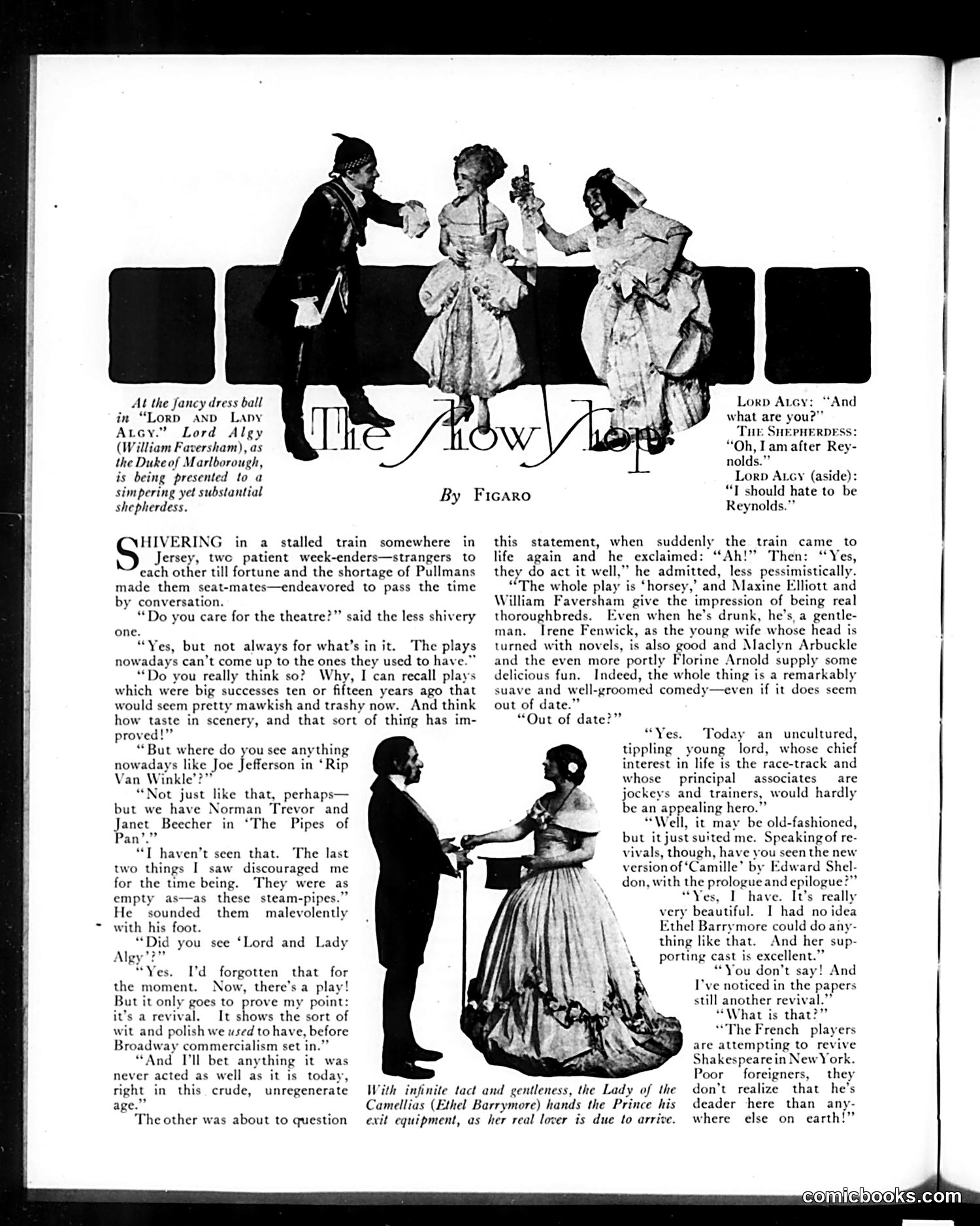
This page satirizes early 20th-century Broadway's nostalgia for older theatrical productions. Two train passengers debate whether modern plays compare to classics—a typical middlebrow conversation about cultural decline. The cartoon mocks contemporary tastes by featuring actual 1912-era stage revivals: *Lord and Lady Algy* (with actors William Faversham and Maxine Elliott) and Edward Sheldon's new *Camille* adaptation (with Ethel Barrymore). The sketch shows Lord Algy in costume at a fancy dress ball, accosting a shepherdess—illustrating the play's dated aristocratic frivolity. The satire's target: American audiences romanticizing "old-fashioned" British comedies while dismissing contemporary work, yet paradoxically proving such revivals successful. The closing dig at French attempts to revive Shakespeare in New York suggests European highbrow culture is irrelevant to American commercial theater—dead on arrival.
📄 Transcribed text from this page (OCR, searchable)
Machine-transcribed from the original scan — historical spelling and the odd misread are preserved.
Ab the fancy dress ball in “Lorp anv Lapy Aucy.” Lord Algy (William Faversham), as the Duke of Marlborough, is being presented to a simpering yet substantial shepherdess. HIVERING in a stalled train somewhere in Jersey, two patient week-enders—strangers to each other till fortune and the shortage of Pullmans made them seat-mates—endeavored to pass the time by conversation. “Do you care for the theatre?” said the less shivery one. “Yes, but not always for what’s in it. The plays nowadays can’t come up to the ones they used to have.” “Do you really think so? Why, I can recall plays which were big successes ten or fifteen years ago that would seem pretty mawkish and trashy now. And think how taste in scenery, and that sort of thing has im- proved!” “But where do you see anything nowadays like Joe Jefferson in ‘Rip Van Winkle’?” “Not just like that, perhaps— but we have Norman Trevor and Janet Beecher in ‘The Pipes of Pan’.? “T haven’t seen that. The last two things I saw discouraged me for the time being. They were as empty as—as these steam-pipes.” He sounded them malevolently with his foot. “Did you see ‘Lord and Lady Alg: “Yes. I'd forgotten that for the moment. Now, there's a play! But it only goes to prove my point: it’s a revival. It shows the sort of wit and polish we used to have, before Broadway commercialism set in.” “And I'll bet anything it w: never acted as well as it today, right in this crude, unregenerate age.” The other was about to question By Ficaro With infinite tact and gentleness, the Lady of the Camellias (Ethel Barrymore) hands the Prince his exit equipment, as her real lover is due to arrive. where else on earth!” Loxp Atcy: “And what are you?” ‘Tue SHEPHERDESS: “Oh, Iam after Rey nolds.”” Lorp Axcy (aside): “T should hate to be Reynolds.” this statement, when suddenly the train came to life again and he exclaimed: “Ah!” Then: “Yes, they do act it well,” he admitted, less pessimistically. “The whole play is ‘horsey,’ and Maxine Elliott and William Faversham give the impression of being real thoroughbreds. Even when he’s drunk, he’s, a gentle- man. Irene Fenwick, as the young wife whose head is turned with novels, is also good and Maclyn Arbuckle and the even more portly Florine Arnold supply some delicious fun. Indeed, the whole thing is a remarkably suave and well-groomed comedy—even if it does seem out of date.” “Out of date “Yes. Today an uncultured, tippling young lord, whose chief interest in life is the race-track and whose principal associates are jockeys and trainers, would hardly be an appealing hero.” “Well, it may be old-fashioned, but itjust suited me. Speaking of re- vivals, though, have you seen the new version of ‘Camille’ by Edward Shel- don, with the prologue and epilogue?” \ “Yes, I have. It’s really very beautiful. I had no idea Ethel Barrymore could do any- thing like that. And her sup- porting cast is excellent.” “You don’t say And I’ve noticed in the papers still another revival. “What is that? The French pl are attempting to revive Shakespeare in NewYork. Poor foreigners, they don’t realize that he’s deader here than any-