
Judge, 1918-02-09 · page 19 of 36
Judge — February 9, 1918 — page 19: what you’re looking at
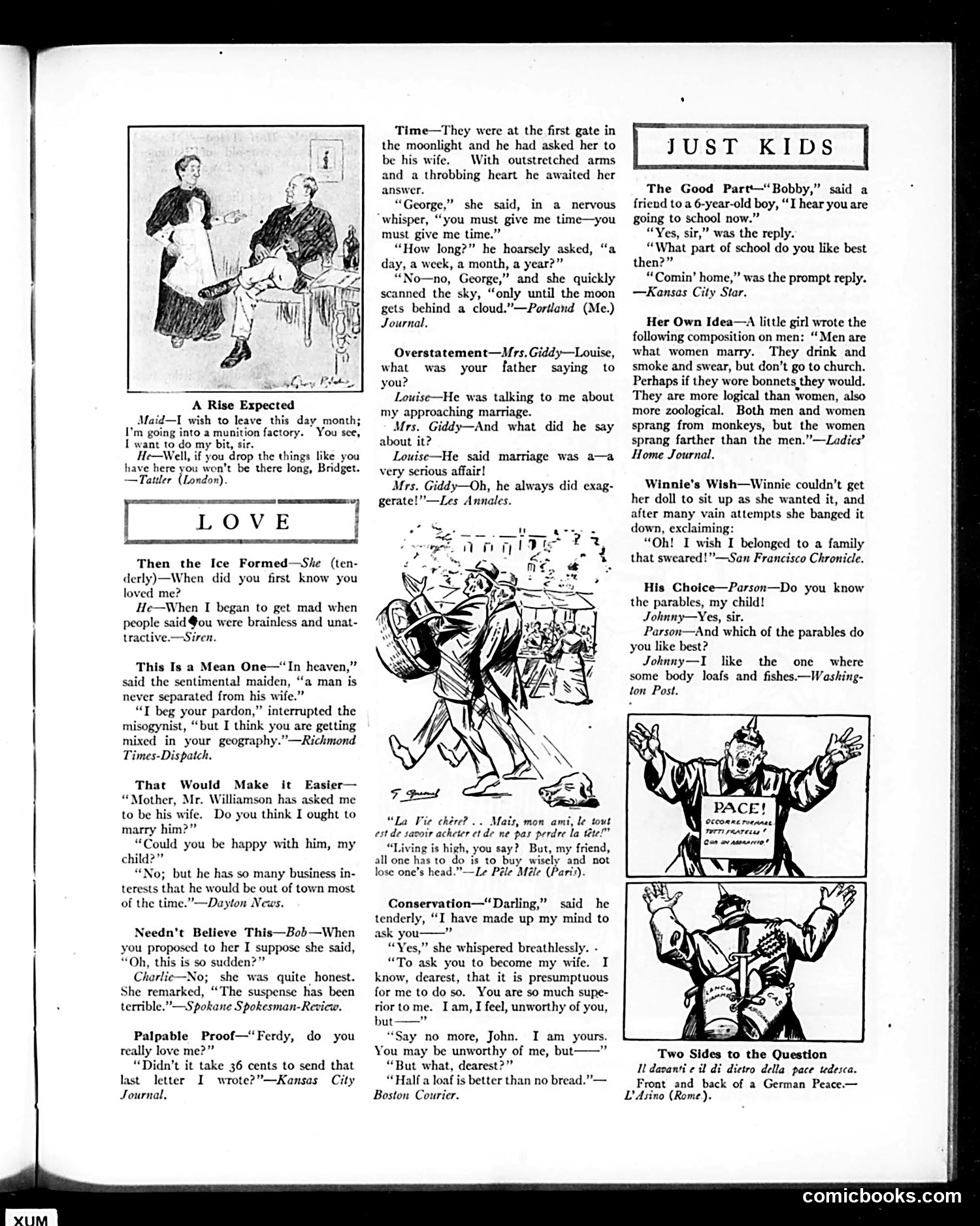
What you’re looking at
This page from the satirical magazine *Judge* collects brief humorous anecdotes and cartoons on themes of love, marriage, and courtship—typical early 20th-century humor. **Key content:** The main cartoons mock romantic conventions. "A Rise Expected" jokes about a maid joining munition factories during wartime (likely WWI), with the employer suggesting she'll fail due to clumsiness. The "Time" piece depicts a marriage proposal where the woman's hesitation is absurdly literal—she'll only agree until the moon hides behind a cloud. Other items satirize marriage's realities: women's practical views of husbands ("Half a loaf is better than no bread"), masculine shortcomings (a girl's composition notes men "drink and swear"), and the gap between romantic declarations and economic necessity. The French cartoon addresses wartime inflation ("Living is high"), advising wise purchasing. **Overall message:** The satire exposes the gap between romantic idealization and practical married life, with particular emphasis on women's unsentimental views of matrimony—a subversive theme for the era.
📄 Transcribed text from this page (OCR, searchable)
Machine-transcribed from the original scan — historical spelling and the odd misread are preserved.
A Rise Expected Maid—I wish to leave this day month; I'm going into a munition factory. You sce, I want to do my bit, sir. He—Well, if you drop the things like you have here you won't be there long, Bridget. —Tatiler (London). 3 Then the Ice Formed—She (ten- derly)—When did you first know you loved me? He—When I began to get mad when people said Gou were brainless and unat- tractive.—Siren. OVE H This Is a Mean One—“In heaven,” said the sentimental maiden, ‘‘a man is never separated from his wife.” “T beg your pardon,” interrupted the misogynist, “but I think you are getting mixed in your geography.”—Richmond Times-Dispatch. That Would Make it Easier— “Mother, Mr. Williamson has asked me to be his wife. Do you think I ought to marry him?” “Could you be happy with him, my child?” “No; but he has so many business in- terests that he would be out of town most of the time.”—Dayton News. Needn't Believe This—Bob—When you proposed to her I suppose she said, s is so sudden?” Charlie—No; she was quite honest. She remarked, “The suspense has been terrible.” —Spokane Spokesman-Revicw. Palpable Proof—‘Ferdy, do you really love me?” “Didn't it take 36 cents to send that last letter I wrote?”—Kansas City Journal, Time—Thcey were at the first gate in the moonlight and he had asked her to be his wife. With outstretched arms and a throbbing heart he awaited her answer. “George,” she said, in a nervous whisper, “you must give me time—you must give me time.” “How long?” he hoarsely asked, “a day, a week, a month, a year?” “No—no, George,” and she quickly scanned the sky, “only until the moon gets behind a cloud.”—Portland (Me.) Journal. Overstatement—Mrs. Giddy—Louise, what was your father saying to you? Louise—He was talking to me about my approaching marriage. Mrs. Giddy—And what did he say about it? Louise—He said marriage was a—a very scrious affair! Mrs. Giddy—Oh, he always did exag- gerate!”"—Les Annales. “La Vie chére? .. Mais, mon ami, le tout est de savoir acheter et de ne pas perdre ta sete!” “Living is high, you say? But, my friend, all one has to do’ is to buy wisely and not lose one’s head.” —Le Péle Méle (Paris). Conservation—“ Darling,” said he tenderly, “I have made up my mind to ask you——” “Yes,” she whispered breathlessly. - “To ask you to become my wife. I know, dearest, that it is presumptuous for me to do so. You are so much supe- rior tome. Iam, I feel, unworthy of you, but——” “Say no more, John. I am yours. You may be unworthy of me, but——” “But what, dearest?” “Half a loaf is better than no bread.”— Boston Courier. The Good Partt—“Bobby,” said a friend to a 6-year-old boy, “I hear you are going to school now.” “Yes, sir,” was the reply. “What part of school do you like best then?” “ Comin’ home,” was the prompt reply. —Kansas City Star. Her Own Idea—A little girl wrote the following composition on men: “ Men are what women marry. They drink and smoke and swear, but don’t go to church. Perhaps if they wore bonnets they would. They are more logical than Women, also more zoological. Both men and women sprang from monkeys, but the women sprang farther than the men.”—Ladies’ Home Journal. Winnie’s Wish—Winnie couldn't get her doll to sit up as she wanted it, and after many vain attempts she banged it down, exclaiming: “Oh! I wish I belonged to a family that sweared!”—San Francisco Chronicle. His Choice—Parson—Do you know the parables, my child! Johnny—Yes, sir. Parson—And which of the parables do you like best? Johnny—I_ like the one where some body loafs and fishes.—Washing- ton Post. Two Sides to the Question Ui davanti e il di dietro della pace tedesca, Front and back of a German Peace.— L’Asino (Rome). comicbooks.com