
A complete issue · 48 pages · 1928
Life — October 5, 1928
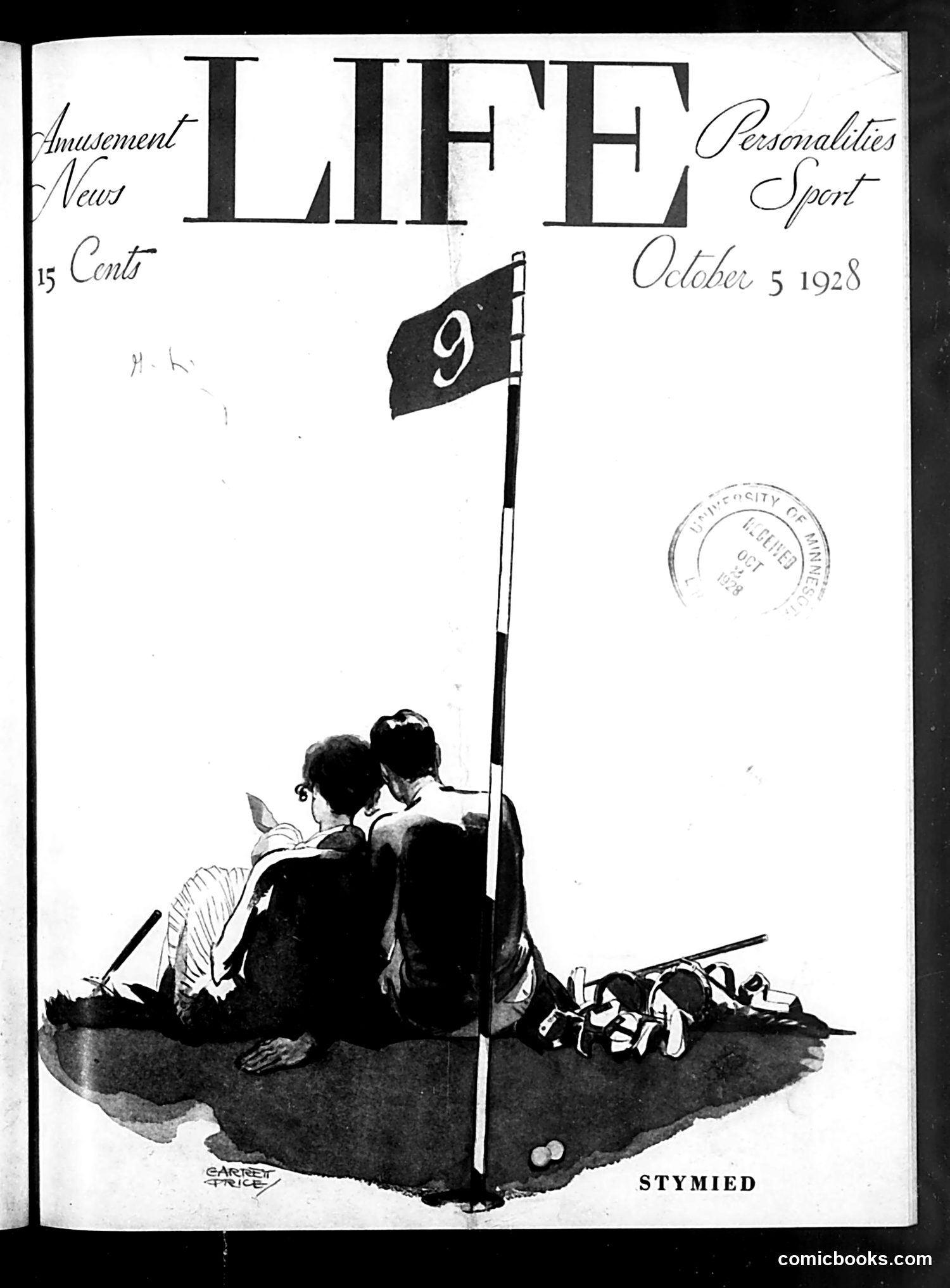
This cover illustration by Stymied depicts two figures sitting in a small boat marked with the number 9, holding a flag also numbered 9. They appear to be golf enthusiasts surrounded by scattered golf clubs. The "9" likely refers to the ninth hole in golf. The cartoon appears to be a sports-themed satire about golf culture, suggesting people are so absorbed in the game that they're lost or stranded—hence the boat setting incongruously paired with golf equipment. Without additional context, the specific satirical target remains unclear, though it likely comments on golf's popularity during the 1920s leisure culture or a particular sports personality of that era. The image's humor relies on the absurdist contrast between golfing and maritime circumstances.
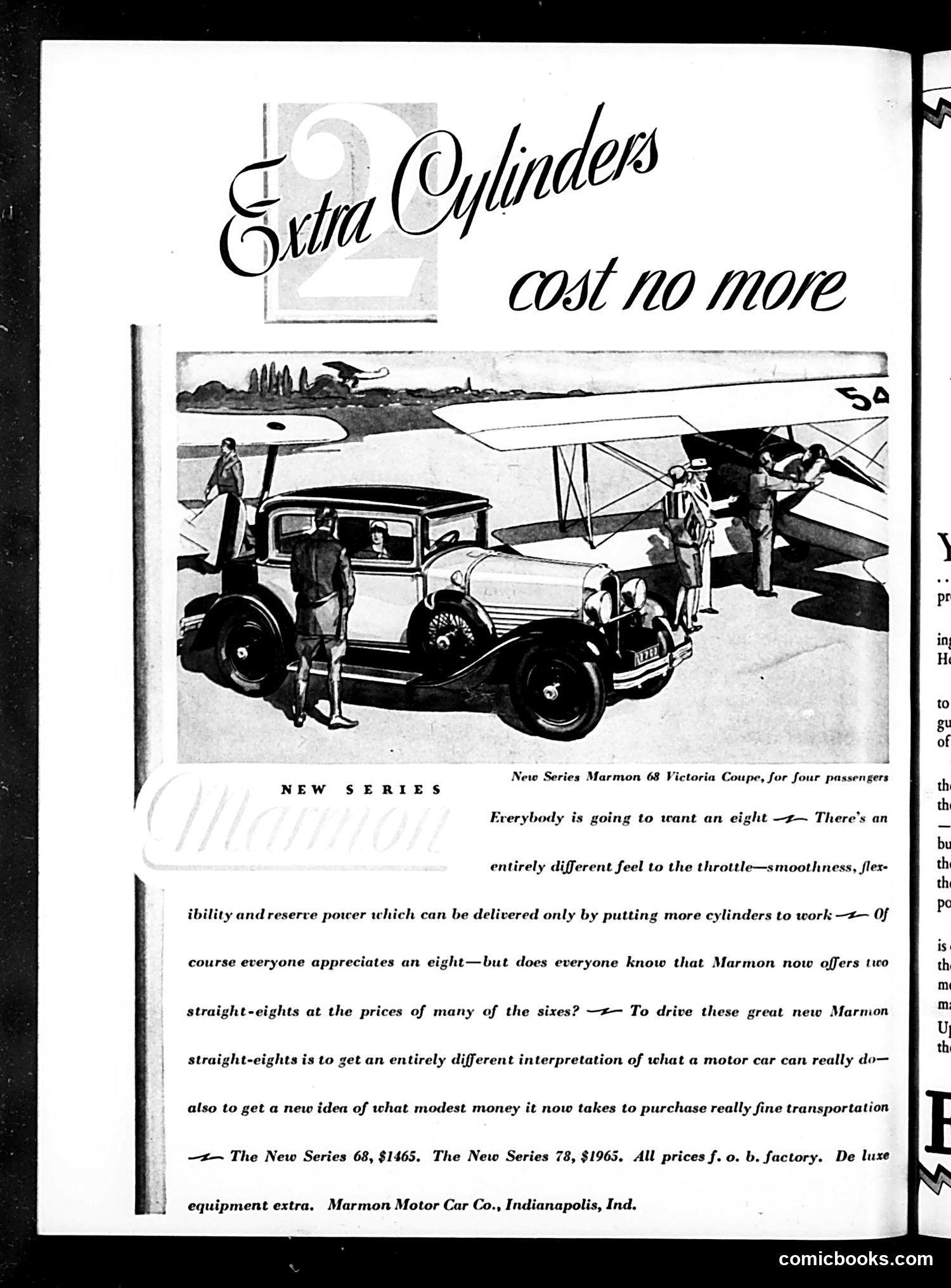
This is **not a political cartoon or satire** — it's a straightforward automobile advertisement for the Marmon Motor Car Company of Indianapolis, Indiana. The ad promotes Marmon's new "straight-eight" engine models (Series 68 and 78), emphasizing that eight cylinders no longer cost significantly more than six-cylinder vehicles. The illustration shows a 1920s Victoria Coupe displayed at what appears to be an airfield, with period-dressed figures and aircraft in the background — imagery meant to convey modernity, sophistication, and progress. The copy argues that buyers can now afford high-performance, smooth-running eight-cylinder cars at prices comparable to cheaper six-cylinder alternatives, positioning Marmon as offering "fine transportation" at modest cost. This is purely commercial advertising with no satirical or political content.
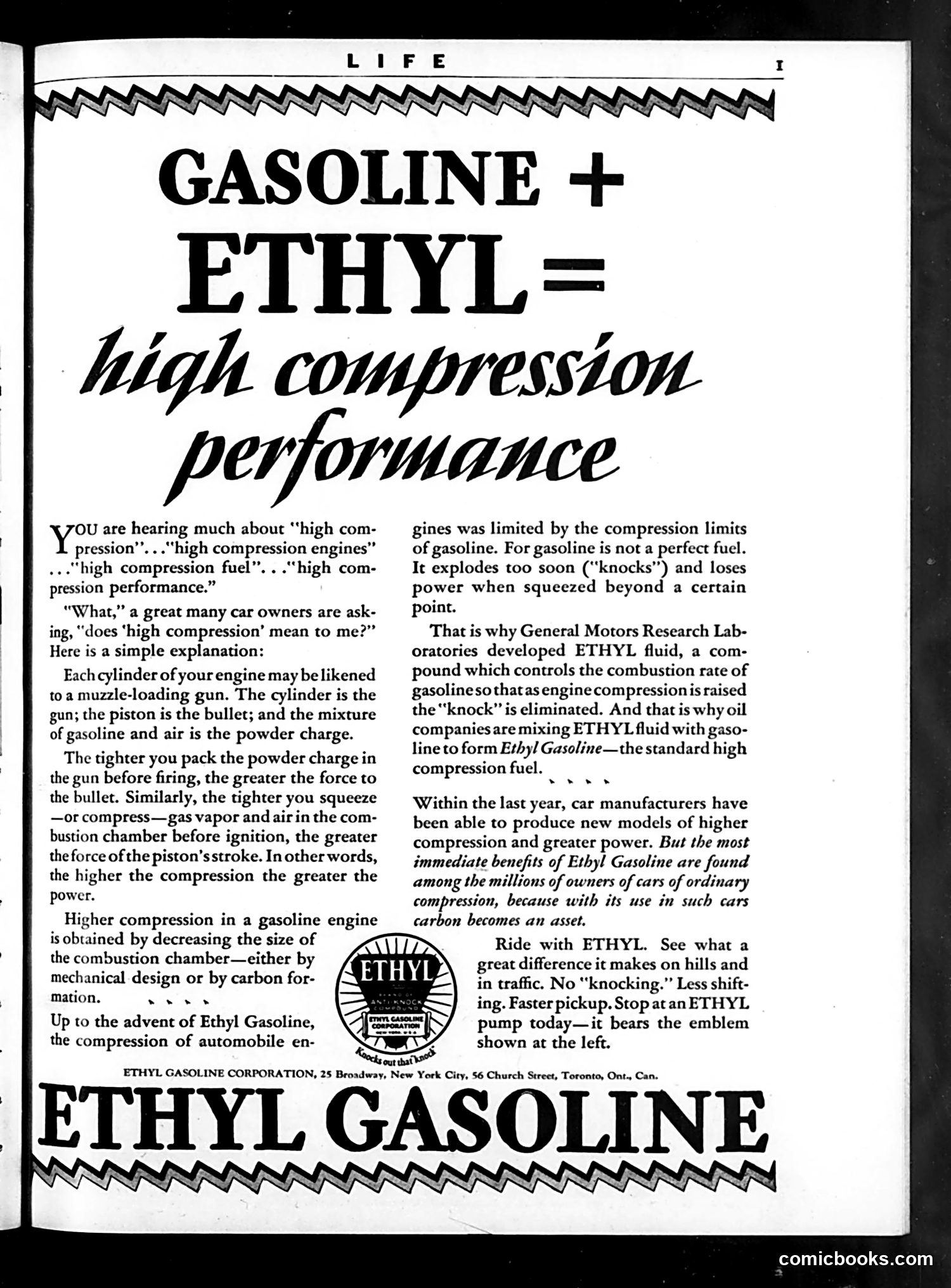
This is **not a cartoon or satire page** — it's a straightforward advertisement for Ethyl Gasoline, published in *Life* magazine. The ad explains a technical concept to ordinary readers: "high compression" engines require specially formulated fuel to prevent "knocking" (premature combustion). The copy uses a muzzle-loading gun analogy to make the physics accessible. General Motors Research Laboratories developed Ethyl fluid (tetraethyl lead) as an anti-knock additive mixed into gasoline. The ad claims this allows car manufacturers to build more powerful engines while eliminating the knocking problem ordinary drivers experienced. There is no political satire here — it's educational advertising promoting a commercial product as solving a real automotive problem.
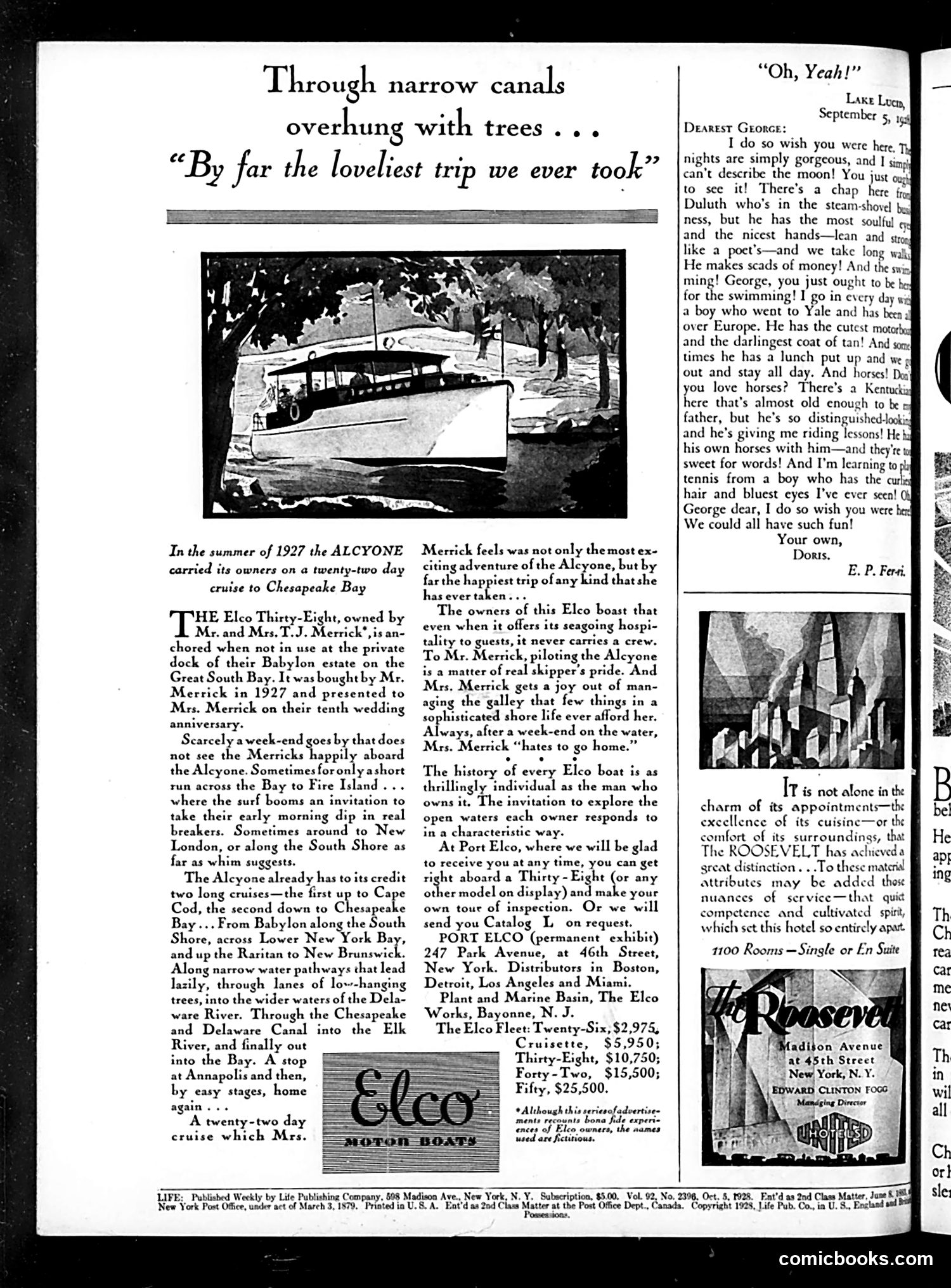
This page is primarily **advertising and lifestyle content**, not political satire. The main feature is a promotional article about the Alcyone, an Elco motorboat owned by Mr. and Mrs. T.J. Merrick, presented as a gift on their tenth wedding anniversary. The article describes their 22-day cruise to Chesapeake Bay and highlights the boat's luxurious appointments and seaworthiness. A personal letter from E.P. Fari to "Dearest George" praises the boat and the Merricks' hospitality. The page includes Elco boat advertisements and pricing information, plus a Roosevelt Hotel advertisement. There is no political cartoon or satirical content visible—this represents typical 1920s **lifestyle marketing** in Life magazine, targeting affluent leisure travelers.
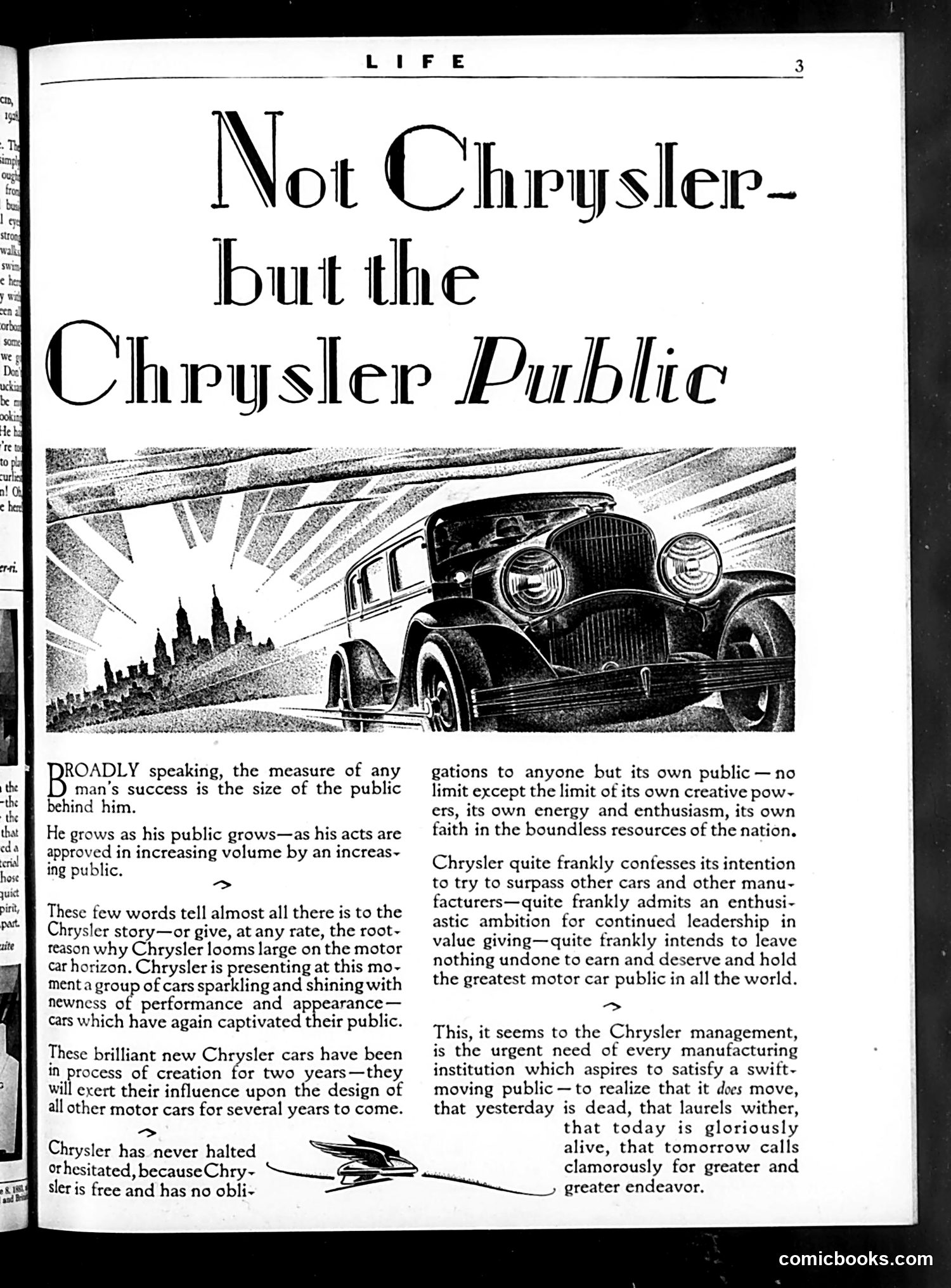
This is **not a satirical cartoon** but rather **paid advertising** for Chrysler automobiles, published in Life magazine. The ad's headline uses a play on words—"Not Chrysler- but the Chrysler Public"—suggesting that Chrysler's real strength comes from public support rather than the company itself. The accompanying illustration shows a sleek 1920s-era automobile with dramatic radiating lines suggesting motion and progress. The text emphasizes Chrysler's ambition to lead the automobile industry through superior design and manufacturing. It argues that a company's success depends on public approval, and that Chrysler has earned this through quality vehicles that appeal to consumers. This represents straightforward corporate messaging rather than satire or political commentary.
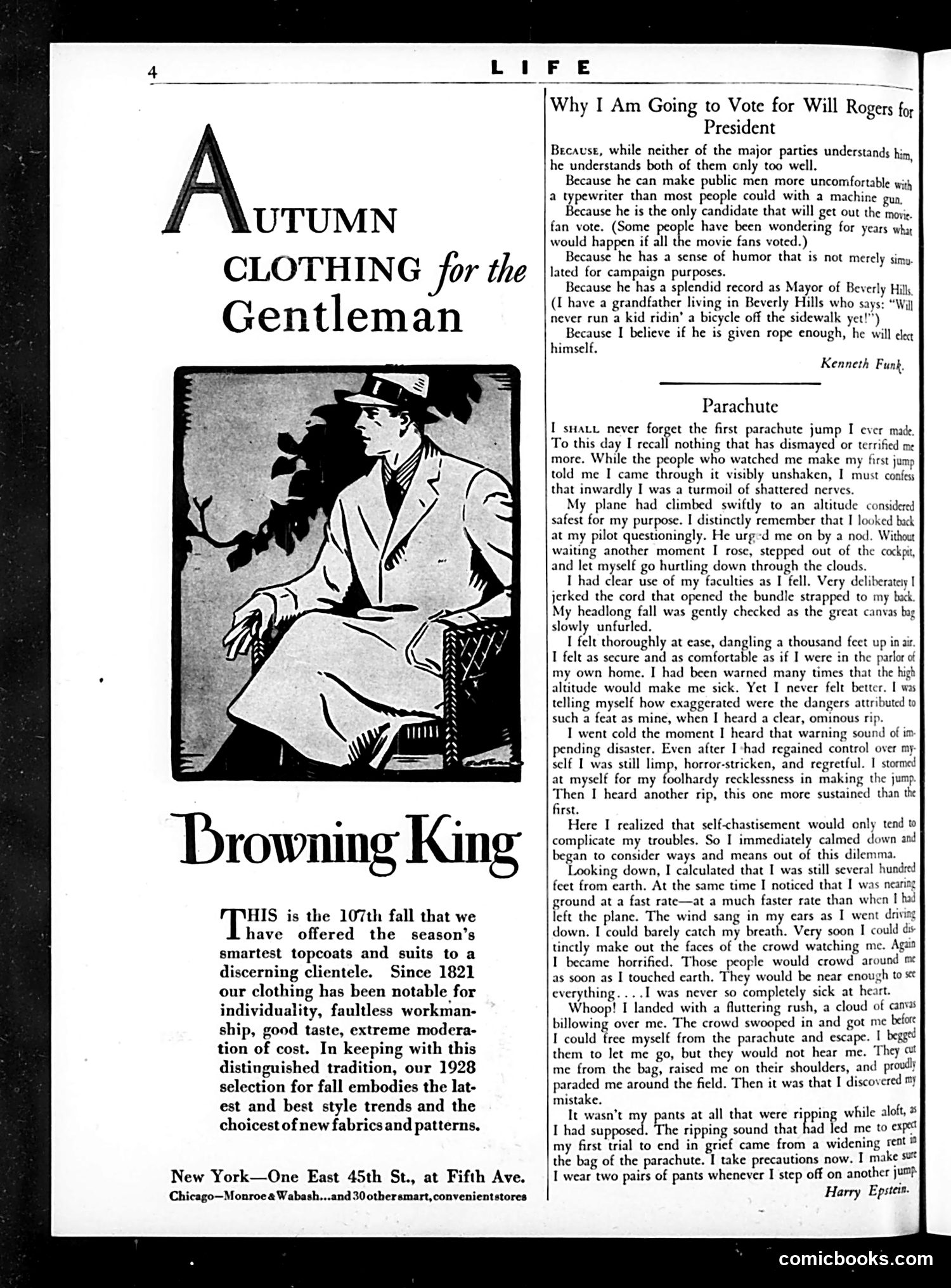
This page contains primarily **commercial advertising** for Browning King autumn clothing, featuring an illustration of a well-dressed gentleman in a suit and hat. The right column includes two **opinion pieces**: one titled "Why I Am Going to Vote for Will Rogers for President" by Kenneth Funk, endorsing Rogers (the famous humorist and entertainer) as a presidential candidate based on his humor and record as Mayor of Beverly Hills. The second piece, "Parachute" by Harry Epstein, is a first-person account describing the author's harrowing experience making his first parachute jump. Neither content constitutes political satire. The Will Rogers endorsement is a genuine (if humorous) campaign statement, while the parachute narrative is experiential memoir. The page primarily serves as a vehicle for both advertising and lifestyle/opinion content typical of 1920s Life magazine.
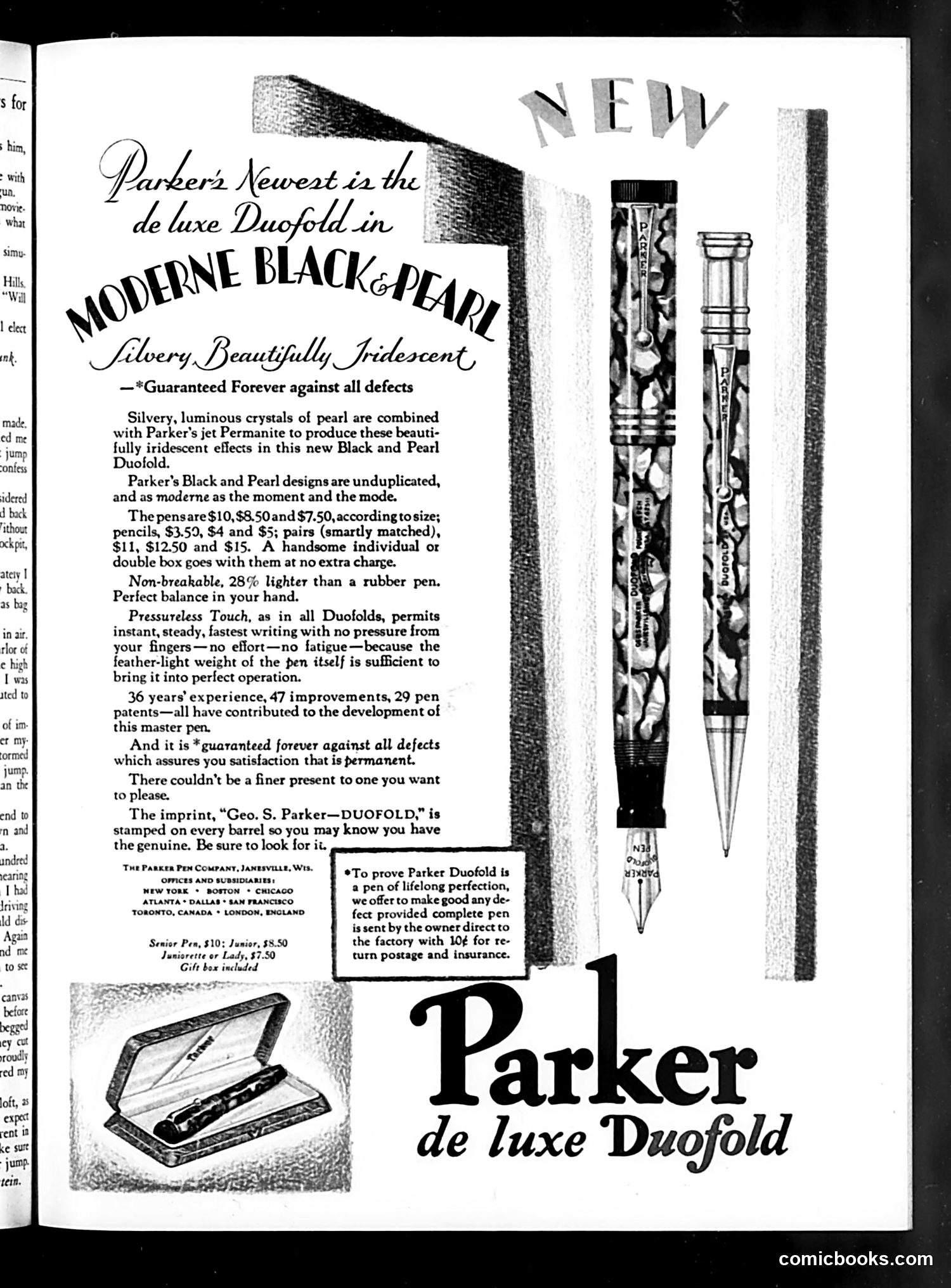
This page is primarily **advertising content**, not satirical commentary. It promotes Parker's "de luxe Duofold" fountain pen in the new "Moderne Black & Pearl" design. The ad emphasizes luxury features: pearl inlay, iridescent effects, and pressureless writing technology. Prices range from $3-$7.50 for pencils to $10-$15 for pen pairs. Key selling points include durability ("guaranteed forever against all defects"), design ("as moderne as the moment"), and engineering credentials (citing 26 years' experience and 47 improvements). The visual displays ornate pen designs and an open gift box. A small box notes Parker's quality-assurance process: defective pens are replaced after sending to the factory with 10¢ postage. This represents early 20th-century premium product marketing emphasizing craftsmanship and reliability.
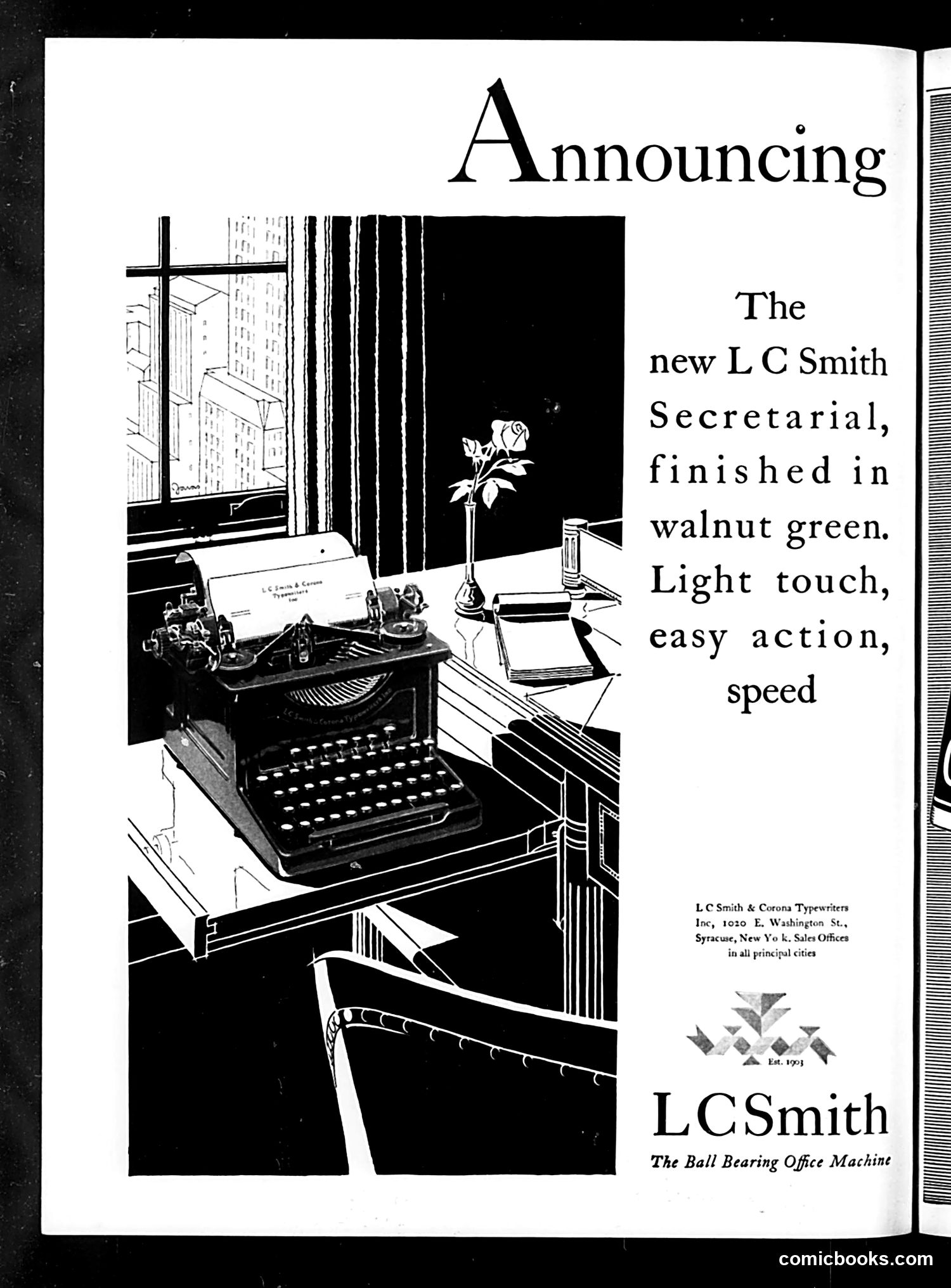
This is an advertisement, not editorial or satirical content. It announces the "new L C Smith Secretarial" typewriter, finished in walnut green, marketed with features like "light touch, easy action, speed." The image shows a typewriter positioned on a desk in an office setting with a window, flowers, and papers—a stylized representation of professional workspace typical of the era. The ad emphasizes practical office benefits rather than making any political or social commentary. There are no cartoons, caricatures, or satirical elements present. This appears to be a straightforward product advertisement from an early-to-mid twentieth century issue of *Life* magazine, using aspirational imagery of modern office work to sell typewriters to secretaries and office workers.
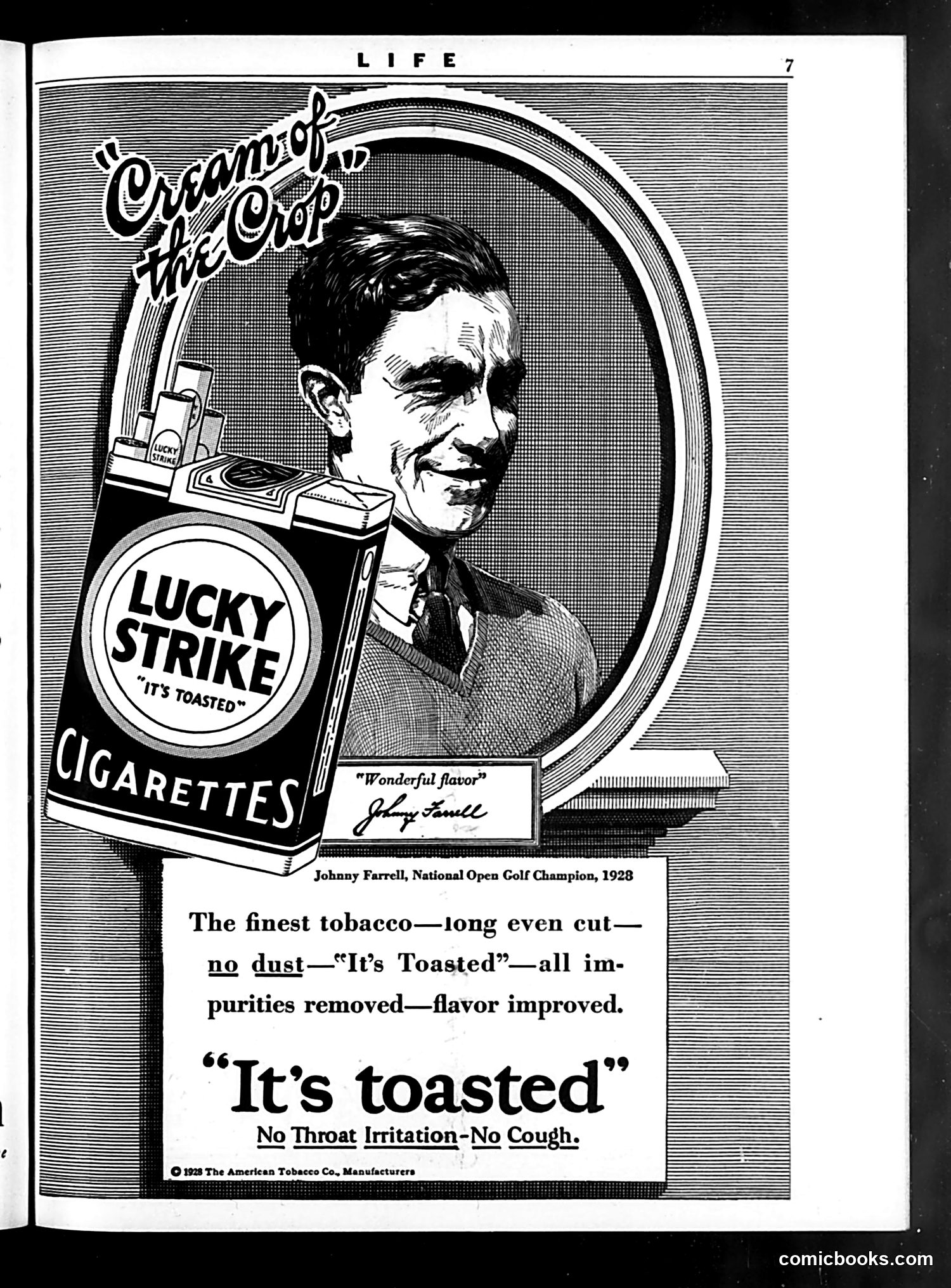
This is a **cigarette advertisement** featuring golfer Johnny Farrell, identified as the "National Open Golf Champion, 1928." The ad uses celebrity endorsement—a standard 1920s marketing technique—to promote Lucky Strike cigarettes. The key claims are that Lucky Strikes offer "the finest tobacco," are "long even cut," contain "no dust," and crucially: **"No Throat Irritation—No Cough."** This last promise is notable because by the late 1920s, health concerns about smoking were already emerging, despite being largely unproven medically at the time. The "It's Toasted" slogan refers to the company's claimed processing method to remove impurities and improve flavor. This advertisement exemplifies how tobacco companies addressed (and dismissed) early health anxieties through celebrity endorsement and marketing claims.
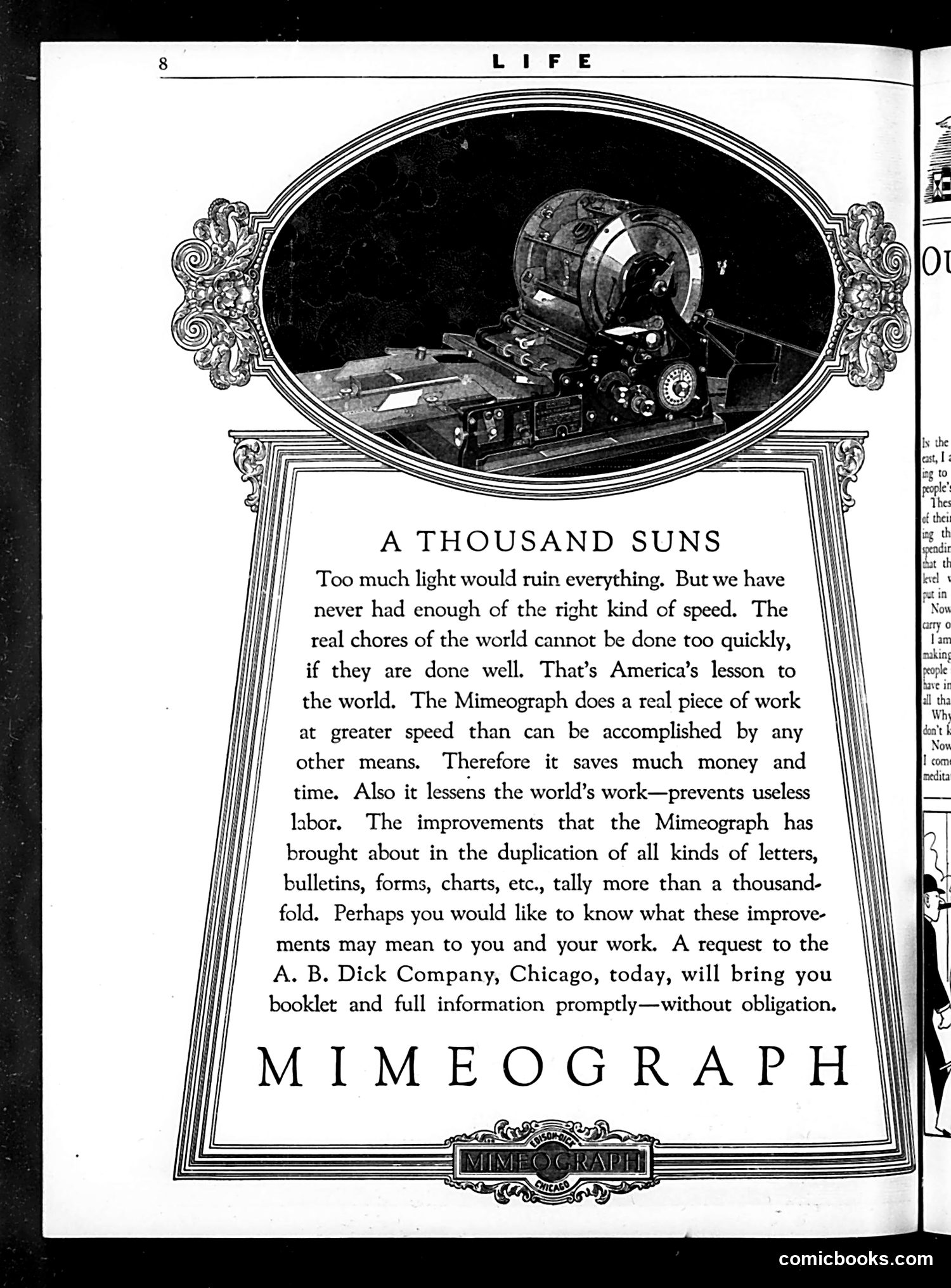
This is a **full-page advertisement for the Mimeograph machine**, not a cartoon or satirical content. The ad's headline "A Thousand Suns" references the machine's bright copy lamp (visible in the photograph at top). The text promotes the Mimeograph as labor-saving technology that performs document duplication faster and more cost-effectively than alternative methods. The pitch appeals to American efficiency values: "The real chores of the world cannot be done too quickly, if they are done well. That's America's lesson to the world." The ad targets businesses by highlighting how the device saves "much money and time" while reducing "useless labor" in duplicating letters, bulletins, forms, and charts. It's a straightforward product advertisement rather than satire, encouraging readers to contact the A.B. Dick Company in Chicago for information.
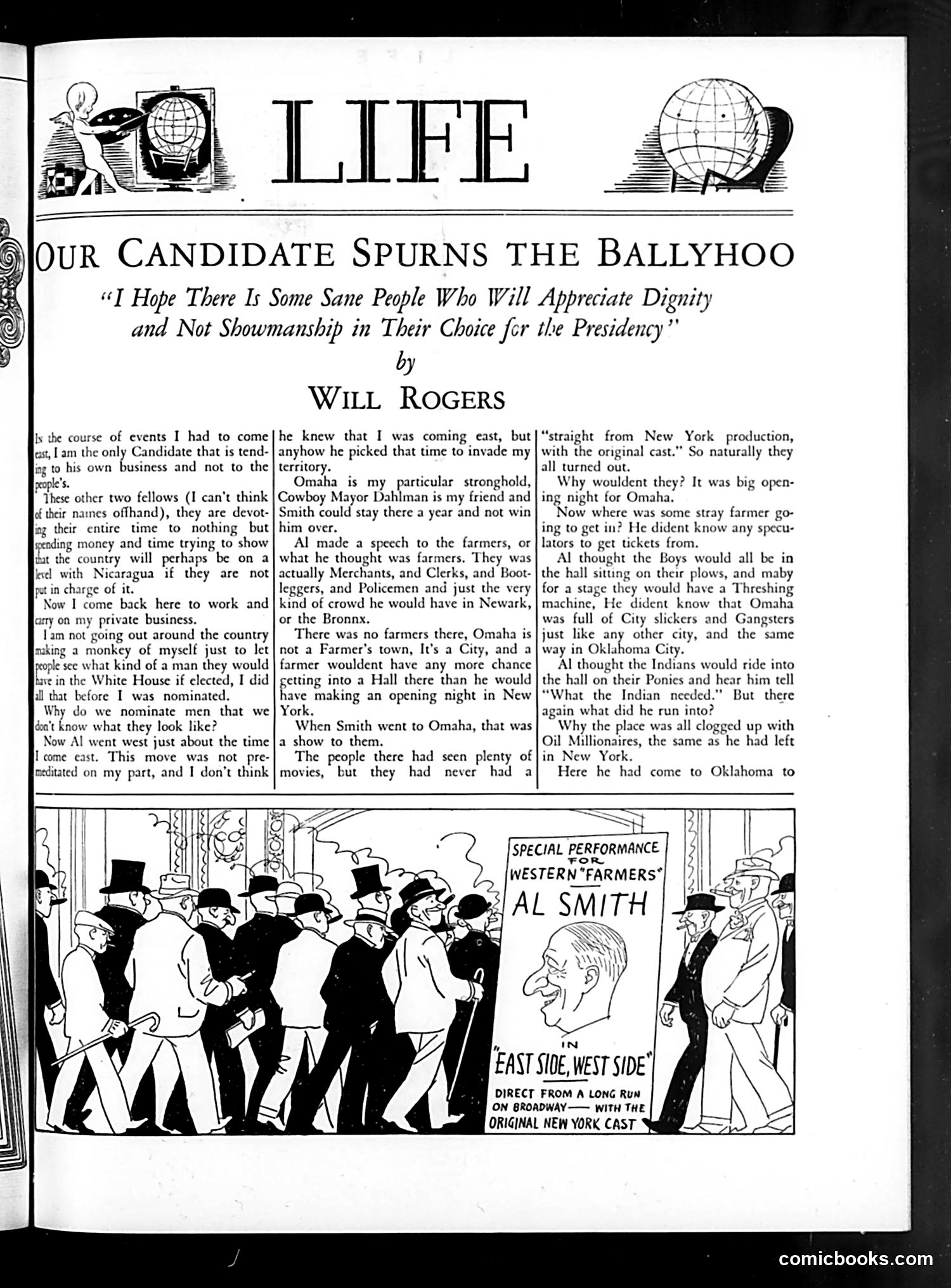
This Will Rogers column satirizes a presidential candidate who refuses the "ballyhoo" of campaigning—specifically avoiding showmanship and spectacle. Rogers criticizes fellow candidates (names partially unclear in OCR) who spend their time making speeches to farmers and staging theatrical productions. The cartoon depicts Al Smith's Broadway show "East Side, West Side" playing to wealthy audiences in formal dress, contrasting with the candidate's claimed focus on farming communities. Rogers's point: the candidate claims dignity over showmanship while his associates literally perform on stage. The satire suggests hypocrisy—they reject political theatricality while embracing entertainment theater, and ignore actual farmers' concerns in favor of city spectacle. The humor targets the contradiction between stated campaign values and actual behavior.
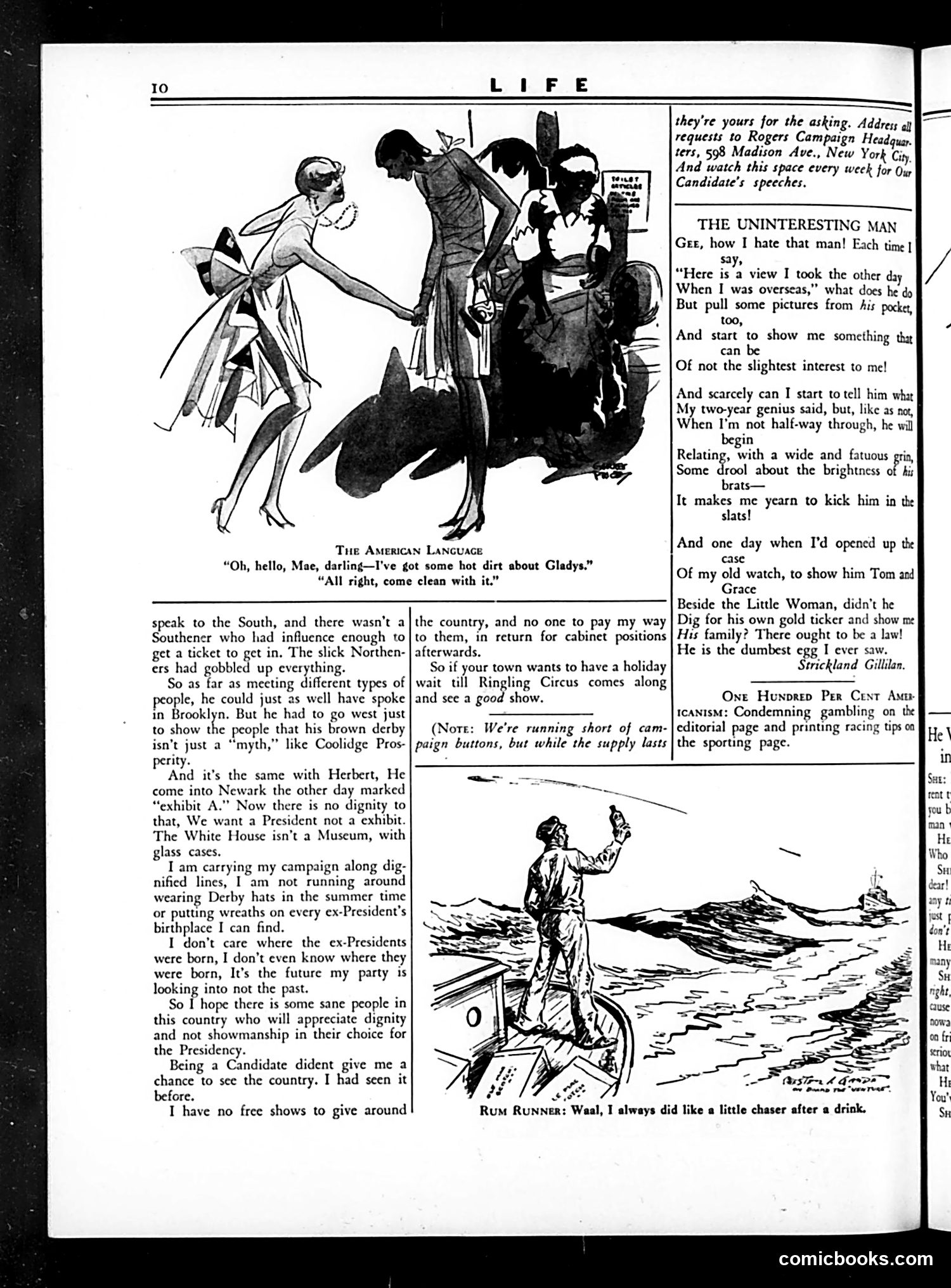
The top cartoon depicts a woman on a bicycle confronting two men, illustrating crude slang: "Oh, hello, Mae, darling—I've got some hot dirt about Gladys" / "All right, come clean with it!" This satirizes colloquial American speech patterns. Below, the accompanying article criticizes a presidential candidate (appears to be Herbert Hoover, mentioned by name) for exhibiting himself like a museum display rather than maintaining presidential dignity. The author complains the candidate is traveling the country wearing Derby hats and seeking publicity stunts—"free shows"—rather than conducting serious campaigning. The bottom cartoon shows a man on a beach labeled "Rum Runner," joking about chasing after alcohol, likely referencing Prohibition-era smuggling. The page satirizes both lowbrow American vernacular and undignified campaign behavior.
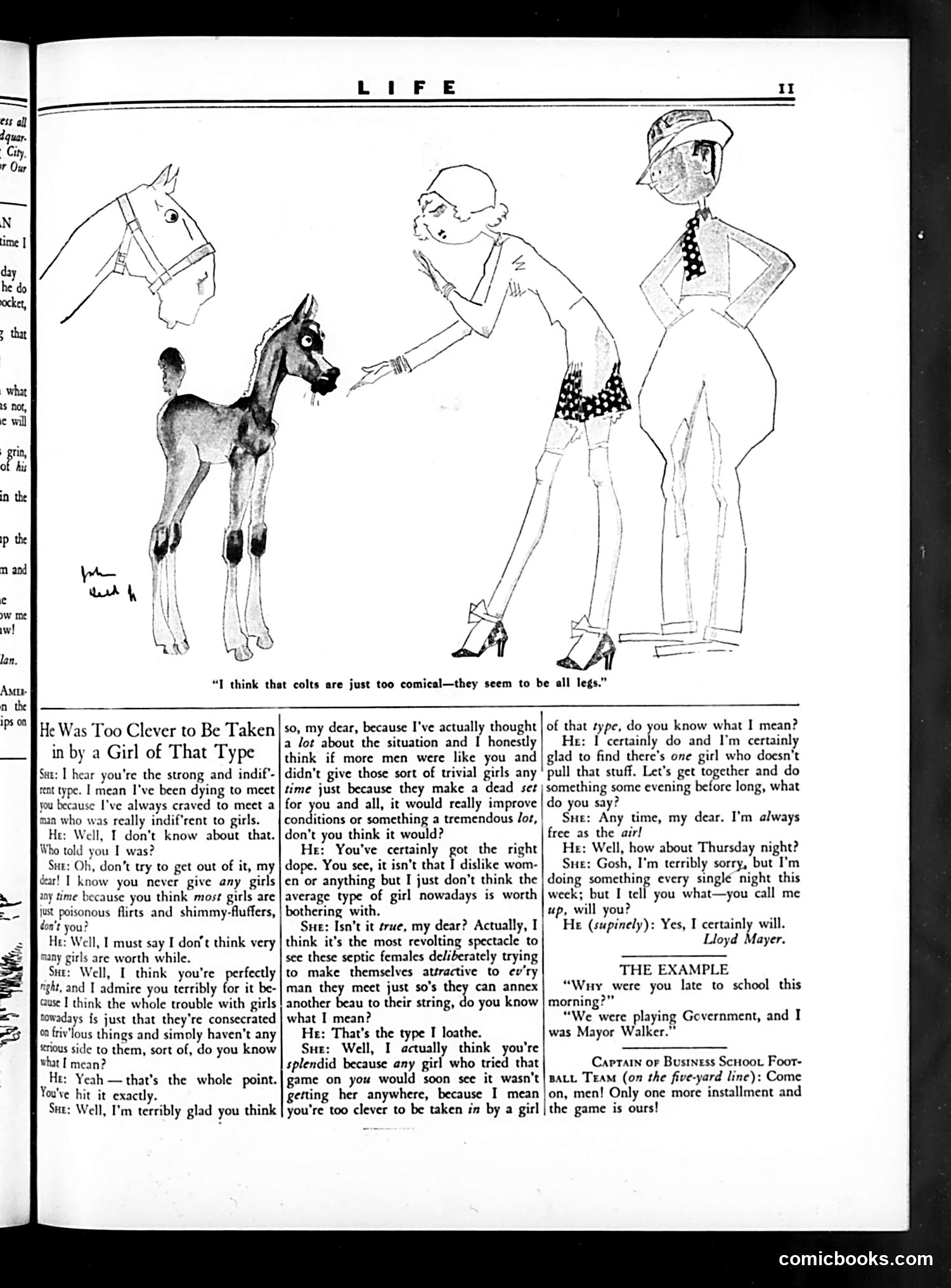
The cartoon satirizes dating advice and gender dynamics of the era. The illustration shows fashionably dressed women, with one's exaggerated leg emphasized—likely mocking contemporary fashion trends and the objectification of women's bodies. The dialogue presents a cynical male perspective: he claims to despise "trivial girls" and their tactics, asserting he's too intelligent to be manipulated. However, the woman's calm responses expose his hypocrisy—she's unmoved by his self-importance and simply arranges their next date without ceremony. The satire targets men who pride themselves on being "too clever" to fall for women's charms while simultaneously being easily manipulated by those same women. The joke undercuts masculine pretension about superior reasoning.
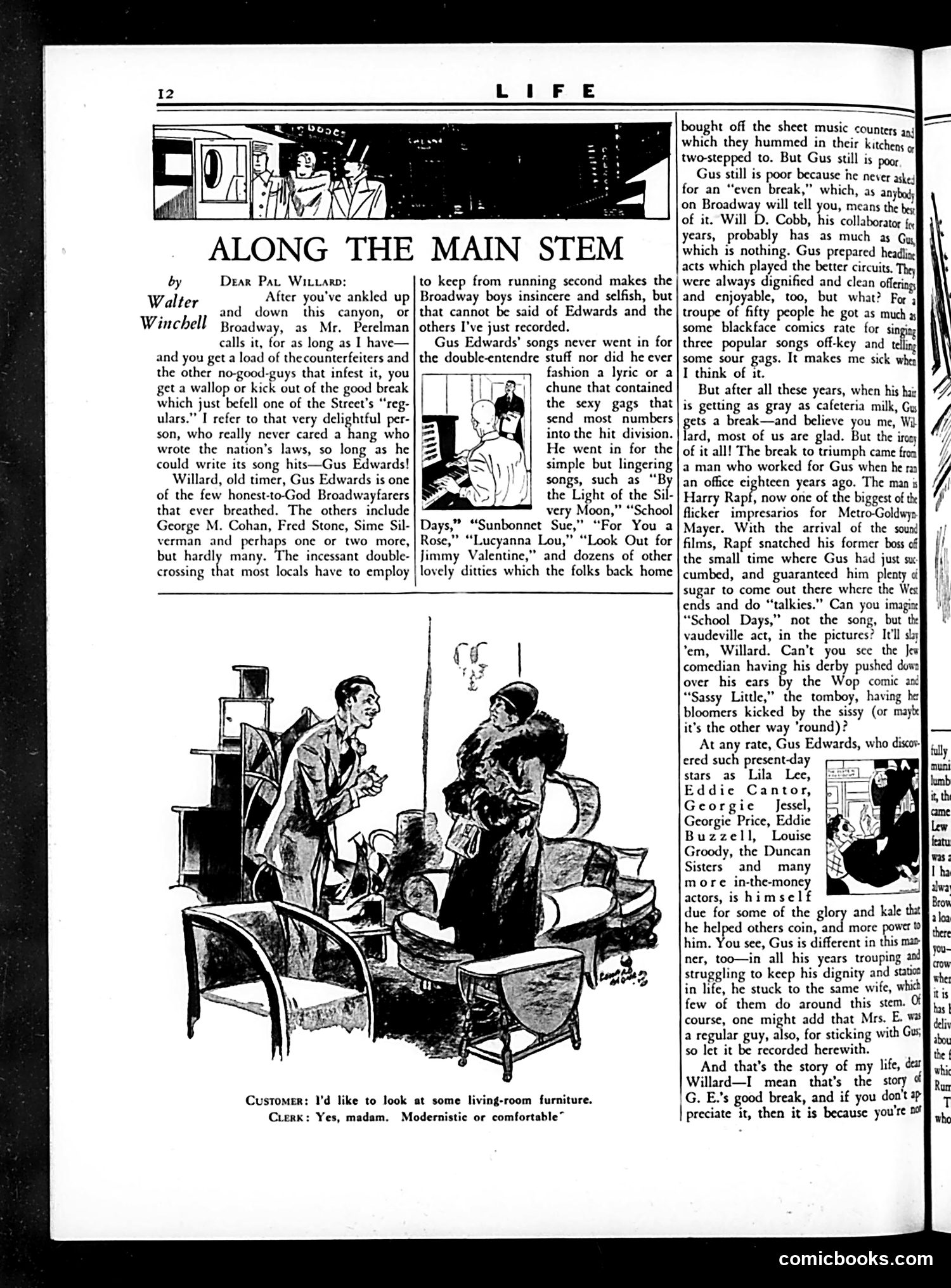
This is a humorous column by Willard about Gus Edwards, a theatrical figure. The text celebrates Edwards as one of Broadway's "most honest-to-God breadwinners," praising his songwriting and mentorship of performers who became famous (Eddie Cantor, George Jessel, and others are named). The accompanying cartoon shows a furniture store scene: a customer asks to see living-room furniture, and the clerk responds "Modernistic or comfortable?" This is satirical commentary on 1920s design trends—mocking the modernist movement's prioritization of style over practicality, suggesting contemporary furniture was often uncomfortable despite fashionable aesthetics. The column's affectionate tone toward Edwards contrasts with the cartoon's gentle mockery of contemporary taste.
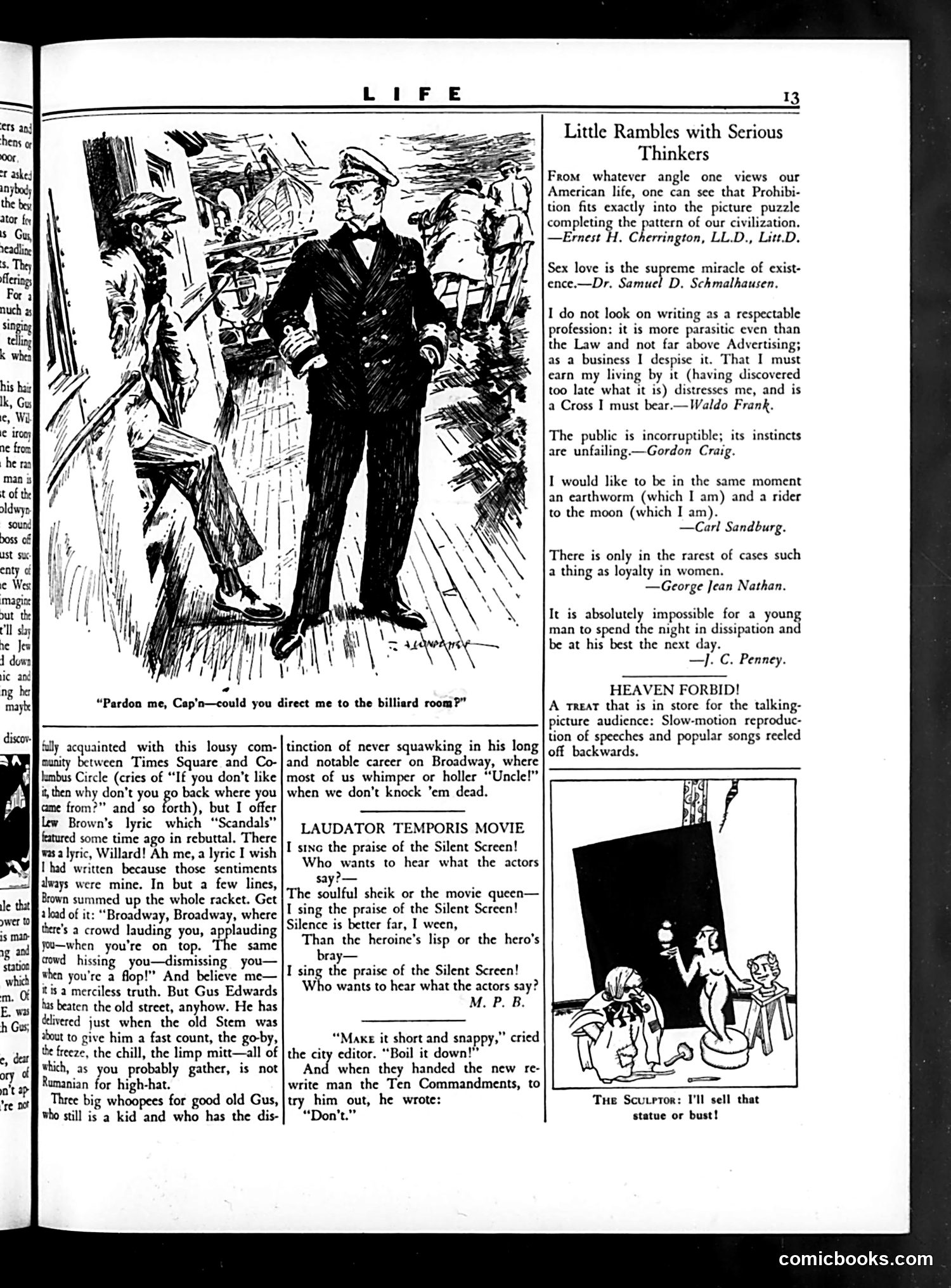
The main cartoon depicts a naval officer (identified by uniform and cap) being asked to direct someone to "the billiard room," a humorous non sequitur. The accompanying text mocks theater critic Gus Edwards and Broadway's "Uncle" (likely a theater figure), praising Edwards for his blunt honesty in dismissing bad performances. The "Little Rambles with Serious Thinkers" section features philosophical quotes from various figures about sex, loyalty, writing, and public taste—typical of Life's satirical approach to intellectual pretension. The bottom section, "Laudator Temporis Movie," sarcastically praises silent films, arguing that silence is preferable to hearing actors speak—a common 1920s joke about early sound technology's awkwardness. The sculptor illustration appears unrelated to the text above it.
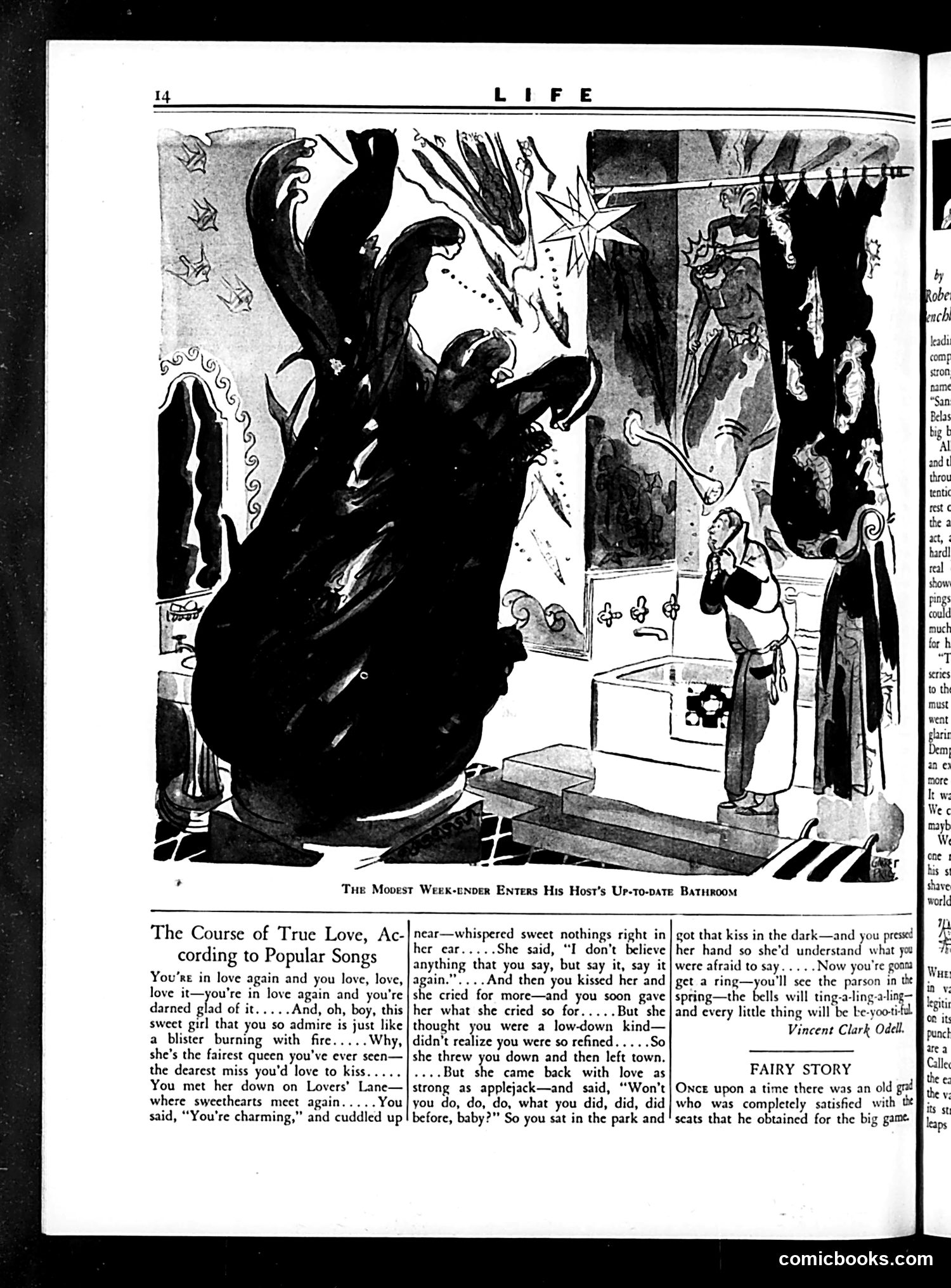
The main cartoon depicts a grotesque creature (labeled "The Modest Week-ender Enters His Host's Up-to-date Bathroom") bursting through a bathroom door in silhouette, startling the inhabitants inside. The exaggerated, monstrous figure appears designed to satirize the "week-ender"—a guest who visits for the weekend and apparently has poor bathroom etiquette or manners. The accompanying text below presents "The Course of True Love, According to Popular Songs," which humorously deconstructs romantic song lyrics by presenting them literally and sarcastically, revealing the clichéd and often ridiculous nature of popular love songs. A "Fairy Story" section begins on the right. The overall page mixes visual satire with written humor targeting social conventions and popular culture.
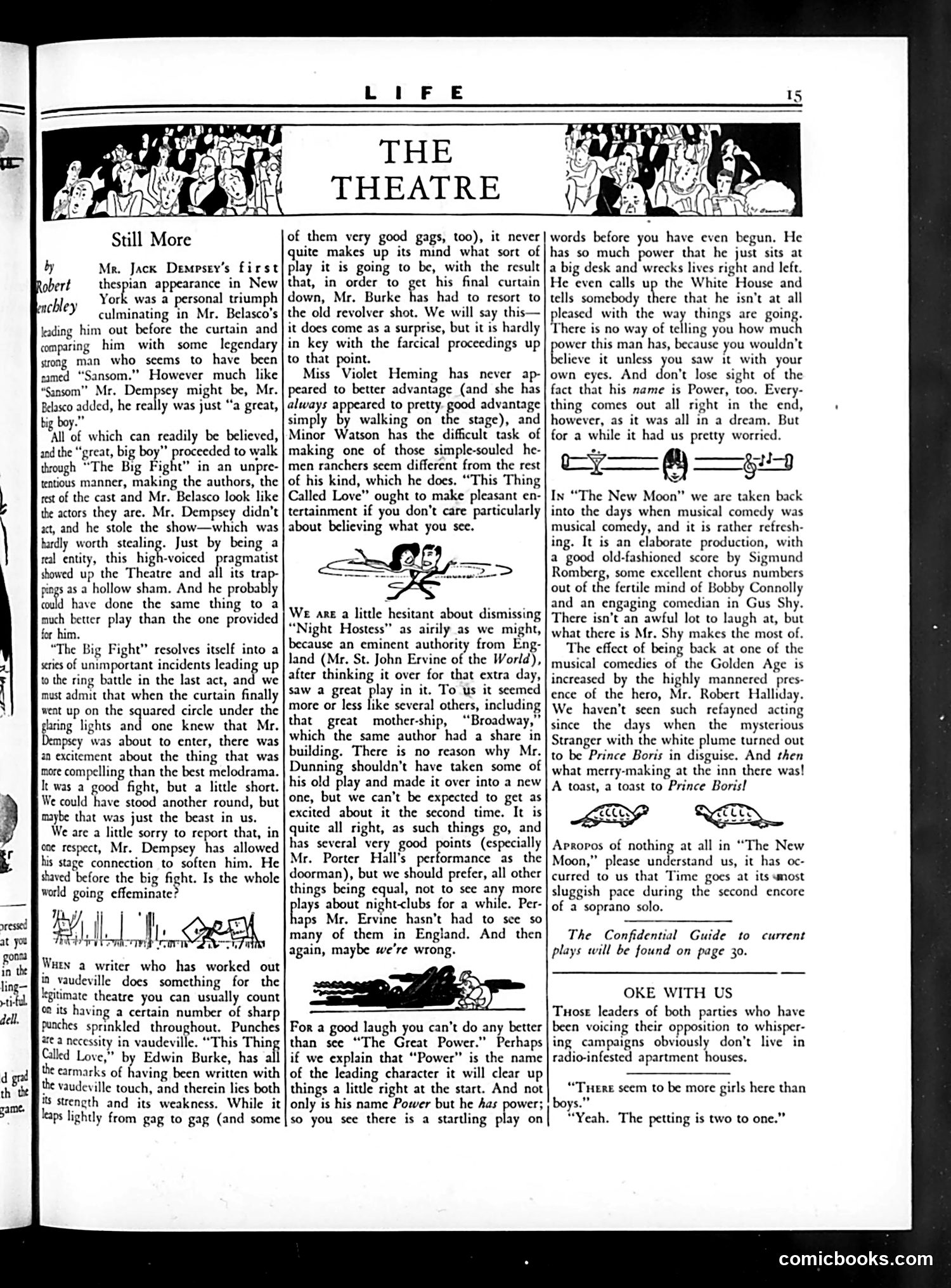
This is a theatre review section from Life magazine discussing several Broadway productions. The page contains three small theatrical cartoons illustrating comedic moments from plays. The reviews critique various shows including "The Big Fight," "The New Moon," and references to Jack Dempsey's theatrical appearance. The critic discusses the merits and flaws of these productions, praising some performances (like Violet Heming's) while questioning the quality of others. One cartoon depicts a couple in an intimate embrace, another shows what appears to be a fish or sea creature. These cartoons seem to illustrate comedic or romantic moments from the plays being reviewed rather than serving a broader satirical purpose about politics or society. The page is primarily devoted to entertainment criticism rather than political satire.
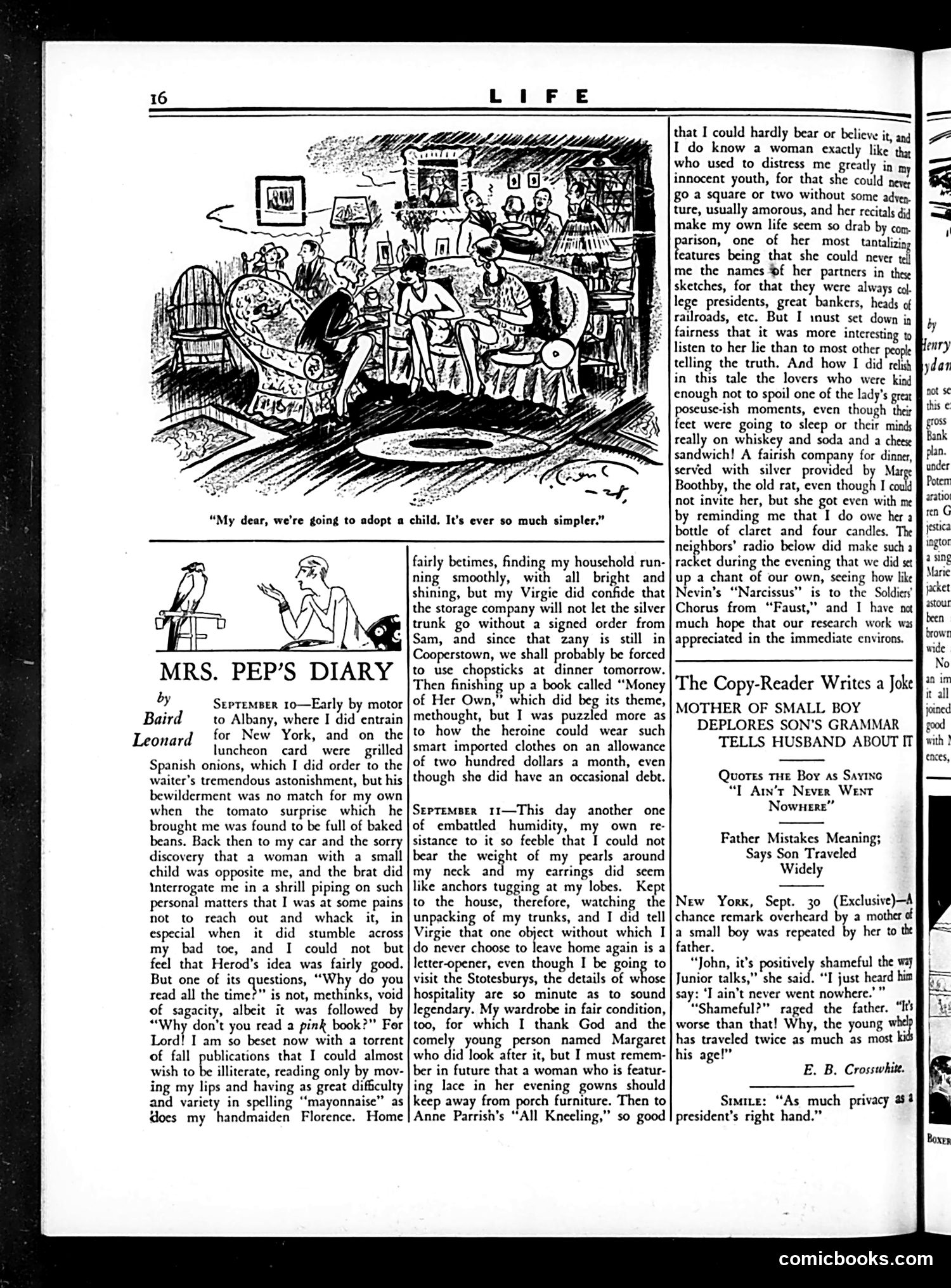
The main cartoon illustrates the caption: "My dear, we're going to adopt a child. It's ever so much simpler." The image shows a chaotic household scene with multiple people, machinery, and disorder—suggesting that adopting a child is presented as *easier* than managing one's existing domestic life. This is satire about early 20th-century upper-class domesticity: the cartoon implies that wealthy couples found child-rearing, household management, and servants so complicated that adoption might seem like a solution. The visual chaos (with what appears to be various domestic contraptions and servants) mocks the absurdity of this logic. The page also contains "Mrs. Pep's Diary," a domestic humor column typical of Life magazine's satirical commentary on marriage, social pretension, and household management.
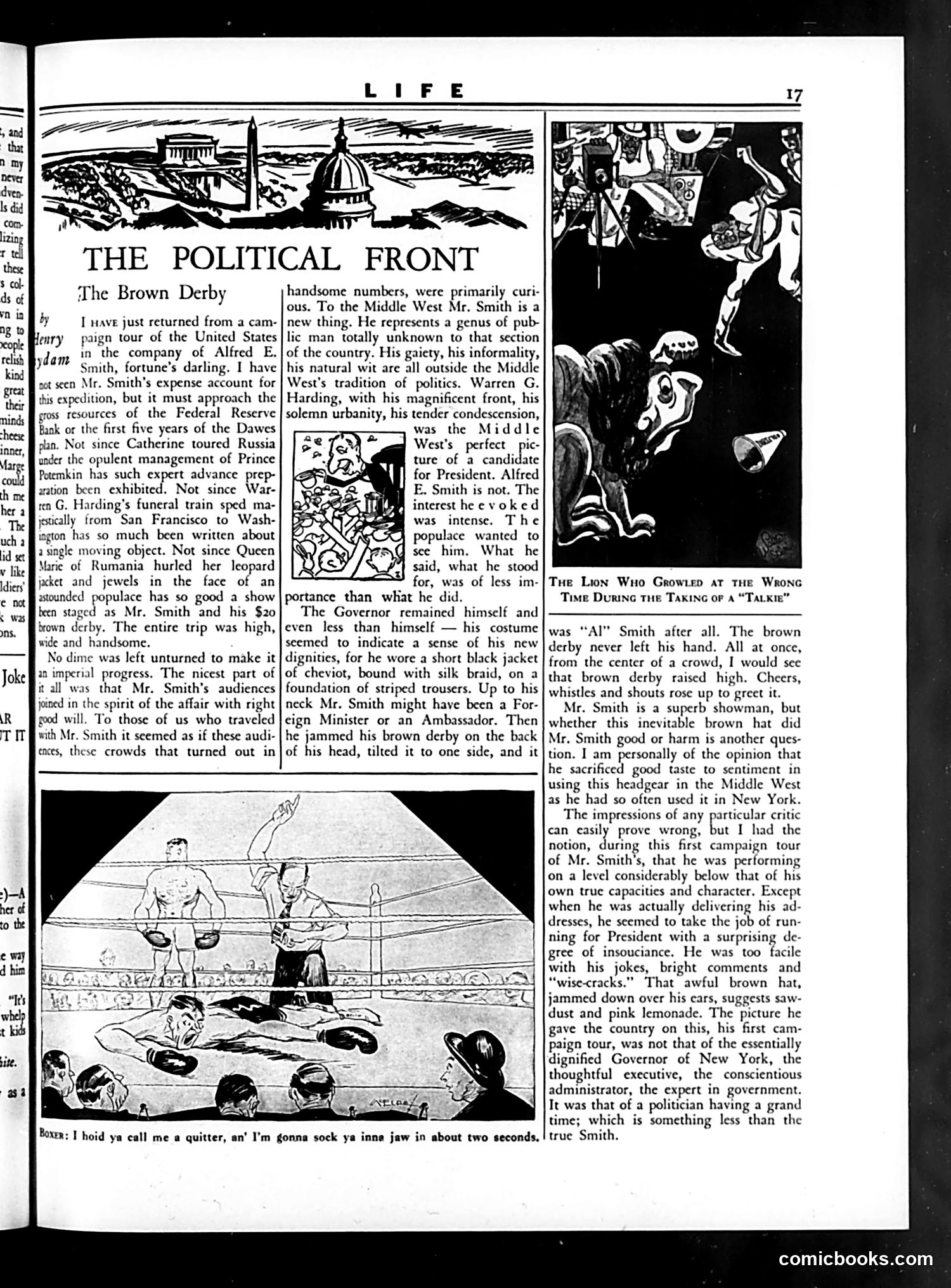
This article reviews Alfred E. Smith's 1928 presidential campaign tour. Smith, a New York politician, wore a distinctive brown derby hat that became his signature. The text criticizes Smith's campaign performance as uninspired and mediocre—he seemed less capable than his actual abilities suggested, delivering jokes poorly and appearing out of his depth outside New York politics. The cartoons mock the brown derby itself: one shows it dominating Smith's head during a "talkie" (early sound film), and another depicts a boxing match where the derby is the prominent focus. The satire suggests Smith's hat became more memorable than his political substance, reducing a serious candidate to a caricature defined by a single accessory rather than substantive leadership qualities.
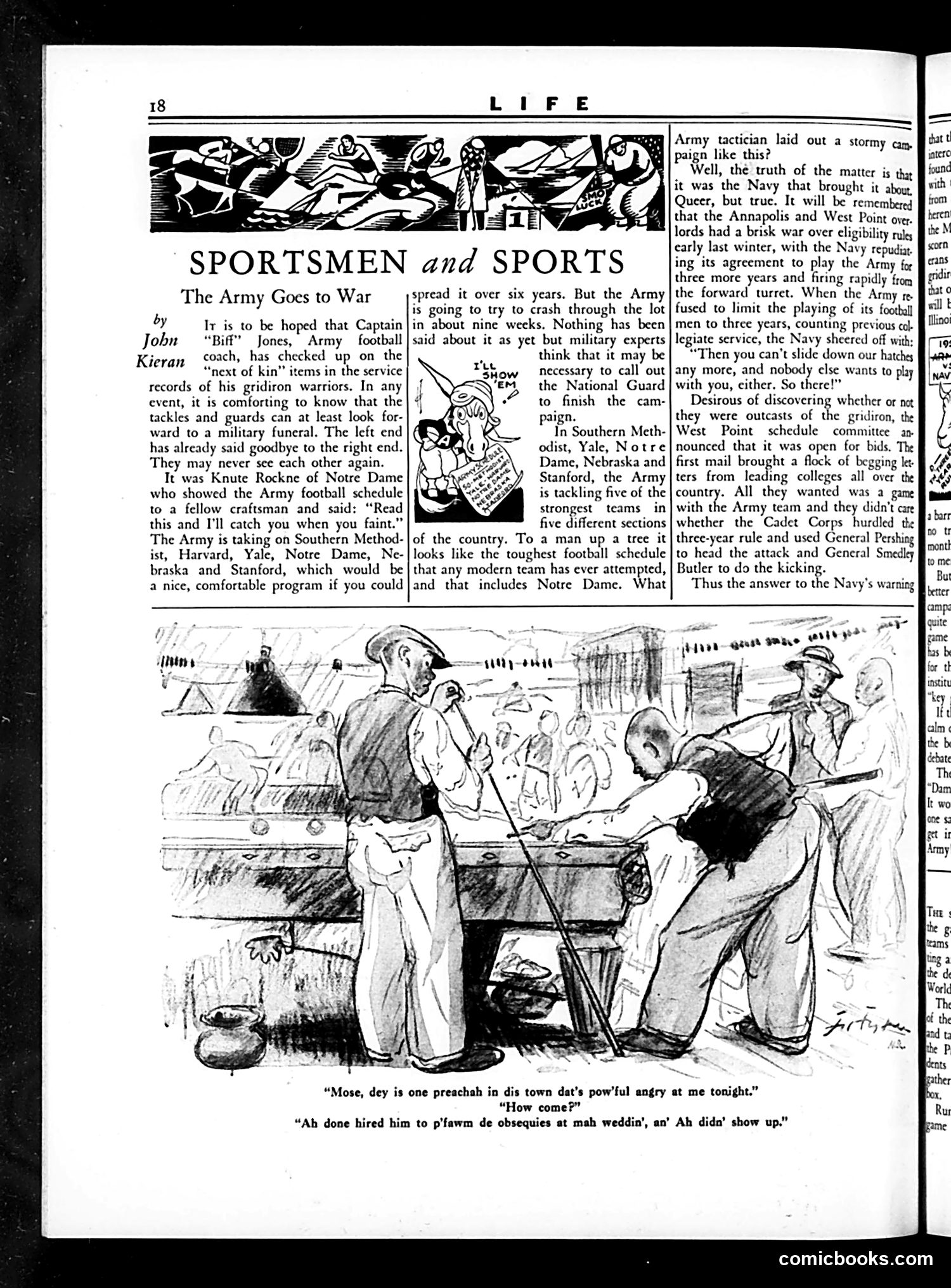
This LIFE magazine article by John Kieran satirizes the Army's grueling 1920s football schedule. The piece explains that the Navy, angry over eligibility rule disputes with West Point, withdrew from their football agreement. The Army then opened its schedule to other schools, and colleges eagerly accepted games despite the brutal schedule (Southern Methodist, Harvard, Yale, Notre Dame, Nebraska, Stanford in nine weeks). The humor lies in the ironic outcome: the Navy's retaliatory snub backfired. Rather than isolating West Point, Army became so sought-after that leading programs competed for slots. The article humorously compares the schedule's difficulty to military combat, with references to "National Guard" intervention and generals like Pershing and Smedley Butler. The bottom cartoon depicts a Southern dialect joke about hiring a preacher for a wedding who didn't show up—unrelated to the main article, typical of LIFE's mixed content style. The satire targets institutional rivalry and wounded pride between military academies.
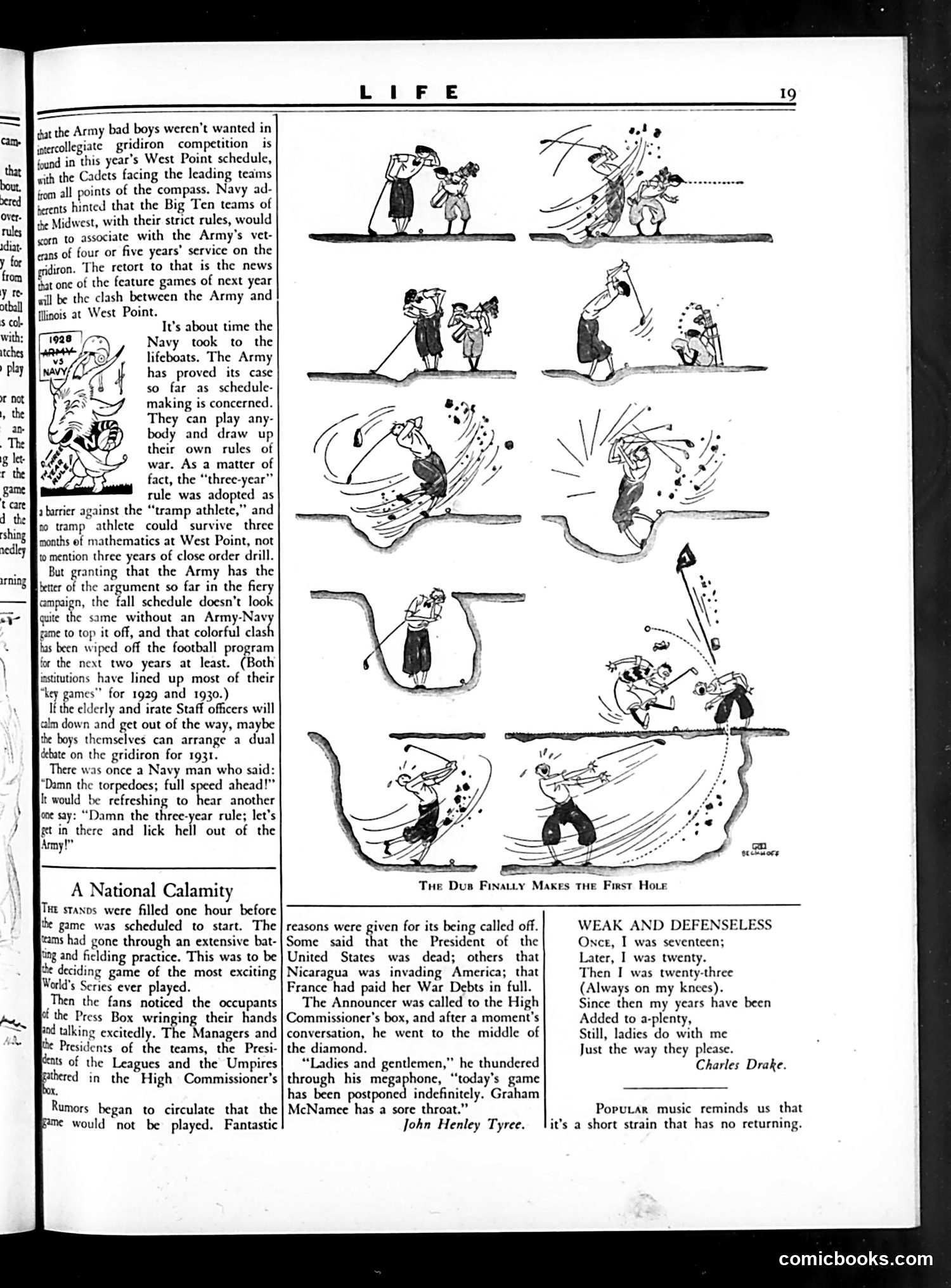
This page contains a multi-panel golf cartoon satirizing amateur golfers' struggles. The sequential panels depict a bumbling golfer attempting various shots, each ending in failure or mishap—slicing balls wildly, hitting into hazards, and contorting himself in increasingly desperate attempts to complete a single hole. The title's irony is clear: "the dub" (slang for an incompetent golfer) finally succeeds, presumably after extensive comic suffering shown in the panels above. The surrounding text discusses Army-Navy football scheduling disputes and includes other satirical pieces about a World Series cancelled because sports announcer Graham McNamee has a sore throat. This is **Life magazine's typical 1920s humor content**—visual slapstick comedy targeting middle-class recreational activities and contemporary public figures, using exaggeration and wordplay for laughs.
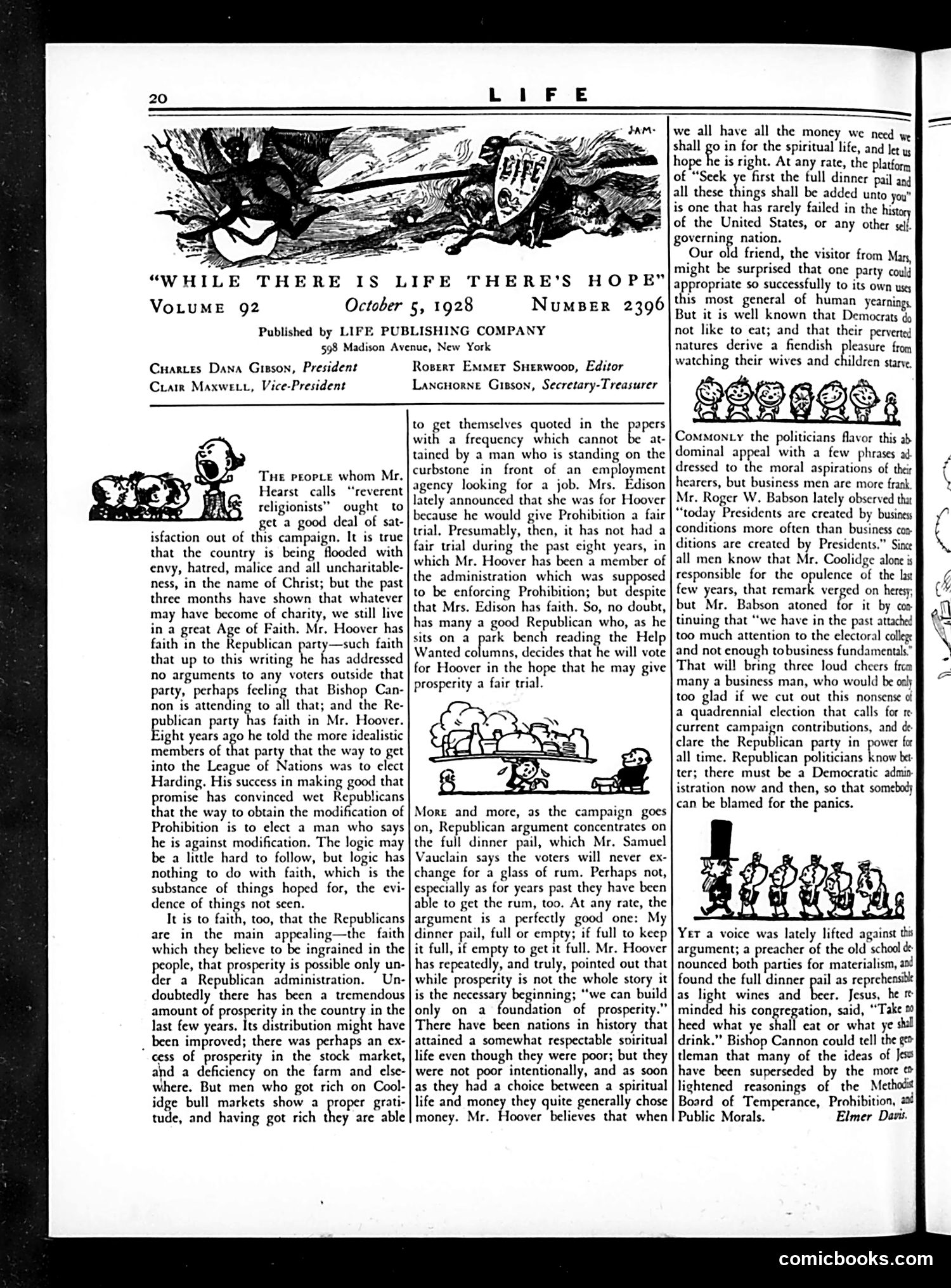
This page contains editorial commentary on the 1928 U.S. presidential campaign, likely supporting Republican Herbert Hoover against Democrat Al Smith (implied by references to "wet Republicans" and Prohibition debates). **Key figures referenced:** - **Herbert Hoover** — Republican candidate, portrayed as having "faith" in Republican prosperity promises - **Bishop Cannon** — Prohibition enforcer attacking Smith - **Samuel Vauclain** — Businessman arguing voters won't trade "full dinner pail" for rum (attacking Smith's opposition to Prohibition) - **Mrs. Edison** — Example of wealthy supporter backing Hoover on Prohibition grounds **The satire's point:** Life mocks Republicans for appealing purely to "faith"—faith that only Republican leadership ensures prosperity and that Prohibition enforcement actually works. The author notes the irony: Hoover promises prosperity despite eight years in Coolidge's administration when it supposedly hasn't worked; voters can already obtain rum despite Prohibition. **Context:** This reflects 1928's clash over Prohibition (Smith opposed it) and the "full dinner pail" economic argument before the October 1929 stock market crash.
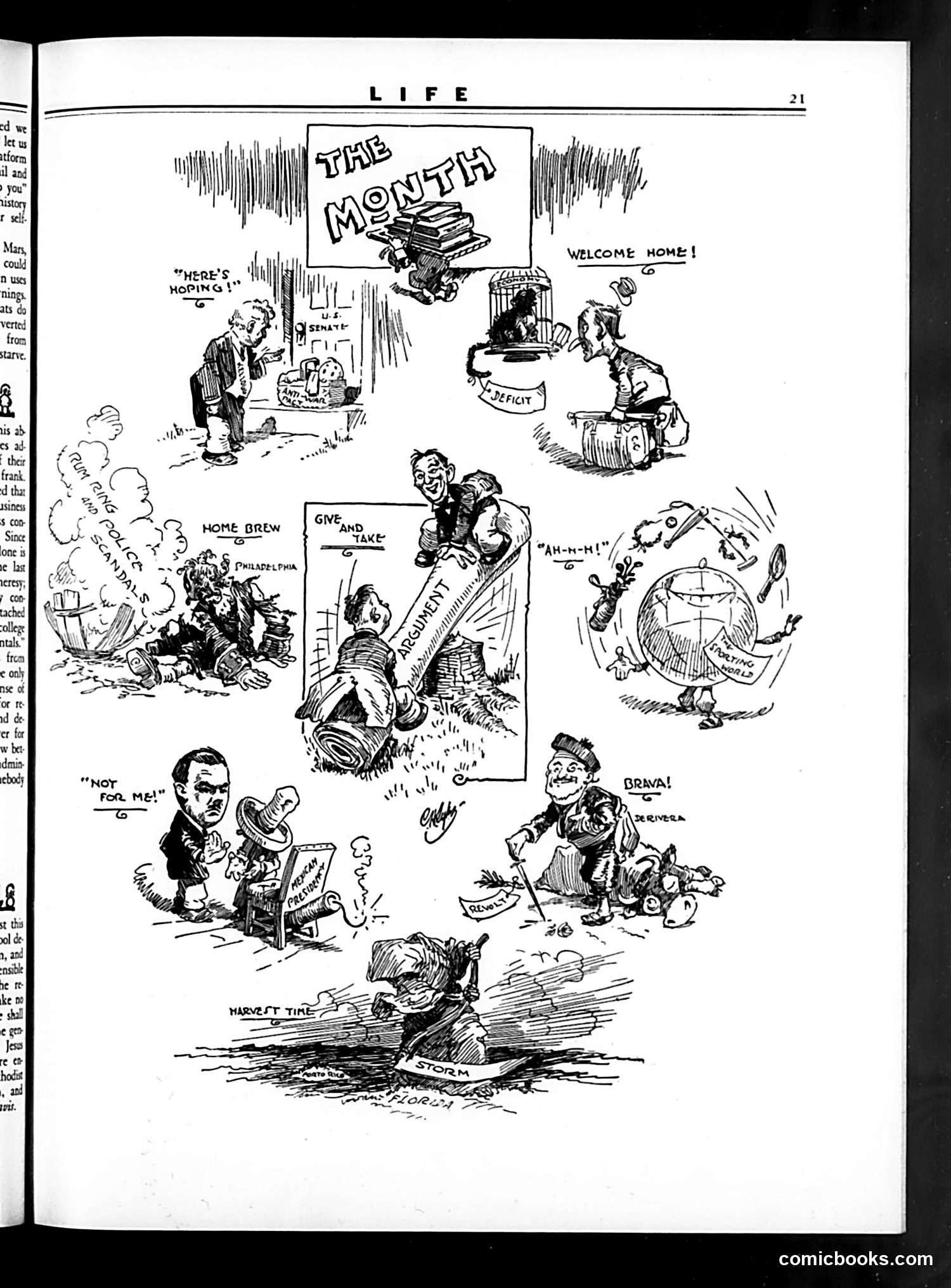
This political cartoon titled "The Month" uses multiple vignettes to satirize American domestic issues. The top panel welcomes home a U.S. Senator to a "deficit" basket. Other panels mock: - **Home Brew in Philadelphia**: depicting Prohibition-era illegal alcohol production - **"Give and Take"**: showing what appears to be labor or industrial disputes - **"Not for Me!"**: unclear reference, possibly tax or policy resistance - **"Bravo! Riviera"**: likely mocking wealth disparity or elite leisure - **Bottom panel**: A figure struggling through "Storm," "Harvest Tide," and "Florida" — suggesting economic hardship affecting farmers or workers The overall theme appears to critique post-war American problems: Prohibition enforcement, labor strife, political corruption (the deficit), and economic struggles. The cartoon suggests these domestic "welcomes home" represent serious national problems rather than celebration.
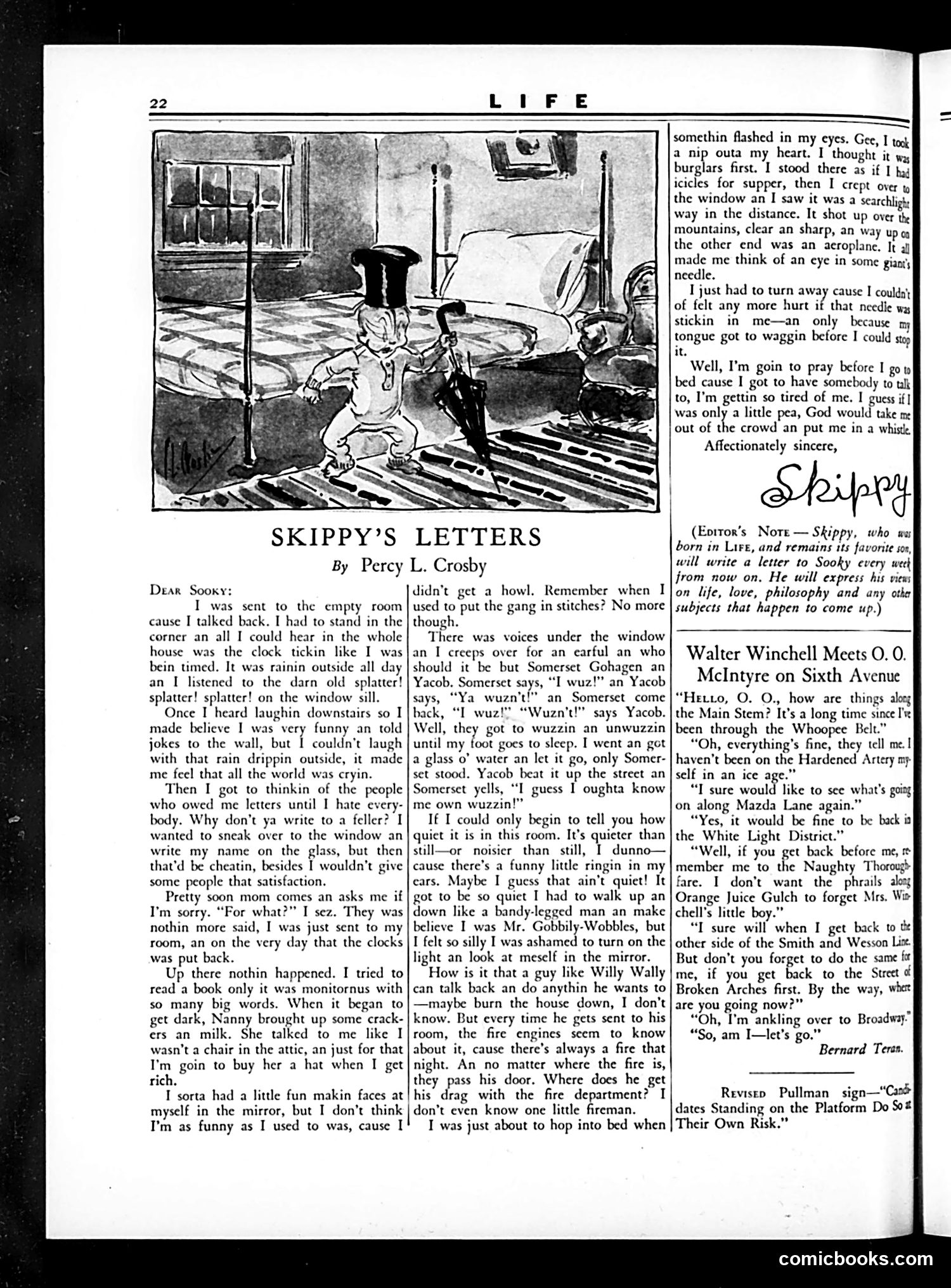
This is a serialized letter column featuring "Skippy," a comic strip character created by Percy L. Crosby. The page shows an illustration of a boy in his bedroom and his letter to "Sooky" describing punishment—being sent to his room for talking back. The humor derives from the contrast between a child's innocent observations and surprisingly sophisticated emotional awareness. Skippy describes boredom, loneliness, and existential sadness with childlike spelling and dialect ("wuzn't," "dunno"). He reflects on popularity, friendship, and self-worth while confined. The searchlight and aeroplane passage conveys metaphorical despair. The satire gently mocks both childhood melodrama and parental discipline methods. The editor's note indicates this was a beloved recurring feature in *Life* magazine, where readers enjoyed Skippy's unfiltered, poignant voice expressing universal childhood experiences in vernacular language.
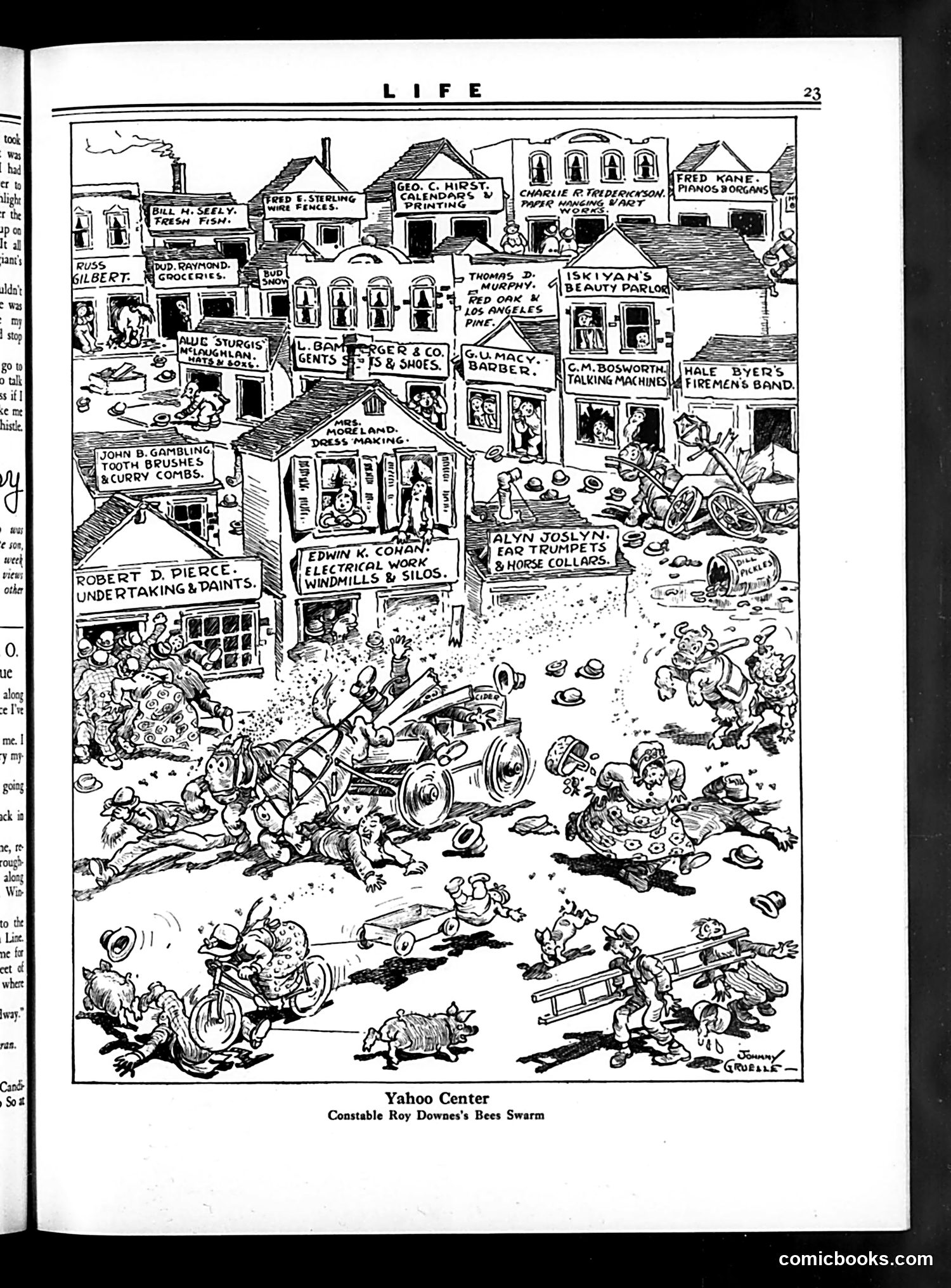
This is a humorous illustration depicting chaos in a small town business district when a swarm of bees escapes. The cartoon shows various storefronts labeled with actual business names (Hirst's Printing, Kane's Pianos, Iskiyans Beauty Parlor, Macy's Barber, etc.), with townspeople fleeing in panic as giant cartoon bees attack. The satire appears to mock small-town life and the disruption of ordinary commerce—constable Roy Downes's apparent inability to control the situation creates absurd mayhem. The joke relies on exaggeration: the bees are drawn comically oversized, and the townspeople's reactions are cartoonishly desperate. This type of visual gag was typical of Life magazine's satirical humor in the early-to-mid 20th century, targeting small-town Americana with gentle mockery of rural/provincial life and local institutions.
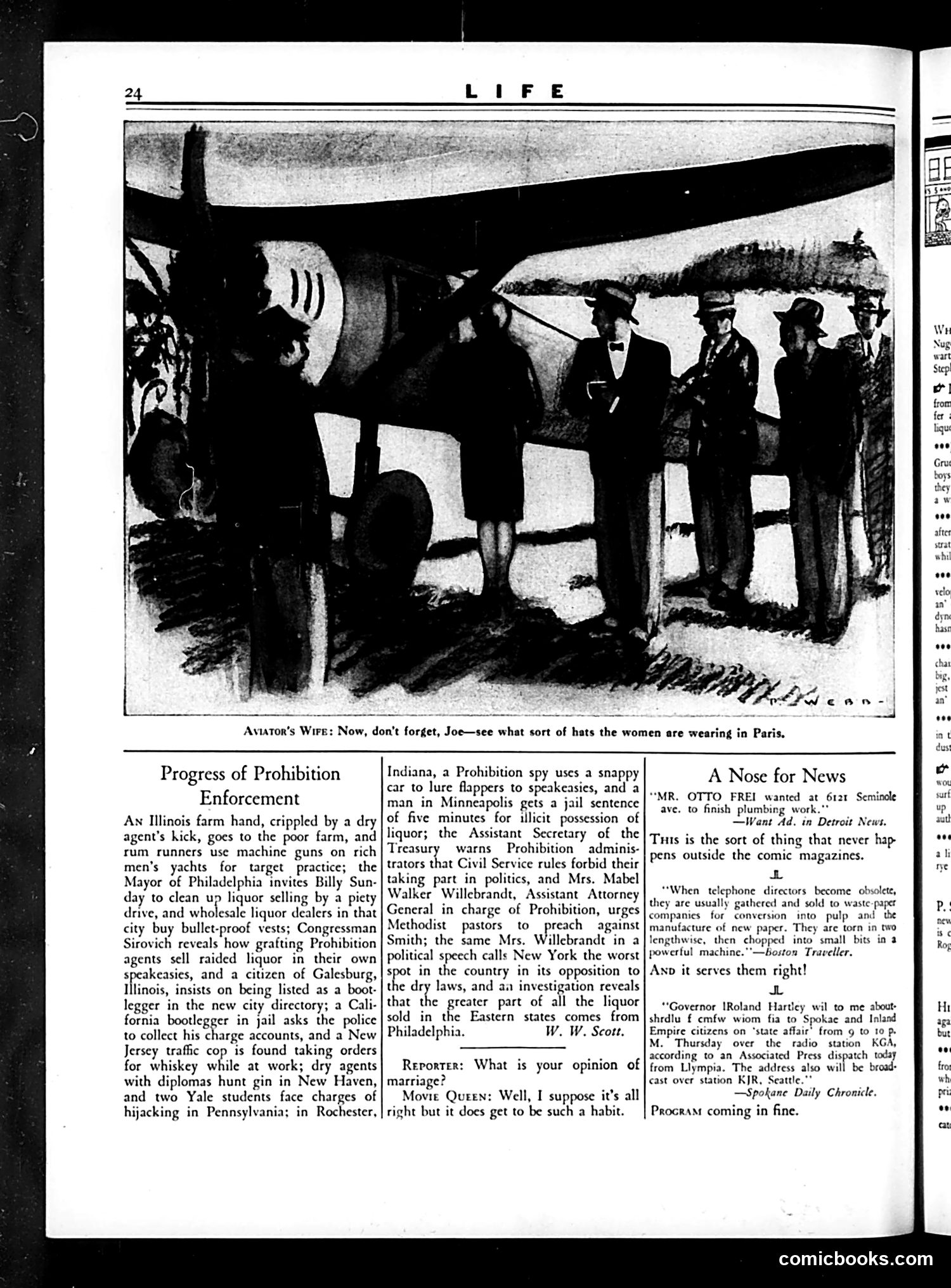
The top cartoon depicts an aviator's wife reminding her husband to observe Parisian women's fashion while traveling—a light domestic joke about husbands' attention to detail. The main article, "Progress of Prohibition Enforcement," is satirical commentary on the failures of Prohibition (1920-1933). It catalogs widespread enforcement chaos: corrupt agents selling confiscated liquor, bootleggers using violence with impunity, Prohibition officials like Mrs. Mabel Walker Willebrandt contradicting themselves politically, and absurdly lenient sentences. The satire's point: despite aggressive dry-law enforcement efforts, the policy has created criminality, corruption, and hypocrisy rather than reducing alcohol consumption. The sidebar items are brief satirical observations: a movie actress joking marriage is monotonous; a newspaper typo creating an absurd classified ad; and bureaucratic inefficiency (old phone directories recycled). These mock everyday American life and institutional incompetence during this era.
This page contains "Neighborhood News"—a satirical gossip column format popular in 1920s Life magazine. Rather than traditional political cartoons, it uses humorous brief anecdotes from various American cities (Indiana, San Francisco, Chicago, Cleveland, Boston). The humor relies on: **Social commentary**: References to Prohibition ("remove his liquor"), the emerging automobile industry, and silent film versus "talkies" (early sound movies). One joke mocks conversational dialogue in films as inferior to Eugene O'Neill's experimental play "Strange Interlude." **Local personalities**: References to real figures like theater producer Templeton Crocker and actress Violet Kemble-Cooper, assuming readers recognized them. **Colloquial wit**: Written in exaggerated rural Indiana dialect ("Abe Martin" persona), contrasting rustic wisdom with modern urbanization and commerce. **The point**: Gentle mockery of contemporary life—social climbing, business deals, technological change, and the pretensions of the emerging entertainment industry. This format was Life's signature: sophisticated satire delivered through seemingly simple, folksy observations.
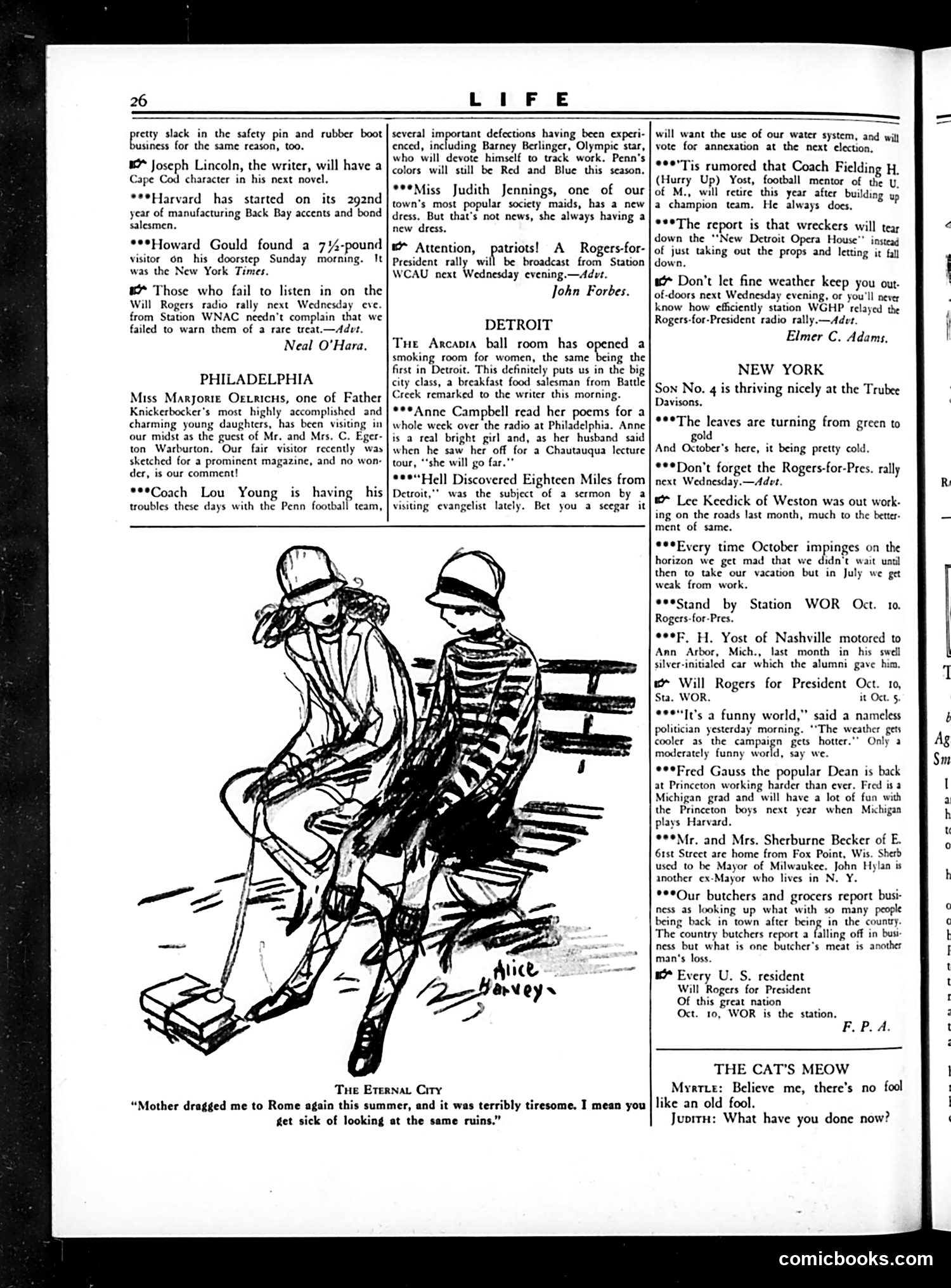
This page from Life magazine (circa 1928, based on references) consists primarily of brief gossip items and social commentary from major American cities, interspersed with advertisements for a **Will Rogers for President radio rally**. ## The Main Cartoon The illustrated cartoon by Alice Harvey depicts two figures in winter clothing sitting on a bench, appearing cold and miserable. The caption reads: "Mother dragged me to Rome again this summer, and it was terribly tiresome. I mean you get sick of looking at the same ruins." **The satire**: This mocks wealthy Americans who travel to Europe and find historic sites boring—a jab at the privileged class's indifference to cultural treasures and their entitled complaints about leisure travel. ## Context The repeated mentions of **Will Rogers for President** radio broadcasts (on stations WNAC, WCAU, and WOR) indicate this was a contemporary promotional campaign, likely humorous given Rogers' reputation as a political humorist rather than serious politician. The scattered social notes are typical Life content: gossipy tidbits about society figures, academics, and local personalities mixed with light mockery of contemporary life.
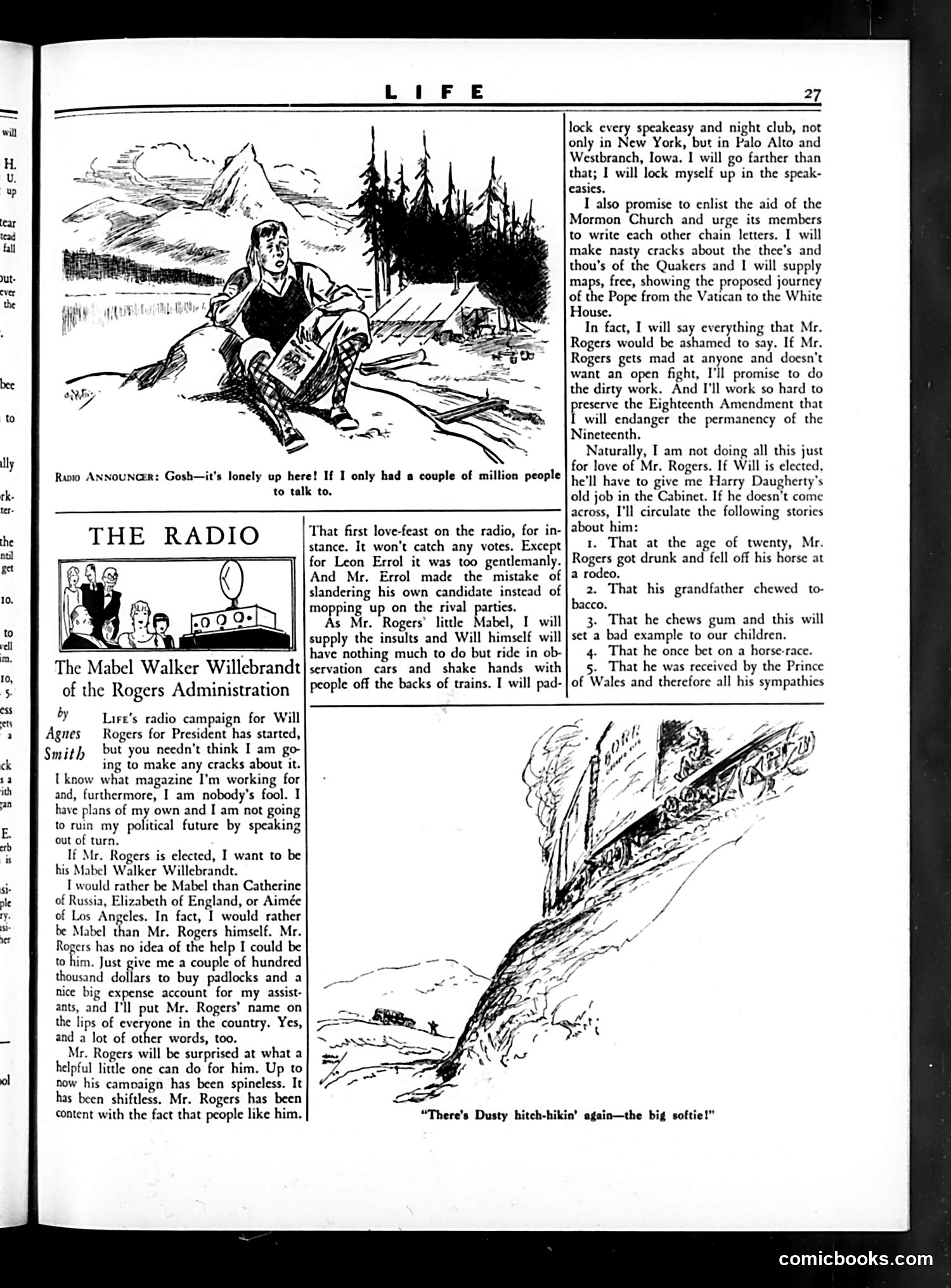
This 1928 *Life* magazine page satirizes Will Rogers' presidential campaign through Agnes Smith's fictional pitch to be his "Mabel Walker Willebrandt"—a real government official famous for aggressive Prohibition enforcement. **The Satire**: Smith humorously claims she'll do Rogers' "dirty work" in politics, offering to attack rival parties, lock speakeasies nationwide, manipulate religious groups, and smear Rogers' opponents. She demands a Cabinet position (comparing it to Harry Daugherty's, from the scandal-plagued Harding administration) in exchange. **The Point**: The piece mocks Rogers' actual campaign as "spineless" and gentlemanly, suggesting he needs ruthless operatives willing to play dirty politics—the opposite of his public image as a folksy, likable humorist. The absurd threats (locking herself in speakeasies, antagonizing Quakers and Catholics) exaggerate what aggressive campaigning looked like in the Prohibition era. **Context**: Rogers was a real public figure; this reflects 1920s political cynicism about backroom dealings and religious manipulation in campaigns.
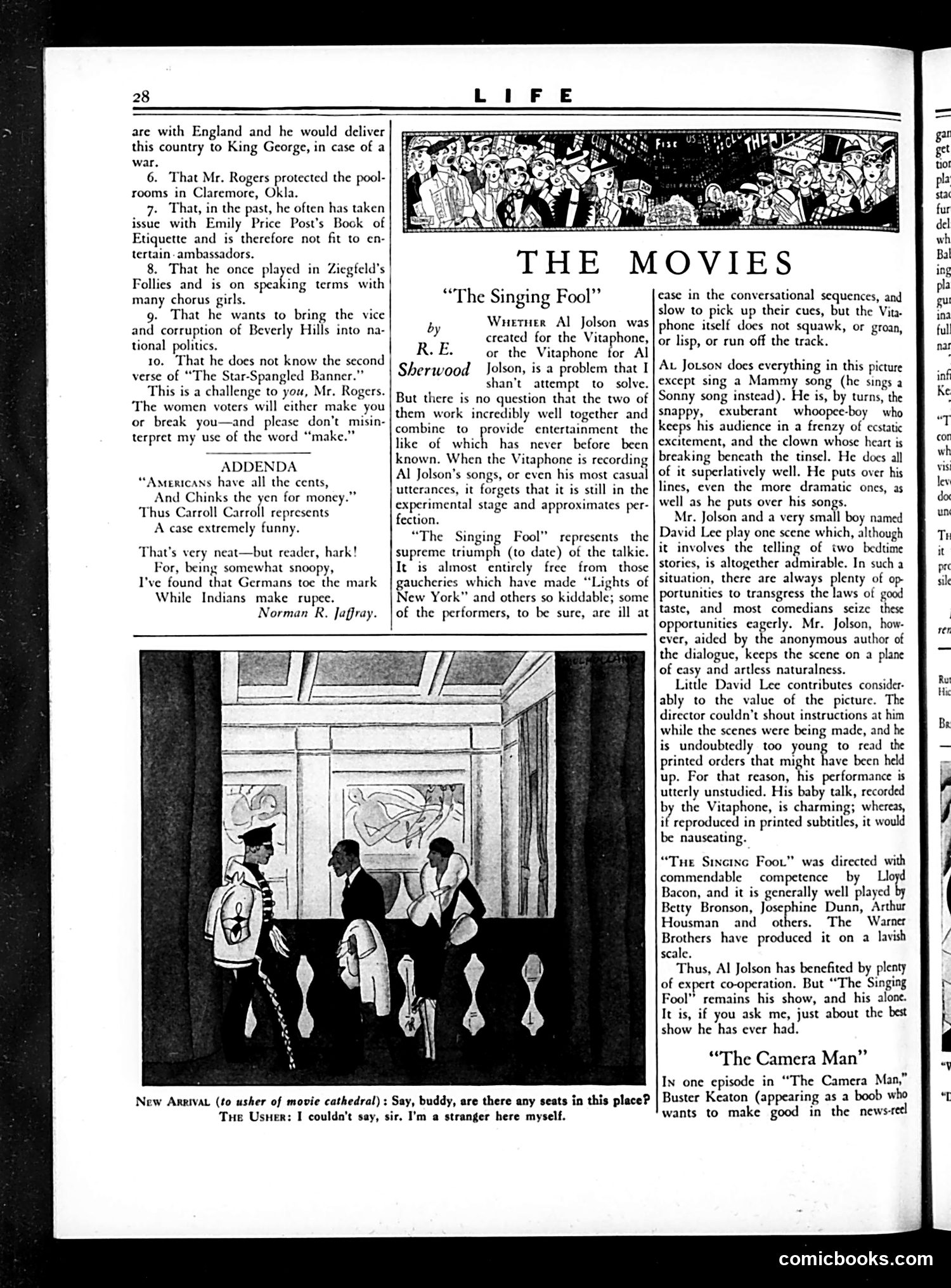
This page from *Life* magazine contains two distinct elements: **The Political List (top):** A numbered critique of "Mr. Rogers" (likely Will Rogers, the famous humorist and entertainer), treating his potential candidacy for office as absurd. The accusations mock both Rogers and political concerns of the era—his friendships with chorus girls, his disrespect for etiquette, his lack of patriotic knowledge (not knowing "The Star-Spangled Banner"), and his potential to corrupt national politics. **The Movie Review & Cartoon (bottom):** R.E. Sherwood reviews Al Jolson's talkie film "The Singing Fool," praising Vitaphone technology's fidelity. The accompanying cartoon jokes about theater ushers being unfamiliar with their own workplace—a light gag about incompetence or new employees. The film review celebrates early "talking picture" technology as revolutionary compared to earlier silent films.
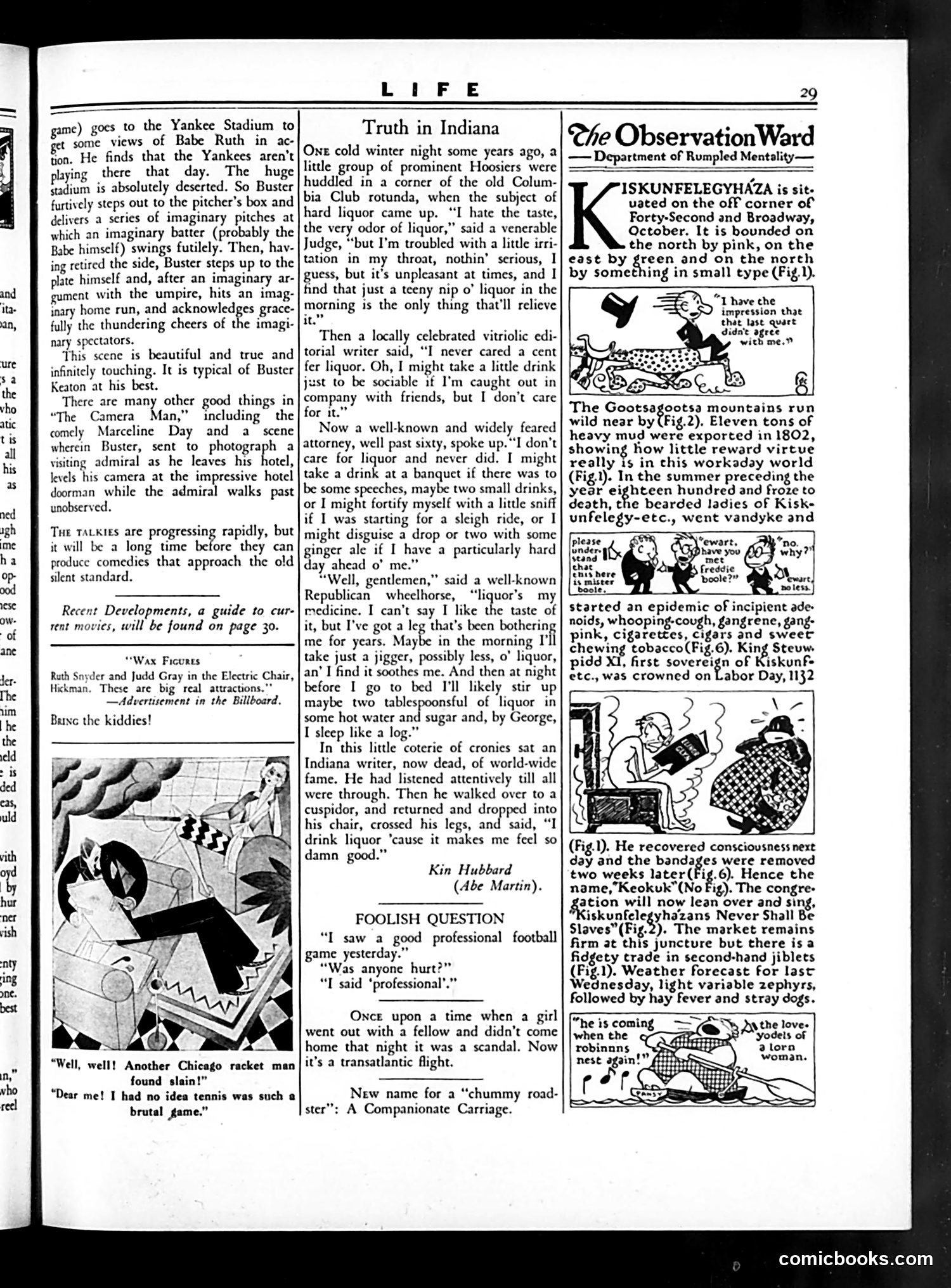
This page contains several satirical pieces mocking Prohibition-era hypocrisy. **"Truth in Indiana"** is the main story, attributed to Kin Hubbard (Abe Martin). It presents four prominent Indiana men—a judge, editor, attorney, and Republican politician—each offering elaborate justifications for drinking alcohol despite claiming not to care for it: medicinal relief, sociability, fortification, and sleep aids. The final speaker, an unnamed "Indiana writer of world-wide fame" (likely a real person, now deceased), cuts through the pretense: he drinks liquor "cause it makes me feel so damn good." **The satire's point**: During Prohibition, respectable citizens constructed elaborate excuses to drink while maintaining social respectability. The anonymous writer's blunt honesty exposes the transparent hypocrisy of the others' rationalizations. **"Foolish Question"** mockingly equates professional football with violence—suggesting the sport is defined by injuries rather than skill. The page reflects 1920s anxieties about Prohibition's unenforceability and widespread moral compromise among the supposedly upright classes.
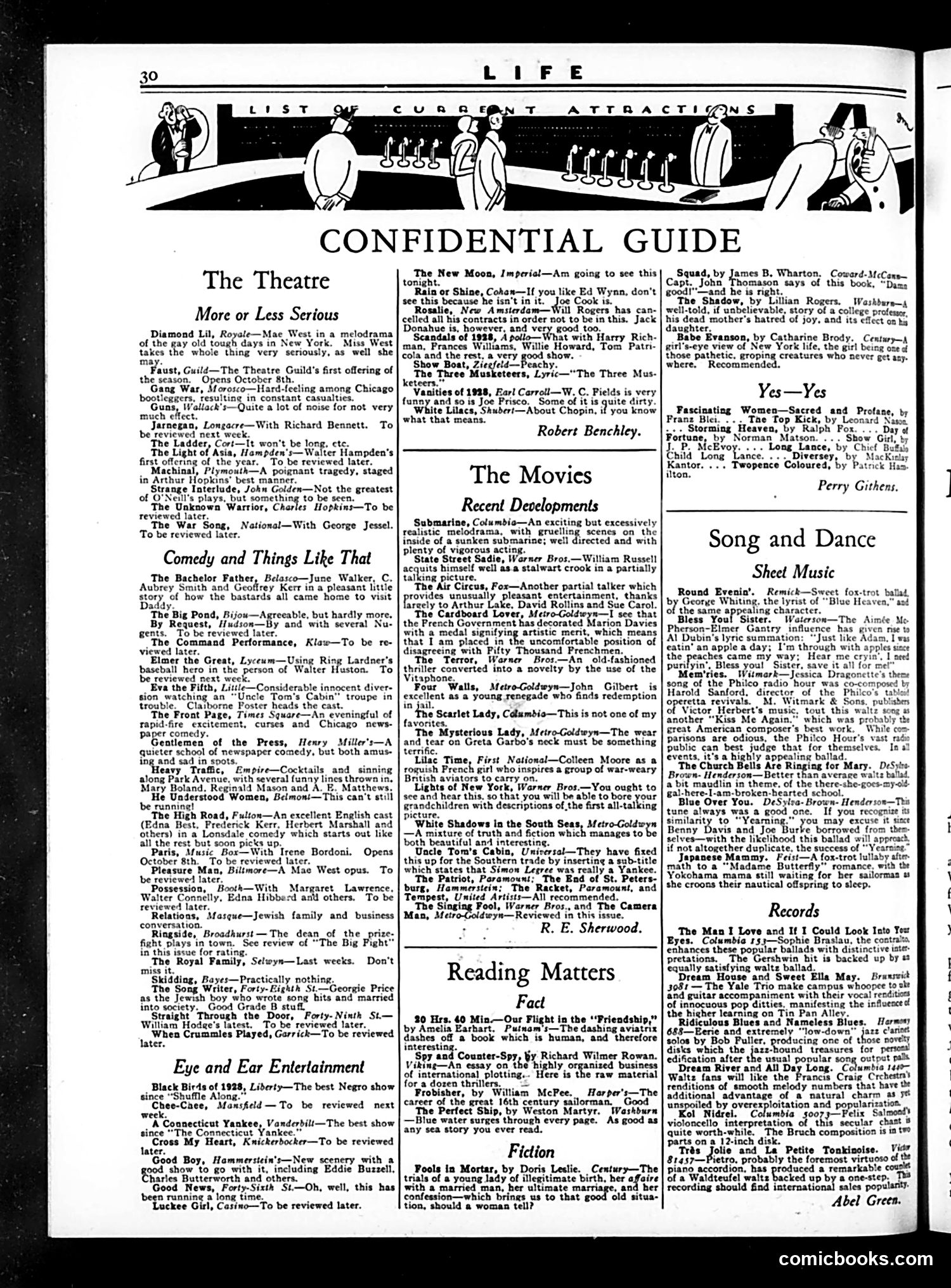
This page is primarily a **listing of current Broadway theater attractions** rather than political satire. It's a standard theatrical review section from Life magazine's entertainment coverage. The "Confidential Guide" format presents brief, often witty dismissals of plays then running on Broadway. The humor is theatrical critique, not political commentary. Notable entries include: - **Mae West's "Diamond Lil"** and **"Pleasure Man"** — West was a controversial figure known for sexual innuendo; the reviewer notes she takes the melodrama "very seriously" - **"Strange Interlude"** by Eugene O'Neill — dismissed as "not the greatest" but "something to be seen" - Generic mockery of lesser productions ("Guns...quite a lot of noise for not very much effect") The page reflects **1920s Broadway culture** and Life's role as entertainment guide for educated urban readers. The tone is sophisticated snark aimed at theatergoers evaluating what's worth attending. There are no identifiable political cartoons or caricatures on this page—it's purely theatrical listing and criticism.
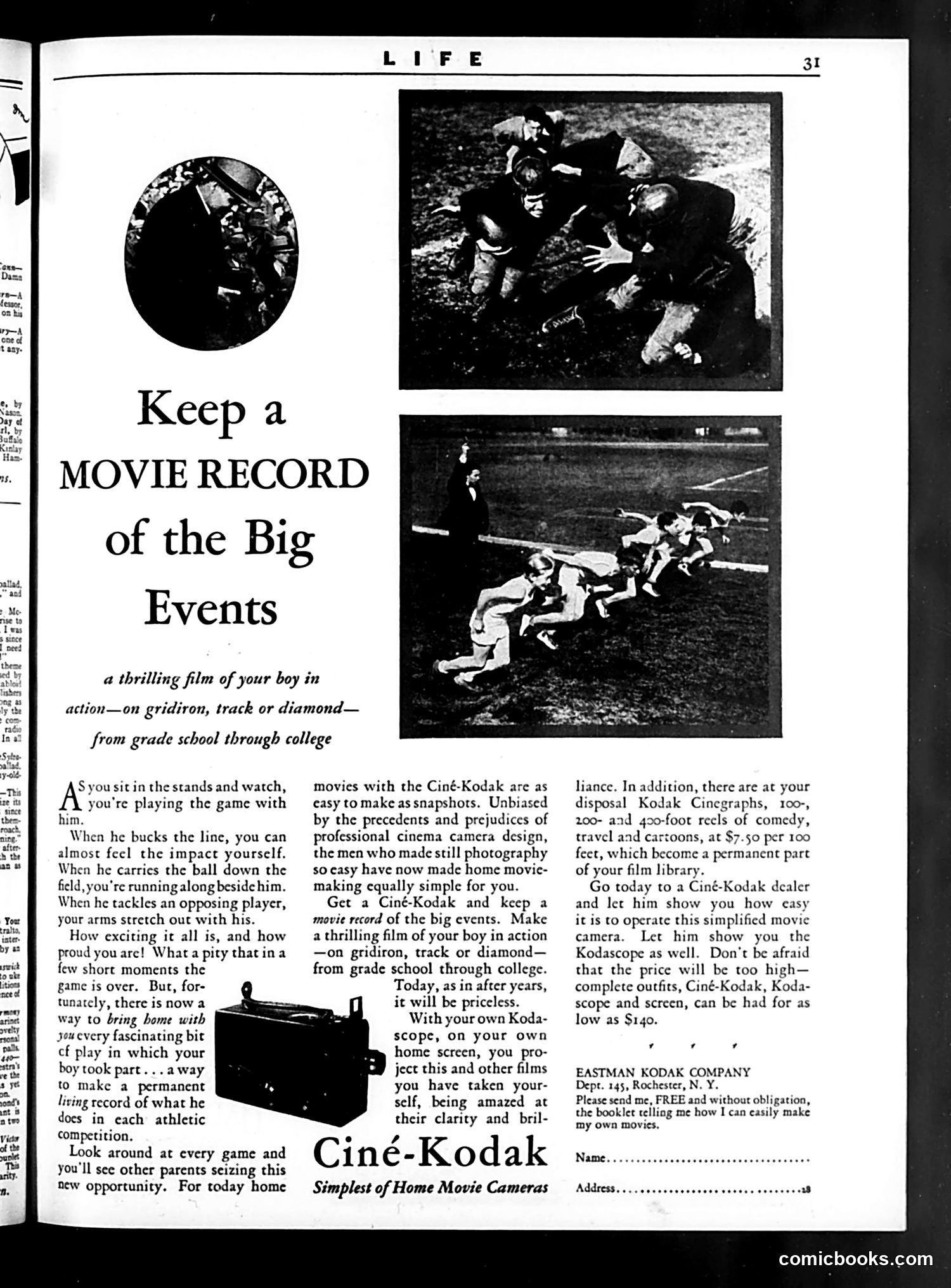
This is a straightforward **advertisement** for Ciné-Kodak home movie cameras, not a political cartoon or satirical content. The page appears in *Life* magazine's editorial space but functions as paid promotion. The ad appeals to **parents** by promising they can film their sons' athletic achievements—football, track, baseball—from grade school through college. The pitch exploits parental pride: watching your boy "in action" will be "priceless" to preserve forever. The two photographs show boys engaged in sports and outdoor play. The text emphasizes ease of use ("as easy as snapshots") and affordability (complete outfit "as low as $140"—substantial money in this era). This reflects **early 20th-century consumer marketing**: targeting middle-class anxiety about capturing fleeting childhood moments and male achievement through new technology. There is no political satire here—just commercial persuasion dressed in sentimental family language.
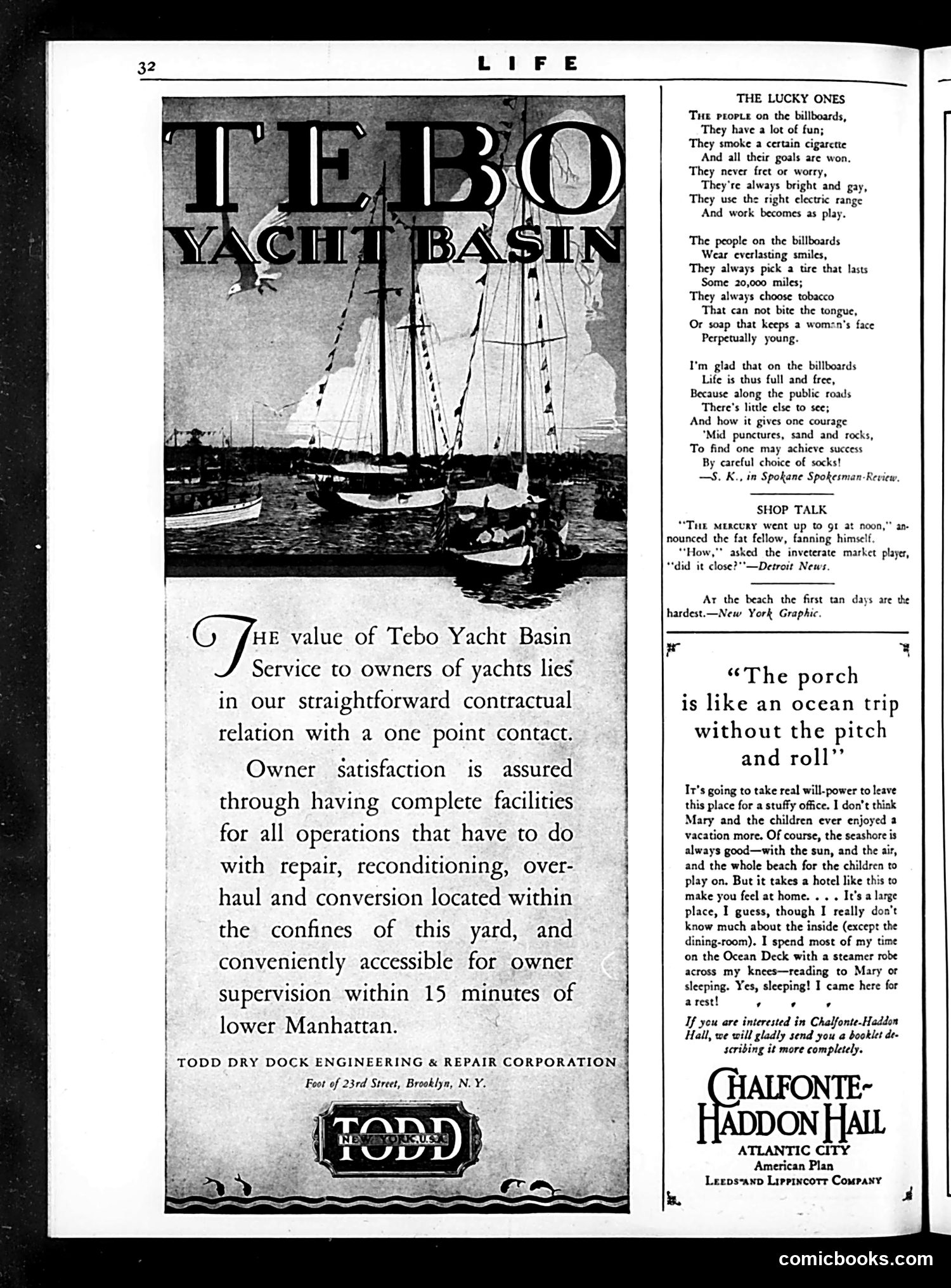
This page combines advertising with social satire. **"The Lucky Ones"** is a poem mocking American consumer culture and billboard advertising. The satirist observes that billboards present an impossibly perfect life—people who achieve happiness through choosing the "right" cigarette, tire, or soap—while actual travelers along public roads see little else but these ads. The poem's final coupoke (about finding success through "careful choice of socks") sarcastically highlights how absurd such promises are. The page otherwise features straightforward advertisements: Todd Dry Dock Engineering promotes yacht repair services, and Chalfonte-Haddon Hall advertises a luxury Atlantic City hotel. A brief "Shop Talk" section includes market-related humor. The satire's point: advertising sells false dreams of perfection to ordinary people experiencing mundane reality—punctures, sand, and rocks rather than billboard glamour.
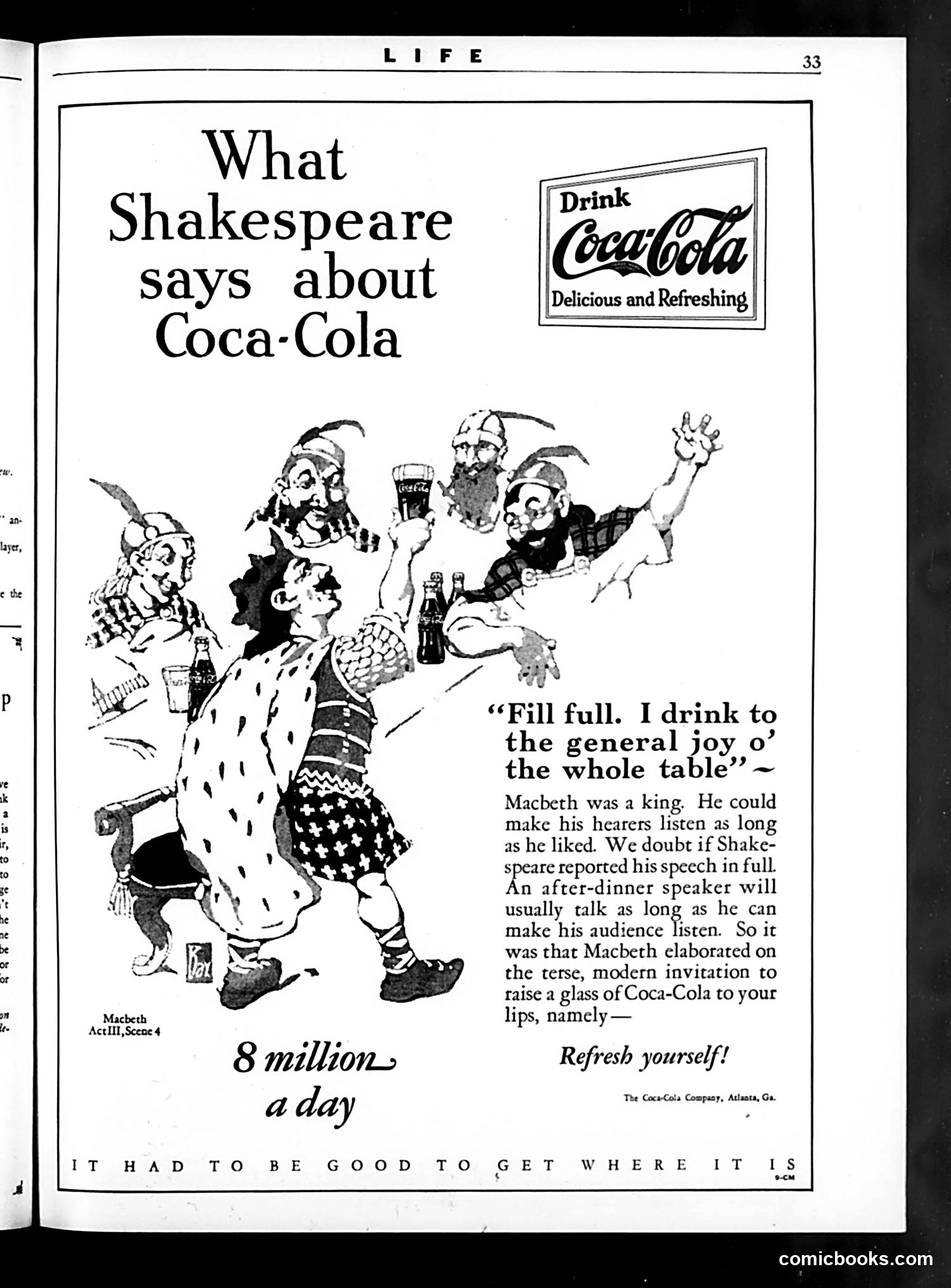
This is a **Coca-Cola advertisement** disguised as literary satire. The page humorously claims that a quote from Shakespeare's *Macbeth* ("Fill full. I drink to the general joy o' the whole table") is actually about Coca-Cola. The joke: The ad suggests that Macbeth, as a powerful king, could hold his audience captive during long speeches. Similarly, modern after-dinner speakers talk as long as possible. Therefore, Macbeth must have elaborated his brief toast into a lengthy speech promoting Coca-Cola—a "modern invitation" to drink the beverage. The cartoon depicts characters in medieval/Shakespearean costume raising Coca-Cola bottles in celebration. **The satire's point**: By attributing Coca-Cola promotion to Shakespeare himself, the advertisement playfully claims the drink is timeless and universally appealing—even worthy of literary endorsement. The bottom tagline "8 million a day" suggests Coca-Cola's enormous consumption. This is pure commercial propaganda wrapped in clever wordplay rather than genuine political or social commentary.
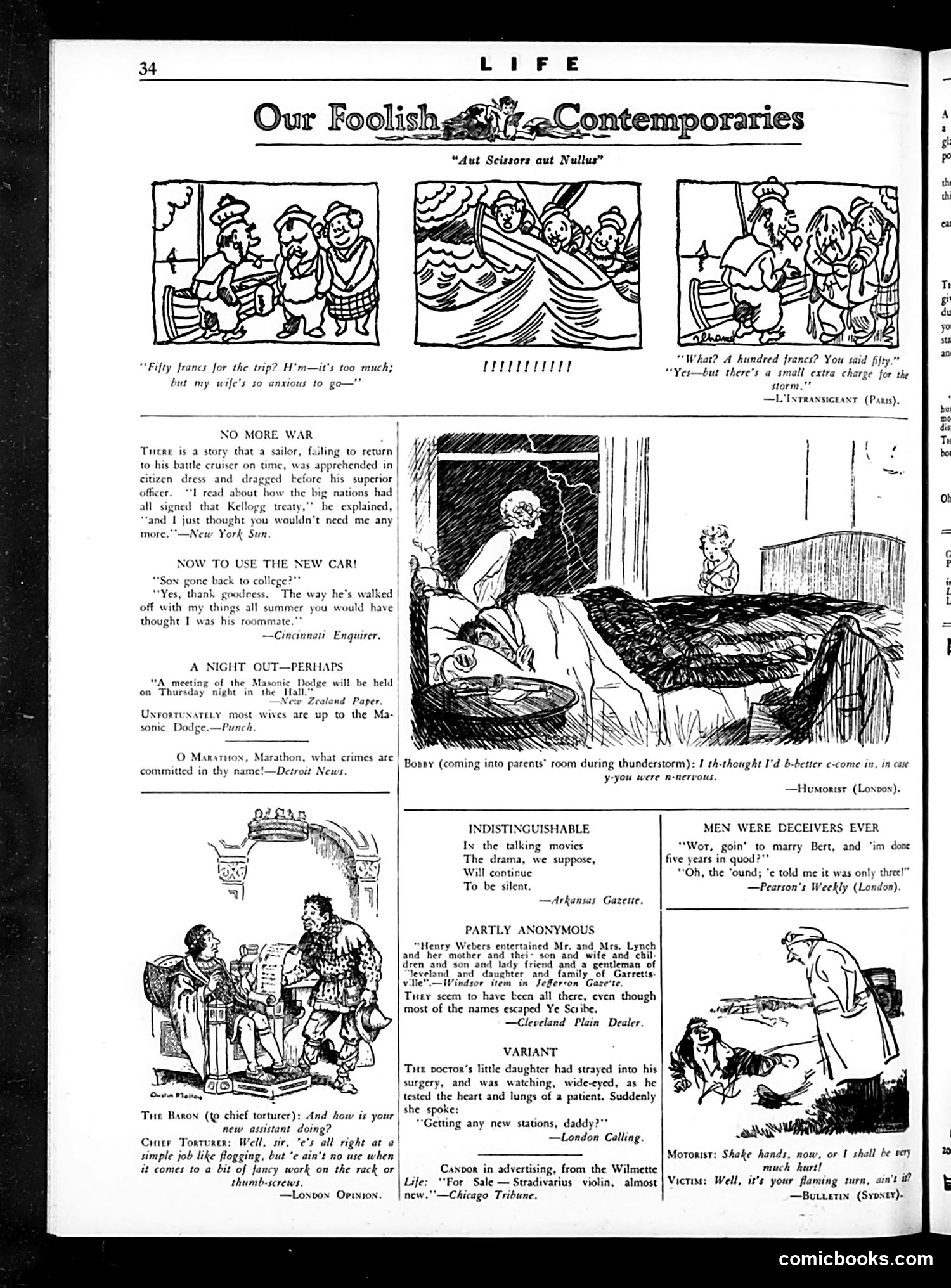
This is a humor anthology page featuring short jokes and comic strips from various publications, typical of Life's satirical format. The content includes: **Top comics**: A three-panel strip about tourists haggling with a French boatman over trip costs; he charges extra for "storm" service—satirizing both tourist naiveté and petty profiteering. **Short humor items** mock contemporary absurdities: - A sailor citing the Kellogg-Briand Pact (1928 anti-war treaty) to avoid duty - A college student appropriating his father's belongings - A child interrupting parents during a thunderstorm - Newspaper social notices listing excessive names confusingly **Recurring themes**: marital deception, class humor (torture/servants), and working-class dialect humor typical of 1920s-30s Life magazine. The page reflects period concerns: disarmament treaties, modern inconveniences, and domestic/social comedy. The tone is lighthearted, drawn from international publications (French, British, Australian sources credited).
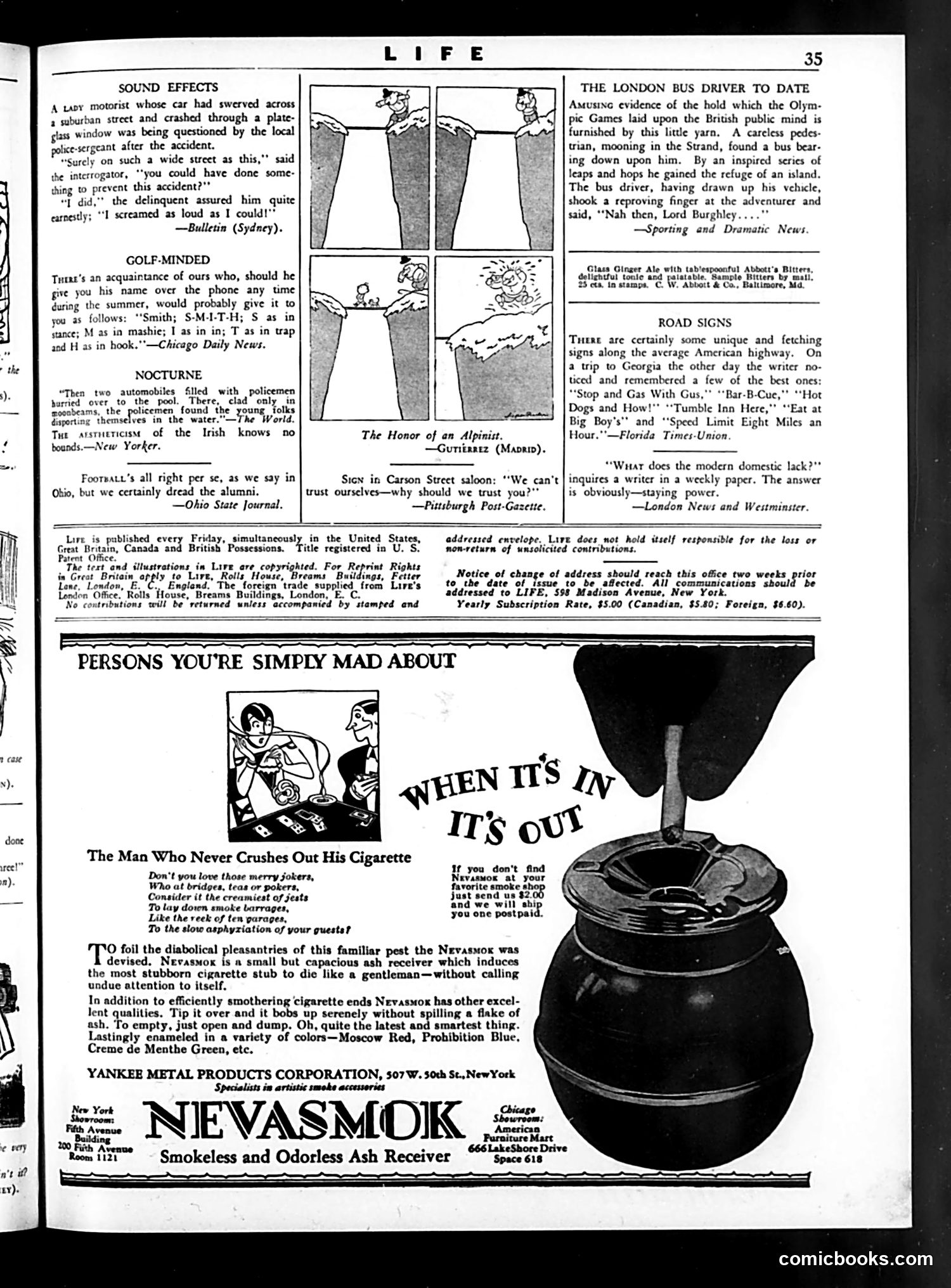
This page contains miscellaneous short humorous items and advertisements typical of Life's satirical format. **The cartoons and jokes** are brief, unrelated anecdotes mocking everyday types: a careless motorist, a golf-obsessed acquaintance who spells his name phonetically, and rowdy behavior. One item about a London bus driver references the 1936 Olympic Games held in Berlin, joking that the driver sarcastically addresses a pedestrian as "Lord Burghley" (likely British Olympic athlete). **The main advertisement** is for Nevasmok, a cigarette ash receiver marketed to "persons you're simply mad about"—specifically targeting the man who inconsiderately leaves cigarette ash everywhere. The ad humorously depicts smoking etiquette as a social problem while ironically promoting a product enabling continued indoor smoking without mess. The page reflects 1930s-era concerns about smoking indoors as a social courtesy issue, not a health hazard. It's mostly light humor and commercial content rather than political satire.
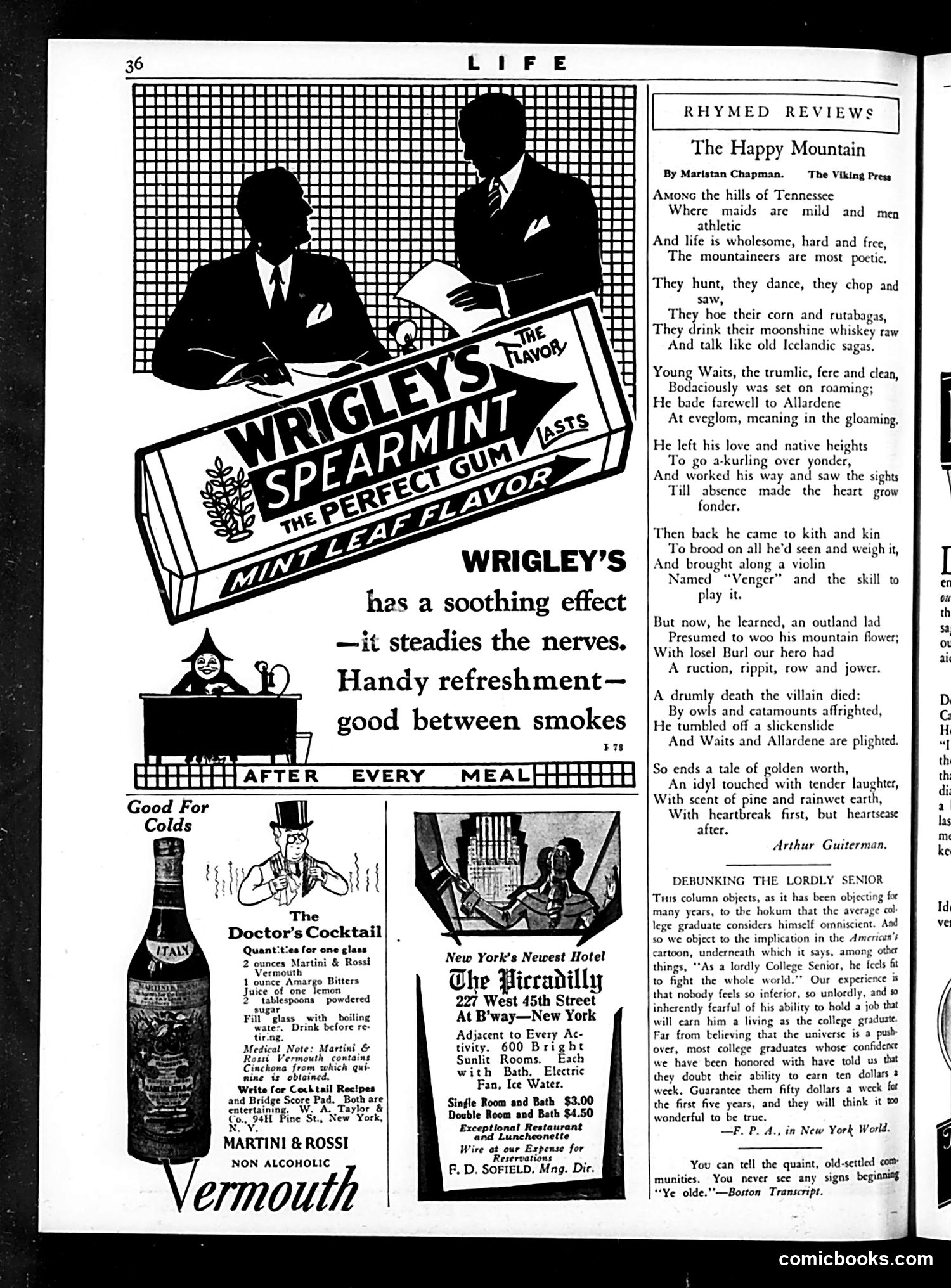
This page mixes **advertisements** with **literary and cultural commentary**, typical of 1920s Life magazine. The **Wrigley's Spearmint ad** (top) uses period imagery: two silhouetted men in business attire examining the product, claiming gum "steadies the nerves" and provides "handy refreshment—good between smokes." This reflects early 20th-century anxieties about modern life and tobacco use. Below are ads for **Martini & Rossi vermouth** and **The Piccadilly hotel** in New York—lifestyle products aimed at affluent readers. The right column features **"The Happy Mountain,"** a romantic poem by Maristan Chapman celebrating Tennessee mountaineers as noble, poetic figures living authentically. This reflects the 1920s literary interest in "folk" culture and rural Americana as antidotes to urban modernity. The **"Debunking the Lordly Senior"** column (lower right) sarcastically challenges the common stereotype that college graduates are arrogant and confident, arguing the opposite—they're actually fearful and insecure about employment prospects. This reflects post-WWI concerns about youth and economic opportunity.
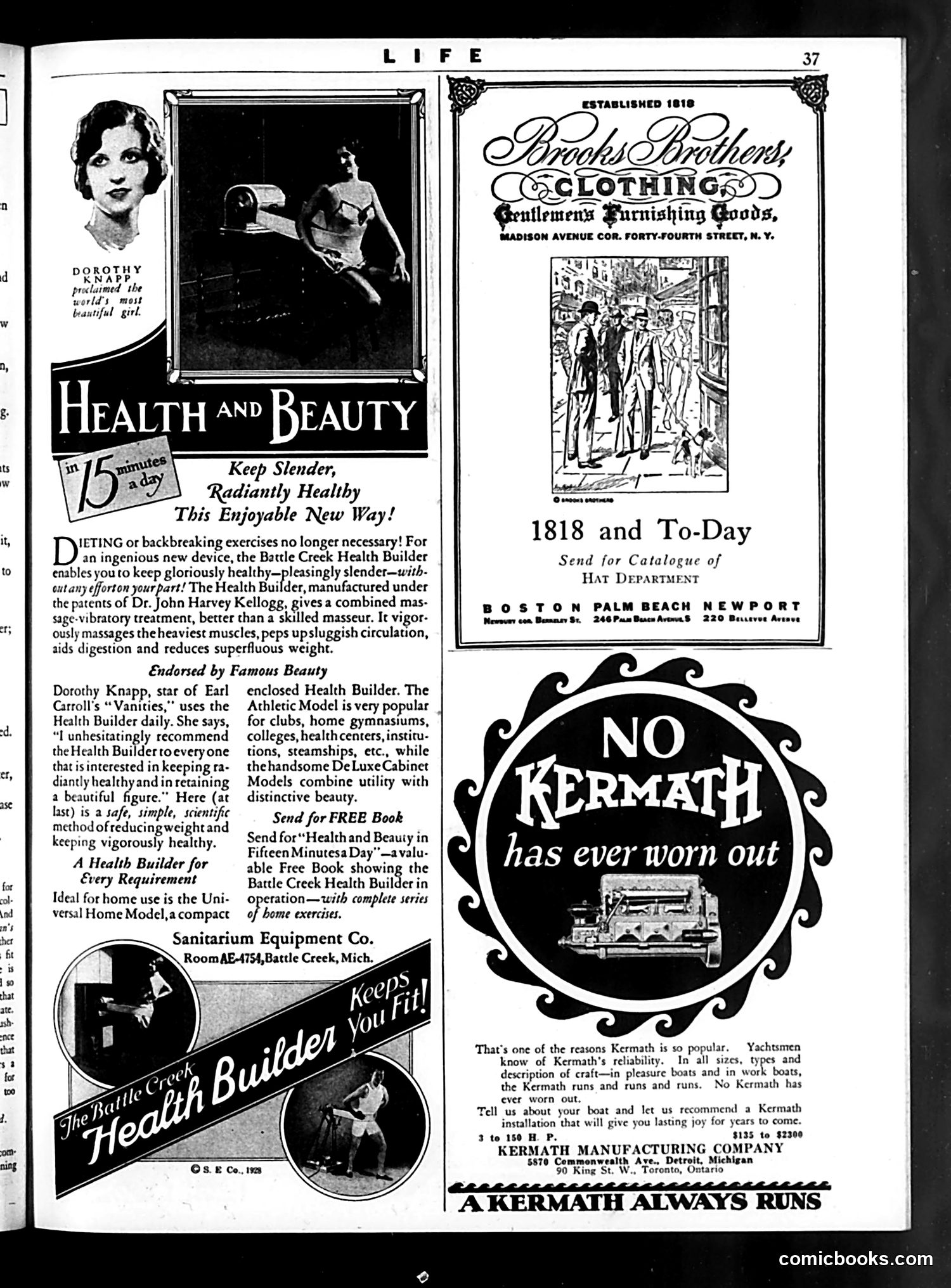
This page is primarily **advertisements**, not satire or political cartoons. The content reflects 1920s consumer culture and marketing claims. **Main advertisements:** 1. **"Health and Beauty" (Battle Creek Health Builder)**: Features Dorothy Knapp, a Broadway performer from Earl Carroll's *Vanities*, endorsing a vibrating exercise machine. The device claimed to provide effortless weight loss and fitness—a marketing claim that modern readers would recognize as dubious. The machine was manufactured under Dr. John Harvey Kellogg's patents, exploiting his medical authority. 2. **Brooks Brothers Clothing**: A straightforward institutional advertisement marking the company's longevity (1818 to present). 3. **Kermath Manufacturing**: Promotes boat engines with the slogan "A Kermath Always Runs," emphasizing reliability. The "Health and Beauty" ad is notable for promoting a passive exercise device as a substitute for actual exercise—a sales strategy that satirizes itself to modern readers familiar with contemporary fitness fads and dubious wellness gadgets.
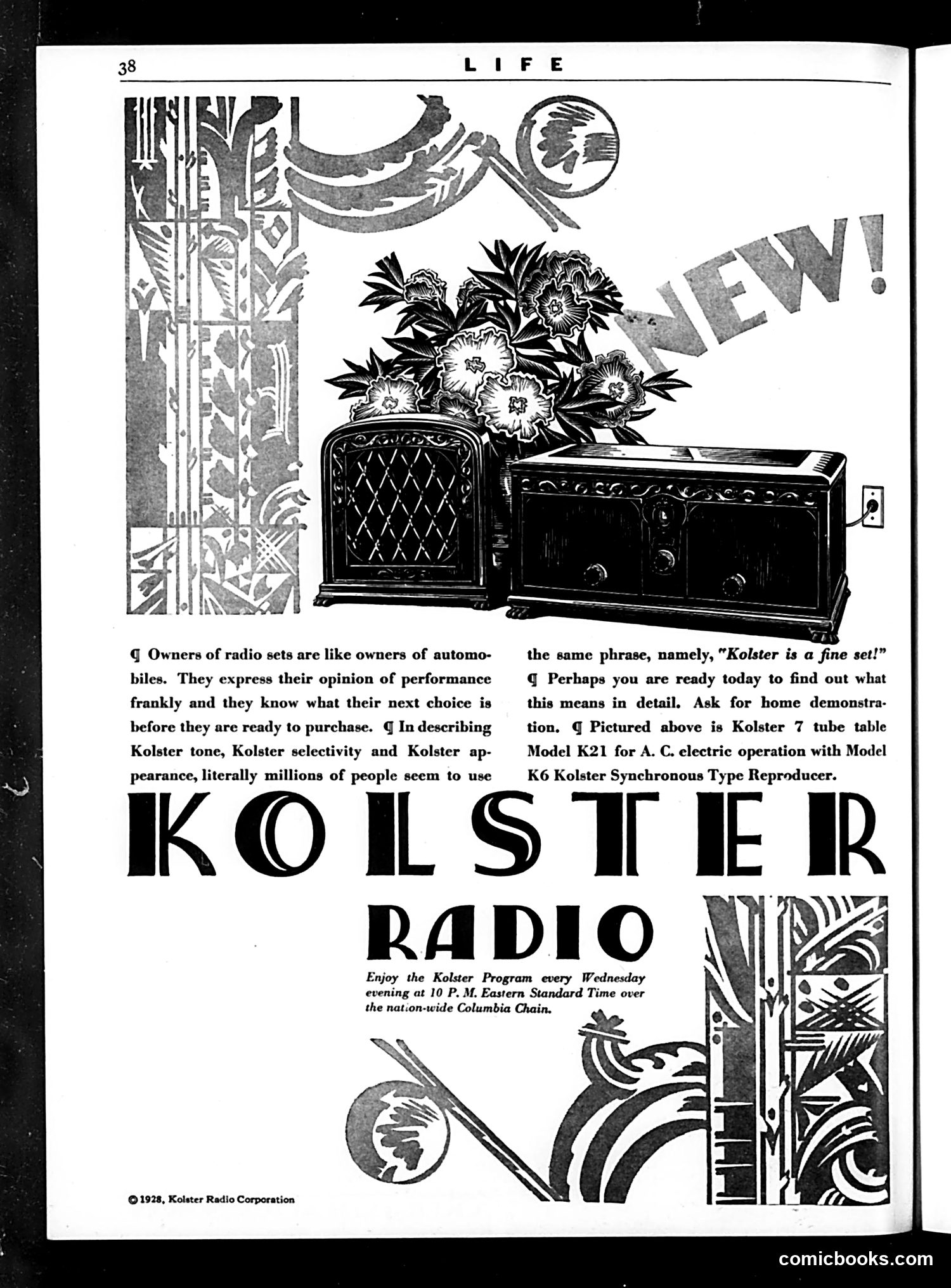
This is a **product advertisement**, not political satire. It promotes Kolster brand radios during the early commercial radio era. The ad compares radio-set owners to automobile owners—both groups are knowledgeable consumers who frankly evaluate performance and know their next purchase before buying. The text claims "millions of people" describe Kolster radios using the identical phrase: "Kolster is a fine set!" The visual shows an ornate 1920s table-model radio with speakers and flowers, styled to appear sophisticated and desirable. The ad invites readers to request a home demonstration and mentions a weekly "Kolster Program" broadcast on Wednesday evenings via the Columbia radio network. This reflects 1928's commercial radio boom, when radio ownership was becoming mainstream and manufacturers competed heavily through branded programming and sponsorships.
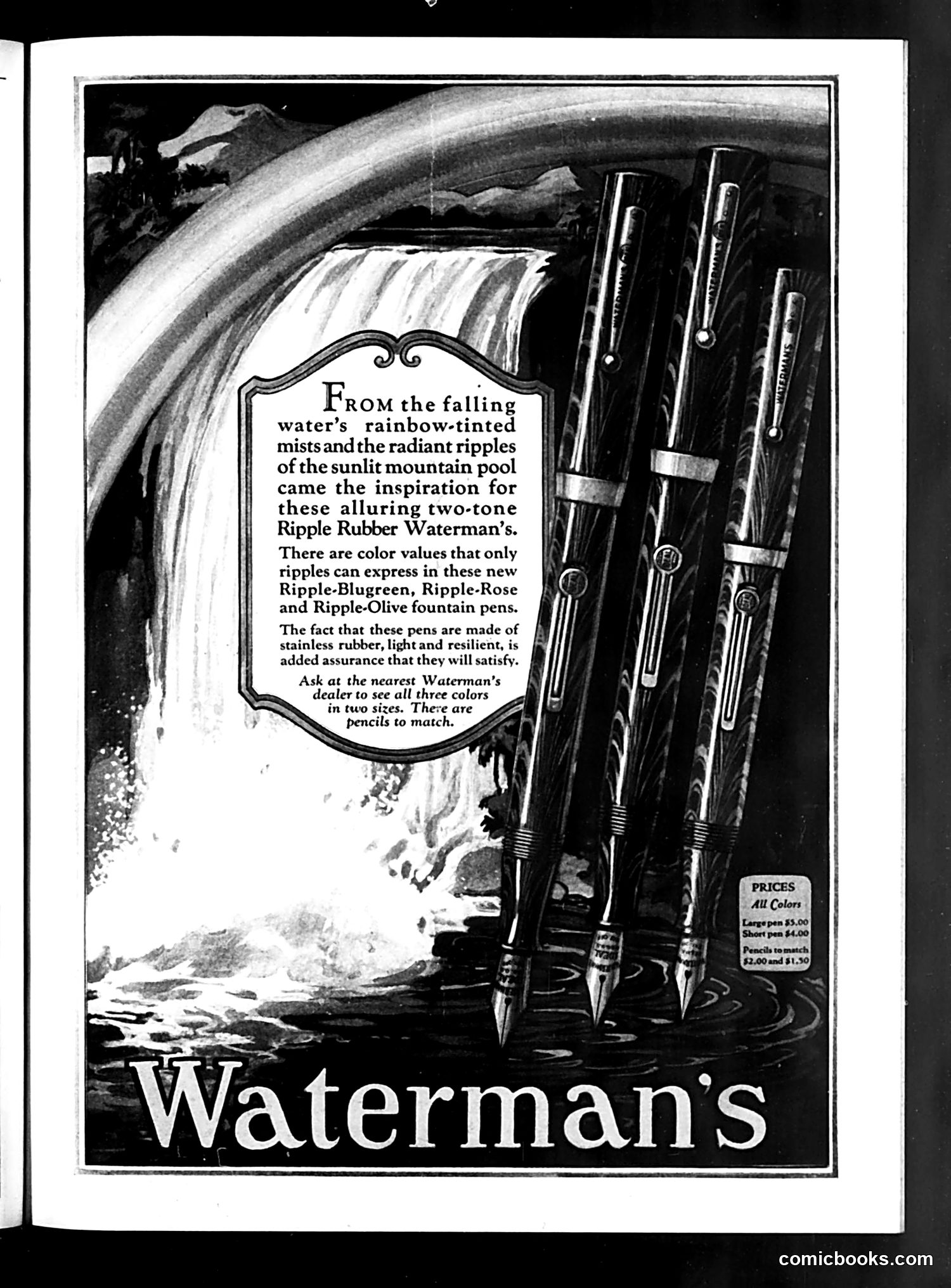
This is a **product advertisement**, not political satire. It promotes Waterman's brand fountain pens and pencils, featuring their new "Ripple Rubber" line in three colors: Ripple-Blugreen, Ripple-Rose, and Ripple-Olive. The ad uses evocative imagery—a dramatic waterfall with rainbow mists—to inspire the pen colors. The text emphasizes that the pens are made of "stainless rubber, light and resilient," appealing to consumers seeking quality writing instruments. A price box indicates pens cost between $1.00 and $6.00, with matching pencils available. The ad directs readers to visit nearby Waterman's dealers to examine all three colors in two sizes. This represents typical mid-century advertising strategy: connecting product features to natural beauty and emotional appeal.
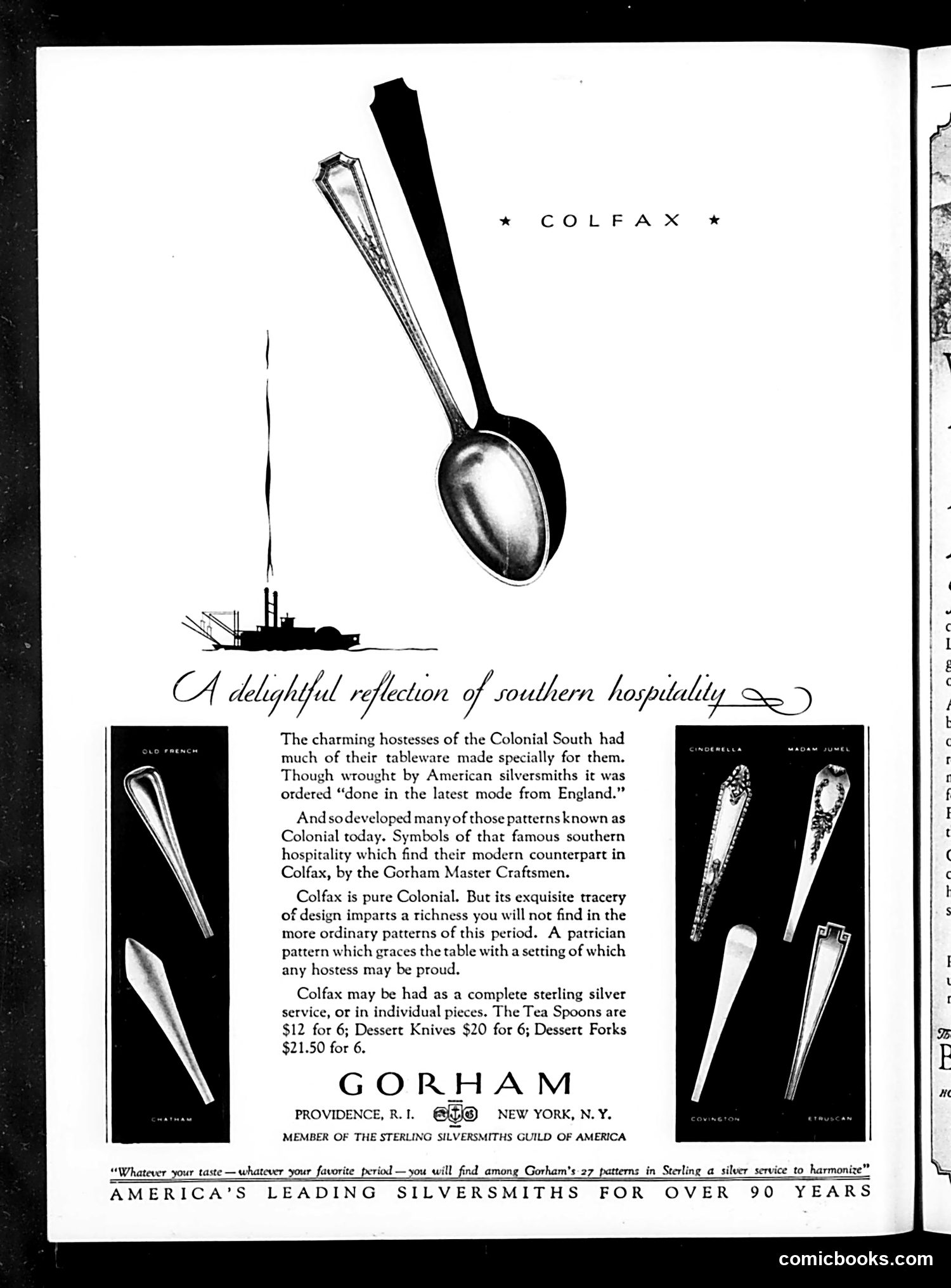
This is **not a cartoon or satire page**, but rather a **full-page advertisement** for Gorham sterling silver flatware, specifically their "Colfax" pattern. The ad uses historical framing to sell luxury tableware: it references Colonial South hospitality and the tradition of American silversmiths creating "English-style" patterns for wealthy southern hostesses. The copy positions the Colfax pattern as authentically Colonial yet more refined than ordinary period designs—appealing to aspirational middle-class customers wanting "patrician" elegance. The imagery shows spoons and forks photographed elegantly against black backgrounds, with a ship illustration evoking historical trade and craftsmanship. Pricing is displayed ($12-$21.50 per piece, premium for the era). This is characteristic of early-to-mid 20th century *Life* magazine advertising: using prestige, history, and class association to market consumer goods to upwardly mobile readers.
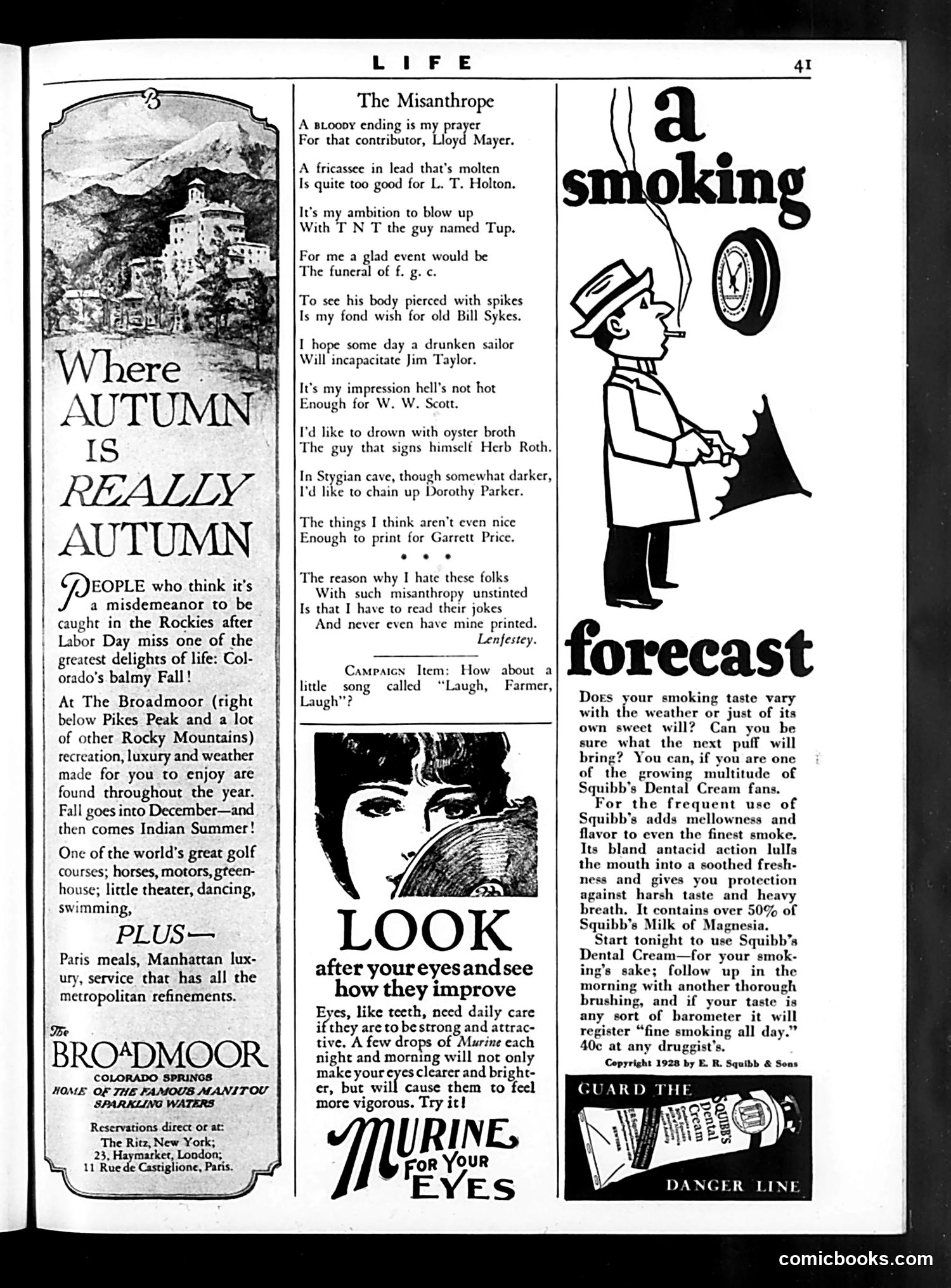
This poem by Lenfestey mocks rejected magazine contributors. The speaker expresses violent wishes toward various named people—Lloyd Mayer, L.T. Holton, "Tup," and others—wishing them bloody, explosive, or drowning deaths. The twist reveals the real complaint: these individuals are *published* contributors whose jokes appear in Life magazine, while the speaker's own submissions are consistently rejected. The satire targets the bitterness of unpublished writers. The absurdly disproportionate hatred (wishing death on people merely for being published) exaggerates how rejection stings creative professionals. Dorothy Parker, a known humorist, is specifically named—suggesting these are real contributors the rejected writer envies. The humor operates on two levels: the dark comedy of the violent fantasies themselves, and the pathetic self-awareness that the speaker's jealousy, not actual wrongdoing, motivates the rants.
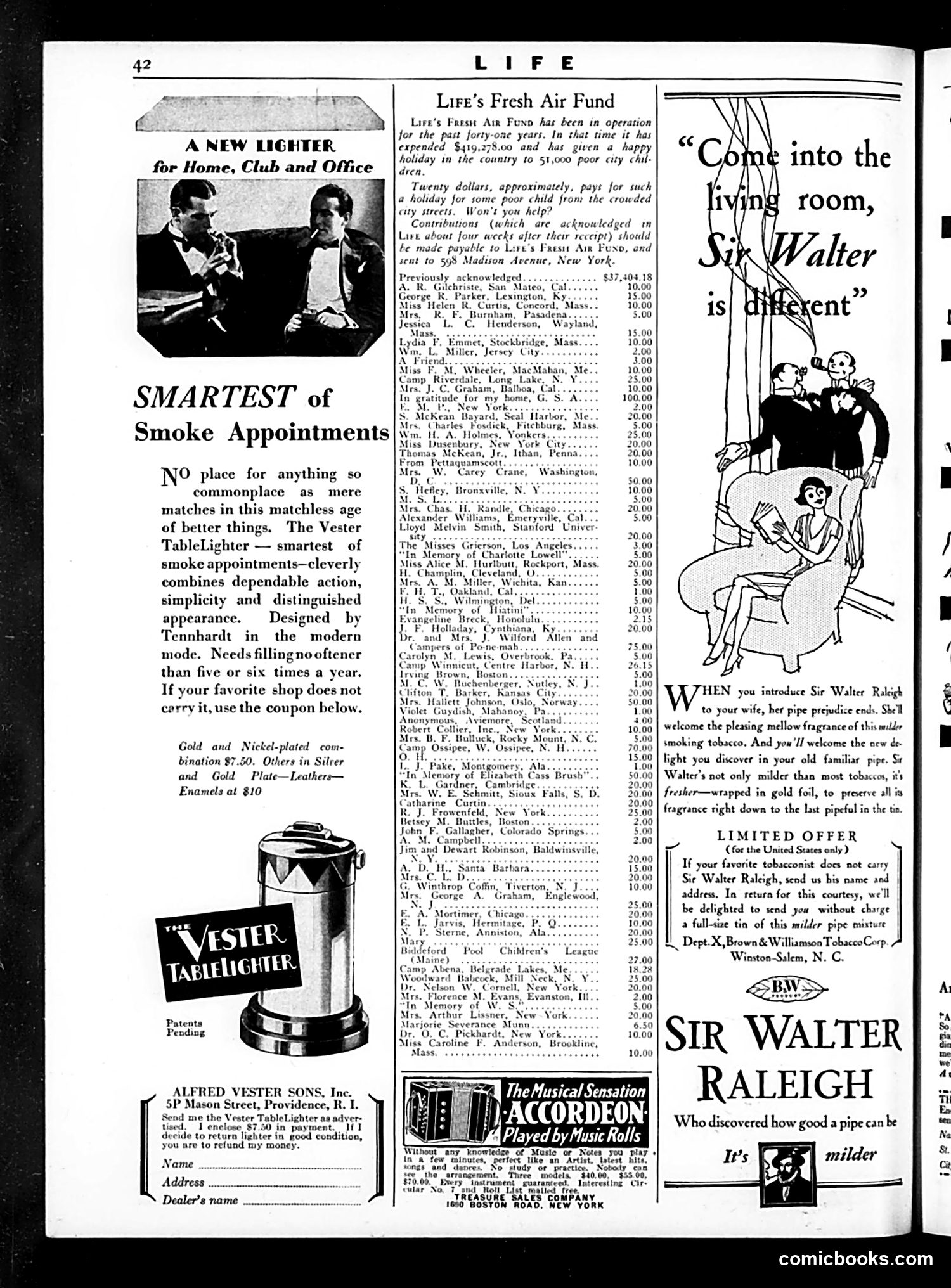
This page is primarily **advertising**, featuring three unrelated commercial promotions typical of early 20th-century magazines: 1. **Vester TableLighter**: A luxury table lighter marketed as a status symbol for "better things" — appealing to affluent homes, clubs, and offices. 2. **Life's Fresh Air Fund**: A charitable appeal listing donor names and contributions (ranging $1-$100) for a 41-year-old program providing country holidays to poor city children — a common Progressive Era philanthropic cause. 3. **Sir Walter Raleigh Tobacco**: The only content approaching satire or humor. The advertisement features an illustration where introducing a wife to the mild tobacco brand supposedly ends her "pipe prejudice." This plays on period gender dynamics, suggesting wives objected to pipe smoking's harshness; the milder product supposedly wins female approval. 4. **Musical Accordion**: A small ad claiming anyone can play music via mechanical rolls without knowledge. The page reflects early 1900s consumer culture, charitable giving patterns, and gender attitudes rather than political satire.
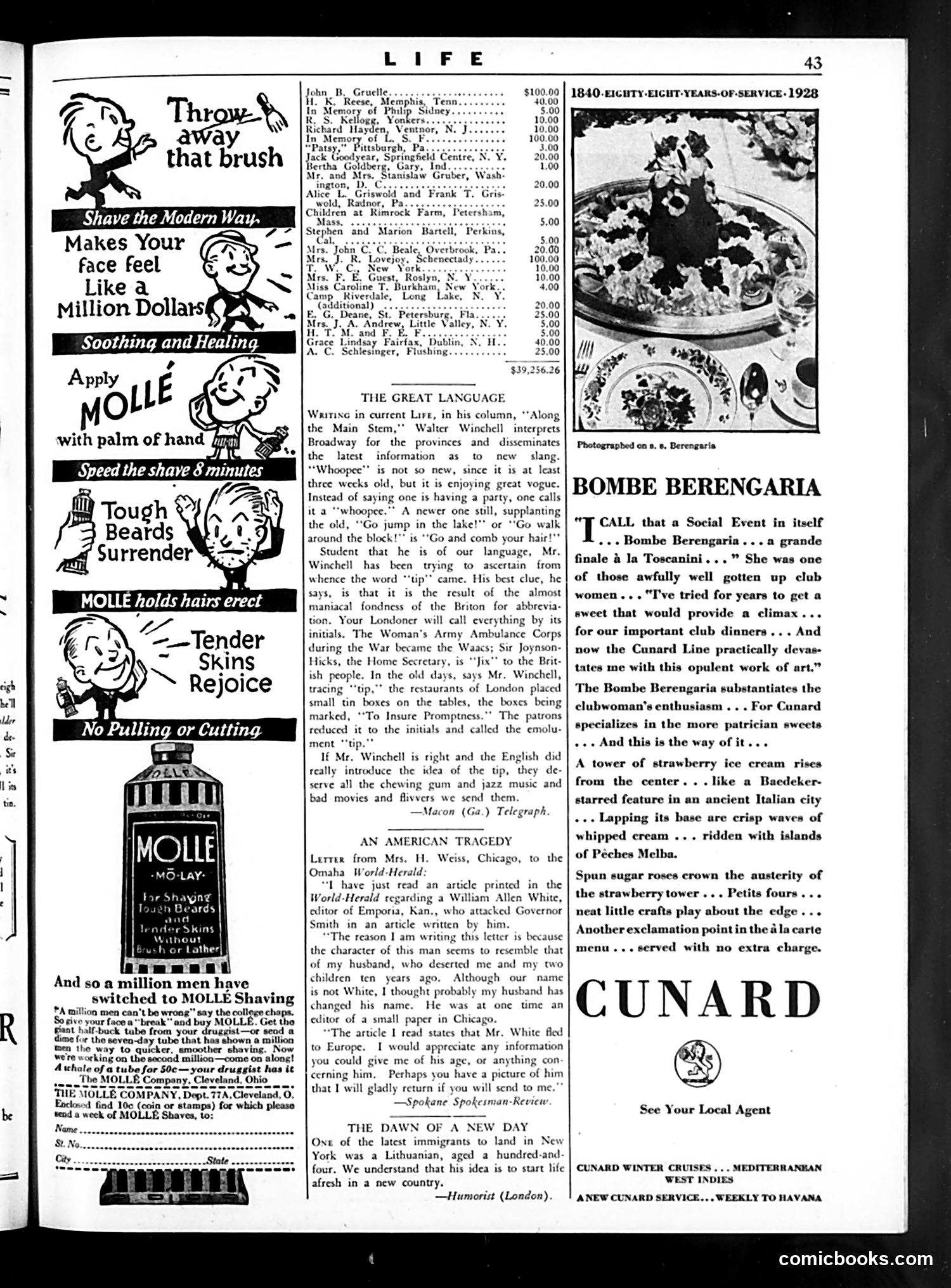
This page is primarily **advertising and miscellaneous content**, not political satire. The dominant left column features **MOLLE shaving cream ads** with cartoon mascots demonstrating product benefits ("Throw away that brush," "Makes Your face feel Like a Million Dollars"). These are standard early-20th-century product advertisements. The right side contains **"Bombe Berengaria,"** describing a fancy dessert served on the Cunard Line cruise ship, presented as social commentary on luxury travel and culinary sophistication. Below that is **"The Great Language"** — a brief article discussing Broadway slang terms like "whoopee," and etymology of the word "tip" (allegedly from British restaurant boxes marked "To Insure Promptness"). The page concludes with brief reader letters to *Life's* editor: one claiming to search for a missing husband who may be editor William Allen White, and another noting a Lithuanian immigrant's arrival. **No significant political satire or cartoon commentary is visible.** This appears to be a typical magazine miscellany page combining advertisements, travel features, and light cultural observation.
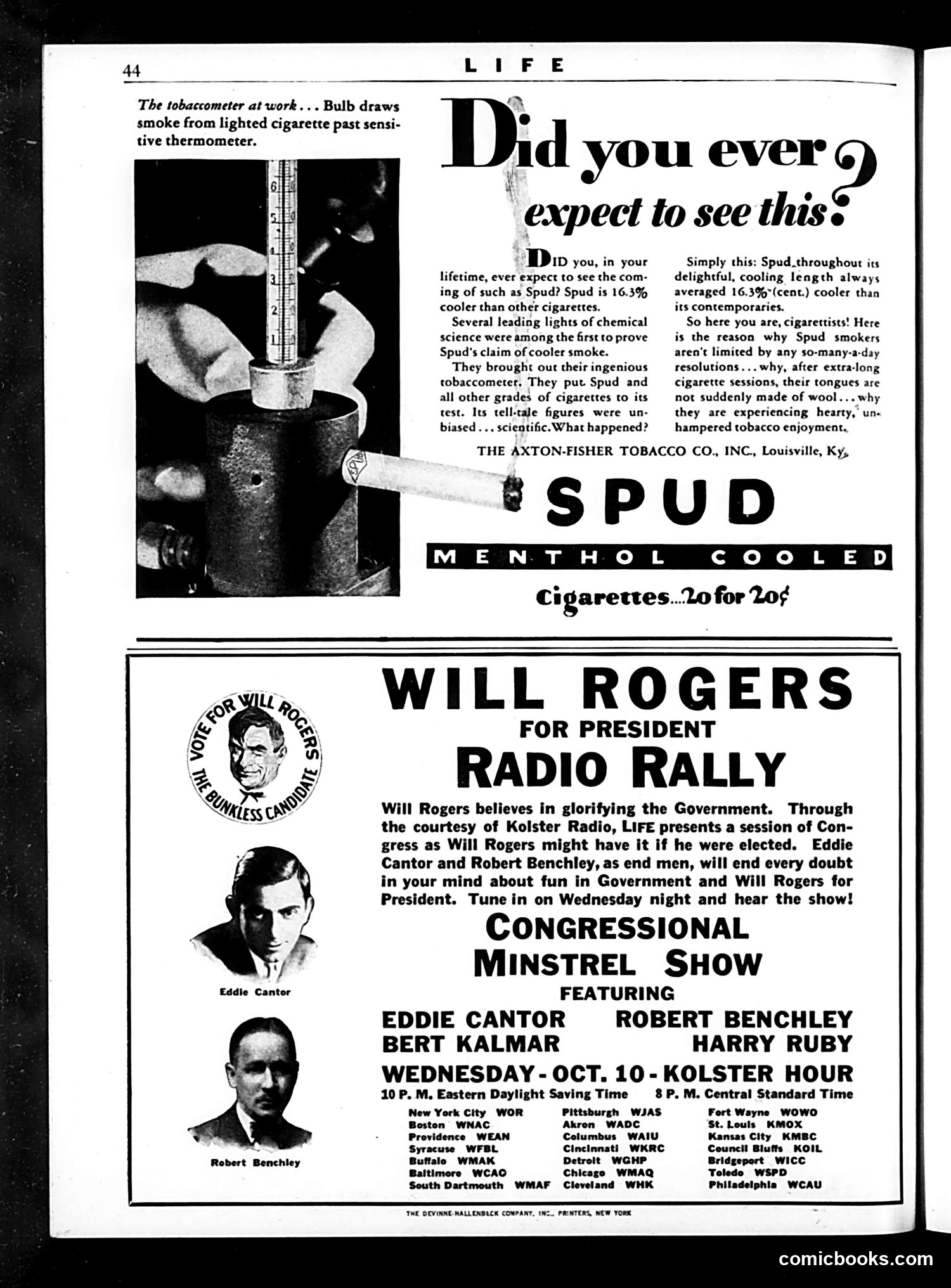
This page contains two distinct advertisements from what appears to be a 1920s-era Life magazine. **Top: Spud Cigarettes Ad** A cigarette company claims scientific superiority by showing a "tobaccometer"—a device measuring smoke temperature. The ad asserts Spud cigarettes are 16.3% cooler than competitors. The copy humorously suggests this coolness means smokers won't experience sore throats or need to limit smoking ("resolutions"). This represents early 20th-century advertising's use of pseudo-scientific claims to market tobacco products, before health dangers were widely acknowledged. **Bottom: Will Rogers for President Radio Rally** A satirical political radio show announcement featuring comedian Will Rogers as a mock presidential candidate. The "Congressional Minstrel Show" (featuring Eddie Cantor and Robert Benchley as "end men") appears to be comedy entertainment mocking government. This reflects 1920s-30s political satire where comedians humorously critiqued government while maintaining that serious democratic participation remained important. The show aired across multiple radio stations nationwide.
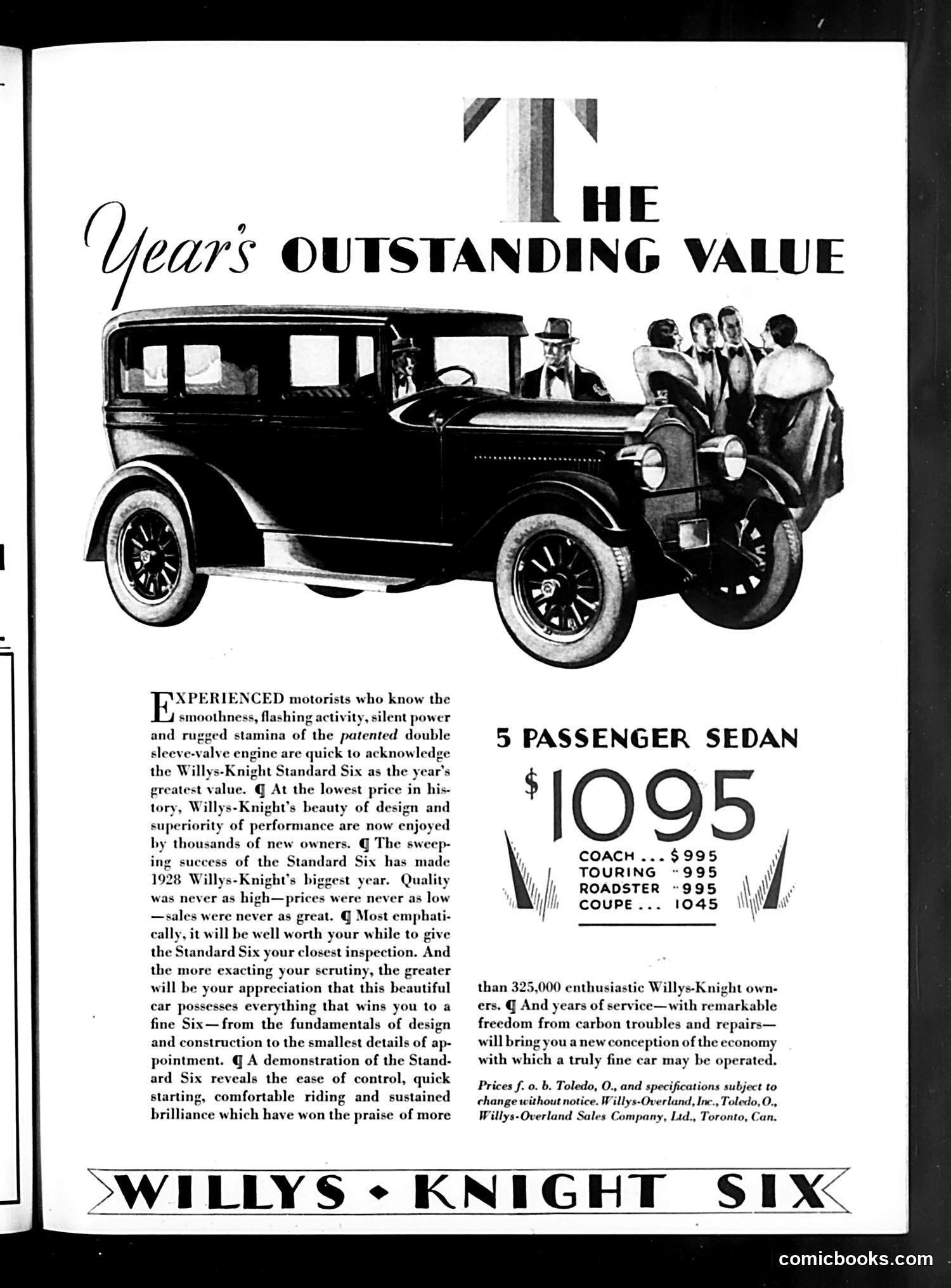
This is **not a satirical cartoon** but a **automobile advertisement** for the Willys-Knight Standard Six, published in 1928. The page advertises a mid-range sedan priced at $1,095, positioning it as exceptional value—"the year's outstanding value." The illustration shows well-dressed men examining the vehicle, conveying aspirational status and reliability. The ad emphasizes the car's "patented double sleeve-valve engine," smooth performance, and low price relative to quality. It notes 325,000 owners and claims the 1928 model was "Willys-Knight's biggest year." **For modern readers:** This reflects pre-Depression prosperity marketing, when automobiles represented middle-class achievement. The formal dress and gentleman-customer focus reflects 1920s consumer culture. The emphasis on "freedom from carbon troubles" reflects genuine mechanical concerns of early automobiles. This is straightforward advertising, not satire or political commentary.
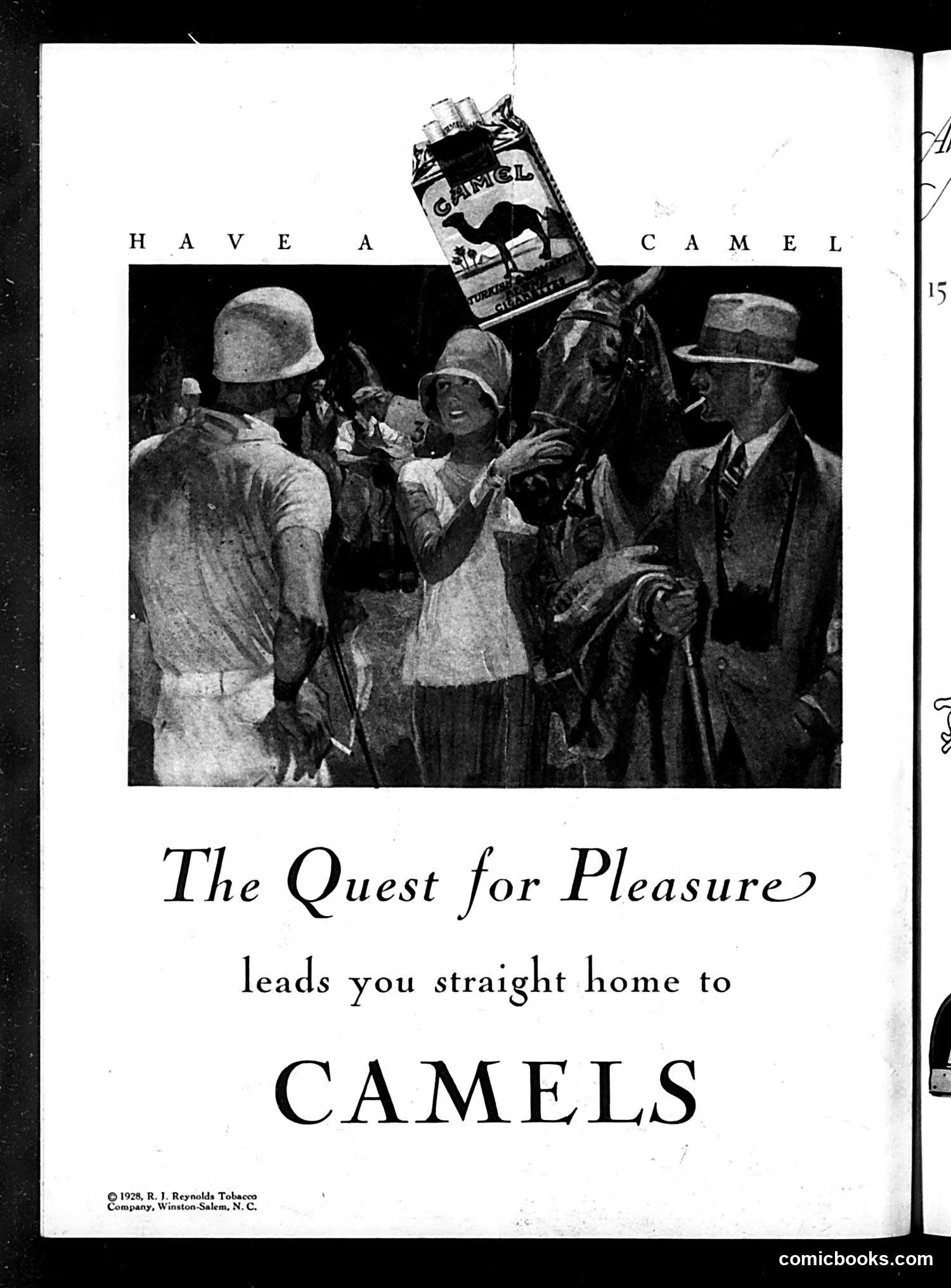
This is a **Camel cigarette advertisement** from 1928, not political satire. The image shows several men in period dress (hats, suits) gathered around a large Camel cigarette package, appearing animated and pleased. The ad's headline plays on the phrase "the quest for pleasure" — suggesting that smoking Camels is the ultimate pleasure-seeking activity that "leads you straight home." This reflects early 20th-century advertising's approach to cigarettes as markers of sophistication and leisure. The copyright attribution to R.J. Reynolds Tobacco Company confirms this is commercial advertising rather than editorial content. The casual grouping and expressions suggest camaraderie and satisfaction associated with the product, a common advertising strategy of the era.