
Life, 1928-10-05 · page 14 of 48
Life — October 5, 1928 — page 14: what you’re looking at
What you’re looking at
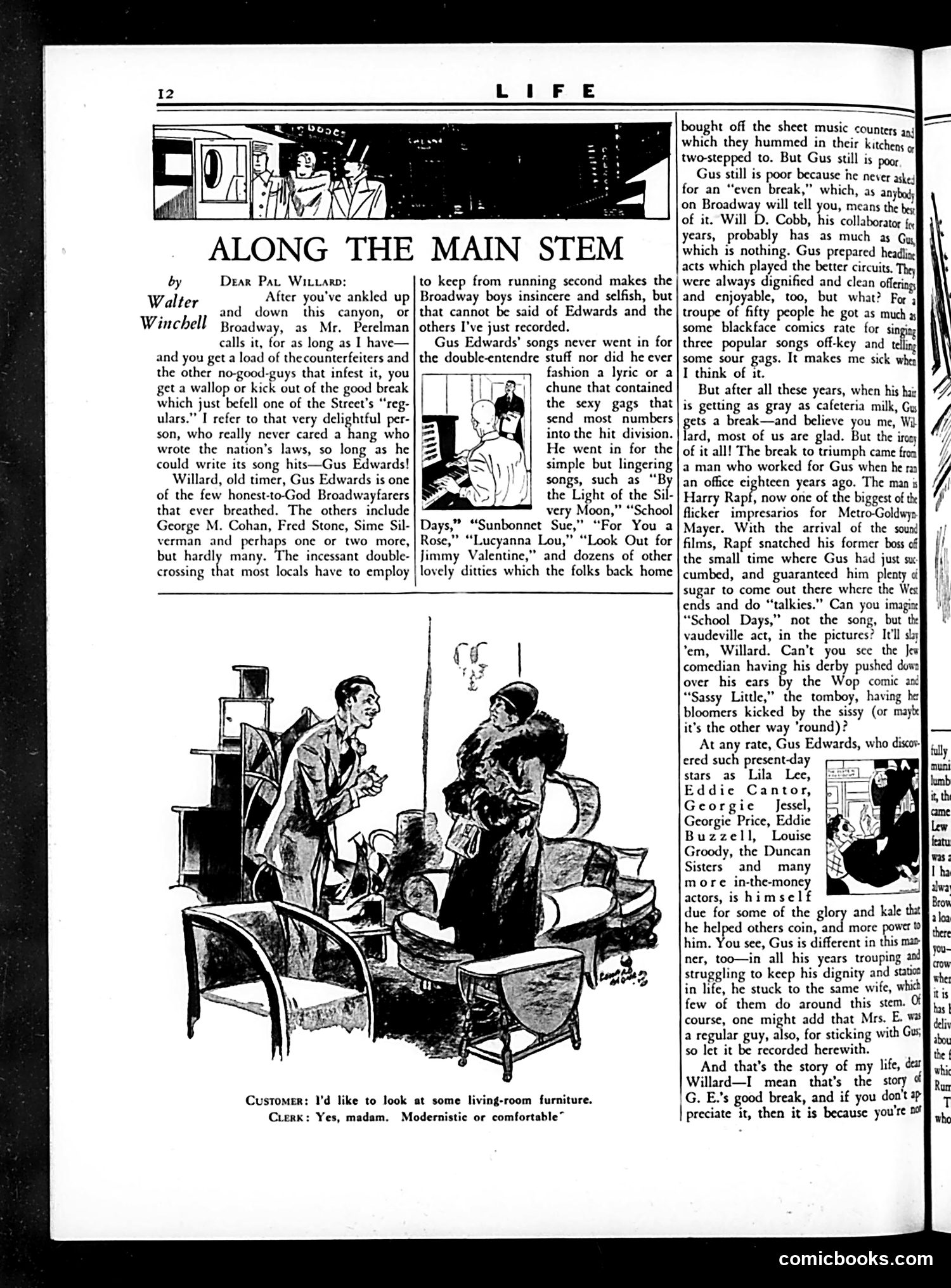
This is a humorous column by Willard about Gus Edwards, a theatrical figure. The text celebrates Edwards as one of Broadway's "most honest-to-God breadwinners," praising his songwriting and mentorship of performers who became famous (Eddie Cantor, George Jessel, and others are named). The accompanying cartoon shows a furniture store scene: a customer asks to see living-room furniture, and the clerk responds "Modernistic or comfortable?" This is satirical commentary on 1920s design trends—mocking the modernist movement's prioritization of style over practicality, suggesting contemporary furniture was often uncomfortable despite fashionable aesthetics. The column's affectionate tone toward Edwards contrasts with the cartoon's gentle mockery of contemporary taste.
📄 Transcribed text from this page (OCR, searchable)
Machine-transcribed from the original scan — historical spelling and the odd misread are preserved.
ALONG THE MAI Dear Pat WiLarp: After you've ankled up and down this canyon, or Broadway, as Mr. Perelman calls it, for as long as I have— and you get a load of thecounterfeiters and the other no-good-guys that infest it, you get a wallop or kick out of the good break which just befell one of the Street's “reg- ulars.” I refer to that very delightful per- son, who really never cared a hang who Winchell wrote the nation’s laws, so long as he} could write its song hits—Gus Edwards! | | Willard, old timer, Gus Edwards is one of the few honest-to-God Broadwayfarers that ever breathed. The others include George M. Cohan, Fred Stone, Sime Sil- verman and perhaps one or two more, but hardly many. The incessant double- crossing that most locals have to employ to keep from running second makes the Broadway boys insincere and selfish, but that cannot be said of Edwards and the others I've just recorded. Gus Edwards’ songs never went in for the double-entendre stuff nor did he ever fashion a lyric or a chune that contained the sexy gags that send most numbers into the hit division. He went in for the simple but lingering songs, such as “Bi the Light of the Sil- very Moon,” “School Days,” “Sunbonnet Sue,” “For You a Rose,” “Lucyanna Lou,” “Look Out for jimmy Valentine,” and dozens of other | lovely ditties which the folks back home Customer: I'd like to look at some living-room furniture. Cierx: Yes, madam. Modernistic or comfortable” bought off the sheet music counters anj which they hummed in their kitchens q two-stepped to. But Gus still is poor Gus still is poor because he never ashes for an “even break,” which, as anybod;| on Broadway will tell you, means the bey of it. Will D. Cobb, his collaborator fe years, probably has as much as Gus, which is nothing. Gus prepared headlize acts which played the better circuits, were always dignified and clean offeri and enjoyable, too, but what? For 4 troupe of fifty people he got as much x some blackface comics rate for singiss three popular songs off-key and teh some sour gags. It makes me sick wher I think of it. But after all these years, when his bai is getting as gray as cafeteria milk, Gu| ets a break—and believe you me, Wit ard, most of us are glad. But the ircey of it all! The break to triumph came froa a man who worked for Gus when he rar an office eighteen years ago. The man is Harry Raph, now one of the biggest of tk flicker impresarios for Metro-Goldwyp. Mayer. With the arrival of the sound films, Rapf snatched his former boss of the small time where Gus had just su- cumbed, and guaranteed him plenty ¢ sugar to come out there where the Wes! ends and do “talkies.” Can you imagine “School Days,” not the song, but th vaudeville act, in the pictures? It'll shy ‘em, Willard. Can’t you see the Jew comedian having his derby pushed dows over his ears by the Wop comic ani “Sassy Little,” the tomboy, having be bloomers kicked by the sissy (or mayte it’s the other way ‘round)? At any rate, Gus Edwards, who disorff , ered such present-day stars as Lila Lee, Eddie Cantor, Georgie Jessel, Georgie Price, Eddie Buzzell, Louise Groody, the Duncan Sisters and many more in-the-moncy actors, is himself : due for some of the glory and kale th! he helped others coin, snd more power ©) him. You see, Gus is different in this mar ner, too—in all his years trouping i struggling to keep his dignity and staves in ie, te stuck 0 the ae wife, whict few of them do around this stem. Of course, one might add that Mrs. E. ws a regular guy, also, for sticking with Gus; so let it be recorded herewith. And that’s the story of my life, dat Willard—I_ mean that’s the story é G. E.’s good break, and if you don’t 3p | preciate it, then it is because you're comicbooks.com