
Life, 1928-10-05 · page 30 of 48
Life — October 5, 1928 — page 30: what you’re looking at
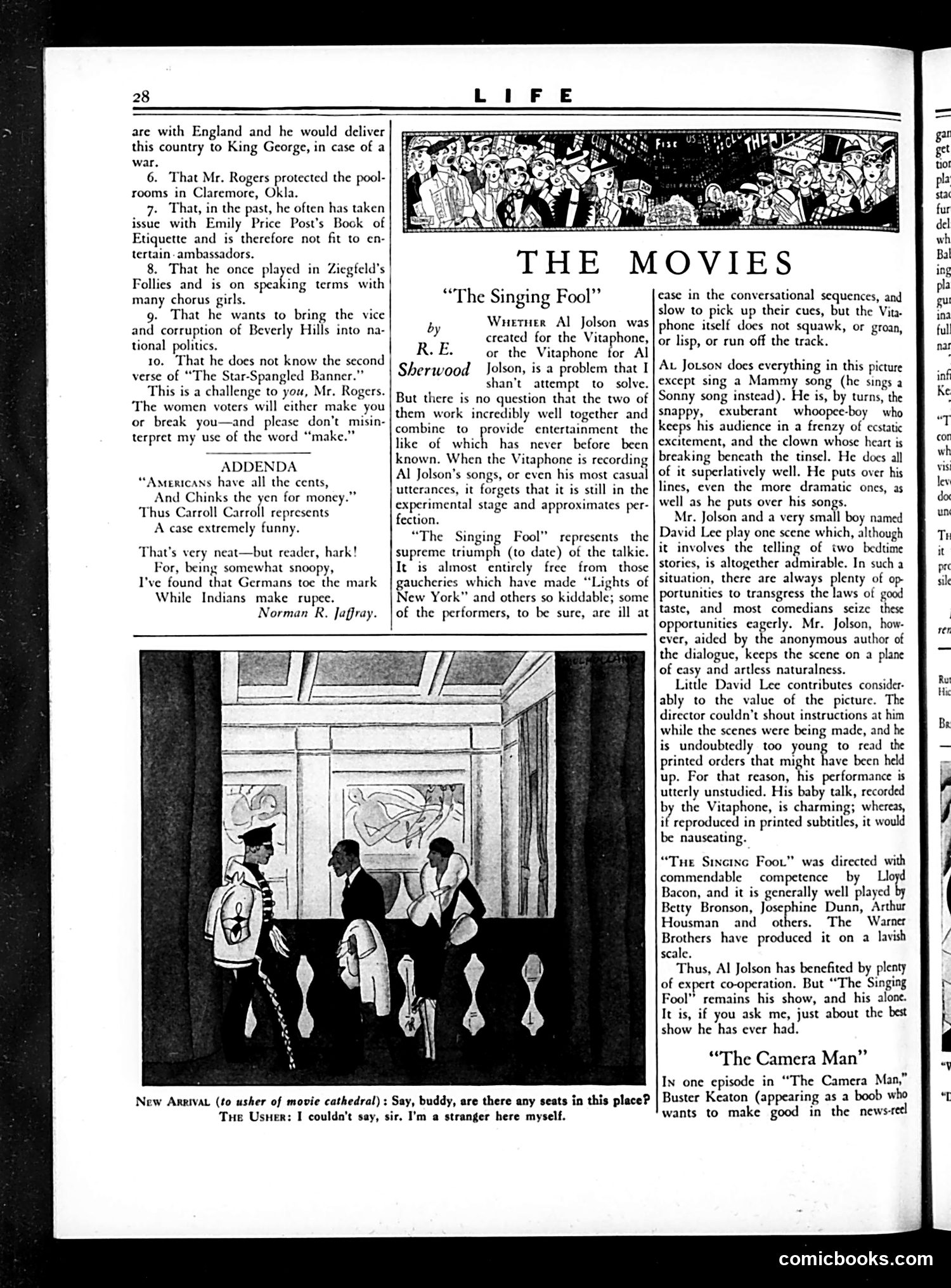
What you’re looking at
This page from *Life* magazine contains two distinct elements: **The Political List (top):** A numbered critique of "Mr. Rogers" (likely Will Rogers, the famous humorist and entertainer), treating his potential candidacy for office as absurd. The accusations mock both Rogers and political concerns of the era—his friendships with chorus girls, his disrespect for etiquette, his lack of patriotic knowledge (not knowing "The Star-Spangled Banner"), and his potential to corrupt national politics. **The Movie Review & Cartoon (bottom):** R.E. Sherwood reviews Al Jolson's talkie film "The Singing Fool," praising Vitaphone technology's fidelity. The accompanying cartoon jokes about theater ushers being unfamiliar with their own workplace—a light gag about incompetence or new employees. The film review celebrates early "talking picture" technology as revolutionary compared to earlier silent films.
📄 Transcribed text from this page (OCR, searchable)
Machine-transcribed from the original scan — historical spelling and the odd misread are preserved.
28 are with England and he would deliver this country to King George, in case of a war. 6. That Mr. Rogers protected the pool- rooms in Claremore, Okla. 7. That, in the past, he often has taken issue with Emily Price Post's Book of Etiquette and is therefore not fit to en- tertain- ambassadors. 8. That he once played in Ziegfeld’s Follies and is on speaking terms with many chorus girls. 9. That he wants to bring the vice and corruption of Beverly Hills into na- tional politics. 10. That he does not know the second verse of “The Star-Spangled Banner.” This is a challenge to you, Mr. Rogers. The women voters will cither make you or break you—and please don’t misin- terpret my use of the word “make.” ADDENDA “Asertcans have all the cents, And Chinks the yen for moncy.” Thus Carroll Carroll represents A case extremely funny. That's very neat—but reader, hark! For, being somewhat snoopy, I've found that Germans toe the mark While Indians make rupee. Norman R. Jaffray. “The Singing Fool” Wuetner Al Jolson was created for the Vitaphone, or the Vitaphone tor Al Jolson, is a problem that I shan’t attempt to solve. But there is no question that the two of them work incredibly well together and combine to provide entertainment the like of which has never before been known. When the Vitaphone is recording Al Jolson’s songs, or even his most casual utterances, it forgets that it is still in the experimental stage and approximates per- fection. “The Singing Fool” represents the supreme triumph (to date) of the talkie. It is almost entirely free from those gaucheries which have made “Lights of New York” and others so kiddable; some of the performers, to be sure, are ill at by R.E. Sherwood New Arriva (to usher of movie cathedral) : Say, buddy, are there any seats in this placeP Tue Usner: I couldn't say, sir. I’m a stranger here myself. (3 A TINE haga! (AR a case in the conversational sequences, and slow to pick up their cues, but the Vita phone itself does not squawk, or groan, or lisp, or run off the track. At Jotson does everything in this picture except sing a Mammy song (he sings a Sonny song instead). He is, by turns, the snappy, exuberant whoopee-boy who keeps his audience in a frenzy of ecstatic excitement, and the clown whose heart is breaking beneath the tinsel. He docs all of it superlatively well. He puts over his lines, even the more dramatic ones, as well as he puts over his songs. Mr. Jolson and a very small boy named David Lee play one scene which, although it involves the telling of two bedtime stories, is altogether admirable. In such a situation, there are always plenty of op- portunities to transgress the laws of good taste, and most comedians seize these Opportunities eagerly. Mr. Jolson, how- ever, aided by the anonymous author of the dialogue, keeps the scene on a plane of easy and artless naturalness. Little David Lee contributes consider. ably to the value of the picture. The director couldn't shout instructions at him while the scenes were being made, and he is undoubtedly too young to read the printed orders that might have been held up. For that reason, his performance is utterly unstudied. His baby talk, recorded by the Vitaphone, is charming; whereas, if reproduced in printed subtitles, it would be nauseating. “Tue Sincinc Foot” was directed with commendable competence by —_Lloy Bacon, and it is generally well played Betty Bronson, Josephine Dunn, Arthur Housman and others, The Warner Brothers have produced it on a lavish scale. Thus, Al Jolson has benefited by plenty of expert co-operation. But ‘The Singing Fool” remains his show, and his alone. It is, if you ask me, just about the best show he has ever had. “The Camera Man” In one episode in “The Camera Man,” Buster Keaton (appearing as a boob who wants to make good in the news-redl comicbooks.com