
Life, 1928-10-05 · page 20 of 48
Life — October 5, 1928 — page 20: what you’re looking at
What you’re looking at
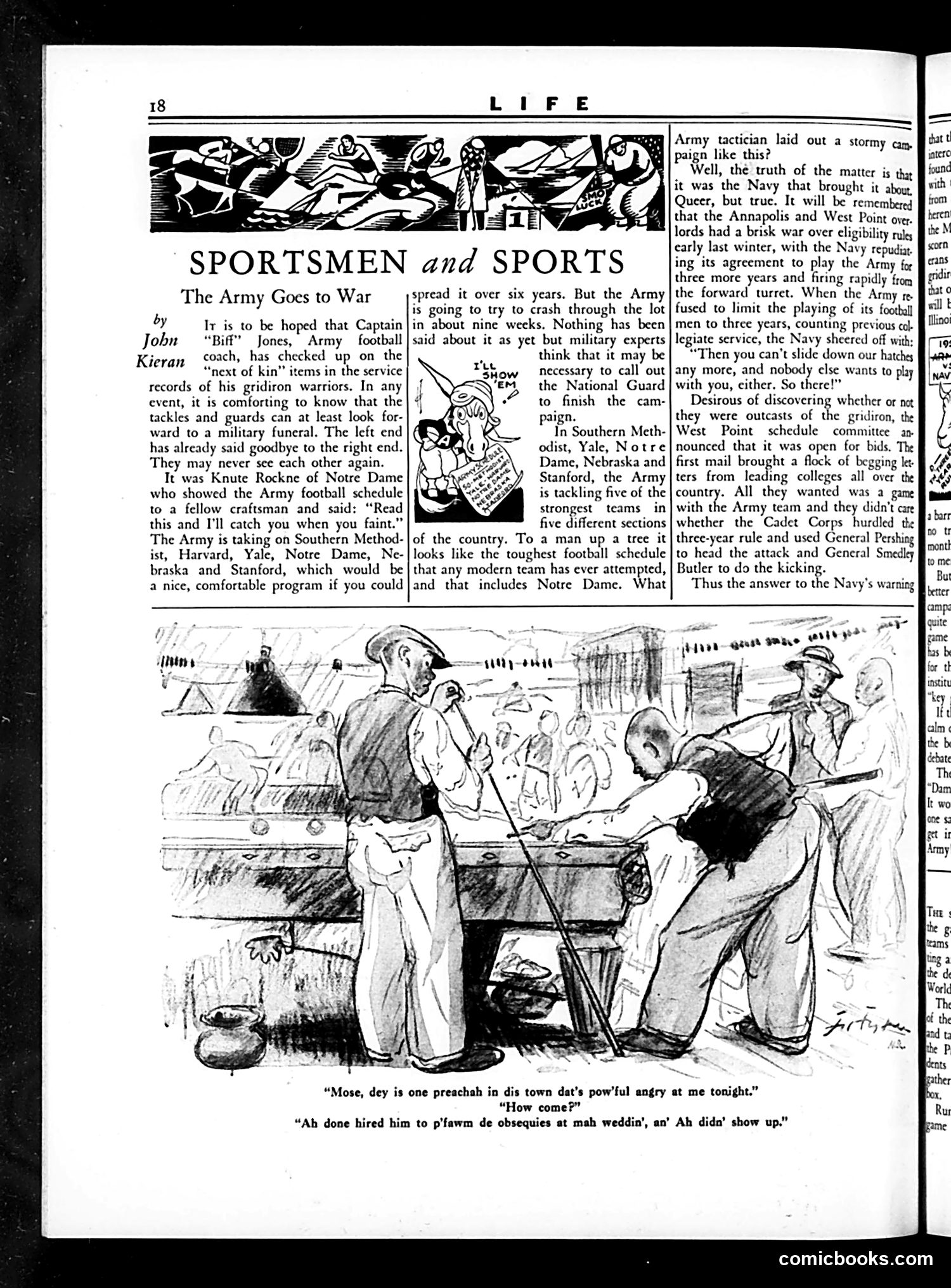
This LIFE magazine article by John Kieran satirizes the Army's grueling 1920s football schedule. The piece explains that the Navy, angry over eligibility rule disputes with West Point, withdrew from their football agreement. The Army then opened its schedule to other schools, and colleges eagerly accepted games despite the brutal schedule (Southern Methodist, Harvard, Yale, Notre Dame, Nebraska, Stanford in nine weeks). The humor lies in the ironic outcome: the Navy's retaliatory snub backfired. Rather than isolating West Point, Army became so sought-after that leading programs competed for slots. The article humorously compares the schedule's difficulty to military combat, with references to "National Guard" intervention and generals like Pershing and Smedley Butler. The bottom cartoon depicts a Southern dialect joke about hiring a preacher for a wedding who didn't show up—unrelated to the main article, typical of LIFE's mixed content style. The satire targets institutional rivalry and wounded pride between military academies.
📄 Transcribed text from this page (OCR, searchable)
Machine-transcribed from the original scan — historical spelling and the odd misread are preserved.
The Army Goes to War Ir is to be hoped that Captain “Biff” Jones, Army football coach, has checked up on the “next of kin” items in the service records of his gridiron warriors. In any event, it is comforting to know that the tackles and guards can at least look for- ward to a military funeral. The left end has already said goodbye to the right end. They may never see cach other again. It was Knute Rockne of Notre Dame who showed the Army football schedule to a fellow craftsman and said: ‘Read this and I'll catch you when you faint.” The Army is taking on Southern Method- ist, Harvard, Yale, Notre Dame, Ne- braska and Stanford, which would be a nice, comfortable program if you could Kieran spread it over six years. But the Army is going to try to crash through the lot in about nine weeks. Nothing has been said about it as yet but military experts think that it may be necessary to call out the National Guard to finish the cam- paign. In Southern Meth- odist, Yale, Notre Dame, Nebraska and Stanford, the Army is tackling five of the strongest teams in five different sections of the country. To a man up a tree it looks like the toughest football schedule that any modern team has ever attempted, and that includes Notre Dame. What Army tactician laid out a storm paige like this? yo Well, the truth of the matter is that it was the Navy that brought it abou, Queer, but truc. It will be remembered that the Annapolis and West Point over. lords had a brisk war over eligibility rules carly last winter, with the Navy repudiat. ing its agreement to play the Army for three more years and firing rapidly from the forward turret. When the Army re fused to limit the playing of its football men to three years, counting previous col- legiate service, the Navy shcered off with: “Then you can’t slide down our hatches any more, and nobody else wants to play with you, either. So there!” Desirous of discovering whether or not they were outcasts of the gridiron, the West Point schedule committee an- nounced that it was open for bids. The first mail brought a flock of begging let- ters from leading colleges all over the country. All they wanted was a with the Army team and they didn’t care whether the Cadet Corps hurdled the three-year rule and used General Pershing to head the attack and General Smedley Butler to do the kicking. Thus the answer to the Navy's warning a ne haan ~ es guest PRS ult “Mose, dey is one preachah in dis town dat’s pow’ful angry at me tonight.” “How come?” “Ab done hired him to p'fawm de obsequies at mah weddin’, an’ Ah didn’ show up.” comicbooks.com