
Life, 1928-10-05 · page 32 of 48
Life — October 5, 1928 — page 32: what you’re looking at
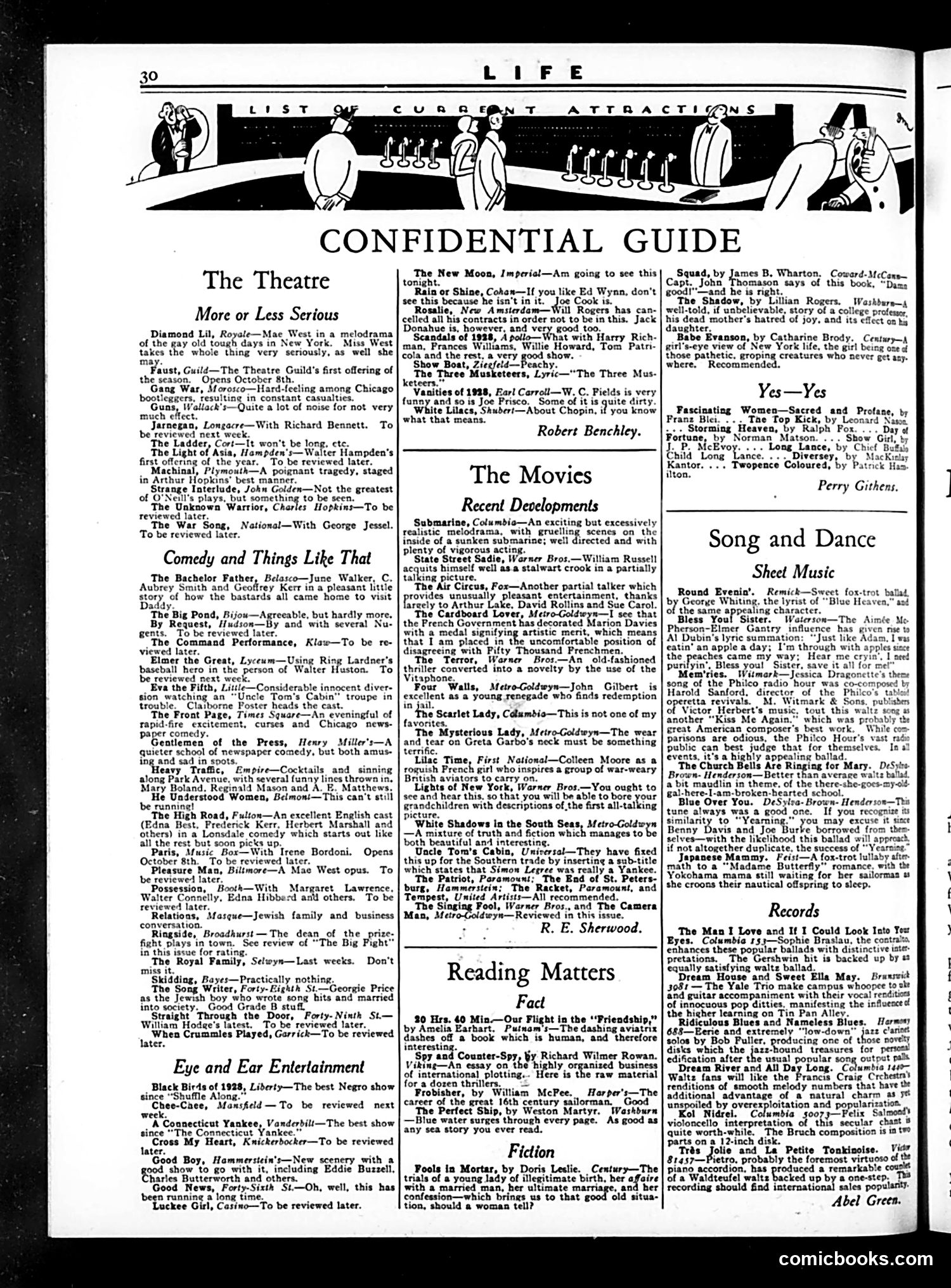
What you’re looking at
This page is primarily a **listing of current Broadway theater attractions** rather than political satire. It's a standard theatrical review section from Life magazine's entertainment coverage. The "Confidential Guide" format presents brief, often witty dismissals of plays then running on Broadway. The humor is theatrical critique, not political commentary. Notable entries include: - **Mae West's "Diamond Lil"** and **"Pleasure Man"** — West was a controversial figure known for sexual innuendo; the reviewer notes she takes the melodrama "very seriously" - **"Strange Interlude"** by Eugene O'Neill — dismissed as "not the greatest" but "something to be seen" - Generic mockery of lesser productions ("Guns...quite a lot of noise for not very much effect") The page reflects **1920s Broadway culture** and Life's role as entertainment guide for educated urban readers. The tone is sophisticated snark aimed at theatergoers evaluating what's worth attending. There are no identifiable political cartoons or caricatures on this page—it's purely theatrical listing and criticism.
📄 Transcribed text from this page (OCR, searchable)
Machine-transcribed from the original scan — historical spelling and the odd misread are preserved.
CONFIDENTIAL GUIDE The Theatre More or Less Serious Diamond Lil, Royale—Mae West in a melodrama of the gay old tough days in New York. Miss West takes the whole thing very seriously, as well she may. Faust, Guild—The Theatre Guild's first offering of the season. Opens October 8th. Gang War, Morosco—Hard-feeling among Chicago bootleggers, resulting in constant casualties. Guns, Wallack’s—Quite a lot of noise for not very much effect. Jarnegan, Longacre—With Richard Bennett. To be‘reviewed’ next week. The Ladder, Cort—It won't, be long, ete. The Light of Asia, Hampden's—Walter Hampden's first offering of the year. To be reviewed later. , Machinal, Plymouth—A poignant tragedy, staged in Arthur Hopkins’ best manner. Strange Interlude, John Golden—Not the greatest of O'Neill's plays, but something to be seen. The Unknown Warrior, Charles Hopkins—To be reviewed later, The War Song, To be reviewed later. Comedy and Things Like That The Bachelor Father, Belasco—June Walker, C. Aubrey Smith and Geoffrey Kerr in a pleasant littie glory, of how the bastards all came home to visit adly The Big Pond, Bijou—Agreeable, but hardly more, By Request, Hudson—Dy and with several Nu: gents. To be reviewed later. "The Command Performance, viewed later. Elmer the Great, Lyceum—Using Ring Lardner’s baseball hero in the person of Walter Huston. To be reviewed next week. . Eva the Fifth, Little—Considerable innocent diver- sion watchi an “Uncle Tom's Cabin" troupe in trouble. Claiborne Poster heads the cast. The Froat Page, Times Square—An eveningful of rapid-fire excitement, curses and Chicago news- paper comedy. Gentlemen of the Press, Henry Miller’s—A quieter school of newspaper comedy, but both amus- ing and sad in spots. i eavy Traffic, Empire—Cocktails and sinning along Park Avenue, with several funny lines thrown in, Mary Boland. Reginald Mason and A. E. Matthews. He Understood Women, Belmoni—This can’t still be running! The High Road, Fulton—An excellent English cast (Edna Best, Prederick Kerr, Herbert Marshall and others) in a Lonsdale comedy which starts out like all the rest but soon picks up. Paris, Music Box—With Irene Bordoni. Opens October 8th. To be reviewed later. Pleasure Man, Bilimore—A Mae West opus. To be reviewed later. " Possession, Booth—With Margaret Lawrence, Walter Connelly, Edna Hibberd anti others. To be reviewed later. ; : Relations, Masque—Jewish family and business conversation. . Ringside, Broadhurst —The dean of the prize- fight plays in town. Sce review of "The Big Fight” in this issue for rating. The Royal Family, Selwyn—Last weeks. Don't Vational—With George Jessel. Klaw—To be re- miss it. Skidding, Bayes—Practically nothing, = The Song Writer, Forty-Lighth St.—Georgie Price as the Jewish boy who wrote song bits and married into society. Good Grade B stuf ; Straight Through the Door, Forty-Ninth St— William Hodge's latest. To be’ reviewed later. sar bes Crummles Played, Garrick—To be reviewed iter. Eye and Ear Entertainment Black Birds of 1928, Liberty—The best Negro show since “Shuffle Along.” Chee-Caee, Mansfeld —To be week. A Connecticut Yankee, Vanderbili—The best show since “The Connecticut Yankee.” ; Cross My Heart, Knickerbocker—To be reviewed later. Good Boy, Hammerstein's—New scenery with a ood show to go with it, including Eddie Buzzell, harles Butterworth and others. ; Good News, Forty-Sixth St.—Oh, well, this has been running a'long time. : Luckee Girl, Casino—To be reviewed later. reviewed next Lhey New Moon, Imperial—Am going to see this tonight. Rain or Shine, Cohan—If you like Ed Wynn, don’t see this because he isn’t in it. Joe Cook is. Rosalie, New Amsterdam—Will Rogers has can- celled all his contracts in order not to be in this. Jack however, and very good too. Scandals of 1938, A pollo—What with Harry Rich- man, Prances Williams, Willie Howard, Tom Patri- “The Three Mus- keteers. Vanities of 1938, Far! Carroll—W. C. Fields is very fonny an fo is Joe Prisco, Some of it is quite dirty. White Lilacs, Shubert—About Chopin, if you know what that m Robert Benchley. The Movies Recent Developments Submarine, Columbio—An exciting but excessively realistic melodrama, with gruelling scenes on the inside of a sunken submarine; well directed and with plenty of vigorous acting. ° State Street Sadie, Warner Bros.—William Russell acquits himself well as.a stalwart crook in a partially talking picture. The Air Circus, Fox—Another partial talker which rovides unusually pleasant entertainment, thanks Rireely to Arthur Lake, David Rollins and Sae Carol. The Cardboard Lover, Meiro-Goldwyn—I see that the Prench Government has decorated Marion Davies with @ medal signifying artistic ment, which mean that I am placed in the uncomfortable position of disagreeing with Pifty Thousand Prenchmen. je Terror, Warner Bros—An old-fashioned thriller converted into a novelty by the use of the Vitaphone. : ; Four Walls, Metro-Goldwyn—John Gilbert is excellent asa young renegade who finds redemption in jail. e Scarlet Lady, Columbio—This is not one of my favorites. The Mysterious Lady, Metro-Goldwyn—The wear and tear on Greta Garbo’s neck must be something terrific. Lilac Time, First National—Colleen Moore as a roguish Prench girl who inspires a group of war-weary Bntish aviators to carry on. Lights of New York, Warner Bros.—You ought to sce and hear this. so that you will be able to bore your grandchildren with descriptions of the first all-talking picture. White Shadows in the South Seas, Metro-Goldwyn —A misture of truth and fiction which manages to be both beautiful and interesting. Uncle Tom's Cabin, Universal—They have fixed this up for the Southern trade by inserting a sub-title es that Simon Legree was really a Yankee. triot, Paramount; The End of St. Peters- merstein; The Racket, Paramount, and Tempest, United Artists—All recommended. Tue Singing Fool, Warner Bros. and The Camera Mai Mf etre ldwyn— Reviewed in this issue. a R. E. Sherwood. Reading Matters Fact 20 Hrs. 40 Min—Our Flight in the ‘‘Priendship,” by Amelia Earhart. Putnom's—The dashing aviatnix dashes off a book which is human, and therefore interesting. ie Spy and Counter-Spy, By Richard Wilmer Rowan. Viking—An essay on the highly organized business of international plotting. lere is the raw material for a dozen thrillers. = Frobisher, by William McPee. Harper's—The career of the great 16th century sailorman. Good The Perfect Ship, by Weston Martyr. IWaskburn —Blue water surges through every page. As good as any sea story you ever read. Fiction Fools in Mortar, by Doris Leslie. Century—The trials of a young lady of illegitimate birth, her sfeire with a marred man, her ultimate marriage, and her Confession—-which brings us to that good old situa tion, should @ woman tell? Squad, by James B. Wharton. Coward-McCam Capt. John Thomason says of this book, “Dane goodi"—and he is right. The Shadow, by Lillian Rogers. Washbure—4 well-told, if unbelievable, story of a college profemcs his dead ‘mother's hatred of joy, and its effect on be daughter. Babe Evanson, by Catharine Brody. Century—4 girl's-eye view of’ New York life, the gil being ose a those pathetic, groping creatures who never get any. where. Recommended. Yes—Yes Fascinating Women—Sacred and Profane, Franz Blei. ... The Top Kick, by Leonard \ ..+ Storming Heaven, by Ralph Fox. ... Fortune, by Norman Matson. ... J. P. Mek roy. see Child Long Lance. ... Diversey, by MacKitliy Kantor, +++ Twopence Coloured, by Patrick Has. ilton. Perry Githens, Song and Dance Sheet Music Round Evenin’. Remick—Sweet fox-trot ballad, by. George Whiting, the lyrist of “Blue Heaven, of the same appealing character. Bless You! Sister. Waeterson—The Ai Pherson-Elmer Gantry influence has Al Dubin’s lyric summation: “Just like . eatin’ an apple a day; I'm through with apples the peaches came my way: Hear me cryin’ 1 purilyin’, Bless you! Sister, save it all for m Mem'ries. tWitmark—Jessica Dragonette’s theme song of the Philco radio hour was co-composed by Harold Sanford. director of the Philco’s table! operetta revivals. vi S ssbers of Victor another “Kiss Me Again.” which was probably great American composer's best work. | While co: parisons are odious, the Philco Hour's vast rade public can best judge that for themselves. In al events, it's a highly appealing ballad. The Church Bells Are Ringing for Mary. DeSyivo- Brown- Henderson—Better than average walt ballad, a bit maudlin in theme. of the there-she-gocs-my-<it gal-here-I-am-broken-hearted school. Blue Over You. DeSylva- Brown- Henderson—Ths tune always was a good one. If you recognize i similarity to “Yearning.” you may excus Benny Davis and Joe Burke borrowed fr selves—with the likelihood this ballad will if not altogether duplicate, the success of “Years Feist—A fox-trot lullaby after Madame Butterfly” romance, with the Yokohama mama still waiting for her sailormas # she croons their nautical offspring to sleep. Records The Man I Love and If I Could Look Into Yee Eyes. Columbia 133—Sophie Braslau, the contrat, enhances these popular ballads with distinctive inte- pretations. The Gershwin hit is backed up by equally satisfying waltz ballad. Dream House and Sweet Ella May. Bransvict 3081 — The Yale Trio make campus whoopee to sit ‘and guitar accompaniment with their vocal renditicss ‘of innocuous pop ditties, manifesting the influenced the higher learning on Tin Pan Ridiculous Blues and Namel Hermey 688—Eerie and extremely “‘low~ {ewe clarinet solos by Bob Puller, producing one of those novelty disks which the jazz-hound treasures person e usual popular son, im River and All Day Long. Columbia 1440 Waltz fans will like the Prancis Craig Crehestn') renditions of smooth melody numbers that have Oe additional advantage of a natural charm as Jt nspoiled by overexploitation and popularization ol Nidrel. Columbia so073—Felix Salmond’ violoncello interpretation of this secular chast # quite worth-while. The Bruch composition is in tr? parts on a 12-inch disk. . Tras Jolie and La Petite Tonkinolse. Vidy 81457—Pietro, probably the foremost virtuoso of piano accordion, has progaced a remarkable cous of a Waldteufel waltz backed up by a one-step] recording should 6: sales popularity: Abel Green. ind internatior comicbooks.com