
Life, 1928-10-05 · page 17 of 48
Life — October 5, 1928 — page 17: what you’re looking at
What you’re looking at
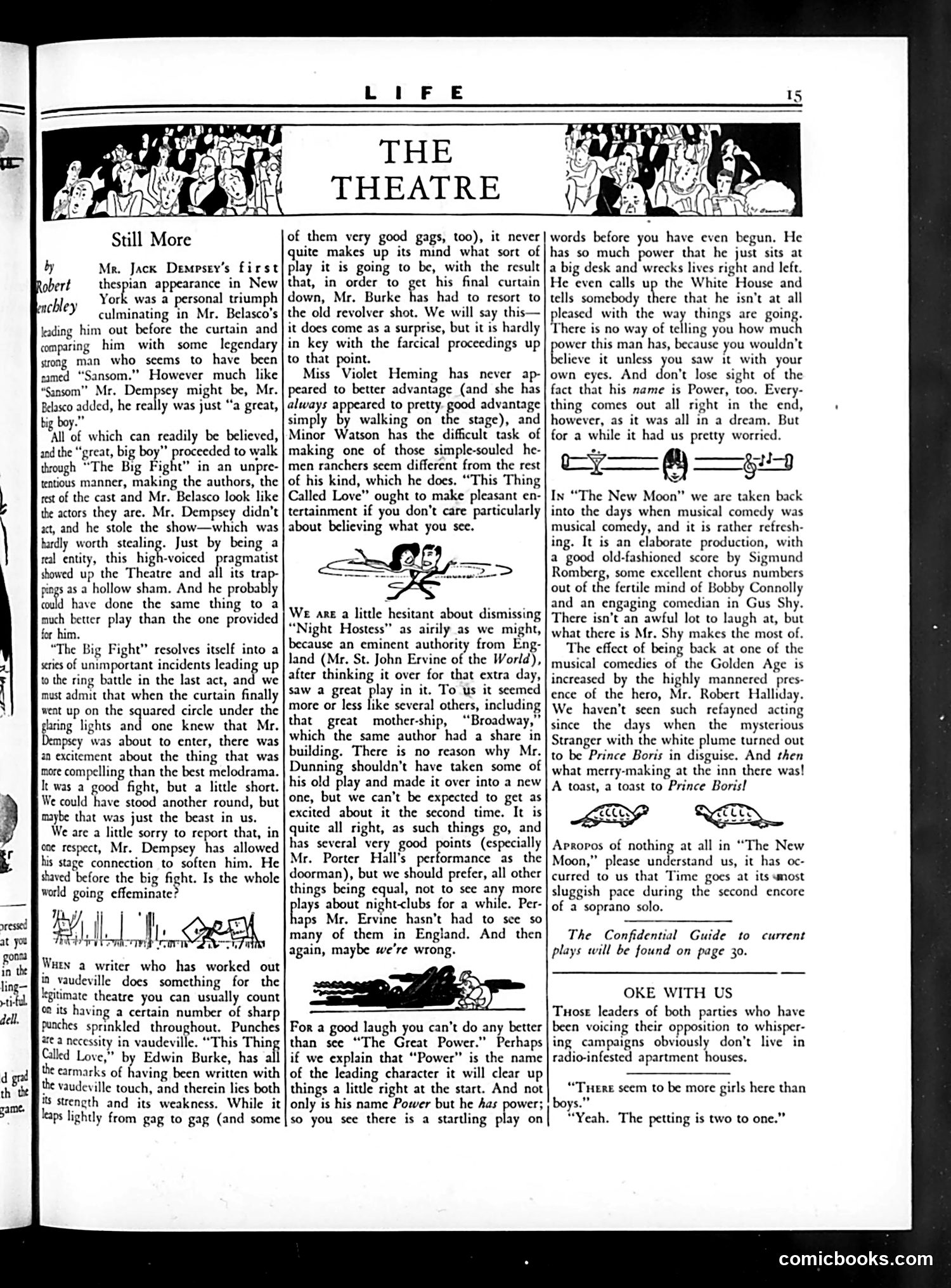
This is a theatre review section from Life magazine discussing several Broadway productions. The page contains three small theatrical cartoons illustrating comedic moments from plays. The reviews critique various shows including "The Big Fight," "The New Moon," and references to Jack Dempsey's theatrical appearance. The critic discusses the merits and flaws of these productions, praising some performances (like Violet Heming's) while questioning the quality of others. One cartoon depicts a couple in an intimate embrace, another shows what appears to be a fish or sea creature. These cartoons seem to illustrate comedic or romantic moments from the plays being reviewed rather than serving a broader satirical purpose about politics or society. The page is primarily devoted to entertainment criticism rather than political satire.
📄 Transcribed text from this page (OCR, searchable)
Machine-transcribed from the original scan — historical spelling and the odd misread are preserved.
by Mr. Jack Dempsey’s first Robert uepan appearance in New ley York was a personal triumph memey culminating in Mr. Belasco’s kading him out before the curtain and comparing him with some legendary srong man who seems to have been maimed “Sansom.” However much like “Sansom” Mr. Dempsey might be, Mr. Belasco added, he really was just “a great, big boy.” F , All of which can readily be believed, and the “great, big boy’* proceeded to walk through “The Big Fight” in an unpre- tentious manner, making the authors, the rest of the cast and Mr. Belasco look like the actors they are. Mr. Dempsey didn’t xt, and he stole the show—which was hardly worth stealing. Just by being a real entity, this high-voiced pragmatist showed up the Theatre and all its tra pings as a hollow sham. And he probably could have done the same thing to a much better play than the one provided for him. “The Big Fight” resolves itself into a sries of unimportant incidents leading up to the ring battle in the last act, and we must admit that when the curtain finally went up on the squared circle under the firing lights and one knew that Mr. mpscy was about to enter, there was an excitement about the thing that was more compelling than the best melodrama. It was a good fight, but a little short. We could have stood another round, but maybe that was just the beast in us. We are a little sorry to report that, in one respect, Mr. Dempsey has allowed his stage connection to soften him. He shaved before the big fight. Is the whole world going effeminate? Wats a writer who has worked out in vaudeville does something for the kgitimate theatre you can usually count ca its having a certain number of sharp punches sprinkled throughout. Punches xe a necessity in vaudeville. “This Thin Called Love,” by Edwin Burke, has al the carmarks of having been written with the vaudeville touch, and therein lies both Hs strength and its weakness. While it leaps lightly from gag to gag (and some THE THEATRE of them very good gags, too), it never quite makes up its mind what sort of play it is going to be, with the result that, in order to get his final curtain down, Mr. Burke has had to resort to the old revolver shot. We will say this— it does come as a surprise, but it is hardly in key with the farcical proceedings up to that point. Miss Violet Heming has never ap- peared to better advantage (and she has always appeared to pretty. pood advantage simply by walking on the stage), and Minor Watson has the difficult task of making one of those simple-souled he- men ranchers seem different from the rest of his kind, which he does. “This Thing Called Love’? ought to make pleasant en- tertainment if you don’t care particularly about believing what you see. We are a little hesitant about dismissing “Night Hostess” as airily as we might, because an eminent authority from Eng- land (Mr. St. John Ervine of the World), after thinking it over for that extra day, saw a great play in it. To us it seemed more or less like several others, including that great mother-ship, “Broadway,” which the same author had a share in building. There is no reason why Mr. Dunning shouldn't have taken some of his old play and made it over into a new one, but we can’t be expected to get as excited about it the second time. It is quite all right, as such things go, and has several very good points (especially Mr. Porter Hall’s performance as the doorman), but we should prefer, all other things being equal, not to sce oy more lays about night-clubs for a while. Per- Fraps Mr. Ervine hasn't had to see so many of them in England. And then again, maybe we're wrong. slo For a good laugh you can’t do any better than see “The Great Power.” Perhaps if we explain that ‘Power’ is the name of the leading character it will clear up things a little right at the start. And not only is his name Power but he has power; so you see there is a startling play on words before you have even begun. He has so much power that he just sits at a big desk and wrecks lives right and left. He even calls up the White House and tells somebody there that he isn’t at all pleased with the way things are going. ‘There is no way of telling you how much power this man has, because you wouldn't lieve it unless you saw it with your own eyes. And don’t lose sight of the fact that his name is Power, too. Every- thing comes out all right in the end, however, as it was all in a dream. But for a while it had us pretty worried. 2. ry ies) ——g9 In “The New Moon” we are taken back into the days when musical comedy was musical comedy, and it is rather refresh- ing. It is an elaborate production, with a good old-fashioned score by Sigmund Romberg, some excellent chorus numbers out of the fertile mind of Bobby Connolly and an engaging comedian in Gus Shy. There isn’t an awful lot to laugh at, but what there is Mr. Shy makes the most of. The effect of being back at one of the musical comedies of the Golden Age is increased by the highly mannered _pres- ence of the hero, Mr. Robert Halliday. We haven't seen such refayned acting since the days when the mysterious Stranger with the white plume turned out to be Prince Boris in disguise. And then what merry-making at the inn there was! A toast, a toast to Prince Boris! SEY QED. Apropos of nothing at all in “The New Moon,” please understand us, it has oc- curred to us that Time goes at its unost sluggish pace during the second encore of a soprano solo. The Confidential Guide to current plays will be found on page 30. OKE WITH US Tuose leaders of both parties who have been voicing their opposition to whisper- ing campaigns obviously don’t live in radio-infested apartment houses. “Tere seem to be more girls here than boys.” “Yeah. The petting is two to one.” comicbooks.com