
A complete issue · 40 pages · 1928
Life — July 19, 1928
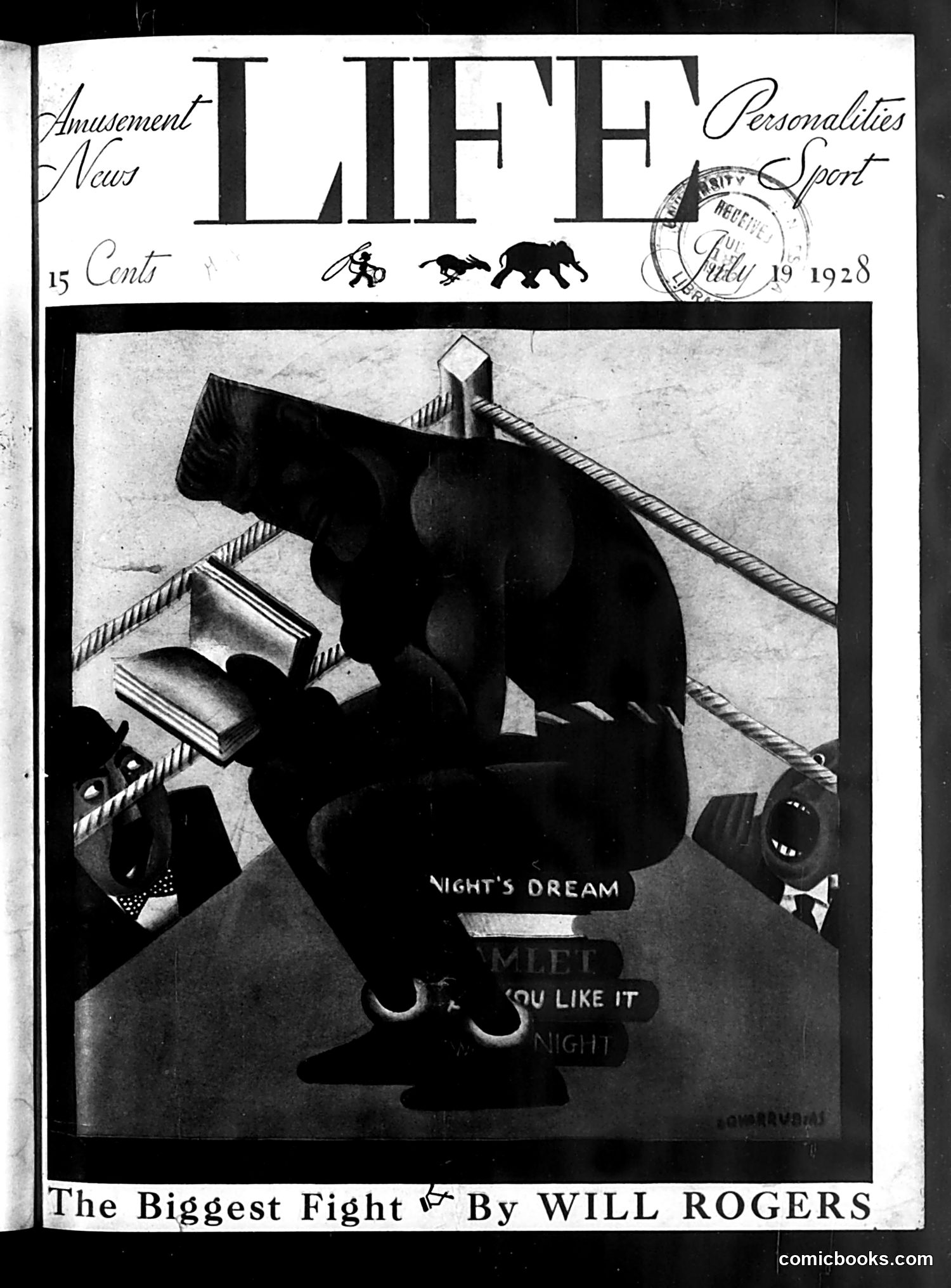
This is a Will Rogers humor piece titled "The Biggest Fight." The central image shows a large figure (likely representing a politician or public figure) bent over reading, with smaller caricatured figures visible—one appears to be sleeping or knocked out on the left, another in formal attire on the right. The partially visible text references "Night's Dream," "Hamlet," and "You Like It"—Shakespeare play titles—suggesting the "fight" being satirized is literary or intellectual rather than physical. Rogers was a famous humorist and social commentator, so this likely mocks some contemporary political or cultural debate of 1928, though the specific target remains unclear from the visible text. The silhouette style was typical of Life's satirical approach.
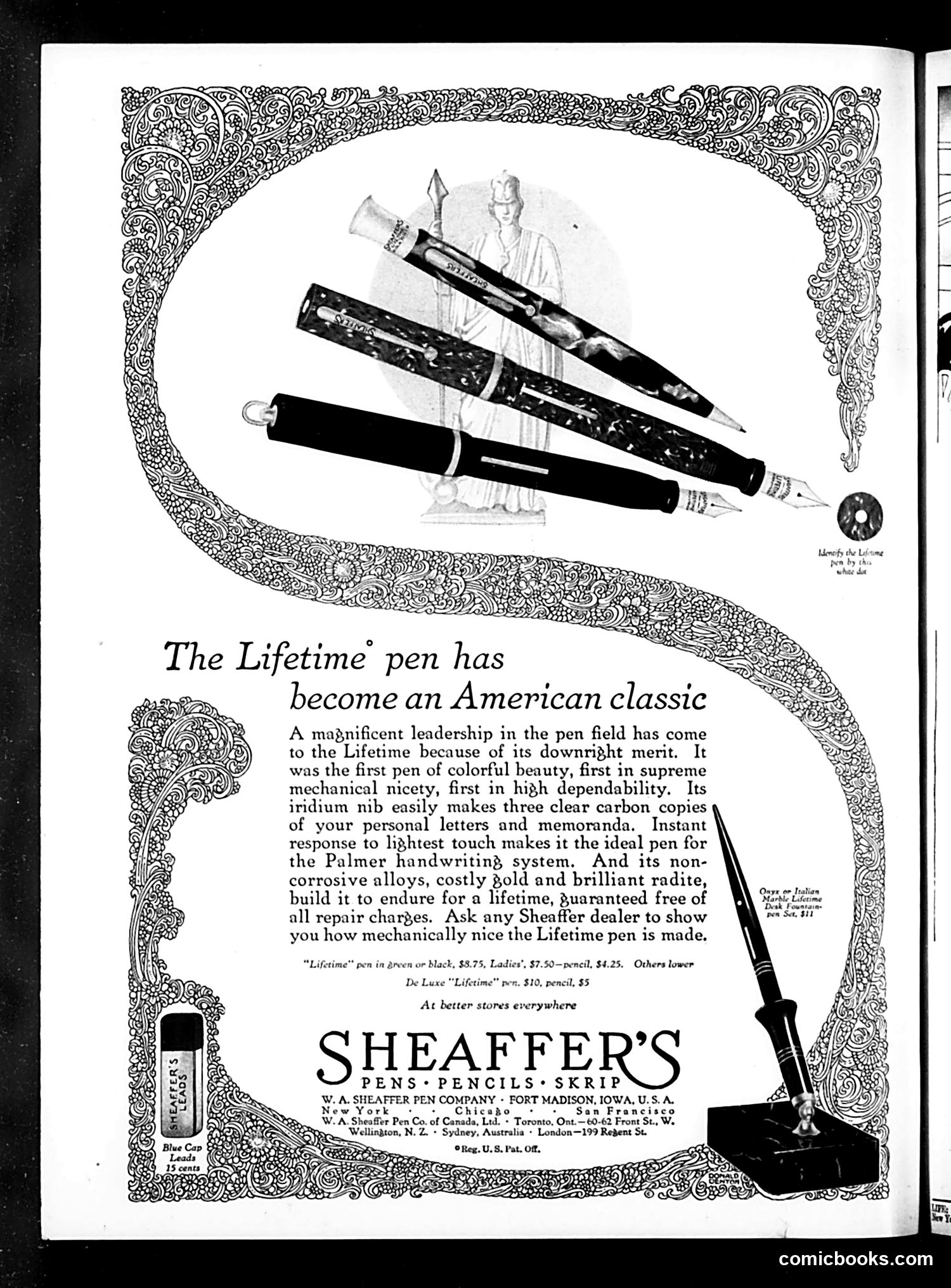
This page is primarily a **Sheaffer pen advertisement**, not political satire. The ornate decorative border frames multiple fountain pens displayed against a classical female figure (likely representing Liberty or artistic refinement). The ad promotes the "Lifetime" pen as "an American classic," emphasizing its mechanical superiority, durability, and suitability for the Palmer handwriting system—a popular penmanship method of the era. The text highlights non-corrosive alloys, gold accents, and lifetime repair guarantees. The classical imagery and elaborate border design reflect 1920s-30s advertising aesthetics, positioning the fountain pen as a prestigious writing instrument. There is no political cartoon or satire present—this is straightforward product marketing using period-appropriate decorative and aspirational imagery to convey quality and permanence.
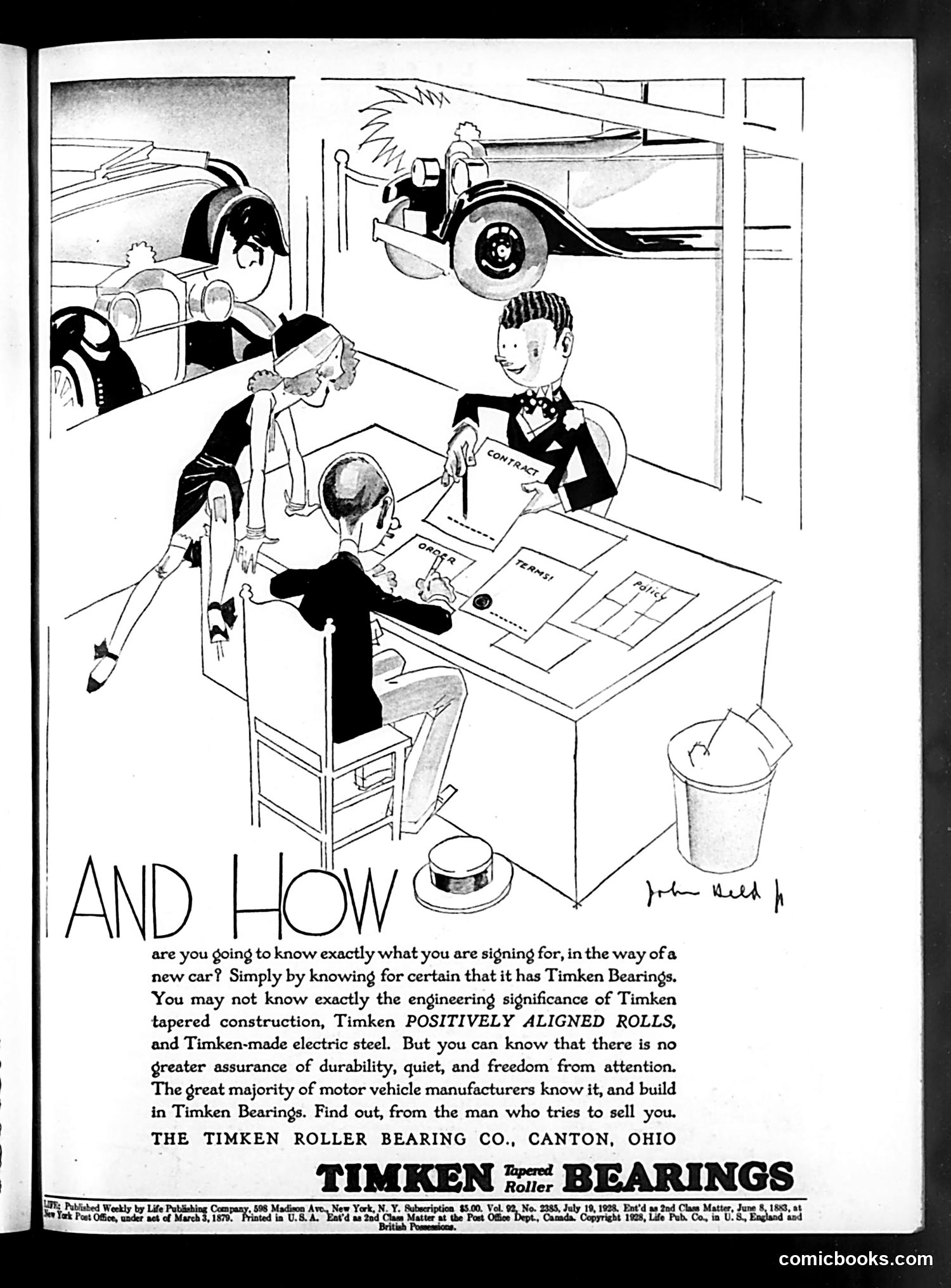
This page is primarily a **1928 advertisement for Timken Roller Bearings**, not political satire. The cartoon illustrates a car dealership scene where a salesman discusses a vehicle contract with customers while cars are visible in the background garage. The ad's message is straightforward: buyers should choose cars with Timken Bearings because, even if they don't understand the technical engineering details (tapered construction, aligned rolls, electric steel), they can trust that Timken parts guarantee durability and reliability. The figures are generic—a salesman, customers, and office workers—not caricatures of specific people. The "satire" is gentle wordplay about consumers making purchasing decisions based on brand reputation rather than technical knowledge. This reflects 1920s consumer marketing strategy.
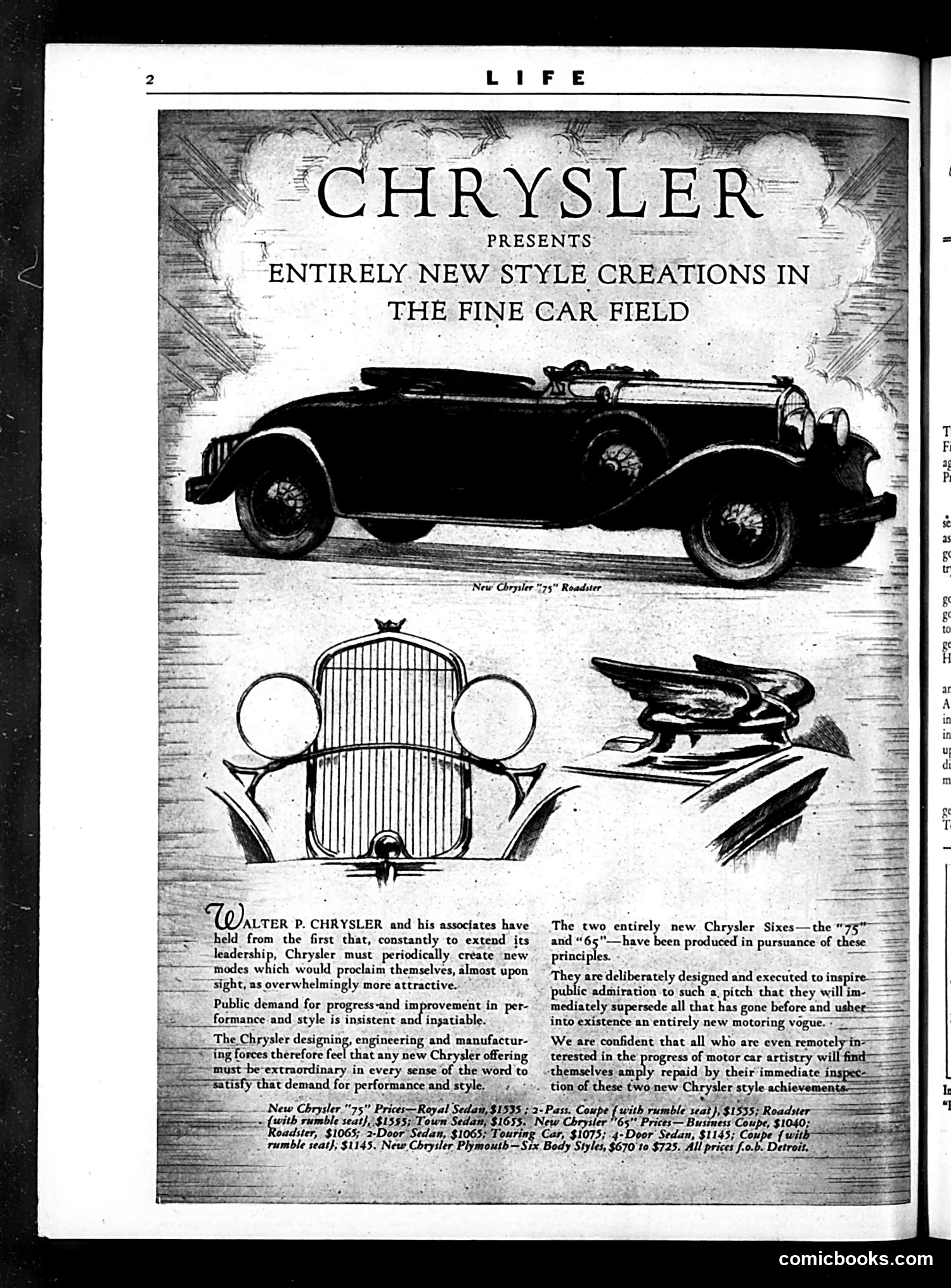
This is a **commercial advertisement**, not political satire. Chrysler presents new automobile models—the "75" and "65" Roadster—emphasizing design innovation and engineering excellence under Walter P. Chrysler's leadership. The ad stresses that Chrysler must "periodically create new models which would proclaim themselves, almost upon sight, as overwhelmingly more attractive." The imagery shows the vehicle's profile, front grille detail, and hood ornament to highlight stylistic features. This reflects 1920s American consumer culture and the competitive automotive industry. The advertisement appeals to luxury buyers by positioning Chrysler as combining aesthetic design with technical advancement—a marketing strategy typical of the era's affluent readership of *Life* magazine.
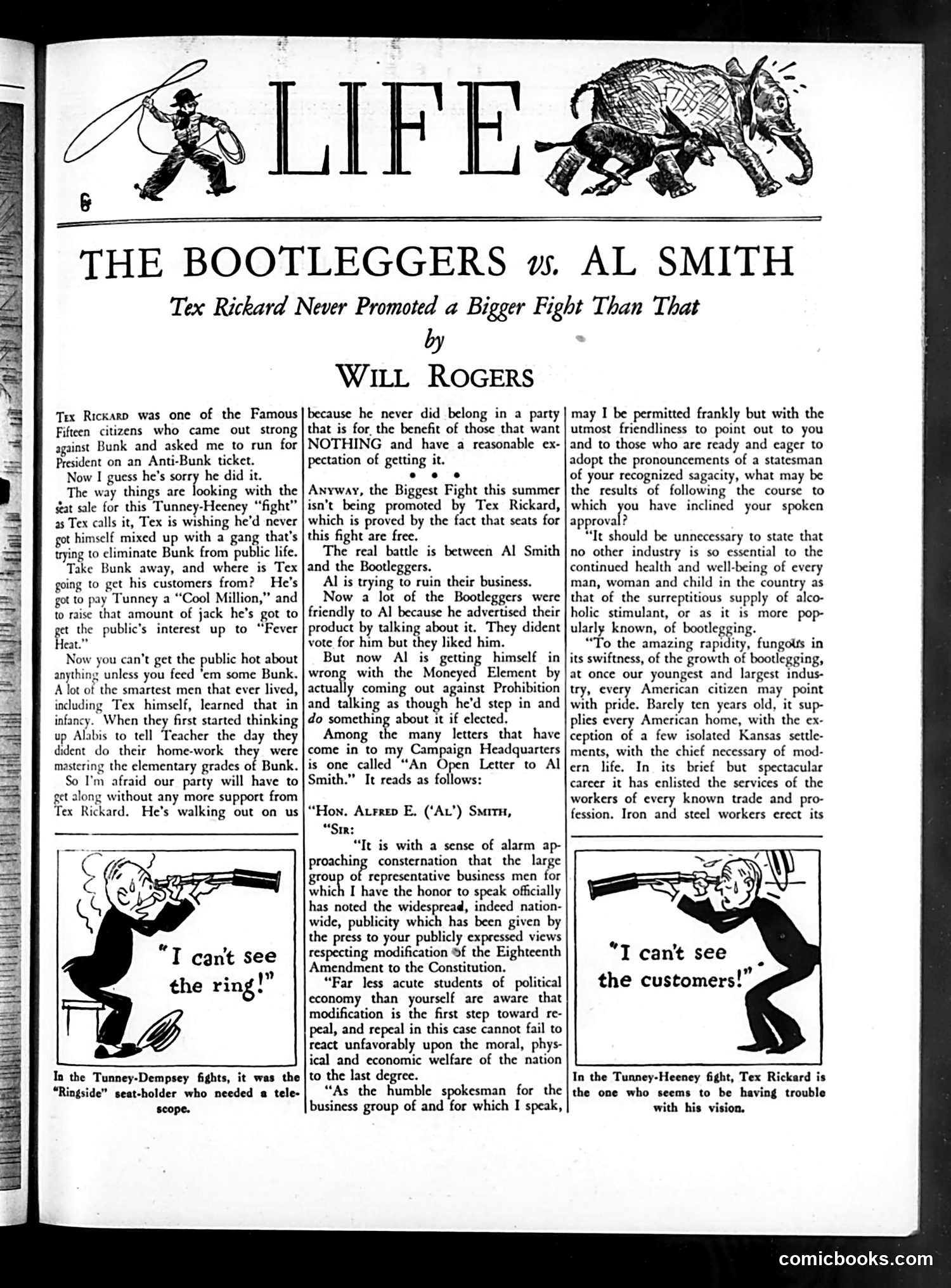
This Will Rogers satire addresses the 1928 presidential campaign of Alfred E. Smith, a New York politician opposing Prohibition. Rogers mocks Tex Rickard (a famous boxing promoter) for promoting this political "fight" as entertainment. The cartoons show figures claiming they "can't see the ring" and "can't see the customers"—visual jokes about Prohibition's illegal nature and hidden commerce. Rogers criticizes both the bootleggers (who oppose Smith's anti-Prohibition stance, fearing legalization would end their profits) and those exploiting the controversy for publicity. The piece satirizes how Prohibition had become sensationalized political theater, with various interests profiting from the debate rather than seriously addressing the amendment's "moral, physical and economic welfare" impact on the nation.
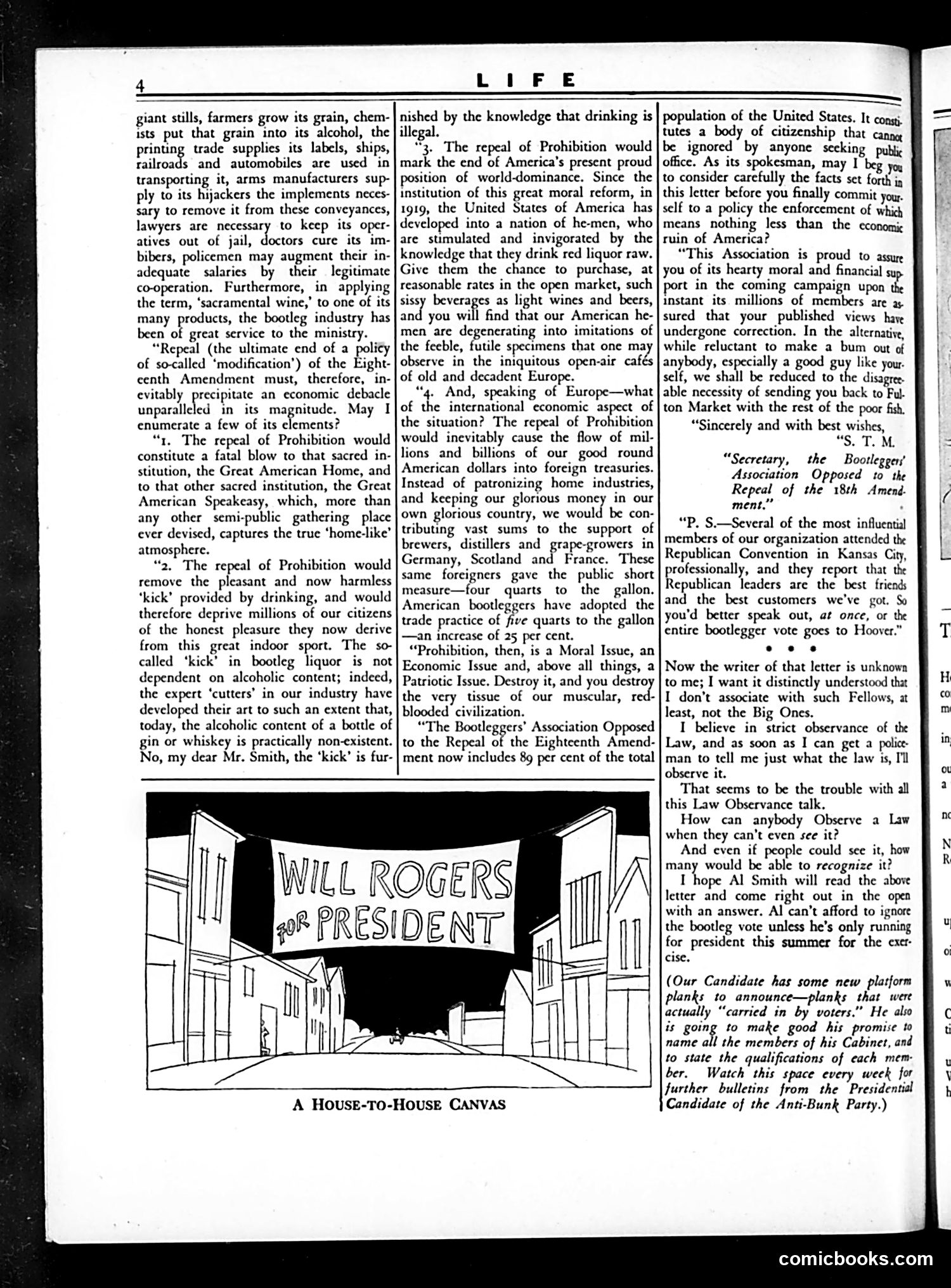
This cartoon satirizes the 1928 presidential campaign of Will Rogers, a famous humorist and social commentator, as a fictional candidate for the "Anti-Bunk Party." The image shows a large banner reading "WILL ROGERS FOR PRESIDENT" displayed prominently on a building, suggesting grassroots campaign efforts reaching voters door-to-door. The accompanying text discusses Prohibition's repeal, bootlegging, and economic concerns—issues central to 1920s politics. The cartoon uses Rogers (known for witty political commentary) as a humorous vehicle to mock both political candidates and campaign promises of the era. The "Anti-Bunk Party" name itself is satirical, suggesting Rogers represents honest, no-nonsense politics against conventional political rhetoric.
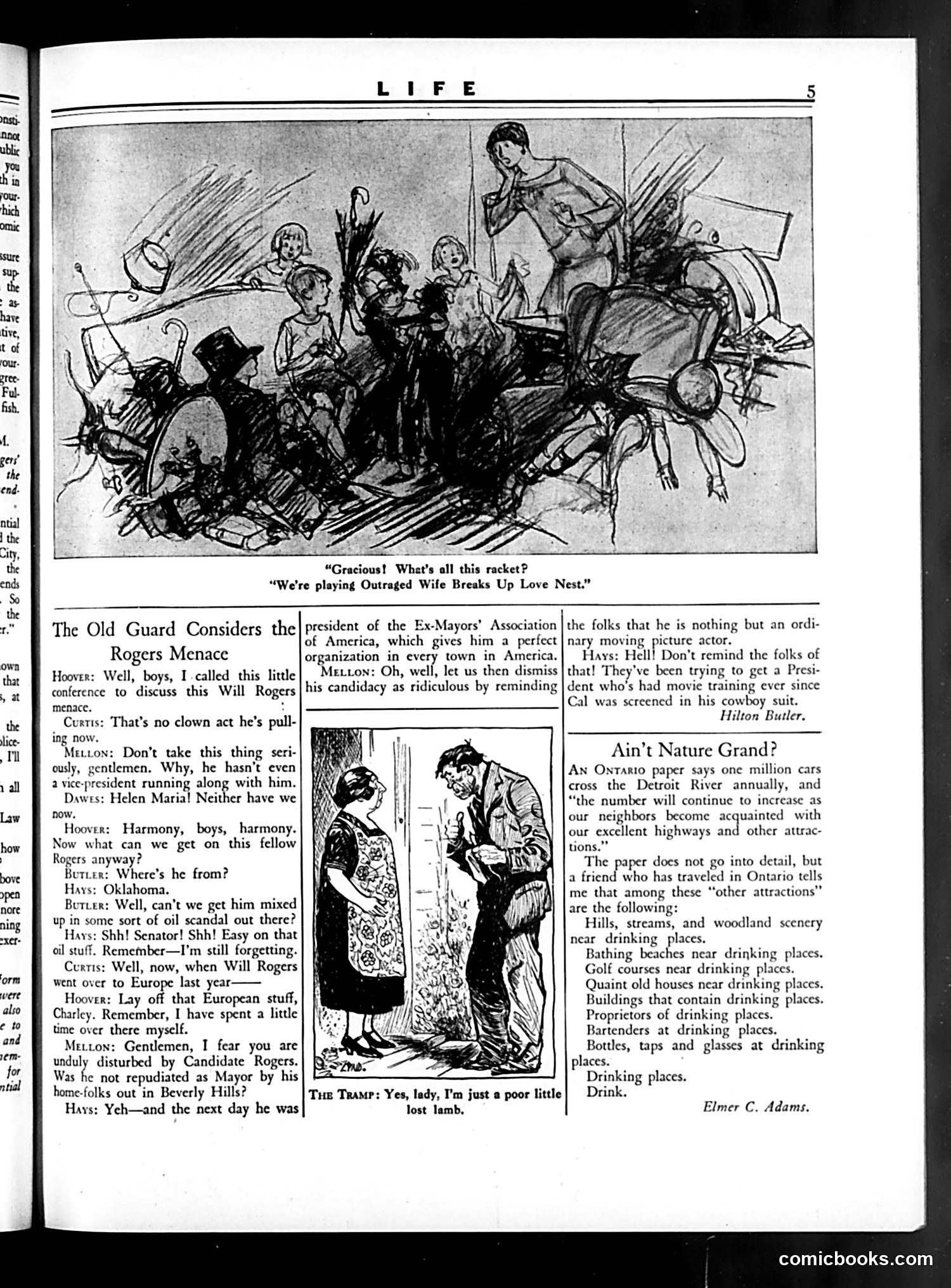
The main cartoon depicts children playing "Outraged Wife Breaks Up Love Nest"—mocking a scandal involving Will Rogers, the famous cowboy entertainer and humorist. The dialogue below, titled "The Old Guard Considers the Rogers Menace," features politicians (Hoover, Curtis, Mellon, and others) discussing Rogers as a presidential threat. They're concerned he lacks proper credentials—no vice-president, no senatorial background, no oil connections. The satire targets the political establishment's anxiety about Rogers' popularity and outsider status, contrasting his genuine public appeal against their formal qualifications. The secondary item "Ain't Nature Grand?" satirizes Ontario's growing automobile culture and its associated drinking establishments, listing various venues where cars and alcohol intersect.
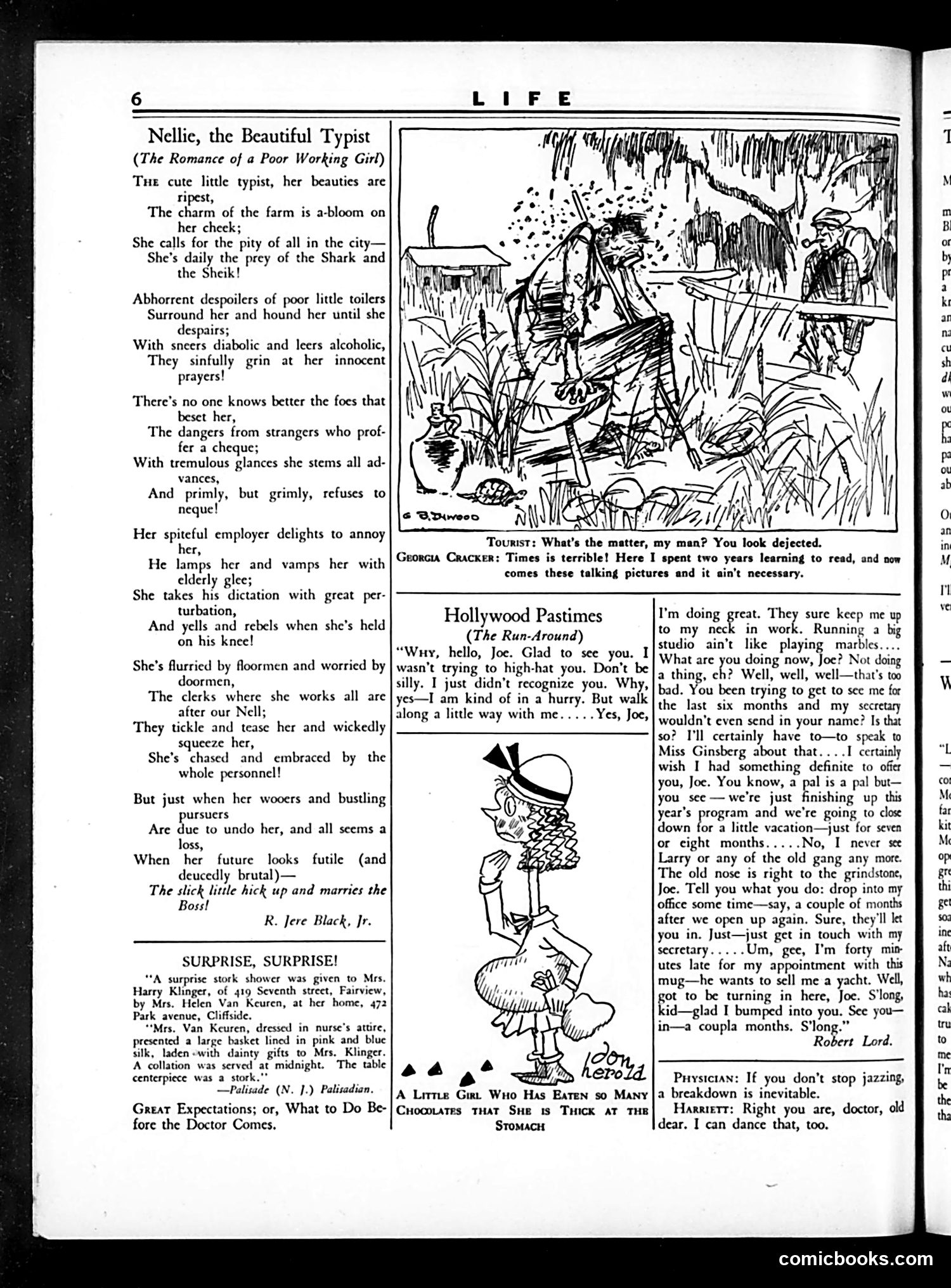
This page contains satirical poetry and humor pieces typical of early 20th-century Life magazine. **"Nellie, the Beautiful Typist"** is a poem mocking working-class women, specifically typists. It presents Nellie as naive and defenseless against predatory men in the workplace ("abhorrent despoilers of poor little toilers"). The satire critiques both the exploitation of female workers and the men who pursue them. **"Hollywood Pastimes"** features dialogue between Joe and a woman, satirizing casual encounters and the film industry's social dynamics—suggesting moral laxity and transactional relationships. The cartoon of a girl with chocolates appears to be humorous rather than political, playing on childhood gluttony. The page reflects early 20th-century attitudes toward gender, class, and morality, mocking both vulnerable working women and predatory behavior through satirical commentary rather than serious reform advocacy.
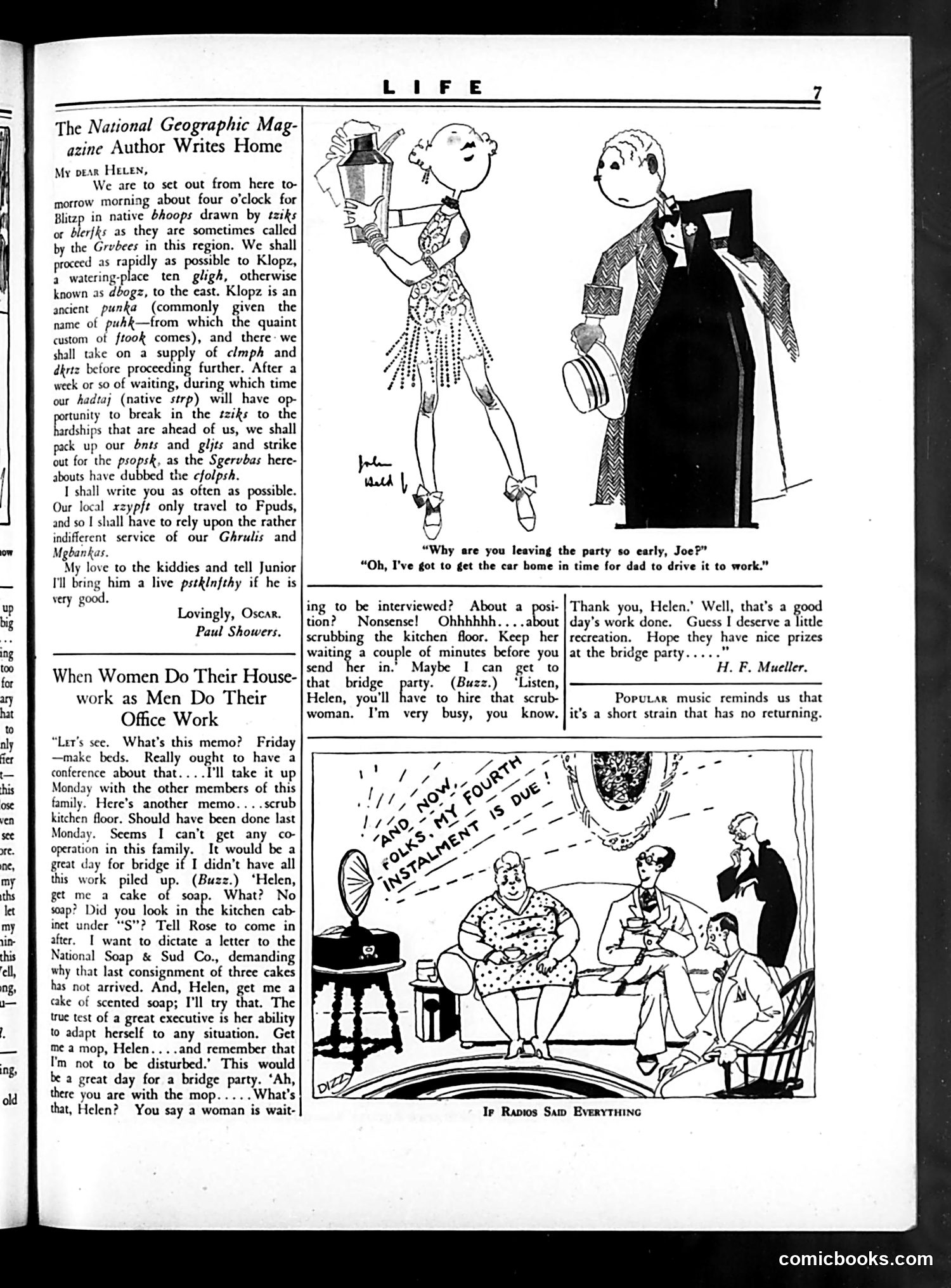
This page contains two distinct pieces of satirical content: **Top Section:** A letter from "Oscar" (signed Paul Showers) describing a National Geographic expedition to remote regions, using deliberately obscure or made-up foreign terms ("Blirtz," "punkà," "calmph"). The satire mocks verbose travel writing and Geographic's pretentious exoticism. **Bottom Sections:** Two separate office/domestic satires. "When Women Do Their Housework as Men Do Their Office Work" depicts a woman treating household tasks with bureaucratic formality—suggesting absurdity in either applying office methodology to housework or vice versa. The lower cartoon, "If Radios Said Everything," shows a megaphone announcing payment notices during a social gathering, satirizing radio's intrusive advertising culture and how commercialism interrupts private life. All three pieces target early-20th-century pretension, gender role confusion, and consumer culture.
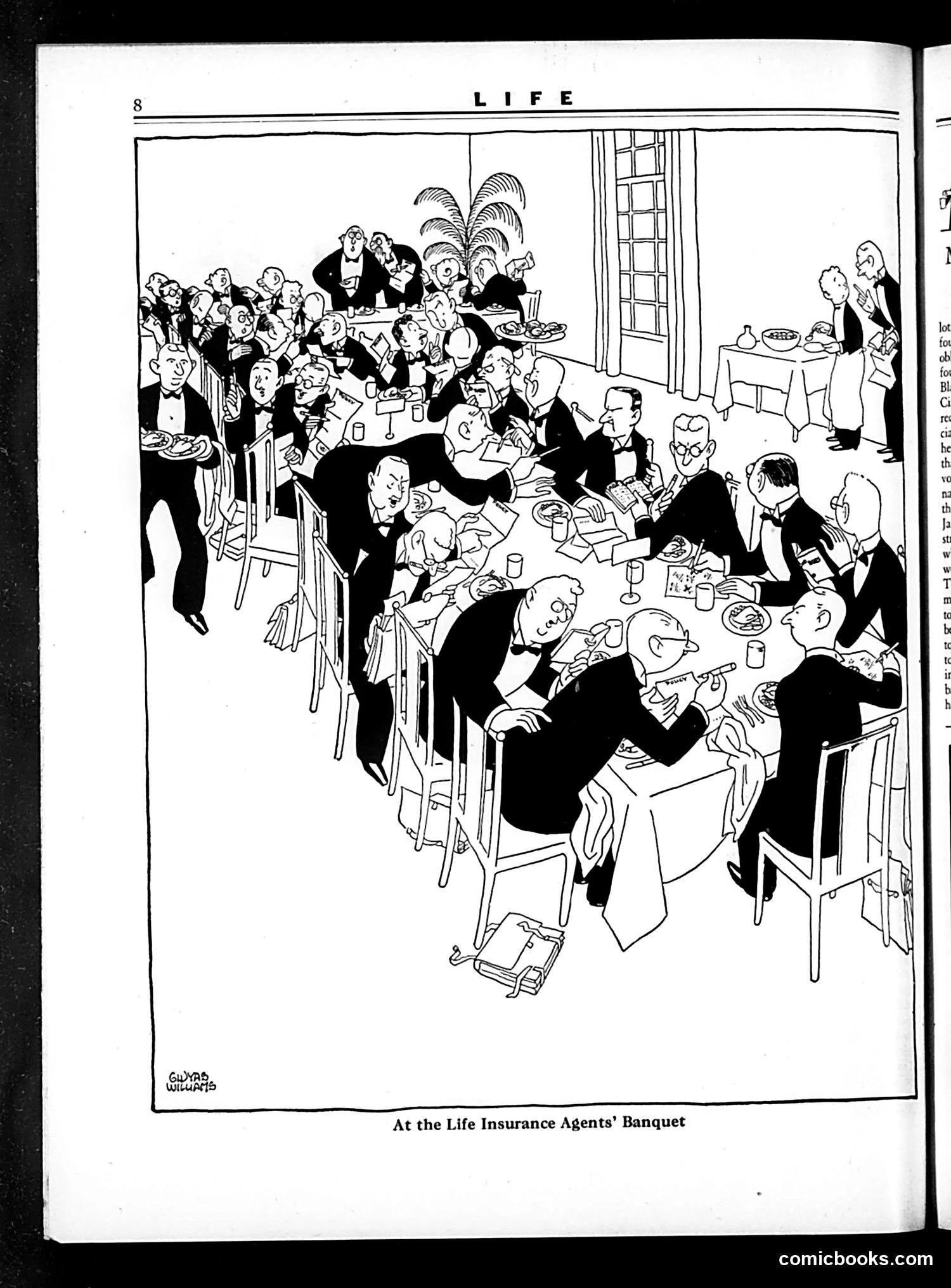
This cartoon satirizes life insurance agents at a formal dinner event. The drawing shows men in tuxedos seated at tables, eating and socializing in what appears to be an elegant banquet hall with decorative plants. The satire likely targets the insurance industry itself—a profession often viewed with suspicion or mockery in early 20th-century American humor. The crowded, somewhat chaotic scene of agents dining together may suggest irony about their profession: these men who sell policies protecting against death and misfortune are themselves indulging in lavish festivities. The cartoon's humor probably derives from poking fun at insurance salesmen as a particular professional type, though the specific satirical point remains somewhat unclear without additional context about contemporary attitudes toward the industry.
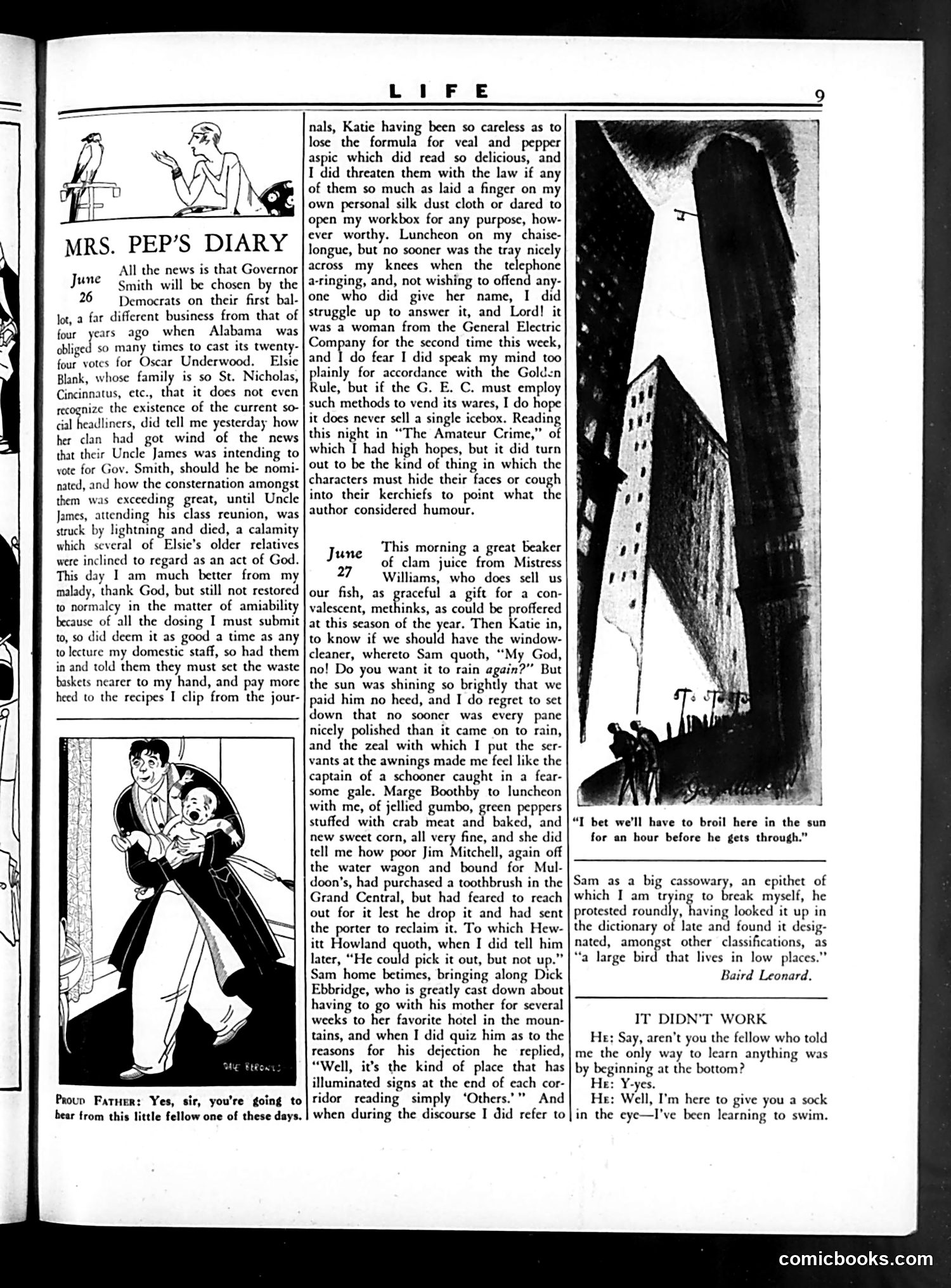
This page contains **Mrs. Pep's Diary**, a humorous domestic column dated June 26-27, humorously complaining about household management during what appears to be the 1920s-30s era. The main cartoon depicts a father holding a baby, captioned "Proud Father: Yes, sir, you're going to hear from this little fellow one of these days." The satire targets: - **Domestic frustrations**: servants losing recipes, telephone interruptions during meals - **Parental pretension**: the "proud father" humorously assumes his unremarkable baby will achieve greatness - **Daily absurdities**: window-washing during lunch, clam juice deliveries, minor household dramas inflated to cosmic significance The humor relies on relatable domestic chaos and gentle mockery of middle-class aspirations and parental self-delusion.
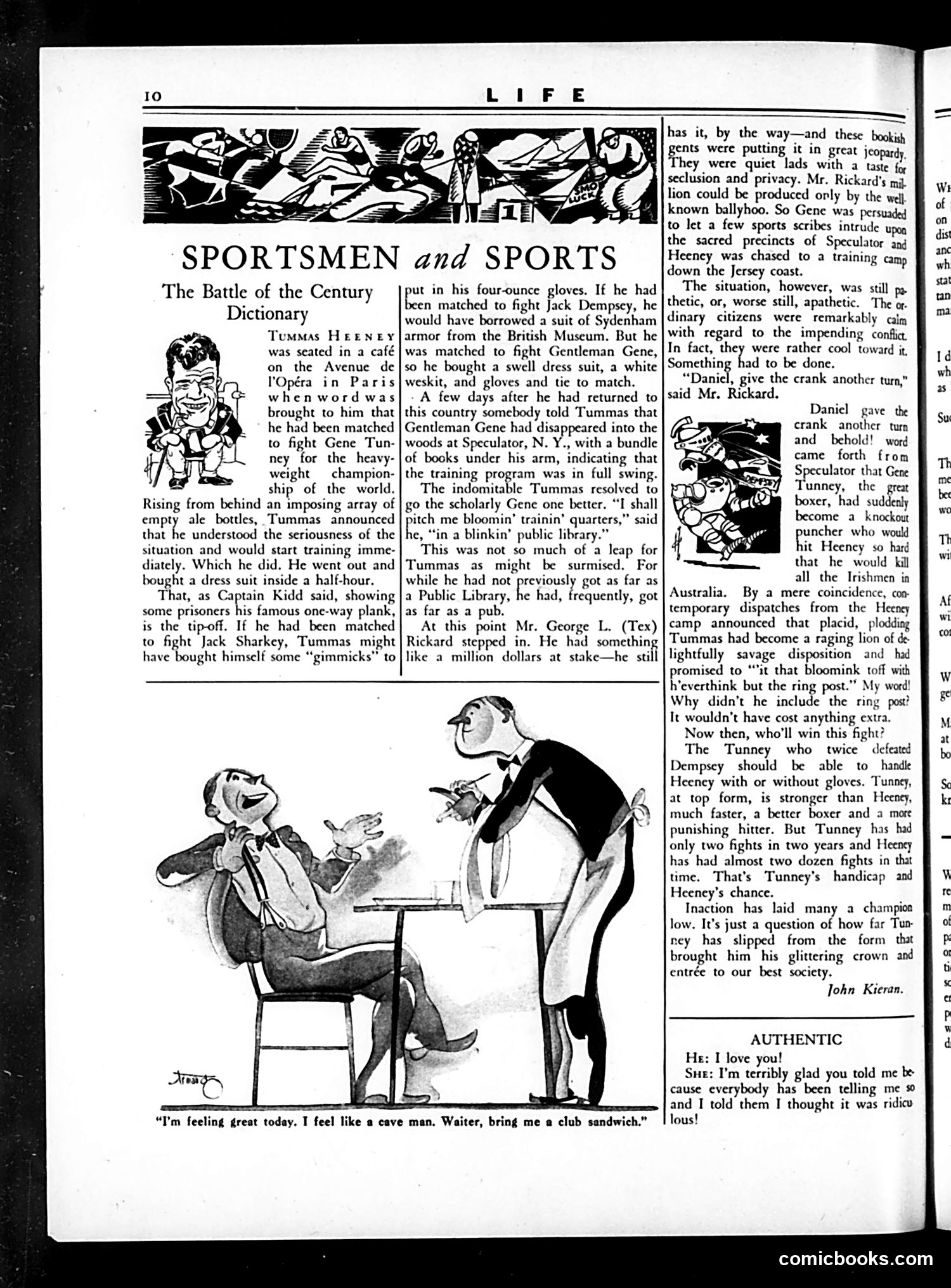
This satirical article concerns the 1926 heavyweight boxing match between **Gene Tunney and Jack Dempsey**. The text humorously documents how Tunney, an intellectually refined boxer who frequented public libraries, prepared for fighting Dempsey by studying in Speculators' clubs and training camps. The main cartoon depicts a waiter serving a diner who declares feeling "like a cave man," requesting a club sandwich—a visual pun playing on Tunney's sophisticated reputation versus the brutish expectations of boxing. The satire mocks the contrast between Tunney's cultured image (he borrowed armor from the British Museum for a costume) and the sport's rough reputation. It captures 1920s fascination with this high-profile match between seemingly mismatched fighters.
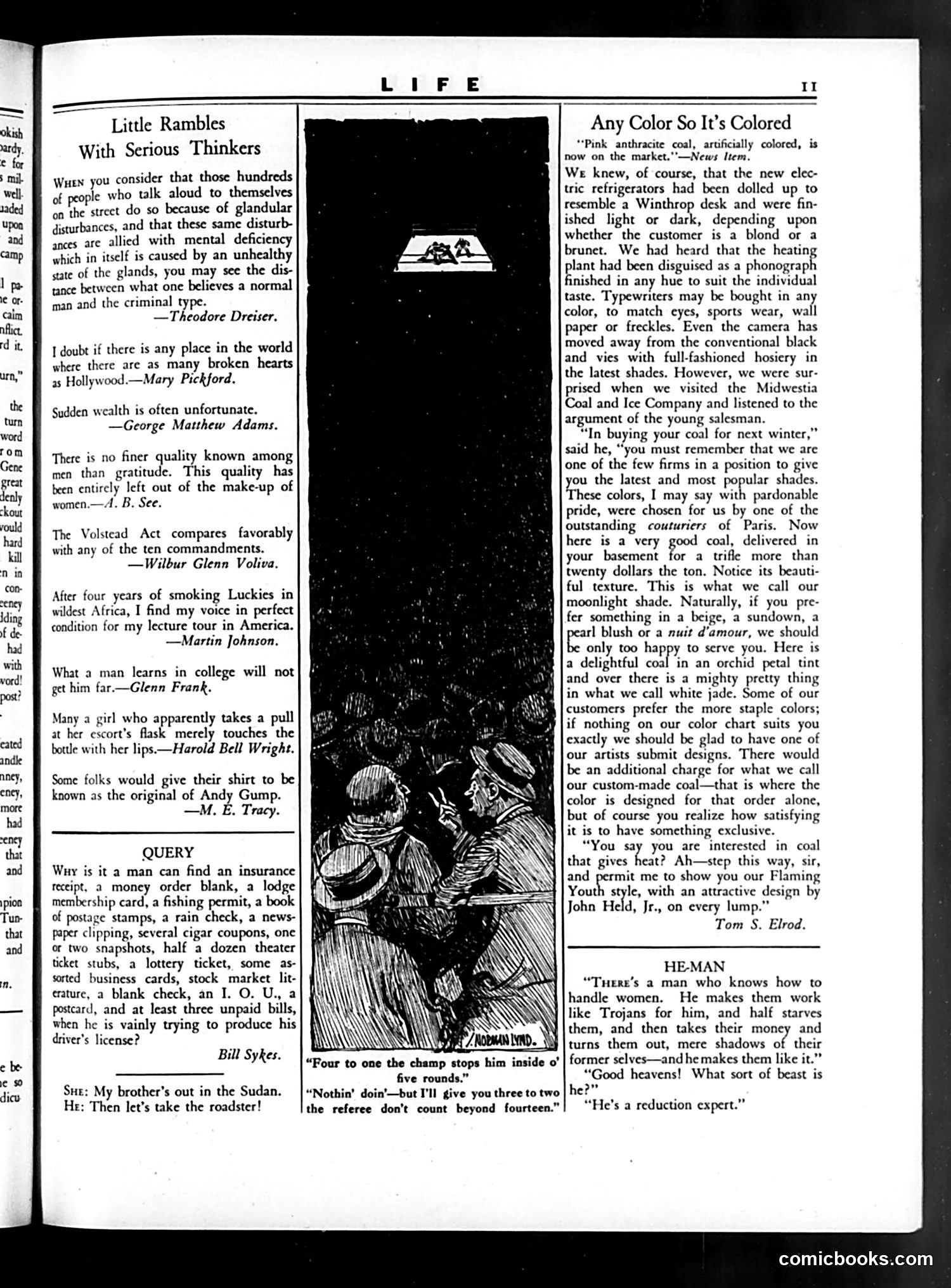
This page contains **satirical quotations and a cartoon**, not political commentary. The left column features "Little Rambles With Serious Thinkers"—short quotes attributed to public figures like Theodore Dreiser and Mary Pickford, offering witty observations on human nature and society. The central cartoon depicts two boxers in a ring, with the caption: "Pour to one the champ stops him inside o' five rounds." / "Nothin' doin'—but I'll give you three to two the referee don't count beyond fourteen." This **satirizes boxing corruption**, suggesting fixed fights and dishonest referees—a common concern in early 20th-century prize fighting. The joke implies that determining the fight's outcome depends not on the boxers but on the referee's willingness to cheat. The right column advertises colored coal and custom-designed heating products.
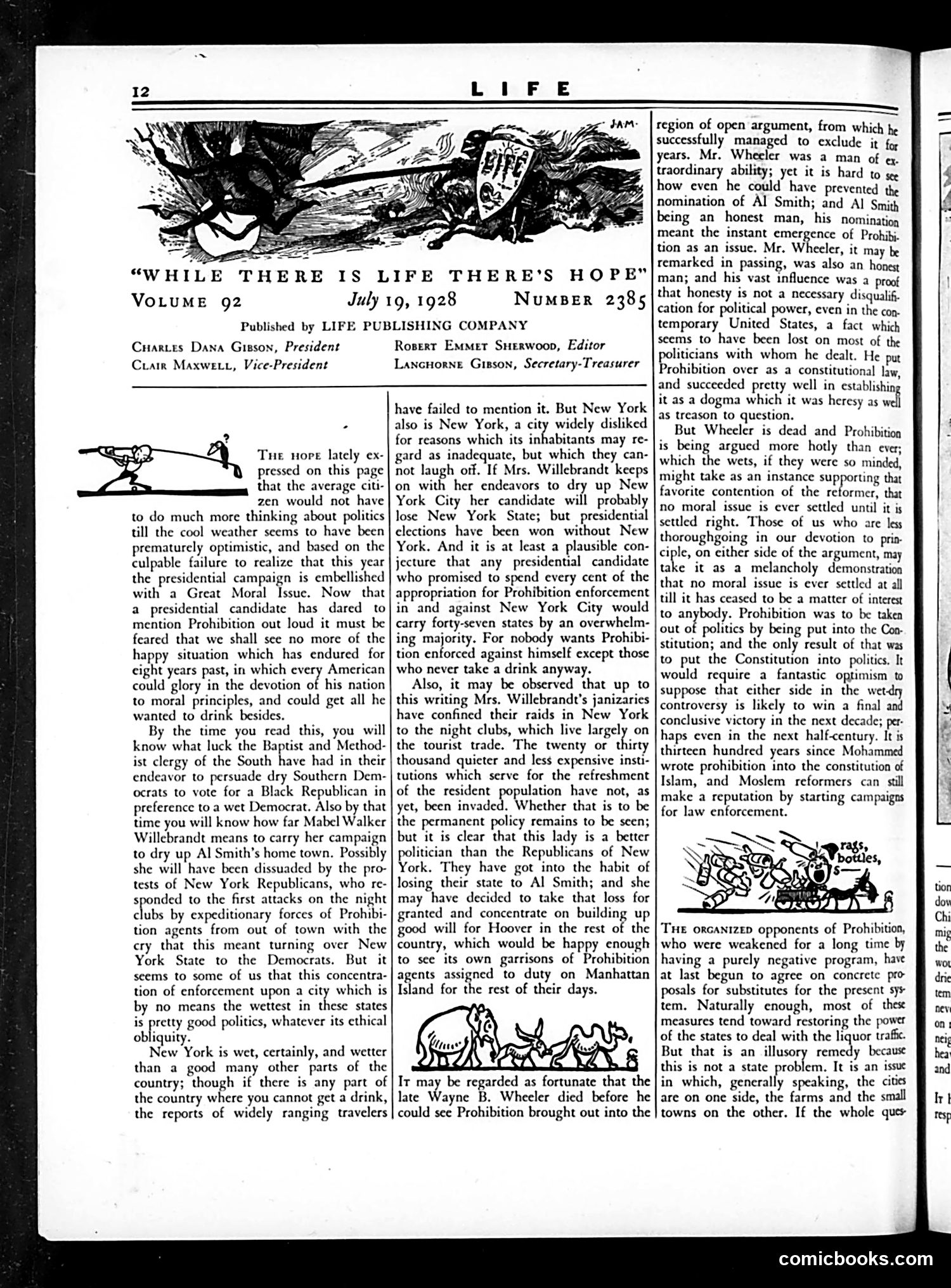
This page discusses Prohibition enforcement and presidential politics. The main text criticizes the inconsistent application of Prohibition laws, particularly regarding New York City's resistance to enforcement. Two political cartoons appear: The first (top) depicts a figure in a precarious position, likely satirizing the political instability around Prohibition policy. The second cartoon (bottom) shows what appears to be animals in conflict, probably representing the clash between wet (anti-Prohibition) and dry (pro-Prohibition) factions during the 1928 election. The article argues that Prohibition has become a divisive political issue where enforcement varies by region, undermining the law's effectiveness and legitimacy across different states and cities.
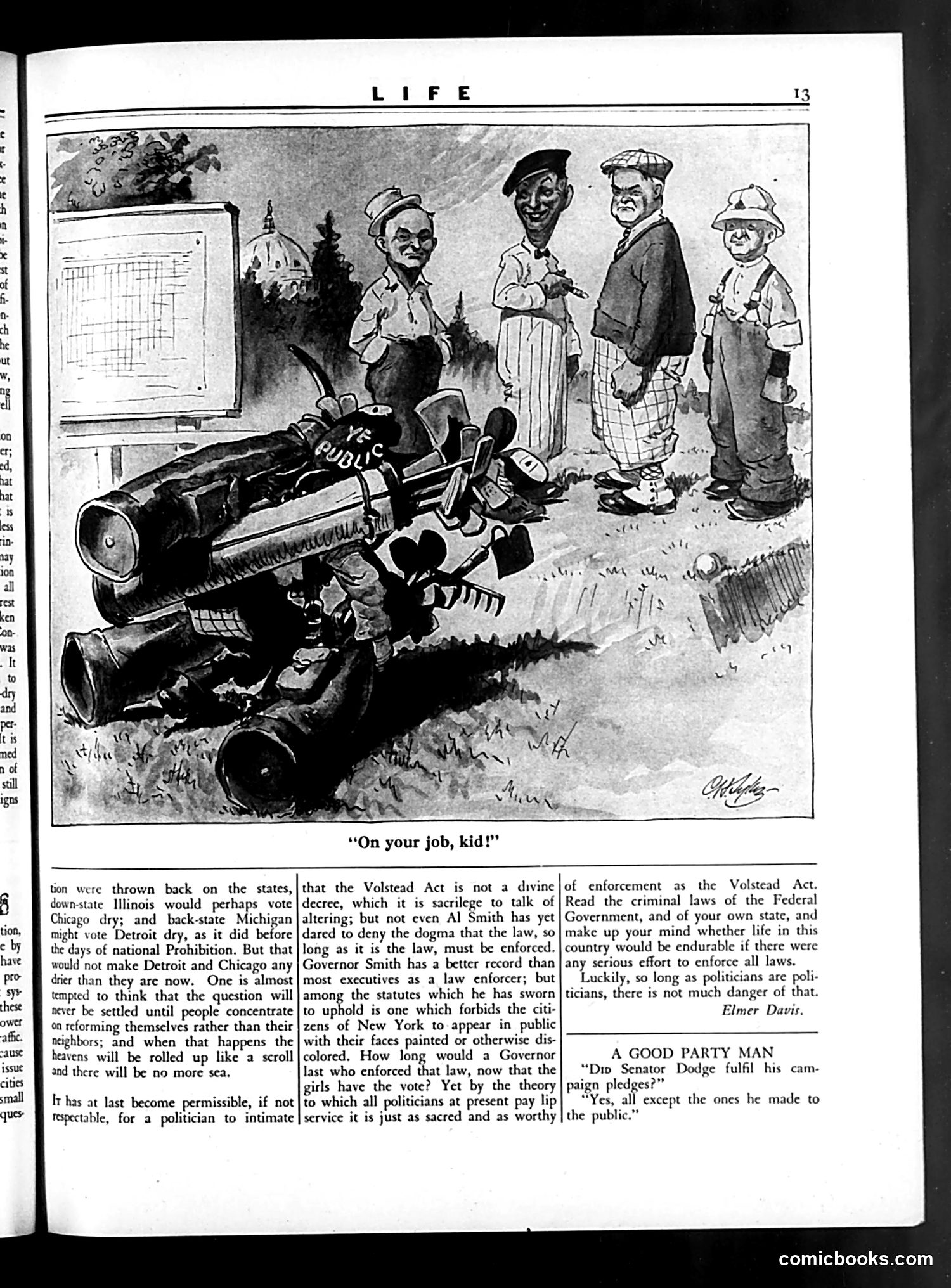
This cartoon satirizes law enforcement during Prohibition. Five caricatured officials stand watching a massive pile of confiscated alcohol barrels labeled "PUBLIC" being destroyed. The caption "On your job, kid!" appears ironic—the cartoon criticizes politicians and law enforcement for failing to genuinely enforce Prohibition. The accompanying text explicitly discusses this hypocrisy: politicians publicly support the Volstead Act while privately opposing enforcement. The article notes it's become "permissible" for politicians to undermine their own laws, and questions how long a governor could enforce Prohibition when "the girls have the vote"—suggesting women voters' opposition undermines enforcement. The cartoon mocks the performative nature of Prohibition enforcement rather than its actual implementation.
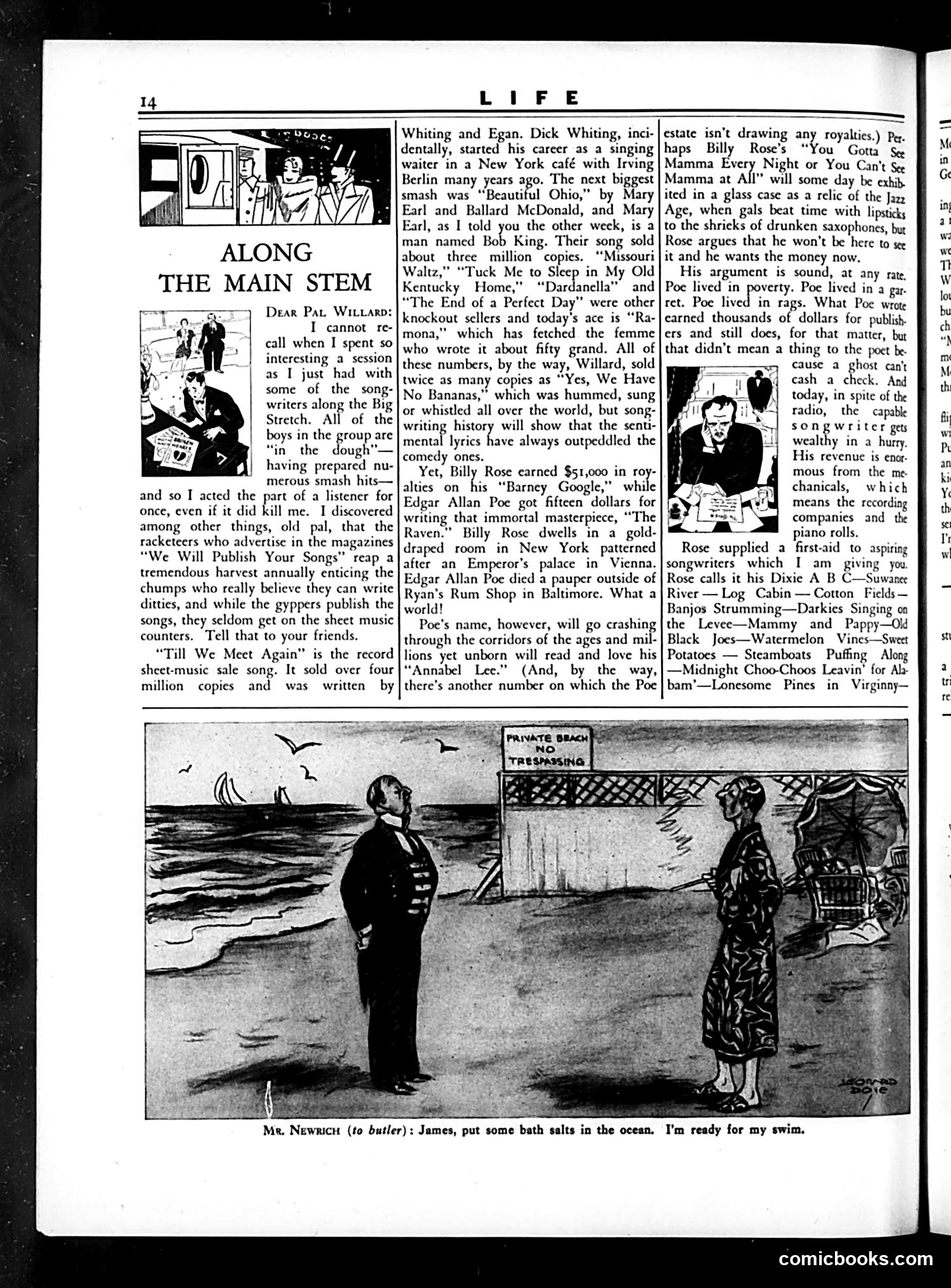
This page from Life magazine contains a column called "Along the Main Stem" by "Dear Pal Willard," discussing popular songs and their commercial success. The cartoon at the bottom depicts a beach scene with a "Private Beach—No Trespassing" sign. A butler (identified as "James" in the caption) addresses his employer, Mr. Newrich, with the line: "James, put some bath salts in the ocean. I'm ready for my swim." **The satire:** "Newrich" (likely a play on "nouveau riche") represents a newly wealthy person with more money than sense. The joke mocks the absurd extravagance and ridiculous expectations of the newly rich—someone so disconnected from reality that they'd expect their servant to chemically treat the entire ocean for their comfort. It satirizes wealth-based pretension and wasteful excess.
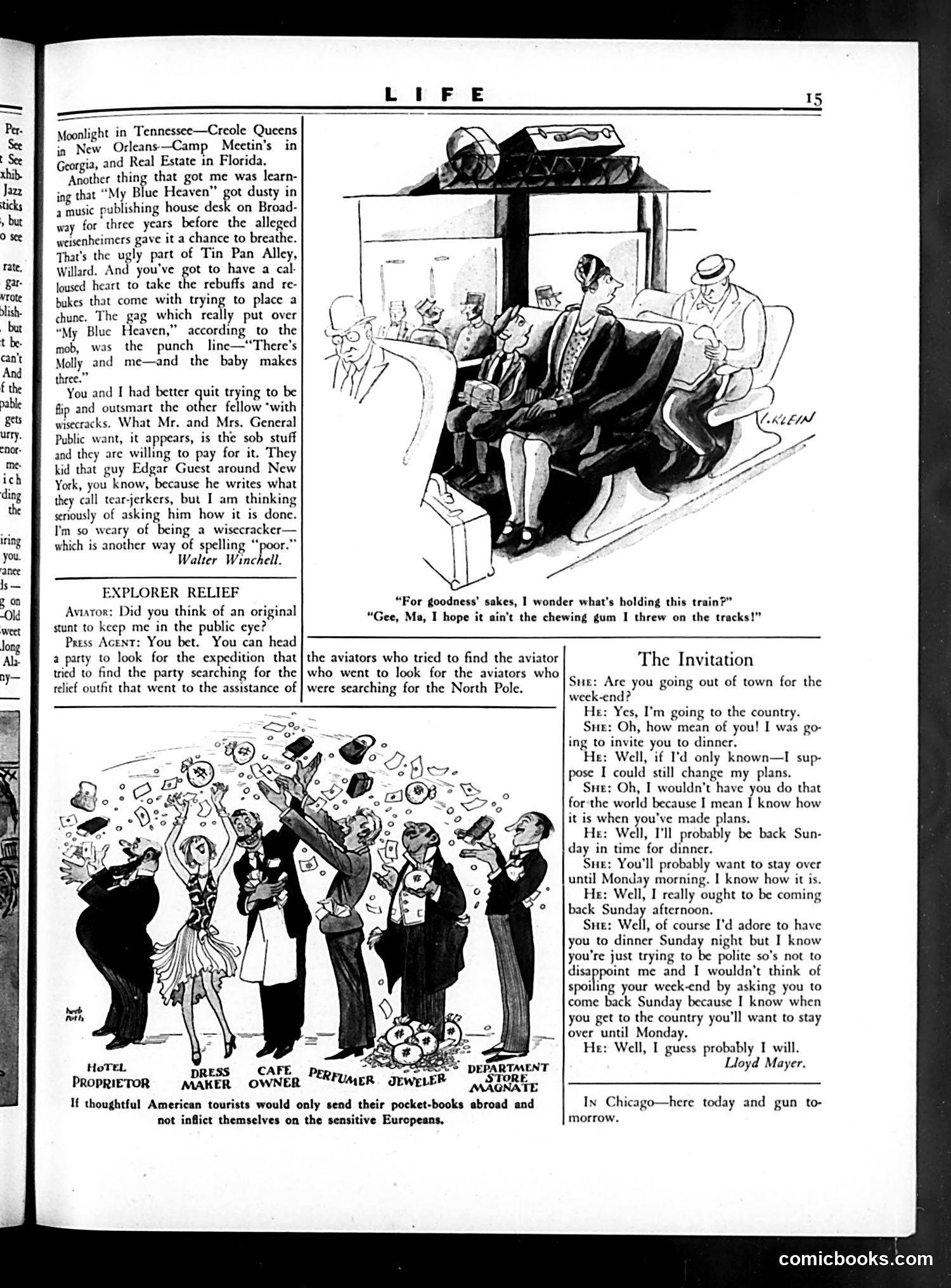
The top cartoon shows train passengers worried about safety, with the caption joke about chewing gum on tracks—a light domestic humor piece about travel anxieties. The "Explorer Relief" section satirizes newspaper sensationalism. It mocks media coverage of polar expeditions, suggesting reporters obsess over finding missing explorers while ignoring the actual search efforts. The cartoon below depicts various European professionals (hotel proprietor, dress maker, cafe owner, perfumer, jeweler, department store clerk) surrounded by scattered American tourist goods—satirizing American tourists abroad who ostentatiously display wealth and fail to respect local customs, treating Europeans as service providers rather than equals. The caption explicitly criticizes American tourists for "inflicting themselves on the sensitive Europeans." "The Invitation" is a humorous dialogue about a couple negotiating weekend plans, showcasing domestic relationship comedy typical of the era.
This page is a theater review by Robert Benchley critiquing Mr. White's theatrical production, "The Ninth," which opened in August. The review discusses various cast members and production elements. The silhouette illustration at top shows theater-goers in formal dress entering a venue. Benchley praises the work of Miss Frances Williams and Mr. Richman, noting their "regulation numbers" and chemistry. However, he criticizes the production's synthetic quality and specific song choices like "On the Crest of a Wave" and "Rockin' Cotton," finding them derivative of earlier hits. The small cartoon figures at the bottom appear to be generic dancers or chorus performers, illustrating Benchley's commentary on the show's choreography and entertainment value. The review's tone is witty but somewhat dismissive of the production overall.
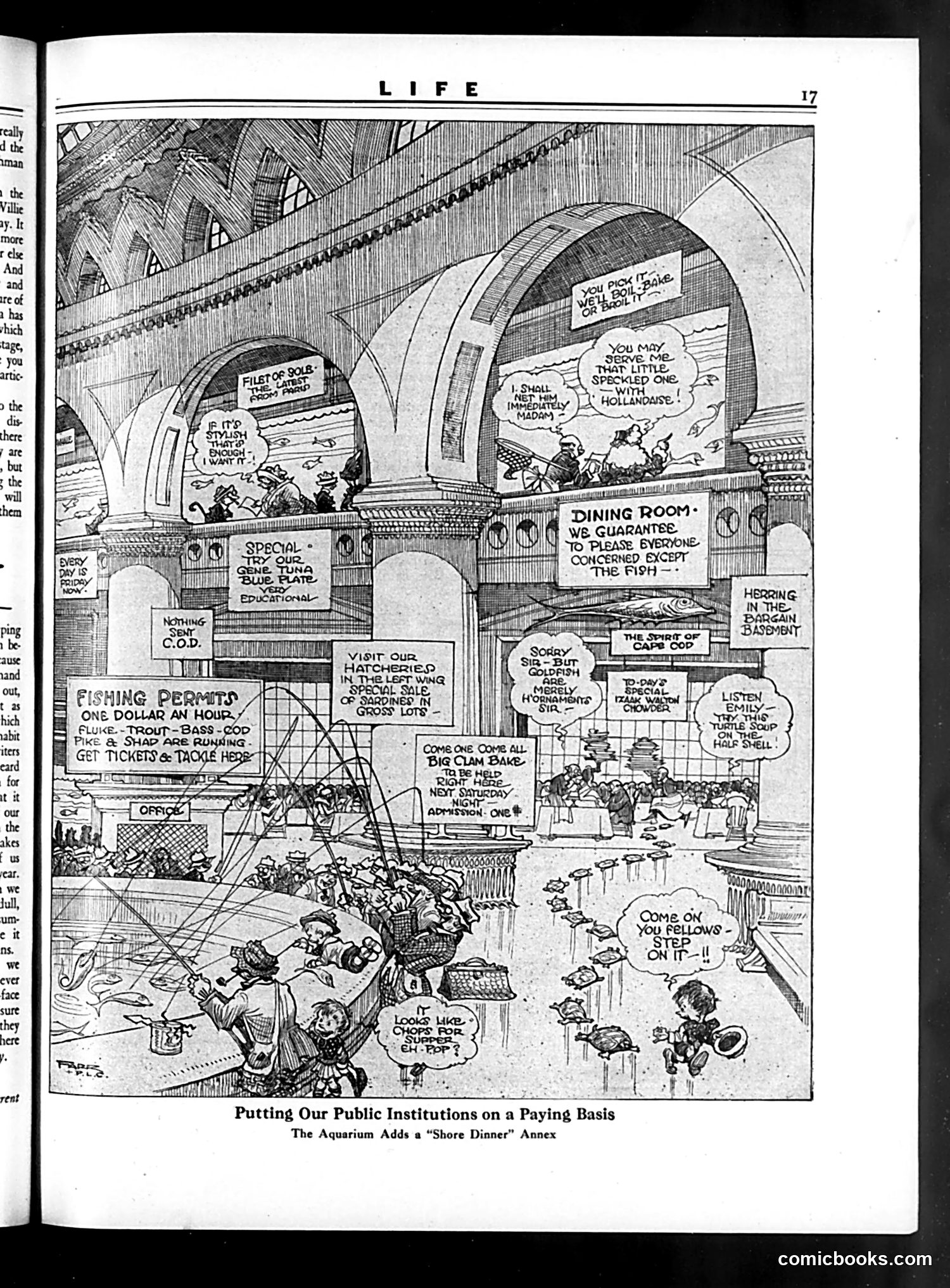
This satirical cartoon critiques the commercialization of public institutions. An aquarium has added a "Shore Dinner" restaurant annex, transforming it into a profit-driven enterprise. The cartoon shows chaos: visitors pursuing fish for meals ("Looks like chops for supper, eh-pop?"), menu boards advertising "filet of sole" and "clam bake," and crowded dining areas. The satire targets the trend of monetizing public spaces that were meant for education or recreation. The "paving basis" reference suggests these institutions are being paved over—literally and figuratively—by commercial interests prioritizing revenue over their original public missions. The humor lies in the absurd image of an aquarium serving its own exhibits as food.
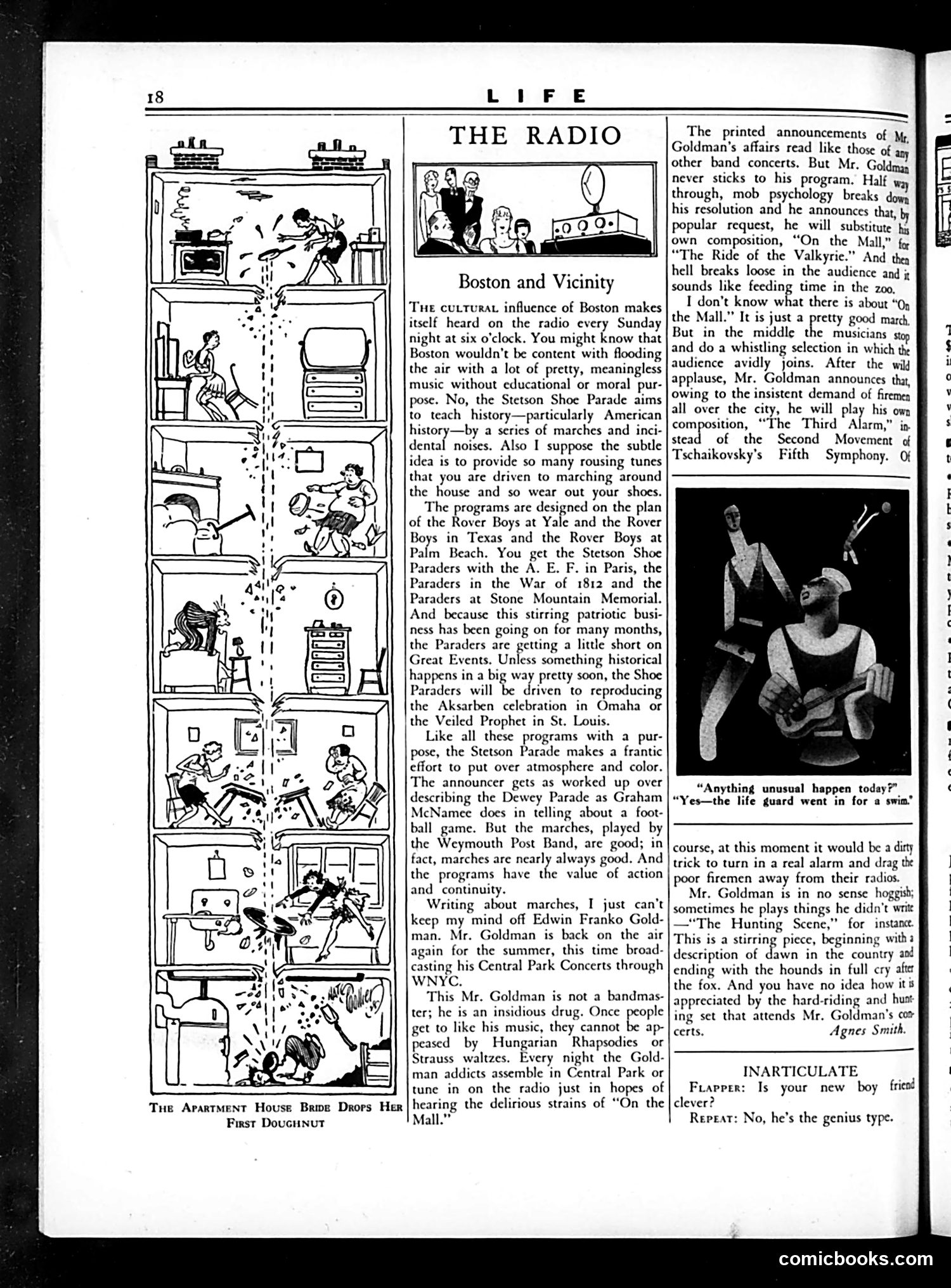
This page satirizes popular 1920s radio programming and two bandleaders. **Left cartoon:** "The Apartment House Bride Doors Her First Doughnut" humorously depicts a bride accidentally destroying her apartment while attempting to cook—showing early 20th-century anxieties about women's domestic competence. **Main text:** Critiques the "Stetson Shoe Parade," a Boston radio program that teaches American history through patriotic marches. The satire targets its heavy-handed educational purpose and repetitive patriotic content, suggesting the station is running out of significant historical events to dramatize. **Central focus:** Edwin Franko Goldman, a real bandleader broadcasting Central Park Concerts on WNYC radio. The writer humorously describes Goldman as an "insidious drug"—his signature composition "On the Mall" so addictive that audiences demand he play it repeatedly instead of his announced program. The satire affectionately mocks how Goldman caves to listener demand and substitutes his own compositions for classical works like Tchaikovsky. The page reflects radio's novelty and cultural significance in this era.
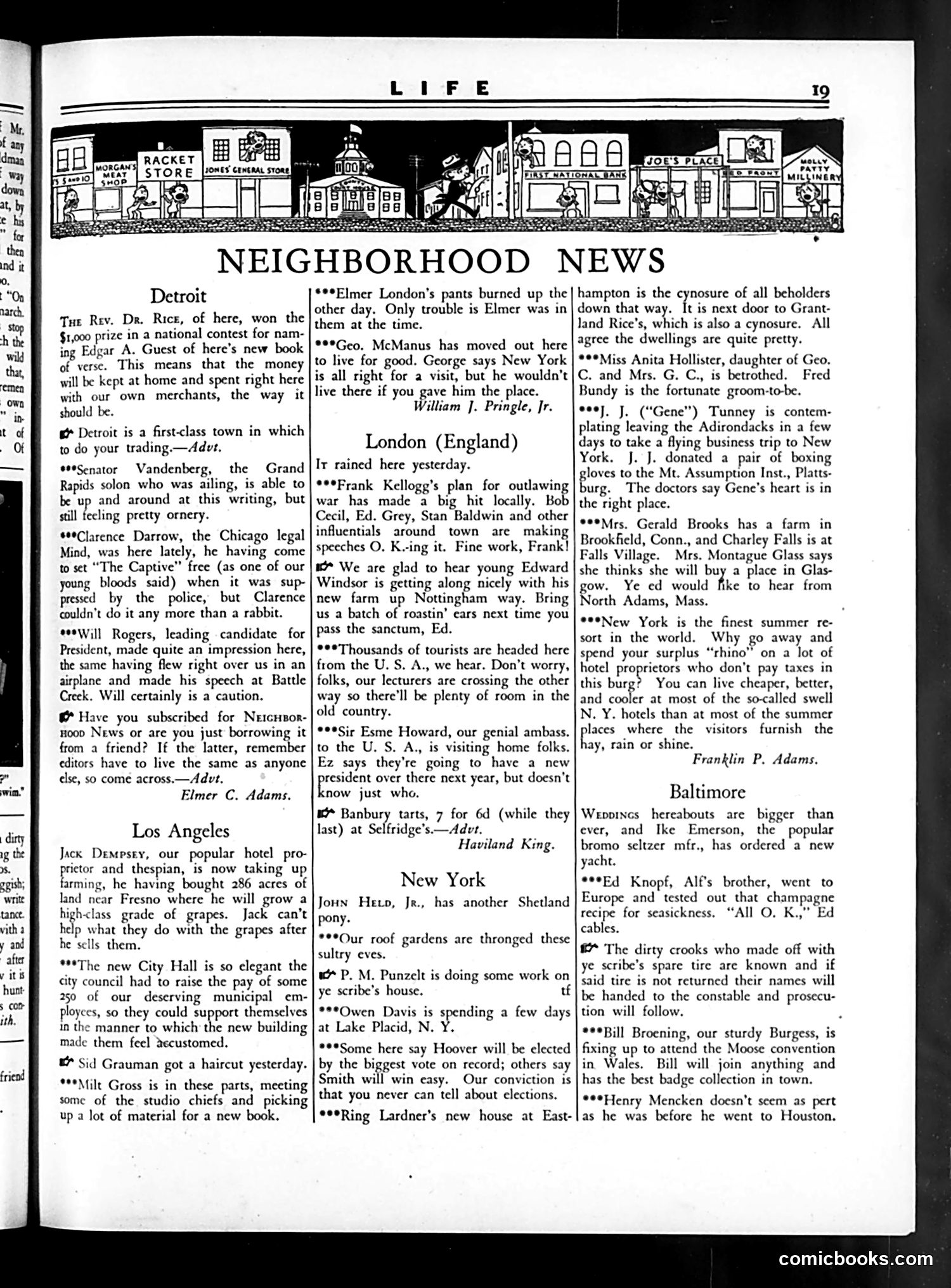
This page features brief, gossipy local news items from American cities (Detroit, Los Angeles, London, New York, Baltimore), presented as authentic neighborhood updates. The satire lies in treating trivial, mundane occurrences as if they're genuinely newsworthy. The humor targets several figures: **Will Rogers** (presidential candidate) receives gentle mockery for making a speech via airplane; **Jack Dempsey** (famous boxer-turned-hotelier-farmer) is joked about for growing grapes near Fresno; references to **Frank Kellogg's** peace plan and **Herbert Hoover** reflect 1920s political discourse. The real satire mocks small-town gossip columns and advertising-driven local papers—note the "(Advt.)" labels mixed with "news." Items like "Elmer London's pants burned up the other day. Only trouble is Elmer was in them at the time" exemplify the absurdist humor. This reflects Life's satirical approach to American provincial life and media culture.
This page contains **gossip columns** from multiple North American cities (Milwaukee, Toronto, Spokane, Boston, Birmingham, Toledo), not political cartoons. The content mocks local celebrities and social pretensions through brief, humorous anecdotes: - **Social hypocrisy**: Oscar Greenwald dressed finely at a yacht club; Ralph Gordon sold his accordion after using it for social climbing - **Wealth/status contradictions**: McLaughlin (Buick manufacturer) drives a Cadillac while waiting for better Buick models - **Local absurdities**: A rodeo cowboy frightened by a cow; a burglar stealing pre-war corn syrup - **Upper-class gossip**: Lady Eaton meeting the King; Steve Leacock hosting his mother-in-law The satire targets **pretension, contradiction, and small-town foibles**—mocking both wealthy individuals' contradictions and ordinary people's social aspirations. This reflects *Life* magazine's role as an urbane satirist documenting American social behavior in the 1920s.
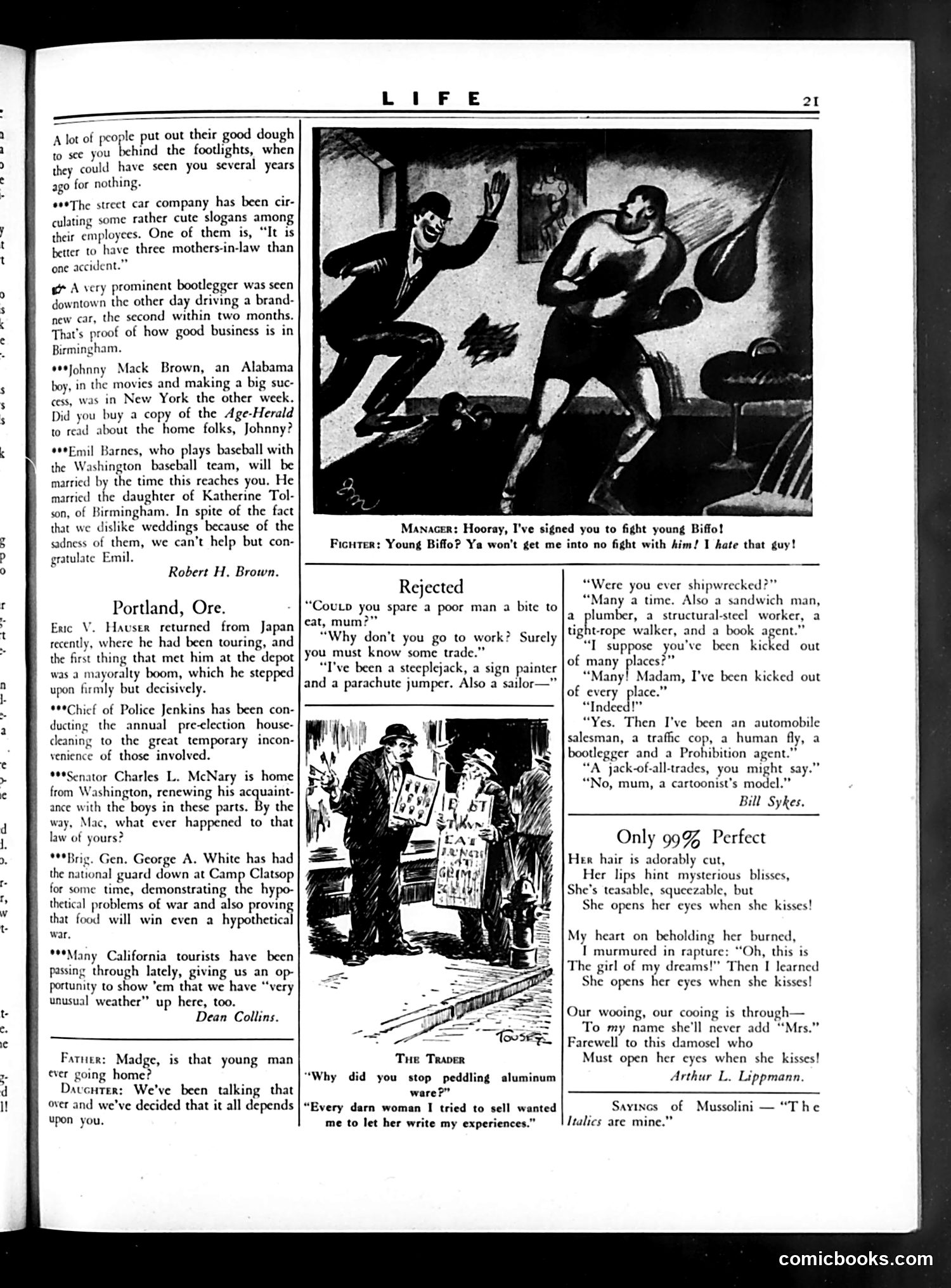
This page from *Life* magazine contains humorous short pieces and cartoons satirizing American social life circa the 1920s. **Top cartoon**: A boxing manager tries to recruit a reluctant fighter to battle "young Biffo," but the fighter refuses, claiming he hates that opponent. **"The Trader" cartoon**: A beggar claims extensive job experience (steeplejack, sign painter, sailor, salesman, cop, etc.) but admits he's been "kicked out of every place." The punchline reveals he's actually a "cartoonist's model"—his function is merely to pose as various types for illustration purposes. **"Rejected"** section: Light humor about a down-on-his-luck man's failed attempts at various trades. **Poetry section "Only 99% Perfect"**: Humorous lament about a beautiful girlfriend with one fatal flaw—she keeps her eyes open while kissing (considered unromantic). The page reflects 1920s preoccupations: economic opportunity, social mobility, romantic ideals, and self-deprecating humor about modern life's disappointments.
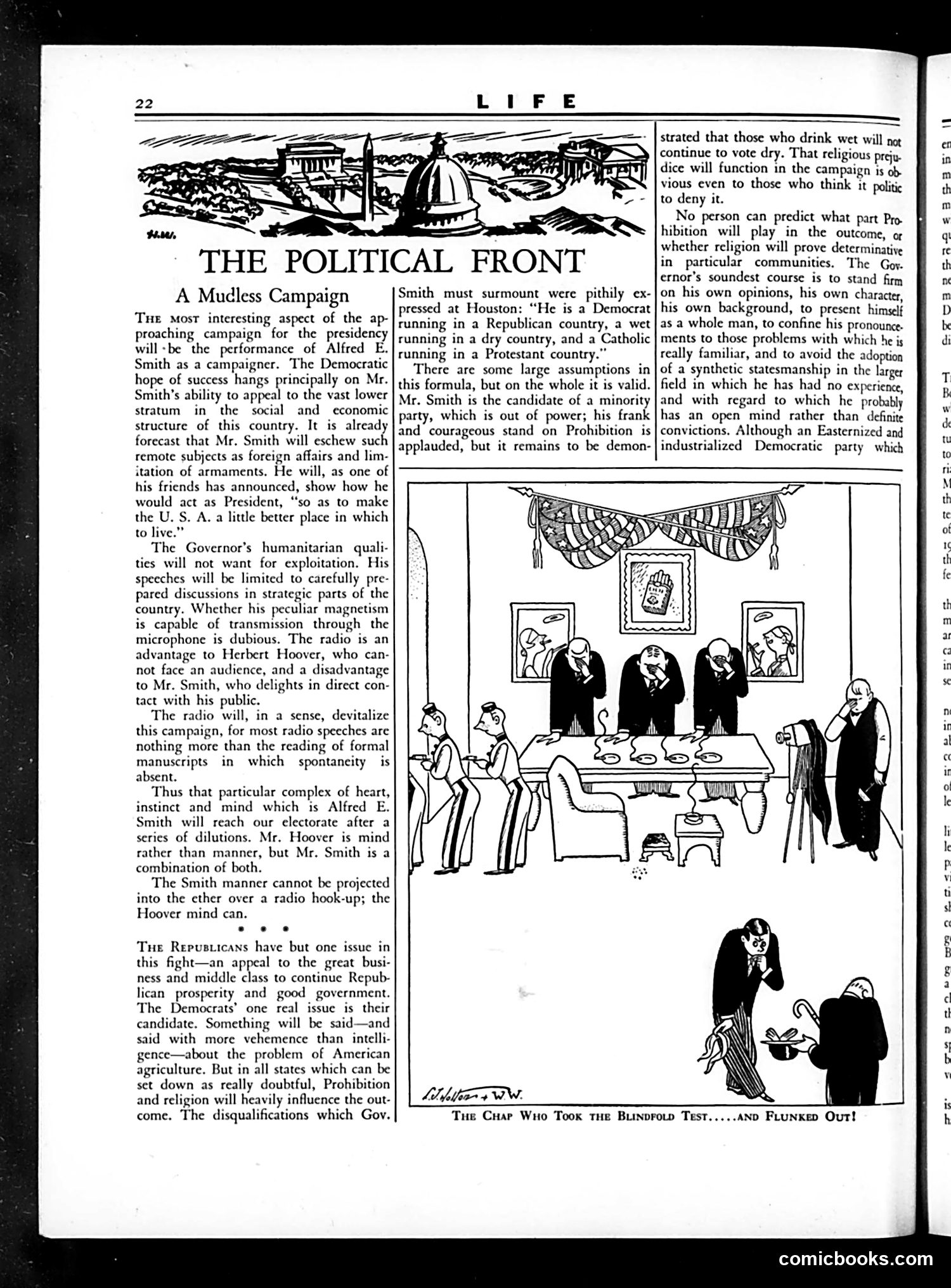
This 1928 Life magazine article analyzes Alfred E. Smith's presidential campaign against Herbert Hoover, identifying Smith's key disadvantages: he's a Democrat in a Republican era, "wet" (anti-Prohibition) in a dry country, and Catholic in a Protestant nation. The piece argues Smith's strength lies in personal charisma and direct appeal to working-class voters, but radio broadcasting—Hoover's advantage—neutralizes this by requiring formal, scripted speeches lacking spontaneity. The author suggests Smith should stick to familiar issues rather than adopt synthetic positions. The cartoon (captioned "The Chap Who Took the Blindfold Test...and Flunked Out!") depicts a blindfolded figure among seated men, suggesting Smith cannot see or navigate the hidden obstacles and prejudices he faces. The "blindfold test" satirizes the naive assumption that merit alone determines electoral success, when religious and Prohibition biases will actually decide the outcome in doubtful states.
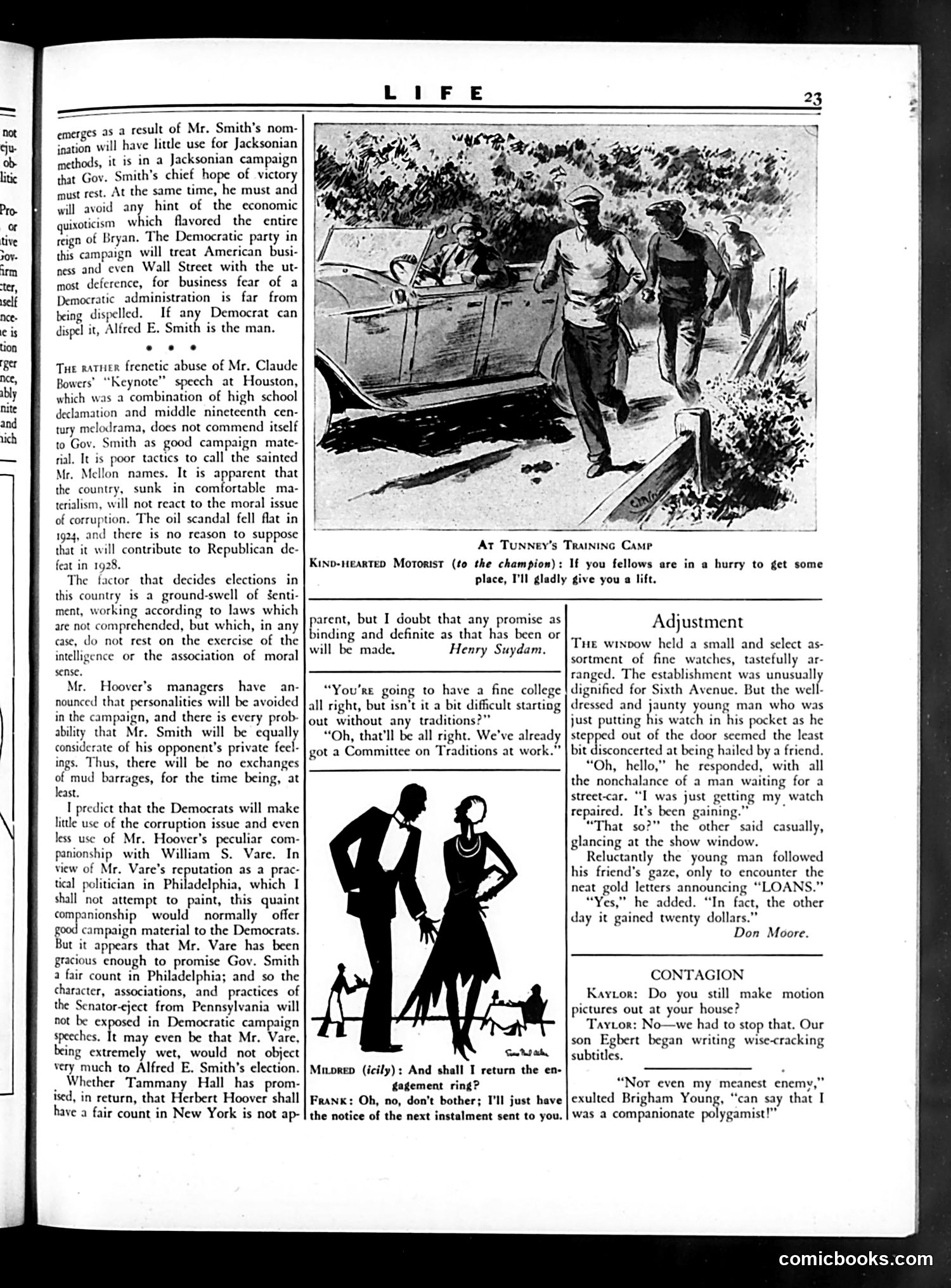
This page contains political commentary on the 1928 U.S. presidential election, discussing Democratic candidate Alfred E. Smith's campaign strategy against Republican Herbert Hoover. The text argues Smith should avoid moral corruption arguments (referencing the Teapot Dome scandal of 1924) and instead appeal to business interests and sentiment rather than intelligence. The main cartoon shows a motorist offering a ride to racing cyclists, captioned "If you fellows are in a hurry to get some place, I'll gladly give you a lift"—likely satirizing campaign maneuvering and backroom deals mentioned in the text, possibly alluding to Philadelphia political boss William S. Vare's promise of a "fair count." The page also includes lighter humor: a couple discussing college traditions, and a young man explaining he's having his watch "adjusted" (repaired) rather than admitting he's pawning it—typical 1920s financial satire.
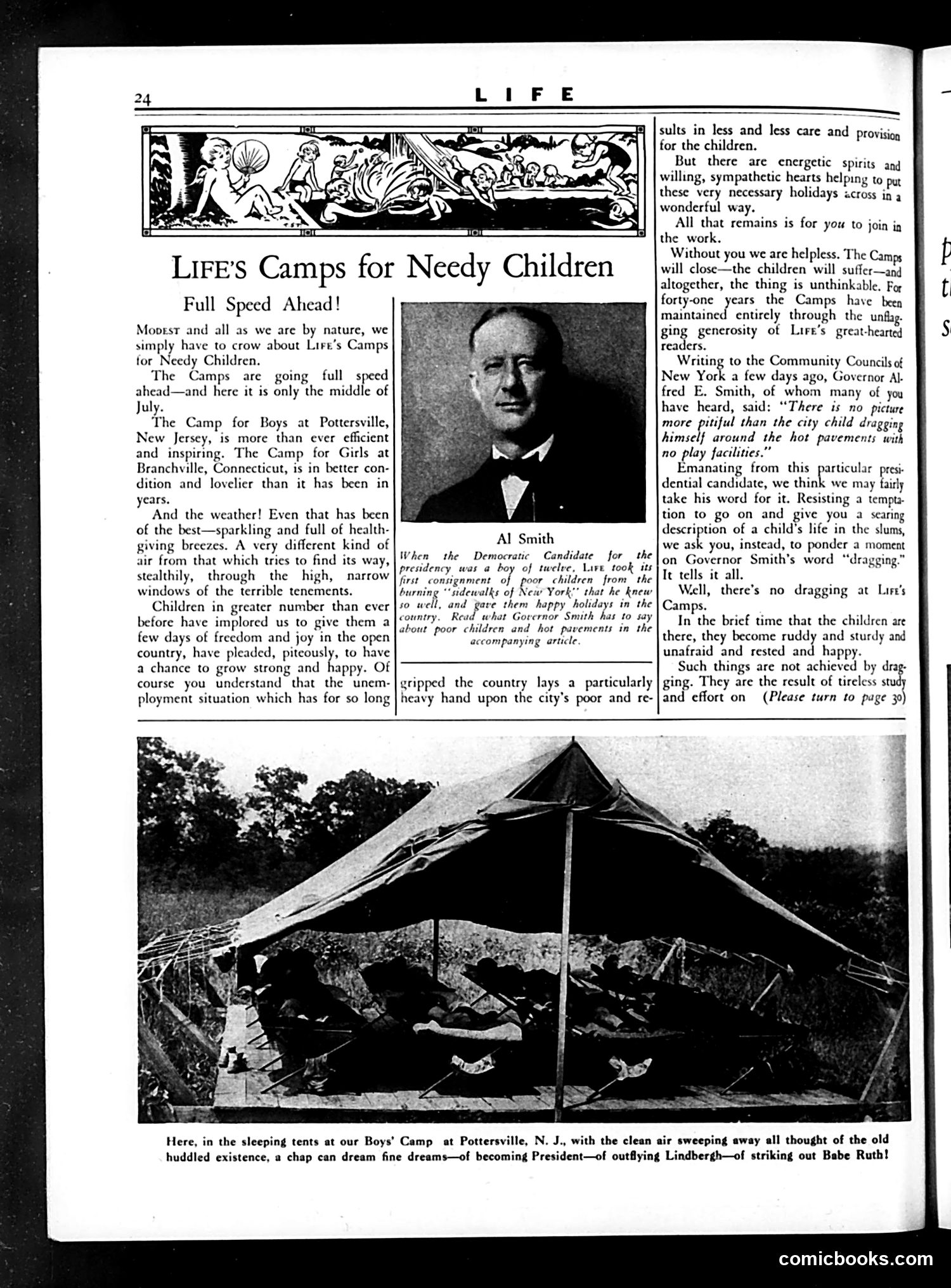
This is a fundraising article promoting Life's charitable camps for poor children, not satire. The page features a portrait of **Al Smith**, the Democratic presidential candidate (likely 1928), endorsing the camps' work. The article argues that urban slum children suffer from inadequate play facilities and need country respite. Smith's quote about children "dragging themselves around hot pavements" lends credibility to the appeal. The accompanying photograph shows boys sleeping in tents at the Pottersville, New Jersey camp, with a caption suggesting that fresh air enables them to dream of becoming President, Lindbergh, or Babe Ruth—aspirational American figures. The piece is essentially a charitable advertisement using Smith's political prominence and the Depression-era unemployment crisis to motivate donations from Life's readers, whom the editors credit with forty-one years of support.
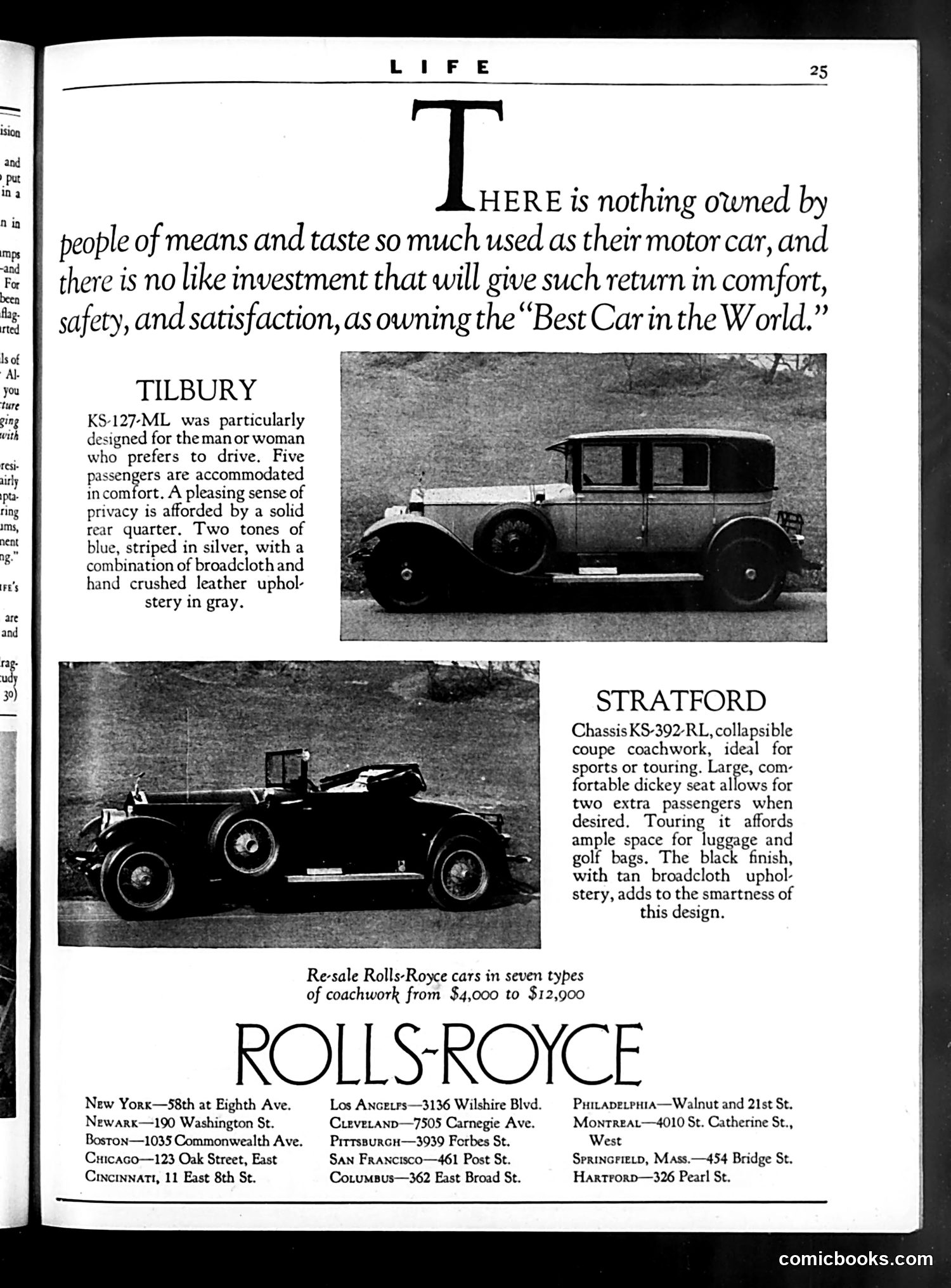
This is a **Rolls-Royce advertisement**, not a cartoon or satire. The page promotes luxury automobiles to wealthy readers of *Life* magazine. The ad presents two car models—the Tilbury and Stratford—emphasizing exclusivity and comfort for the affluent. The opening text uses flattery, claiming that owning a Rolls-Royce is the finest investment for people "of means and taste," offering unmatched "comfort, safety, and satisfaction." Each model is described with details meant to appeal to luxury consumers: the Tilbury offers privacy and elegant upholstery; the Stratford provides sports-touring capability with space for luggage and golf equipment. The advertisement lists dealership locations across major American cities, emphasizing the brand's prestigious availability. Prices ranged from $4,000 to $12,900—substantial sums in this era, accessible only to the wealthy. This represents early 20th-century advertising strategy: appealing to class aspirations and social status.
This page is a **"Confidential Guide"** theater review section from Life magazine, likely from the late 1920s based on show titles and references. It's not primarily satirical cartoon content—it's a entertainment guide with critical commentary on current Broadway productions. The page lists contemporary stage productions across three categories: serious drama, comedies, and musical entertainment. Reviewer **Robert Benchley** provides witty, brief critiques of shows like "Porgy" (noted as a "Negro play"), "Strange Interlude," and popular musicals like "Show Boat." The satire is gentle and embedded in Benchley's commentary rather than visual—he mocks productions' pretensions ("The Ladder" asks real money for admission), pokes fun at overwrought plots, and notes which shows are worth seeing "for conversational purposes if for nothing else." The small decorative header illustration shows theater-related figures but carries no specific political meaning—it's decorative branding for the entertainment section. This reflects 1920s popular culture and Broadway's prominence in American entertainment.
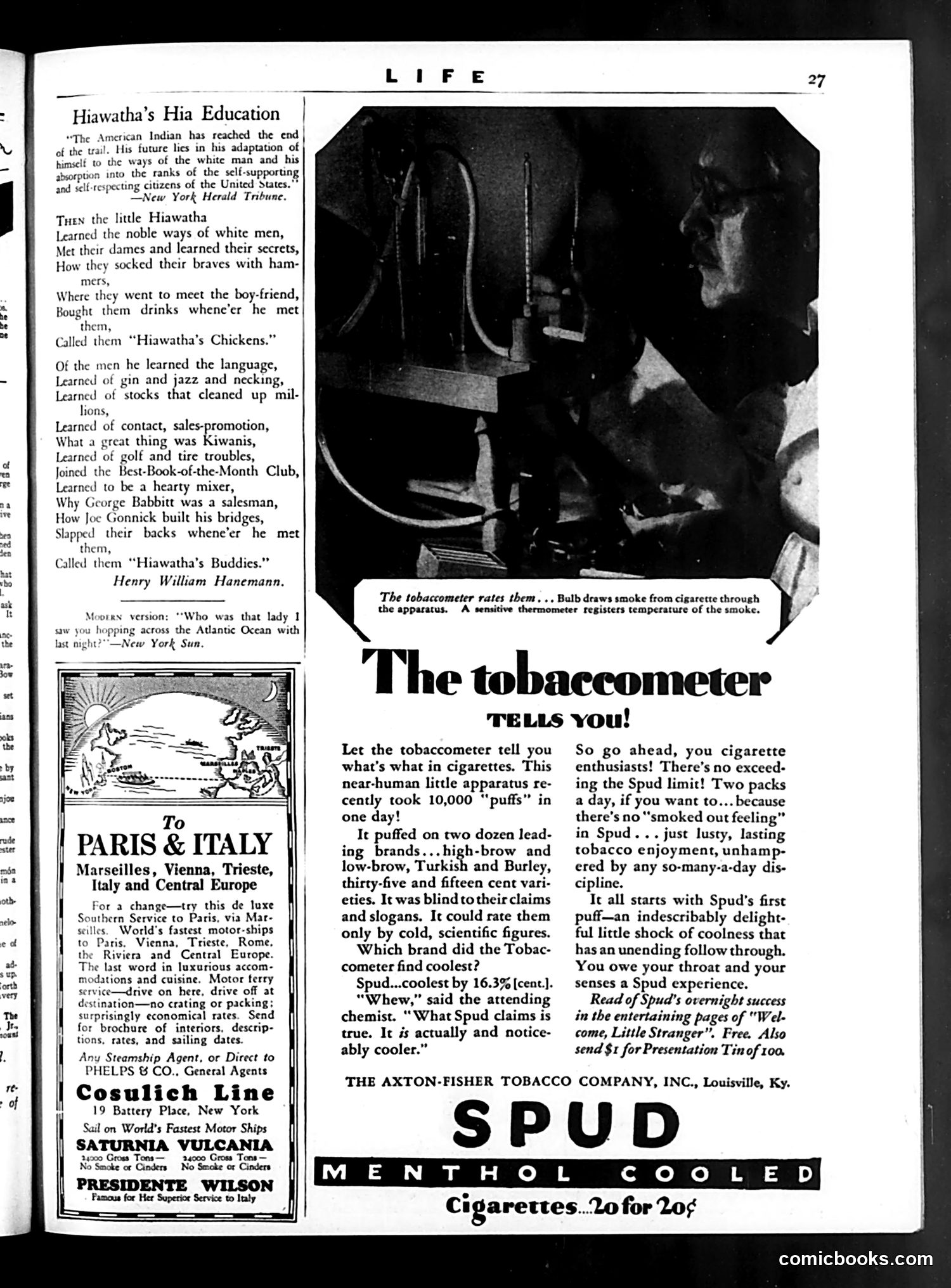
This poem by Henry William Hanemann satirizes the assimilation ideology promoted by mainstream outlets like the *New York Herald Tribune* (quoted at top). The piece mocks the notion that Native Americans must abandon their culture to become "self-supporting" American citizens. The satire works by cataloging what "little Hiawatha" learns from white Americans: not noble virtues, but shallow materialism and vice—gin, jazz, necking, stock manipulation, golf, the "Best-Book-of-the-Month Club," and the false camaraderie of service clubs like Kiwanis. He adopts their slang ("Hiawatha's Chickens," "Hiawatha's Buddies"), treating cultural assimilation as degrading mimicry. The poem suggests that "white civilization" offers only consumerism and empty social performance, not genuine advancement. By juxtaposing a New York Herald Tribune quote endorsing assimilation with a poem showing what assimilation actually entails, Hanemann critiques both the policy and the shallow culture being imposed. The rest of the page contains unrelated advertisements (travel, cigarettes).
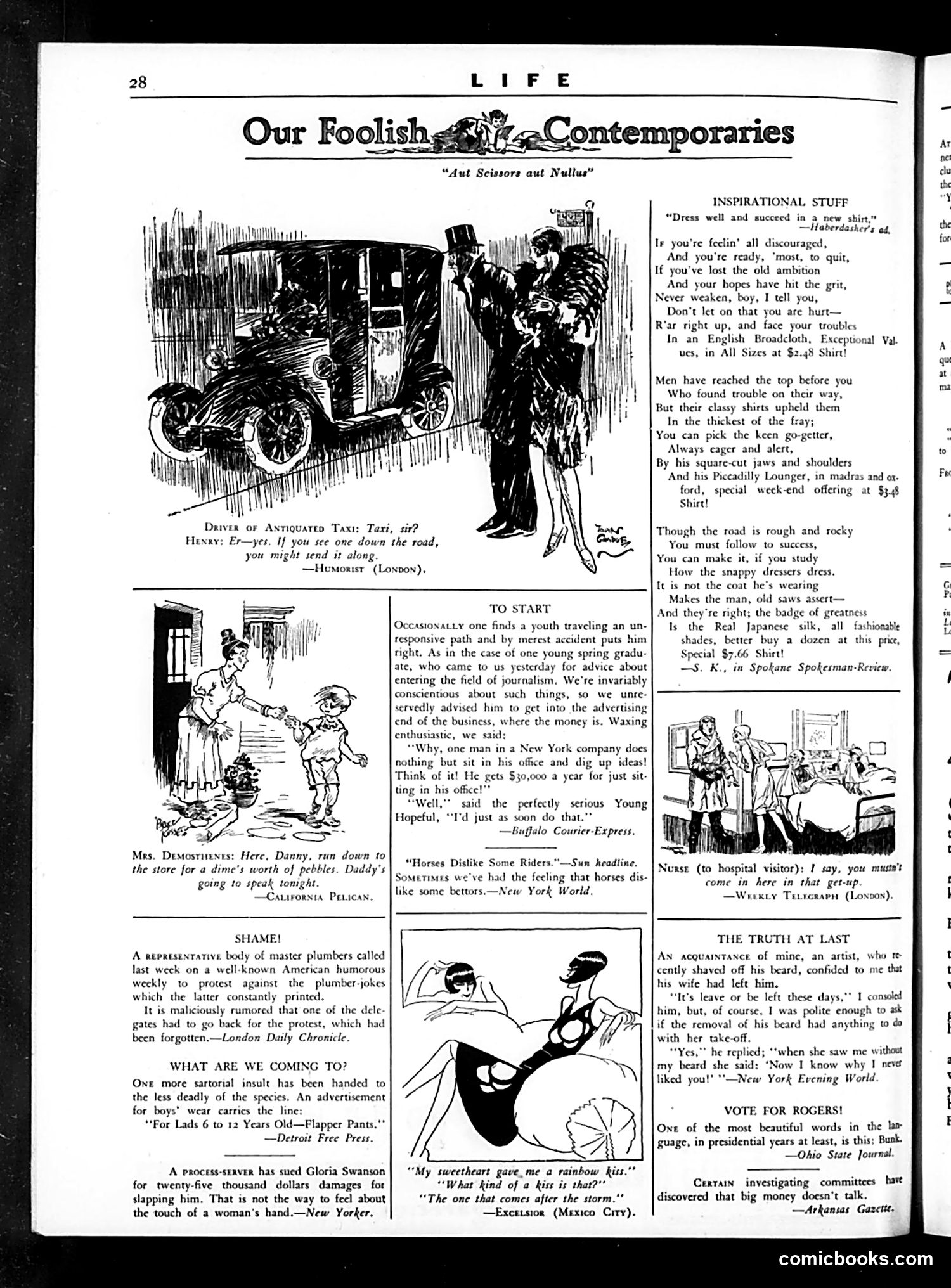
This page collects brief humorous observations about modern absurdities, typical of Life's satirical format. Key items include: **The Taxi Joke**: A man asks a taxi driver to find him a taxi—wordplay on the driver already *being* a taxi driver. **Plumbers' Protest**: Life mocks plumbers who complained about constant plumber jokes in humor publications, with a rumor that one delegate forgot the protest document itself—satirizing both the plumbers' humorlessness and Life's own joke-heavy approach. **Flapper Pants for Boys**: Criticism of marketing "flapper pants" (women's fashion) to young boys, reflecting 1920s anxiety about blurred gender lines in fashion. **The Shirt Advertisement Satire**: The lengthy "Inspirational Stuff" section parodies self-help platitudes by insisting that wearing nice shirts—not actual work or character—leads to success. It's absurdist advertising satire. **The Beard Joke**: A wife leaves her artist husband after he shaves; she finally understands why she never liked him. Dark marital humor. These represent typical Life content: mockery of social pretension, advertising excess, and modern foolishness.
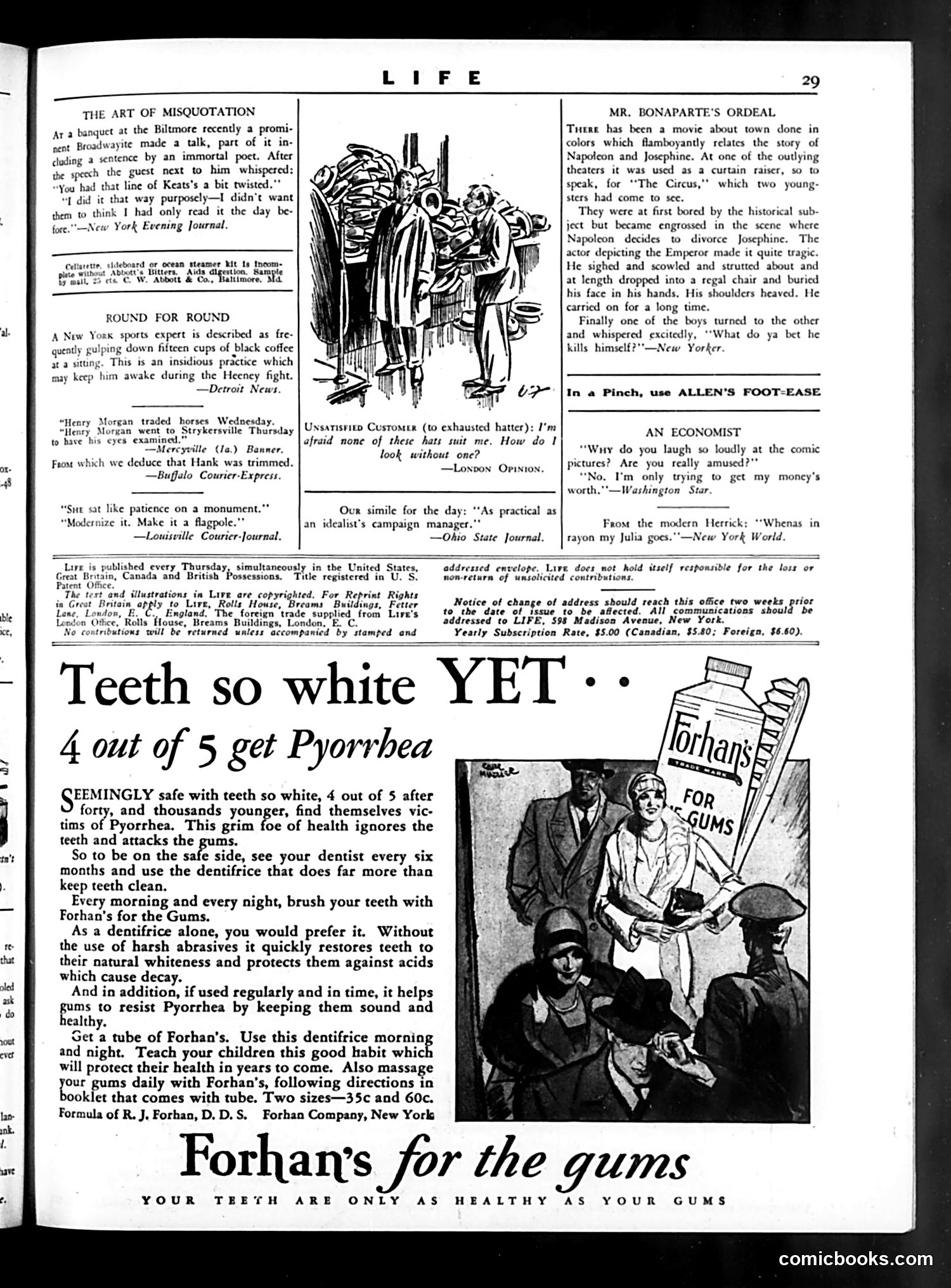
This page combines short humorous anecdotes with a vintage advertisement for Forhan's toothpaste. **The humor pieces** are brief satirical observations on contemporary life. "The Art of Misquotation" mocks intellectual pretension—a Broadway socialite deliberately misquotes Keats to avoid appearing well-read. "Round for Round" contains newspaper mishaps suggesting a man was cheated in a horse trade. "Mr. Bonaparte's Ordeal" jokes that children watching a Napoleon film misinterpret his dramatic despair over divorcing Josephine as suicidal. "An Economist" satirizes Depression-era penny-pinching: someone laughs loudly at movies solely to justify their admission cost. **The Forhan's advertisement** exploits health anxiety about pyorrhea (gum disease), claiming their dentifrice prevents the condition that affects four of five people over forty. This represents typical 1920s-30s fear-based marketing. The page reflects *Life*'s role as a satirical magazine targeting urban, educated readers with witty social commentary alongside period advertising.
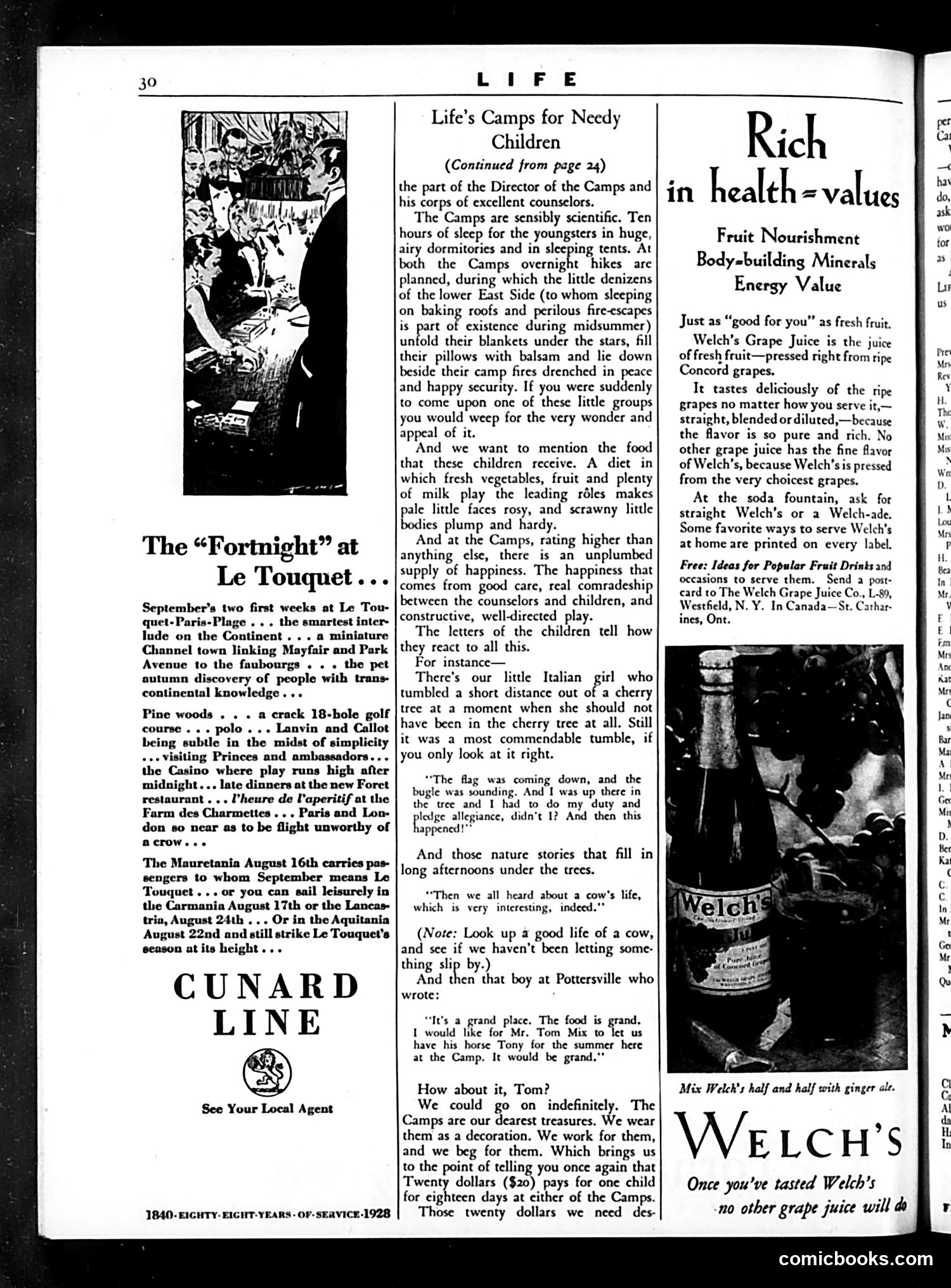
This page combines two unrelated articles typical of Life magazine's format: **Left side:** A Cunard Line advertisement promoting Le Touquet-Paris-Plage as an exclusive French seaside resort ("the smartest interlude on the Continent"). It targets wealthy Americans with transatlantic travel aspirations, listing luxuries like golf, polo, casinos, and fine dining—a clear appeal to the affluent leisure class during the 1928 Jazz Age. **Right side:** An article about Life magazine's charitable camps for impoverished Lower East Side children, emphasizing wholesome nutrition, outdoor activities, and moral development. It includes touching letters from benefiting children. **The satire:** The juxtaposition itself is the commentary—the page contrasts extreme wealth (Le Touquet's opulence for the elite) against genuine need (poor urban children). This reflects Life's self-presentation as a magazine serving both high society *and* social conscience, though the advertising arguably dominates editorial space.
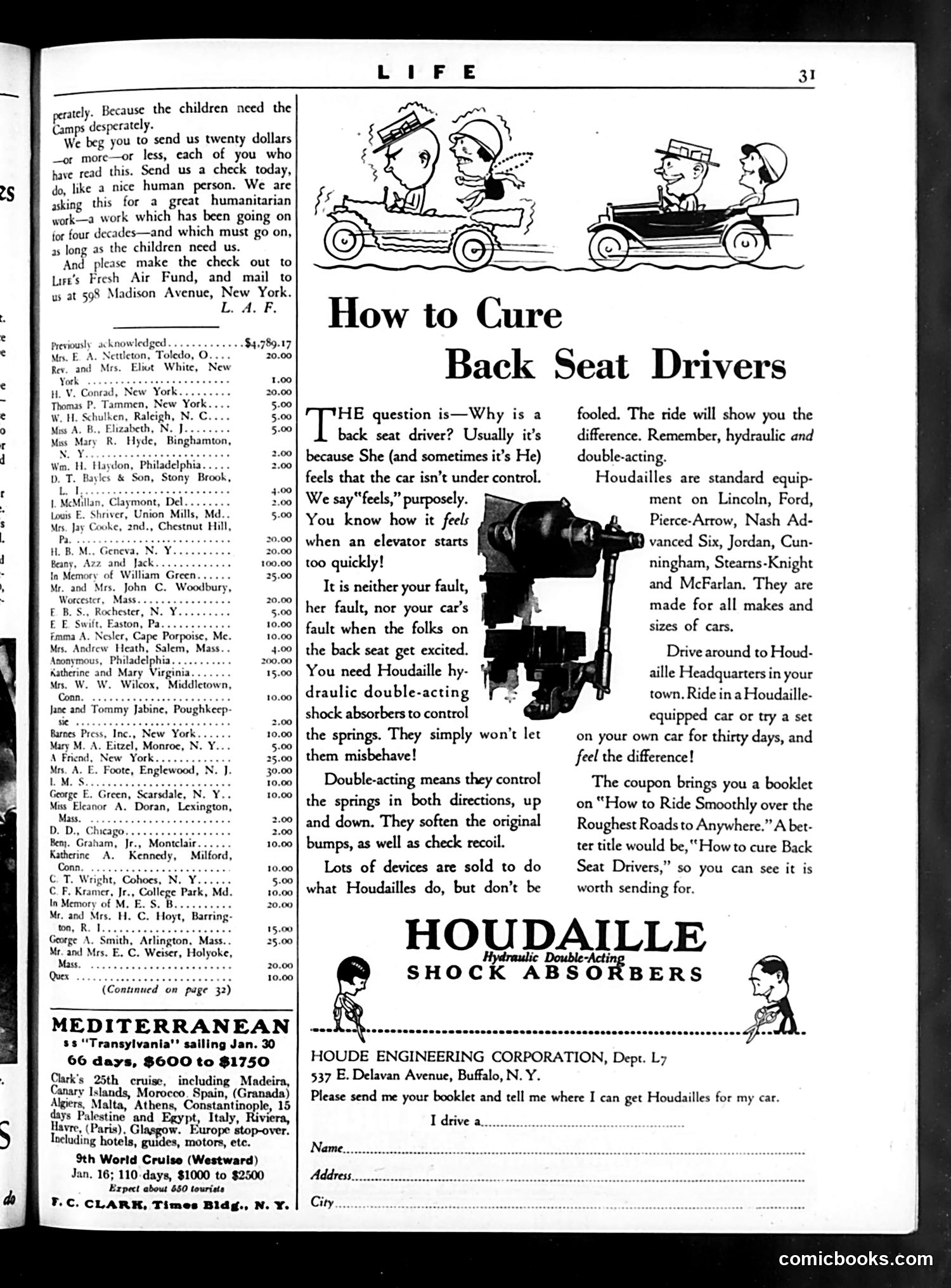
This page combines charity fundraising, a cartoon, and automobile advertising. **The Cartoon:** The small illustration at top shows three cars with exuberant passengers gesturing wildly—depicting the "back seat driver" problem humorously. **The Article & Advertisement:** The main content is a Houdaille shock absorber advertisement disguised as helpful advice. It addresses a common 1920s domestic annoyance: passengers (typically wives, the text suggests) who nervously grab the seat or give unsolicited driving directions because they feel unsafe. The satirical angle: the advertiser blames the *car's suspension*, not the passenger's anxiety. By installing Houdaille hydraulic shock absorbers (which control spring movement in both directions), passengers supposedly won't feel compelled to backseat drive because the ride will be smoother. The humor lies in the implicit claim that women's safety concerns aren't legitimate—they're merely *feelings* caused by poor suspension. The solution frames the product as a way to keep wives quiet rather than actually address their concerns. **Context:** This reflects 1920s gender dynamics and early automobile culture, when car ownership was still novel and many women were uncomfortable as passengers.
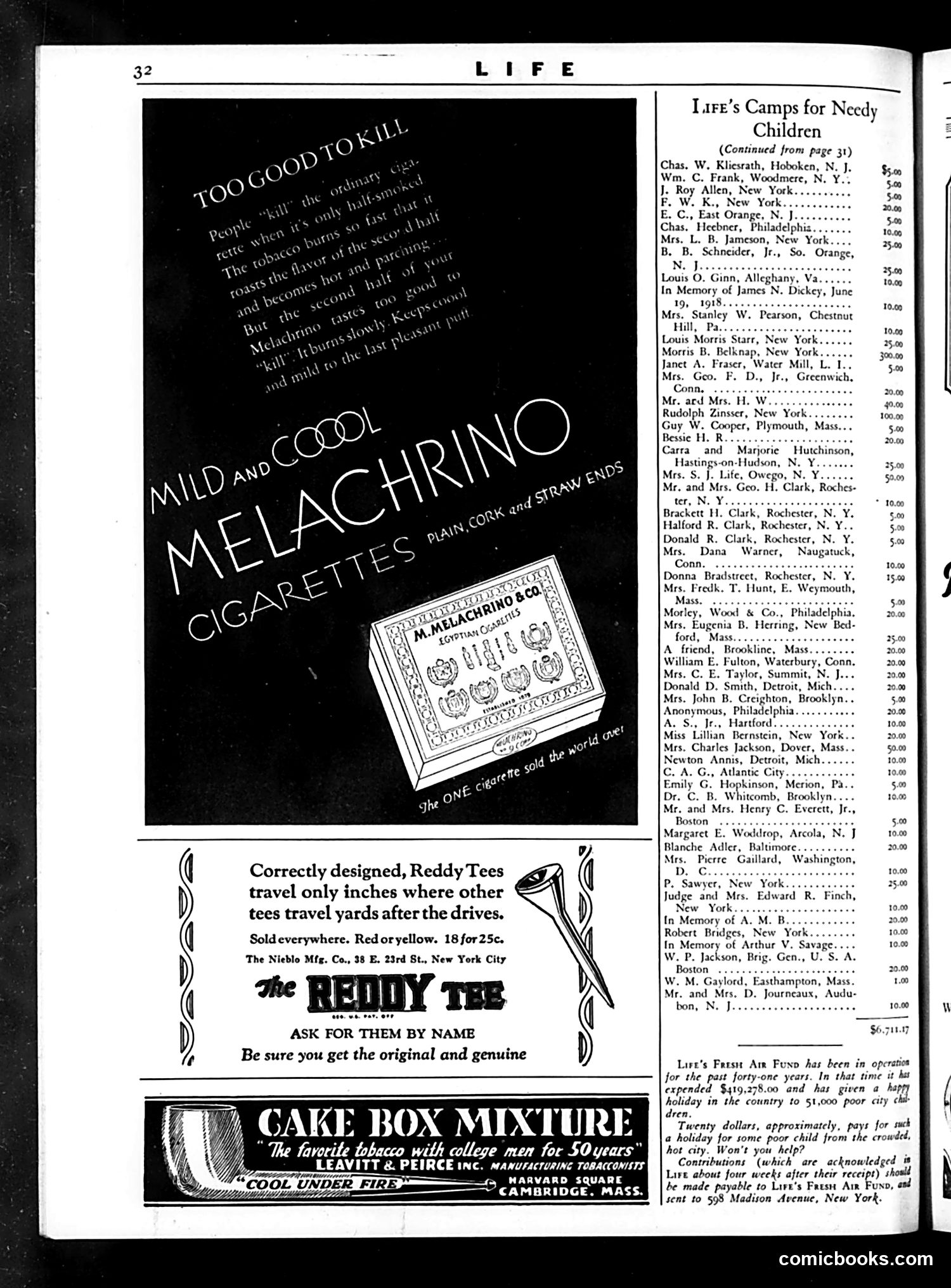
This page is primarily **advertising and charitable content**, not political satire. **Left side:** Three product advertisements—Melachrino cigarettes (emphasizing mildness), Reddy Tees golf equipment, and Cake Box tobacco mixture (marketed to college men). These are straightforward commercial ads typical of 1920s magazine pages. **Right side:** A continuation of Life's charitable campaign for "Life's Camps for Needy Children," listing donors and their contributions. The accompanying note explains the fund has operated 41 years, provided $319,278 in aid, and funded holidays for 51,000 poor urban children at an approximate cost of $20 per child. **Context for modern readers:** This reflects early 20th-century philanthropic efforts and advertising standards. There is no political cartoon or satire present—this is a standard magazine layout mixing commerce with charitable appeals, common in publications of that era.
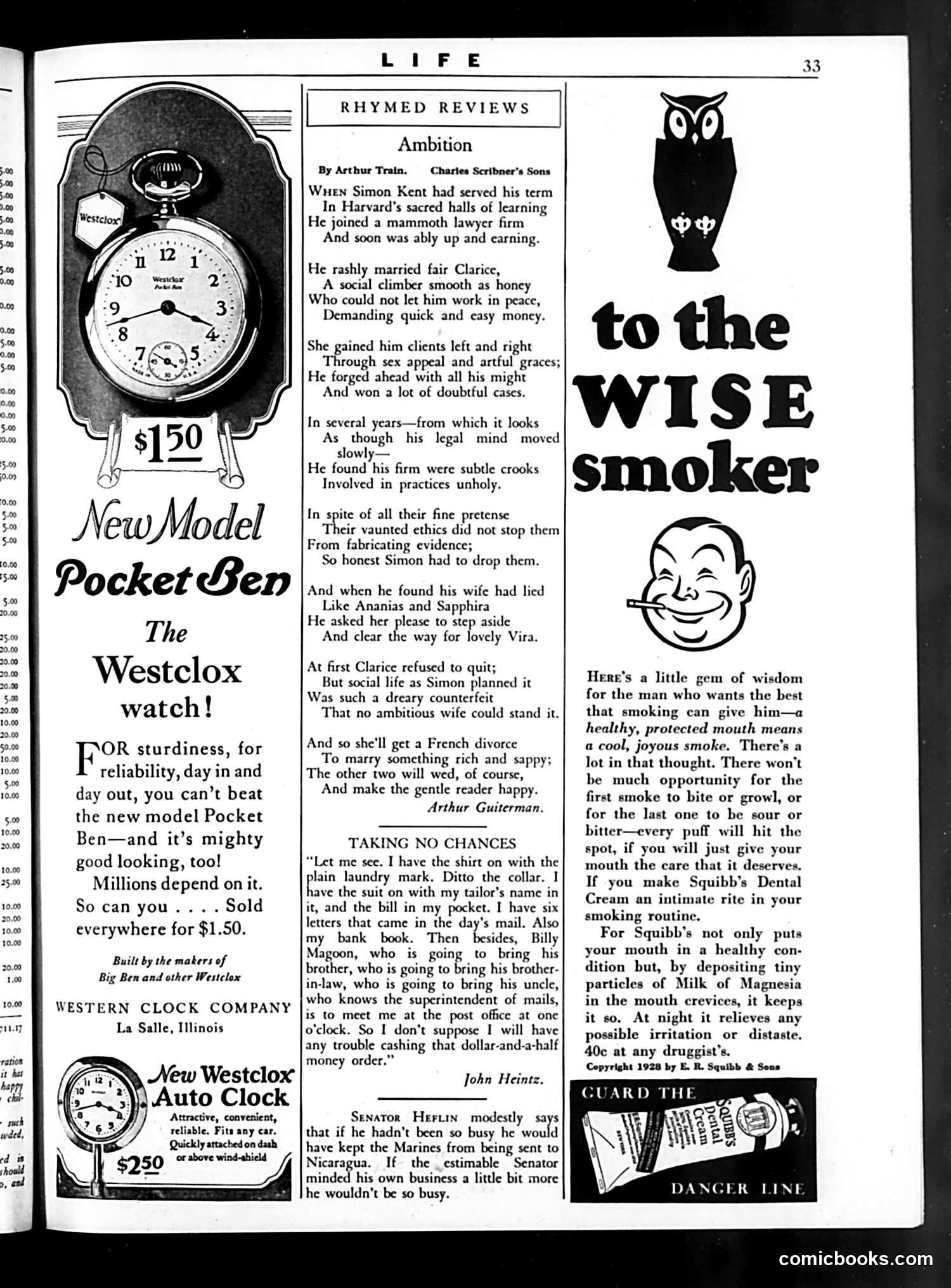
This page contains a book review in verse and period advertisements. **"Ambition" Review:** Arthur Train's novel follows Simon Kent, a Harvard lawyer who marries the socially ambitious Clarice. She pushes him to accumulate wealth through morally questionable means—he gains clients through her sexual appeal and wins "doubtful cases." Eventually discovering his firm fabricates evidence, the honest Simon leaves and divorces the manipulative Clarice. The satire critiques how ambition and social climbing corrupt professional ethics. The ending—Clarice remarrying a wealthy man while Simon finds happiness with another woman—rewards virtue while punishing shallow materialism. **Advertisements:** The page features period product ads (Pocket Ben watches, Westclox clocks) and a "To the Wise Smoker" ad for Squibb's Dental Cream toothpaste—ironic given it promotes oral health benefits of smoking. **Political Humor:** A brief Senator Hefflin joke mocks politicians' claims of being "too busy" to address serious issues like the Nicaragua intervention, suggesting self-serving priorities.
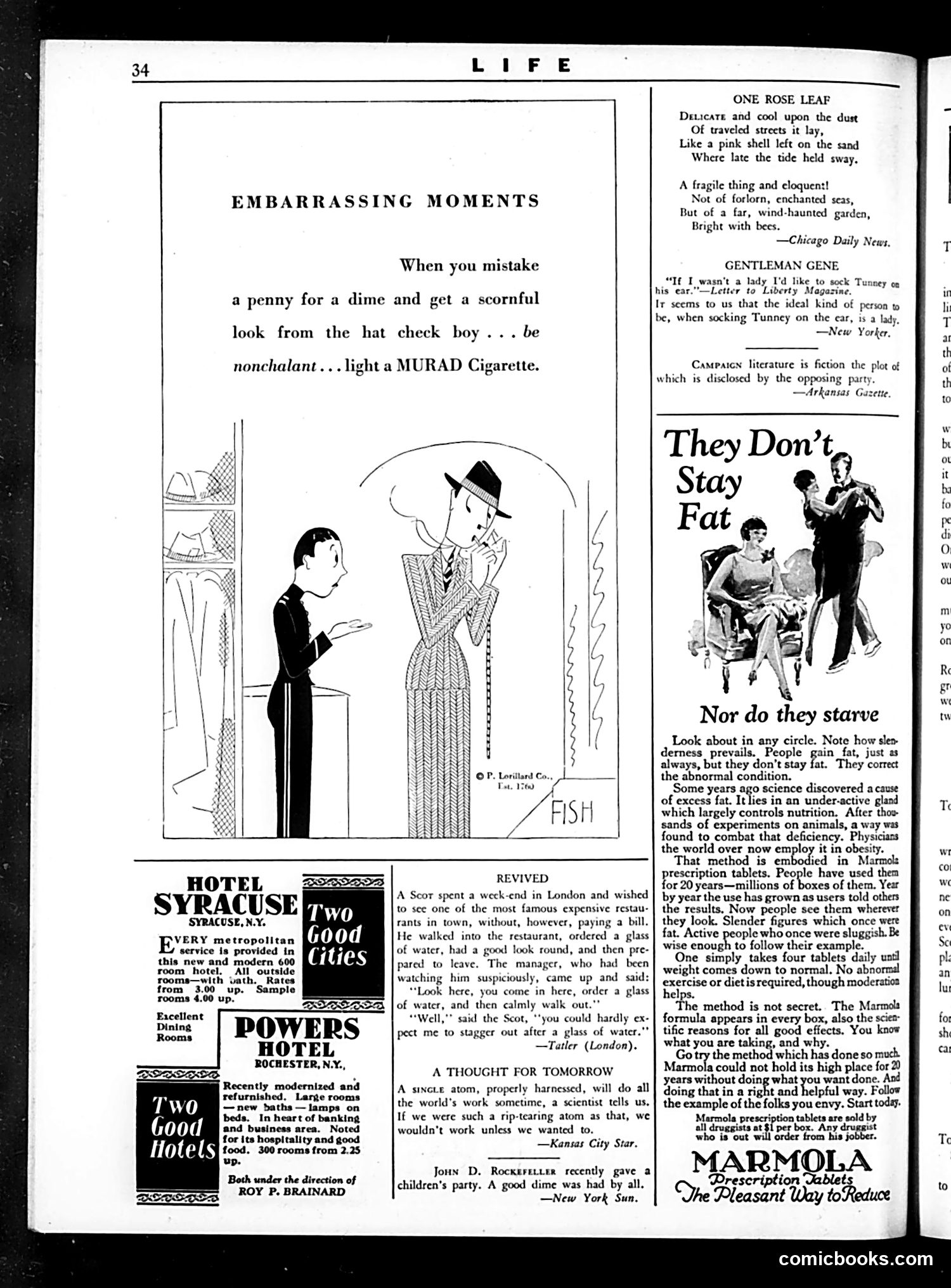
This single-panel cartoon depicts a social embarrassment scenario: a man in a hat has given a hat-check boy a penny instead of a dime, earning a disapproving look. The cartoon's "solution" is to light a MURAD cigarette—implying that appearing nonchalant and sophisticated (via smoking) will mask the social gaffe. The humor targets early 20th-century anxieties about social class and etiquette. Tipping correctly was a sign of gentility; getting it wrong invited scorn from service workers. The cartoon satirizes how people use consumer products (cigarettes) as performative props to project confidence and sophistication when embarrassed—a common theme in period advertising culture that Life magazine frequently mocked. The joke relies on readers understanding that no cigarette actually solves social awkwardness, only *performs* composure.
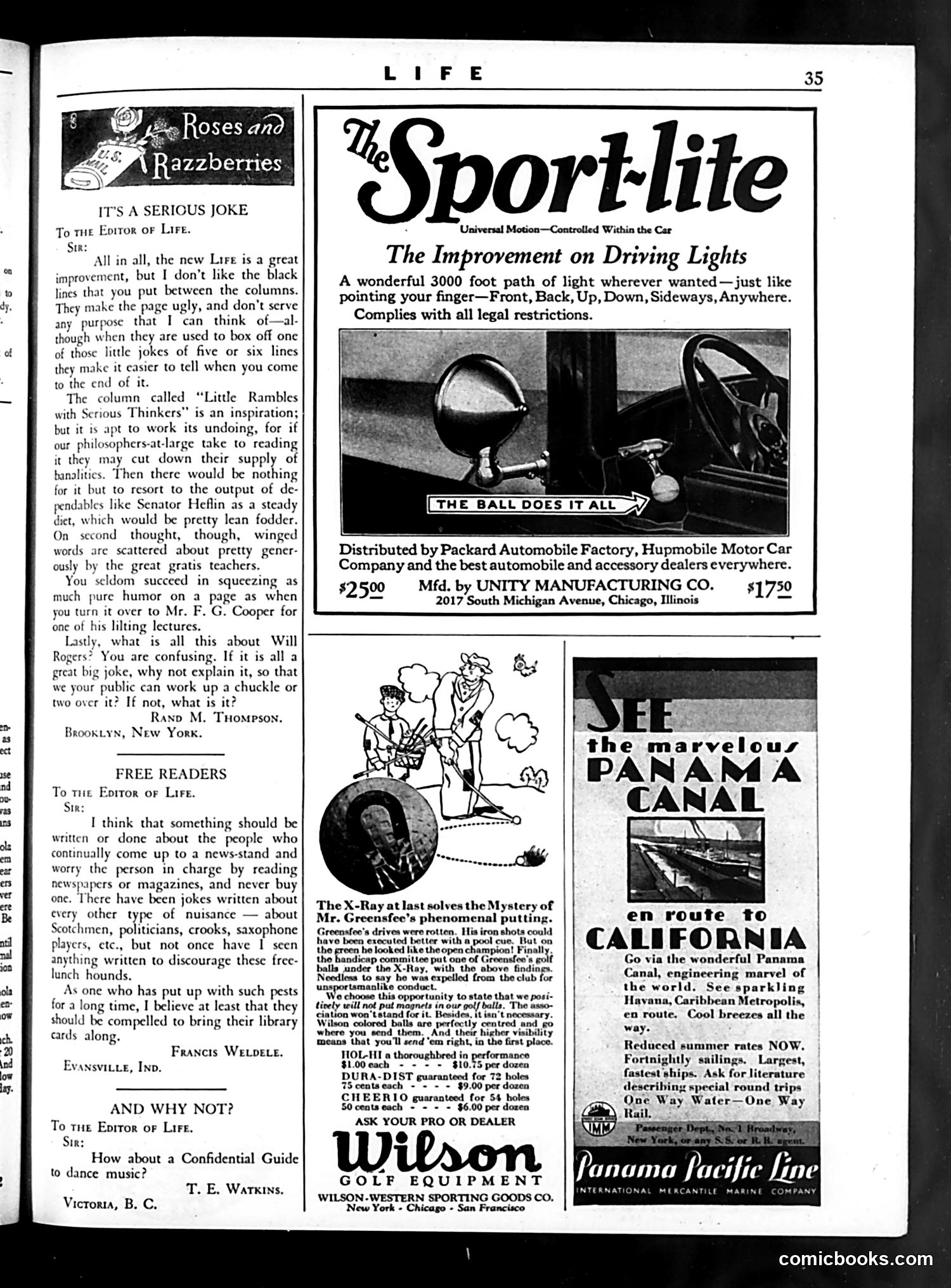
This page consists primarily of **reader letters to the editor** and **advertisements**—not political cartoons. The letters address three complaints: 1. **Design criticism** of Life's new layout (the black column dividers) 2. **"Free readers"**—people who browse magazines at newsstands without buying, compared unfavorably to other satirized social types 3. A **humorous suggestion** for a dance music guide The one cartoon visible depicts **golfer "Greensfee"** whose putting mysteriously improved, solved by an X-ray showing magnets in his clubs. This is gentle sports humor about cheating. The page is dominated by **automobile and travel advertisements** (Sport-lite driving lights, Wilson golf equipment, Panama Pacific Line cruises), typical of 1920s Life magazine's advertising-heavy format. There are no clear political references or social satire beyond mild workplace humor about nuisances at newsstands. The content reflects ordinary magazine reader correspondence from the era.
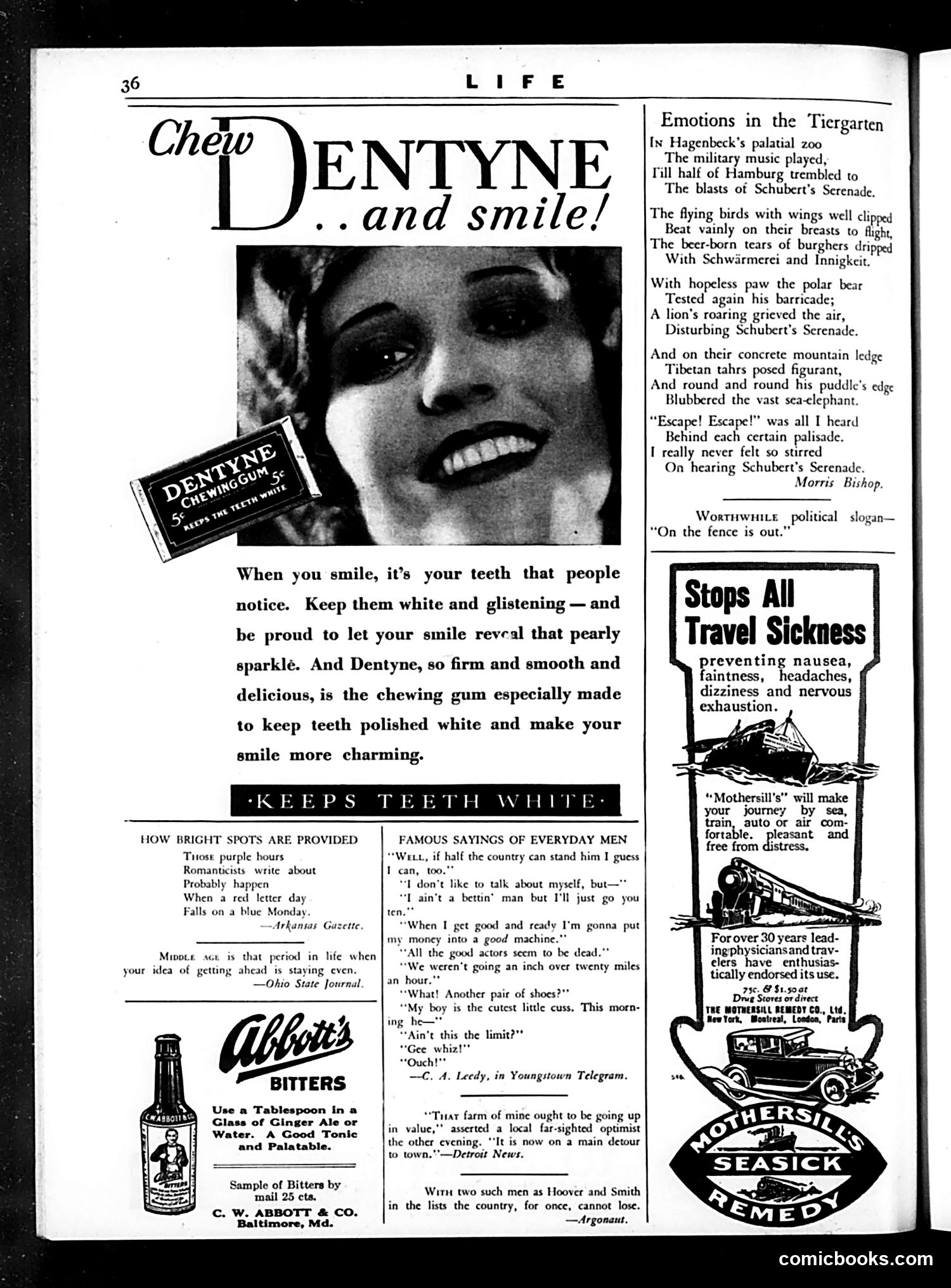
This page primarily contains **advertisements and humorous filler content** rather than political cartoons. The main feature is a **Dentyne chewing gum ad** with a smiling woman's photograph—a straightforward product advertisement emphasizing teeth whiteness. The poem "Emotions in the Tiergarten" (by Morris Bishop) is satirical *commentary on post-WWI Germany*. It describes animals at Hamburg's zoo reacting emotionally to Schubert's music, with repeated phrases like "Escape! Escape!" This appears to mock German Romanticism and sentimentality, possibly critiquing the emotional/nationalist fervor that had characterized Germany. The "Famous Sayings of Everyday Men" section collects mundane quotes with asterisks marking obvious lies or exaggerations—satirizing how ordinary people deceive themselves and others. The reference to "Hoover and Smith" suggests this is from the 1928 U.S. presidential election period. Otherwise, the page contains typical period advertisements (Abbott's Bitters, Mothersill's seasickness remedy) and filler quotes—standard magazine content rather than pointed satire.
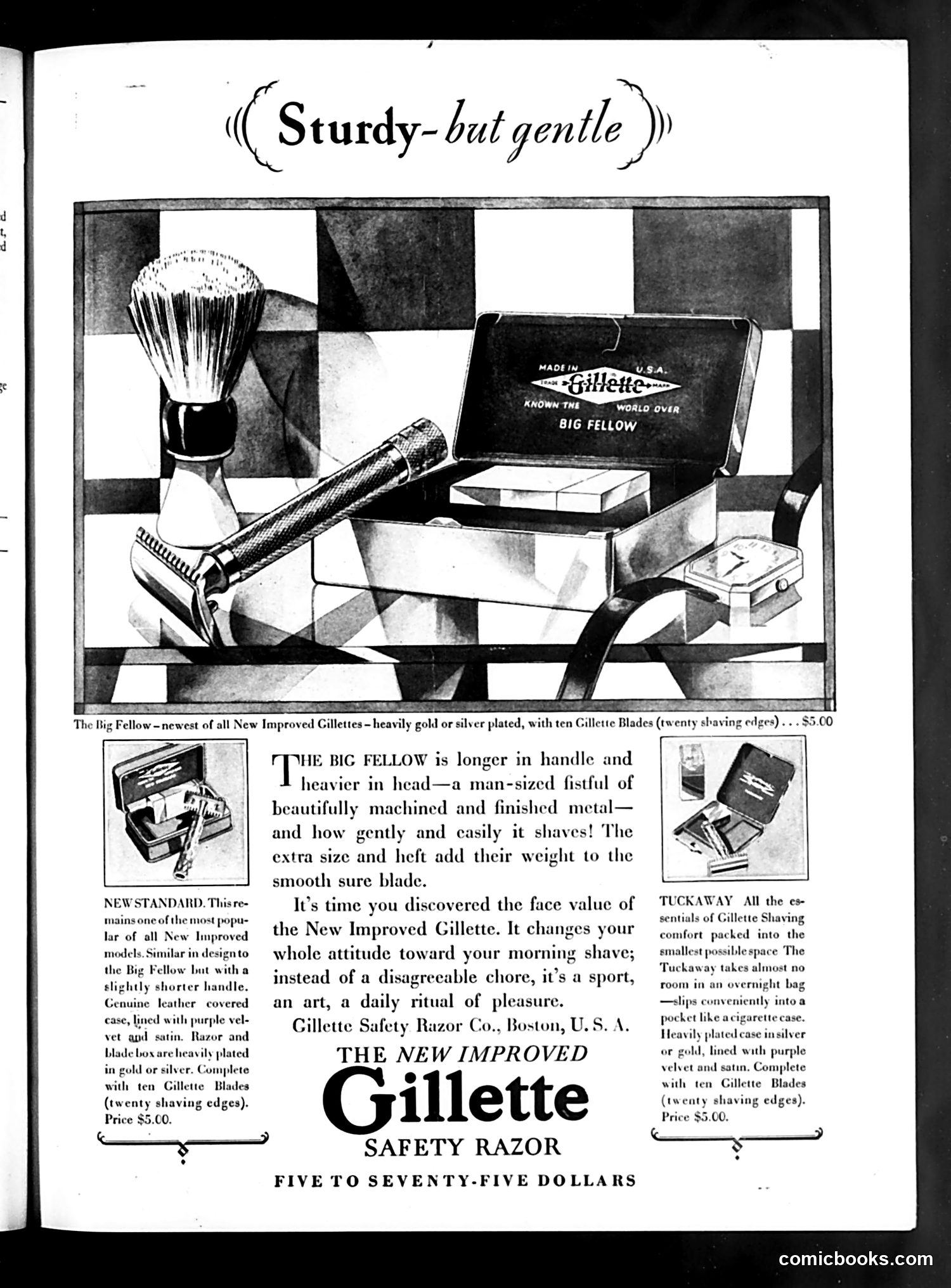
This is **not a political cartoon but a product advertisement** for Gillette Safety Razors. The page promotes three razor models ("Big Fellow," "New Standard," and "Tuckaway") with prices ranging from $5 to $75. The phrase "Sturdy—but gentle" in the header is the advertising slogan, not satire. The imagery showcases shaving implements arranged in a still-life composition against a checkered background—a common Art Deco advertising design of the era. The text emphasizes how these razors transform shaving from "a disagreeable chore" into "a sport, an art, a daily ritual of pleasure"—typical early 20th-century marketing rhetoric that positioned consumer goods as lifestyle improvements rather than mere necessities. There are no political figures, caricatures, or satirical commentary visible. This appears to be a straightforward commercial advertisement typical of *Life* magazine's advertising content.
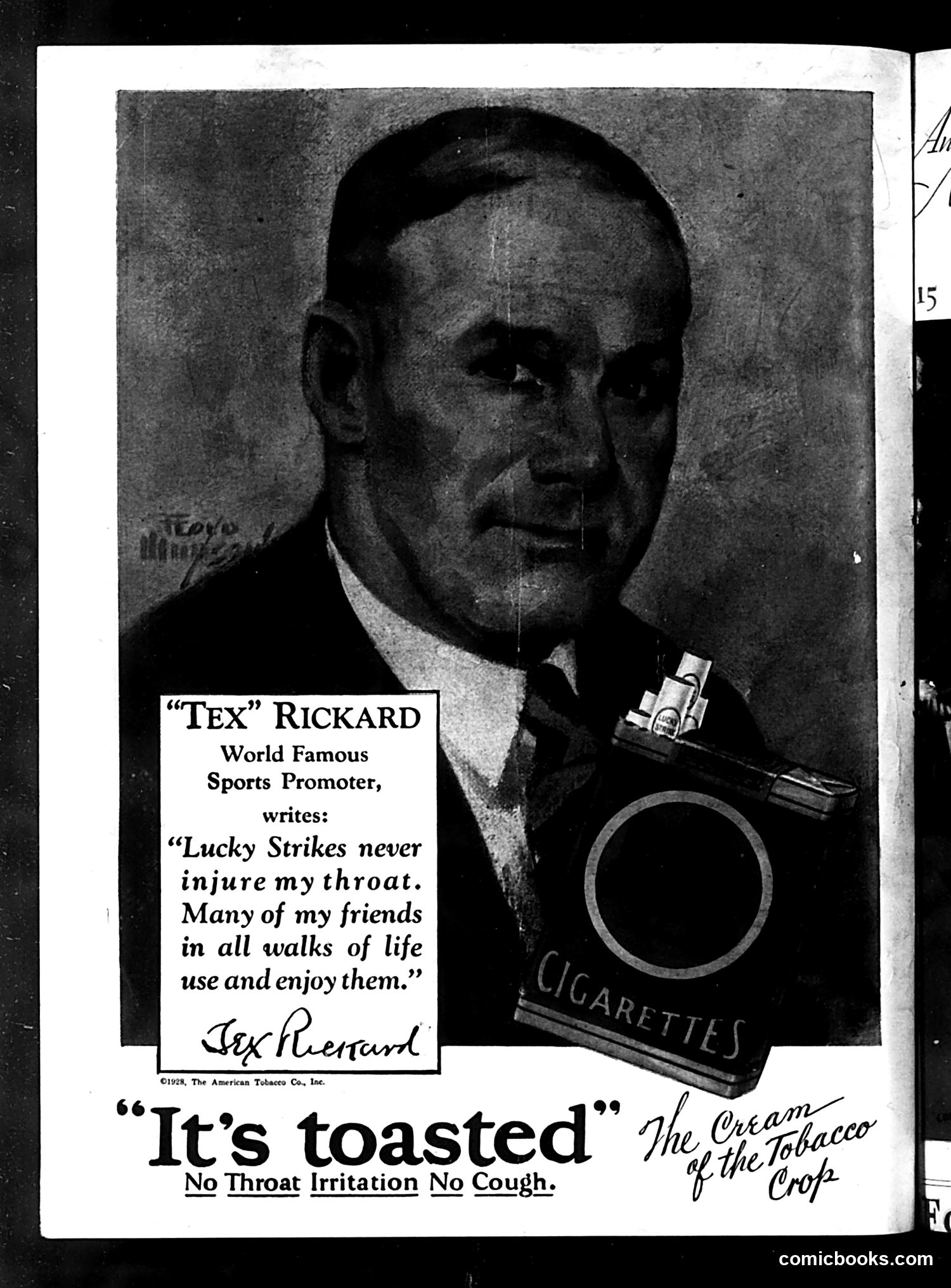
This is a **cigarette advertisement**, not satire or political commentary. It features "Tex" Rickard, identified as a "World Famous Sports Promoter," endorsing Lucky Strike cigarettes. The ad uses a celebrity testimonial format common in early 20th-century advertising. Rickard claims the cigarettes "never injure my throat" and states that friends "in all walks of life use and enjoy them." The product is marketed as "toasted" with "No Throat Irritation No Cough"—claims designed to address growing health concerns about smoking. This represents the era when tobacco companies freely used celebrity endorsements and made unsubstantiated health claims, before modern advertising restrictions and health warnings existed.