
Life, 1928-07-19 · page 16 of 40
Life — July 19, 1928 — page 16: what you’re looking at
What you’re looking at
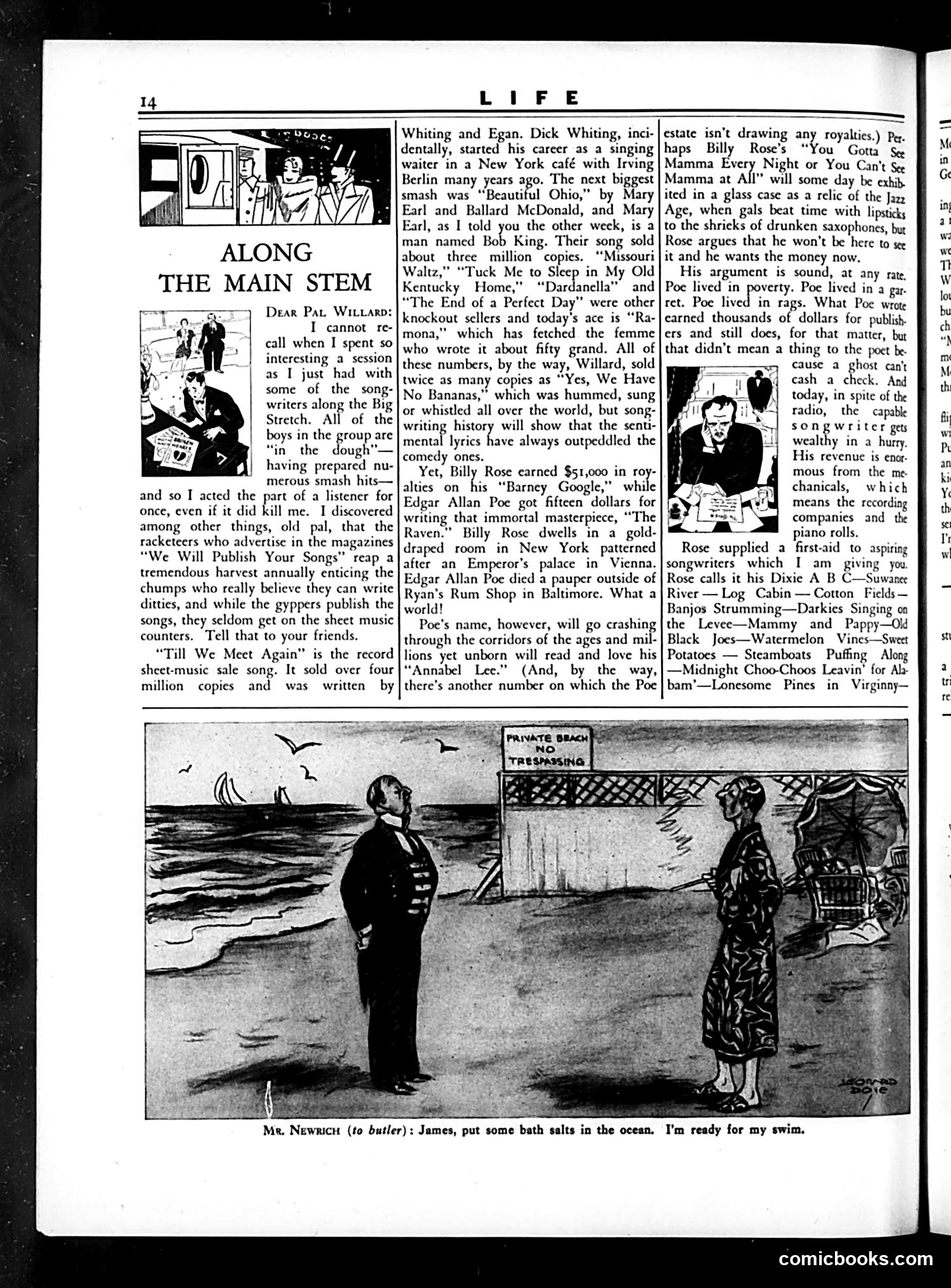
This page from Life magazine contains a column called "Along the Main Stem" by "Dear Pal Willard," discussing popular songs and their commercial success. The cartoon at the bottom depicts a beach scene with a "Private Beach—No Trespassing" sign. A butler (identified as "James" in the caption) addresses his employer, Mr. Newrich, with the line: "James, put some bath salts in the ocean. I'm ready for my swim." **The satire:** "Newrich" (likely a play on "nouveau riche") represents a newly wealthy person with more money than sense. The joke mocks the absurd extravagance and ridiculous expectations of the newly rich—someone so disconnected from reality that they'd expect their servant to chemically treat the entire ocean for their comfort. It satirizes wealth-based pretension and wasteful excess.
📄 Transcribed text from this page (OCR, searchable)
Machine-transcribed from the original scan — historical spelling and the odd misread are preserved.
LIFE THE MAIN STEM Dear Pat Witvarp: I cannot re- call when I spent so interesting a session as I just had with some of the song- writers along the Big Stretch. All of the boys in the group are “in the dough" having prepared nu- merous smash hits— and so I acted the part of a listener for once, even if it did kill me. I discovered among other things, old pal, that the racketeers who advertise in the magazines “We Will Publish Your Songs” reap a tremendous harvest annually enticing the chumps who really believe they can write ditties, and while the gyppers publish the songs, they seldom get on the sheet music counters. Tell that to your friends. “Till We Meet Again” is the record sheet-music sale song. It sold over four million copies and was written by a) Whiting and Egan. Dick Whiting, inci- dentally, started his career as a singing waiter in a New York café with Irving Berlin many years ago. The next biggest smash was “Beautiful Ohio,” by Mary Earl and Ballard McDonald, and Mary Earl, as I told you the other week, is a man named Bob King. Their song sold about three million copies. ‘Missouri Waltz,” “Tuck Me to Sleep in My Old Kentucky Home,” “Dardanella” and “The End of a Perfect Day” were other knockout sellers and today’s ace is “Ra- mona,” which has fetched the femme who wrote it about fifty grand. All of these numbers, by the way, Willard, sold twice as many copies as “Yes, We Have No Bananas,” which was hummed, sung or whistled all over the world, but song- writing history will show that the senu- mental lyrics have always outpeddled the comedy ones. Yet, Billy Rose earned $51,000 in roy- alties on his ‘Barney Google,” while Edgar Allan Poe got fifteen dollars for writing that immortal masterpiece, “The Raven.” Billy Rose dwells in a gold- draped room in New York patterned after an Emperor's palace in Vienna. Edgar Allan Poe died a pauper outside of Ryan's Rum Shop in Baltimore. What a world! Poe's name, however, will go crashin, through the corridors of the ages and sik lions yet unborn will read and love his “Annabel Lee.” (And, by the way, there’s another number on which the Poe estate isn’t drawing any royalties. % haps Bill Rose's “You, Gon. a Mamma Every Night or You Can't See Mamma at All” will some day be exhib. ited in a glass case as a relic of the Jazz Age, when gals beat time with lipsticks to the shrieks of drunken saxophones, bur Rose argues that he won't be here to se it and he wants the money now. His argument is sound, at any rate, Poe lived in poverty. Poe lived in a gu ret. Poe lived in rags. What Poe wrote earned thousands of dollars for publish. ers and still does, for that matter, but that didn’t mean a thing to the poet be. = cause a ghost can't j cash a check. And today, in spite of the radio, the capable songwriter gets wealthy in a hurry, His revenue is enor- mous from the me. chanicals, which means the recording companies and the piano rolls. Rose supplied a first-aid to aspiring songwriters which I am_ giving you. Rose calls it his Dixie A B C—Suwanee River — Log Cabin — Cotton Fields — Banjos Strumming—Darkies Singing on the Levee—Mammy and Pappy—OW Black Joes—Watermelon Vines—Sweet Potatoes — Steamboats Puffing Along —Midnight Choo-Choos Leavin’ for Al- bam'—Lonesome Pines in Virginny— Me. Newricu (to butler): James, put some bath salts in the ocean. I’m ready for my swim. comicbooks.com