
Life, 1928-07-19 · page 14 of 40
Life — July 19, 1928 — page 14: what you’re looking at
What you’re looking at
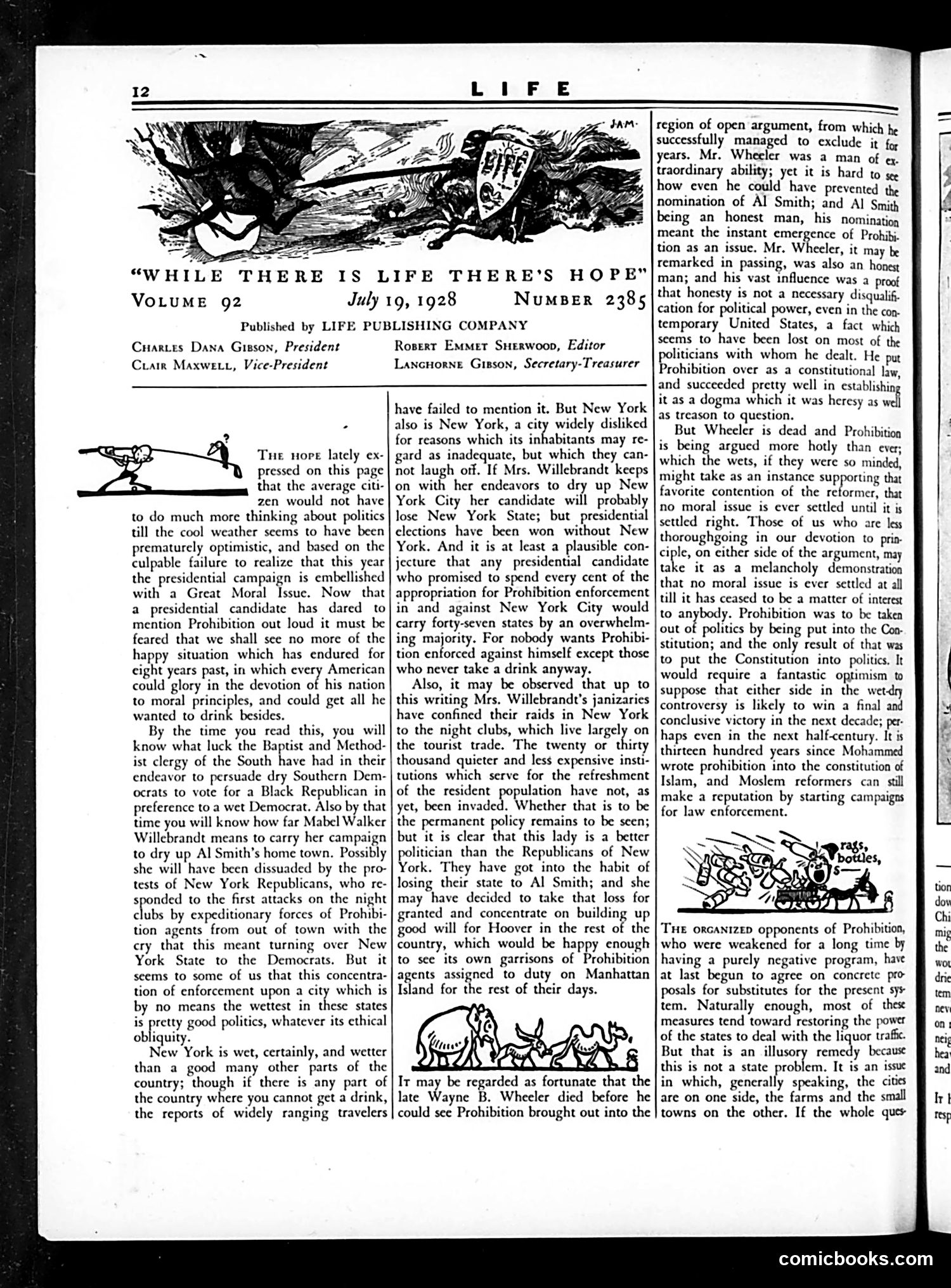
This page discusses Prohibition enforcement and presidential politics. The main text criticizes the inconsistent application of Prohibition laws, particularly regarding New York City's resistance to enforcement. Two political cartoons appear: The first (top) depicts a figure in a precarious position, likely satirizing the political instability around Prohibition policy. The second cartoon (bottom) shows what appears to be animals in conflict, probably representing the clash between wet (anti-Prohibition) and dry (pro-Prohibition) factions during the 1928 election. The article argues that Prohibition has become a divisive political issue where enforcement varies by region, undermining the law's effectiveness and legitimacy across different states and cities.
📄 Transcribed text from this page (OCR, searchable)
Machine-transcribed from the original scan — historical spelling and the odd misread are preserved.
wy “WHILE THERE IS LIFE THERE'S HOPE” VOLUME 92 July 19, 1928 NuMBER 2385 Published by LIFE PUBLISHING COMPANY Cartes Dana Gipson, President Crain Maxwe tr, Vice-President Rosert Emmet Suerwoon, Editor LancHorne Gisson, Secretary-Treasurer Tue nore lately ex- pressed on this page that the average citi- zen would not have to do much more thinking about politics till the cool weather seems to have been prematurely optimistic, and based on the culpable failure to realize that this year the presidential campaign is embellished with a Great Moral Issue. Now that a presidential candidate has dared to mention Prohibition out loud it must be feared that we shall see no more of the happy situation which has endured for eight years past, in which every American could glory in the devotion of his nation to moral principles, and could get all he wanted to drink besides. By the time you read this, you will know what luck the Baptist and Method- ist clergy of the South have had in their endeavor to persuade dry Southern Dem- ocrats to vote for a Black Republican in preference to a wet Democrat. Also by that time you will know how far Mabel Walker Willebrandt means to carry her campaign to dry up Al Smith’s home town. Possibly she will have been dissuaded by the pro- tests of New York Republicans, who re- sponded to the first attacks on the night clubs by expeditionary forces of Prohibi- tion agents from out of town with the cry that this meant turning over New York State to the Democrats. But it seems to some of us that this concentra- tion of enforcement upon a city which is by no means the wettest in these states is pretty good politics, whatever its ethical obliquity. New York is wet, certainly, and wetter than a good many other parts of the country; though if there is any part of the country where you cannot get a drink, the reports of widely ranging travelers have failed to mention it. But New York also is New York, a city widely disliked for reasons which its inhabitants may re- gard as inadequate, but which they can- not laugh off. If Mrs. Willebrandt keeps on with her endeavors to dry up New York City her candidate will probably lose New York State; but presidential elections have been won without New York. And it is at least a plausible con- jecture that any presidential candidate who promised to spend every cent of the appropriation for Prohibition enforcement in and against New York City would carry forty-seven states by an overwhelm- ing majority. For nobody wants Prohibi- tion enforced against himself except those who never take a drink anyway. Also, it may be observed that up to this writing Mrs. Willebrandt’s janizaries have confined their raids in New York to the night clubs, which live largely on the tourist trade. The twenty or thirty thousand quieter and less expensive insti- tutions which serve for the refreshment of the resident population have not, as yet, been invaded. Whether that is to be the permanent policy remains to be seen; but it is clear that this lady is a better politician than the Republicans of New York. They have got into the habit of losing their state to Al Smith; and she may have decided to take that loss for granted and concentrate on building up good will for Hoover in the rest of the country, which would be happy enough to see its own garrisons of Prohibition agents assigned to duty on Manhattan Island for the rest of their days. tf Sh ANS A OZ It my be regarded as fortunate that the late Wayne B. Wheeler died before he could see Prohibition brought out into the region of open argument, from which he successfully managed to exclude it for years. Mr. Wheeler was a man of e. traordinary ability; yet it is hard to see how even he could have Prevented the nomination of Al Smith; and Al Smith being an honest man, his Nomination meant the instant emergence of Prohibi- tion as an issue. Mr. Wheeler, it may be remarked in passing, was also an honest man; and his vast influence was a proof that honesty is not a necessary disqualif- cation for political power, even in the con- temporary United States, a fact which seems to have been lost on most of the liticians with whom he dealt. He put Prohibition over as a constitutional law, and succeeded pretty well in establishin it as a dogma which it was heresy as well as treason to question. But Wheeler is dead and Prohibition is being argued more hotly than ever; which the wets, if they were so minded, might take as an instance supporting that favorite contention of the retormer, that no moral issue is ever settled until it is settled right. Those of us who are less thoroughgoing in our devotion to prin- ciple, on cither side of the argument, may take it as a melancholy demonstration that no moral issue is ever settled at all till it has ceased to be a matter of interest to anybody. Prohibition was to be taken out of politics by being put into the Con- stitution; and the only result of that was to put the Constitution into politics. It would require a fantastic optimism to suppose that cither side in the wet-dry controversy is likely to win a final and conclusive victory in the next decade; per- haps even in the next half-century. It is thirteen hundred years since Mohammed wrote prohibition into the constitution of Islam, and Moslem reformers can still make a reputation by starting campaigns for law enforcement. THE orcanizep opponents of Prohibition, who were weakened for a long time by having a purely negative program, have at last begun to agree on concrete pro posals for substitutes for the present sy tem. Naturally enough, most of thes measures tend toward restoring the power of the states to deal with the liquor trafic. But that is an illusory remedy because this is not a state problem, Tt is an issue in which, generally speaking, the cities are on one side, the farms and the small towns on the other. If the whole quer comicbooks.com