
Life, 1928-07-19 · page 24 of 40
Life — July 19, 1928 — page 24: what you’re looking at
What you’re looking at
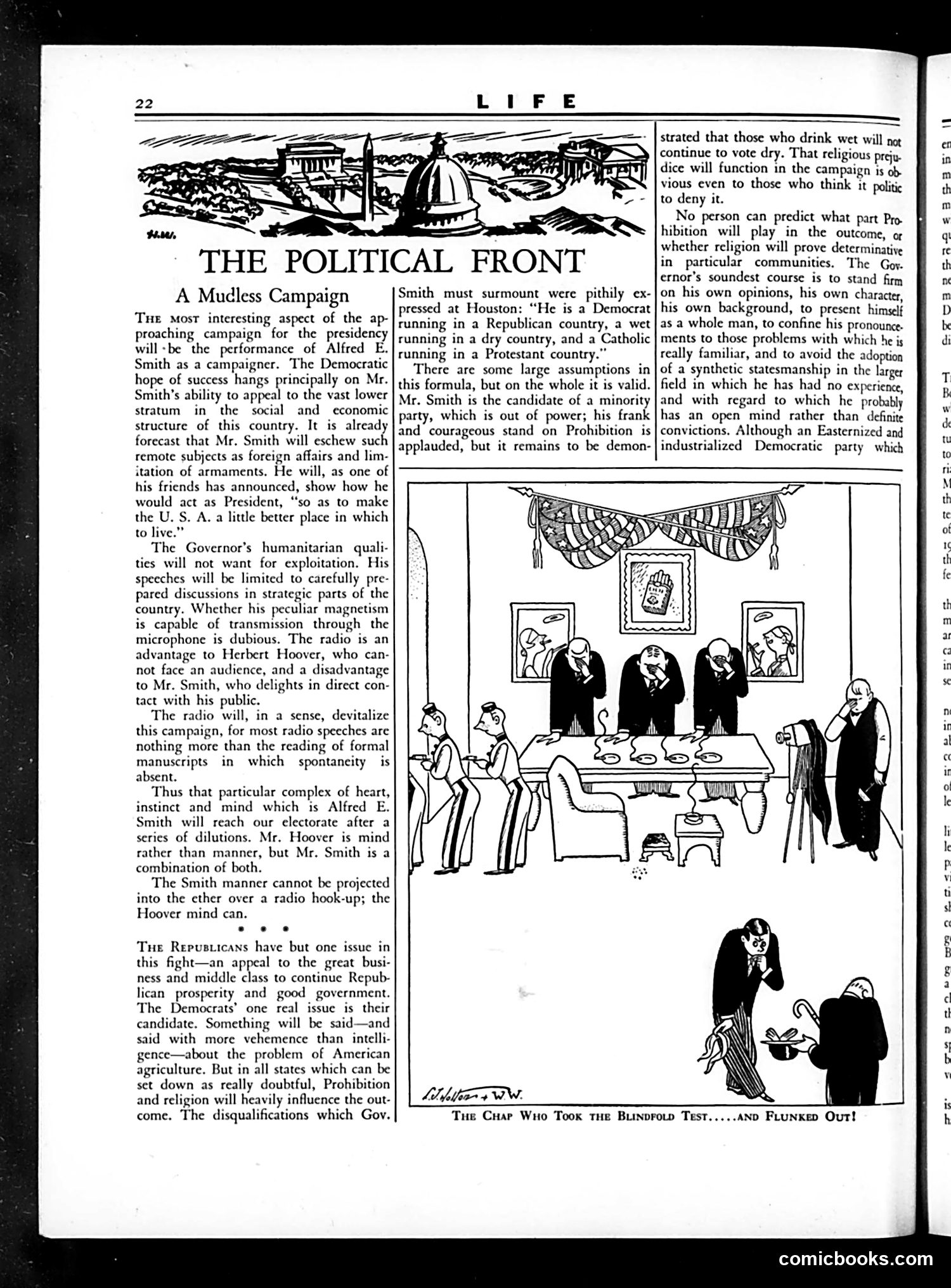
This 1928 Life magazine article analyzes Alfred E. Smith's presidential campaign against Herbert Hoover, identifying Smith's key disadvantages: he's a Democrat in a Republican era, "wet" (anti-Prohibition) in a dry country, and Catholic in a Protestant nation. The piece argues Smith's strength lies in personal charisma and direct appeal to working-class voters, but radio broadcasting—Hoover's advantage—neutralizes this by requiring formal, scripted speeches lacking spontaneity. The author suggests Smith should stick to familiar issues rather than adopt synthetic positions. The cartoon (captioned "The Chap Who Took the Blindfold Test...and Flunked Out!") depicts a blindfolded figure among seated men, suggesting Smith cannot see or navigate the hidden obstacles and prejudices he faces. The "blindfold test" satirizes the naive assumption that merit alone determines electoral success, when religious and Prohibition biases will actually decide the outcome in doubtful states.
📄 Transcribed text from this page (OCR, searchable)
Machine-transcribed from the original scan — historical spelling and the odd misread are preserved.
eo B= Hey, A Mudless Campaign THe Most interesting aspect of the ap- proaching campaign for the presidency will-be the performance of Alfred E. Smith as a campaigner. The Democratic hope of success hangs principally on Mr. Smith’s ability to appeal to the vast lower stratum in the social and economic structure of this country. It is already forecast that Mr. Smith will eschew such remote subjects as foreign affairs and lim- itation of armaments. He will, as one of his friends has announced, show how he would act as President, “so as to make the U. S. A. a little better place in which to live.” The Governor’s humanitarian quali- ties will not want for exploitation. His speeches will be limited to carefully pre- pared discussions in strategic parts of the country. Whether his peculiar magnetism is capable of transmission through the microphone is dubious. The radio is an advantage to Herbert Hoover, who can- not face an audience, and a disadvantage to Mr. Smith, who delights in direct con- tact with his public. The radio will, in a sense, devitalize this campaign, for most radio speeches are nothing more than the reading of formal manuscripts in which spontaneity is absent. Thus that particular complex of heart, instinct and mind which is Alfred E. Smith will reach our electorate after a series of dilutions. Mr. Hoover is mind rather than manner, but Mr. Smith is a combination of both. The Smith manner cannot be projected into the cther over a radio hook-up; the Hoover mind can. eee Tue Repusticans have but one issue in this fight—an appeal to the great busi- ness and middle class to continue Repub- lican prosperity and good government. The Democrats’ one real issue is their candidate. Something will be said—and said with more vehemence than intelli- gence—about the problem of American agriculture. But in all states which can be set down as really doubtful, Prohibition and religion will heavily influence the out- come. The disqualifications which Gov. THE POLITICAL FRONT Smith must surmount were pithily ex- pressed at Houston: “He is a Democrat running in a Republican country, a wet running in a dry country, and a Catholic running in a Protestant country.” There are some large assumptions in this formula, but on the whole it is valid. Mr. Smith is the candidate of a minority party, which is out of power; his frank and courageous stand on Prohibition is applauded, but it remains to be demon- LA EAS Tue Crar Wo Took tHe Buinproww Test... strated that those who drink wet will not continue to vote dry. That religious Preju- dice will function in the campaign is ob- vious even to those who think it politic to deny it. No person can predict what part Pro hibition will play in the outcome, of whether religion will prove determinative in particular communities. The Goy. ernor’s soundest course is to stand firm on his own opinions, his own character, his own background, to present himself as a whole man, to confine his pronounce. ments to those problems with which he is really familiar, and to avoid the adoption of a synthetic statesmanship in the larger field in which he has had no experience, and with regard to which he probably has an open mind rather than definite convictions, Although an Easternized and industrialized Democratic party which and Fiunkep Out! comicbooks.com